fact etiketine sahip kayıtlar gösteriliyor. Tüm kayıtları göster

5 Mayıs 2017 Cuma

Fact check: how well does your birth control work?

Hello, how are you today? If you’ve got a uterus, maybe the answer is “not so great” – especially if you’ve heard reports about Donald Trump’s latest appointee. The woman tipped for a key family planning role, Teresa Manning, has previously worked with an anti-abortion group as well as an anti-LGBT rights lobbying group.


If Manning is appointed as deputy assistant secretary for population affairs at the Department of Health and Human Services, she would have oversight of the federal program that provides contraceptive services to low-income and uninsured women and men.


Manning, who is a law professor, has said “family planning is something that occurs between a husband and a wife and God, and it doesn’t really involve the federal government”. I won’t be fact-checking that statement (because it’s tricky to prove who does and who does not have a direct line to chat to God), but rather Manning’s claim that contraception doesn’t work well.


Here’s Manning’s statement in full which she gave in full during a radio interview:


Its efficacy is very low, especially when you consider over years – which, a lot of contraception health advocates want to start women in their adolescent years, when they’re extremely fertile, incidentally, and continue for 10, 20, 30 years. The prospect that contraception would always prevent the conception of a child is preposterous.


Let’s fact-check this.


Step 1: Do an internet search for “contraception efficacy rates”. You’ll very quickly land at this summary published by the Centers for Disease Control and Prevention (CDC). It shows that the effectiveness of contraception varies depending on which method is being used.


They range from spermicide (which is the least effective, with about 28 out of every 100 women who use it becoming pregnant on average within the first year of typical use) to the hormonal implant (which is the most effective, with one out of every 200 women becoming pregnant in the first year of typical use).


Step 2: Check the reliability of your source. While Wikipedia is certainly not the most accurate site on the internet, the thousands of editors who regularly work there can be more inclined to dig up criticism than the standard “about” page on a website.


The Wikipedia page on the CDC offers few leads about a corrupt, biased organization – rather, the CDC is simply described as a federal agency whose “main goal is to protect public health and safety through the control and prevention of disease, injury, and disability in the US and internationally”. The organization doesn’t seem to have an interest in overstating the effectiveness of contraception.


Step 3: Understand the terms used. The CDC talks about “typical use” and that seems kind of important, so I repeat the same internet search but this time with those two words added in there.


I land at this New York Times page, which has been built using data compiled by James Trussell from the Office of Population Research at Princeton University and also the Brookings Institution. Here’s how they define typical use:


“This is the norm, reflecting the effectiveness of each method for the average couple who do not always use it correctly or consistently.”


That makes sense. It is part of the reason why methods that require planning (eg “Babe, do you have the spermicide?”) or some other action before or during sex (“Don’t worry, I’ll pull out in time”) are much less effective than those that don’t (hormonal implants, intra-uterine devices and sterilization require much less upkeep).


Perfect use, by the way, is defined as:


“A measure of the technical effectiveness of each method, but only when used exactly as specified and consistently followed. Few couples, if any, achieve flawless contraceptive use, especially over long time periods.”


If 100 women were to use the pull-out or withdrawal method “perfectly”, 34 of them would wind up pregnant within 10 years (yep, that’s the 10-year use period Manning mentioned). But even with perfect use, there’s still a significant gap between different contraceptive methods. If those same women were to use a hormonal implant, chances are only one would be pregnant at the end of 10 years.


By appointing Manning, an opponent of Planned Parenthood, Trump takes another step towards his goal: defunding it. As a result, the availability of contraception such as the hormonal implant will be curtailed.


Step 4: Find a sexually active woman and listen to what she has to say. Ask her whether she wants to have the freedom to choose.


Would you like to see something fact-checked? Send me your questions! mona.chalabi@theguardian.com / @MonaChalabi


Fact check: how well does your birth control work?

18 Temmuz 2014 Cuma

Andrew Lloyd Webber: "I went by way of a second of deep depression - I in fact got the kinds for Dignitas"

The fulfilment of Jean Lloyd Webber’s fiercest want, that her kids should attain all the good results of which they had been capable, is reflected in her older son’s domain. We meet in his London house, a palatial residence in which a modern day elevator whisks guests between floors of huge rooms adorned with very good furnishings and fine art.


Lord Lloyd-Webber (he acquired a hyphen with his peerage) owns a London theatre empire, a cellar of vintage Burgundy, a nation mansion and a assortment of Victorian art so magnificent that he strategies to endow a gallery to house it right after his death. And but, at 66, he combines an unaffected method with the insatiable appetite for work instilled in him by his mother. Jean Lloyd Webber, far from searching for luxury, lived a daily life of Spartan thrift. Until her last days, she would cycle or stroll to give her music lessons and furnished her flat with the barest necessities, refusing all offers to support from her older son.


“When I very first manufactured some income out of Jesus Christ Superstar, I inspected her fridge and stated: ‘Mum, this issue ought to be condemned. I’d like to purchase you a new a single.’ She wouldn’t even accept that.” Careless of material comforts, she had “an enormous work ethic. She at first wished me to be a performer like my brother, but anyone who heard my French horn practice realised that was not to be my destiny.”


When Andrew expressed an curiosity in history and architecture instead, she supported him to the extent of decreeing – to the dismay of her husband William, director of the London School of Music – that household trips have to be geared to her older son’s new passion. “We spent one vacation staying by a steelworks due to the fact I had explained I wanted to pay a visit to [the nearby] Margam Abbey.”


The close Lloyd Webber household was shaken when Andrew’s father died, unexpectedly, at 67. Soon afterwards, Jean Lloyd Webber, grief-stricken by her reduction, developed breast cancer. “My mom was a fighter, but she did not feel in traditional medication. She became far more and more ill, refusing any remedy, at a time when I essential her a lot.” Her decline coincided with the breakdown of his marriage to the singer, Sarah Brightman, and the start off of his relationship with his wife, Madeleine.


At first Jean was resistant to her future daughter-in-law, an completed horsewoman, believing her, mistakenly, to be in favour of the bloodsports she abhorred. “On one particular event she turned up for lunch with close friends carrying anti-hunting placards. But she came to adore and adore Madeleine, and she was a wonderful assistance to both of us.


“Still she stored saying that she couldn’t carry on any much more due to the fact she was a burden on us. We advised her she was anything at all but she was the rock from which we could go forward. Then she said she did not want to be a burden on Julian who, like John Lill [the concert pianist, whom she taken care of as an adopted family members member], lived in the exact same block of flats as she did.


“I was away, doing work round the world. I couldn’t be with her all the time. And frankly, in the state she was in, I fear that a couple of medical professionals would have concluded that, if she wished to destroy herself, they would agree.”


Her conviction that she would be a roadblock to her sons’ fantastic talents, ebbed only following she – a stranger to the planet of musicals – began to understand how she was a helpmate, not a hindrance, in a collaborative business. And so, in the final phase of her life, she grew closer to her older child than they had ever been. When death ultimately came, Andrew was operating in Los Angeles. She, the selfless promoter of her children’s successes, would have wished it no other way.


Long right after her tiny funeral was over, mortality continued to stalk her son’s existence. The themes of adore and death, which run like a fugue through the functions of Andrew Lloyd Webber, were soon to turn out to be individual. After a schedule blood check, he discovered that he had prostate cancer. “It was the most virulent kind, but I was quite fortunate. I didn’t consider I was going to die – just that I should have the wretched [cancer] removed so that I could get on with my occupation.”


Close to two years in the past, with his cancer cured, he began to suffer from a ache in one leg. A method to ease his discomfort and a subsequent back operation led to a sequence of interventions in which he had 14 procedures below general anaesthetic. By last summertime, Andrew Lloyd Webber – who had so a lot in common with his mom – identified that he also shared her wish to die.


“There have been days when I believed that I would do something to get out of this. I adore my perform, and I imagined that if I could not do that, then I had nothing more. I went through a moment of deep depression – that awful moment when you consider that you must find a way out. I truly got the forms for Dignitas. With hindsight, it was stupid and ridiculous, but I couldn’t feel what to do.


“I received through the demonstrate I was doing work on, but it was murder. I was on every type of painkiller there is… I couldn’t think what to do. In the finish, I threw away the kinds.” His journey back from despair was assisted by a chiropractor who alleviated his signs and symptoms. Nevertheless he says that his back condition indicates that “a sword of Damocles hangs more than me… and I can understand what serious pain means”.


Possessing watched his mom navigate the divide in between fulfilment and a daily life that has become intolerable, Lord Lloyd-Webber walked that lonely pathway for himself. These experiences have rendered him one particular of the most thoughtful critics of Lord Falconer’s Bill, the initial try to legalise assisted dying for the terminally ill given that 2006.


He will not communicate in today’s debate, but he will listen to the arguments innovative with respect and some humility. Unlike the strident advocates on each sides, Lord Lloyd-Webber – who has stared at death a lot more closely than most – nevertheless wrestles with a single of the best questions of the age.


“If individuals get to a point where their lives are so impossible, I would agree with the Bill. What concerns me, and I suspect many other individuals, is what floodgates would [this measure] open? Does it generate a culture in which older people are a burden? In 20 years’ time, signing off on the deaths of outdated folks may well not be taken as seriously as it is now. I am entirely uncertain.”


That admission must not recommend any weakness. The doubt that he is trustworthy adequate to countenance is mirrored in the health-related occupation, the place views differ, and in a Church riven by schism. Even though Justin Welby, the Archbishop of Canterbury has come out towards the measure, his predecessor Lord Carey supports the Bill, persuaded by “the actuality of needless suffering”.


Meanwhile Archbishop Desmond Tutu, 1 of the biggest churchmen in the globe, has asserted that he sees no sanctity in struggling. Lord Lloyd-Webber, who has watched a youthful acquaintance dying of motor-neurone ailment, does not dissent from the argument that it could be a lot more compassionate to allow some individuals to die. “I wonder if the principle of the Bill is not a excellent a single but that it requirements an amendment [to target on whether or not] people are on mechanical daily life assistance or in such intense discomfort that absolutely nothing can be accomplished.”


For many reasons, Lord Lloyd-Webber has studied the issues of daily life and death with forensic precision – not just because of the struggling he has witnessed and endured but because a wealthy man’s legacy demands considerably forethought.


His fortune will not go to his 5 children for, like his mother, he expects the next generation to make their personal way. Instead the beneficiary will be his Arts Foundation, whose operate consists of teaching music to state college youngsters who may possibly otherwise miss the chance to fulfil their dreams. Individuals plans in area, he has no intention of lessening his personal workload. With his musical Cats due back in London and a present to open on Broadway subsequent year, his life seems as settled as it has ever been.


Today, however, he will focus on the lives and on the deaths of others. A pragmatist, he is grateful to Lord Falconer for bringing a Bill which will allow a significantly-needed debate. As he says regularly, if the arguments in favour prove sufficiently compelling, then he reserves the right to modify his thoughts.


This kind of a alter of heart does not seem to be probably. As he says: “The danger for me lies in a situation like my mother’s.” When the claims and counter-claims are aired right now, one memory will lodge in his mind. The picture he can not shift is that of an elderly instructor particular that she is dying, but established to impart the present of music that will live on prolonged following she is gone.


Andrew Lloyd Webber: "I went by way of a second of deep depression - I in fact got the kinds for Dignitas"

19 Haziran 2014 Perşembe

Did Teen Suicide Warnings About Antidepressants In fact Lead to Suicides To Enhance?

In what would be a tragic case of the law of unintended consequences, a new research claims that the really warnings about the suicide dangers to teens taking antidepressants could have contributed to a surge in attempted teen suicides.


The study, published this week in the journal BMJ, investigated outcomes soon after the US Foods and Drug Administration (FDA) started publicizing warnings of increased risk of suicidality with antidepressant use in youthful folks. The FDA warnings, which started in 2003, have been particularly related with modifications in antidepressant use, suicide attempts, and completed suicides among adolescents.


The examine tracked information derived from the virtual data warehouse of 11 overall health plans in the US Psychological Well being Research Network covering around two.5 million adolescents and young grownups. Its findings recommend that the FDA warnings about enhanced risk of suicide linked to antidepressants induced antidepressant use amid teens and young grownups to substantially drop after 2003. Concurrently, the number of attempted suicides between the identical age groups elevated.


“This was a massive worldwide event in terms of the mass media,” says Stephen Soumerai of the Harvard Health-related School, a co-writer of the study. “Many of the media reviews in fact emphasized an exaggeration of the warnings.” [reported by NPR, June 18, 2014]


Antidepressant use fell 31 % among adolescents and 24 percent amid youthful adults following the FDA warnings, according to the study. Suicide attempts increased by almost 22 percent amid adolescents and 33 percent between younger grownups in the very same time time period. Suicide attempts tracked in the study have been largely the result of drug overdoses.


“The warnings have been well-intentioned but individuals were concerned that the ferocity of the messages may well impact clinicians, dad and mom and younger folks in a way that would minimize required drugs,” Soumerai stated in a press briefing.


Not all professionals agree with the research team’s interpretations of the information.  An official from the National Institute of Mental Health advised NPR that there are other possible factors why antidepressant use fell, and it is also not achievable to recognize what percentage of the drug overdoses were intentional or accidental.


As with all cohort scientific studies, which track outcomes across large groups over time, it is impossible to ferret out each conceivable element that may possibly have influenced the outcomes. But the study’s outcomes, at minimum, suggest the chance that the warnings had been not communicated effectively and could have triggered an overreaction in the common media that influenced a lot of parents to pull their youngsters off antidepressants.


In an emailed statement to NPR, the FDA defended its decision to warn the public. “The FDA noticed an important danger signal with antidepressants and we put that details in the drug labels,” the agency said.


The examine was published June 18, 2014 in the journal BMJ.


You can locate David DiSalvo on Twitter @neuronarrative, and at his website The Everyday Brain. His most recent guide is Brain Changer: How Harnessing Your Brain’s Energy To Adapt Can Change Your Lifestyle.


Did Teen Suicide Warnings About Antidepressants In fact Lead to Suicides To Enhance?

26 Mayıs 2014 Pazartesi

I lost my dream work with Emirates due to the fact of depression | Megan Cox

Woman and case at an airport

‘I was shortlisted from 1000′s of candidates and invited to an Emirates open day for a cabin crew position.’ Photograph: Scanpix/Reuters


In March 2014 I was shortlisted from 1000′s of candidates and invited to an Emirates open day for a cabin crew role. Following an exceptionally tense evaluation day I manufactured it via to the last interview stage. Inside 3 weeks I received a cellphone call congratulating me on being effective and that I would be moving to Dubai in June. I was briefly informed that I would have to meet some pre-medical circumstances, but by no means imagined what was to unfold subsequent.


After finally getting the comprehensive pre-health-related forms, I was shocked to find out that Emirates does not accept staff with lengthy-term recurrent psychological health troubles, and that isolated instances necessary a doctor’s report. I was slightly concerned, obtaining suffered with isolated bouts of depression in the past. I supplied the essential report, the place my medical professional states that I am mentally and physically fit, that I no longer require any medicine and that these have been isolated circumstances linked to particular traumatic events.


During the entire method I was necessary to receive a several quantity of pricey vaccinations, dental examinations and health care reviews inside of a tight deadline. Me and my household started out to put together for my departure to Dubai a matter of weeks away.


Final week I received an e-mail from Emirates stating that I had not met their pre-health-related conditions and that the occupation provide had been withdrawn. The single paragraph left me shocked and heartbroken. I had had my dream work taken away from me and lost a substantial quantity of money because I suffered with depression. Mental health discrimination is illegal in England and Wales but Emirates seem to be to keep away from this because they abide by UAE laws.


I do not feel as if the business that was voted “world’s best airline” need to be treating its staff and potential staff in this manner. If the person is medically match, capable of carrying out the task, and free of use of medicine, then why deny them the position? They have presently proven their suitability via the rigorous interview approach, however a previous use of antidepressants immediately negates this. I believe a significant 21st-century reconsideration is required in Emirates’ selection approach – not that they agree, obtaining considering that released a statement stating that they have a “clear and fair recruitment process”.


Depression has made me a more powerful, more healthy particular person and has offered me with capabilities to empathise with all kinds of individuals and to deal with high-stress circumstances.


I at first set up a Facebook page called Emirates Against Depression to warn other aspiring cabin crew against the unfair remedy by the airline. I have obtained an overpowering response from folks all in excess of the planet sharing their personal stories of Emirates, other airlines and even other industries. I want to proceed to increase awareness of discrimination towards psychological well being sufferers and help folks who have been in my situation. The messages I am acquiring clearly present that there stays a stigma attached to psychological health sufferers inside the workplace. This is not acceptable. I am not afraid of talking about my depression, it is manufactured me who I am today a strong, resilient, challenging-functioning person. Emirates has misplaced out.


I lost my dream work with Emirates due to the fact of depression | Megan Cox

21 Mayıs 2014 Çarşamba

Wild mice in fact appreciate working on physical exercise wheels | @GrrlScientist

According to a newly published examine, wild mice usually and voluntarily run on an workout wheel if offered access to them in nature, even in the absence of a meals reward. More, the length of running bouts by wild mice matched those of captive mice. These findings dispel the idea that wheel working is an artefact of captivity, indicative both of neurosis or a mindless repetitive behaviour (stereotypy) that might be connected with poor welfare or shut confinement.


Exercise wheels come in a assortment of sizes and types, but their basic objective is to provide confined animals with the opportunity to physical exercise, as you see these adorable dwarf hamsters carrying out here:


Studying on a mobile device? Here is the video link.


That’s an amusing video, and the hamsters seem to be enjoying themselves, but are they actually? And how may possibly you figure this out?


I ran across an exciting tiny study paper that addresses a fundamental — and controversial — question in exercising physiology: is running in an exercising wheel an artefact of captivity as exhibited by small pets, like hamsters, mice and rats? Why do they do it? Is it intended to alleviate pressure or neurosis triggered by near confinement, is it a repetitive and invariant behaviour that is devoid of any clear goal or function (stereotypy), this kind of as cage-pacing seen in some zoo animals, or may possibly it signify some thing else?


“When it comes to stereotyped behaviour, there are competing theories. 1 situation, as an instance, is no matter whether stereotyped behaviour is a symptom of bad welfare that must be prevented, or whether or not it is a coping technique that in fact increases welfare”, explained the study’s co-writer, Yuri Robbers, in e-mail.


Mr Robbers, who works as a grammar school biology teacher, has a master’s degree in animal behaviour and is at the moment researching animal behaviour, theoretical biology and ecology as he performs towards his PhD below the mentorship of neurophysiologist Johanna H. Meijer, a professor in the Department of Physiology at the Leiden University Medical Center in The Netherlands.


The controversy swirling about operating on an exercise wheel anxious the Dutch researchers so a lot that they developed many experiments to clarify the basis of this behaviour. Especially, they wished to test regardless of whether wheel running fulfills the criteria for a stereotypy: (one) it occurs only in captive animals, (2) it is repetitive, invariant and devoid of obvious goal or perform, (3) if it consists of all-natural behavioural factors, these factors happen at higher rates and for longer durations than located in nature, and (four) it is partially or not at all dependent on external stimuli.


Will wild mice use a working wheel if a single is presented in nature?


Well-known animal behaviourist Konrad Lorenz after remarked that rodents that had either escaped or been launched will enter and run on exercising wheels if a single is accessible to them (as cited right here: doi:10.1126/science.155.3770.1623). Intrigued, Professor Meijer and Mr Robbers made the decision to follow up on this observation by going one particular phase additional: they asked whether or not cost-free-living animals that had never just before witnessed an activity wheel would voluntarily use 1 if it was accessible to them.


They made a cage that particularly excluded large animals (so they wouldn’t knock more than the exercising wheel set up). Inside this cage, which could be freely accessed by small animals, they positioned a operating wheel along with some meals intended to attract mice. These exclosures have been set up in nature at two various discipline internet sites a green urban region (Professor Meijer’s back backyard) and a dune location that was inaccessible to the public (see under):


Setting up the gear in the dunes field site. (Left to appropriate: Eva Koster, Yuri Robbers, Doortje Krijbolder, Joke Meijer.)
Image: Jan Janse, with permission.


Every check out to the experimental set-up was recorded by a night-vision camera, employing passive infrared motion detection. At night, the camera relied upon infrared light (infrared light is invisible to mice), which did not interfere with motion detection.


Wheel working and movement detection kit.
Picture: Johanna H. Meijer and Yuri Robbers, with permission.


Information have been collected for a lot more than three many years making use of this experimental set-up (green urban area information have been collected from October 2009 to February 2013, and dune region data have been collected from June 2011 to January 2013 figure two):


Figure two. Different animals use working wheels, though mice are by far the most common. Breakdown by species in (a). Note that the vertical axis has been broken to accommodate mice, which accounted for 88% of wheel running. Also note that birds visited the recording products occasionally, but never ran in wheels. Species identified making use of video recordings. Stills taken from these recordings display examples of a mouse (b), a frog (c) and a slug (d) utilizing the wheel.


The working wheels proved common with a range of free of charge-residing animal species. Above time period of above three many years, Professor Meijer and Mr Robbers created more than 200,000 recordings of animal site visitors and analysed much more than twelve,000 video fragments in which wheel motion was detected.


In the initial 24 months, the urban green location resulted in 1011 animal visits (of which 734 had been mice). The 1st 20 months in the dunes resulted in 254 animal visits (of which 232 had been mice). Although the cage was baited with food particularly meant to entice mice, other animals — shrews, rats, snails, slugs, and frogs — also stopped in to do some running (or sliming?). Interestingly (to this ornithologist), even little birds popped in sometimes, although they were never ever recorded operating on the wheel.


“Our information signifies that wheel working takes place in nature, currently being carried out by totally free-living wild animals”, mentioned Mr Robbers. Thus, “captivity, extended or otherwise, can not possibly be the lead to of wheel operating”. Because all the experts agree that stereotypical behaviours only happen in captivity, wheel running does not fit well into the criteria.


In view of the broad assortment of diet plans preferred by these other species of animal visitors, it would seem they had been not coming solely for the meals. So of course, Professor Meijer and Mr Robbers then asked what would occur if they stopped offering any meals at all — may well these animals even now pop in for a run on the workout wheel?


Will free of charge-living animals use a running wheel with out a foods reward?


Even though Professor Meijer and Mr Robbers stopped delivering food in the urban spot enclosures for more than a 12 months (October 2011–February 2013), animal visits continued. Professor Meijer and Mr Robbers observed 78 wheel operating visits (62 mouse visits — 36 of which have been really modest mice, indicating they have been as well young to know the cages had previously been baited with meals).


The information uncovered that the number of visits to the exercise wheel dropped substantially as quickly as the foods was removed, but visits that incorporated wheel running actually elevated by 42 percent, indicating that the animals (wild mice, primarily) were visiting the cage specifically to run on the exercise wheel, that exercise is rewarding in itself. The experimental gadget acts as a sort of neighbourhood mouse gym, it would seem.


Were action bouts comparable in between wild and lab mice?


Another check of whether or not wheel running fulfills a behavioural stereotypy was to assess wheel operating exercise between wild and lab mice. To get a clearer image of the animals’ action patterns, Professor Meijer and Mr Robbers compared wheel-working data from their wild mice to wheel-working information from laboratory mice that had been collected previously by another researcher (doi:ten.1126/science.155.3770.1623, see figure 3):


Figure three. Distribution of operating wheel bout lengths in one min bins. Urban region (a), juvenile laboratory mice (b), 200 day outdated lab mice (c) 400 day previous lab mice. Note: juvenile lab mice have increased median bout lengths than wild mice but this variation disappears in older mice. 200 day old lab mice run as considerably as wild mice, whilst older mice run much less. Information panels (b–d) based on [doi:10.1126/science.155.3770.1623].


The data reveal that most of the wheel operating mice were juveniles, and 20 % of them had bouts that lasted longer than one minute, with the highest bout lasting 18 minutes. This is related to action bouts was reported for 200-day outdated lab mice that had been closely confined.


The wild mice had been actually doing work challenging, as well: despite the fact that the regular speed of running was slightly much less than for lab mice (1.3 versus
two.3 km/h), the optimum running speed observed for wild mice was increased
than the maximum for lab mice (five.7 versus 5.1 km/h).


Why do wild mice voluntarily run on workout wheels?


This research shows that wheel working is voluntary in wild mice, is not dependent on a meals reward, and takes place in bouts that are comparable to people recorded for captive mice, so it does not satisfy the established criteria for a stereotypical behaviour, as some scientists have argued. Of program, this raises the query: why do they do it?


“We’re considering play behaviour as a viable explanation, and have began follow-up experiments to test that hypothesis”, said Mr Robbers.


Wheel operating appears rather boring (suggestive of my least favourite piece of gym equipment, the treadmill), but possibly these animals view an exercise wheel similarly to humans when offered the option to climb musical stairs as an alternative of riding an escalator, as we see in this video?


Studying on a mobile gadget? Here’s the video link.


Why do we care about mice and their physical exercise wheels?


As any individual who reads the newspapers or listens to the radio is aware of, we are everyday advised to get far more exercise. Essentially, daily bodily exercise slows ageing, reduces the incidence of numerous cancers, assists maintain a reasonable body weight, lowers the incidence of diabetes, heart attack and stroke, and improves brain perform — and which is just to title a number of advantages that I’ve read about this week. Investigation into the human well being rewards of physical exercise depend upon the use of running wheels utilised by lab animals. If this wheel working is a stereotypy, this could be problematic.


“Some scientists … have had a tendency to dismiss analysis findings primarily based on the use of working wheels outright,” explained Mr Robbers in email. “This is rather far more challenging, now that our information is there to suggest that wheel working can occur in free residing animals.”


Reading on a mobile gadget? Here is the video hyperlink.


Sources:


Meijer J.H. &amp Robbers Y. (2014). Wheel running in the wild, Proceedings of the Royal Society B: Biological Sciences, 281 (1786) 20140210-20140210. DOI: ten.1098/rspb.2014.0210


Yuri Robbers [emails 17, 18, 20 &amp 21 May 2014]


Many thanks of course to my twitter followers who kindly sent at lightning velocity the PDF I requested @GOrizaola, @ConservResearch, @Rob0Sullivan, and @_inundata.


Also cited:


Sherwin C.M. (1998). Voluntary wheel running: a assessment and novel interpretation, Animal Behaviour, 56 (one) eleven-27. doi:ten.1006/anbe.1998.0836


Science&amprft.artnum=http%3A%2F%2Fwww.sciencemag.org%2Fcgi%2Fdoi%2F10.1126%2Fscience.155.3770.1623&amprft.volume=155&amprft.issue=3770&amprft.issn=0036-8075&amprft.spage=1623&amprft.epage=1639&amprft.date=1967&amprfr_id=info%3Asid%2Fscienceseeker.org&amprft.au=Kavanau+J.+L.&amprft.aulast=Kavanau&amprft.aufirst=J.+L.&amprfs_dat=ss.incorporated=one&amprfe_dat=bpr3.included=1bpr3.tags=Biology%2CPsychology”&gtKavanau J.L. (1967). Conduct of Captive White-Footed Mice, Science, 155 (3770) 1623-1639. doi:ten.1126/science.155.3770.1623 [Open entry]


.. .. .. .. .. .. .. .. .. .. ..


When she’s not doing work out in the gymnasium or operating up the stairs to her flat (situated on the 13th floor), GrrlScientist can also be located here: Maniraptora. She’s quite lively on twitter @GrrlScientist and at times lurks on social media: facebook, G+, LinkedIn, and Pinterest.


Wild mice in fact appreciate working on physical exercise wheels | @GrrlScientist

Wild mice in fact appreciate running on physical exercise wheels | @GrrlScientist

In accordance to a newly published study, wild mice often and voluntarily run on an exercise wheel if presented entry to them in nature, even in the absence of a food reward. Further, the length of operating bouts by wild mice matched people of captive mice. These findings dispel the concept that wheel running is an artefact of captivity, indicative either of neurosis or a mindless repetitive behaviour (stereotypy) that may possibly be connected with poor welfare or close confinement.


Action wheels come in a range of sizes and styles, but their simple objective is to supply confined animals with the possibility to workout, as you see these adorable dwarf hamsters doing here:


Reading through on a mobile device? Here is the video hyperlink.


Which is an amusing video, and the hamsters seem to be enjoying themselves, but are they genuinely? And how may possibly you figure this out?


I ran across an fascinating minor research paper that addresses a basic — and controversial — question in exercising physiology: is operating in an exercising wheel an artefact of captivity as exhibited by small pets, like hamsters, mice and rats? Why do they do it? Is it intended to alleviate stress or neurosis brought on by near confinement, is it a repetitive and invariant behaviour that is devoid of any apparent goal or function (stereotypy), this kind of as cage-pacing observed in some zoo animals, or may possibly it signify some thing else?


“When it comes to stereotyped behaviour, there are competing theories. One problem, as an example, is no matter whether stereotyped behaviour is a symptom of negative welfare that must be prevented, or whether or not it is a coping technique that in fact increases welfare”, explained the study’s co-author, Yuri Robbers, in email.


Mr Robbers, who works as a grammar college biology teacher, has a master’s degree in animal behaviour and is presently researching animal behaviour, theoretical biology and ecology as he performs towards his PhD underneath the mentorship of neurophysiologist Johanna H. Meijer, a professor in the Department of Physiology at the Leiden University Healthcare Center in The Netherlands.


The controversy swirling close to running on an exercise wheel worried the Dutch researchers so much that they developed numerous experiments to clarify the basis of this behaviour. Particularly, they desired to check whether or not wheel operating fulfills the criteria for a stereotypy: (one) it happens only in captive animals, (two) it is repetitive, invariant and devoid of obvious objective or function, (three) if it consists of all-natural behavioural elements, these factors take place at larger rates and for longer durations than located in nature, and (four) it is partially or not at all dependent on external stimuli.


Will wild mice use a operating wheel if a single is supplied in nature?


Popular animal behaviourist Konrad Lorenz once remarked that rodents that had either escaped or been launched will enter and run on physical exercise wheels if one particular is accessible to them (as cited here: doi:10.1126/science.155.3770.1623). Intrigued, Professor Meijer and Mr Robbers decided to comply with up on this observation by going one stage even more: they asked whether cost-free-residing animals that had in no way prior to observed an activity wheel would voluntarily use a single if it was accessible to them.


They made a cage that exclusively excluded large animals (so they would not knock more than the workout wheel set up). Within this cage, which could be freely accessed by little animals, they placed a operating wheel along with some foods intended to appeal to mice. These exclosures had been set up in nature at two various discipline sites a green urban location (Professor Meijer’s back garden) and a dune region that was inaccessible to the public (see below):
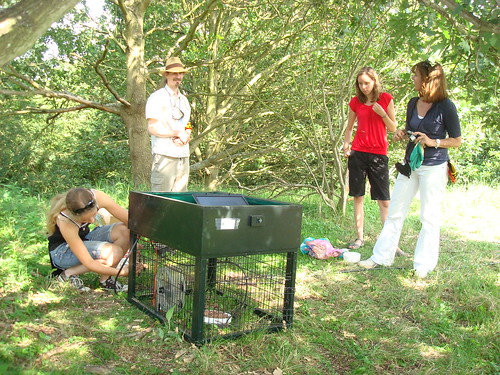

Setting up the products in the dunes area website. (Left to proper: Eva Koster, Yuri Robbers, Doortje Krijbolder, Joke Meijer.)
Picture: Jan Janse, with permission.


Every single pay a visit to to the experimental set-up was recorded by a evening-vision camera, employing passive infrared movement detection. At evening, the camera relied upon infrared light (infrared light is invisible to mice), which did not interfere with movement detection.


Wheel working and motion detection kit.
Image: Johanna H. Meijer and Yuri Robbers, with permission.


Data have been collected for far more than 3 years utilizing this experimental set-up (green urban location information had been collected from October 2009 to February 2013, and dune area information had been collected from June 2011 to January 2013 figure two):


Figure 2. Various animals use running wheels, even though mice are by far the most widespread. Breakdown by species in (a). Note that the vertical axis has been broken to accommodate mice, which accounted for 88% of wheel working. Also note that birds visited the recording gear occasionally, but by no means ran in wheels. Species recognized employing video recordings. Stills taken from these recordings present examples of a mouse (b), a frog (c) and a slug (d) using the wheel.


The operating wheels proved well-known with a range of cost-free-residing animal species. More than time period of above three years, Professor Meijer and Mr Robbers manufactured much more than 200,000 recordings of animal guests and analysed far more than 12,000 video fragments in which wheel movement was detected.


In the 1st 24 months, the urban green location resulted in 1011 animal visits (of which 734 were mice). The very first 20 months in the dunes resulted in 254 animal visits (of which 232 were mice). Even though the cage was baited with foods exclusively intended to appeal to mice, other animals — shrews, rats, snails, slugs, and frogs — also stopped in to do some running (or sliming?). Interestingly (to this ornithologist), even small birds popped in occasionally, although they were in no way recorded operating on the wheel.


“Our information signifies that wheel operating takes place in nature, getting performed by free-living wild animals”, said Mr Robbers. Hence, “captivity, extended or otherwise, can not probably be the cause of wheel operating”. Considering that all the professionals agree that stereotypical behaviours only occur in captivity, wheel operating does not match properly into the criteria.


In view of the broad variety of diet programs favored by these other species of animal guests, it would appear they had been not coming solely for the foods. So of course, Professor Meijer and Mr Robbers then asked what would occur if they stopped delivering any meals at all — might these animals still pop in for a run on the exercise wheel?


Will free of charge-residing animals use a running wheel with no a foods reward?


Though Professor Meijer and Mr Robbers stopped offering food in the urban area enclosures for far more than a year (October 2011–February 2013), animal visits continued. Professor Meijer and Mr Robbers observed 78 wheel working visits (62 mouse visits — 36 of which had been very little mice, indicating they had been as well youthful to know the cages had previously been baited with food).


The information exposed that the quantity of visits to the exercise wheel dropped drastically as quickly as the food was removed, but visits that incorporated wheel running really enhanced by 42 %, indicating that the animals (wild mice, mostly) were visiting the cage particularly to run on the action wheel, that workout is rewarding in itself. The experimental device acts as a type of neighbourhood mouse fitness center, it would seem.


Were action bouts comparable in between wild and lab mice?


Yet another test of regardless of whether wheel running fulfills a behavioural stereotypy was to examine wheel operating exercise among wild and lab mice. To get a clearer image of the animals’ exercise patterns, Professor Meijer and Mr Robbers in contrast wheel-working information from their wild mice to wheel-running data from laboratory mice that had been collected previously by another researcher (doi:10.1126/science.155.3770.1623, see figure 3):


Figure 3. Distribution of operating wheel bout lengths in 1 min bins. Urban spot (a), juvenile laboratory mice (b), 200 day previous lab mice (c) 400 day old lab mice. Note: juvenile lab mice have increased median bout lengths than wild mice but this big difference disappears in older mice. 200 day old lab mice run as considerably as wild mice, whilst older mice run much less. Information panels (b–d) based on [doi:10.1126/science.155.3770.1623].


The data reveal that most of the wheel working mice had been juveniles, and 20 % of them had bouts that lasted longer than one minute, with the highest bout lasting 18 minutes. This is comparable to activity bouts was reported for 200-day old lab mice that were closely confined.


The wild mice have been truly functioning tough, also: despite the fact that the common speed of running was slightly much less than for lab mice (one.3 versus
two.three km/h), the highest running velocity observed for wild mice was higher
than the highest for lab mice (five.7 versus five.1 km/h).


Why do wild mice voluntarily run on workout wheels?


This study displays that wheel working is voluntary in wild mice, is not dependent on a food reward, and takes place in bouts that are comparable to those recorded for captive mice, so it does not satisfy the established criteria for a stereotypical behaviour, as some scientists have argued. Of course, this raises the query: why do they do it?


“We’re considering perform behaviour as a viable explanation, and have started follow-up experiments to test that hypothesis”, said Mr Robbers.


Wheel operating looks rather uninteresting (suggestive of my least favourite piece of health club equipment, the treadmill), but probably these animals see an exercise wheel similarly to humans when given the choice to climb musical stairs as an alternative of riding an escalator, as we see in this video?


Reading on a mobile device? Here is the video hyperlink.


Why do we care about mice and their exercise wheels?


As anybody who reads the newspapers or listens to the radio knows, we are daily told to get much more workout. Fundamentally, everyday physical exercise slows ageing, reduces the incidence of many cancers, assists maintain a affordable physique weight, reduces the incidence of diabetes, heart assault and stroke, and improves brain function — and that is just to name a couple of benefits that I have read about this week. Investigation into the human wellness advantages of bodily activity depend upon the use of running wheels employed by lab animals. If this wheel running is a stereotypy, this could be problematic.


“Some scientists … have had a tendency to dismiss study findings based mostly on the use of operating wheels outright,” explained Mr Robbers in electronic mail. “This is rather much more challenging, now that our information is there to propose that wheel running can take place in totally free residing animals.”


Reading through on a mobile device? Here’s the video hyperlink.


Sources:


Meijer J.H. &amp Robbers Y. (2014). Wheel operating in the wild, Proceedings of the Royal Society B: Biological Sciences, 281 (1786) 20140210-20140210. DOI: 10.1098/rspb.2014.0210


Yuri Robbers [emails 17, 18, twenty &amp 21 May possibly 2014]


A lot of thanks of course to my twitter followers who kindly sent at lightning pace the PDF I requested @GOrizaola, @ConservResearch, @Rob0Sullivan, and @_inundata.


Also cited:


Sherwin C.M. (1998). Voluntary wheel running: a review and novel interpretation, Animal Behaviour, 56 (1) eleven-27. doi:10.1006/anbe.1998.0836


Science&amprft.artnum=http%3A%2F%2Fwww.sciencemag.org%2Fcgi%2Fdoi%2F10.1126%2Fscience.155.3770.1623&amprft.volume=155&amprft.situation=3770&amprft.issn=0036-8075&amprft.spage=1623&amprft.epage=1639&amprft.date=1967&amprfr_id=information%3Asid%2Fscienceseeker.org&amprft.au=Kavanau+J.+L.&amprft.aulast=Kavanau&amprft.aufirst=J.+L.&amprfs_dat=ss.incorporated=1&amprfe_dat=bpr3.integrated=1bpr3.tags=Biology%2CPsychology”&gtKavanau J.L. (1967). Habits of Captive White-Footed Mice, Science, 155 (3770) 1623-1639. doi:10.1126/science.155.3770.1623 [Open access]


.. .. .. .. .. .. .. .. .. .. ..


When she’s not doing work out in the fitness center or running up the stairs to her flat (located on the 13th floor), GrrlScientist can also be found here: Maniraptora. She’s very lively on twitter @GrrlScientist and occasionally lurks on social media: facebook, G+, LinkedIn, and Pinterest.


Wild mice in fact appreciate running on physical exercise wheels | @GrrlScientist

13 Mayıs 2014 Salı

Kids Don"t Read through Books Due to the fact Mother and father Do not Read Books

There is a cultural narrative about how electronic devices are pulling kids away from books. When I meet with other university professors they typically tell me that the college students don’t study anymore due to the fact their eyeballs are glued to their phones. Technophobes feel we are raising a generation that does not comprehend the worth of literature.


The polarization of outdated and new continues. Maybe it is leftover sediment from an anti-display mindset that was often on the fringes of the golden age of tv. It is a trite myth-like story that attempts to cast books as the underdog in battle towards thechno-imperialism. Paper is the great man and Gorilla Glass is the villain.


Book Worm


Widespread Sense Media’s new report, entitled “Children, Teenagers, And Reading,” attempts to offer you a “big-picture perspective on children’s reading habits in the United States and how they might have changed during the technological revolution of current decades.” The huge scary takeaway:


In accordance to government studies, considering that 1984, the % of 13-12 months-olds who are weekly readers went down from 70% to 53%, and the percent of 17-yr-olds who are weekly readers went from 64% to 40%. The percent of 17-year-olds who by no means or hardly ever read through tripled for the duration of this period, from 9% to 27%.


These statistics are startling. But I’m not certain what this has to do with technologies. The framing does not make significantly sense to me.


It seems to me that we at present dwell in a culture that is a lot more heavily text based mostly than any other time in background. Folks study all day long. Google, Twitter, and Facebook provide words. Folks cannot peel their eyes from the smartphone–essentially a text and data distribution mechanism. We really have trouble NOT reading. Individuals are constantly checking their e mail and their text messages. Often it is difficult to pull away from this matrix of letters.


Nonetheless, what are men and women reading through? It looks like they really do not read numerous books. I’m not speaking about youngsters, but rather grownups. Even the technophobes really don’t read books.


I’ve met very educated elite people who have advised me they just really don’t have time to go through books. They skim the NY Instances book assessment so they can participate in cocktail celebration conversations. They buy executive summaries from the back of in-flight magazines. I’m shocked by the quantity of people who request me if there are audio versions of my books accessible.


Is the difficulty that little ones don’t go through books, or is the dilemma that no one reads books because our culture has become anti-academic and anti-intellectual? We’d prefer to study magazines and blogs that are subtly self-promotional in their incessant questioning the worth of the humanities, liberal arts training, and those university degrees that are much more dependent on books than algorithms and databases. The common rhetoric tells us we need more STEM schooling, far more engineers, more entrepreneurs. We’re surrounded by an implicit anti-guide agenda, and nonetheless we wonder why children really don’t study books.


I’ll admit that I’m biased. I’m an academic. I get paid to go through. But my children (6 and 8) also study a whole lot on their personal. Not only because I require it–30 minutes of reading is a prerequisite to video game time–but also due to the fact their dad versions very good studying behaviors. Dad is usually ordering new books dad is usually reading them. In my home, becoming an grownup indicates feeling comfy with books. Maturity signifies having extreme familiarity with long-form written word.


The Frequent Sense Media report agrees. “Parents can inspire reading through,” they clarify, “by retaining print books in the residence, reading through themselves, and setting aside time everyday for their young children to study.”


Sturdy correlations exist between these parental actions and the frequency with which youngsters study (scholastic, 2013). For example, among children who are frequent readers, 57% of parents set aside time each and every day for their child to study, compared to sixteen% of mother and father of children who are infrequent readers.


When it comes to books, however, most research display that the text delivery technique is irrelevant. Excellent reading habits has nothing at all to do with engineering. E-readers, tablets, laptop screens are all capable of delivering extended-kind text. Books have absolutely nothing to do with paper. In fact, electronic gadgets only improve accessibility to books. A report from the Joan Ganz Cooney Center released earlier this yr explains that “a vast majority of children ages 2 to 10 have entry to a device for electronic reading through: 55% have a multipurpose tablet in the home, and 29% have a devoted e-reader (62% have entry to at least one particular of these devices). Between young children with a single of these devices in the residence, half (49%) engage in electronic reading through, either on their own or with their parent (30% of all kids).” Books matter how youngsters read them doesn’t.


My kids read through on the iPad, the e-reader, and paper. I make confident of it. I read to my kids every night. I study with my children for the duration of the day. I do it due to the fact I see it as a essential piece of their training. I can not just outsource the raising of my youngsters to specialists–and then complain that people teachers are failing. It is apparent to me that mothers and fathers also need to be concerned. They need to have to make certain their kids read books.


Of program, it is simpler to frame the story as paper vs. digital. It offers us permission not to engage with our youngsters. We can blame the video video games and apps rather than blaming ourselves. Mother and father need to have to take obligation for raising thoughtful, empathic, open-minded grownups. Books are a crucial component of the equation. But even if we eliminated each and every digital technologies from our lives, our youngsters even now will not go through books unless we tell them in no uncertain terms that books are an essential part of currently being an adult.


Educate your kids to read. And teach your children that it matters what they study. Renaissance Learning’s annual “What Youngsters Are Reading through Report” tells us a lot about what children are at present reading through and it is not all fairly. Their enormous study “does not summarize income or library information. It uses information from 318 million books go through by 9.8 million college students in the U.S. to establish what the most well-liked books are in a offered 12 months. It is the most extensive report in the U.S. that reflects K12 reading trends.”


3 exciting findings:


1. Gendered reading through starts as early as 1st grade. Elementary-school boys go through tons of “Captain Underpants,” but it doesn’t even make it to the girls’ leading 20 checklist. We’re conditioned to study statistics like this as proof that girls and boys have various preferences, tastes, and attitudes. I really do not believe it. Alternatively, we might study this as evidence that we are generating an increasingly gendered globe where roles and intellectual expectations are divided in accordance to biological reproductive organs. If this is truly what you want, by all indicates, keep at it. If not, there are loads of books that are non-gendered let your little ones know that you feel a lot more hugely of these.


two. Middle schoolers (in distinct 6th graders) are studying the most phrases per pupil. The typical words per student increases via middle college and then starts decreasing once more in high school. I see this as proof that mothers and fathers are sending the incorrect message about books to their kids. We value literacy, cheering on modest kids to understand to read as rapidly as possible. But when these children turn into adolescents they attempt to immediately emulate their adult part models. If adults do not read books then making an attempt to act like an grownup implies not reading books.


three. Books like Twilight and Hunger Games are far more common than literary classics. These days, teachers assign these more usually than Shakespeare or Don Quixote. Most of them will inform you that it is due to the fact they figure any reading is good studying and books like these boost pupil engagement. On the 1 hand, this helps make sense. On the other hand, we ought to don’t forget that popular fiction prioritizes income in excess of content material. They are revenue generators very first and literary explorations of the human situation only afterward. This does not necessarily suggest popular fiction is negative, but there’s also a cause that particular books have transcended the financial, political, and epistemological trends of particular centuries.


At the finish of the day, how our children study and what our youngsters read through says a lot far more about adult attitudes about books than it does about the kids’. Model the behaviors and attitudes you want your kids to emulate.


Jordan Shapiro is author of FREEPLAY: A Video Game Manual to Maximum Euphoric Bliss, a guide about how playing video games can transform psychological attitudes. For data on Jordan’s approaching books and events click right here.


Kids Don"t Read through Books Due to the fact Mother and father Do not Read Books

28 Mart 2014 Cuma

Cherry Juice: Fact or Myth when Fighting Arthritis and Gout Ache Naturally

The more advanced health-related technological innovation becomes the far more we comprehend how wise Mother Nature is. As extremely educated and extremely devoted foods researchers continue their try to discover NEW tricks, we sometime comprehend seeking BACK is the wisest factor to do.


It appears numerous of today’s breakthroughs in present day medication are just a discovery of what Mother Nature has been making an attempt to tell us all along. The secret to enjoying a healthier and lively life style is not in some magical pill, but in listening to our entire body and creating wise choices about what we put into it.


A single region that impacts millions of people every single 12 months is joint pain induced by arthritis and gout. In accordance to the Center for Condition Handle (CDC) approximately 52.5 million Americans suffer from joint ache. The amount of men and women affected by this unpleasant illness is expected to boost yearly as the general population ages.


With so numerous folks suffering on an yearly basis, no wonder countless dollars are spent in the search to relieve people that are suffering. Nevertheless, a basic, small red fruit has caught the focus of each discomfort sufferers and food researchers.


Meals That Heal Inflammation: Embrace Healthful Living and Eradicate Pain, 1 Meal at at Time


Quick History of the Cherry


The sour cherry, technically called Prunus Cerasus, has a prolonged history of satisfying the palette and easing discomfort of a great number of individuals. It is believed the mighty Roman basic Lucius Licinius was accountable for introducing the sour cherry to the Roman world.


The standard was constantly on the lookout for unique plants to carry back to Rome from his military conquests. According to historical past, the standard 1st turn into conscious of the sour cherry even though on a campaign along the Black Sea in Asia Minor. Upon winning a decisive battle towards Mithridates VI, the king of Pontus, the common returned to Rome and with his spoils of war he carried the sour cherry. When back in Rome, legionnaires, messengers and every day citizens assisted to spread this ruby red fruit across the whole Roman Empire.


Cherry trees were quickly planted along Roman roads. The wood from the trees was utilized to make weapons, fix gear and as firewood. The legionnaires enjoyed the fruit for the duration of long journeys to defend and broaden the Empire.


As the globe expanded west, the cherry tagged along. The cherry finally created its way to the New Globe with the early settlers. It was during the early centuries from its travels from Asia Minor to North America that the folklore of its pain fighting potential grew. Stories have been passed from generation to generation, from father to son, from grandmother to granddaughter.


The Initial Published Examine on the Cherry


It wasn’t until the 1950’s that that initial investigation was published on the overall health benefits of the cherry. Dr. Ludwig Blau very first identified how effectively the cherry worked in fighting gout soreness. Due to an very painful gout assault, the medical doctor was confined to a wheelchair for numerous days. It was throughout this time a buddy informed him about gout and cherries.


Dr. Blau was so thrilled about the good benefits he personally skilled that he made the decision to perform analysis on the gout-fighting capability of the fruit. He soon recruited 12 gout sufferers to take element in a gout examine. The participants drank a glass of cherry juice or ate a single-half pound of cherries each day throughout the review.


The final results of the examine unveiled uric acid ranges lowered down to pre-gout ranges. In addition, the folks also stated they skilled much less discomfort in their joints and no additional gout attacks. Even though black cherry was utilized during individuals research conducted by Dr. Blau, the sweet yellow and sour cherries were successful, as well.


Joint Soreness and Cherries


Fast forward fifty many years to the early 2000’s and you will learn similar groundbreaking research published on the pain relieving properties of the tart cherry. Thankfully, with modern investigation products, foods researchers can far more properly figure out the secret of why certain meals aid with specific conditions. According to published research, the tart cherry is made up of naturally occurring compounds referred to as anthocyanins plus 17 other power antioxidants. The anthocyanins alone are shown to offer ten instances the ache relief of aspirin or ibuprofen. This tiny red super fruit is packed complete of soreness relieving advantages.


Researchers at the Philadelphia VA Health-related Center carried out a study on 53 patients with osteoarthritis. The participants have been asked to drink two 8-ounce bottles of tart cherry juice everyday for a 6 week period. The published results in Arthritis &amp Rheumatism Magazine indicated these patients reported considerable improvement in bodily perform and reduction of ache and stiffness.


So the up coming time you’re looking for a natural way to fight joint pain due to gout or arthritis, think about including a glass of tart cherry juice to your daily program.


Healthful Blessings,


Sandy


Visit out Wholesome Residing Site for fantastic natural treatments and recipes!


Cherry Juice: Fact or Myth when Fighting Arthritis and Gout Ache Naturally

29 Ocak 2014 Çarşamba

"My close friends do not know what it"s in fact like to reside with it"

But, thanks to the children’s charity Chicks, Max has been capable to go on holiday three times above the final five many years. Every single was a week-long break with 17 other young carers or youngsters from challenging homes, most of whom had never had a vacation ahead of.


“I get to bond with people my age and it gives me some time to get away from caring for Jake and some freedom,” says Max. He grins as he tells me about the actions on offer: entire body-boarding, rock-climbing, riding, swimming and playing games with the volunteers and employees.


“It builds your self-assurance a lot due to the fact you can go up to men and women and make close friends, and it’s less complicated than being at property caught with Jake and carrying out issues for him. Your mum’s not there to say, ‘Max, do this, do that.’ You can just be yourself really.”


It is not just about the pursuits, even though: each meal at the Chicks retreats in Devon and Cornwall is residence-cooked and the kids consume collectively at a table, some thing that numerous of them have never ever carried out at house. There is no tv, no net and no mobile phones are allowed.


Now in its 21st yr, the charity hopes to increase £1.4 million to carry on helping about one,200 disadvantaged kids among the ages of eight and 15 all through 2014, as it receives no government funding.


“Places like Chicks give the kids a break to just be standard children,” Mandy says. 4 of her young children have now benefited from the charity’s respite breaks, and she has noticed the variation it tends to make to the whole loved ones. “It’s very good for them. When Max comes back he’s usually really self-assured.”


Nonetheless, every single of the 3 times he has gone away with Chicks, Max has woken up worrying about Jake. “The 1st or second day I thought, ‘Is Jake there, do I need to have to do that’, then I think, ‘Ah no, it is all right.’


“Then you get used to it and when you come house it’s a bit of a shock: I require to do this swift and Jake’s screaming again. He cannot tell you what’s incorrect with him. If he even now cries, you don’t know what to do. It is just tough.”


And, as Jake gets older, it is turning out to be even harder. The family now uses a hoist to lift him in and out of his bed, simply because he is also hefty to carry, and they are usually aware that he is terminally sick. Over Christmas 2012, Jake had to be positioned on daily life assistance for a fortnight and considering that then he has been in and out of hospital.


“I get unhappy, but I really do not cry,” says Max. “It’s tough on you since you do not know if he’s going to make it and it is your brother. I try out not to feel of it also considerably, and just be a regular youthful person. If something occurs I’ll phone my mate and try out to consider my mind off it as much as I can.”


Yet it isn’t the identical as being with young children who can truly recognize his residence lifestyle – 1 of the motives he loves Chicks. “We can speak about each and every other’s lives, what’s going on and how they cope with it,” he says. “My friends really do not know what it is actually like to dwell with it, but men and women at Chicks do.”


Now that Max is about to flip 16, he can no longer attend a Chicks camp, but he hopes to return as a volunteer. “After looking right after Jake, I’m really very good with children,” he laughs. “I want to bond with them genuinely nicely and I guess just make them have a very good time like I did.”


Chicks is one particular of three charities supported by the Telegraph Christmas Appeal, which closes on on January 31. To make a donation please check out http://www.telegraph.co.united kingdom/information/telegraphchristmasappeal/


"My close friends do not know what it"s in fact like to reside with it"