Appreciate etiketine sahip kayıtlar gösteriliyor. Tüm kayıtları göster

21 Mayıs 2014 Çarşamba

Wild mice in fact appreciate working on physical exercise wheels | @GrrlScientist

According to a newly published examine, wild mice usually and voluntarily run on an workout wheel if offered access to them in nature, even in the absence of a meals reward. More, the length of running bouts by wild mice matched those of captive mice. These findings dispel the idea that wheel working is an artefact of captivity, indicative both of neurosis or a mindless repetitive behaviour (stereotypy) that might be connected with poor welfare or shut confinement.


Exercise wheels come in a assortment of sizes and types, but their basic objective is to provide confined animals with the opportunity to physical exercise, as you see these adorable dwarf hamsters carrying out here:


Studying on a mobile device? Here is the video link.


That’s an amusing video, and the hamsters seem to be enjoying themselves, but are they actually? And how may possibly you figure this out?


I ran across an exciting tiny study paper that addresses a fundamental — and controversial — question in exercising physiology: is running in an exercising wheel an artefact of captivity as exhibited by small pets, like hamsters, mice and rats? Why do they do it? Is it intended to alleviate pressure or neurosis triggered by near confinement, is it a repetitive and invariant behaviour that is devoid of any clear goal or function (stereotypy), this kind of as cage-pacing seen in some zoo animals, or may possibly it signify some thing else?


“When it comes to stereotyped behaviour, there are competing theories. 1 situation, as an instance, is no matter whether stereotyped behaviour is a symptom of bad welfare that must be prevented, or whether or not it is a coping technique that in fact increases welfare”, explained the study’s co-writer, Yuri Robbers, in e-mail.


Mr Robbers, who works as a grammar school biology teacher, has a master’s degree in animal behaviour and is at the moment researching animal behaviour, theoretical biology and ecology as he performs towards his PhD below the mentorship of neurophysiologist Johanna H. Meijer, a professor in the Department of Physiology at the Leiden University Medical Center in The Netherlands.


The controversy swirling about operating on an exercise wheel anxious the Dutch researchers so a lot that they developed many experiments to clarify the basis of this behaviour. Especially, they wished to test regardless of whether wheel running fulfills the criteria for a stereotypy: (one) it occurs only in captive animals, (2) it is repetitive, invariant and devoid of obvious goal or perform, (3) if it consists of all-natural behavioural factors, these factors happen at higher rates and for longer durations than located in nature, and (four) it is partially or not at all dependent on external stimuli.


Will wild mice use a working wheel if a single is presented in nature?


Well-known animal behaviourist Konrad Lorenz after remarked that rodents that had either escaped or been launched will enter and run on exercising wheels if a single is accessible to them (as cited right here: doi:10.1126/science.155.3770.1623). Intrigued, Professor Meijer and Mr Robbers made the decision to follow up on this observation by going one particular phase additional: they asked whether or not cost-free-living animals that had never just before witnessed an activity wheel would voluntarily use 1 if it was accessible to them.


They made a cage that particularly excluded large animals (so they wouldn’t knock more than the exercising wheel set up). Inside this cage, which could be freely accessed by small animals, they positioned a operating wheel along with some meals intended to attract mice. These exclosures have been set up in nature at two various discipline internet sites a green urban region (Professor Meijer’s back backyard) and a dune location that was inaccessible to the public (see under):
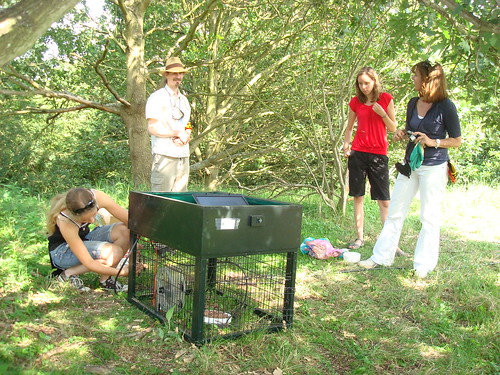

Setting up the gear in the dunes field site. (Left to appropriate: Eva Koster, Yuri Robbers, Doortje Krijbolder, Joke Meijer.)
Image: Jan Janse, with permission.


Every check out to the experimental set-up was recorded by a night-vision camera, employing passive infrared motion detection. At night, the camera relied upon infrared light (infrared light is invisible to mice), which did not interfere with motion detection.


Wheel working and movement detection kit.
Picture: Johanna H. Meijer and Yuri Robbers, with permission.


Information have been collected for a lot more than three many years making use of this experimental set-up (green urban area information have been collected from October 2009 to February 2013, and dune region data have been collected from June 2011 to January 2013 figure two):


Figure two. Different animals use working wheels, though mice are by far the most common. Breakdown by species in (a). Note that the vertical axis has been broken to accommodate mice, which accounted for 88% of wheel running. Also note that birds visited the recording products occasionally, but never ran in wheels. Species identified making use of video recordings. Stills taken from these recordings display examples of a mouse (b), a frog (c) and a slug (d) utilizing the wheel.


The working wheels proved common with a range of free of charge-residing animal species. Above time period of above three many years, Professor Meijer and Mr Robbers created more than 200,000 recordings of animal site visitors and analysed much more than twelve,000 video fragments in which wheel motion was detected.


In the initial 24 months, the urban green location resulted in 1011 animal visits (of which 734 had been mice). The 1st 20 months in the dunes resulted in 254 animal visits (of which 232 had been mice). Although the cage was baited with food particularly meant to entice mice, other animals — shrews, rats, snails, slugs, and frogs — also stopped in to do some running (or sliming?). Interestingly (to this ornithologist), even little birds popped in sometimes, although they were never ever recorded operating on the wheel.


“Our information signifies that wheel working takes place in nature, currently being carried out by totally free-living wild animals”, mentioned Mr Robbers. Thus, “captivity, extended or otherwise, can not possibly be the lead to of wheel operating”. Because all the experts agree that stereotypical behaviours only happen in captivity, wheel running does not fit well into the criteria.


In view of the broad assortment of diet plans preferred by these other species of animal visitors, it would seem they had been not coming solely for the meals. So of course, Professor Meijer and Mr Robbers then asked what would occur if they stopped offering any meals at all — may well these animals even now pop in for a run on the workout wheel?


Will free of charge-living animals use a running wheel with out a foods reward?


Even though Professor Meijer and Mr Robbers stopped delivering food in the urban spot enclosures for more than a 12 months (October 2011–February 2013), animal visits continued. Professor Meijer and Mr Robbers observed 78 wheel operating visits (62 mouse visits — 36 of which have been really modest mice, indicating they have been as well young to know the cages had previously been baited with meals).


The information uncovered that the number of visits to the exercise wheel dropped substantially as quickly as the foods was removed, but visits that incorporated wheel running actually elevated by 42 percent, indicating that the animals (wild mice, primarily) were visiting the cage specifically to run on the exercise wheel, that exercise is rewarding in itself. The experimental gadget acts as a sort of neighbourhood mouse gym, it would seem.


Were action bouts comparable in between wild and lab mice?


Another check of whether or not wheel running fulfills a behavioural stereotypy was to assess wheel operating exercise between wild and lab mice. To get a clearer image of the animals’ action patterns, Professor Meijer and Mr Robbers compared wheel-working data from their wild mice to wheel-working information from laboratory mice that had been collected previously by another researcher (doi:ten.1126/science.155.3770.1623, see figure 3):


Figure three. Distribution of operating wheel bout lengths in one min bins. Urban region (a), juvenile laboratory mice (b), 200 day outdated lab mice (c) 400 day previous lab mice. Note: juvenile lab mice have increased median bout lengths than wild mice but this variation disappears in older mice. 200 day old lab mice run as considerably as wild mice, whilst older mice run much less. Information panels (b–d) based on [doi:10.1126/science.155.3770.1623].


The data reveal that most of the wheel operating mice were juveniles, and 20 % of them had bouts that lasted longer than one minute, with the highest bout lasting 18 minutes. This is related to action bouts was reported for 200-day outdated lab mice that had been closely confined.


The wild mice had been actually doing work challenging, as well: despite the fact that the regular speed of running was slightly much less than for lab mice (1.3 versus
two.3 km/h), the optimum running speed observed for wild mice was increased
than the maximum for lab mice (five.7 versus 5.1 km/h).


Why do wild mice voluntarily run on workout wheels?


This research shows that wheel working is voluntary in wild mice, is not dependent on a meals reward, and takes place in bouts that are comparable to people recorded for captive mice, so it does not satisfy the established criteria for a stereotypical behaviour, as some scientists have argued. Of program, this raises the query: why do they do it?


“We’re considering play behaviour as a viable explanation, and have began follow-up experiments to test that hypothesis”, said Mr Robbers.


Wheel operating appears rather boring (suggestive of my least favourite piece of gym equipment, the treadmill), but possibly these animals view an exercise wheel similarly to humans when offered the option to climb musical stairs as an alternative of riding an escalator, as we see in this video?


Studying on a mobile gadget? Here’s the video link.


Why do we care about mice and their physical exercise wheels?


As any individual who reads the newspapers or listens to the radio is aware of, we are everyday advised to get far more exercise. Essentially, daily bodily exercise slows ageing, reduces the incidence of numerous cancers, assists maintain a reasonable body weight, lowers the incidence of diabetes, heart attack and stroke, and improves brain perform — and which is just to title a number of advantages that I’ve read about this week. Investigation into the human well being rewards of physical exercise depend upon the use of running wheels utilised by lab animals. If this wheel working is a stereotypy, this could be problematic.


“Some scientists … have had a tendency to dismiss analysis findings primarily based on the use of working wheels outright,” explained Mr Robbers in email. “This is rather far more challenging, now that our information is there to suggest that wheel working can occur in free residing animals.”


Reading on a mobile gadget? Here is the video hyperlink.


Sources:


Meijer J.H. &amp Robbers Y. (2014). Wheel running in the wild, Proceedings of the Royal Society B: Biological Sciences, 281 (1786) 20140210-20140210. DOI: ten.1098/rspb.2014.0210


Yuri Robbers [emails 17, 18, 20 &amp 21 May 2014]


Many thanks of course to my twitter followers who kindly sent at lightning velocity the PDF I requested @GOrizaola, @ConservResearch, @Rob0Sullivan, and @_inundata.


Also cited:


Sherwin C.M. (1998). Voluntary wheel running: a assessment and novel interpretation, Animal Behaviour, 56 (one) eleven-27. doi:ten.1006/anbe.1998.0836


Science&amprft.artnum=http%3A%2F%2Fwww.sciencemag.org%2Fcgi%2Fdoi%2F10.1126%2Fscience.155.3770.1623&amprft.volume=155&amprft.issue=3770&amprft.issn=0036-8075&amprft.spage=1623&amprft.epage=1639&amprft.date=1967&amprfr_id=info%3Asid%2Fscienceseeker.org&amprft.au=Kavanau+J.+L.&amprft.aulast=Kavanau&amprft.aufirst=J.+L.&amprfs_dat=ss.incorporated=one&amprfe_dat=bpr3.included=1bpr3.tags=Biology%2CPsychology”&gtKavanau J.L. (1967). Conduct of Captive White-Footed Mice, Science, 155 (3770) 1623-1639. doi:ten.1126/science.155.3770.1623 [Open entry]


.. .. .. .. .. .. .. .. .. .. ..


When she’s not doing work out in the gymnasium or operating up the stairs to her flat (situated on the 13th floor), GrrlScientist can also be located here: Maniraptora. She’s quite lively on twitter @GrrlScientist and at times lurks on social media: facebook, G+, LinkedIn, and Pinterest.


Wild mice in fact appreciate working on physical exercise wheels | @GrrlScientist

Wild mice in fact appreciate running on physical exercise wheels | @GrrlScientist

In accordance to a newly published study, wild mice often and voluntarily run on an exercise wheel if presented entry to them in nature, even in the absence of a food reward. Further, the length of operating bouts by wild mice matched people of captive mice. These findings dispel the concept that wheel running is an artefact of captivity, indicative either of neurosis or a mindless repetitive behaviour (stereotypy) that may possibly be connected with poor welfare or close confinement.


Action wheels come in a range of sizes and styles, but their simple objective is to supply confined animals with the possibility to workout, as you see these adorable dwarf hamsters doing here:


Reading through on a mobile device? Here is the video hyperlink.


Which is an amusing video, and the hamsters seem to be enjoying themselves, but are they genuinely? And how may possibly you figure this out?


I ran across an fascinating minor research paper that addresses a basic — and controversial — question in exercising physiology: is operating in an exercising wheel an artefact of captivity as exhibited by small pets, like hamsters, mice and rats? Why do they do it? Is it intended to alleviate stress or neurosis brought on by near confinement, is it a repetitive and invariant behaviour that is devoid of any apparent goal or function (stereotypy), this kind of as cage-pacing observed in some zoo animals, or may possibly it signify some thing else?


“When it comes to stereotyped behaviour, there are competing theories. One problem, as an example, is no matter whether stereotyped behaviour is a symptom of negative welfare that must be prevented, or whether or not it is a coping technique that in fact increases welfare”, explained the study’s co-author, Yuri Robbers, in email.


Mr Robbers, who works as a grammar college biology teacher, has a master’s degree in animal behaviour and is presently researching animal behaviour, theoretical biology and ecology as he performs towards his PhD underneath the mentorship of neurophysiologist Johanna H. Meijer, a professor in the Department of Physiology at the Leiden University Healthcare Center in The Netherlands.


The controversy swirling close to running on an exercise wheel worried the Dutch researchers so much that they developed numerous experiments to clarify the basis of this behaviour. Particularly, they desired to check whether or not wheel operating fulfills the criteria for a stereotypy: (one) it happens only in captive animals, (two) it is repetitive, invariant and devoid of obvious objective or function, (three) if it consists of all-natural behavioural elements, these factors take place at larger rates and for longer durations than located in nature, and (four) it is partially or not at all dependent on external stimuli.


Will wild mice use a operating wheel if a single is supplied in nature?


Popular animal behaviourist Konrad Lorenz once remarked that rodents that had either escaped or been launched will enter and run on physical exercise wheels if one particular is accessible to them (as cited here: doi:10.1126/science.155.3770.1623). Intrigued, Professor Meijer and Mr Robbers decided to comply with up on this observation by going one stage even more: they asked whether cost-free-residing animals that had in no way prior to observed an activity wheel would voluntarily use a single if it was accessible to them.


They made a cage that exclusively excluded large animals (so they would not knock more than the workout wheel set up). Within this cage, which could be freely accessed by little animals, they placed a operating wheel along with some foods intended to appeal to mice. These exclosures had been set up in nature at two various discipline sites a green urban location (Professor Meijer’s back garden) and a dune region that was inaccessible to the public (see below):


Setting up the products in the dunes area website. (Left to proper: Eva Koster, Yuri Robbers, Doortje Krijbolder, Joke Meijer.)
Picture: Jan Janse, with permission.


Every single pay a visit to to the experimental set-up was recorded by a evening-vision camera, employing passive infrared movement detection. At evening, the camera relied upon infrared light (infrared light is invisible to mice), which did not interfere with movement detection.


Wheel working and motion detection kit.
Image: Johanna H. Meijer and Yuri Robbers, with permission.


Data have been collected for far more than 3 years utilizing this experimental set-up (green urban location information had been collected from October 2009 to February 2013, and dune area information had been collected from June 2011 to January 2013 figure two):


Figure 2. Various animals use running wheels, even though mice are by far the most widespread. Breakdown by species in (a). Note that the vertical axis has been broken to accommodate mice, which accounted for 88% of wheel working. Also note that birds visited the recording gear occasionally, but by no means ran in wheels. Species recognized employing video recordings. Stills taken from these recordings present examples of a mouse (b), a frog (c) and a slug (d) using the wheel.


The operating wheels proved well-known with a range of cost-free-residing animal species. More than time period of above three years, Professor Meijer and Mr Robbers manufactured much more than 200,000 recordings of animal guests and analysed far more than 12,000 video fragments in which wheel movement was detected.


In the 1st 24 months, the urban green location resulted in 1011 animal visits (of which 734 were mice). The very first 20 months in the dunes resulted in 254 animal visits (of which 232 were mice). Even though the cage was baited with foods exclusively intended to appeal to mice, other animals — shrews, rats, snails, slugs, and frogs — also stopped in to do some running (or sliming?). Interestingly (to this ornithologist), even small birds popped in occasionally, although they were in no way recorded operating on the wheel.


“Our information signifies that wheel operating takes place in nature, getting performed by free-living wild animals”, said Mr Robbers. Hence, “captivity, extended or otherwise, can not probably be the cause of wheel operating”. Considering that all the professionals agree that stereotypical behaviours only occur in captivity, wheel operating does not match properly into the criteria.


In view of the broad variety of diet programs favored by these other species of animal guests, it would appear they had been not coming solely for the foods. So of course, Professor Meijer and Mr Robbers then asked what would occur if they stopped delivering any meals at all — might these animals still pop in for a run on the exercise wheel?


Will free of charge-residing animals use a running wheel with no a foods reward?


Though Professor Meijer and Mr Robbers stopped offering food in the urban area enclosures for far more than a year (October 2011–February 2013), animal visits continued. Professor Meijer and Mr Robbers observed 78 wheel working visits (62 mouse visits — 36 of which had been very little mice, indicating they had been as well youthful to know the cages had previously been baited with food).


The information exposed that the quantity of visits to the exercise wheel dropped drastically as quickly as the food was removed, but visits that incorporated wheel running really enhanced by 42 %, indicating that the animals (wild mice, mostly) were visiting the cage particularly to run on the action wheel, that workout is rewarding in itself. The experimental device acts as a type of neighbourhood mouse fitness center, it would seem.


Were action bouts comparable in between wild and lab mice?


Yet another test of regardless of whether wheel running fulfills a behavioural stereotypy was to examine wheel operating exercise among wild and lab mice. To get a clearer image of the animals’ exercise patterns, Professor Meijer and Mr Robbers in contrast wheel-working information from their wild mice to wheel-running data from laboratory mice that had been collected previously by another researcher (doi:10.1126/science.155.3770.1623, see figure 3):


Figure 3. Distribution of operating wheel bout lengths in 1 min bins. Urban spot (a), juvenile laboratory mice (b), 200 day previous lab mice (c) 400 day old lab mice. Note: juvenile lab mice have increased median bout lengths than wild mice but this big difference disappears in older mice. 200 day old lab mice run as considerably as wild mice, whilst older mice run much less. Information panels (b–d) based on [doi:10.1126/science.155.3770.1623].


The data reveal that most of the wheel working mice had been juveniles, and 20 % of them had bouts that lasted longer than one minute, with the highest bout lasting 18 minutes. This is comparable to activity bouts was reported for 200-day old lab mice that were closely confined.


The wild mice have been truly functioning tough, also: despite the fact that the common speed of running was slightly much less than for lab mice (one.3 versus
two.three km/h), the highest running velocity observed for wild mice was higher
than the highest for lab mice (five.7 versus five.1 km/h).


Why do wild mice voluntarily run on workout wheels?


This study displays that wheel working is voluntary in wild mice, is not dependent on a food reward, and takes place in bouts that are comparable to those recorded for captive mice, so it does not satisfy the established criteria for a stereotypical behaviour, as some scientists have argued. Of course, this raises the query: why do they do it?


“We’re considering perform behaviour as a viable explanation, and have started follow-up experiments to test that hypothesis”, said Mr Robbers.


Wheel operating looks rather uninteresting (suggestive of my least favourite piece of health club equipment, the treadmill), but probably these animals see an exercise wheel similarly to humans when given the choice to climb musical stairs as an alternative of riding an escalator, as we see in this video?


Reading on a mobile device? Here is the video hyperlink.


Why do we care about mice and their exercise wheels?


As anybody who reads the newspapers or listens to the radio knows, we are daily told to get much more workout. Fundamentally, everyday physical exercise slows ageing, reduces the incidence of many cancers, assists maintain a affordable physique weight, reduces the incidence of diabetes, heart assault and stroke, and improves brain function — and that is just to name a couple of benefits that I have read about this week. Investigation into the human wellness advantages of bodily activity depend upon the use of running wheels employed by lab animals. If this wheel running is a stereotypy, this could be problematic.


“Some scientists … have had a tendency to dismiss study findings based mostly on the use of operating wheels outright,” explained Mr Robbers in electronic mail. “This is rather much more challenging, now that our information is there to propose that wheel running can take place in totally free residing animals.”


Reading through on a mobile device? Here’s the video hyperlink.


Sources:


Meijer J.H. &amp Robbers Y. (2014). Wheel operating in the wild, Proceedings of the Royal Society B: Biological Sciences, 281 (1786) 20140210-20140210. DOI: 10.1098/rspb.2014.0210


Yuri Robbers [emails 17, 18, twenty &amp 21 May possibly 2014]


A lot of thanks of course to my twitter followers who kindly sent at lightning pace the PDF I requested @GOrizaola, @ConservResearch, @Rob0Sullivan, and @_inundata.


Also cited:


Sherwin C.M. (1998). Voluntary wheel running: a review and novel interpretation, Animal Behaviour, 56 (1) eleven-27. doi:10.1006/anbe.1998.0836


Science&amprft.artnum=http%3A%2F%2Fwww.sciencemag.org%2Fcgi%2Fdoi%2F10.1126%2Fscience.155.3770.1623&amprft.volume=155&amprft.situation=3770&amprft.issn=0036-8075&amprft.spage=1623&amprft.epage=1639&amprft.date=1967&amprfr_id=information%3Asid%2Fscienceseeker.org&amprft.au=Kavanau+J.+L.&amprft.aulast=Kavanau&amprft.aufirst=J.+L.&amprfs_dat=ss.incorporated=1&amprfe_dat=bpr3.integrated=1bpr3.tags=Biology%2CPsychology”&gtKavanau J.L. (1967). Habits of Captive White-Footed Mice, Science, 155 (3770) 1623-1639. doi:10.1126/science.155.3770.1623 [Open access]


.. .. .. .. .. .. .. .. .. .. ..


When she’s not doing work out in the fitness center or running up the stairs to her flat (located on the 13th floor), GrrlScientist can also be found here: Maniraptora. She’s very lively on twitter @GrrlScientist and occasionally lurks on social media: facebook, G+, LinkedIn, and Pinterest.


Wild mice in fact appreciate running on physical exercise wheels | @GrrlScientist

14 Nisan 2014 Pazartesi

Trust your pregnant gut: Appreciate calories with a dollop of typical sense

These days, with all the engineering and science behind us, it can look even more hard, even more fraught, than it was before all this know-how existed, to try and give birth to a wholesome youngster.


We are in danger of turning into paranoid, obsessed, neurotic mothers before we’ve even created a little one bump. And I can’t help but consider that this worry, anxiety and fretting will only hinder the baby’s odds of a healthy upbringing, after all.


Time to panic!


The minute I informed my GP I believed I was pregnant, I was bombarded with leaflets and printouts about what I could and couldn’t eat, the exercising I should and should not be performing and the vitamins I ought to and shouldn’t be taking.


My mind went into panic mode about what to do and what not to do, when actually all I essential was a bit of frequent sense.


This latest study is no exception. We are now advised that eating too significantly, or as well minor, during pregnancy could generate an unhealthy infant. Well, duh.


But – panic mode setting in – how do you know what the right about of meals to consume is? How do you know if a little bit of weight gain throughout pregnancy is healthier, standard, abnormal or unhealthy?


She seems to be healthy.Butis she?!


I’ve just passed the 6-months pregnancy mark. Have I acquired too a lot? Too tiny? Oh god, how do I know? The review says that even staying slim – apparently healthier – during pregnancy ‘risks obese children’.


I have put on a bit of weight – I can inform by seeking at myself in the mirror. But I haven’t nevertheless ‘blown up’ as several mums have warned me about. I am thankful about that. But perhaps I need to be worrying about the truth I have not? What if that means my child is not wholesome? If I do or will not place on plenty of fat in the ultimate trimester, must I be worrying about it?


Apparently, yes I ought to be, according to this new review from the US research from the Kaiser Permanante Division of Analysis in Oakland, California.


“Gaining either as well minor or too significantly excess weight in pregnancy may possibly completely affect mechanisms that manage power balance and metabolic process in the offspring, such as appetite control and power expenditure. This could potentially have lengthy-phrase effects on the child’s subsequent growth and weight,” says Dr Monique Hedderson, a researcher on the study, in accordance to reviews.


So how do you know what the appropriate sum of fat to obtain is?


‘The rules’


Thankfully, the US’ Institute of Medication has produced guidelines for the level of fat obtain deemed ‘healthy’ during pregnancy, dependent on your excess weight in the initial place.


If you measure a healthier BMI at 12 weeks, then you need to be gaining about 25 to 35lbs in the course of pregnancy. If you have a BMI of thirty or much more, then you should seem to put on only 11 to 20lbs.


Source: Institute of Medication, Excess weight Achieve For the duration of Pregnancy, 2009


This table is a helpful manual. And alleviates my worries (the worries that I did not have this time yesterday ahead of studying about this new examine). The UK’s overall health physique, Nice, mentions it inside of its own documentation on bodyweight acquire during pregnancy, although there is no equivalent guide for the Uk and as this kind of, it is not ‘official’.


At the minute in the Uk, pregnant women’s BMI is measured at the 12 week stage. If you are deemed normal, you’re not measured once again.


Tam Fry, honorary chairman of the Child Growth Foundation, thinks this is incorrect and desires to see BMI measured every trimester, to verify things are progressing as they must be.


He factors out that the NHS is not obliged to pass the US manual information onto sufferers, so largely, they are kept in the dark about acceptable fat gain.


People that were placing on bodyweight prior to they became pregnant, and who measured healthful at twelve weeks, are most at danger – as they could nonetheless be gaining excess weight and but no person is bothering to monitor it, he says.


“The issue is that making it possible for men and women to put on extra excess weight during their pregnancy is that they finish up contemplating they can eat for two. This indicates they’ll become heavy and the chances of them obtaining a c-part are elevated as it’s the only way they can squeeze the kid out.


“Dieting in pregnancy is not a great thought both, as it can endanger the unborn infant. The only way all around this is that medical doctors, midwives and dietitians should be giving you tips and monitoring you throughout your pregnancy to check all is on track.”


It truly is really worth pointing out that the degree of proper excess weight gain will fluctuate massively based on the patient their pre-pregnancy excess weight, their household background, any medication they are on, and so on. There is no ‘one size fits all’ method that dictates you need to consume X quantity of calories far more a day, when pregnant.


A pal of mine, for illustration, was advised by her GP to consume around 300 calories extra a day, on best of the 2,000 that ladies are typically suggested. But this figure will have been distinct to her situations and health-related background. It is not a blanket rule.


A lot more monitoring?


Mr Fry would like to see mothers-to-be monitored more than weight achieve throughout each and every trimester. This wouldn’t expense anything, let us encounter it.


Even so, Uk professionals do not, as a matter of course, give females information about the risks of weight problems and significance of fat management ahead of or following pregnancy.


I can confirm this is correct: I measured ‘normal’ at 12 weeks and I have not been weighed by my NHS midwife because.


Mr Fry thinks I need to be demanding that they measure my BMI following time I go in. “It is difficult to tell visually if you are putting on the proper quantity of excess weight or not,” he says.


And the NHS pays much less consideration if you remain slim all the target appears to be on whether or not you happen to be placing too considerably excess weight on, not regardless of whether you’re placing on as well little.


Crikey. So is this really but an additional issue to worry about then?


And but, and however. Offered that in the ‘normal’ assortment over, the prime most acquire of 35lbs is the equivalent of 2.5 stone, that is fairly a great deal of bodyweight, isn’t it? Certainly, I would be able to inform no matter whether I’d put on much more than two.five stone? In that case, once more, does not this just come down to typical sense? Do I truly want to demand they measure my BMI?


Maternity units have had to order particular operating tables, wheelchairs and other tools to deal with the rising number of obese mothers


Equally, the smallest obtain in the ‘normal’ variety, at 25lbs, is one.seven stone. That appears about appropriate, such as infant excess weight.


Dr Geeta Nargund, of the Create fertility clinic in London, agrees with Mr Fry and thinks pregnant girls need to be far more active about managing their fat. They must actively seek advice from the NHS site, she says.


“Some girls may eat too minor simply because they are concerned about their figure and as well considerably weight gain. Some may possibly consume as well much since they believe they have to eat for two men and women. It is important to get tips before and during pregnancy from their GP about this,” she says.


Aren’t we forgetting some thing?


Her words make sense. But provided that I am really pregnant, I cannot support but feel we’re missing the apparent here. I feel alright. I am eating well adequate. I’m not taking or obtaining any tips from my GP about consuming. And that is Ok, isn’t it?


She laughs. “Nicely yes, it does come down to common sense. But seek out suggestions if you are concerned about it,” she says.


Ah ha! Lastly! A overall health skilled is allowing me to trust my gut (excuse the pun). Use my widespread sense. If anything isn’t going to come to feel proper, I will look for assist.


Till then, I’m *not* going to get caught up in the ‘science’ of it all and worry about factors unnecessarily.


There are far far better items to do with your time throughout pregnancy. (1 of which, includes the capacity to appreciate consuming. Heaven understands you can not take pleasure in a excellent drink, so foods is the only issue you truly can indulge in. And don’t consider that away from me!)


Are you worried about your bodyweight in the course of pregnancy? Are you ‘eating for two’ or consciously dieting? How do you know you’re consuming the proper volume? Join the debate on Twitter and send us your ideas @TeleWonderWomen


Trust your pregnant gut: Appreciate calories with a dollop of typical sense