Nasal etiketine sahip kayıtlar gösteriliyor. Tüm kayıtları göster

19 Nisan 2017 Çarşamba

Nasal tampons, black alerts and Peppa Pig: junior doctors confess all

From as young as 23, junior doctors work in every department of a hospital, from the corridors of A&E to the operating theatres. A new Channel 4 series, Confessions of a Junior Doctor, explores the story of these NHS frontliners as they deal with unprecedented difficulties for public healthcare. Four of them, writing anonymously, describe these early years.


The junior paediatrician


“Doctor! There’s seven in the waiting room, a child upstairs has pulled his cannula out and A&E say you’ve got 20 minutes left to see that child with a burn,” the nurse in charge barks furiously. I’m interrupted by a screeching bleep. “Better answer that,” I say, with a thinly veiled whimper. “Doctor, we’ve got a 75-year-old epistaxis here, on warfarin. I can’t get it to stop, come now!” In plain English, that’s an elderly man who is about to die from an unstoppable nosebleed.


I sprint via children’s A&E to launch a rapid charm offensive and manage to buy time to see the burnt child later. Carnage meanwhile ensues as a hapless elderly gentleman is spraying blood from his nose and mouth. After 45 minutes of tinkering with various sprays, gauze and nasal packs, I manage to stop his bleeding. A nasal pack, by the way, is a tampon with a rough outer surface like a nail file. Imagine that being rammed into your nose at midnight; a necessary evil, I assure you. I bid a curtailed farewell and sprint back to paediatric A&E.
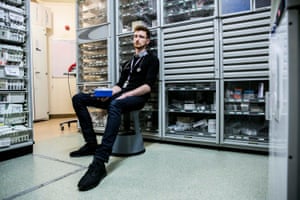


All worth it? A junior doctor takes five.


All worth it? Junior doctor Sam takes five. Photograph: Ryan Mcnamara/Channel 4

There, my heart sinks as three-year-old Oscar weeps in pain. He was victim to curiosity and managed to tip a hot coffee on himself. He breaks the ice by laughing and grabbing my head torch – apparently I’m a cartoon Minion! I give pain relief and fight to dress his wounds, and book him into a specialist clinic for tomorrow morning. We high-five and I send him home. A moment of light relief in an otherwise dreadful night.


I work for the next six hours to clear my waiting room of patients with their relatively minor ailments, sent from the out-of-hours GP. It’s 4am and I’m still getting an onslaught of referrals from all directions. The entire night I am needed in three places at once, firefighting as I go along. I’m not happy, the team isn’t happy and, most crucially, my patients aren’t happy. I’m despondent – we need increased staffing and a fresh change in attitude. It seems as though the current system is optimised for patient flow rather than patient care. As for the elderly chap with the nosebleed, thank God he arrived when my other patients were less urgent, and I got to him when I did.


The paediatric registrar


When asked why you want to do medicine, the stock medical student answer is often: “To help others.” While this is undoubtedly a rewarding bonus, a more realistic question for doctors in the current climate, all of whom have lives and families of their own, is rather: what are you prepared to sacrifice to succeed in medicine?


I’m a paediatric registrar. For me, nothing compares to the unique challenges of managing the care of children and their families. Having an unwell child is a frightening experience for parents and clinicians alike. Treating them, and seeing the majority do very well, is an incredibly rewarding privilege.


As a (now not so) new registrar, “the fear” briefly returned to me as I stepped up to this new level of seniority. My first out-of-hours shift as a new registrar came with an overwhelming sense of awareness that I was responsible for providing the emergency care and leading the junior team.


While I am a doctor to countless little boys and girls, I am also a mum to my own little boy. Settling into my role has therefore been a mixed journey. The shift-based, unpredictable nature of clinical work has made childcare a difficult balancing act – particularly with a surgeon husband whose hours can be as unreliable as mine. I remember seeing my son’s first scan and searching for abnormalities – the downside of knowing what can go wrong. I tucked him into bed before my first registrar night shift, hoping “mummy’s at work tonight” wouldn’t become one of his first phrases. The families I meet on those shifts remind me how precious he is, and he in turn helps me understand the angst that those parents must be experiencing. My son has undoubtedly made me a better doctor, a more insightful version of myself.


Doctor with her young charge.


Twinkle, twinkle little stars … One doctor with a young patient. Photograph: Jude Edginton/Channel 4

Who else gets to calm frightened patients by singing Twinkle, Twinkle Little Star, or gain their trust for a procedure through an encyclopaedic knowledge of Peppa Pig? Despite being around them at home and work 24/7, children are always full of surprises, and that is what keeps me motivated.


The junior doctor on the A&E ward


On-call shifts are usually going to be busy. I knew one night would be hectic when I arrived and there were 26 patients waiting to be seen. The medical team consisted of one other house officer and a registrar, and we were responsible for clerking new admissions, covering two assessment wards and carrying the cardiac arrest bleeps.


That night was particularly tough. It was during winter when the emergency care crisis was at its peak, and the hospital was full. With no beds on the wards, the patients stacked up in A&E and just kept coming. Not only was the volume of patients high, but many were very unwell with complex problems.


When work is that busy you tell yourself: “I can only do what I can do; I need to prioritise and go from there.” With experience, you learn to force yourself to grab something to eat and drink while doing paperwork, as there is no point waiting for a break that never comes. Without sustenance, a 13-hour shift becomes impossible. Sometimes, a kind nurse will make you a cup of tea.


Things get really stressful when several patients simultaneously become acutely unwell and prioritising is almost impossible. I once had five patients all deteriorating – fortunately, they were on the same ward, which helped logistically, but added to the danger that they would “merge into one” and mistakes could be made.


After a day or night like that, I often drive home going through my patient list worrying that I have forgotten something. Yet no matter how tough work has been, I always leave knowing that I have made a difference to patients and their families. That helps me get through the more challenging shifts, when it feels as though there is just not enough time.



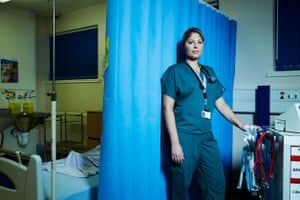
Emily from Confessions of a Junior Doctor.


Thirteen hours later… Emily from Confessions of a Junior Doctor. Photograph: Ryan Mcnamara/Channel 4

The junior doctor on the surgical ward


7.45am: One of the nursing staff tells me the hospital is on “black alert”; there are no beds available anywhere in the hospital. I already know it’s going to be a long day.


The on-call consultant has been up all night in an emergency operation, so ward round is delayed, which has a knock-on effect throughout the day. I get a call at 1pm from the bereavement office to complete a death certificate for a woman who passed away in the night.


My bleep goes. A young patient has become inexplicably confused. I assess and treat him to the best of my ability, but he needs a senior review; I feel helpless. It’s 2pm and I haven’t made it to the bereavement office – they have bleeped again. A nurse tells me a patient can return to her nursing home but transport has been arranged for 3pm. There is a hectic dash to complete all of the paperwork and order the necessary medicines.


It’s now past 3pm and I haven’t yet eaten, but as I collect my lunch, a consultant arrives to review his patients. This generates more jobs, including an urgent investigation for a patient heading to theatre first thing tomorrow morning. It takes more than an hour to request the investigation and find a technician able to perform it, but they are short staffed and cannot guarantee it will happen before the end of play today. My registrar calls; he has organised a scan for the young gentleman with confusion, to rule out stroke, and asks me to chase the results.


It’s gone 4.30pm and I still haven’t eaten. I need to chase test results, so sit in the doctor’s office and plan to eat while I work. However, one of the results shows a patient needs a blood transfusion. He requires a further blood test, so I take the sample and deliver it to the laboratory on the other side of the hospital. I go back to checking results. The report for the confused man identifies a stroke. I contact my registrar and organise an urgent review by the stroke team.


I look at the clock – it has gone 6pm. I should have finished at 5pm. Then I remember the death certificate. Too late. I am tired and hungry, and know I face it all again tomorrow.


Confessions of a Junior Doctor is on Channel 4 at 9pm


Nasal tampons, black alerts and Peppa Pig: junior doctors confess all

21 Ekim 2016 Cuma

Fracking Linked to Migraine Headaches, Severe Fatigue, Chronic Sinus and Nasal Symptoms, Study Finds

Fracking has expanded — outpacing scientific understanding of its potential health risks and impacts.  Nevertheless, there’s a lack of studies relating to health outcomes for people living in close proximity of hydraulic fracturing, or fracking well sites.


John Hopkins researchers recently initiated a study to find out more about the impact of fracking on human health.  As a result, their research adds to the growing evidence of a link between fracking and health problems.


Fracking Industry Linked to Health Problems


Hydraulic fracturing involves injecting millions of liters of water into deep rock formations to free up natural gas or petroleum. Energy companies moved toward fracking in the early 2000s when natural gas prices were high and supplies were low.


In addition, hydraulic fracturing represents an increasing share of energy production worldwide. Currently, shale gas extraction equate to 40 percent of U.S. domestic natural gas production.


According to John Hopkins researchers, unconventional natural gas development — like fracking — produces environmental contaminants and psychosocial stressors.  Even so, a rapid increase in fracking has occurred in Pennsylvania.  More than 8,800 fracking wells have been drilled in Pennsylvania in the past ten years.


In recent years, fracking has expanded rapidly in other states, as well — including Ohio, Wyoming, North Dakota, Colorado, and West Virginia.


A team of researchers from Johns Hopkins Bloomberg School of Public Health initiated a study to look further into the impact of fracking on Pennsylvania residents’ health.  Their findings suggest that Pennsylvania residents with the highest exposure to active natural gas are almost twice as likely to suffer from a combination of health problems.  These health problems include: severe fatigue, migraine headaches, and chronic sinus and nasal symptoms.


The study’s first author, Aaron W. Tustin, a resident physician in the Department of Environmental Health Sciences at the Bloomberg School, comments on their findings.


“These three health conditions can have debilitating impacts on people’s lives.  In addition, they cost the health care system a lot of money. Our data suggest these symptoms are associated with proximity to the fracking industry.”


Study Results


In this study, Tustin and his colleagues created a questionnaire and received responses from 7,785 adult primary care patients of the Geisinger Health System.  Geisinger Health System is a health care provider that covers 40 counties in north and central Pennsylvania.


Between April and October 2014, participants returned the questionnaires to the researchers for analysis. The team of researchers found that 1,765 respondents suffered from migraines; 1,930 people experienced severe fatigue.  In addition, 1,850 had current symptoms of chronic rhinosinusitis — three or more months of nasal and sinus symptoms.


Health Conditions and Exposure to Wells


The researchers used publicly available well data to estimate the study participants’ exposure to the fracking industry. Their models accounted for the size and number of wells, as well as the distance between wells and people’s homes.


No single health condition was associated with proximity to active wells.  However, participants who met criteria for two or more of the health conditions were about twice as likely to live closer to more, or larger wells.


Previous research conducted by the study’s senior author, Brian S. Schwartz, a professor in the Department of Environmental Health Sciences at the Bloomberg School, has linked the fracking industry to increases in indoor radon concentrations, asthma attacks, and premature births.


Schwartz notes the need for more research and protection.


“We don’t know specifically why people in close proximity to these larger wells are more likely to be sick.  We need to find a way to better understand the correlation and, hopefully, do something to protect the health of these people.”


This study titled, “Associations between Unconventional Natural Gas Development and Nasal and Sinus, Migraine Headache, and Fatigue Symptoms in Pennsylvania,” is in the journal Environmental Health Perspectives.


Fracking Linked to Migraine Headaches, Severe Fatigue, Chronic Sinus and Nasal Symptoms, Study Finds

2 Kasım 2015 Pazartesi

How Nasal Balloon Can Assist With Glue Ear

Offering kids antibiotics also often can lead to them to develop a resistance to the antibiotics and can worsen the situations they have.


Middle ear infections are frequently handled with antibiotics, and in some patients these infections recur repeatedly. Past this, many drugs for ear infections have not been approved by the FDA for effectiveness in the circumstances for which they are prescribed.


An alternative may possibly be a nasal balloon, which is inflated to dilate the sinus cavity to relieve the middle ear issues in sufferers and avoids prescribing a lot more antibiotics. A nasal balloon is not constantly achievable, but quite often an selection in children who have regular middle ear issues, or hearing loss due to middle ear difficulties.


What is Glue Ear?


Glue ear, also known as Otitis Media, is a problem in which thick fluid collects in the middle ear ceasing free of charge movement of the ossicles, stopping sound vibrations from being passed to inner ear. Parents generally have no concept their child has a difficulty till the kid is not ready to hear effectively or has excessive discomfort.


Leads to and Widespread Treatments of Glue Ear


According to Dr. Jordan Josephson from New York’s Lenox Hill Hospital, the most regular cause that children get glue ear is since their Eustachian tube (connecting the ear to back of the nose) will get clogged. Reactions to sinus infection, allergies, or pollution traveling through the tube can turn into really thick, clogged the tube resulting in glue ear.


The most typical remedies for glue ear start with the antibiotics, antihistamines, decongestants or intranasal steroids to relieve the infection. These treatment options are only possibly successful in the early onset of glue ear. Once the fluid has created up to a degree exactly where the hearing is impacted, most physicians suggest the insertion of drainage tubes to alleviate the pressure.


The Nasal Balloon Procedure


Dr. Ian Williamson of the University of Southampton carried out automobile-inflation with a nasal balloon on children between ages of 4 and eleven with the thick fluid associated with glue ear. The kids had been instructed to blow into a nozzle via every of their nostrils. At the finish of the nozzle was a balloon that they inflated whilst popping their ears.


Of the 3 hundred and twenty children that participated in the research, some have been shown the nasal balloon treatment and advised to use it 3 times daily for a single to three months. Some of the youngsters have been selected for normal treatment method of glue ear.


The balloon treatment method had larger prices of regular pressure in their middle ear after a one particular month period than the children who obtained common treatment options. Right after 3 months of treatment method, the kids who utilized the balloon method had been twice as very likely to have normal strain in their middle ear. The kids who employed the nasal balloon also reported fewer cases of signs like ache, dizziness, or bad hearing, for the duration of, and right after the nasal balloon treatment.


With this remedy, physicians have a straightforward, minimal cost, organic and non-invasive way of treating sufferers with glue ear. There are also no adverse side-results that come with the use of antibiotics, antihistamines or steroids.


How Nasal Balloon Can Assist With Glue Ear