Winning etiketine sahip kayıtlar gösteriliyor. Tüm kayıtları göster

13 Eylül 2016 Salı

"It"s better than winning the lottery": readers" organ donation stories

‘To be dialysis free is better than winning the lottery’


In 2008 I became very ill with a rare autoimmune disease called microscopic polyangiitis vasculitis which caused severe kidney failure. In 2014 I was due to receive a living kidney donated by my husband, but was failed by my consultant and ended up not expecting to survive fighting for my life in hospital instead for four months. Thankfully on 4 July of this year (the first anniversary of my mother’s passing) my hero husband donated a wonderful kidney to me. There is no doubt he saved my life and to be dialysis free is better then winning the lottery.


Both our operations went fantastically and my only challenge was being 12 litres over with fluid (they pump you with fluid to keep the kidney working and alive) and the excess fluid leaked from my wound so I needed a Vac dressing and my right leg was terribly swollen. It is not an easy journey physically, mentally nor emotionally however one I would recommend to anyone lucky enough to be offered a kidney and a life again.


Jackie Bex, United Kingdom


‘The decision seemed easy: I had two kidneys and only needed one’


My experience in donating a kidney has been amazing and has left me with a great feeling of having actually achieved something life-changing. I had no idea that it was even possible to donate a non-directed living-kidney initially (in other words to someone I did not know), but I chose to become a kidney donor after watching a BBC documentary on the subject. I was also surprised that at the age of 63, I was not too old (donation is actually possible from age 18 and the oldest donor is over 80!). The decision seemed easy to me, as I had two kidneys and only needed one and the risk was totally minimal. Why not save a life?


My friends and family were very divided about the decision. Many people could not understand my motivation and felt the risk was unnecessary. Others completely appreciated my desire to do something practical and life-changing.


After the operation I was fortunate enough to receive a letter from the recipient of my kidney explaining how much it had changed her life. She had been on dialysis for many years, could not find employment, was unable to travel on holiday and relied on her parents. Now she is independent, has a job and can travel freely without the need for painful dialysis.


Chris Jones, a retired 67-year-old living in Scotland


‘We told each other how lucky we were. How wrong we were’


Not long after we were married my husband Keith discovered that he had kidney disease. I offered to be a donor and was successful, even though we were incompatible blood types and he required plasmapheresis to remove his antibodies.


In 2010, on the night we were supposed to be admitted to the transplant ward we sat huddled together. We told each other how lucky we were. How wrong we were. The surgery went well but afterwards in the recovery room, I found out that morphine has no affect on me and awoke feeling as if I had just been chopped in half. Eventually though, we both went home and started to plan the lives that we thought we had ahead of us. We celebrated my birthday and started to plan for Christmas. Keith was so unbelievably happy and grateful and had endless plans for all the things he thought he would now be able to do. But he seemed to continue to struggle.


One day he fainted twice. He was still under the care of the renal unit, going back twice a week for appointments there, so he phoned them for advice. They took hours to phone back and when they did, simply told him not to take his blood pressure medication in the morning. He didn’t live that long. The next morning, I found him dead on the hall carpet.


I regretted the surgery very bitterly as I felt – and still do – that if the transplant had never happened, my beloved husband would still be here. Life on dialysis would have been a very different kind of life – but it would still have been life.


Rebecca Farwell, a writer and tutor in Norwich
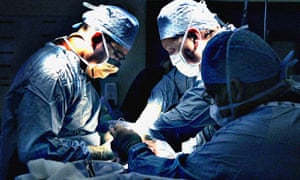


Consultant Surgeon Andrew Ready and his team conducting a live donor kidney transplant at The Queen Elizabeth Hospital, Birmingham in 2006.


Consultant Surgeon Andrew Ready and his team conducting a live donor kidney transplant at The Queen Elizabeth Hospital, Birmingham in 2006. Photograph: Christopher Furlong/Getty Images

‘I became a doctor because of my transplant’


I was 21-years-old and had three weeks left to live. I had idiopathic hepatitis, was scared, helpless and questioning how I had ended up facing death at such a young age. I was so far from the young, seemingly arrogant and invincible boy I was a year previously. When only 10% of my liver was functional I was put on the transplant list as a final resort.


Before I became ill I had just graduated from the University of Sheffield. From the point I left home at 18 to go and live in Sheffield I thought I was fully independent, untouchable, and had everything in my life because of my actions and nobody else’s. I acted as though I would never need any kind of emotional support from anybody, especially my parents. Fighting to survive, they were all I wanted now.


As a GP my father struggled to cope. He was only too aware of the implications of each set of test results and took every deterioration in my health personally. Being a man that had healed and treated people for over 30 years I felt his helplessness knowing he couldn’t make his own son better.


Very few people get to have a second chance at life. My experience has made me realise how important the smallest things in life are; post-transplant, the most groundbreaking day for me was when I managed to get out of bed and walk to the toilet on a zimmerframe with my dad supporting me.


My decision to study medicine was a direct result of my hepatitis; I want to be one of those doctors that had the same life changing effect on me. I see no other profession in the world that compares to medicine and no one I have a greater respect for.


Marcus Mehta, a 29-year-old doctor from Lincoln


The day I received my new lung is my re-birthday


I was told I had idiopathic bronchiolitis obliterans and needed a lung transplant to save my life. 3 November 2014 was the day that I received the ultimate gift of life and my new lung was transplanted. This date is now my re-birthday and my family and I celebrate it every year with a quiet dinner. We also take a moment to raise our glasses to honor my donor and donor family who made that day possible.


Only eight days days after my transplant I was discharged and was allowed to go home. I felt like the luckiest person in the world. So far I have not had any rejection episodes and my new lung is doing great.


Catherine Horine, 61-years-old and living in the US


‘One man was able to have an extra 16 years with his family due to my father’s heart’


In 1988, my parents were struck by a train on their way to a local lake. My mother was killed on impact while my father survived the accident with a severe skull fracture and a collapsed lung. My father had surgery and the doctors removed his right temporal lobe. He never regained consciousness and remained in a coma until his death 10 days later.


About three days before his death, I was approached by the hospital staff about organ donation. Once we understood that my father’s prognosis was not going to improve and that the process of brain death had started to take his life, we agreed to the organ donation. The decision was easy for us. Once brain death was confirmed, they took my father in for the harvesting surgery. They ended up taking his kidneys, one cornea (the other had bacteria on it) and his heart. My father was in great shape and worked as a ski instructor. Despite being a smoker, his heart was in an excellent condition.


Afterwards, we were given the number of the local organ donation organization and told we could get vague updates on the recipients. We were able to find out the age, sex and state of the recipients and whether the surgery was successful. We received vague, non descriptive thank you notes from the families that received the kidneys and heart, but had no update on the cornea transplant.


17 years later, as part of a public speaking class on organ donation I contacted the company to see if my father’s recipients were alive and well. One of the kidney recipients had rejected his new kidney within a few short months but had received another kidney approximately a year later. Sadly, he passed away not long after. The other kidney recipient was still alive and well. She still had my father’s kidney. I was so pleased to hear this. Sadly, the heart recipient had passed 6 months prior to my call. I was told that he was gravely ill when he had the transplant and due to my father’s heart got an extra 16 years with his family.


Lynn, 48-years-old and living in Pennsylvania


"It"s better than winning the lottery": readers" organ donation stories

24 Haziran 2014 Salı

seven factors why Sierra Leone is winning towards neglected tropical illnesses

Children in Sierra Leone

Young children relax in a lobby in Aberdeen street of Freetown, Sierra Leone. The country has made important progress in eliminating NTDs. Photograph: Alamy


The Lancet just lately published a report on gains created towards reaching the 2020 neglected tropical ailment (NTD) elimination ambitions set by the 2012 London declaration. Despite being one particular of the world’s poorest countries, Sierra Leone, in particular, has produced amazing strides.


Ahead of the existing NTD manage programme, about half of the districts noticed in excess of 50% of their youngsters contaminated with schistosomiasis (snail fever) just before they reached 14. By 2010 mass drug administration had reached, and has since maintained, 100% geographic coverage of people at chance of NTDs, outperforming neighbouring countries.


This quick progress has been sudden in the submit-conflict setting. By the finish of the rebel war in 2002, most wellness services were broken, ill-equipped and their personnel and communities traumatised. Many overall health pros had been evacuated during the war and had tiny chance or incentives to return.


Although sustained funding from USAid is 1 explanation behind the country’s success, other nations like Nigeria, with robust funding and better resourced overall health sectors and public communications programs, have not created the very same degree of progress. So why has progress in NTD control in Sierra Leone been so swift? Right here are some crucial lessons behind Sierra Leone’s achievement.


one. Dimension matters


Although infrastructure remains a challenge, especially during the rainy season, Sierra Leone is tiny and most communities can be reached in a sturdy 4-wheel drive inside of a day’s travel from Freetown. This can make implementing, and evaluating a nationwide NTD programme considerably a lot more manageable.


2. Invest in nation-particular investigation


There has been a long-standing academic interest in tropical conditions in Sierra Leone. This can be traced back nearly a century to what is now recognized as the Liverpool School of Tropical Medicine, exactly where research commenced in diseases contracted by sailors returning from the country.


In addition, Glasgow University has contributed to developing human resource and investigation capability since the 1980s with two local universities and a neighborhood NGO. These have all supplied broad foundations of knowing and operational encounter which have been utilized in the advancement of post-war management programmes.


3. Decentralise healthcare to attain marginal populations


The Regional Government Act in 2004 known as for the lively participation of communities in public policy discourse and selection generating to boost the delivery of basic providers. The adoption of neighborhood-based approaches, and the decentralisation of wellness care delivery solutions, has had a important affect. This is notably evident in vulnerable and resource-constrained settings in rural communities where the NTD burden is most prevalent.


four. Offer sufficient training to wellness leaders


Typically in Sierra Leone healthcare was delivered by people without formal training. After the war, health care officers that lead the district teams have been sponsored by WHO for a public well being masters degree at Leeds University, giving rise to a new generation of well being leaders much better positioned to give service with accountability.


five. Never underestimate the energy of neighborhood


The higher NTD burden has been a key motivating issue. Neighborhood neighborhood drug distributors volunteer to go from residence to house to conduct village censuses, offer details and administer NTD drugs. The inspiration of the 29,000 volunteers and that of the one,500 wellness staff that train and supervise them come from the clear improvement they see in the overall health and wellbeing of their communities.


6. Harness the power of technology


In 2010 mobile technology and independent monitors have been introduced to facilitate the tracking of mass drug administrations in genuine time, enabling the NTD programme crew to see progress and issues immediately, as well as to validate results. This has been critical in the post-conflict setting in which speedy internal migrations and urbanisation takes place.


seven. Tailor communication to regional demands


Tailoring messages for viewpoint leaders, overall health staff, volunteers and the public in the context of local culture and conventional beliefs has been important to controlling the illnesses. Frequently asked questions must be extensively pre-examined, routinely revised, and aired on radio programmes that encourage listener participation. Public mobile phone-in and SMS messages aid maintain the dialogue pertinent and the considerations of the public swiftly addressed. Facebook and other net sources have significantly assisted make sure messages get to even the most difficult-to-reach communities in remote spots.


There is nevertheless a lot to be accomplished if we are to reach the 2020 global elimination targets, but learning from countries like Sierra Leone, who have succeeded towards all odds, is a phase in direction of conserving and bettering the lives of millions.


Dr Mary Hodges is the Sierra Leone country director for Helen Keller Worldwide. Comply with @HelenKellerIntl on Twitter.


Read through much more stories like this:


• Football followers warned about dengue fever risk at Fifa Globe Cup in Brazil


• Man v mosquito: who is the most unsafe carrier of malaria?


• How one particular Ghanaian town sprayed away 74% of malaria instances in two years


Join the community of worldwide growth experts and professionals. Turn out to be a GDPN member to get more stories like this direct to your inbox


seven factors why Sierra Leone is winning towards neglected tropical illnesses

4 Mayıs 2014 Pazar

How A lot Are Insurers Winning Beneath Obamacare?

Despite the gloom and doom of Obamacare predictions, capitalism is alive and effectively in the wellness care marketplace. In the first quarter soon after the insurance coverage provisions of the Affordable Care Act have gone “live,” the insurers are now releasing their earnings reports. How is it looking so far? Excellent for the insurers, not so excellent for the insured. I show why it matters.


  • WellPoint WellPoint beat earnings estimates by twenty cents a share and raised earnings estimates for the year. From their press release, “Our membership is developing across our platforms and we are pleased with the progress we have seen in the exchanges.” Their dividend paid to traders will be $ .4375 per share, which on an annualized basis final results in $ 493.6 million paid to shareholders in 2014.

  • Aetna Aetna reported earnings of $ 1.98 per share, which is an enhance of 27% in excess of the first quarter of 2013. From their press release, “Aetna posted higher operating earnings, working revenues and health care membership in the first quarter, each representing historic highs for our business.” They repurchased six.five million shares for $ 465 million in the very first quarter. Their dividend paid to traders will be $ .225 per share, which on an annualized basis outcomes in $ 330.75 million that will be paid to shareholders.

  • Cigna Cigna reported a income increase of 4% in excess of the first quarter of 2013. From their press release, “Results in the very first quarter of 2014 reflect solid revenue development, disciplined expense management and continued powerful medical price management.” 12 months to date, Cigna has repurchased $ 425 million in stock. The dividend payout is $ .04 per share annually, or $ ten.75 million that will be paid to shareholders.

  • UnitedHealthcare’s very first quarter earnings in fact fell 7.8% but they still had a revenue of $ one.ten per share, or $ 1.one billion. Revenue rose 4.5%. The annualized dividend is $ one.12 and outcomes in $ one.116 BILLION that will be paid to shareholders in 2104.


1 big difference in between the U.S. well being care program and other countries is that we are the only country that relies so heavily on for-profit insurers. For instance, in Switzerland, revenue need to be utilised to decrease premiums. The 4 organizations I listed will pay out a complete of $ one.951 BILLION in dividends to shareholders in 2014. This does not count all the billions utilised for share buybacks. Insurers need to have somewhere to put that cash.


If revenue have been utilised for health care rather of payouts to shareholders, what would we get? Contemplate this – a local community well being center can provide primary care for one particular grownup for $ 687 per yr. If we use the $ one.951 billion from just these 4 businesses to fund local community health centers, we could supply principal care to two.84 MILLION folks. And feel about how several men and women we could cover if we throw in the earnings from the rest of the insurance companies and all the funds insurers are utilizing to buy back their shares. I would dare to say we could give simple care to many of the uninsured.


Capitalism is what constructed this country and we should stability the wish for revenue with maintaining our nation powerful. Our wellness care program is the most expensive in the globe by far and we are not any more healthy despite all the income we devote. Good health improves productivity. And to invoke Piketty, the money paid to shareholders in the form of dividends and share buybacks is incorporating to capital and is not getting reinvested in society. The end result – an additional spigot flowing into the bucket of earnings inequality.


Do men and women care about income inequality? If you asked individuals in the street, they probably care much more about a fair revenue which puts meals in their belly, a roof more than their head, and improves their health. And if individuals with the capital are sensible, they would care about that also. Content, healthier normal people develop a more powerful and much more productive nation. Investments back into men and women and their overall health would make the income proceed to flow.


So what do we do to be honest to the insurers and their want for revenue in a nation that defines capitalism? Take standard overall health out of the for-revenue insurer’s realm. Provide a base of care not tied to insurance coverage to everybody in this nation. Make catastrophic insurance non-revenue. And then, let insurance coverage firms to make their income on the “niceties” through supplemental plans – personal rooms, care that is not regarded proof primarily based (do you actually need that back surgery,) once a day ease drugs instead of twice a day generics, “full court press” for futile circumstances, and all the other pointless overall health care expenses that the men and women in this country can not seem to be to do with out.


The Affordable Care Act was a great route to a single thought that will stick in this nation – no a single ought to be turned down for well being coverage based mostly on wellness standing. If the law can stay intact extended ample for this to be ingrained in our culture, it will be nicely well worth the pain. Nevertheless, it was set up to supply continued outlandish rewards to for-revenue insurers at the expense of the well being of our nation. This is what wants to adjust.


Queries, comments? Post right here, reach me @CarolynMcC, or Carolyn.mcclanahan@gmail.com. I’m on the road a lot, and I enjoy your persistence with the timing of my reply.


How A lot Are Insurers Winning Beneath Obamacare?