donation etiketine sahip kayıtlar gösteriliyor. Tüm kayıtları göster

2 Ocak 2017 Pazartesi

Organ donation becomes mandatory in France

France has reversed its policy on organ donations so that all people could become donors on their death unless they join an official register to opt out.


The new law presumes consent for organs to be removed, even if it goes against the wishes of the family.


Until 1 January, when the legislation took effect, unless the person who had died had previously expressed a clear wish for or against donation, doctors were required to consult relatives who, in almost a third of cases, refused.


Those who do not want all or any of their organs to be used must now put their name on a “refusal register” – so far 150,000 people have signed up. The authorities have promised to make it easier for those who wish to refuse by allowing them to join the register online instead of by registered post.


Alternatively, those vehemently opposed to their organs being used can leave a signed document with their next-of-kin or transmit their wish orally to relatives who must make a written declaration of non-consent to doctors at the time of death. The process is explained on the agency’s Facebook page.


In November, the French Agence de la Biomédecine released a film, Déjà-vu2, aimed at encouraging 15- to 25-year-olds to agree to organ donation.


The European Union has highlighted the lack of organs for transplant and the increasing number of patients on waitings lists worldwide. Its figures claim that in 2014, 86,000 people were waiting for organ donations in EU states, Norway and Turkey, and 16 people were dying every day while waiting for a transplant.


In the UK, doctors lament one of the lowest consent rates in Europe, as well as a shortage of donors from black or Asian communities. A record number of organs were donated and transplanted in the UK in 2015-16, but the rate remains short of the target of 80% by 2020. The biggest obstacle remains relatives’ opposition, who have vetoed transplants even from registered donors.


NHSBT, which is responsible for the NHS organ donor register and for matching and allocating donor organs, said it was considering further steps it could take when approaching families to ensure more potential donors’ decisions were not vetoed.


One option would be to no longer ask the next-of-kin to confirm consent or authorisation. Their permission is not required by law if someone has registered a decision to donate on the NHS organ donor register.


Families in Scotland are already required to complete a retraction form to record why they overturned a relative’s decision to donate. NHSBT said a similar form could be introduced across the UK.


Organ donation becomes mandatory in France

13 Eylül 2016 Salı

"It"s better than winning the lottery": readers" organ donation stories

‘To be dialysis free is better than winning the lottery’


In 2008 I became very ill with a rare autoimmune disease called microscopic polyangiitis vasculitis which caused severe kidney failure. In 2014 I was due to receive a living kidney donated by my husband, but was failed by my consultant and ended up not expecting to survive fighting for my life in hospital instead for four months. Thankfully on 4 July of this year (the first anniversary of my mother’s passing) my hero husband donated a wonderful kidney to me. There is no doubt he saved my life and to be dialysis free is better then winning the lottery.


Both our operations went fantastically and my only challenge was being 12 litres over with fluid (they pump you with fluid to keep the kidney working and alive) and the excess fluid leaked from my wound so I needed a Vac dressing and my right leg was terribly swollen. It is not an easy journey physically, mentally nor emotionally however one I would recommend to anyone lucky enough to be offered a kidney and a life again.


Jackie Bex, United Kingdom


‘The decision seemed easy: I had two kidneys and only needed one’


My experience in donating a kidney has been amazing and has left me with a great feeling of having actually achieved something life-changing. I had no idea that it was even possible to donate a non-directed living-kidney initially (in other words to someone I did not know), but I chose to become a kidney donor after watching a BBC documentary on the subject. I was also surprised that at the age of 63, I was not too old (donation is actually possible from age 18 and the oldest donor is over 80!). The decision seemed easy to me, as I had two kidneys and only needed one and the risk was totally minimal. Why not save a life?


My friends and family were very divided about the decision. Many people could not understand my motivation and felt the risk was unnecessary. Others completely appreciated my desire to do something practical and life-changing.


After the operation I was fortunate enough to receive a letter from the recipient of my kidney explaining how much it had changed her life. She had been on dialysis for many years, could not find employment, was unable to travel on holiday and relied on her parents. Now she is independent, has a job and can travel freely without the need for painful dialysis.


Chris Jones, a retired 67-year-old living in Scotland


‘We told each other how lucky we were. How wrong we were’


Not long after we were married my husband Keith discovered that he had kidney disease. I offered to be a donor and was successful, even though we were incompatible blood types and he required plasmapheresis to remove his antibodies.


In 2010, on the night we were supposed to be admitted to the transplant ward we sat huddled together. We told each other how lucky we were. How wrong we were. The surgery went well but afterwards in the recovery room, I found out that morphine has no affect on me and awoke feeling as if I had just been chopped in half. Eventually though, we both went home and started to plan the lives that we thought we had ahead of us. We celebrated my birthday and started to plan for Christmas. Keith was so unbelievably happy and grateful and had endless plans for all the things he thought he would now be able to do. But he seemed to continue to struggle.


One day he fainted twice. He was still under the care of the renal unit, going back twice a week for appointments there, so he phoned them for advice. They took hours to phone back and when they did, simply told him not to take his blood pressure medication in the morning. He didn’t live that long. The next morning, I found him dead on the hall carpet.


I regretted the surgery very bitterly as I felt – and still do – that if the transplant had never happened, my beloved husband would still be here. Life on dialysis would have been a very different kind of life – but it would still have been life.


Rebecca Farwell, a writer and tutor in Norwich


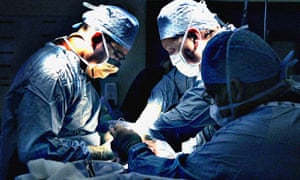
Consultant Surgeon Andrew Ready and his team conducting a live donor kidney transplant at The Queen Elizabeth Hospital, Birmingham in 2006.


Consultant Surgeon Andrew Ready and his team conducting a live donor kidney transplant at The Queen Elizabeth Hospital, Birmingham in 2006. Photograph: Christopher Furlong/Getty Images

‘I became a doctor because of my transplant’


I was 21-years-old and had three weeks left to live. I had idiopathic hepatitis, was scared, helpless and questioning how I had ended up facing death at such a young age. I was so far from the young, seemingly arrogant and invincible boy I was a year previously. When only 10% of my liver was functional I was put on the transplant list as a final resort.


Before I became ill I had just graduated from the University of Sheffield. From the point I left home at 18 to go and live in Sheffield I thought I was fully independent, untouchable, and had everything in my life because of my actions and nobody else’s. I acted as though I would never need any kind of emotional support from anybody, especially my parents. Fighting to survive, they were all I wanted now.


As a GP my father struggled to cope. He was only too aware of the implications of each set of test results and took every deterioration in my health personally. Being a man that had healed and treated people for over 30 years I felt his helplessness knowing he couldn’t make his own son better.


Very few people get to have a second chance at life. My experience has made me realise how important the smallest things in life are; post-transplant, the most groundbreaking day for me was when I managed to get out of bed and walk to the toilet on a zimmerframe with my dad supporting me.


My decision to study medicine was a direct result of my hepatitis; I want to be one of those doctors that had the same life changing effect on me. I see no other profession in the world that compares to medicine and no one I have a greater respect for.


Marcus Mehta, a 29-year-old doctor from Lincoln


The day I received my new lung is my re-birthday


I was told I had idiopathic bronchiolitis obliterans and needed a lung transplant to save my life. 3 November 2014 was the day that I received the ultimate gift of life and my new lung was transplanted. This date is now my re-birthday and my family and I celebrate it every year with a quiet dinner. We also take a moment to raise our glasses to honor my donor and donor family who made that day possible.


Only eight days days after my transplant I was discharged and was allowed to go home. I felt like the luckiest person in the world. So far I have not had any rejection episodes and my new lung is doing great.


Catherine Horine, 61-years-old and living in the US


‘One man was able to have an extra 16 years with his family due to my father’s heart’


In 1988, my parents were struck by a train on their way to a local lake. My mother was killed on impact while my father survived the accident with a severe skull fracture and a collapsed lung. My father had surgery and the doctors removed his right temporal lobe. He never regained consciousness and remained in a coma until his death 10 days later.


About three days before his death, I was approached by the hospital staff about organ donation. Once we understood that my father’s prognosis was not going to improve and that the process of brain death had started to take his life, we agreed to the organ donation. The decision was easy for us. Once brain death was confirmed, they took my father in for the harvesting surgery. They ended up taking his kidneys, one cornea (the other had bacteria on it) and his heart. My father was in great shape and worked as a ski instructor. Despite being a smoker, his heart was in an excellent condition.


Afterwards, we were given the number of the local organ donation organization and told we could get vague updates on the recipients. We were able to find out the age, sex and state of the recipients and whether the surgery was successful. We received vague, non descriptive thank you notes from the families that received the kidneys and heart, but had no update on the cornea transplant.


17 years later, as part of a public speaking class on organ donation I contacted the company to see if my father’s recipients were alive and well. One of the kidney recipients had rejected his new kidney within a few short months but had received another kidney approximately a year later. Sadly, he passed away not long after. The other kidney recipient was still alive and well. She still had my father’s kidney. I was so pleased to hear this. Sadly, the heart recipient had passed 6 months prior to my call. I was told that he was gravely ill when he had the transplant and due to my father’s heart got an extra 16 years with his family.


Lynn, 48-years-old and living in Pennsylvania


"It"s better than winning the lottery": readers" organ donation stories

5 Eylül 2016 Pazartesi

Has your life been changed by organ donation? Share your stories

On average three people die a day in need of a transplant, highlighting a shortage of people willing to donate their organs.


Despite a rise in organ donation in Wales due to their “deemed consent” system, where residents are presumed to have consented to organ donation unless they positively opt out, there is still a shortfall of donors from black or Asian communities.


Last year, 466 patients died in need of an organ and a further 881 were removed from the transplant waiting list, many whom would also have died shortly afterwards.


NHS Blood and Transplant estimates that if 80% of families approached to donate a relative’s organs said yes, more than 1,000 additional transplants would take place across the UK each year.


If your life has been changed by organ donation we’d like to hear from you. Whether you’re a donor, someone who has had a transplant, or a friend or family of either, share your stories with us. What did the experience mean for you? Why do you think organ donation is so important? Perhaps you’re medical staff and work on donation and transplant procedures.


You can share your experiences with us (anonymously if you wish) by filling in the form below. We’ll include some of your responses in our reporting.


Has your life been changed by organ donation? Share your stories

4 Eylül 2016 Pazar

Welsh "deemed consent" organ donation system shows promising results

The number of families agreeing that their loved ones’ organs can be donated for transplantation may be rising more quickly in Wales than other parts of the UK following the introduction of a groundbreaking new consent system, new figures suggest.


Health officials and ministers in Wales are encouraged by how the so-called “deemed consent” system is working and NHS Blood and Transplant (NHSBT) has said the picture in Wales is promising.


Under the new Welsh system, which came into force last December, residents are deemed to have consented to organ donation unless they positively opt out.


In June the Welsh government said the scheme had already saved dozens of lives after revealing that in the first six months, of the 60 organs that were transplanted, 32 came from people whose consent had been “deemed”.


New figures from NHSBT show that in the financial year 2015/16 the family consent/authorisation rate increased in Wales from 49% to 59%. Across the UK the rise was smaller: 58% to 62%.


Although the overall UK rate is higher, the more significant percentage increase in Wales last year may signal a change in attitude.


The number of living donors in Wales also increased by 20% to 49. Across the UK the number of such donors dropped by 2%.


Organ Donation week takes place across the UK from Monday. One priority in Wales is to get its messages across to young people and the Welsh government is mailing every new student arriving in the country this autumn to explain the system.


Under the Welsh system people who want to be an organ donor either register a decision to opt in or do nothing. For those who choose to do nothing, if they are 18 or over, have lived in Wales for more than 12 months and die in Wales, they will be regarded as having consented to organ donation.


Family consent, however, is still important because if a person has not opted in or out, relatives are still involved in the process and if they say their loved one would not have wanted their organs removed, a donation would not go ahead.


Dr Frank Atherton, chief medical officer for Wales, said he was pleased with how the scheme was working. “Things seem to be moving in the right direction,” he said. “It is encouraging. We’ve put a lot of effort into campaigns to help people understand their options. All that is starting to make an impact.”


He made it clear that the scheme was still in its very early days. The 2015/16 figures relating to family consent have to be treated with caution as the Welsh scheme was launched with only four months of the financial year to go and experts warn there could be fluctuations from year to year.


But Atherton said the move towards the system has certainly led to many more families discussing the topic. “Next year there will be a full evaluation of what the impact of deemed consent has been.”


Overall, the figures show there is still a long way to go if the UK target of increasing consent rates to 80% by 2020 is to be met. In Wales and in the UK as a whole, around four out of 10 families who were approached did not agree to organ donation taking place.


Last year in the UK, 466 patients died in need of an organ and a further 881 were removed from the transplant waiting list. Many of them would have died shortly afterwards.


Sally Johnson, director of organ donation at NHSBT, expressed optimism about what was happening in Wales. “We welcome the opportunities that the legislation and communications programme in Wales is providing in getting everyone in Wales to think about and talk about organ donation.


“We have been working closely with the Welsh government on the introduction of deemed consent and are working with them to make it a success. It’s early days, but things look promising.”


Case study


Kimberly Chard, 31, from Cardiff, who was born with cystic fibrosis, underwent a double lung transplant at the end of last year.


She said: “Every day I think of the selfless gift my donor and their family gave me, how they chose to save lives despite their loss. They are my heroes and I feel very blessed to have had the chance to live again. Having a transplant shows just how precious life is and what’s truly important. I will always treasure the future my donor and their family gave me.


“The new system has created an opportunity for everyone to get involved and discuss their choices and what their decision would be if they were ever in the situation to be able to donate their organs.


“By talking to their loved ones, people are making it so much easier for their family as they would know what their decision was and be able to honour their loved ones decision.”


Welsh "deemed consent" organ donation system shows promising results

1 Eylül 2016 Perşembe

Organ donation rates for transplants still too low in UK, says NHS

A record number of organs were donated and transplanted in the UK in 2015-16 but the consent rate is still one of the lowest in Europe, with a worrying shortfall of donors from black or Asian communities.


In the 12 months to the end of March, 1,364 people became organ donors when they died and their donations resulted in 3,519 transplants taking place, figures published on Thursday show.


The consent rate stood at 62%, slightly up on 2012-13 when it was 57%, but well short of the target of 80% by 2020 with the biggest obstacle being family refusal, mostly when they were unaware of their deceased relative’s intentions.


The consent rate was much lower (34%) among potential black, Asian and minority ethnic (BAME) donors, which is of particular concern as 26% of the current waiting list are BAME.


Sally Johnson, NHS Blood and Transplant director of organ donation and transplantation, said: “Think about what we would want others to do for us if we ever need a transplant and be prepared to donate. Talking to your relatives about what you want is crucial as it is much more difficult to agree to donation when you don’t know what the patient would have wanted. There are about 6,500 people waiting for a transplant now and they need people to agree to donate for them to get the organ transplant they so desperately need.


“It is especially important for people from our black and Asian communities to talk about organ donation. I realise that this is a very difficult subject but there are many black and Asian people who need a transplant. While some are able to receive an organ from a white donor, others will die if there is no donor from their own community.”


Last year, 466 patients died in need of an organ and a further 881 were removed from the transplant waiting list, many whom would also have died shortly afterwards.


NHS Blood and Transplant estimates that if 80% of families approached to donate a relative’s organs said yes, more than 1,000 additional transplants would take place across the UK each year.


People from black and Asian communities have a higher incidence of conditions such as diabetes and certain forms of hepatitis, making them more likely to need a transplant, and make up a third of the active kidney transplant waiting list. But in 2015-16 only 67 (5%) of all deceased organ donors were from black and Asian backgrounds.


Lloyd Dalton-Brown, 65, who lives in Exeter, agreed to donate his half-sister Jane’s organs when she died aged 29 after being hit by a truck in 2000. Their father was from Trinidad. “Because of that gift [of organs] five people had transplants, which is utterly fantastic. One of them was a mother of children of three and four; she got one of Jane’s kidneys and because of that ended up with quality of life and was able to bring up her children.


“A lot of people from Caribbean backgrounds are quite susceptible to kidney disease. Her organs were going to be really beneficial to someone in that category. There’s a positive outcome after a very sad ending.”


The Welsh government, which on 1 December became the first part of the UK to introduce a “soft opt-out” system, expressed satisfaction at a 24% rise in the number of its citizens whose lives have been saved or improved by organ transplants, compared with a 4% increase in the UK as a whole. The effect of the change in system was relatively small in the period analysed, during which there were nine cases where consent was deemed.


Charities including Live Life Give Life and the British Heart Foundation urged people to join the organ donor register and communicate their decision to their loved ones.


To join the NHS Organ Donor Register visit www.organdonation.nhs.uk or call 0300 123 2323.


Organ donation rates for transplants still too low in UK, says NHS

10 Ağustos 2016 Çarşamba

Giving Life: organ donation in Australia – in pictures

Giving Life, by Andrew Chapman, charts the life-changing impact of organ donation. The photographer began his project after receiving a donated liver in 2011. ‘I’m only here because of a miracle of modern life,’ he says. ‘Following catastrophic liver failure, I was in a coma with only days to live when I received a donor organ. For this gift of life I am extremely grateful, not only to the donor and his family but also to a wonderful team of doctors, nurses and support staff at Melbourne’s Austin hospital liver transplant unit.’ For more information go to Donate Life, ‘and once you’ve registered, don’t forget to tell your family and friends of your intentions,’ Chapman adds.


Giving Life: organ donation in Australia – in pictures

10 Temmuz 2014 Perşembe

Mom meets guy her son"s heart donation saved six many years earlier

Mrs Carter mentioned: “Scott was studying a tribute and when I sat down and turned the webpage on the purchase of services and noticed his identify there a strange feeling came above me.


“I knew he was the recipient of John’s heart.”


Mr Carter’s loved ones, such as Mrs Carter, her husband John, their son’s widow, Andrea, 37, and his sister, Julie, 43, have been only ever informed the first name of the recipent of their son’s organs soon after they agreed to donate his kidneys, liver and heart.


Mrs Carter additional: “I think it must have been maternal instinct. I was crying and every person started out to stare in excess of at us.


“I have constantly stated given that John passed away that my dying want, the a single issue I wanted to do in existence was to meet the boy who received his heart and to feel our John’s beat again.


“It was a total miracle that he was standing in front of us. His heart could have gone anyplace in the Uk.”


In the course of the ceremony Mr Rutherford sang ‘I dreamed a dream’ prior to he then went on to talk about getting a heart transplant.


The pair met shortly following the ceremony.


Mr Carter, 70, mentioned: “We are over the moon for Scott, John lives on through him. He is not dead really.”


Mr Rutherford, an actor from North Shields, was born with a problem that impacted his arteries which meant they did not function properly. When he acquired the transplant he had been offered just hrs to adore.


He mentioned: “When I was increasing up, I had barely any lifestyle. I was miserable and when my heart problems acquired worse I just wished to die.


“I am unbelievably thankful to John and his family members for everything that they have done for me.


“The difference in my well being is wonderful, I can’t even commence to describe it. My heartbeat is so powerful that it keeps me awake at night – I am a fully diverse person.”


Donor households and recipients are usually recommended to have minimal contact, usually by letter.


Lynn Holt, heart and lung transplant coordinator at the Newcastle Freeman hospital explained: “These conditions are extremely unusual. I can think of a few events when I was involved with the organ donor’s family members meeting their recipient.


“However this is usually done through an arranged go to or by letter which is our business process, and it often has to be instigated by the recipient.


“This situation is a one particular off predicament because it was totally coincidental as Scott was a guest speaker at a services the place John’s loved ones were attending.


“It is an incredible consequence and I know that Scott was so happy that he got to meet the loved ones, even if it was this kind of an uncommon situation. He was above the moon and at some point received round to send them a thank you letter, some thing which he has desired to do for years.”


Mom meets guy her son"s heart donation saved six many years earlier

16 Haziran 2014 Pazartesi

Organ donation: The family members who turned their grief into the gift of daily life

For her component, Ilse says: “Life with out Georgia does not make sense and it’s only just starting up to sink in that we will never see her yet again. But understanding Georgia has saved other people means it wasn’t all for nothing.”


Georgia was a pleased youngster who loved ballet, could count to a hundred and knew the words to her favourite Julia Donaldson books by heart. “She was vivid and humorous an effortless daughter and a supply of huge joy,” says Ilse, 39, who gave up her task as an air site visitors controller right after her son Joshua, two, was born.


She and James, 38, a property barrister, have been on vacation in Sharm el-Sheikh in Egypt with their two children when Georgia collapsed on Christmas Day final 12 months. “We were about to go into the sea when Georgia stated ‘Mama, mama,’ and collapsed,” says Ilse. “I caught her as her head and arms flopped back and she gasped for air.”


Georgia was rushed to the nearby hospital and place on a lifestyle-assistance machine. Tests recommended she was possibly brain-dead, but Ilse and James desperately tried to get their daughter repatriated to a British hospital with a far better standard of health-related care. “We knew in our hearts she was gone, but we still hoped there was a likelihood,” says Ilse.


Later that day, they received hold of Dr Akash Deep, head of the children’s intensive care unit at King’s School Hospital, London, which specialises in brain injuries. “There was no point in raising hopes but I wanted to do every little thing I could to aid,” says Dr Deep.


On Boxing Day at 6pm, Georgia and her family were airlifted to King’s School Hospital, with the minor woman nonetheless on lifestyle support. Georgia was pronounced brain-dead on arrival at 1am the following morning. CT scans showed a bleed in her brain. It was later on confirmed as a ruptured aneurysm – a blood-filled bulge in a blood vessel. “They are very rare, specifically in children, and most only trigger signs and symptoms if they burst,” says Dr Deep.


The household had been provided 5 hours to say goodbye prior to their daughter was taken off existence assistance. “We begged for far more time and have been grateful to be granted it,” says Ilse. “Georgia was warm and her skin pink. We lay subsequent to her, assisted wash her hair and talked to her. It had been so sudden it did not sink in.”


It was for the duration of these darkest of hours that the topic of organ donation was raised by Ilse. “As James and I held Georgia’s hands, I said that it was anything I felt strongly about,” says Ilse.


James was initially much less specified. “We had in no way talked about organ donation prior to,” he explains. “Georgia was nonetheless my princess and I didn’t want someone carving her up. But I centered on how I would really feel if Joshua essential a transplant, and how grateful I would be to a donor. Right after that, it wasn’t a hard determination.”


Yet Ilse says they required the additional time Dr Deep had allowed Georgia to invest on her existence-assistance machine to come to this selection. “There are some dad and mom who have to decide on the spot, which is why it is excellent for folks to be educated about this concern, so they really do not have to talk about it for the initial time when one thing horrible transpires.”


Dr Deep says that at King’s there is a loved ones liaison nurse, a advisor and a specialist nurse on call to discuss organ donation with mothers and fathers. He was struck by the Fieldsends’ altruism: “They utilised their private grief as an possibility to turn their tragedy into a present of daily life,” he explains. “They were hugging each and every other and crying, but when we talked about donation their eyes would sparkle yet again. The spark was indescribable. As medical doctors we are supposed to be skilled, but we’re human beings as well, and it provides me a chill down my spine to consider about it.”


Ilse and James signed papers agreeing to donate Georgia’s liver, kidney, corneas (eyes) and heart valves Georgia had suffered a cardiac arrest whilst currently being examined on the life-support machine, so she was unable to donate her heart. “James said no to her eyes at initial. They were the lovely, sparkly, blue eyes that we looked into every single day,” says Ilse. “We have been both crying, but I stated: ‘I know it is horrible, I do not want to do this either, but imagine Joshua was blind. Wouldn’t we want a person to aid? As terrible it was, we had to tick ‘yes’.”


Then the process to discover suitable recipients for Georgia’s organs began. “It is doubly hard in paediatric practice due to the fact the size completely matters,” says Dr Murphy.


A liver can survive between 6 and eight hrs outside of the body before transplant a kidney up to 24 hrs. Inside of days, a lady in her early teenagers was found for her kidneys and a baby boy for her liver it meant medical doctors have been ready to flip off Georgia’s lifestyle-help machine. They gave Ilse and James permission to aid by getting rid of the tape on her mouth. “Akash informed us that Georgia’s heart would stop beating 15 minutes following the machines had been turned off, and the tubes taken out of her. Following that, we would have five minutes to say goodbye ahead of she was taken into theatre.”


Ilse and James each cuddled their daughter. “We stated: ‘Go, Georgia, you go do your bit’,” remembers Ilse, through tears. “She was so caring, it is what she would have wished.”


Georgia was pronounced dead one evening a number of days following Christmas. Following the operation to eliminate her organs, she was taken to the hospital morgue. “She had been modified into her favourite pink dress with purple flowers. I considered seeing her would be upsetting, but she only had a line from her chest to her belly button from the operation. I hadn’t grasped how lovely she was going to look,” says Ilse.


That morning, Georgia’s brain – which the household have donated for healthcare review – was eliminated for autopsy, along with Georgia’s eyes. Afterwards Ilse and James took Georgia to their property in Bramley, Surrey, exactly where she remained in her bed right up until she was cremated on January eleven. “Her eyelids have been closed and artificial eyeballs meant you couldn’t tell her eyes had been removed,” says Ilse. “I slept with her every evening. I advised her how considerably I loved her and how great she was. We informed Joshua that Georgia was poorly and essential to rest. He talked to her, also.”


She is mindful to some this may possibly sound morbid, but adds: “We mentioned a number of times no matter whether it was the appropriate point to do. If we hadn’t been able to bring her house, it would have been so considerably more difficult.”


By the time of Georgia’s cremation and funeral, Ilse had learnt that the liver and kidney donations had been profitable. “It gave me power, even though I was still in a state of shock,” says Ilse.


Afterwards, Joshua asked exactly where his sister was. “I informed him Georgia was dead and asked him to repeat it to me so he understood,” says Ilse. “I mentioned Georgia would stay in his heart.”


In April, Ilse and James were informed that Georgia’s heart valves – which can be stored for up to ten many years – had been utilised to save the lives of two distinct children a young girl and a new-born infant. Last week, Ilse found out that Georgia’s corneas – which can been stored for up to 28 days – had assisted give sight to two guys in their twenties. “Georgia has saved four lives and given two other individuals sight, which is extraordinary,” she says.


Ilse is even now in anguish at the reduction of her kid: she sleeps in Georgia’s bed, keeps her dresses hanging from her cupboard doors and carries her daughter’s ashes with her. “I don’t truly feel I’ll ever be ready to spread them,” says Ilse. But she is comforted in the knowledge that Georgia lives on in other people: “There will come a day when I can look back and smile and believe about Georgia and the lives she saved.”


Dr Murphy urges all parents to discuss what would come about in the occasion of a child dying and to take into account signing the complete family up to the nationwide organ donor register. “The loss of a kid is unimaginable for most of us, but with children often dying in require of an organ, we need far more parents to say yes to organ donation, just as Ilse and James did. They are actually an inspiration to us all.”


To discover out far more, go to organdonation.nhs.united kingdom or phone 0300 123 23 23


To protect the identity of recipients, we have been asked not to publish the exact date of Georgia’s death


Organ donation: The family members who turned their grief into the gift of daily life

10 Mart 2014 Pazartesi

Doctor"s Diary: The marvels of kidney donation


This year, it so happens, marks the 60th anniversary of the first successful kidney transplant, when American surgeon Joseph Murray eliminated a kidney from Ronald Herrick and transplanted it into his identical twin brother Richard, then in the terminal stages of renal failure from the progressive inflammatory problem glomerulonephritis. His new kidney functioned immediately and inside of a couple of weeks he was effectively ample to be discharged from hospital, promptly marrying the nurse who had looked following him in the recovery room soon after his operation.


Just lately retired doctor Dr Chris Burns-Cox, an altruistic donor when he was 72, has set up a charity, Give a Kidney, to motivate other individuals. This has grow to be a sensible prospect for many largely due to another health-related marvel – keyhole surgical treatment – that permits the surgeon to get rid of the kidney by means of a small incision in the flank. “Donation is no big deal for the donor, but a significant one for the recipient,” Dr Burns-Cox observes, anticipating a time when “the days of suffering and even dying on a waiting list for a kidney transplant will be over”.


Mystery smell


The frustrating knowledge of the gentleman, as featured final week, who finds that cooking the family supper brings about him temporarily to get rid of his sense of smell has prompted an fascinating suggestion from a former surgeon at St Bartholomew’s Hospital, Mr J Buchanan. He proposes really plausibly this might be relevant to the heat of the kitchen stove or cooker aggravating some lower-grade catarrhal irritation of the nose and sinuses – therefore diminishing the perception of smell as mediated through the olfactory nerve.


This is really distinct from the scenario with the gentleman who can nevertheless appreciate the bouquet of his fine wines (consequently the olfactory nerve have to be intact) but finds they taste “disgusting”. This would imply some disturbance of the nerves accountable for relaying sensation from one or other of the 4 types of taste buds (sweet, sour, salt or bitter) at the back of the tongue.


Canine fury


This week’s health care query comes courtesy of Mrs CM of Kent, writing on behalf of her husband, 78. He is “a sort person often fond of cats and dogs”, but lately, when strolling to the neighborhood village, the dogs he has encountered have had to be held back, snapping and growling, by their owners and he has twice been “nipped”. She wonders whether or not the canines may probably be sensing some chemical of 1 or other of the a number of prescription drugs he will take and would be more than interested to hear of any similar knowledge.


Summer digestion


Lastly, my thanks to a reader for passing on her most fascinating treatment for heartburn and acid reflux, prompted by her observation that she is much much less troubled by her symptoms in the summer season compared to the winter months.


She speculated that this might be relevant to the truth that during the summer she goes swimming most days and that plying up and down the pool performing the breaststroke might strengthen her diaphragm, providing it a tighter grip on the oesophagus and thus avoiding the upward reflux of acid from the abdomen. Accordingly, since Christmas she has taken to incorporating into her hold-match regime the practice of simulating the very same muscular movements as people involved in doing the breaststroke. “I have not been troubled by heartburn given that,” she writes.


Email medical concerns confidentially to Dr James LeFanu at drjames@telegraph.co.united kingdom. Answers will be published each and every Friday, at telegraph.co.uk/well being


Doctor"s Diary: The marvels of kidney donation

5 Mart 2014 Çarşamba

Farage lobbies for "remarkable" e-cigarettes in video following donation from maker


Ukip accepted a donation of £25,000 Pillbox 38, the Blackburn firm behind electronic cigarette brand Absolutely Wicked final May possibly. The get together then accepted a additional donation of £11,000 from Jason Cropper the founder of the group in July, the electoral commission register exhibits.


In the 90 second video Mr Farage attempted out a greater e-cigarette comparable to the type that Totally Wicked makes and then on an e-cigar.


Mr Farage says that smaller sized, non-refillable cigarettes that are not going to be banned by the commission are largely produced by the “big pharmaceutical lobby and by large tobacco.”


The Ukip leader described the greater cigarettes of the kind make by Absolutely Wicked which had been recommended for a ban, “remarkable” and produced by “a total host of entrepreneurs.”


Mr Farage continued: “I have to say, as a smoker, frankly I haven’t yet offered up but I could do very very easily and there are 1.eight million men and women in this nation utilizing these factors, it is cutting down tobacco use massively.


“Yet these are due to be banned… I want to see the British government stand up and say, we, underneath no situations, will we accept this.”


Following debate the European Commission made a decision to impose bigger health warnings on cigarette packets and cap the amount of nicotine allowed in e-cigarettes rather than impose a ban.


A Ukip spokesman stated: “The only response we’re offering is that Nigel Farage is properly identified for his libertarian views on such matters.” He added: “Nigel has always been campaigning on this type of issue.”


Mr Cropper’s brother Fraser, who took more than as chief executive of Pillbox 38 mentioned MEPs from other parties had been far more “tenacious” than Mr Farage in standing up for the organization in Brussels.


Farage lobbies for "remarkable" e-cigarettes in video following donation from maker

9 Şubat 2014 Pazar

Organ donation: A kidney donor dies – and brings new life to two people

As Mrs X begins to die in a lilac-painted hospital side room, surrounded by her husband and children who are perched on a semi-circle of purple plastic chairs, a team of surgeons and nurses is making preparations for her afterlife. In an operating theatre a few metres down the corridor, a six-person team of organ retrieval specialists has arrived to remove her kidneys, her liver and possibly her corneas.


Elsewhere, another possible recipient receives a midnight call, and is summoned to a third hospital to await the second kidney.


For the operations to be successful, the removal of the organs and the transplant must happen very swiftly. Complex arrangements begin around lunchtime when Mrs X’s family are made to understand that there is no hope of her recovering from the catastrophic heart attack that brought her to hospital two weeks earlier, and agree that it is time to let her die.


She has signed the organ donor register, and the family have supported her request, so a specialist nurse for organ donation (shortened with the ugly acronym Snod), has been paged in to help them, and to launch the laborious job of searching for the best recipients. If a recipient is found on the other side of the country, then air transport will have to be arranged, because once the kidney is out of the body there is only a 12-hour transplantation window, otherwise its functions begin to deteriorate.


The Snod is here before the donor has died, before the recipients even know their lives are about to be transformed by the long-awaited arrival of an organ. He will be here for a day’s work that won’t end until early the following morning, supporting the family through the process, performing the last offices on the donor, washing and dressing the body and placing her in a shroud once the organs have been removed.


The family has had two weeks coming to understand that their mother will not survive, so they are better prepared for the process than many. Doctors have scanned her head, established that there is an unsurvivable brain injury, and concluded that it would be in her best interests to withdraw treatment. In her late 50s, the dying patient is not too old to donate her organs. “Kidneys have no sell-by date,” a doctor says.


The nurse has spent much of the afternoon talking to them, explaining what will happen. Families find it easier to talk to nurses than doctors. “Sometimes you have to explain information again and again and again, because they are at a stage of such great grief that we have to ensure they have understood. Doctors are not very good at having this conversation. They use medical terms people don’t understand. It is a lot of information to take in. The consultant on the intensive care ward will be looking after 22 people. Nurses have more time. Families feel they can ask the silly question,” he says.


Some families are uncertain about what their relative would have wanted, and staff wish this was a subject people were more ready to discuss. “We are asking people to do something for others at a time that is so devastating for them. It is an awful time to be asking someone this information. A lot of families say no because they don’t know what their relatives would have wanted,” he says. NHS Blood and Transplant (NHSBT) figures show that despite the fact that most people either want to donate their organs, or would consider it, only half have talked to their families about it. Figures also show that seven out of 10 families opt not to give permission for their relative’s organs to be donated, if they don’t know their wishes.


Fortunately Mrs X’s family knows want she would have wanted and are anxious for as much of her body to be transplanted in new people as possible. “They are a lovely family. Really kind,” the nurse says.


operation to retrieve kidneys from a donor ‘It is the most rewarding type of operation you can do. You know at once if it has worked.’ Photograph: Sean Smith for the Guardian


Following the journey of a transplant is a uniquely challenging journalistic exercise, not least because the timing of an operation is impossible to predict in advance and depends on human tragedy. There are very strict rules governing confidentiality, to prevent the family of the donor and the recipient finding out too much about each other. Contact between the two is rare, and only happens at the end of a very supervised process. To adhere to these rules, all names, locations and dates have been removed from this account, making this an uncomfortably detail-free article.


But there is a parallel desire from NHSBT to focus attention on the need to sign up new organ donors and to highlight the extraordinary life-prolonging effect of a successful transplant. Although there has been a 30.5% increase in transplants in the past five years, there are still more than 7,000 on the transplant list, and last year more than 1,300 people either died while on the waiting list or became too sick to receive a transplant. The process of signing up to donate is simple and takes only a couple of minutes online.


Earlier this year, the law was changed in Wales to introduce a system of presumed consent for organ donation, which will give doctors the right, in principle, to remove people’s organs when they die unless they have registered an objection. Supporters of the new policy, which will be introduced in December 2015, believe that it will save lives; opponents worry that it could intensify the anguish of some grieving families. France, Spain, Sweden, Italy, Belgium and numerous other countries have already adopted the system. In England, the debate continues.


By early evening, the final medical checks are done on the dying woman, and the nurse sends out a list of possible body parts that might be suitable for transplant to an organ donation coordinating hub in Bristol. He receives back a list of hospitals, caring for possible recipients, and begins to call consultants to tell them what is on offer, and to see if they want to accept it on behalf of a patient.


Until this is all in place, the family must wait, before the breathing tubes are removed and their relative is allowed to begin the process of dying. They are encouraged to go home for a while, before returning to sit in the depressing waiting room, drinking cherry cola and Ribena, watching a muted television in the corner. A homemade sign, decorated with a sketch of a fluctuating heartbeat line, promises: “Throughout Your Loved One’s Journey, There May be Ups and Downs, However We Will Endeavour, To Make It as Smooth as Possible.”


a kidney ‘We do it like a plumbing job. It looks nice on paper, but it is a major ­operation …’ a kidney just after its removal from a living donor. Photograph: Sean Smith for the Guardian


Staff know that this wait can be agonising and try to prepare them for it. “Sometimes they withdraw consent if the process takes too long. We do tell them the process takes a long time,” the nurse says. By 10.30pm, recipients have been found for the two kidneys, but no home has been found for the liver.


He begins instructing the retrieval team on this basis, but is interrupted by his mobile phone. “Really? That’s fantastic. Anne, you have made my day. That is amazing,” he says, smiling into the phone. “The breathing is fading a bit. We’ll do the extubation between 11.30 and 12 …” The surgeon in Birmingham who was previously offered the liver has changed his mind, and decided to accept it. “That’s good news for two reasons. It could save someone’s life; also it helps the family who are very keen for the donation to happen,” he says.


At around midnight, the breathing tube is removed from Mrs X’s mouth, and the family is called back to be with her for the final process. “I don’t do anything to accelerate her death. We ensure that she is comfortable, but we don’t do anything else.” She lies on the bed, with a pile of soft toys on her feet, breathing independently. There is silence apart from the whir of the air conditioning, and the high chirruping from medical equipment in the room, echoed by cheeps in the ward across the corridor, like electronic birds answering each other’s call, wearyingly unceasing.


Her eyes are shut. The nurse notes that the oxygen levels are dropping quite quickly. At some point in this hospital’s long history, someone decided it would be soothing to paint the wards with a lavender paint. Now the pale pink is criss-crossed with old plug sockets, bits of dried-up Sellotape, and endless bossy public health instructions, hand-shaped stickers that instruct visitors to “Stop and Wash! Do your bit!” and to “Switch It Off! Making Business Sense of Climate Change”. She dies surrounded by scuffed grey lino, bright yellow binliners, a box screwed to the wall dispensing white plastic gloves, breakfast trolleys pushed into the corner, and the orange glow of street lights outside, rain dripping down the windows.


Family members come out to the corridor, for a break from the pressure. Something is ending here, but not quite ending. Naturally, there is none of the joy of a maternity ward, but there is a sense of expectation, of new life beginning.


In the cool ante-room outside the theatre, the young surgical team are briefed on her medical details and told which organs should be retrieved. The last stage of life turns out to be very quick, and is over within 30 minutes. Doctors start removing Mrs X’s organs at around 1am. It turns out that the liver is not good enough to transplant, but the kidneys look in very good condition.


A beautiful procedure


Later that night, in another hospital, somewhere else, Mr Y is mentally preparing himself for a major operation, which has inevitably come without warning. He is lying in a room that he has to himself, still dressed, a thin hospital blanket pulled over his clothes, when I’m taken in to meet him at around 4am. He is awake, but was initially (understandably) not desperate to talk to me. The prospect of having a major operation you were not expecting to have just a few hours ago is dispiriting enough without being asked to describe how you’re feeling to a journalist in the early hours of the morning.


After a reassuring conversation with the surgeon, he is very obliging, however, and explains how he went to the doctor a few years ago with swollen legs and a puffy face, and discovered he had high blood pressure and that his kidneys were no longer working. He hadn’t realised anything was seriously wrong. “It is the silent killer,” he says. He has been on dialysis for two years.


He had worked as a warehouse employee but lost his job recently. In any case, dialysis had made work exhausting. “I’m always tired. I feel very weak and sleepy as well. Dialysis is very, very time-consuming. You’re stuck to a machine all the time. I don’t feel happy, but you get used to it, because if you don’t, you can’t survive.”


He has been looking for new work, but a lot of jobs he can’t apply for because the three weekly visits he needs to make for dialysis eat into his working hours. His illness also makes interviews complicated. “If you disclose your sickness, they will not call you back, because they think your performance will be low. But if you don’t disclose your illness and they find out, they can terminate your contract. You are stuck between two positions.


“My mind was not on transplants at all. The doctor told me that it would be difficult and I would have to wait a long time,” he says.


He regrets not having taken his health more seriously. “The car goes to an MoT; every six months, you should get into the habit of doing the same, visiting your GP. I didn’t go to the doctor. I should have gone to the doctor.”


He isn’t curious about the donor family or the circumstances that have made the organ available. “I don’t want to know anything. I just don’t want to know.”


This is not unusual, a consultant at the hospital explains. “They tend not to ask. I suspect it is because they want to dehumanise it a little bit – take the organ now and deal with the human side later. It is emotionally challenging as it is, to be called in for a transplant, without thinking about the donor family’s grief. There’s a lot to cope with already.”


kidney courier The donated organs are taken for transplant … some 7,000 people in the UK are on the waiting list for a kidney transplant. Photograph: Sean Smith for the Guardian


The surgeon reports later that the procedure, which began at 8.30 the following morning and was over by 11.30, went “beautifully”. He was thrilled at the state of the kidney. “It was really a wonderful organ,” he says with unexpected delight.


His description highlights both the amazing simplicity of the process – pulling an organ out of one body and popping it in to someone else a few hours later – and the extraordinary sophistication required to make it work.


The host of the kidney has changed gender. It has left the body of the woman, where it has grown for the past five decades and been sewn into the body of a sick man. The surgeon could tell that the kidney was not in its first flush of youth – it had lost its pearly sheen, and there were traces of scarring – but it was functioning well. “The donor was a good donor. This was an excellent kidney, beautifully retrieved,” he says.


When the transplant box arrived, he had to check that it was the correct organ, coming from the hospital he expected, checking that it was the right kidney, as promised, and not the left one. The kidney was not ready for transplanting, so he worked with colleagues to trim it, remove all the fat, expose the anatomy, check the vein, the artery, the urethra, and repair anything that was damaged.


Transplanting an organ is less traumatic than removing one (several doctors use the word “harvesting”, although one corrects himself, apologetically: “Harvesting – I try not to use that word, it sounds like a 1970s cloning film”); the old kidneys are left in the body. The critical moment comes towards the end, when doctors release the clamps, the instruments that hold the blood flow, and allow the blood to rush into the new organ. “You don’t stop to think ‘this is fantastic’ and have a moment of happiness. It is a moment of attentiveness. You are too busy, you need to make sure you do a good job,” he says. “When you see the production of urine in recovery, that’s when we can start to relax, then things look good.”


Sometimes it can take days before the new organ starts functioning, but in Mr Y’s case, it was almost instantaneous. “When it works, I feel good. It is the most rewarding type of operation you can do. It is completely different from the feeling you have after a cancer operation, when the best you can hope for is that everything bad has been removed. This is something positive. You know immediately if it has worked. It is extremely satisfying.


“The speciality that I have the privilege to work in is the most exciting of any others – we are so exposed to the ethical, legal and emotional aspects. We are just immensely grateful to the families because it is extremely difficult to agree to donation when it is so sudden and so unexpected.”


That night Mrs X’s second kidney is also successfully transplanted into another sick individual. Her death has saved two lives.


Pretty incredible people


Things do not always go so smoothly. In a third hospital, Mrs Z, 53, who has been on dialysis for six years, has been called in at midnight to receive a new kidney. She has had a suitcase packed, ready by her front door for years, as she waits for the correct organ to come up. This is the fourth time she has been summoned; on the three previous occasions tests showed that her body was likely to reject the organ. She is calmly thrilled at the prospect of a transplant, which will free her from dialysis, and will enable her to make a long-postponed visit to her 90-year-old father in India.


She is at the end stage of kidney failure, and finds the thrice-weekly requirement to be in hospital for dialysis profoundly wearing. “Some days you feel depressed. You get emotional, very upset.” A surgeon comes in and draws a picture in ballpoint pen of how the operation will be done. “We do it like a plumbing job,” he says, explaining that it will take up to four hours. “It looks nice on paper, but it is a major operation. It takes one month to feel OK. Are you OK with that?”


She smiles and says she is. Staff have taken a blood sample to see whether there is anything to prevent the operation from going ahead. “It was very heartbreaking last time.”


Later that night, it turns out that the final tests have again shown a strong likelihood that she will reject the organ, and she is again sent home, with no option but to continue on dialysis.


Giving a tour of the dialysis unit at a busy London hospital, the clinical director of renal nephrology explains how exhausting the process is. There are 70 dialysis machines constantly in use here, over three shifts, seven days a week, cleaning the blood, sucking out its toxins, and returning it to the body. The process offers only the equivalent of 10% of normal kidney function.


“They will make light of it but these are pretty incredible people. It is hard work being on dialysis. It takes incredible patience. We circulate blood for four hours, which leaves them tied for four hours to the machine. During that time, we ask their heart and blood vessels to do things that are not unlike a 10-mile run for me. Then they have to go home on the tube, pick the kids up from school or go back to work. These are superhumans for what they endure,” he says. “The joy we get when people are transplanted is immense. It is a wonderful thing to see people get better, to see their quality of life go back up.”


He is undecided about whether England should follow Wales towards a policy of presumed consent. “Families often balk at the idea of somebody putting a knife to someone they barely think of as dead. I don’t think anyone would ever take an organ without consent. We want the public to tell us what to do; we want to know that the public is comfortable with what we are doing,” he says.


The assistant director of Organ Donation and Transplantation NHSBT, Anthony Clarkson, mostly wants people to discuss the issue with their families. “We know there is a reluctance to talk about organ donations among families – research shows that half of the population has never had this conversation. There are taboos around death. There is a reluctance to talk about this,” he says.


“For the revolution on consent for organ donation in the UK, we need it to become a normal part of end of life care, and we need it to become a normal part of society, where people expect to be asked about organ donation, and the expected response is that they will be a donor. People don’t talk about it enough.”


Ten days later, Mr Y is still recovering, but has come home after a week in hospital. He is still finding it painful to walk, and is a bit overwhelmed by the quantity of drugs he is required to take, but he hopes he will be well enough to start looking for work again in a couple of months.


He has had a very positive experience in hospital. “It started working straight away. It was amazing. The doctors answered my questions with dignity and respect. They are there to help you to live. The only question the doctor cannot answer properly is how many years the kidney can continue working.”


He still has no desire to find out anything about the donor whose organ has freed him from a life on dialysis. “I have the right to ask, but I decided not to. I’m a Christian. I feel it is a gift from God.”


Does it feel strange to be living with part of someone else inside? “That is the reason I don’t want to know anything about the source. It will play on my mind. I feel if I ask too many questions, I will get too much information. Somebody else’s body is in my stomach. Some people wouldn’t care, but I mind. I am not so keen to know. It makes me feel sad.”


• Join the NHS organ donor register at organdonation.nhs.uk or call 0300 123 23 23


Organ donation: A kidney donor dies – and brings new life to two people

2 Şubat 2014 Pazar

Stem cell donation: make a friend, save a existence

Mick Davidson

Pen pals … Mick Davidson has corresponded with the recipient of his stem cells for twenty many years. Photograph: Christopher Thomond for the Guardian


Someplace in London is my best match. He is effectively-developed, a 12 months older than me, well-known with my friends and family members – a real hero. We have in no way met.


He is my stem cell donor, a 10/10 fit for my blood tissue sort, according to our human leukocyte antigen (HLA) – the unique “barcode” we each and every have on our immune system’s cells – which makes it possible for the physique to distinguish itself from foreign bodies so it can fight invading organisms.


When I was diagnosed with large-danger leukaemia last February, I was informed that I would want a stem cell transplant. My bone marrow could not be trusted to create cells on its personal – the total system required to be wiped out, deleted with high-dose chemotherapy and radiation, and essentially replaced with a new hard drive. With no a transplant of a person else’s cells, my medical doctor explained, there was a 60% possibility that the leukaemia would return, and possibly kill me.


Following my sister was tested and found incompatible (siblings are a match in only about thirty% of cases), the hospital commenced browsing the Anthony Nolan charity’s bone marrow register for a donor. I was lucky – a month later, I was advised that a match had been discovered: a 24-12 months-old “chunky lad”.


Apart from his age and robust physique, I do not know anything at all about him. In two years’ time, as lengthy as I am nonetheless in remission, I’ll be permitted to meet him – if he agrees. Till then, donors and recipients can only exchange quick, anonymous messages. But in the meantime, I can’t aid feeling curious about this total stranger whose blood is now flowing through my veins, whose DNA and blood group I now share (along with his Y chromosomes).


Hannah Watterson, 31, originally from County Armagh in Northern Ireland, has been questioning about her donor for many years – and she is about to meet him for the initial time. “I’m nervous,” she says. “I feel like I must know him, since he’s a part of me.” Diagnosed with Hodgkin’s lymphoma in 2003, Watterson underwent several years of chemotherapy. But right after a relapse in 2007, medical doctors warned her that a stem cell transplant was her only opportunity of survival. “I’d presently had as significantly chemo as they could give me. If I didn’t have the transplant, I would die.”


Her brother was not a match, but luckily a person else was – Gil Lewis, now 43, a warehouse supervisor in Coventry. Lewis had been on the register for 20 many years, right after signing up when a buddy was diagnosed with blood cancer. When he acquired a contact one particular day from Anthony Nolan, inviting him to a clinic in Harley Street, London, he did not hesitate. The process of drilling into his bone to harvest the stem cells from his marrow was, he says, “entirely painless” – the only side impact was some small backache. He even ran the London Marathon six months later, in support of Anthony Nolan.


Stem cells are frequently in the headlines, hailed as a miracle remedy of the potential. For numerous, they exist in a faraway land of test tubes and laboratories – but they are already employed in hospitals, and are very easily obtained from donors by means of a basic method, similar to providing blood.


It is one thing Mick Davidson, 58, from Northumberland, is aware of all about. As a taxi driver, he tends to make frequent hospital trips, carrying precious cargo: some of his passengers are volunteer couriers for Anthony Nolan, delivering bags of stem cells. Making certain they arrive on time is crucial, as they should be administered inside of 72 hrs of donation. But then, Mick has acknowledged about the lifestyle-conserving effect of stem cells for a long time, obtaining donated his very own 20 years ago to somebody on the other side of the globe.


“At the time, all we knew was that he was a youthful man from North America,” says Davidson, who signed up to the register soon after his aunt died of leukaemia. The recipient of his cells was Rob Kaufman, then a 23-12 months-old from Ohio who had from aplastic anaemia. 1 day Davidson received a letter thanking him for his act of generosity, to which he replied, starting an anonymous correspondence. “It snowballed from there, actually.” He 1st met Kaufman a couple of years later on, and the pair have been close pals ever because, sharing family holidays and celebrating milestones with each other – Davidson attended Kaufman’s wedding in 1999, and final summer their families met in Florida to celebrate the 20th anniversary of the transplant.


For approximately 1,800 men and women in the United kingdom each yr struggling from aggressive blood cancers and other haematological illnesses, a stem cell transplant is their only hope of a cure. But regardless of increases in donors on bone marrow registers, the NHS Stem Cell Strategic Forum reports that much more than 400 individuals a year are denied remedy merely since there is no match.


Anthony Nolan, which is this year celebrating forty years given that its basis, is calling for more people to sign up in the hope that a single day they can give matches for all. There is a specifically urgent need for far more donors from ethnic minorities, who are seriously beneath-represented on the register, that means that patients from these backgrounds only have a 40% possibility of finding a match.


Davidson says that donating his stem cells was the most rewarding choice he has ever manufactured, and he would encourage other individuals to signal up to be likely donors. “It could save someone’s life. And it could even change your daily life as properly. It truly is undoubtedly altered ours.”


• Uncover out more at anthonynolan.org/bethecure.


Stem cell donation: make a friend, save a existence