bones etiketine sahip kayıtlar gösteriliyor. Tüm kayıtları göster

16 Şubat 2017 Perşembe

Black bones, gangrene and weeping: the unwelcome return of scurvy

When doctors and patients realised that scurvy had reappeared, in separate outbreaks in Zimbabwe and Sydney recently, they were stunned. “I couldn’t believe it,” Penelope Jackson, one of the Sydney victims, recalled, “I thought, ‘Hang on a minute, scurvy hasn’t been around for centuries’.”


Shame followed, as it often does with scurvy. “Does scurvy just affect developing countries?” asked Newsweek 24 of the Bulawayo emergency in Zimbabwe. “I couldn’t believe you could be obese and malnourished,” said Jackson. “We have sent a team to attend to it,” the Bulawayo city council curtly announced, by way of a plenary reply to such questions about the disease.


We forget about scurvy – deliberately perhaps. And we seem to forget as well just how simple it is to cure and prevent. As Jenny Gunton, the clinician at the Westmead Institute in Sydney, pointed out, scurvy is prevented if we don’t boil vegetables to a paste, and as for the cure: “It’s so easily treated with one vitamin tablet a day” or by fresh vegetables and fruit. When the rules for eating properly are neglected by a significant sector of the population, and their forgetfulness is allied with government cutbacks for social services, the outlook for outbreaks gets a lot grimmer.


The recent sieges in Aleppo and Mount Sinjar have doubtless been accompanied by unreported scorbutic outbreaks. Over the last few years there have been a steady trickle of stories of individual cases in Europe and the US – an eight-year-old in Wales died of cardiac arrest brought on by severe scurvy in 2011, and a toddler in Michigan who couldn’t walk and was successively tested for Guillain-Barré syndrome, osteomyelitis and cancer until physicians finally diagnosed scurvy.


But now that multiple cases are appearing in a single place, it suggests that either bad choices of diet are becoming more common, or that institutional food programmes are failing. Or that both are occurring simultaneously.


Vitamin C – the life sustainer


Human beings have, in common with a few other species (apes, fish, fruit bats and guinea pigs), an inability to synthesise vitamin C out of their own bodies. Although it contributes nothing to body mass, vitamin C is vital to life: without it death is inevitable. For centuries this was not really a problem, but once the western powers started sailing the great oceans of the earth in search of riches and territory, scurvy became a serious issue for sailors such as Bligh and his mutinous crew on the Bounty. Commanders and administrators who understood the benefit of frequent stops for refreshment, especially oranges, lemons and limes, could alleviate it. But no one discovered the secret of an entirely reliable preventive at sea because it was hard to preserve juice without destroying the crucial vitamin it carried.



Limes


Commanders who understood the benefit of frequent stops for refreshment, especially oranges, lemons and limes, could alleviate scurvy. Photograph: Getty/iStockphoto

The illness itself is actually a fairly simple progression. Once the content of vitamin C in blood plasma falls from 40 micromoles to 10, as it did in among diabetics at the Sydney Westmead Clinic, then the body stops producing collagen, the protein that glues us together and ensures our hydraulic systems operate smoothly. Cartilage disappears, hair and teeth fall out, bones weaken, skin bruises as the capillaries rupture, and soon it ulcerates: old wounds and fractures unknit, tendons stiffen and artery walls collapse.


Mucus tissue begins to rot, and come away from bone that is blackened by leaking blood. At the same time brain function is compromised. Vitamin C is an extremely efficient antioxidant that is the first line of defence against potentially damaging waste products generated by normal metabolic activity. It has a number of further functions, such as supporting the production of neurotransmitters such as serotonin and dopamine, the chemical messengers of the brain. Without them, neuronal signalling – feeling and thinking – can be compromised. And so the deficit of the vitamin contributes to the powerful and obsessive fantasies of scorbutic patients (usually of food) that alternate with profound lassitude, likened by one specialist to “a falling down of the whole soul”.


The illness brought on odd effects in the imaginations of victims, as historical accounts show. Tears were very common, even among rugged old tars. The Scottish naval physician Thomas Trotter remarked: “In dreams they are tantalised by the favourite idea; and on waking, the mortifying disappointment is expressed with the utmost regret, with groans, and weeping, altogether childish.” (Observations on the Scurvy, 1792, 44).


This soul hath been/ Alone on a wide wide sea:/ So lonely ‘twas, that God himself/ Scarce seemed there to be


Coleridge’s ​The​ Rime of the Ancient Mariner


“Our mental sufferings were such as defy description,” wrote Thomas Beale, author of the Natural History of the Sperm Whale and a favourite of Herman Melville, “and nothing but being placed within the same situation could convince those who have not the power to imagine its monotonous dreariness.” The repulsion felt by the eyewitness and the abjection endured by the victim of scurvy combined to make even this narrow band of sympathy uninhabitable. The great ballad of scurvy, Coleridge’s Rime of the Ancient Mariner, explores the radical loneliness of the scorbutic seaman and the impossibility of its story ever being fully told: “O Wedding-Guest! This soul hath been/ Alone on a wide wide sea:/ So lonely ‘twas, that God himself/ Scarce seemed there to be.”


Outbreaks of scurvy on a ship were, according to Captain William Bligh, disgraceful, a sign of bad management, so when his surgeon diagnosed scurvy on the Bounty he promptly had it re-diagnosed as rheumatism. On his 3,000 mile journey from Tahiti to Kupang he could not bear to look at the sick among his crew, whose leaden pallor and sunken eyes made them look like the walking dead.


And when Robert Scott’s company became scorbutic in Antarctica on his first expedition, he was furious with Ernest Shackleton for getting it so badly, and was glad to pack him off home. On the second expedition, when scurvy re-appeared, he said: “The great thing is to pretend that there is nothing to be alarmed at.” He even thought of suppressing any mention of it in his log. On whaleships Herman Melville noticed that scorbutic sailors would hide their symptoms as long as they could, for “sickness at sea is so heartily detested”.


The cause, and the cure, eluded scientists for years. It didn’t help that scurvy was often innocently confused with other nutritional illnesses. The blindness sometimes ascribed to scurvy was owing to lack of vitamin A.


It was not until 1933 that ascorbic acid was finally isolated. Up until that point nobody had been absolutely sure what it was in food that prevented or cured scurvy. Before that date the theories fell into two schools: that scurvy was caused by toxic food, which was false but not possible to disprove; or that there was some virtue present in food independent of its nutrient value – a sap, latex, or nitrous salt – which was true but not provable.


James Lind’s magnificent feat of clinical observation in 1747, when he proved that citrus fruit cured scurvy, was hindered from a full application by his belief that tainted food was indeed the cause of scurvy, and therefore while oranges and lemons definitely operated as a remedy, they could not (according to him) prevent the onset.


This caused Trotter the frustration shared by many historians of this malady when hindsight offers them an unobstructed view of important people making mistakes about its origin and cure. In his Observations on the Scurvy (1792) he cited the paragraph in Lind’s postscript (“I am fully confirmed … that whatever weakens the constitution, and especially the organs of digestion, may serve without any other cause to introduce this disease … even among such as live on fresh vegetables, greens, or the most wholesome diet, and in the purest air”), and added, “This paragraph . . . is one of the most unaccountable that has ever crept into the records of medicine”.
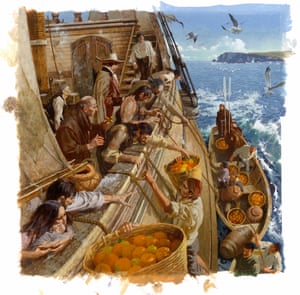


A painting depicting passengers and crew from Manila reaching for oranges and lemons, some antidotes to scurvy.


A painting depicting passengers and crew from Manila reaching for oranges and lemons, some antidotes to scurvy. Photograph: Robert E McGinnis/Getty/National Geographic Creative

But even though we have known how to prevent scurvy with absolute certainty for nearly a century, still it recurs and resurfaces because of the ever present trickery of the fact that, as Gunton puts it of November’s outbreak, “It highlights a danger that you can consume plenty of calories yet not receive enough nutrients.” If people feel full, then they believe they are well nourished. This was the very same mistake the brilliant medical men of the 17th century were trying to correct. Very simply; sufficient body mass and malnutrition can co-exist.


If people feel full, then they believe they are well nourished


And still, populations throughout the world are proclaiming their ignorance of this truth. A survey of North American students discovered that 14% of those tested had concentrations in the blood below the medically accepted minimum level for normal health. An average person needs to consume up to 300 milligrams of vitamin C a day to maintain maximal circulating levels and preserve the estimated whole body pool of 1,500mg.


The reality is that we can be scorbutic even before we get bruising and stiff legs. The brain survives longer than any other organ, owing to the additional protection afforded the transport of vitamin C into the cerebrospinal fluid in which it bathes and from which the major brain cells are supplied with the antioxidants they need. But even that citadel will succumb when the level of the vitamin falls low enough.


More work is being done now on conditions such as sepsis, chronic fatigue syndrome, and symptoms of diabetes. But this research pales in comparison with the rise in the consumption of sugar, especially by young people, and the enforcement of recent policies of austerity by western governments. Figures quoted in the Guardian at the same time as the Sydney outbreak revealed that diagnoses of malnutrition in Britain have increased by 44% in the five years to 2015. Ignorance about food among individuals and misguided state policies concerning diets of the young and the elderly: these are the nurseries of scurvy, and always have been.


Jonathan Lamb is Mellon Professor of the Humanities at Vanderbilt University and author of Scurvy, The Disease of Discovery.


With thanks to Professor James May and Professor Fiona Harrison, Vanderbilt University Medical Centre, who helped with the medical aspects of scurvy.


Join our community of development professionals and humanitarians. Follow @GuardianGDP on Twitter.


Black bones, gangrene and weeping: the unwelcome return of scurvy

10 Ağustos 2016 Çarşamba

How a Healthy Gut Means Healthy Bones (& What To Do If Yours Isn’t)

Your gut is home to trillions of intestinal bacteria. Over 100 trillion to be exact!


These bacteria help you digest food, remove waste and circulate essential elements. It might be hard to believe, but we have more “creatures” living inside our bodies than there are stars in our galaxy!


But don’t let that scare you. Research has shown that this living system, also known as your gut microbiome, can lower your risk of inflammatory bowel disease, rheumatoid arthritis, cancer, diabetes and even osteoporosis, when healthy. 


Factors That Affect Your Gut Microbiome


Unfortunately, not all organisms are gut-friendly. Some are good and others are bad.


The key is keeping your gut flora ‘balanced’.


You see your gut flora is extremely sensitive, which means there are plenty of factors that can affect your gut microbiome. Some of them are:


  • Birthplace

  • Age

  • Diet

  • Personal hygiene

  • Antibiotics and prescription medication

  • Environment

Even small differences in the makeup of your microbiome can have real effects on your health. These include your risk for cardiac issues, diabetes, Alzheimer’s disease, and obesity. 


And the latest research has added osteopenia and osteoporosis to the list.


How Your Gut Health Affects Your Bones


Inflammation in the gut can lead to damage of your tissues, organs, and gut flora.


Anything that promotes chronic inflammation also promotes osteoclasts. These are known as the ‘bone-dissolving cells’ and when triggered, can affect the bone-remodeling process.


Inflammation also inhibits absorption of important bone-building minerals like calcium and magnesium, making it more difficult for you to give your bones the nutrients they need.


But there are ways to combat this inflammation…


Probiotics Combat Inflammation And Protect Your Bones


Probiotics have been studied and shown to be beneficial for an array of health problems such as immune function, diarrhea, cancer and inflammatory bowel disease. 


In particular, they have been shown to reduce systemic inflammation.


Probiotic rich foods include:


  • Yogurt

  • Kefir

  • Sauerkraut

  • Kombucha

  • Miso

  • Microalgae

  • Pickles

  • Tempeh

  • Kimchi

Studies that test how probiotics and prebiotics affect bone health are in the works. Probiotics are live microbes that help move food through your gut. Prebiotics – found in such foods as raw garlic and leeks – help stimulate useful bacteria.


In animal tests probiotics improve bone mass and prebiotics increase bone density.


What do these studies reveal?


Researchers know that when you regulate the microbiome, you regulate bone health. 


Take Home Message


A healthy gut is a happy, healthy you.


To maintain and restore a healthy gut, include more probiotic-rich foods in your diet such as sauerkraut and yogurt to stimulate healthful bacteria.


Not only will your gut thank you, but your bones will too.


Sources:


  1. Jun Sun, Eugene B. Chang. Exploring gut microbes in human health and disease: Pushing the envelope. Genes & Diseases. Volume 1, Issue 2, December 2014, Pages 132–139

  2. Inna Sekirov, Shannon L. Russell, L. Caetano M. Antunes, B. Brett Finlay. Gut Microbiota in Health and Disease. Physiological Reviews Published 1 July 2010 Vol. 90 no. 3, 859904 DOI: 10.1152/physrev.00045.2009

  3. https://www.researchgate.net/profile/Reza_Darsanaki/publication/236963823_Probiotics_and_Health/links/0deec51a78ed71c361000000.pdf

  4. Ritchie ML, Romanuk TN. A meta-analysis of probiotic efficacy for gastrointestinal diseases.PLoS One. 2012;7(4):e34938. doi: 10.1371/journal.pone.0034938. Epub 2012 Apr 18.


How a Healthy Gut Means Healthy Bones (& What To Do If Yours Isn’t)

3 Haziran 2014 Salı

Children who perform tennis will have more powerful bones, researchers discover

“The research demonstrate that when you’re older you are much less in a position to get the benefits,” said investigation leader Alex Ireland.


“Childhood as a result represents a very good window of chance to really build strength for bones.


“Making (bones) more powerful and larger in childhood, particularly in adolescence, indicates that you’re less very likely to have breaks when you get older.


“Having a fracture when you are older can be incredibly detrimental to your life, you turn out to be significantly less mobile and become weaker, reinforcing the significance of ensuing normal physical action in youth.”


Research evaluating sports folks with less lively people face criticism that bigger, stronger men and women tend to choose to play sport so distinctions identified could not be a consequence of physical exercise.


In tennis gamers, each arms have the exact same dietary and genetic influences, so researchers say they can be confident that bodily activity is the trigger of the big variations in bone power.


Some tiny in between-arm distinctions in bone strength are located in non-athletes, probably because men and women favour 1 arm when creating or carrying a bag, for example. Nevertheless, the differences found in tennis players are about 10 times greater than individuals in non-players.


In total, 51 male and 37 female gamers were analysed at the LTA Open Veterans Indoor Championships and the Open Veterans Clay Court Championship, and thirty male and twenty female juniors at the LTA British Junior Championships.


The examine was published in the journal Osteoporosis Worldwide.


Children who perform tennis will have more powerful bones, researchers discover

29 Nisan 2014 Salı

3D printed cast could heal bones forty per cent more quickly


The cast is combined with a minimal intensity pulsed ultrasound program, known as LIPUS, for twenty minutes a day, which the designer claims will minimize the healing approach of fractures by up to 38 per cent.


DK Styles


Designed by Turkish industrial designer Deniz Karasahin says that the Osteoid will “enhance the total healing expertise for broken or fractured limbs by focusing on the patient’s comfort and the quantity of time necessary for the entire body to heal itself.”


Mr Karasahin also says that the Osteoid is environmentally friendly and water resistant as nicely as being slimmer and lighter than standard casts.


The 3d casts would be customised for each and every patient. In order to fit the limb completely the injured location is scanned utilizing a 3d physique scanner. The subsequent data is transferred to a modelling software, exactly where the total size and geometry of the cast is made a decision.


DK Patterns


The Osteoid is in the concept stage, but hand surgeon Dr. Michael Hausman informed Co. Layout site that it could be medically viable.


“We know that ultrasound performs. There is great evidence, presented most lately in two papers published in the Journal of Bone and Joint Surgical procedure, the major journal in orthopaedics.”


The papers showed that ultrasound could be utilized for healing tibia fractures, and the other showed that it accelerated the healing of wrist fractures.


3D printed cast could heal bones forty per cent more quickly

5 Mart 2014 Çarşamba

Silk screws could substitute metal devices in repairing broken bones

In total, 28 silk-based screws were inserted into 6 rats in which they functioned efficiently for eight weeks.


In accordance to the researchers, the outcome of the trial suggests that employing silk screws could spare patients the issues of getting rid of metal devices due to the fact they could dissolve in the body.


The screws are also not witnessed on X-rays, which means that it would be less complicated for medical doctors to observe how a fracture is progressing soon after an operation.


Scientists say that the original aim is to use silk-based screws to deal with facial injuries, but that the gadgets have the likely for the treatment of a assortment of diverse kinds of bone fractures.


Co-writer of the examine Dr Samuel Lin, from Harvard Health-related School, explained, “Not like metal, the composition of silk protein could be related to bone composition.


“Silk resources are extremely robust. They sustain structural stability beneath quite large temperatures and stand up to other intense conditions, and they can be readily sterilised.”


Dr David Kaplan, from Tufts University, additional: “A single of the other huge advantages of silk is that it can stabilise and supply bioactive parts, so that plates and screws manufactured of silk could in fact deliver antibiotics to avert infection, pharmaceuticals to improve bone regrowth and other therapeutics to assistance healing.”


Silk screws could substitute metal devices in repairing broken bones

27 Ocak 2014 Pazartesi

Woman breaks eight bones in sleepwalking fall and still does not wake up

In spite of her comprehensive injuries she only spent ten days in the significant trauma unit at the Queen’s Health care Centre in Nottingham and hopes to be back at perform inside of two months.


Morgan has now set up infant gates on the stairs of her property in Witham-St-Hughes, Lincs, to stop a repeat of the accident.


The client companies assistant stated: “When they located me I was bleeding a lot and my pal who used to be a nurse considered I was dead.


“The ambulance acquired to me and took me to the major trauma unit and later that afternoon the medical professionals said that they did not know how I was not in intensive care.


“It was a week ahead of I looked at myself in the mirror simply because my encounter was such a mess, I just couldn’t bring myself to it.


“Now, when I do appear at myself I feel lucky to be alive and even luckier to be strolling. It is a miracle I did not die.


“I have sleepwalked prior to but normally I just wander around and then go back to bed, but since I was at a friend’s house it was unfamiliar and I fell.”


Morag was staying with her good friend Carl Muggleton in Prolonged Eaton, Notts, when he was roused by a loud noise at 5am on November 23 last year.


The 39-yr-old said: “I woke up to an almighty crash and jumped out of bed and noticed her lying at the bottom of the stairs in a pool of blood.


“I knew that she did sleep stroll but by no means anticipated something like this.


“I tried to stem the bleeding until the ambulance arrived and it was not until finally it came that I observed 1 of her wrists had spun all the way all around.


“I have a extremely sharp set of stairs and there is not a lot of area at the bottom so she is fortunate to be with us nowadays.”


Morag, who lives with her 6-12 months-old daughter Olivia in Lincolnshire, has sleepwalked all her daily life and explained it generally transpires when she is stressed.


She additional: “My daughter has been a superstar during all of this and if anything at all she is mothering me.


“I am nevertheless sporting a brace for my back and she helps me with it. She even explained that I seem like a mummy yet again and not a zombie.


“I have now put stair gates in to maintain my home secure.”


Rohan Revell, major trauma situation manager at the Queen’s Healthcare Centre, stated: “We can only presume that she went head-in excess of-heels as an alternative of down on her bum and a good deal of fatalities happen this way.


“When she came in she looked like she had gone ten rounds with an individual.


“We gave her an epidural to address her ache and the spinal damage she had. She nevertheless has to put on a back brace like a corset to defend the spine while it heals.


“She was an absolutely beautiful patient and the most rewarding thing for us is that she has been back to pay a visit to us all.”


An estimated ten million men and women in Britain suffer from sleepwalking.


Woman breaks eight bones in sleepwalking fall and still does not wake up

Woman breaks eight bones in a sleepwalking fall and nevertheless does not wake up

Morgan has now put in child gates on the stairs of her home in Witham-St-Hughes, Lincs, to stop a repeat of the accident.


The client providers assistant explained: “When they identified me I was bleeding a lot and my pal who utilised to be a nurse considered I was dead.


“The ambulance got to me and took me to the major trauma unit and later that afternoon the doctors stated that they did not know how I wasn’t in intensive care.


“It was a week ahead of I looked at myself in the mirror because my face was such a mess, I just couldn’t carry myself to it.


“Now, when I do appear at myself I feel fortunate to be alive and even luckier to be walking. It’s a miracle I didn’t die.


“I have sleepwalked ahead of but generally I just wander about and then go back to bed, but due to the fact I was at a friend’s property it was unfamiliar and I fell.”


Morag was staying with her buddy Carl Muggleton in Extended Eaton, Notts, when he was roused by a loud noise at 5am on November 23 last yr.


The 39-year-previous stated: “I woke up to an almighty crash and jumped out of bed and noticed her lying at the bottom of the stairs in a pool of blood.


“I knew that she did sleep stroll but never expected something like this.


“I experimented with to stem the bleeding till the ambulance arrived and it wasn’t until finally it came that I observed a single of her wrists had spun all the way all around.


“I have a quite sharp set of stairs and there is not a great deal of room at the bottom so she is lucky to be with us today.”


Morag, who lives with her six-12 months-previous daughter Olivia in Lincolnshire, has sleepwalked all her life and explained it normally occurs when she is stressed.


She added: “My daughter has been a superstar throughout all of this and if anything at all she is mothering me.


“I am even now wearing a brace for my back and she helps me with it. She even stated that I seem like a mummy again and not a zombie.


“I have now put stair gates in to preserve my residence safe.”


Rohan Revell, major trauma situation manager at the Queen’s Medical Centre, explained: “We can only presume that she went head-over-heels alternatively of down on her bum and a good deal of fatalities happen this way.


“When she came in she looked like she had gone ten rounds with somebody.


“We gave her an epidural to handle her soreness and the spinal damage she had. She nonetheless has to dress in a back brace like a corset to shield the spine even though it heals.


“She was an definitely pretty patient and the most rewarding factor for us is that she has been back to pay a visit to us all.”


An estimated 10 million individuals in Britain suffer from sleepwalking.


Woman breaks eight bones in a sleepwalking fall and nevertheless does not wake up