feet etiketine sahip kayıtlar gösteriliyor. Tüm kayıtları göster

14 Eylül 2016 Çarşamba

"Back on my feet": how artificial limbs can have a second life in Africa

Losing a limb is a devastating physical and psychological experience for anyone. For adults and children in countries where prosthetics are not routinely available, it can also mean losing your home, your family and ending up on the streets.


Mohamad Musa, from Sanchaba in western Gambia, has experienced first-hand the harsh reality of life as an amputee. His leg was removed at Banjul hospital in 2014 after suffering pain for many years. Without a prosthetic limb, he spent much of his day “just sitting” and had to leave school in 7th grade.
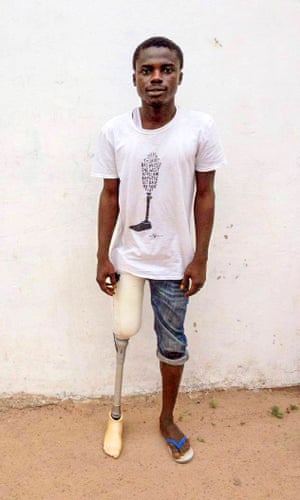


Mohamad Musa had his leg removed in 2014 after suffering pain for many years.


Mohamad Musa had his leg removed in 2014 after suffering pain for many years. Photograph: Legs4Africa

Now in his twenties, Musa is among hundreds to date who have benefited from recycled artificial legs sent out by UK charities to places where they are desperately needed. Earlier this year, Legs4Africa volunteers arrived in his town and offered him the chance of being fitted with a prosthetic. “They brought me back on my feet,” he explains.


His story and others have been made possible due to effective partnerships. One such collaboration between Limbcare and Legs4Africa resulted in 500 limbs being despatched to Tanzania in May this year. The prosthetics which also include arms and hands will be distributed to a Dar es Salaam hospital where experienced technicians will fit them to those in need. Len Amos, Limbcare’s director of recycling and communication, says: “All of these parts went to a country with no NHS and where an awful lot of children are disowned by their parents because they can’t work, so end up begging.”


The partnership between the two charities began with a phone call. Amos had been asked by a foundation working with underprivileged communities to send out disability equipment. He contacted Legs4Africa founder Tom Williams asking if he wanted to help fill the container destined for Tanzania. By coincidence, Williams had received a request for legs also from Tanzania. Aided by volunteers, they had the limbs tagged, bagged and sent on to their destination.


Limbcare and Legs4Africa obtain second-hand legs from the NHS, private clinics and funeral firms. Under EU laws, prosthetics are classed as medical waste so the NHS cannot reuse them once a patient has outgrown or stopped using them because of a change in health. Instead, around 5,000 are either incinerated or go for landfill every year in the UK.


[A prosthetic] leg can be the reason someone rises out of poverty and begins living a life of dignity


“There’s no market [for used limbs] in the UK and if we don’t collect them they’ll be destroyed,” explains Williams whose charity collects from nearly a dozen hospitals and clinics. This informal process usually starts with Legs4Africa approaching either senior management or the prosthetist who then fill a box of redundant limbs for the charity to collect. In some cases, trusts will encourage staff to put prosthetics and mobility aids aside. Williams’s dream would be for formal collaboration and partnership between charities and the entire NHS.


One country’s waste is another’s opportunity to transform lives, especially in parts of sub-Saharan Africa where prosthetics are not manufactured. “You have to be rich, in the military or the government to receive an artificial limb,” says Amos. “You’d have to be lucky even to get walking sticks.”


Although manufacturers will not guarantee prosthetics for life, secondhand ones are generally perfectly reusable according to Amos. They will be exported to local hospitals where occupational therapists assess people for suitability then engineers adapt the limbs to individual patients. It is a painstaking process. A person’s height has to be taken into account, to ensure the leg section is the correct length, and their weight so the limb doesn’t swing out too quickly.


Diseases such as diabetes, car accidents and civil war are all to blame for an increasing number of people in Africa living with limb loss. Gambia’s only prosthetist, Gabu Jarjue, is based at the Royal Victoria teaching hospital in Banjul which benefited from a Legs4Africa shipment this year. Gambia is a developing nation and disability a low priority, says Jarjue, with the daily life of patients and their families one of “discrimination and exclusion”. His belief is that the sooner Gambia addresses the needs of amputees, the quicker it will realise that a properly rehabilitated patient costs less than a disabled one. “[A prosthetic] leg can be the reason someone rises out of poverty and begins living a life of dignity.”
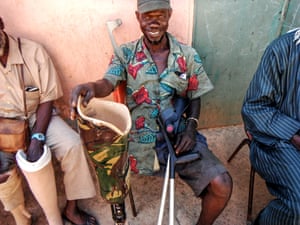


Musa, a mechanic who lost his leg in an accident at work, is a recipient of a prosthetic leg.


Musa, a mechanic who lost his leg in an accident at work, is a recipient of a prosthetic leg. Photograph: Legs4Africa

There is no set structure to how Legs4Africa establishes and maintains partnerships with healthcare professionals like Jarjue and with healthcare institutions. However, hospitals and clinics, which are often referred to the charity by individuals in the community, must meet strict criteria. They must have the facilities and expertise to customise the components sent out by the charity, guarantee not to sell them and be responsible for transporting the prosthetics from port to hospital. “We also ask for reports and photos,” adds Williams.


As for Musa, he’s enjoying having a new prosthetic leg and the opportunities it affords him. He says: “I’m with no pain and thinking of my future – my dream is education.” The aim of charities like Limbcare and Legs4Africa is to get many more like Musa back on their feet. Through partnerships like theirs, this is a very achievable goal.


Join the Healthcare Professionals Network to read more pieces like this. And follow us on Twitter (@GdnHealthcare) to keep up with the latest healthcare news and views.


"Back on my feet": how artificial limbs can have a second life in Africa

16 Ağustos 2016 Salı

Feet first, our NHS is limping towards privatisation | Polly Toynbee

A fish rots from the head, but the NHS may be rotting from the feet. Podiatry is not up there in the headlines, yet what’s going on in that unglamorous zone is an alarming microcosm of the downward path of the health service. This is a story of the NHS in England in retreat and the private sector filling the vacuum.


Related: How much is the government really privatising the NHS?


You know the big picture from the ever-worsening monthly figures: deteriorating A&E, ambulance and operation waiting times, and a steep rise in bed-blocking. As debts pass £2.5bn, the NHS feels the tightening financial tourniquet.


Now look at it through the prism of just one small corner, as seen from the feet up. Every week 135 people have amputations because diabetes has caused their feet to rot: their circulation goes and then the sensation in their feet, so they don’t notice damage done by rubbing shoes, stubbed toes or stepping on nails. Minor injuries turn into ulcers that if left untreated turn gangrenous, and so the toes, then the foot, then the leg are lost – horrific life-changing damage. Numbers are rising fast, with nearly three million diabetics. The scandal is that 80% of these amputations are preventable – if there were the podiatrists to treat the first signs of foot ulcers. But the numbers employed and in training are falling.


In his surgery, the head of podiatry for Solent NHS Trust, Graham Bowen, is unwrapping the foot of a lifelong diabetic to reveal a large missing chunk of heel, a great red hole nearly through to the bone. This man has already had some toes amputated. He has been having treatment with maggots, bandaged into his wound to eat the dead skin and help healing – and he is slowly improving. Everyone Bowen sees now is at similarly high risk. Small ulcers, incipient ulcers, the ones that need to be caught early (and cheaply) no longer get NHS treatment. “On the NHS we’re essentially firefighting the worst cases now,” says Bowen. “We are going through our lists and discharging all the rest of our patients.”


Carer helping elderly man


‘On a 15-minute visit carers can’t check feet.’ Photograph: Andrew Bret Wallis/Getty Images

But not even all these acute patients get the same optimal treatments, due to the vagaries of the 2012 NHS Act. Solent, a community trust that covers mental health and a host of other services, is used by five different clinical commissioning groups (CCGs), including Southampton, Portsmouth and West Hampshire. Each has its own criteria for what it will pay for, and each is toughening those criteria. Depending on their address, some patients get the very best, others only get what their cash-strapped CCG pays for.


You need to know about diabetic feet to understand the difference in treatments: the conventional and cheapest treatment is a dressing and a removable plastic boot, and telling patients to keep their foot up for months. But patients who can’t feel their feet tend to take off the boot and hobble to make a quick cup of tea. “Ten minutes of putting pressure on the ulcer undoes 23 hours of resting it,” Bowen says, so it takes 52 weeks on average to heal ulcers that way. For £500 extra, a new instant fibreglass cast saves any pressure on ulcers and cures them within eight weeks.


Although the National Institute for Health and Care Excellence says this total-contact cast is the gold standard, most of Bowen’s CCGs won’t pay for it. I watched him putting one on a patient in under half an hour: after nine weekly replacements, that ulcer would be completely healed. For every 10 of the new casts, one amputation is prevented – and each amputation costs the NHS £65,000. Such is the madness of NHS fragmentation, divided between multiple commissioners and providers, all in serious financial trouble, that no one spends a bit more now for others to save later, even when the payback is so quick.


This clinic lost four podiatry posts to save money: though diabetic numbers soar, its budget has been static for five years. “Doing more for less,” he says with the same weary sigh you hear echoing through the NHS. As Bowen goes through the clinic’s books removing all but the most acute cases, he turns away diabetics whose problems should be caught early. He turns away others he used to treat: the old and frail who have become immobile due to foot problems; the partially sighted or people with dementia who have poor home care. On a 15-minute visit carers can’t check feet and find out if they are the reason someone doesn’t get out of bed, toes buckled in, leaving them needlessly incapacitated and heading for residential care sooner than necessary.


What happens to those he takes off his books? “They have to go private, if they can afford it. If not, then nothing.” He used to send them to Age UK, but lack of funds shut that service. Only 5% of podiatry is now done by the NHS so Bowen has set up TipToe, a private practice attached to his NHS clinic. It’s not what he wants, but it keeps prices low and all proceeds go to the NHS.


Next year podiatry trainees, like nurses, will no longer get state bursaries, so fewer will apply


Alarm bells should ring here: how silently the NHS slides into the private sector. Labour leadership contender Owen Smith has flagged up his team’s research showing private practice has doubled since 2010. Now that many CCGs only pay for one cataract, how many go private for the second eye? As the Guardian’s health policy editor, Denis Campbell, has asked, how many more vital treatments will go this way?


Podiatry is the ground floor of the NHS hierarchy. The profession reckons the NHS in England needs 12,000 practitioners but only has about 3,000 – and that’s falling, despite so many high-risk diabetics needing weekly appointments. Next year podiatry trainees, like nurses, will no longer receive state bursaries, so fewer will apply. They tend to be older, with families, unable to take on a £45,000 debt for a job paying around £35,000 per year. Already student places have been cut by nearly a quarter in five years. Most of the 7,000 amputations a year are preventable. A shocking statistic: half of those who undergo amputations will die within two years.


Only in the details of what’s happening on the frontline can we understand the daily reality of Britain’s shrinking state. Step back and ask how it can be that a country still growing richer can afford less quality care than when it was poorer? Is that the country’s choice? As the NHS slides into the private sector, here is yet another public service in retreat.


Feet first, our NHS is limping towards privatisation | Polly Toynbee

3 Haziran 2014 Salı

British feet acquiring longer and wider, say specialists

Feet

The survey of 2,000 British adults discovered 48% of guys explained their feet have got bigger, and 61% said their feet are wider. Photograph: Nick Hawkes/Alamy


British feet are acquiring longer and wider, authorities have mentioned.


Throughout the final 4 decades, the regular British foot has improved by two shoe sizes, the University of Podiatry mentioned.


In 1970, men’s feet have been size eight on common and girls size four, but now the average male wears a dimension ten and the common female wears a size six, a spokeswoman explained.


The enhance could be linked to the population’s enhanced excess weight and height, she added.


A poll conducted by the college identified two-thirds of ladies declare their feet have acquired wider in grownup lifestyle, and 35% said they have acquired larger. And the survey of 2,000 British adults located 48% of guys said their feet have acquired greater, and 61% explained they are wider.


The college also cautioned that several individuals are risking foot troubles by striving to squeeze their feet into footwear that are too tiny and narrow.


“Feet are getting greater because as a nation we are turning into taller and we’re escalating in bodyweight,” stated Lorraine Jones from the School of Podiatry.


“Elevated weight obtain spots more pressure on the feet and indicates ligaments and joints need to have to work tougher to maintain the foot’s framework and hold you mobile.


“Above time, if a person is gaining weight, the feet splay to attempt and accommodate the increased pressure – which can trigger discomfort, lead to mobility troubles and improve your risk of creating osteoarthritis in the lower limb joints.


British feet acquiring longer and wider, say specialists

2 Haziran 2014 Pazartesi

British feet "have grown two sizes given that 1970s"

Investigation primarily based on two,000 adults discovered 26 per cent of men and 41 per cent of women say their feet have received greater throughout their grownup lifestyle, with almost half attributing it to putting on fat.


Lorraine Jones, from The College of Podiatry, stated: “Feet are receiving bigger simply because as a nation we are turning out to be taller and we’re rising in excess weight.


“Increased fat obtain spots much more stress on the feet and indicates ligaments and joints want to perform tougher to maintain the foot’s framework and keep you mobile.


“In excess of time if a person is gaining bodyweight, the feet splay to try out and accommodate the increased strain.


“This can cause discomfort, lead to mobility issues and improve the risk of building osteoarthritis in the decrease limb joints.


“What ever your shoe size, the most important thing is to put on a relaxed, effectively-fitting shoe.”


Her colleague Emma Supple additional: “It should be practically nothing to be embarrassed about but there is a perception that tiny, slender feet are dainty and feminine.


“We believe this can be a barrier to some girls purchasing more substantial-sized and wider-fitting shoes.


“Much more merchants are stocking larger and wider fitting sneakers to accommodate modifications in foot size.


“Nonetheless, there is still operate to be accomplished to offer a great variety of footwear which are noticed as ‘fashionable’ but are also comfy to wear and effectively fitting.


“Numerous are unaware they are wearing the incorrect shoe dimension – substantial numbers of Uk grownups are not having sneakers professionally fitted or have not had their feet measured just before.


“The other issue is some designs of shoe this kind of as fashionable ballet pumps and court sneakers often have to be worn in a smaller size just so they will not fall off.”


The analysis, which marks the ‘Feet for Life’ campaign, also identified the most frequent complaints from both men and ladies.


The leading 5 complaints for men were:


one. Difficult skin (27 per cent)


2. Sore/aching feet (18 per cent)


3. Tight calf muscle tissue (sixteen per cent)


4. Joint spot – corns (13 per cent) and blisters (13 per cent)


five. Calluses (12 per cent)


The prime 5 complaints for ladies have been:


one. Hard skin (42 per cent)


two. Sore/aching feet (29 per cent)


3. Joint area – bunions (15 per cent) and blisters (15 per cent)


4. Tight calf muscle tissue (14 per cent)


five. Calluses (15 per cent)


Leading 5 causes for possessing bought shoes which never fit:


1. I considered I was getting the correct size but when I attempted them on at residence/wore them they did not feel relaxed (35 per cent)


2. I liked the sneakers and they did not have them in my size (27 per cent)


three. I bought them on the web and didn’t realise they would not match (26 per cent)


4. They had been on sale (19 per cent)


five. I did not have time to try them on in the stores (15 per cent)


British feet "have grown two sizes given that 1970s"