monitoring etiketine sahip kayıtlar gösteriliyor. Tüm kayıtları göster

15 Eylül 2016 Perşembe

Monitoring of prostate cancer as effective as treatment in some cases

Regular monitoring of men with localised prostate cancer offers them the same – higher than expected – survival chance after 10 years as surgery or radiotherapy, according to a major study.


The trial, the largest of its type, looked at men diagnosed with the low-risk form of the disease through a PSA (prostate-specific antigen) test and found the survival rate for all three main treatment options was 99%, compared with the 90% researchers expected.


Having surgery to remove the prostate gland – a prostatectomy – or radiotherapy halved the risk of cancer progression, compared with monitoring, to around 10%, but caused more unpleasant side-effects.


The experts behind the study, funded by the National Institute for Health Research (NIHR) and published in the New England Journal of Medicine on Wednesday, said it has significant implications for up to 30,000 men diagnosed with localised prostate cancer via a PSA test each year.


Chief investigator Prof Freddie Hamdy, from the University of Oxford, said: “The doctor will be able to say your risk of dying of prostate cancer within 10 years is very low. If you do have [radical] treatment, it does improve [the chances the disease will not spread] but you have those side-effects. The conversation now between doctors and patients will be much better informed than in the past and will have less bias than before.”


He said clinicians had a tendency to recommend the treatment they offer personally but hoped the study would change that.


For the ProtecT trial, led by researchers at the universities of Oxford and Bristol in nine UK centres, 82,429 men across the UK aged 50-69 were tested and 1,643 diagnosed with localised prostate cancer agreed to be randomised to active monitoring (545), radical prostatectomy (553) or radical radiotherapy (545) between 1999 and 2009. The research team measured mortality rates at 10 years, cancer progression and spread, and the impact of treatments reported by men.


Approximately 50% of men under active surveillance, which includes regular PSA tests, had surgery or radiotherapy later in the trial monitoring period because of fear the disease was progressing.


The researchers said a longer-term follow-up was needed to see whether reducing the spread of prostate cancer through radical treatment boosted longevity and/or quality of life.


Prostatectomy had the greatest negative effect on sexual function and urinary incontinence, and radiotherapy caused more bowel problems, although the number of men experiencing side-effects declined over time.


The researchers stressed they were not recommending a particular course of action for men with a positive PSA test.


Co-investigator Prof David Neal, from the universities of Oxford and Cambridge, said: “Clinicians don’t necessarily have the right answer. It’s important there’s a genuine partnership so men can really understand what the benefits and disbenefits are so they can take the right decision for them as an individual.”


Anne Mackie, director at Public Health England Screening, said the study provided “key information needed to manage localised prostate cancer”.


Prostate cancer is the most common cancer in men, with about 47,000 diagnoses and 10,000 deaths every year in the UK.


But there is currently no national screening programme because of issues with the accuracy of PSA tests and their potentially harmful consequences. However, the advantage is that they may catch the cancer early.


Dr Matthew Hobbs, deputy director of research at Prostate Cancer UK, said the results were good news for men diagnosed with the localised form of the disease, adding: “Many men decide against active surveillance because of the uncertainty about the impact of that choice and the anxiety it causes.”


He said more work was needed to ensure cancers are found at an early stage, pointing out that only 22% of men diagnosed when it has spread outside the prostate and abdomen survive for 10 years.


Monitoring of prostate cancer as effective as treatment in some cases

21 Ağustos 2016 Pazar

Five of the best health monitoring devices

You can record your heart rate manually by holding your wrist and counting your pulse, but this hasn’t stopped technology companies producing devices to do the job with electronics. Most of these devices collect heart data all day long and record it on a smartphone app which builds up a richer set of data than you might get with a stopwatch and pencil. One of the most useful metrics they collect is your RHR (resting heart rate) a reading taken when you are relaxed, most typically first thing in the morning. In most cases a low RHR indicates a strong, healthy heart which has to beat fewer times to circulate blood around the body. However in older people a low RHR might indicate diseased heart muscle or overmedication. Some day-to-day variation in your RHR (or indeed in many of the metrics these devices measure) isn’t something to be worried about, explains Dr Satpal Arri of the British Heart Foundation Centre of Research Excellence, King’s College London, “A certain amount of variability is normal, healthy in fact – as you get older variability tends to decrease.” So by all means listen to your heart, but don’t become obsessed.


Measures: RHR, HR, recovery time, V02 max, movement, sleep; £359


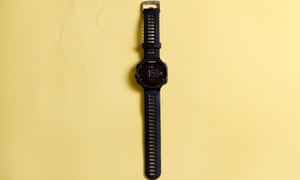
Garmin Forerunner 735XT


All photos by Linda Nylind for the Guardian.


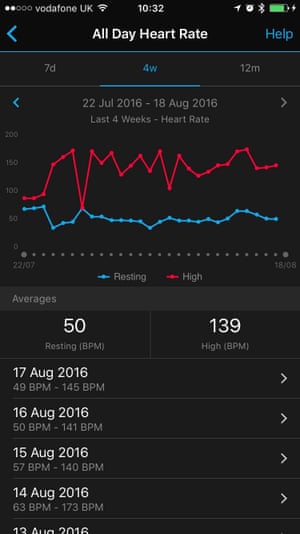
Garmin heart rate app


Data from the Garmin Forerunner.

Garmin’s latest exercise tracking watch records your runs, rides, steps and swims using GPS or an accelerator. The rear of the watch features an optical sensor that uses a light to measure blood flow, which is processed by an algorithm to create HR data. The watch displays HR and RHR but these are better displayed on Garmin’s Connect smartphone app where you can see historical data. The watch also had a recovery adviser feature, which advises you how many hours you should wait before exercising again – for running the times seemed consistent but for cycling I found them to be a little haphazard – the software company says that power meter data is required for an accurate result. When running, the watch will also produce a V02 max (the maximum value of oxygen you can use) score, which they claim is 95% accurate when compared to lab tests. You’ll need to purchase a power meter to generate a cycling V02 max figure.


Accuracy: You need to wear the watch day and night to get an accurate RHR reading. Wearing it on and off, or only using it when exercising, will affect the averages the software calculates. For example, my RHR for one month when I only wore the watch on a couple of occasions was 10bpm, whereas days when I only wore it while running or cycling would push the average into the 60s. It’s surprising that the algorithm can’t recognise and remove these biases.


Verdict: This is a powerful tool for tracking and improving your sporting performance – probably the best sports watch on the market – but for simple monitoring of your RHR you might be better off using a smartphone app such as Instant Heart Rate.


Measures: RHR, HR, movement, sleep; £199


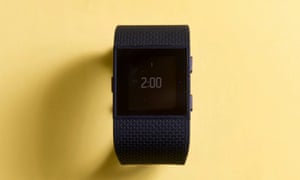
FitBit Surge


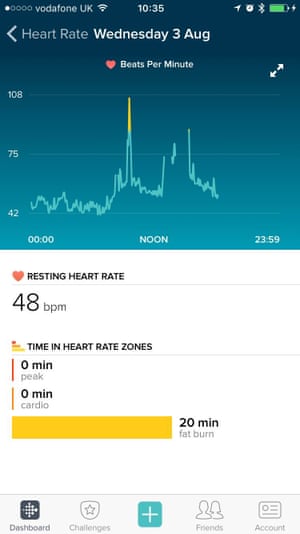
FitBit heart rate App


The FitBit Surge app.

Much like the Garmin, this unit will track exercise and steps, and collects HR data using an optical sensor. The interface is a little confusing, requiring a mix of buttons, presses and touchscreen swipes to operate it. The rubber wristband tended to cut into my wrist and felt sweaty.


Accuracy: Worn side by side, the FitBit and the Garmin record the same HR. However, the Surge’s software does more to remove outliers when calculating a RHR – mine rarely varied by more than a BPM each day. That said, if you don’t wear the watch the app will tell you that your RHR is the same as the last time you were wearing it – a big assumption. The app itself is easy to navigate and visualises your data clearly.


Verdict: If you’re mainly interested in monitoring your general health, ie your RHR, sleep and a bit of exercise, this is a good choice.


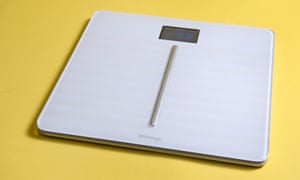
Measures: HR, pulse rate velocity, weight, fat mass, bone mass, muscle mass, water; £149


Withings Body Cardio Scale


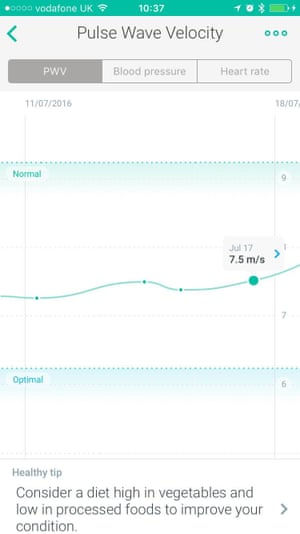
Withings pulse wave velocity heart rate App


Data from the Withings Body Cardio Scale.

This wireless-connected scale generates a slew of data to pore over. Integrating it into your morning routine is pretty simple – just stand on it for few seconds. The scale sends a small electrical current through the body, measures impedance and then, using sophisticated algorithms, generates body fat percentage, muscle mass and so on. The measurements are displayed briefly on the scale itself and then turned into graphs and the like on Withings Health Mate app.


Accuracy: It’s moot how useful the HR data collected by the scale is. A reading taken while standing isn’t a RHR; anything you do between your bed and the scale, such as a bathroom visit, taking a shower, walking up stairs or even talking, will influence your HR. However, the scale’s USP is that it takes a reading of your pulse wave velocity – a measure of how quickly blood is travelling along your arteries, and therefore how stiff or supple they are. A reading over 10 is associated with an increased risk of cardiovascular events.


“PWV is a research tool, but not normally something we would measure in routine practice. However, it is a validated measure of risk,” says Arri.


Verdict: If you’re looking for a device to monitor your cardiovascular health, you’re probably better using this in combination with a blood pressure monitor or a device that measures your RHR.


Read an in-depth of the Body Cardio here.


Measures: blood pressure, HR; £109


Withings Blood Pressure Monitor


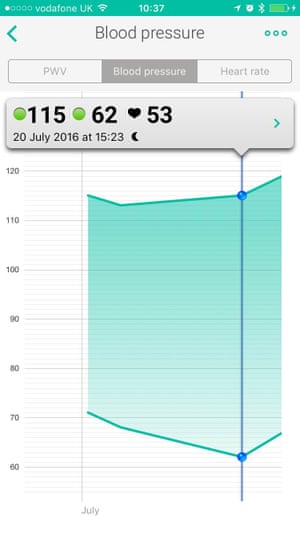
Withings Blood Pressure heart rate app


The Withings Blood Pressure Monitor app.

Easily the coolest looking blood pressure monitor you can own. Unlike most, there are no cables; it communicates with your smartphone via Bluetooth. Once charged, the sleeve inflates around your arm to take a reading – you can also set it up to take three readings in one session, from which it takes an average. The results are displayed on Withings Health Mate app, so you can track the readings over time.


Accuracy: Produced consistent results over a couple of months. It also records your heart rate, which is a good indicator of how “rested” you were when the reading was taken.


Verdict: A great piece of design, simple to use, and if you’re concerned about your blood pressure, it produces useful data. “Having a blood pressure monitor at home is a good idea, because high blood pressure doesn’t have any symptoms – the patient will feel fine. If well people who are worried can pick it up early with one of these devices, we can treat them early,” says Arri.


Measures: HR, ECG data, blood oxygen, respiration rate, skin temperature; £99


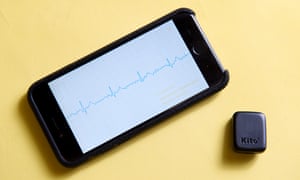
Kito+

This consists of a credit-card sized device that slips into one of two specially designed iPhone cases (for the 6 and 6S) and a small black connector for charging up the card-shaped bit. To take a reading, you fire up the Kito app and place your fingers on the sensors at the rear of the card. You can then see a graph of electrical activity created by your heart beating on your iPhone screen, which is pretty incredible.


Accuracy: A hospital ECG would be able to detect whether a patient had a heart attack recently – this device isn’t sensitive enough to do that, but it can help patients monitor an abnormal heart rhythm. “Typically we give patients who report palpitations, blackouts or light-headedness monitors that they can use for 24 hours or a week but if they don’t have an episode during that period, we don’t capture any data. With something like this a patient can check for themselves when they feel something happening,” says Arri.


For such patients a device that captures ECG data is more useful than those with an optical sensor. “When you’re in an irregular rhythm, your peripheral heart rate becomes unreliable. Because an ECG monitors electrical activity, it will pick up those extra beats that aren’t translated into a peripheral pulse.”


Verdict: A useful device if you have an irregular heart rhythm.


Five of the best health monitoring devices

21 Ocak 2014 Salı

Remote monitoring of rest apnoea remedy in France raises issues

Sleep apnoea mask

French sleep apnoea sufferers with breathing masks chance having therapy funding withdrawn if remote monitoring determines they are ‘non-compliant’. Photograph: Alamy


Considering that last October folks in France treated for rest apnoea syndrome have been subjected to remote monitoring: medical information is getting recorded, transmitted (normally by means of the internet) and interpreted elsewhere, perhaps major to choices on subsequent remedy. The protests of numerous patients’ associations have gone unheeded.


Remote monitoring, along with other prospects this kind of as teleconsulting, is component of a new branch acknowledged as telemedicine. Although it may possibly be right here to keep, it raises numerous inquiries.


Rest apnoea syndrome is a disorder characterised by pauses in breathing (apnoea) or intervals of abnormally shallow breathing (hypopnea). If these episodes arise too usually they could trigger sleepiness in the course of the day (responsible for accidents at work and on the street) and heart issues (high blood pressure, coronary thrombosis). Among one million and 3 million patients endure from the syndrome in France.


The primary therapy involves wearing a mask at night, to breathe air beneath constant optimistic airway pressure. The required devices are loaned to individuals and installed in their houses by contractors, the price currently being refunded by the social security method.


The number of patients acquiring this treatment is steadily escalating and costs have soared, reaching €440m ($ 575m) in 2011. Early in 2013 the French government published a decree requiring electronic sensors to be fitted and information to be transmitted to check use of the devices. If usage falls beneath a specified degree, patients will be rated as “non-compliant”, with the probability that expenses will no longer be reimbursed. For the very first time in France coverage of overall health expenses is conditional on sufferers wearing the mask during sleep.


The implications reach significantly additional than monetary issues raised by treating rest apnea. It is the very first time that remote monitoring has been enforced to verify patient compliance. Several organisations attempted to cease the decree and an appeal was lodged with France’s Conseil d’Etat, the highest administrative court, but to no avail.


No a single has any idea of the consequences of fiscal sanctions for bad compliance. To assist sufferers getting problems following prescriptions, the global medical community and wellness authorities have promoted remedies based on decision autonomy and incentives. Twenty many years in the past, therapeutic patient schooling was launched to involve sufferers in their own treatment method and to respect their freedom of choice. Remote monitoring, with its mixture of electronic surveillance and punishment, is a quite distinct strategy. It is also unclear how considerably say medical professionals will have when confronted with monitoring benefits or, if prescriptions are justified, how they will be capable to aid sufferers.


With remote monitoring the authorities are waving a stick at non-compliant sufferers, but is there a carrot? Telemedicine experts hope treatment method can be improved by monitoring rest patterns. But at what cost and with what advantages stays to be observed.


A rigorous evaluation will be needed above the following 12 months or two, involving patient organisations. Will they be offered a hearing, or will the authorities be the only ones to have a say?


Dr Nicolas Postel-Vinay is a practitioner at Georges Pompidou hospital in Paris


This story appeared in Guardian Weekly, which incorporates material from Le Monde


Remote monitoring of rest apnoea remedy in France raises issues