overseas etiketine sahip kayıtlar gösteriliyor. Tüm kayıtları göster

6 Şubat 2017 Pazartesi

NHS hospitals to charge overseas patients for non-urgent care

Hospitals will be required by law to check whether patients are eligible for free care on the NHS from April onwards, the health secretary has announced.


The rule raises the prospect of patients having to produce their passports and other identity documents before receiving most kinds of treatment as the government aims to claw back £500m a year. Patients from overseas will also be billed in advance for all non-urgent care as part of a government clampdown on the cost of overseas visitors using the service.


The Department of Health said nobody would be denied emergency treatment, whether they could pay or not. Under the changes, migrants from outside Europe, who pay an immigration health surcharge, will also lose their right to free NHS fertility treatment.


Jeremy Hunt said: “We have no problem with overseas visitors using our NHS – as long as they make a fair contribution, just as the British taxpayer does. So today we are announcing plans to change the law which means those who aren’t eligible for free care will be asked to pay upfront for non-urgent treatment.”


Doctors of the World, which runs clinics in the UK, raised concerns about the impact of identity checks. Shyamantha Asokan from the medical charity told the Guardian: “We see really vulnerable people: undocumented migrants, victims of human trafficking, homeless people. Already they’re often very worried about going to a hospital because they are worried about being asked for documents they don’t have or being asked to pay.”


She added: “A lot of the doctors who volunteer for us don’t want to be made into border guards – they just want to treat the people in front of them … We don’t believe that immigration and healthcare are areas of government policy that are overlapping.”


When a senior official acknowledged the government was considering introducing identity checks last November, some doctors threatened to boycott the scheme.


One wrote to the Guardian: “If migrants know that doctors and other healthcare professionals will actively liaise with the Home Office to deport them then they will avoid seeking healthcare. That’s hugely dangerous – especially in pregnant women, because without prompt early access to healthcare they stand a much higher risk of presenting as an emergency later on, potentially with much worse outcomes.”


The Department for Health said refugees and asylum seekers were exempt from paying, and that hospitals would work with people who do not have the required documents to establish whether they are eligible. The government is “determined to ensure there is minimal burden on British citizens”, a press release said.


Health tourism, where people travel to Britain for NHS treatments they are not entitled to, takes up about 0.3% of the NHS’s budget, according to fact-checking website Full Fact. This could include British citizens living overseas who return to the UK for treatment. Treating people who fall ill while visiting the UK costs the NHS about £1.8bn a year.


A National Audit Office report last year said the government paid £674m to other European countries for treatment of Britons abroad, but received only £49m in return for NHS treatment of European citizens.


A pilot scheme for improving how much money is collected from patients who are not eligible for free care has been running in Peterborough and Stamford hospitals NHS foundation trust since May 2013. There, patients are told to bring a passport or birth certificate as well as proof of residence, such as utility bills or bank statements, to new appointments. The trust’s chief executive, Stephen Graves, said: “There has not been any impact on the number of non-UK residents coming through the system for treatment but we do now identify non-eligible patients sooner, and at a higher volume than previously.”


NHS hospitals to charge overseas patients for non-urgent care

5 Ekim 2016 Çarşamba

"Diversity is good": your views on plans to end reliance on overseas doctors

Those who agree with Hunt’s proposals: ‘I think it is wrong that graduates aren’t legally obliged to stay’


I think Hunt’s proposals are excellent considering what he has said in the past. It’s important to train more British doctors and I also really like his idea to help more people from disadvantaged backgrounds get into medicine.


Foreign students already pay eye-watering fees to study medicine in this country. If you can afford to pay £35,000 per year it isn’t that much of an increase to £40,000. So the funding should be there, as should the demand for medical school places from domestic students.


I’m not put off by his proposal to work for four years. The NHS massively subsidise medical students and I think it is wrong that UK graduates aren’t legally obliged to stay in the NHS after graduating. I certainly feel morally obliged to do so.


Anonymous, 23, medical student, London


‘Doctors need to be able to communicate in English to a very high level’


Doctors need to be able to communicate in English to a very high level, so what Hunt is proposing is a good idea. Also, it is not ethical to employ doctors from countries who have a great need for doctors themselves. Especially when the need for doctors in hospitals and in GP practice is increasing.


As a nurse, I saw doctors who were far too tired to be working. I know things are better since the early 1980s, but there is still room for more improvement.


Anonymous, 64, former nurse living in Huddersfield


‘We have been draining other countries of their clinical talent for decades’


Hunt’s proposals are the right decision but have been far too long in coming. While I have complete faith in the ability and competence of foreign NHS staff of all grades, we have been draining other countries of their clinical talent for decades – this is not a newly identified issue.


While medical schools conduct fairly robust vetting processes already, which of course include a requirement to achieve specific grades at A-level, I do believe that there is room for this process to become more nuanced.


One risk to Mr Hunt’s plan, however, is that his recent battles with junior doctors may undermine any prospective student’s faith that they will receive a fair salary once they find themselves in employment as a doctor after years of studying and training – a considerable commitment.


Anonymous, 32, senior NHS analyst, Hampshire


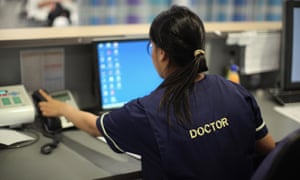
A doctor at the accident and emergency department of Birmingham Queen Elizabeth Hospital.


A doctor at the accident and emergency department of Birmingham Queen Elizabeth Hospital. Photograph: Christopher Furlong/Getty Images

Those who disagree with Hunt’s proposals: ‘The NHS needs those extra 100,000 medics’


I believe having a diversity of doctors and nurses in the NHS is a good thing. Our patients are not exclusively UK-born or speak English as a first language, so why should our doctors?


There are excellent doctors, and not-so-excellent doctors. There are doctors who are wholeheartedly invested in the NHS, what it stands for, what it provides, and some who are not. My experience is that neither of these groups relate to a doctor’s immigration status.


1500 extra medical students a year will not replace 100,000 doctors, particularly in a service that is spectacularly under-staffed as it is. The NHS needs those extra 100,000 medics, regardless of what Jeremy Hunt says or believes.


Becca, 27, junior doctor, Yorkshire and Humber


‘People will just leave after four years’


This will not help the recruitment and retention crisis whatsoever. Unsatisfied with breaking every NHS target in recent years, he’s now picking fights with the people who work tirelessly to keep the NHS going. He is the most hated health secretary, and possibly politician, of recent times.


Hunt’s proposals are absolutely not workable. People will just leave after four years, or, train in European universities, the fees are much less than UK, and allows them freedom to move. We will haemorrhage the brightest and best.


I am leaving for Canada. I have no intention in taking part in the willful destruction of the NHS. Medicine as a career is finished in this country. Rather like our motor industry, we have been mismanaged to the point of rock bottom morale and people are leaving in droves. Several of my colleagues have left for Australia and New Zealand, I wish I had left sooner. If you treat highly intelligent people like this, they will leave.


Zakir Hajat, 30, anaesthetist, Sheffield


‘If I were a student now there is no way I would pursue medicine in the UK’


Hunt’s proposals are insane. We’ve never trained enough doctors or nurses to staff the NHS. We used to have a regular supply of well-trained doctors coming here from the Indian subcontinent, as well as a steady flow of doctors from Australia and New Zealand who would come for a couple of years as our training was excellent. They don’t anymore, because why would they now?


To train enough doctors to be all UK grown will take many, many years. With the haemorrhaging of staff to early retirement or overseas he’ll be lucky to have any kind of useful workforce to maintain what services we provide now. To recruit and retain doctors is easy. You treat them with respect. You offer them reasonable conditions. You pay them fairly, and you train them well. Then they will come and they will willingly work very hard, over and above what is expected or paid for. Treat them the way Hunt is, and they’ll go.


If I were a student now, there is no way I would pursue medicine in the UK. If you treat staff properly, they won’t want to leave anyway. This is home. The vast majority want to live and work here.


Tim Campbell-Smith, 47, consultant surgeon, Sussex


"Diversity is good": your views on plans to end reliance on overseas doctors

3 Ekim 2016 Pazartesi

Jeremy Hunt promises to end NHS reliance on overseas doctors after Brexit

Jeremy Hunt is to pledge that the NHS in England will be “self sufficient” regarding doctor numbers after Britain leaves the European Union, as he sets out a package of measures aimed at reducing its reliance on foreign-trained medics.


The health secretary will use his speech to the Conservative party conference on Tuesday to promise that medical schools in the UK will be allowed to offer up to 1,500 extra training places every year, and released figures that said that one in four NHS doctors have been trained abroad.


Hunt will stress that foreign-trained doctors do a “fantastic job”, and say that “we want EU nationals who are already here to be able to stay post-Brexit” – but he will also ask: “Is it right to import doctors from poorer countries that need them while turning away bright home graduates desperate to study medicine?”


He wants NHS England to reach the target in 2025. “Of course it will take a number of years before those doctors qualify, but by the end of the next parliament we will make the NHS self- sufficient in doctors,” Hunt is to add.


Remain campaigners warned in the run-up to the referendum that the NHS, which relies heavily on foreign staff, would be hit if EU workers could no longer travel freely to work in the UK. Data from the General Medical Council records that 30,472 doctors come from the EU and other countries in the European Economic Area, while 71,139 were trained elsewhere in the world outside the UK.


Hunt hopes that by boosting the number of places now, he will have a pipeline of British-trained doctors ready in time. There is rapidly accumulating evidence that doctor shortages are causing serious problems, including the part-closure of A&E units at hospitals in Chorley, Lancashire and Grantham in Lincolnshire.


The move represents a partial U-turn by Hunt, as until now he has repeatedly responded to evidence of understaffing by pointing out that the NHS in England has more doctors now than when the coalition took office in 2010. Currently half of those people applying for medical school are rejected, because of the limits on the number of places.


Jeremy Hunt


A Royal College of Physicians report last month, which said the NHS was understaffed and overstretched, irritated health secretary Jeremy Hunt. Photograph: Carl Court/Getty Images

Before individual medical schools are allowed to lift the cap on training places, they will have to show the government they are taking steps to attract students from deprived economic backgrounds.


Trainee doctors will have to work in the NHS for four years before they can accept overseas postings in an attempt to avoid a rapid exodus of people trained in the UK. Many young doctors head to Australia and elsewhere overseas, and increasing numbers say they want to go abroad as the protracted junior doctors dispute has dragged on.


Medical organisations welcomed what the British Medical Association said was Hunt’s belated recognition that the NHS is under-doctored, especially in specialities such as A&E, paediatrics, anaesthesia and psychiatry. But they warned that the health service would not benefit from the extra medics for another decade and that others were were needed to tackle doctor shortages.


“While it is welcome that he has finally admitted the government has failed to train enough doctors to meet rising demand, this announcement falls far short of what is needed”, said Dr Mark Porter, the BMA’s chair. “We desperately need more doctors, particularly with the government plans for further seven-day services, but it will take a decade for extra places at medical school to produce more doctors. This initiative will not stop the NHS from needing to recruit overseas staff.”


The Department of Health is expected to publish a consultation paper on the details of the plans later in the autumn.


Hunt was irritated last month when a report from the Royal College of Physicians, which represents hospital doctors, said that the NHS was “underfunded, under-doctored [and] overstretched.”


Welcoming Hunt’s plan, RCP president Prof Jane Dacre said: “The RCP has long argued that rota gaps and staff shortages are the greatest threat to patient safety and have significantly contributed to low morale among junior doctors. The NHS needs more doctors, and this dramatic increase in medical school places will help relieve many of the pressures faced by the NHS in the long-term, and support a more sustainable workforce.”


Dr Simon Clark, workforce officer for the Royal College of Paediatrics and Child Health, cautioned that “with 30% of doctors deciding to take a break from medicine in the UK for a period of time before they take up speciality training, government must address the retention, attrition and career hiatus that occurs.” Ministers would need to ensure that the extra doctors would be deployed in the areas of England which are facing the greatest shortages, he added.


Labour’s shadow health secretary, Diane Abbott, said: “It appears that Hunt has taken a chapter from the Hard Brexiter’s Myth book. The idea that we can be self-sufficient in medical staff is nonsense.”


“The true picture is that the NHS has never been in a more perilous state and the Tories are cutting the health budget by £22bn.


“The reality is that Hunt has lost the trust of the medical profession and is the least popular health minister in recent history. Morale among NHS staff is at rock bottom and Hunt has shown once again just how little regard he has for the hard-working people that keep our health service running.”


The first of the extra places, which could eventually increase the number of trainee doctors by up to a quarter, will start to become available from 2018-19.


The Department of Health, which subsidises medical students by funding their clinical placements in hospitals, will pay for the expansion from its existing budget.


It plans to offset part of the cost – expected to be £100m in total by 2021 – by forcing foreign medical students to pay for their own clinical placements.


That will increase fees for medical school for students from overseas – but Department for Health sources pointed out that the current £9,000 a year is far lower than the fees for other prestigious international medical schools.


Jeremy Hunt promises to end NHS reliance on overseas doctors after Brexit

17 Haziran 2014 Salı

NHS trusts offered incentives to recoup overseas patient fees

NHS doctor fills out paperwork

At current, NHS trusts have no incentive to report a person as an EU visitor, according to overall health secretary Jeremy Hunt. Photograph: Christopher Thomond


Fiscal incentives are to be utilised to encourage NHS trusts to report remedy of EU nationals, as portion of a drive to recoup up to £500m a yr from overseas patients.


The well being secretary, Jeremy Hunt, announced on Tuesday that trusts will be supplied a premium of 25% on prime of the tariff they acquire for delivering treatment method if they report that it was offered to a citizen of one particular of the 27 other EU member states.


Hunt mentioned that the move would “much more than spend for itself” because the NHS is ready to reclaim the price of remedy from other member states beneath extended-standing reciprocal arrangements via the use of a European Wellness Insurance coverage Card (Ehic).


At existing, the United kingdom pays other EU nations far more than £800m a 12 months to cover the value of Britons receiving healthcare on holidays and other visits abroad, but receives back only £29m for nationals of the EU and European Financial Area taken care of right here.


When sufferers from outdoors Europe are integrated, the NHS takes in only £73m of the £500m a 12 months believed to be due, which is all around 16% of the complete, mentioned Hunt.


Speaking at a Westminster lunch, Hunt stated the shortfall stemmed from the truth that recording remedy of foreign nationals represents an further administrative burden for hospitals and surgeries, but they acquire the same payments beneath the NHS tariff scheme as they would if the patient was British.


Hunt said: “Independent study suggests there is about half a billion quid in money we need to be collecting from global guests who use the NHS. We only collect around sixteen% of that funds – £73m a 12 months.


“I have no difficulty whatsoever with foreigners utilizing our NHS, as long as they contribute to it either via taxes or via paying expenses. We require to be significantly greater at collecting that income.”


Hunt additional: “We ought to be receiving a great deal far more money, but we do not. The explanation is since trusts have no financial incentive to report an individual as an EU visitor. It truly is an additional complication and if they never report it they get the NHS tariff.


“These days, we are announcing a premium on the tariff for trusts who report EU guests employing their providers, to pay for the added administrative costs and to produce economic incentives so we get suitable reporting and we get the money.


“My target is that by this and subsequent measures we will announce for non-EU visitors, we will raise around half a billion lbs a yr to spend for additional medical professionals and nurses on the frontline.”


The new 125% tariff for treating EU nationals will be offered to NHS trusts in England.


NHS trusts offered incentives to recoup overseas patient fees