tops etiketine sahip kayıtlar gösteriliyor. Tüm kayıtları göster

14 Kasım 2016 Pazartesi

GSK tops list of drug firms improving global access to medicine

GlaxoSmithKline has come top of a league table that monitors the availability of medicine in developing countries, with fellow UK drugmaker AstraZeneca making it into the top 10.


The non-profit Access to Medicine foundation, which compiles the biennial index of drug companies, warned that while the availability of medicines is improving, the industry needs to do more on affordable pricing and the fight against corruption. Jayasree Iyer, executive director of the foundation, said: “Now is the time to step up those efforts.”


Overall, drugmakers have 850 products on the market for the 51 worst diseases in low and middle-income countries. They are developing another 420. But only 5% of products are covered by pricing strategies that were deemed affordable for different population groups within countries.


Iyer said there was no area where drugmakers had gone backwards, but noted that affordable pricing and misconduct were “static”. Breaches of laws or codes relating to corruption, unethical marketing and anti-competitive behaviour continue to arise.


GSK came first in the rankings for the fifth time, followed by Johnson & Johnson of the US, Swiss company Novartis and German group Merck. AstraZeneca jumped from 15th to seventh position after introducing a new affordability-based pricing strategy and expanding its Healthy Heart Africa programme, which aims to treat 10 million people for hypertension, or high blood pressure, over the next decade. The company was in sixth place in 2008 but then fell behind in several areas.
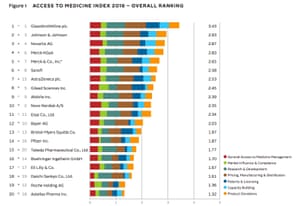


Access to Medicine Index.


Access to Medicine Index. Photograph: Access to Medicine Foundation

GSK accounted for the most research and development projects in areas of great need but with low commercial incentive, followed by AbbVie and Johnson & Johnson. The British drugmaker also topped the index for considering affordability when setting prices. Its top ranking came despite a damaging bribery scandal in China in 2014, for which it was fined £300m. The scandal prompted the company to overhaul its sales practices.


Iyer expressed some concern about GSK chief executive Sir Andrew Witty’s departure next March and what it could mean for the company’s efforts. He will be succeeded by Emma Walmsley, who currently runs GSK’s consumer healthcare business.


The index assesses the world’s 20 largest pharmaceutical companies on a range of measures, including their willingness to discount prices in poor countries, research on neglected tropical diseases, lobbying, patent policies, breaches of codes of conduct, corruption or bribery, transparency and conduct in clinical trials.


The Access to Medicine foundation is funded by the UK and Dutch governments and the Bill and Melinda Gates Foundation. It says its framework is used by companies to draw up access to medicine strategies.


GSK tops list of drug firms improving global access to medicine

27 Eylül 2016 Salı

China tops WHO list for deadly outdoor air pollution

China is the world’s deadliest country for outdoor air pollution, according to analysis by the World Health Organisation (WHO).


The UN agency has previously warned that tiny particulates from cars, power plants and other sources are killing 3 million people worldwide each year.


For the first time the WHO has broken down that figure to a country-by-country level. It reveals that of the worst three nations, more than 1 million people died from dirty air in China in 2012, at least 600,000 in India and more than 140,000 in Russia.


At 25th out of 184 countries with data, the UK ranks worse than France, with 16,355 deaths in 2012 versus 10,954, but not as poorly as Germany at 26,160, which has more industry and 16 million more people. Australia had 94 deaths and 38,043 died in the US that year from particulate pollution.


Maria Neria, director of the WHO’s public health and the environment department, told the Guardian: “Countries are confronted with the reality of better data. Now we have the figures of how many citizens are dying from air pollution. What we are learning is, this is very bad. Now there are no excuses for not taking action.”


Gavin Shaddick, who led the international team that put together the data, said: “Globally, air pollution presents a major risk to public health and a substantial number of lives could be saved if levels of air pollution were reduced.”


Deaths attributable to ambient air pollution

Sixteen scientists from eight international institutions worked with WHO on the analysis, which gathered data from 3,000 locations, using pollution monitors on the ground, modelling and satellite readings.


They looked at exposure to tiny particulates 2.5 microns in size, known as PM2.5s, which penetrate the lungs and are the air pollutant most strongly associated with an increased risk of death. “The real driver of ill health is ultra-fine particles, 2.5s – they have the ability to permeate the membrane of the lungs and enter our blood system,” said Shaddick, who is based at the University of Bath. “Increasingly there is an understanding that there are not just respiratory diseases but cardiovascular ones associated with PM2.5s.”


In the UK more than 90% of the population lives in areas with levels of PM2.5s above the WHO’s air-quality limits of 10 micrograms per cubic metre for the annual mean. The government is in the high court on 18 and 19 October facing a legal challenge by environmental law group ClientEarth, which says ministers’ clean-up plans are inadequate.


Globally, 92% of the population breathes air that breaches WHO limits but the world map of deaths caused by PM2.5s changes when looked at per capita. When ranked by the number of deaths for every 100,000 people, Ukraine jumps to the top of the list at 120.


It is followed by eastern European and former Soviet states, and Russia itself, probably due to a legacy of heavy industry in the region. China drops down to 10th, at 76 per 100,000, and India falls to 27th, with 49 per 100,000.


Worst and cleanest countries per capita

Most of the air pollution comes from cars, coal-fired plants and waste burning but not all of it is created by humans. Dust storms in places close to deserts also contribute to dirty air, explaining partly why Iran is at 16th highest for total deaths, at 26,000 a year.


Most of the total deaths worldwide – two out of three – occur in south-east Asia and the western Pacific, which includes China, Vietnam, Japan, Australia, South Korea and small Pacific island states.


Shaddick said: “We might think of [pollution in] Beijing as being very high, but when you fill in the gaps between the big [Chinese] cities, [air pollution in] regions [is] remarkably high compared to the WHO limits [10 grams per cubic metre for the annual mean], up in the 50s and 60s. That’s something we in the west can’t even comprehend. That was probably a bit of a shock [to me].”


The Pacific states of Brunei Darussalam, Fiji and Vanuatu have the lowest number of deaths from air pollution, the WHO found.


Anne Hidalgo, mayor of Paris and chair-elect of a network of cities combating climate change, said: “Fighting pollution is one of my top priorities as mayor of Paris. It is a vital public health issue and all mayors should take on their responsibility to deliver bold actions.”


The city of Paris voted on Monday to ban cars along a stretch of the river Seine to cut pollution, defeating a minority rightwing opposition.


Hidalgo added: “I have said it before and am saying it again: we cannot negotiate with Parisians’ health.”


Neira said Canada and Scandinavian countries deserved praise for curbing air pollution and singled out France too. “France is taking a lot of action, Paris is taking aggressive measures: aggressive in the good sense. [It] maybe unpopular because it’s for the health of people but they are putting some restrictions on individuals. We all need to understand this is a matter of public health,” she said.


China tops WHO list for deadly outdoor air pollution

15 Temmuz 2014 Salı

Cleveland Clinic Once Yet again Tops Heart Hospital Rankings

For the twentieth yr in a row the Cleveland Clinic manufactured the #one spot on the US Information &amp Planet Report‘s yearly ranking of heart hospitals. The Cleveland Clinic was 4th in the total class. For the initial time the Mayo Clinic was the top hospital total, beating long-time rivals Massachusetts Standard and Johns Hopkins.


As I’ve stated prior to, I am not a huge fan of these type of ratings. But irrational as they could be they often have enormous sensible significance.


Here’s the prime twenty:


  1. Cleveland Clinic

  2. Mayo Clinic

  3. New York-Presbyterian University Hospital of Columbia and Cornell

  4. Duke University Hospital

  5. Brigham and Women’s Hospital

  6. Massachusetts Standard Hospital

  7. Hospitals of the University of Pennsylvania-Penn Presbyterian

  8. Cedars-Sinai Health care Center

  9. St. Francis Hospital

  10. Mount Sinai Hospital

  11. NYU Langone Medical Center

  12. UCLA Healthcare Center

  13. Northwestern Memorial Hospital

  14. Texas Heart Institute at St. Luke’s Episcopal Hospital

  15. Barnes-Jewish Hospital/Washington University


Rounding out the top twenty, Emory University Hospital and Johns Hopkins Hospital tied for 16th location. They were followed in 18th spot by a 3-way tie between Houston Methodist Hospital, Scripps La Jolla Hospitals and Clinics, and Stanford Hospital and Clinics.


Cleveland Clinic Once Yet again Tops Heart Hospital Rankings