firms etiketine sahip kayıtlar gösteriliyor. Tüm kayıtları göster

12 Nisan 2017 Çarşamba

UK supreme court denies tobacco firms permission for plain packaging appeal

All cigarettes sold in the UK must have standardised packaging from next month after the supreme court refused permission to the tobacco industry to appeal against the new laws.


This is the final domestic legal decision, meaning that plain packaging of cigarettes will come into force on 20 May, the Department of Health said.


Rules requiring tobacco to be packaged in drab, dark brown packs with no graphic branding came into effect in May 2016, with branded packs subsequently being phased out.


Tobacco companies went to the supreme court after the court of appeal last November rejected their attempt to prevent the introduction of mandatory plain packaging of cigarettes in the UK.


British American Tobacco, Imperial Brands, Japan Tobacco International (JTI) and Philip Morris International claimed that the law would infringe their human and intellectual property rights.


The new packs are the same shape, size and colour, with two thirds of the front and back surfaces covered by pictorial health warnings, and written warnings on the sides.


The health secretary, Jeremy Hunt, welcomed the supreme court’s decision, saying: “Standardised packaging will cut smoking rates and reduce suffering, disease and avoidable deaths.”


Smoking remains the biggest cause of premature mortality in the UK, killing more than 100,000 Britons annually, despite Public Health England figures showing a decline in the number of smokers to fewer than one in six adults.


Widespread use of e-cigarettes, nicotine patches and gum helped a record 500,000 smokers kick the habit in 2015, the agency said, bringing the number of ex-smokers in England to 14.6 million.


In 1974, more than half of men in Britain smoked, but that fell in England to just 19.1% by 2015. The rate for women declined from just over 40% in 1974 to only 14.9% in 2015.


The chief medical officer, Dame Sally Davies, said: “Smoking is the biggest preventable killer in this country and this legislation will save lives, so I am thrilled that the tobacco industry will not be allowed to appeal. After years of hard work, I look forward to seeing this policy now brought in, and smoking numbers fall even further.”


Deborah Arnott, chief executive of the health charity Ash (Action on Smoking and Health UK), said the ruling finally ended attempts by “big tobacco” to overturn the UK legislation on standardised packaging.


“This is the latest in a long line of crushing legal defeats for the tobacco industry. Over the years the industry has squandered many millions of pounds of its own money in futile legal challenges, but worse still it has wasted public time and money, which could have been much better spent improving public health.”


In a sign that tobacco companies acknowledge that the tide of public opinion is turning against them, the boss of Marlboro maker Philip Morris has predicted a “phase-out period” for cigarettes.


André Calantzopoulos made the comments in November as the company launched a new product it claimed was less harmful than traditional smoking. The iQos heats tobacco but does not burn it, releases fewer toxins and is capable of replacing cigarettes in the long term, according to Philip Morris.


However, campaigners and analysts questioned whether e-cigarettes or other products such as the iQos would ever replace cigarettes.


Arnott said at the time: “Philip Morris claims to be moving towards a post-smoking future but, like other tobacco companies, it is still actively promoting smoking around the world, using methods that would be illegal in the UK.”


UK supreme court denies tobacco firms permission for plain packaging appeal

28 Ocak 2017 Cumartesi

Drug firms ‘put lives of cancer patients at risk’ as out-of-patent prices are inflated

Drug companies have been accused of profiteering by raising the prices of out-of-patent cancer medicines that cost just pence to make, inflating the bills of the cash-strapped NHS by hundreds of millions of pounds.


Academics say the prices of 14 cancer drugs have increased by between 100% and nearly 1,000% over the past five years in the UK. These are all generic drugs where the patent has expired, which means they can be made for little more than the cost of the raw ingredients.


But, say experts who presented their findings at the European Cancer Congress in Amsterdam, generic drug companies have been price-gouging, just as Turing Pharmaceuticals was found to have done in the US with Daraprim, a 70-year-old drug used in Aids treatment. The price rose from $ 13.50 to $ 750 to universal outrage and became an issue in the presidential election. Turing CEO Martin Shkreli was dubbed the most hated man in America.


Andrew Hill from the department of pharmacology and therapeutics at the University of Liverpool, said the price increases in the UK would be costing the NHS a huge amount of money at a time when it has said it may have to ration 20% of the very expensive new cancer drugs coming on the market. “This figure will probably be in the high hundreds of millions of pounds per year, or possibly £1 billion,” he said.


He and co-author Melissa Barber, from the London School of Hygiene and Tropical Medicine, funded by the World Health Organisation and the Open Society Foundation, could not calculate the exact costs to the NHS because they did not have access to data from hospitals, where cancer drugs are usually prescribed. But they also looked at the increase in prices of all types of generic drugs – not just cancer – that are prescribed by GPs and pharmacists and found that the NHS paid £380m more in 2015 than it had five years earlier, as generic companies pushed up their prices. The hospital bill is likely to be much more.


Hill said the rises were going unnoticed because they were “under the radar”. The NHS was not keeping an eye on the steady increases year on year. “They are not negotiating well enough,” he said. “They should be looking at any company that starts raising the price of any drug.”


Among the drugs with price rises is melphalan for ovarian cancer, a drug invented by the UK company GlaxoSmithKline and then passed with a number of other cancer drugs that were going out of patent to Aspen Pharmaceuticals, a South Africa-based generics company, in 2009. GSK took a 16% shareholding in Aspen at the time.


Hill and Barber say the price of melphalan in the UK went up from 55p for 2mg in 2011 to £1.82 in 2016, a rise of 230%. The NHS did not contest it, unlike in Italy. There, Aspen negotiated a deal in 2014 to raise the price of the drug by up to 1,500%, having threatened to stop supplying the ovarian cancer drug to patients altogether. The Italian competitions authority fined the company nearly $ 5.5m last October for its behaviour. “The negotiation strategy adopted by Aspen was so aggressive as to reach the credible threat of interrupting the direct supply of the drugs to the Italian market,” said the authority’s report.


Australia, New Zealand, France and Brazil have also faced shortages of Aspen’s drug, says Hill. Aspen did not return calls asking for the reason for the shortages.


In France, three women died after being given an alternative drug to melphalan. The drug, cyclophosphamide, should have been safe, because it was used before melphalan came on the market. An investigation is now under way into what happened.


The biggest price rise in the UK that the team found was also for an Aspen drug. The cost of busulfan for chronic myeloid leukaemia to the NHS rose from 21p for 2mg in 2011 to £2.61 in 2016, an increase of 1,143%.


Aspen’s share price rose more than 650% from 2009 to last year. GSK sold its shares in Aspen in three tranches – the last one in September – netting about £1.5bn.


The multinational giant Pfizer was fined £84m in the UK in December for conspiring with a generic company, Flynn Pharma, to raise the price paid by the NHS by 2,600% for an anti-epilepsy drug that came off-patent. The Competitions and Markets Authority said it had exploited the fact that the NHS had no alternative, because no other company was making it. In the wake of that case, a bill is going through parliament to give the Department of Health powers to investigate when the price of a drug goes up without clear justification.


Sarah Wollaston, the Tory MP who chairs the health select committee, said the research findings were concerning. “It is unacceptable for drug companies to artificially inflate the cost of drugs. This will inevitably result in less funding being available for other vital treatments,” she said.


Ian Banks, representing the patient organisation the European Men’s Health Forum at the conference, said the price rises were more than outrageous. “Behind these statistics there is a patient not getting treatment that could save their lives or at the very least improve their quality of life. That is unacceptable,” he said.


Mia Rosenblatt from Breast Cancer Now said: “We’d be extremely concerned by any suggestion of companies raising the price of tamoxifen and other generic drugs, which would only add to the current strain on the NHS.


“Part of the understanding – by health bodies – of the high cost of new drugs is based on the knowledge that there is a limited time for drug companies to see return on their investments and that these drugs will be available at a much cheaper rate in due course.


“Significant driving up of the prices of generic drugs would be of real concern and we therefore support the government’s activity to address this possibility through the Health Services Medical Supplies Bill.”


The British Generic Manufacturers Association said that most of the drugs highlighted in the study had no competition, because there was only one supplier. “That is because the total market size is too small to be attractive for generic companies to enter, since they would not recoup the million-pound plus costs of developing, testing and registering a new generic medicine,” it said in a statement.


Hill countered that the cost of developing a new generic drug is not high and that cheaper versions than those sold to the NHS could be imported from India.


Drug firms ‘put lives of cancer patients at risk’ as out-of-patent prices are inflated

5 Ocak 2017 Perşembe

NHS groups "paying millions to private firms that block GP referrals"

NHS organisations are paying millions of pounds to private firms that stop patients being referred to hospital by their GPs, an investigation has found.


Controversial referral management centres are used by some clinical commissioning groups (CCGs) to scrutinise patient referrals to hospitals by family doctors.


Supporters say they can reduce inappropriate referrals, saving the NHS money, but critics argue that adding an extra layer of scrutiny risks delaying diagnosis. There is also doubt over the effectiveness of such schemes.


In an investigation, the British Medical Journal (BMJ) sent freedom of information requests to all 211 CCGs in England. Of the 184 that responded, 72 (39%) said they commissioned some form of referral management scheme.


Almost a third (32%) of the schemes are provided by private companies, while a further 29% are provided in-house and 11% by local NHS trusts. Some 69% of the CCGs with schemes gave details of operating costs. These CCGs combined have spent at least £57m on schemes since April 2013.


Most CCGs were unable to provide evidence showing the scheme saved money. Only 14% could show that the scheme had saved more cash than it had cost to operate, while 12% showed that their schemes had not saved money overall.


Meanwhile, 74% of CCGs (53 groups) failed to supply figures to show whether any money had been saved, the BMJ reported.


Some CCGs did not collect data on savings, some said their referral scheme was designed not to save money but to improve the quality of referrals, and others declined to disclose details of savings on the grounds of commercial confidentiality.


Overall, there were 93 referral management schemes in operation across 72 CCGs, with some CCGs having more than one.


Dr Richard Vautrey, deputy chairman of the British Medical Association’s GPs committee, told the BMJ: “[CCGs] are leaping at these schemes without any clear evidence of benefit. They are just hopeful that it might reduce their costs.


“It is a very short-term approach to healthcare management. We need to see much more evaluation … and not just keep making the same mistakes year after year. As public bodies, there should be an expectation on every CCG to account for what it is doing.”


Vautrey said some schemes were helpful because they gave GPs rapid access to advice from local specialists.


Graham Jackson, co-chair of NHS Clinical Commissioners, the membership organisation representing CCGs, said referral management was only one way of managing demand for services.


“In many cases they provide a useful and effective role which is more than a redirection service,” he said. “CCGs will balance the cost of commissioning with the benefit they provide to GPs and patients in terms of peer review, education, caseload management and choice.”


In October, Roberta Blackman-Woods, Labour MP for City of Durham, criticised a local scheme to screen referrals for conditions including cardiology, gynaecology and gastroenterology.


The North Durham CCG has awarded a contract to the private firm About Health to manage referrals.


NHS groups "paying millions to private firms that block GP referrals"

22 Kasım 2016 Salı

Private firms should have bigger role in care says NHS leader

A senior NHS leader has sparked controversy by urging ministers and health service bosses to let private firms treat more patients in a bid to cut hospital waiting lists.


Stephen Dalton, the chief executive of the NHS Confederation, said Theresa May and Jeremy Corbyn should stop denying that private sector health companies are “a force for good” in the NHS. They are not “bogeymen”, look after patients well and should start treating more than the 10 million patients a year they are already paid for out of the NHS’s budget, he said.


The service is under such intense pressure that private firms should urgently be handed a greatly enhanced role, just as Tony Blair’s Labour government did in the early 2000s, in order to help it cope with fast-rising demand, Dalton argues in an article in Tuesday’s Guardian.


“What was seen a decade or so ago as a sensible way of attracting investment, and helped get average waiting times down from 18 months to 18 weeks, is now seen as a political no-go area, with the Tories and Labour locked in an arms race over who has used the private sector the least while in office”, Dalton writes.


“This is a con-trick, when the reality is that the private sector has been used for decades to help sustain a health service which is free at the point of use and available to all based on need and not ability to pay. So let’s stop pretending that private sector involvement in the NHS is a uniformly bad thing; it isn’t.”


Dalton also wants private firms to help provide the “billions” of pounds needed to build a new generation of hospitals and clinics as part of the NHS’s Sustainability and Transformation Plans, though acknowledged that lessons should be learned from Labour’s use of the discredited Private Finance Initiative.


The Confederation represents most of England’s 238 NHS acute, mental health, ambulance and community services trust but also, through its NHS Partners Network, private firms who have been awarded contracts to treat patients.


But Dalton’s views prompted warnings that the private sector’s track record in the NHS made it unfit to expand its role and that handing it more contracts would pose “serious dangers” to patient care. The firm Coperforma recently lost its contract to ferry tens of thousands of patients in Sussex to and from hospital after a string of blunders sparked huge concern.


Two former health ministers said they shared Dalton’s belief that private firms can deliver real benefits for patients and his belief that “the public sector doesn’t have the monopoly on caring.”


“What matters is what works best for patients”, said Conservative MP Dr Daniel Poulter, who was a health minister until May 2015 and is also doctor in the NHS. The fact that GPs and pharmacies work closely with the NHS but operate outside it shows that the NHS has always been a public/private partnership, he added.


Liberal Democrat MP Norman Lamb, who was also part of the health ministerial team during the coalition, said: “We should focus on the quality of care and equal access rather than on who provides it. Around the country there are good collaborations between statutory and independent sector, which I welcome.”


But both MPs said they feared that a greater private sector role could threaten the drive to integrate NHS and social care services, which the government has pledged to deliver by 2020. “While there is undoubtedly considerable benefit to the approach taken by Tony Blair of using the private sector to help the NHS to increase capacity, the history of wider private sector NHS commissioning tells us that private providers tend to ‘cherry pick’ the most profitable services to deliver,” said Poulter.


“So there is undoubtedly a serious danger that widespread commissioning of alternative – private – providers will result in greater fragmentation of the health and care system at the very time when there is need for increasing integration of services.”


Lamb warned against relying on private capital to build new NHS premises. “We must never again allow the outrageous profiteering under the last Labour government’s Private Finance Initiative, which has mortgaged the future of the NHS to the tune of tens of billions of pounds.”


Labour rejected Dalton’s call and said that problems with contracts previously awarded to private firms meant they could not be trusted to expand their role.


“In recent times private providers have utterly failed to offer patients the quality of care they would expect. What’s more when the priority should be public investment in the NHS, privatisation such as the selling off of NHS Professionals announced last week could very well end up costing the taxpayer more”, said Jon Ashworth, the shadow health secretary.


Dalton’s plea was prompted by ministers denying the NHS enough money to do its job properly, he added. “It is indicative of the government’s neglect of our NHS that senior figures are saying we now must resort to the private sector for the investment our NHS so badly needs”.


At last month’s Conservative annual conference Theresa May used her set piece speech to deny Labour claims that her government was privatising the NHS. “Every election, they say we want to privatise the NHS – and every time we have protected it. In fact, the party that expanded the use of the private sector in the NHS the fastest was not this party, but the Labour Party”, she said.


The Department of Health said only that “Any decisions about use of the private sector are taken by local doctors who know their patients best. We are clear that patients should be able to access the best possible treatments based on quality of care not the provider.”


Private firms should have bigger role in care says NHS leader

14 Kasım 2016 Pazartesi

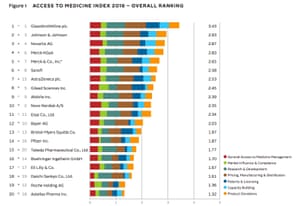
GSK tops list of drug firms improving global access to medicine

GlaxoSmithKline has come top of a league table that monitors the availability of medicine in developing countries, with fellow UK drugmaker AstraZeneca making it into the top 10.


The non-profit Access to Medicine foundation, which compiles the biennial index of drug companies, warned that while the availability of medicines is improving, the industry needs to do more on affordable pricing and the fight against corruption. Jayasree Iyer, executive director of the foundation, said: “Now is the time to step up those efforts.”


Overall, drugmakers have 850 products on the market for the 51 worst diseases in low and middle-income countries. They are developing another 420. But only 5% of products are covered by pricing strategies that were deemed affordable for different population groups within countries.


Iyer said there was no area where drugmakers had gone backwards, but noted that affordable pricing and misconduct were “static”. Breaches of laws or codes relating to corruption, unethical marketing and anti-competitive behaviour continue to arise.


GSK came first in the rankings for the fifth time, followed by Johnson & Johnson of the US, Swiss company Novartis and German group Merck. AstraZeneca jumped from 15th to seventh position after introducing a new affordability-based pricing strategy and expanding its Healthy Heart Africa programme, which aims to treat 10 million people for hypertension, or high blood pressure, over the next decade. The company was in sixth place in 2008 but then fell behind in several areas.


Access to Medicine Index.


Access to Medicine Index. Photograph: Access to Medicine Foundation

GSK accounted for the most research and development projects in areas of great need but with low commercial incentive, followed by AbbVie and Johnson & Johnson. The British drugmaker also topped the index for considering affordability when setting prices. Its top ranking came despite a damaging bribery scandal in China in 2014, for which it was fined £300m. The scandal prompted the company to overhaul its sales practices.


Iyer expressed some concern about GSK chief executive Sir Andrew Witty’s departure next March and what it could mean for the company’s efforts. He will be succeeded by Emma Walmsley, who currently runs GSK’s consumer healthcare business.


The index assesses the world’s 20 largest pharmaceutical companies on a range of measures, including their willingness to discount prices in poor countries, research on neglected tropical diseases, lobbying, patent policies, breaches of codes of conduct, corruption or bribery, transparency and conduct in clinical trials.


The Access to Medicine foundation is funded by the UK and Dutch governments and the Bill and Melinda Gates Foundation. It says its framework is used by companies to draw up access to medicine strategies.


GSK tops list of drug firms improving global access to medicine

17 Haziran 2014 Salı

Hundreds of thousands of NHS data sold to insurance coverage firms

The report discloses that patient details was sold to 178 personal firms on 588 occasions in between 2005 and 2012, with product sales to pharmaceutical firms and at least 5 major insurance companies, who used it to adjust consumer premiums.


Shockingly, in two situations, auditors had been unable to track down in which the NHS data had been passed.


The overview was led by Sir Nick Partridge, a non-executive director of the Wellness and Social Care Information Centre (HSCIC), which is now in charge of NHS information.


The transactions were dealt with by the NHS Details Centre, its predecessor entire body.


Sir Nick stated: “The HSCIC have to discover lessons from the loosely recorded processes of its predecessor organisation. The public simply will not tolerate vagueness about healthcare information that could be intensely private to them. We exist to guard their data and we have to earn their trust by demonstrating scrupulous care with which we deal with their personal information.”


Even though information did not identify sufferers, in some instances it would have been attainable to “deduce” which patients the data referred to, although this is unlawful, the evaluation found.


It concluded that “there had been considerable administrative lapses in recording the release of data. In some circumstances the choice making process was unclear and data of choices incomplete when managing health-related data this is unacceptable.”


Phil Booth, from privacy campaigners MedConfidential, stated: “The government says it will quit the sale of patient records to insurers, but what about the hundreds of thousands that have already been sold? All business reuse contracts need to be shut down instantly and all our information that should never have been given away must be deleted.”


The review calls for a series of changes to tighten controls of information and improved transparency about the use of info.


The report says three insurance coverage businesses – Scor Worldwide Life Uk, RGA Uk Solutions and Milliman – which hold recent patient information have been ordered to delete their information.


At least two a lot more insurance coverage firms, Very first Help and Pacific Existence, previously had accessibility to aggregate data, the HSCIC mentioned.


None had entry to named patient data. Information was utilized to set premiums for types of consumers, not distinct people.


The disclosures in February about the dealing with of hospital information emerged amid growing worries about plans for a nationwide database which will carry together information from GP data.


The programme was due to be launched in Could, but has been put on hold until next year as even more controls had been drawn up, and will comply with a number of neighborhood pilot schemes.


The HSCIC board stated it had accepted Sir Nick’s suggestions in total.


Helen White, Head of Safety at the Association of British Insurers, mentioned the sector supported the findings.


She mentioned: “Insurers do not want or use data that enables them to recognize people.


“They are interested only in information that demonstrates population trends in health, such as trends in how frequent specific illnesses are, and trends in recovery from specific illnesses.”


Hundreds of thousands of NHS data sold to insurance coverage firms

25 Mart 2014 Salı

60+ Firms have Policies to Get rid of Pig Gestation Crates: Discover Out Which Ones

Gestation crates confine pregnant sows to cages tiny ample that they can not flip around in. The move to end gestation crates will call for a significant overhaul of the pork industry.  Thanks to readers requests on my earlier weblog on this issue, I have received a response today from each the Humane Society and Dominos representatives to get the update on regardless of whether or not Dominos has any plans on refusing to allow gestation crates for their pork products (you know the source for your sausage and pepperoni toppings), here’s a fantastic resource identifying which businesses have committed to moving away from this practice.  See the emails I acquired under this important listing to judge for oneself.


Total Report can be discovered at http://cratefreefuture.com (you can also read exclusively what the firms policy is and when they program to phase out the gestation crates for pigs) 


Foods Company Policies on Gestation Crates


Below is a listing of the 60+ key food organizations with policies to eliminate gestation crates. (See complete report at link above)


McDonald’s


Wendy’s


Burger King


Subway


Denny’s


Dunkin’ Brand names


Sonic Drive-in


Arby’s


Common Mills


ARAMARK


TGI Friday’s


Roundy’s


DineEquity (IHOP &amp Applebee’s)


Chipotle


Campbell Soup


Atlantic Premium


Costco


Sysco


Bon Appétit


Williams Sausage


Smithfield (world’s biggest pork producer)


Kraft Meals (Oscar Mayer)


Quiznos


Harris Teeter


Cracker Barrel


Compass Group


Einstein


Noah Restaurant Group


Kmart


Hormel Food items (top pork producer)


Target Corp.


Carnival Cruise Lines


Believe in House


Maple Leaf (top Canadian pork producer)


Jack in the Box/Qdoba


Brinker (Chili’s, Romano’s, Maggiano’s)


Total Meals


Kroger ConAgra Meals


Wienerschnitzel


Heinz


Safeway


Carl’s Jr./Hardee’s


Hillshire Brand names (Jimmy Dean, Ballpark)


Bruegger’s Bagels


Common Mills


Supervalu


The Cheesecake Factory


Royal Caribbean Cruise Lines


Baja Fresh


Sodexo


Wolfgang Puck


Tim Hortons


Bob Evans Farms


Olymel (best Canadian pork producer)


Metz Culinary


Tyson Meals


Johnsonville Sausage


The Retail Council of Canada (Walmart, Safeway, Loblaw, Metro, Costco, Metro &amp the other largest Canadian merchants)


Au Bon Discomfort


Marriott


Clearly I’m not endorsing nor recommending any of the organizations on this checklist. I’m merely stating that they at least have had the decency to pay attention to public viewpoint about the cruelty to animals and are inclined to eliminate this practice from their suppliers/producers.


Quickly Meals Nation: The Dark Side of the All-American Meal


Electronic mail Responses for an Update on this circumstance obtained three/24/2014:


Hi, Sammy.


Thank you for contacting us. As part of our ongoing commitment to supply our consumers with only best-quality items, we at Domino’s Pizza work diligently with our globe renowned suppliers to make certain they meet or exceed the company’s rigorous requirements with respect to food quality and safety.


We are currently operating this by means of with our suppliers, each and every of whom purchases a percentage of their pork from farmers who do not use gestation crates. Through our suppliers, we assistance hundreds of individual family members farms across the nation.


We also care about the humane therapy of animals. Domino’s Pizza does not personal, increase, transport or procedure the meats utilised for our items, but our suppliers know of our commitment to the humane remedy of animals and the expectations we have of them. Our suppliers meet or exceed business requirements for the humane treatment and processing of the pork utilised in our items.


Tim McIntyre


Vice President, Communications


Description: M:WebMobile AppsGoogle Android &amp AmazonGoogle Android App Iconsdpz_tile-logo_blue-type_114x114.png


=============================================


Hi Sammy,


Thanks for contacting us about this!
Right here is the response from my colleague Josh B. in our Farm Animal Safety division:


“While Dominos has so far been an outlier and remained neutral on the issue, much more than 60 main meals businesses – including Domino’s competitors like Papa John’s – have pledged to boost animal welfare in their supply chains by getting rid of gestation crate confinement. The checklist contains McDonald’s, Burger King, Wendy’s, Costco, Safeway, Oscar Mayer, and dozens far more.


You can see what these organizations have to say about this situation right here.”


Let me know if you have any even more questions!


Very best,


Anna West
Media Relations Manager
The Humane Society of the United States
2100 L Street NW Washington, DC 20037
humanesociety.org


 Second Message from Tim McIntyre at Dominos when I asked him to be more direct:


I did response your question. And it is not a basic “yes or no” query, despite what you may possibly think. The issue to far as well complex for an solution so simplistic.


We are operating by way of the situation with our suppliers.


We are not animal professionals. We feel in taking the guidance of folks who are: veterinarians, researchers and the farmers themselves. There is a constrained provide of pork accessible via farms that provide much more open housing. We do get from individuals farms via our suppliers, and consequently have crate-totally free pork in our supply chain, but aren’t going to make any false claims about our provide.


Except if or till the supply of crate-free pork increases drastically, yes, we program to use these suppliers – as will every major restaurant chain and grocery shop in America. We purchase what is obtainable. The only other alternative is to stop offering pork, which most shoppers are against.


In my personal investigation on this subject, I identified this internet website, which tells an additional side of the story, because there always is yet another side: www.porkcares.org


Tim McIntyre
Vice President, Communications


=============================================


Go to our Wholesome Residing and Natural Remedies Blog


Ironic Truth: Dominos was the proud Official Pizza Sponsor of GroundHog day on 01/31/14.  Just saying!!


60+ Firms have Policies to Get rid of Pig Gestation Crates: Discover Out Which Ones

21 Ocak 2014 Salı

NHS chiefs might request personal wellness firms to assist if there is a patient surge

a hospital operating theatre

Any of the NHS clinical commissioning groups in England could outsource cataract removals, or hip or knee replacements to a personal company. Photograph: Sean Smith for the Guardian


Private firms will be asked to get on some of the NHS’s workload if the support can’t cope with demand this winter, it has emerged, as hospital bosses warned that emergency providers have been on a knife edge.


Professor Sir Bruce Keogh, NHS healthcare director, stated personal organizations would be asked to carry out planned operations in buy to relieve stress on hospitals “when the going gets rough in winter”.


Dame Barbara Hakin, NHS England’s deputy chief executive, has talked to personal companies about the likelihood of them providing “spare capability” to support the services deal with a potential surge in the variety of sufferers ending up in hospital if very cold weather happens.


Keogh told the Commons well being pick committee: “We have started out to seem at how the personal sector might be engaged in the event of a surge by way of hospitals, coming through A&ampE. One particular of the troubles under consideration is when the going will get rough in winter, typically a single of the impacts is on elective care, so waiting lists start off to drift out, so could much more elective care be shifted into the private sector?”


Although the NHS has used private firms just before – to clear backlogs of sufferers waiting for operations – it would be very unusual to bring them in to manage schedule operations, even temporarily. Keogh stated that Hakin “has had meetings not only with the personal sector but with the voluntary sector to see what they could do to support” if the NHS identified itself struggling.


An NHS spokesman explained that could imply any of the 211 GP-led clinical commissioning groups in England outsourcing cataract removals or hip or knee replacements to a private company, but that none have been considered to have signed any contracts so far.


The prospective use of personal firms emerged as the NHS Confederation voiced critical concern that hospitals, specifically A&ampE services, may not be in a position to handle a sudden spike in demand induced by a bout of cold weather.


In a briefing sent to MPs on the select committee, the Confederation, which represents hospitals, warned: “It is clear from our members that urgent and emergency care is on a knife-edge. There are considerable issues about a lack of capacity in the technique to react to a sudden boost in demand for care.


“For instance, although this winter has so far been comparatively mild, our members are concerned about the consequences of any sustained drop in temperatures.”


Also a lot of hospitals continue to be understaffed, it stated. “Our members continue to express significant issues about lack of capacity, notably in terms of staffing. Numerous expressed the see that urgent and emergency care is on a knife-edge.


“While the scenario feels under manage at the moment, there is nervousness about the consequences of a sudden modify in the weather, offered how mild winter has been so far. A cold spell could lead to greatly enhanced stress on our members when there is small slack in the method.”


Whilst hospitals have welcomed the £400m of extra funding for this winter that the well being secretary, Jeremy Hunt, has announced, they think it has come as well late to permit them to retain the services of additional personnel this winter, it explained.


“Our members are even now concerned about the comparatively late release of winter stress funding. This makes arranging and recruitment really hard.”


The Confederation also warned that injections of further funds for emergency care – what it referred to as “sticking-plaster answers” – were not adequate to tackle “the extended-phrase issues the system faces”.


Despite the generally mild winter so far and low levels of flu and norovirus, some hospitals have even now located themselves underneath extreme pressure considering that Christmas, with the two the social-care companies and community-primarily based health providers required to assist keep sufferers out of hospital inadequate, the briefing warned.


An NHS spokesman explained that deals with personal companies could consist of beds in care homes for elderly folks who have been medically well but not yet fit to go house, to assist ease stress on hospital beds.


The influential King’s Fund wellness thinktank additional warned that a lot more overall health organisations had been running into fiscal issues, with 22% of hospitals and 13% of clinical commissioning groups set to end the monetary year in deficit in late March.


Professor John Appleby, the King’s Fund’s chief economist, explained: “The developing quantity of hospitals set to overspend their budgets shows that for some it is no longer attainable the two to sustain the good quality of solutions and balance the books.”


Andy Burnham, the shadow health secretary, explained: “David Cameron promised not to reduce the NHS but that is exactly what is occurring across the nation as NHS organisations struggle to stability the books. As fiscal panic spreads, providers are going downhill.” The coalition’s unpopular £3bn reorganisation of the NHS in England had led to a lot of of the difficulties now currently being noticed, he mentioned.


The Department of Overall health said the NHS had to give better care despite also obtaining to conserve £20bn by 2015. “We have increased the NHS price range in genuine terms, but the NHS need to also turn into far more productive if it is to meet the rapid rise in demand, whilst guaranteeing compassionate care for all in the wake of the Francis inquiry.


“Getting 3,300 more nurses on our wards now than in 2010 is a good issue for individuals,” the spokeswoman stated.


Most hospital trusts had been in a healthier economic place, though some have been being assisted to “get back on track and continue to supply very first-class solutions”, she explained.


NHS chiefs might request personal wellness firms to assist if there is a patient surge

18 Ocak 2014 Cumartesi

Health Insurance Firms See ObamaCare Medicaid Boon


Capitol Reflections

In spite of controversy more than the Reasonably priced Care Act, Congress and lawmakers at state capitols across the country have permitted far more Medicaid sufferers to enroll in managed wellness programs. (Photo credit score: Glyn Lowe Photoworks, 2 Million Views, Thanks)


As the Obama administration touts the need to have for uninsured Americans to signal up for personal coverage through exchanges underneath the Inexpensive Care Act, the insurance coverage industry sees growth in an expanded Medicaid system for the poor below the health law.


This week, the chief executive of the nation’s biggest overall health insurance business and a new examination indicate significant growth ahead for well being programs that have contracts with state Medicaid programs thanks in large portion to President Obama’s signature legislative achievement.


As state budgets have been harm by the stagnant economic climate, lawmakers have turned far more individuals eligible for Medicaid more than to privately-contracted insurance firms. Now, the health law offers a cash infusion of far more than $ 900 billion in federal bucks from 2014 to 2022 to increase Medicaid applications for states interested in the proposition.


“We anticipate to realize strong development by serving in numerous ways: as established Medicaid packages expand by way of the ACA expansions as eligible Medicaid prospects are recognized via the federal and state exchange markets and as the inevitable dual eligible …initiatives commence to form and are implemented,” UnitedHealth Group UnitedHealth Group (UNH) chief executive officer Stephen J. Hemsley stated on the company’s 2013 fourth-quarter and complete-yr earnings phone earlier this week.


Helmsley has purpose for optimism.


Enrollment in wellness plans that have contracts with Medicaid will rise by 20 % this year and by virtually 40 percent from final 12 months to 2016, in accordance to a report this week from Avalere Health, a analysis and advisory companies firm on well being policy issues monitoring the Inexpensive Care Act.


Other major gamers in the Medicaid managed care market consist of Aetna Aetna (AET),  Centene (CNC), Humana Humana (HUM), Wellpoint (WLP) and its Americagroup (AMG) as nicely as a host of Blue Cross and Blue Shield ideas.


“The continuing shift toward Medicaid managed care presents a substantial growth possibility for well being programs that specialize in managing these low-cash flow populations,” mentioned Avalere executive vice president Matt Eyles mentioned in a statement accompanying the examination. “Plans that at the moment operate in Medicaid could see considerable membership growth, and people outside of the Medicaid market till now could achieve industry share by moving into this room.”


This Medicaid funding beneath the Inexpensive Care Act is as opposed to previous efforts to expand Medicaid in that the federal government will pick up the total tab for the 1st three many years. The state gradually has to pick up some expenses in 2017 but by 2020 the federal government is still choosing up 90 percent or a lot more of the Medicaid tab.


It’s a significantly far better funding proposition than the existing Medicaid program that primarily shares the expense in between the states and the federal government. The federal government traditionally picks up a tiny a lot more than half of the price of Medicaid.


Avalere explained 38 states and Washington, D.C. contract with personal managed care programs “to give care to some or all of their Medicaid beneficiaries.”


Health Insurance Firms See ObamaCare Medicaid Boon

17 Ocak 2014 Cuma

South African pharma firms accused of arranging to delay patents law reform

Aids drugs seen in South Africa

Patents on new medicines may possibly be bypassed in South Africa if adjustments to intellectual home law go ahead. Photograph: Krista Kennell/ZUMA/Corbis


Drug firms in South Africa have been accused of preparing a covert, properly-funded campaign to delay the introduction of laws that threaten their earnings. Leaked paperwork demonstrate that pharmaceutical firms planned a $ 450,000 campaign, involving a high-profile consultancy primarily based in Washington, DC, against modifications to intellectual house laws that would allow their patents on new medicines to be bypassed in the interests of public health. This would permit the manufacture of less costly copies of their medicines.


Campaigners accused the global drug giants of trying to derail existence-saving legislation. The trade entire body IPASA (Modern Pharmaceutical Industry Association South Africa), which was coordinating the campaign, explained on Thursday the programs have been no longer going ahead – though it was legitimate for drug organizations to advertise their views in this way.


One particular of the leaked paperwork is an e-mail dated 10 January from a member of IPASA’s executive to representatives of most of the large-name drug businesses operating in South Africa. As agreed in December, it says, “we have moved ahead in identifying a large-calibre consultancy group to work with us”, naming Washington-based mostly Public Affairs Engagement (PAE).


The second document is the proposed PAE approach, involving the creation of an alliance of businesspeople and academics, the placement of prominent editorials in newspapers, and a bid to “distract” access to medicine campaigners “from their personal aggressive campaign”.


The document later names Médecins Sans Frontières (MSF) and the Therapy Action Campaign (TAC), calling them a “coalition that was formed to pressure the government into making [the draft IP policy] in the initial location”.


The stakes are high, says the document. “South Africa is now ground zero for the debate on the value of robust IP protection. If the battle is misplaced right here, the results will resonate. Clearly MSF and related NGOs understand that … With no a vigorous campaign, opponents of strong IP will prevail – not just in South Africa but eventually in much of the rest of the developing world.”


Campaigners mentioned they had been shocked. “What is surprising to us is that it is done so subversively,” stated Julia Hill of MSF. “We have really made an effort to be really transparent. It is disappointing that this is currently being carried out in secret and that this kind of an extraordinary volume of funds is getting spent to interfere with the democratic method.”


Lotti Rutter, a senior researcher at TAC, stated: “We have received substantial concerns in excess of what seems to be fairly a covert and well-funded atempt from foreign sector to delay an essential law reform method happening here in South Africa.”


Val Beaumont of IPASA said the discussions had taken spot but the PAE proposal had not been accepted. “It is a really, quite essential situation to us and it will be to any of the knowledge-primarily based organisations,” she stated. “There was a large concern that it would be rushed.” It was Ok for an organisation to have a PR company to support place across its views, she said.


South African pharma firms accused of arranging to delay patents law reform

9 Ocak 2014 Perşembe

US"s greatest food firms cut calorie counts by 78 per person, examine shows

Some of the nation’s biggest foods firms have minimize everyday calorie counts by an typical of 78 per person, a new examine says, much more than 4 times the volume the business pledged to slash by subsequent 12 months.


The examine sponsored by the Robert Wood Johnson Foundation discovered that amongst 2007 and 2012, the estimated the complete cut in food product calories to be about six.4tn.


Seventy-eight calories would be about the identical as an typical cookie or a medium apple, and the federal government estimates an common everyday diet plan at about two,000 calories. The review stated the calories cut averaged out to 78 calories per day for the entire US population.


The 2010 pledge taken by 16 businesses – including General Mills Inc, Campbell Soup Co, ConAgra Meals Inc, Kraft Food items Inc, Kellogg Co, Coca-Cola Co, PepsiCo Inc and Hershey Co – was to minimize 1tn calories by 2012 and 1.5tn calories by 2015.


The Robert Wood Johnson Foundation signed on to hold the organizations accountable, and that group employed researchers at the University of North Carolina at Chapel Hill to painstakingly count the calories in nearly every single packaged item in the grocery shop. To do that, the UNC researchers employed the store-based mostly scanner information of hundreds of 1000′s of meals, business databases and nutrition facts panels to calculate exactly how several calories the organizations had been marketing.


The researchers are not yet releasing the total study, but they mentioned Thursday that the companies have exceeded their very own targets by a wide margin.


Dr James Marks, director of the Well being Group at the Robert Wood Johnson Foundation, said the group is pleased with the results but the organizations “need to sustain that reduction, as they’ve pledged to do, and other food businesses ought to comply with their lead”.


The Robert Wood Johnson Foundation is a nonpartisan philanthropic and study organization that operates to boost the nation’s health.


Even although the businesses that produced the dedication represent most of the nation’s most properly-identified foods organizations, they offered only all around a third of all packaged meals and drinks at the starting of the study. Missing are numerous off-label brands sold underneath the names of retailers, and it is unknown whether or not individuals items have altered.


It is also unclear how the reduction in calories translates into consumers’ diet plans. When the organizations created the pledge in 2010, they mentioned one way they would consider and decrease calories would be to alter portion sizes in an attempt to persuade shoppers to consume significantly less. The companies also said that they would develop new reduce-calorie options and modify existing merchandise so they have fewer calories.


Proof of those efforts are noticeable on any grocery store shelf. Numerous goods now come in reduce calorie versions, are baked as an alternative of fried, or offered in miniature as properly as larger versions.


Marks says he believes that companies’ efforts to package deal smaller servings – one hundred calorie packs of well-liked snacks, for instance – and smaller sized cans of sugary drinks might have contributed to the reduction in calories. He says the major contributors most likely had been the public’s growing willingness to get healthier foods and organizations responding to individuals shoppers.


The organizations concerned are all portion of an market coalition of foods organizations called the Healthier Bodyweight Dedication Foundation that has organized to help reduce weight problems. The foundation pledged to reduce the calories as element of an agreement with a group of nonprofit organizations and manufactured the 2010 announcement as element of very first lady Michelle Obama’s Let’s Move campaign to combat childhood obesity.


Lisa Gable of the Healthy Weight Commitment Foundation says the study’s findings “exceeded our expectations”.


She stated the companies achieved the goal by coming collectively and also competing to make new lower-calorie food items. Market place research have proven that several of the healthier food items have outperformed other goods, she mentioned.


“This is a really significant shift in the marketplace,” Gable said.


US"s greatest food firms cut calorie counts by 78 per person, examine shows

3 Ocak 2014 Cuma

Drug firms "withholding research" from doctors, MPs warn

Richard Bacon, MP for south Norfolk, said: “It’s quite difficult to tell what is and what is not dangerous when the info is not publicly accessible.”


The withholding info of trial final results “has ramifications for the entire of medicine”, he explained.


“The potential of physicians, researchers and sufferers to make informed selections about treatment options is currently being undermined.


“Regulators and the industry have just lately produced proposals to open up accessibility, but these do not cover the problem of accessibility to the outcomes of trials in the past which bear on the efficacy and safety of medicines in use today.


“Study suggests that the probability of finished trials currently being published is roughly 50 per cent. And trials which gave a favourable verdict are about twice as very likely to be published as trials giving unfavourable results.


“This is of extreme concern to this committee.”


Mr Bacon known as on the Government to make sure that complete techniques and final results of all trails are opened up to wider scrutiny by physicians and researcher. He explained medical doctors should be capable to appear at outcomes for both new and existing medication.


But he predicted it would get “sustained pressure” from parliament and the public to make drug organizations act.


Businesses argue the details is commercially delicate and can give competitors potent insights into the progress or troubles of their operate.


Mr Bacon said there was still a lack of consensus above how effectively Tamiflu, stockpiled for use in an influenza pandemic, actually performs.


He explained: “The lack of transparency of clinical trial information on this drug to the wider study community is avoiding correct discussion of this issue amongst professionals. We are disturbed by claims that regulators do not have access to all the offered info.”


He continued: “The case for stockpiling antiviral medicines at the existing degree is based mostly on judgment rather than on proof of their effectiveness during an influenza pandemic.


“Prior to paying funds in long term to maintain the stockpile, the department wants to evaluation what level of coverage is proper. It need to search at the degree of stockpiling in other countries, bearing in thoughts that the patent for the medication runs out in 2016.”


Drug firms "withholding research" from doctors, MPs warn

Drug firms "witholding research" from doctors MPs warn

Richard Bacon, MP for south Norfolk, said: “It’s really difficult to inform what is and what is not dangerous when the info is not publicly available.”


The withholding details of trial final results “has ramifications for the complete of medicine”, he stated.


“The capacity of medical professionals, researchers and patients to make informed selections about treatments is becoming undermined.


“Regulators and the industry have just lately made proposals to open up accessibility, but these do not cover the concern of accessibility to the benefits of trials in the previous which bear on the efficacy and security of medicines in use nowadays.


“Investigation suggests that the probability of finished trials becoming published is roughly 50 per cent. And trials which gave a favourable verdict are about twice as likely to be published as trials providing unfavourable results.


“This is of excessive concern to this committee.”


Mr Bacon named on the Government to make certain that full strategies and benefits of all trails are opened up to wider scrutiny by medical doctors and researcher. He explained doctors should be able to look at outcomes for both new and current medicines.


But he predicted it would take “sustained pressure” from parliament and the public to make drug firms act.


Companies argue the data is commercially sensitive and can give competitors effective insights into the progress or troubles of their operate.


Mr Bacon said there was even now a lack of consensus over how nicely Tamiflu, stockpiled for use in an influenza pandemic, truly works.


He stated: “The lack of transparency of clinical trial info on this drug to the wider analysis community is preventing suitable discussion of this situation between pros. We are disturbed by claims that regulators do not have entry to all the offered data.”


He continued: “The situation for stockpiling antiviral medicines at the present degree is primarily based on judgment rather than on proof of their effectiveness throughout an influenza pandemic.


“Before spending money in long term to maintain the stockpile, the department requirements to review what degree of coverage is acceptable. It need to look at the level of stockpiling in other nations, bearing in thoughts that the patent for the medication runs out in 2016.”


Drug firms "witholding research" from doctors MPs warn