'Can etiketine sahip kayıtlar gösteriliyor. Tüm kayıtları göster

20 Mart 2017 Pazartesi

Residential care costs "can soak up over 50% of property values"

The cost of an average stay in a residential care home can swallow up more than half the value of an individual’s house in some parts of the country, according to new research.
The findings, which show that the typical person entering residential care will face a total bill of £50,000-£93,000 depending on where they live, will fuel the debate about social care funding.
The chancellor, Philip Hammond, announced in this month’s budget that an extra £2bn would be granted to social care in England over the next three years. He also said the government would produce a discussion paper later this year that looks into how to fund social care in the future.
The new research from the mutual insurer Royal London, whose director of policy is the former pensions minister Steve Webb, found that variations in house prices around the UK mean the cost of a typical residential care home stay could range from 18% to 56% of the value of the average house.


It described the situation as a lottery and said many people were at risk of losing “a large part of the value of their home” if they were hit with such costs.
It said that for most pensioners, their house was likely to be by far the biggest asset on which they would need to draw to meet care home bills. For many, that will mean selling the family home to pay the fees.
For people in north-east England, where the average house price at the end of 2016 was just under £129,000, an average stay of 30 months in a local home costing £554 a week would eat up 56% of the value of their home. The total bill would be £71,000.
For those living in London, where the average house price is around £484,000, 30 months of residential care at a typical cost of £666 a week would only account for around 18% of the value of their home. The total bill would be £86,000.
The equivalent percentages for south-east England, East Anglia and the Midlands were 29%, 32% and 40-41% respectively.
The research relates to residential rather than nursing care. For those who need nursing care, the total bill is likely to be smaller because average stays in nursing homes are significantly shorter than those for residential homes,which more than offsets the higher weekly costs of nursing care.
Webb, a former Liberal Democrat MP, said successive governments had “failed to grasp the nettle” when it came to care costs, and that urgent action was needed.


Residential care costs "can soak up over 50% of property values"

16 Ocak 2017 Pazartesi

"Can I speak to a serial killer?": there"s more to NHS comms than you"d think

“Can I speak to Peter Sutcliffe?”


The journalist was perfectly serious. I was working in communications at Broadmoor hospital and he saw me as a route to people he thought were patients there. He wanted Sutcliffe’s “take” on a series of recent “Ripper style” murders in the Ipswich area. I explained – while trying to not audibly gasp – that Broadmoor could not confirm who its patients were, let alone put them up for press interviews.


Every so often, an FOI request asks how much the NHS spends on “communications”. The easy headline is that the NHS needs real doctors, not spin doctors. But it is only when you look at the range of activities that communications cover that you wonder if the real spin doctors are those writing the story.


To some, communications is just shorthand for public relations and spin. In fact, responding to media queries (and FOI requests) – which the NHS is rightly expected to do as a public service – is a tiny proportion of our work.


Much of it is about making sure staff know what’s going on in their organisation, that information for patients is clear and easy to access and that MPs, local councils, regulators and community organisations are kept informed and involved in what the NHS is doing.


I have worked at a large trust where there was no system in place for briefing staff on the wards about things they needed to know. I’ve worked in places where every department was producing its own, homemade newsletter that was badly written, misspelt and missed out the information patients needed. I have had to advocate for people’s right to know about changes to local services and to develop plans to reach people who don’t read newspapers, rarely visit their GP and certainly don’t attend NHS meetings.


Part of the job is to manage press and public interest in the event of a major incident. This involves careful planning, working with other emergency services. How do you keep people informed, including your own staff, concerned members of the public and relatives of those impacted? Where do they all go in a busy working hospital? And major incidents come in different shapes and sizes. If a high-profile patient dies in your hospital, you need to be able to manage not just a potential media scrum disrupting your hospital, but the needs of the family too. I recall liaising with one very high-profile family after their son died, because they wanted to visit the hospital morgue without being accosted by the press.


Then there is the navigation issue. How does a person find their way around a hospital, let alone the whole NHS? Part of our job is to make sure that patients can get to the service they need as quickly as possible. How do we reach every potential patient to achieve this? How do we describe different services to the public? (spoiler: not always very helpfully).


I don’t deny that the odd Amateur Alistair surfaces, desperate to turn their job running comms for a cottage hospital into The Thick of It. But they are a rare breed. The majority of us see our job as helping the public, the media and a huge range of stakeholders to understand how the NHS works, the challenges it is facing and how they might be able to help. If you think about the huge numbers of services we provide, the many different communities we serve and the amount of information that implies, this is far from easy.


In recent years we have seen the beginnings of a sea change in the way the NHS talks to patients and the public. Expertise in consultation and community engagement is increasingly valued, not just because these things are required of the NHS, but because we know that involving patients in the development of services improves those services no end.


Some of the best conversations I have had about the NHS have been with the public. Most people understand the challenges presented by an ageing society, flat funding and increasingly expensive treatments. While they will not always agree with each other – or the NHS – on the best solutions, I am yet to attend an NHS public engagement event where I didn’t hear several good ideas. Of course, there is the odd moment – one man went around each person on a table, asked them their background and announced none of them were as qualified as him to talk about “his NHS” – but we should not underestimate the positive contribution patients and the public can make.


If you would like to write a blogpost for Views from the NHS frontline, read our guidelines and get in touch by emailing sarah.johnson@theguardian.com.


Join the Healthcare Professionals Network to read more pieces like this. And follow us on Twitter (@GdnHealthcare) to keep up with the latest healthcare news and views.


"Can I speak to a serial killer?": there"s more to NHS comms than you"d think

5 Ekim 2016 Çarşamba

Cervical cancer: gap between screenings ‘can be increased to 10 years’

The length of time between cervical screenings can safely be extended to a decade for some women, research suggests.


The findings from researchers in the Netherlands show that for women over the age of 40 who test negative for the human papillomavirus (HPV), the gap between screening rounds could be increased to 10 years.


Almost 900 women in the UK died from cervical cancer in 2014, with the disease the most common cancer among women aged between 15 and 34. Among the risk factors for the disease is infection with certain types of HPV.


Women in the UK are currently invited for their first round of screening at the age of 25, with three-year intervals between screening rounds until the age of 49. Women aged between 50 and 64 are invited for screening every five years.


While screening has traditionally involved looking for abnormal cells from a smear test, followed by HPV testing if abnormalities are found, in July it was announced that the UK will shift to an approach whereby smear test samples will be screened for HPV first.


As a result, the UK is reconsidering its stance on the length of screening intervals, while in the Netherlands – which is also pursuing an HPV-first approach – intervals between screening rounds are set to increase from five years to 10 years from 2017 for HPV negative women over the age of 40.


A team of researchers from the Netherlands has now confirmed that the extension is safe. Writing in the British Medical Journal, the researchers describe how they analysed outcomes for more than 43,000 women aged between 29 and 61 years who enrolled in cervical screening trials, with a follow-up period of 14 years.


The results reveal that for women over the age of 40 who test negative for HPV, the risk of having the highest level of abnormal cells in the cervix was 72% lower than for younger women. The research also found that HPV testing is more accurate than examination of cells from smear tests when it comes to assessing cervical cancer risk.


The results, the authors say, suggests that for HPV-negative women, the increase in screening intervals for over-40s is justified.


“Based on the results for the most severe pre-cancer endpoint we think it is safe to extend from five to 10 years,” said Johannes Berkhof, a co-author of the research, from the VU university’s medical centre in Amsterdam.


But, the authors add, with a lack of data available it is unclear if there is a link between the risk of developing cervical cancer and age. “Close monitoring of interval cancers in between these two screening time points that are 10 years apart is crucial,” said Berkhof.


Dr Anne Mackie, Public Health England’s director of screening, said: “The UK national screening committee is currently carrying out a review to identify how often a woman should be tested for HPV. A consultation on the review findings will begin next year.


“Testing for HPV first will be rolled out into the English cervical screening programme over the next few years and we are currently working with NHS colleagues to ensure an effective implementation into the existing screening programme,” she added.


Dr Jana Witt, the health information officer at Cancer Research UK, described the study as important and said it could help to inform future changes to cervical screening programmes.


“It’s important to remember that whatever your screening history, always tell your doctor if you notice any unusual changes to your body such as bleeding between periods, during sex or after the menopause,” she added.


Cervical cancer: gap between screenings ‘can be increased to 10 years’

16 Eylül 2016 Cuma

Majority of those with common cancer types "can expect to live for 10 years"

Large majorities of people diagnosed with some of the most common cancers can now expect to live for at least 10 years, according to the latest estimates drawn up by government statisticians.


Those who develop skin cancer are the most likely to still be alive a decade after their diagnosis, with 89.4% of sufferers able to expect this lifespan, according to the Office for National Statistics (ONS).


More than four in five (80.6%) women diagnosed with breast cancer, the most common form of cancer in females, should also survive for 10 years, given the gradual upward trend in survival, the ONS said.


Anticipated 10-year survival is almost as high for those with prostate cancer, the most common cancer among men. As many as 79.9% of those diagnosed with it can expect to still be alive after such a period.


Only 5.7% of those diagnosed with pancreatic cancer will live that long, as will jonly 9.8% of people who develop lung cancer and 11.9% of those with brain cancer.


The figures are part of calculations the ONS made for the first time that project how many people diagnosed with certain forms of cancer in 2015 are expected to survive for a decade. They estimate future survival rather than capturing the number of years cancer patients have already lived since diagnosis. They are based on all those diagnosed with the disease regardless of at what stage their cancer was identified.


The figures come as evidence continues to suggest that new drugs, better treatments and earlier diagnosis of the disease are helping to sustain the gradual increase in survival of some, but not other, cancer types. For example, 96.4% of women diagnosed with breast cancer in 2009-13 lived for at least a year, while 86.7% survived for five years – the largest numbers on record.


For men, survival rates at one year and five years are highest for those with testicular cancer. Women diagnosed with melanoma of the skin have the best chance of the same highest one-year and five-year outcomes.


“Cancer survival is improving and has doubled over the last 40 years. For a number of cancers, including breast and skin cancer, more than eight out of 10 people will survive their disease,” said Rebecca Smittenaar, Cancer Research UK’s statistics manager. “Research has led to better treatments, new drugs, more accurate tests, earlier diagnosis and screening programmes, giving patients a better chance of survival,” she added.


For example, one-year survival for breast cancer has crept up from 95% for those diagnosed in 2007-11 to 96.4% of those who developed it in 2009-13, while five-year survival rose over the same period from 85% to 86.7%.


But Cancer Research UK is concerned that survival remains stubbornly low for some cancers, including lung, pancreatic and oesophageal forms of the disease and brain tumours. That is mainly because they are often diagnosed too late for treatment to be effective, experts say.


Lynda Thomas, chief executive of Macmillan Cancer Support, said: “Surviving is not necessarily the same as living well, and too many people with cancer miss out on the support they badly need once treatment has finished.


“While today’s figures are to be celebrated, they should also act as a warning that as the number of long-term survivors increases, we will need a health service that is able to cope with this increasingly complex situation.”


David Crosby, director of services and engagement at Breast Cancer Care, said: “These extra years of life mean more precious time with loved ones, as well as the ability to continue to work and contribute to society.


“However, readjusting to life after the rollercoaster of breast cancer treatment can be the most traumatic time, for some even harder than the diagnosis itself. They may be struggling with body image or learning to cope with long-term effects of treatment, such as fatigue or painful joints, and living every day with the fear of the cancer returning or spreading.”


Majority of those with common cancer types "can expect to live for 10 years"

13 Temmuz 2014 Pazar

Cataract surgery "can help the memory"


Findings from the examine of 28 patients suffering from problems this kind of as Alzheimer’s ailment, carried out by Situation Western Reserve University in Cleveland, United States, were presented to the Alzheimer’s Association International Conference in Copenhagen on Sunday.


Dr Doug Brown, Director of Research and Improvement at Alzheimer’s Society, mentioned: “This tiny examine suggests that cataract surgical treatment might benefit men and women with dementia past just enhancing their vision. All as well typically people really do not see the worth of surgery for somebody with a progressive overall health problem, like dementia.”


Dr Brown added: “Even though we require to see this replicated in bigger trials, this examine highlights how essential it is to re-think about this strategy, as it could enhance the top quality of existence of individuals with dementia. 800,000 individuals in the Uk have dementia. Study such as this is vitally important to aid enable individuals to live well with the situation.”


Separate analysis presented at the exact same conference found basic normal eye exams could be utilized to identify Alzheimer’s illness at a very early stage.


The Australian and US scientific studies advised standard eye checks could be utilised to spot the problem prolonged just before any symptoms were suffered, which could support to develop efficient therapies to halt the condition.


Studies also discovered that a worsening sense of smell could be an early indicator of dementia.


US researchers at Harvard Healthcare College showed that men and women with a poorer sense of smell had smaller sized brain volumes in two important regions linked to memory.


Scientists from Columbia University in New York discovered that poorer performance in smell exams was considerably associated with enhanced incidence of the problem.


Cataract surgery "can help the memory"

4 Temmuz 2014 Cuma

Glass of wine at 14 "can flip a teenager into a binge drinker"


A single glass of wine or beer at the age of 14 can push a younger teenager along the path to binge drinking, say scientists.


Delaying consuming by just 6 months or a 12 months would have “vast beneficial consequences”, they discovered.


Early alcohol knowledge is one particular of a broad assortment of variables that can be utilised to determine long term binge drinkers, investigation has shown. Other individuals incorporate persona traits this kind of as danger and sensation seeking, household historical past, genetics and brain construction.


Employing such details the scientists had been capable to predict with 70 per cent accuracy who, from a big group of 14–year–olds, would be binge consuming by the age of sixteen. Getting even a single alcoholic drink at the age of 14 was shown to be a “effective” predictor of binge drinking, possibly due to the fact of its association with risk–taking and impulsiveness.


Dr Hugh Garavan, from the University of Vermont in Canada, a joint leader of the examine, stated the vulnerable period among 14 and sixteen was “critical” to potential drinking behaviour. “Just delaying individuals drinking by 6 months or a 12 months is truly a really, quite substantial intervention that would have vast advantageous consequences,” he added. The team analysed a lot more than two,000 14–year–olds from England, Ireland, France and Germany. All were participants in Imagen, an ongoing review of adolescent advancement.


They looked for patterns that singled out youngsters who went on to become binge drinkers by sixteen – defined as getting drunk on at least 3 separate occasions.


The findings appear in the journal Nature. One surprising discovery was that bigger brains in 14–year–olds are related with future binge drinking. Adolescents undergo substantial rewiring in their establishing brains and it is normal for their brains to lessen to a far more effective dimension. Larger brains are for that reason a indicator of immaturity.


Professor Gunter Schumann, a co–author of the review from the Institute of Psychiatry at King’s College London, stated: “This work will inform the advancement of certain early interventions in carriers of the risk profile to minimize the incidence of adolescent substance abuse.”


Glass of wine at 14 "can flip a teenager into a binge drinker"

28 Nisan 2014 Pazartesi

Half of new United kingdom cancer patients "can anticipate to live for another decade"

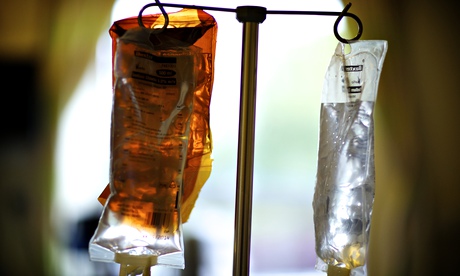
Chemotherapy bags in a hospital ward

Chemotherapy bags in a hospital ward. Photograph: Christopher Thomond for the Guardian


Dramatic enhancements in cancer survival suggest that half of people diagnosed right now can count on to reside for at least ten years, according to the UK’s top cancer study charity – even though survival prices in the Uk nevertheless lag behind people of comparable western European countries.


New figures demonstrate excellent progress in the diagnosis and treatment method of cancer in excess of the last four decades, but accelerating in recent many years. In the 1970s, 50% of cancer patients have been surviving for just a single 12 months and just a quarter lived for 10, mentioned Cancer Analysis Uk. By 2005-06, 50% were living for 5 years and 46% for 10.


Nowadays, according to the most latest figures accessible (2010-eleven), 50% are predicted to dwell for at least ten years.


The figures come from the cancer survival group funded by CRUK at the London School of Hygiene and Tropical Medication, led by Professor Michel Coleman. “These outcomes come from in depth analysis of the survival of far more than seven million individuals diagnosed in England and Wales considering that the 1970s,” he said. “They demonstrate just how far we’ve come in enhancing cancer survival, but they also shine a spotlight on areas where considerably much more wants to be carried out.”


CRUK published the figures at the launch of what it described as an ambitious technique to guarantee that, in 20 years’ time, 3-quarters of all those diagnosed survive for at least 10 years.


“We know more about cancer than we ever have ahead of,” stated Harpal Kumar, chief executive of CRUK. “We feel the understanding we have acquired in excess of the last twenty years puts us in a amazing place to accelerate that progress. We want to see things move even quicker from right here on.


“We want 3-quarters of men and women who hear individuals words, ‘you have cancer’ also to hear the phrases, ‘but will not be concerned – you will be fine,’” he stated.


The statistics display that some cancer individuals have far better prospects than other folks. Ladies with breast cancer now have a 78% possibility of surviving for at least a decade – up from forty% in the 1970s.


Testicular cancer individuals have a 98% opportunity of surviving for 10 many years and the probabilities of individuals with malignant melanoma have risen from 46% to 89% because the 1970s.


Others are not so fortunate. Only 1% of men and women diagnosed with pancreatic cancer will survive for ten years and only 5% of lung cancer sufferers. Ten-12 months survival in oesophageal cancer is twelve% and for individuals with brain tumours it is 13%.


People four cancers will be a prime focus of CRUK’s efforts, said Kumar.


It has been identified since the Eurocare examine in 1995, carried out by Coleman’s group, that survival rates in the United kingdom lag behind people of comparable western European nations, and the gap still exists due to the fact, although the Uk has been bettering, so have the other folks.


“There is not a single explanation that accounts for the difference,” stated Coleman. His group did a detailed global benchmarking examine evaluating elements that could affect survival in Australia, Canada, Denmark, Norway and Sweden with the United kingdom, which was published in 2011. All had greater survival than the United kingdom except for Denmark.


“A single [of the concerns] is that cancer sufferers in Britain do have a tendency to get diagnosed at a later on stage than in other nations, but it was not correct for all cancers,” he explained.


Nevertheless, in some cancers, survival in the United kingdom was poorer at every stage, suggesting that investigation and treatment method in the United kingdom was not as very good as elsewhere.


Coleman pointed out that investment in the overall health services and in technologies such as CT and MRI scans has been reduce in the United kingdom in excess of the last 25 many years than in comparable European countries. The distinctions were not about medication, he mentioned. For most of the significant cancers, surgical treatment to eliminate the tumour is the most essential therapy.


CRUK’s new approach consists of making sure all patients are diagnosed at the earliest feasible second, when treatment method is much more probably to be productive. It also desires to velocity up the transition of new surgical techniques as effectively as medication from the lab to the clinic. And it will proceed to operate on avoiding cancer – notably by campaigning towards smoking. In cancer prevention, said Kumar, the single most essential concern was tobacco handle. “Roughly a single fifth of the adult population is smoking in the United kingdom,” he explained. CRUK would like to see a largely tobacco-totally free society, he additional.


CRUK ideas to improve its spending on study by 50% more than the up coming 5 to 10 years to support its ten-12 months method. One of the initiatives it programs to fund is a “grand challenge” scheme for researchers in academia and market in the Uk and overseas to locate answers to the most significant exceptional inquiries in cancer.


It also hopes to harness the UK’s strength in engineering and physical sciences with multidisciplinary awards to scientists in people disciplines investigating new methods to stop, diagnose or deal with cancer.


Half of new United kingdom cancer patients "can anticipate to live for another decade"

14 Şubat 2014 Cuma

Katie Hopkins interview: "Can you imagine the pent-up rage?"

Two million people watched Katie Hopkins’ latest TV appearance last week, but I’m not sure how many of them would even recognise the woman I meet a few days later at her London hotel. The snarling aggressor we saw on Channel 5′s Big Benefits Row has become a friendly Sloane who squeals “Lush!” at the waiter, teaches me how to talk about sex in “girl code” (a sort of exaggerated whisper that sounds like Miranda Hart playing a boarding school girl on her “PER-I-OD!”), jokes around, laughs at herself and is great company.


Viewers who have followed her TV career are unlikely to have formed this impression. Having distinguished herself as The Apprentice’s most notoriously rude and ruthless contestant ever, the former business consultant has built a media career as a “social commentator”, and is a regular fixture on TV studio sofas, scandalising audiences with a set of opinions typically held by mean girls bitching in the playground. When not on telly, she can be found calling Nelson Mandela a “cantankerous old git” in her weekly Sun column, or tweeting prolifically about her disgust for people who are fat, or unemployed, or badly dressed. Most famously, she has declared ginger-haired babies “harder to love”, and forbidden her children to have friends called Tyler or Chardonnay, as these names are “lower class”.


If you managed to miss all of that, you would get an idea of her style from her reply when I ask if she’d call herself a snob. “Oh, definitely yeah, 100%. I think it’s really important to be snobby. Do I think social mobility policy will ever work? Absolutely not. Is social class a much more efficient way of getting people to the top? Absolutely. Social class has worked for years. Born into the right family, go to the right schools, even if you’re not super bright to start with, you’ll turn out bright. You go to the right university, you get the right job, you have the right connections, you’ll make it to the top. Job done, very efficient.”


Efficient at what? “Efficient at getting smart, well-connected people to the top. It is efficient, because what public money was required to move those people to the top? None.” That would depend on whether we want the best people at the top, surely, or just the cheapest way to get some people to fill up the top? “Oh, for goodness sake,” she exclaims impatiently. “It’s this whole state school thing: ‘Oh, there are a couple of bright sparks, let’s invest £50m trying to get the two or three that might achieve to the top.’ Or, shall we take really clever people and not have to spend any money on them, and get them to the top because they’re connected and went to brilliant schools and their families will support them and they’re fantastic? So why bother with social mobility? Why does it matter? Why? Why? I don’t understand the obsession with it.”


We could easily spend the interview arguing. I think Hopkins would quite like that – she tries to pick a couple of fights when I haven’t even disagreed with her. In between the jokes and giggles she is coiled to spring from what she calls “girly chitchat” into TV studio rottweiler mode, but whenever she does, she stops listening, so it seems pointless. We already know what she thinks. I’m more interested to know why.


“But a lot of women think the sort of things I say,” she protests. “You know, ‘Oh God she’s put on so much weight, she looks dreadful.’ Well, I just say it.” But that still doesn’t explain why an apparently cheerful and successful woman would want to make herself a national hate figure. Rubbished all over the internet and booed by studio audiences, Hopkins seems to relish her reputation as a pantomime monster.


Some critics claim she doesn’t believe a word she says, and peddles controversy for money. Others think she must be secretly horrified that so many people hate her. I don’t detect an ounce of truth in either theory. It turns out Hopkins has never watched herself on television, never cries, is essentially immune to most human emotion, confuses public insults with compliments, and has kept secret the fact that she is hospitalised on average once every 10 days. The curious puzzle of Hopkins only begins to make sense when she describes the first 23 years of her life.


Now 39, Hopkins grew up in “a regular middle-class family” in a small Devon town, the youngest of two daughters to an electrical engineer and a housewife. Both girls attended a private convent school from the age of three to 16. “I don’t mean some notion of a grammar school convent school, I mean proper nuns, nunned up to the max. The headmistress was called Sister Philomena, and she,” Hopkins adds admiringly, “was mean.” The nuns tied Hopkins’ left hand behind her back to try and force her to be right-handed, and school life was highly regimented. “Oh, beyond! Whistle blows once: don’t move. Whistle blows twice: into lines. Whistle blows three times: into class. Can you imagine,” she laughs, “the pent-up rage?”
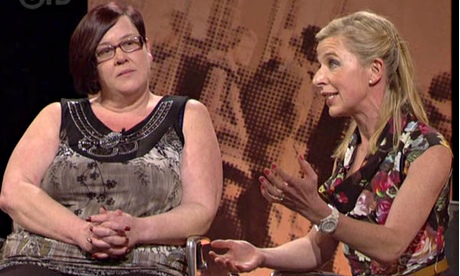

Katie Hopkins causes a stir on The Big Benefits Row Deirdre Kelly from Benefits Street and Katie Hopkins on Channel 5′s Big Benefits Row


I can imagine, but it appears Hopkins can’t. “Yuh, very exciting. I had a hoot at school, it was a blast, it really was St Trinian’s – we were all girls together and it was really good fun.” She can’t recall any bullying or teasing, lost her virginity at 14 to a boyfriend “who looked like Tom Cruise”, and had no teenage insecurities at all, on account of always getting As, mastering grade eight piano and violin by 14, and being picked for all the sports teams. “I suppose I was one of those girls that was just fine.” Her parents were strict about exams and homework, but didn’t need to be, because “I wasn’t going to come second. One of the frustrating things with my children now is that I understood very quickly what you had to give the teacher to get a top mark. It’s not rocket science, is it? It frustrates me that mine can’t see that yet.” Her three children are nine, eight and five.


She knew exactly what she wanted to do. “I was going to be the colonel of the forces. I loved the military. I loved the discipline, the rigour, the big shouty men. I love monosyllabic orders. ‘George: Bed! George: Shoes!’ That’s how I talk to my children, yeah, and I love it. Love it!” She still likes to address her girlfriends by their surnames, “So you’d be ‘Heads’”, and the very thought of a man in uniform barking acronyms sends her into a schoolgirl froth. “Yes! Someone hot. With muscles. That you can clearly see, despite thick cotton. Definitely!”


After A-levels she signed a 35-year contract with the intelligence corps, who sponsored her through an economics degree at Exeter University, where she spent her weekends with the Territorial Army – “really fun, lying around in forests with guns having a brilliant time” – before arriving at Sandhurst. “And someone starts shouting at you the minute your parents drive away. Put in a little tiny room and told to clean it with a toothbrush, that kind of stuff.” Literally? “Yeah!” Her eyes gleam. “And you had to iron your pants into six-inch squares. I can still do it now. Everything in your wardrobe had to be a certain way. Brilliant!” She looks visibly excited by the memory. “Yeah I am, really excited.”


Significantly, she was at her happiest when being publicly insulted on the parade square. “The drill sergeant majors are enormously funny individuals, with brilliant lines. To the girl with sticky-out teeth: ‘You could eat an apple through a tennis racket with those teeth!’ I can’t even be half as witty, and everyone loves the guys, these are massive men who’ve earned their stripes, they’re 6ft 4in, usually Welsh, brilliant! Utterly brilliant men.” They mocked her ceaselessly for the size of her nose, but she never took offence, “because it’s almost more like kudos – you’re in the club and they know you can take it.” No insult was off limits. “There is no line, no barrier, no nothing.” She thinks every young person should have to go through something similar. “Wouldn’t it be great? Do you not think we’d all learn a little bit of discipline?”


But Hopkins’ military career came to an abrupt end days before the passing out ceremony. If I didn’t slow her down she would have glossed briskly over the details, but it transpires that she had an epileptic seizure on the parade square. “It’s not something I talk about,” she says quickly, “because I see it as a failing. So it does annoy me a little bit when people say ‘she failed at the forces’, but of course I never respond. I never say why, because it sounds like an excuse, and I won’t have that. I won’t have an excuse.”


She didn’t cry when the army discharged her. In fact, in her whole life she “genuinely can’t remember ever crying”, and says she doesn’t even know what fear feels like. The only failure she can identify was her first marriage, which ended within a year. “That was bad. But am I over it? Yes. Did it really matter? No.”


Hopkins joined a business consultancy after Sandhurst, moved to Manhattan and began going out with the boss. When their first daughter, India, was born in 2004, she took two weeks maternity leave, and was away on business most of the time, seeing her daughter only at weekends. The couple moved back to the UK and got married before the arrival of their second daughter, Poppy, the following year. Her husband was present for the birth, but Hopkins had to get herself and Poppy home from the maternity ward 48 hours later, because by then he had left her for his secretary. Neither Hopkins nor her daughters have ever spoken to or seen him again.
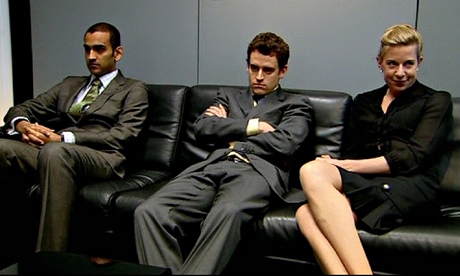

Katie Hopkins and fellow contestants on The Apprentice in 2007 Katie Hopkins and fellow contestants on BBC2′s The Apprentice in 2007


She relays all this with the pragmatism of someone describing a little HR restructuring – and looks pleased when I say so. “Well, it sort of was like that, only in a life way.” She says she doesn’t experience “emotional stuff”, has never known a moment’s maternal guilt, and were I to ridicule her children in this article, “I would go, ‘You know what, I put myself out there, so I have to accept what happens.’” Nothing anyone has ever said or written has hurt Hopkins, or caused her to reconsider, because no one else’s feelings or opinions matter to her in the slightest, apart from her close family’s. For Hopkins, being in the public eye is exactly like being on the army parade square. Anything is fair game, and anybody who gets upset is as pathetic as the women in her old platoon who couldn’t hack Sandhurst and quit.


Deaf to distress, her indifference towards anyone else’s feelings makes sense. But I’m confused about how she reconciles her contempt for emotional messiness with a private life so colourful that she once listed “stealing husbands” as her hobby on her CV. Her first husband was just one of a string of married fathers whom Hopkins seduced away from their families, including her second husband, the father of her five-year-old son.


How can someone so impatient with indisciplined self-indulgence justify wreaking havoc in so many lives, in of all things the name of love? “Oh, spare me the oestrogen tears,” she groans. “We’ve all got skeletons in our closets. I couldn’t be disingenuous enough to say I’m sorry for those women or children, because lots of us have done things wrong. When you look at the statistics for men and women having affairs, it’s huge.”


Lots of women are a size 18, but in Hopkins’ book that’s inexcusable. So why is poor impulse control acceptable in sexual behaviour, but not anything else? “For me there are certain standards of life. Intrinsic to my life are work, fitness, discipline.” So if I was fat she’d call me disgusting, but if I tried to steal her husband she’d say: ‘Fair enough’? “Yeah.”


It must surely have struck Hopkins that her arguments about how everyone should be – slim, fit, punctual, organised, smartly dressed, hard-working – are just descriptions of her own preferences. We’d all like everyone else to abide by our personal rules, but most of us see that our rules are wildly inconsistent and wholly subjective, whereas she has invested hers with the certainty of universal truths. How can she be so sure her standards are objectively right? “Because when I look at the things I think are important, they’re all things that don’t ask anything of anybody else. If you are healthy and not obese you’re not asking the NHS for anything. I’m not asking the taxpayer to fund my benefits. Because I’m not asking anything from anyone, I think that that gives me the right to say: ‘This is how it should be.’”


I had put Hopkins’ horror of being weak and needing help down to nothing too terrible ever having happened to her. But the horror is too visceral for that, and the real explanation is a revelation. She can see how some people have suffered awful things, “but I just don’t connect with that, because I still have my thing going on.” It takes a moment to realise she is talking about epilepsy. All of a sudden she speaks very quickly, as if the words were burning coals.


“When I have a fit at night, my arms come out. They dislocate. So I have to go into hospital to have them relocated. That’s happened 26 times in the last nine months. So we all have crap to deal with in our lives. I’m hard with myself. Get on with it. Move on. Get your arms put back in.” She never talks about it, she says, and as soon as has told me she looks as if she wishes she hadn’t.


Has anyone ever suggested, I ask, that she is profoundly disconnected from her emotions? “No, I think I’m just very male.” I think her emotional disconnect is quite extreme. “Do you?” She looks surprised. “I don’t think it is.” But being “very male” wouldn’t explain her violent disgust for others’ failure to live up to her standards, nor why women’s failings upset her so much more than men’s. It doesn’t explain why she never watches herself on TV, not even her debut on The Apprentice. “Yes, that is odd,” she concedes, when this curious fact emerges. “I hadn’t actually thought that before, but I suppose it is.” And it doesn’t explain why the only response she seems unable to deal with is sympathy. If I glowered at her she would be quite impervious – but a sympathetic look is a kind of agony for Hopkins, making her literally squirm, and I think this has distorted her entire perspective on other people’s problems.


Had she been born to a drug-addicted prostitute and an alcoholic pimp, and suffered unspeakable violence and neglect from infancy, would she expect herself to be as self-sufficient as she has been? “Look, there’s always an argument for why people don’t make it. Whereas I look at myself and go, you know what, I’ve had a fair amount to overcome. But I haven’t allowed it to get in my way.” So she would expect the same of someone born into addiction and abuse? “Yes. And I’m sorry, but they lose. They lose. The truth is, life is just not fair.”


Isn’t it interesting that people who say that are always at the top of the pecking order? “Yes, but isn’t it interesting that people who work hard do really well? Isn’t it interesting that people who get up at 5.30am to go running aren’t fat?” Not really, I say. Those are just examples of logical cause and effect. The child I’ve just described didn’t do anything to cause its circumstances – so why is it right for that human being to lose?


“I really don’t have an answer for it,” she admits. “But if you’re the sort of parent who can’t give a toss, then I can’t give a toss about your child either.”


Katie Hopkins interview: "Can you imagine the pent-up rage?"