Call etiketine sahip kayıtlar gösteriliyor. Tüm kayıtları göster

1 Mayıs 2017 Pazartesi

Critics slam "rip off" 50p-a-minute charge to call patients" hospital phones

Relatives who call patients in hospital are still being forced to pay “rip off” charges of 50p a minute despite a promised clampdown on the issue.


The firm Hospedia, which runs bedside TV and phone services in NHS hospitals and made £21.2m in revenue last year, makes people call loved ones via costly 070 numbers. The charges vary from hospital to hospital, but many trust websites say they cost about 50p a minute or more.


Callers are also forced to listen to a lengthy recorded message of about 70 seconds – which racks up charges before they are even connected to their loved one.The message contains information already obvious to the caller, such as the fact the patient is in hospital, and tells callers to be “patient”. Critics say patients are being treated as “cash cows” and described the charges as “extortionate”.


Hospedia currently manages TV and bedside phone services in 150 NHS hospitals, installing services for free in return for keeping the money charged to patients and relatives.


The firm said in 2014 it planned to phase out the use of 070 numbers but it has not happened. Ofcom reviewed the high costs in 2006 following complaints from users and recommended a substantial reduction in incoming call charges.


It urged the Department of Health to review all aspects of the system, and the way these costs appear “to be borne disproportionately by friends and family”.


The department looked at the issue and agreed to consider a skip facility at the start of the recorded message, enabling callers to bypass it and reduce the cost of the call. But this never came into effect and high call charges have remained.


A health department report in 2007 concluded that decisions on phones should remain with local hospitals. MPs on the health select committee also recommended a reduction in phone costs and called for a skip facility on the recorded message.


Hospedia refused to answer several questions posed by the Press Association, including how much money it makes from 070 numbers and why it still uses them.


A spokesman said: “Ofcom granted us use of the 070 number range to enable every bedside unit to have its own unique telephone number so that friends and relatives can call patients directly, alleviating pressure on nursing staff having to field calls.


“The patient’s bedside phone number is unique to each patient’s account and can follow them around the hospital if they are moved bed, a frequent occurrence.”


He said Hospedia offers free TV on children’s wards and free channels BBC1, BB2, ITV, Channel 4 and channel 5 from 8am to noon on adult wards. Outbound calls to landlines are also free.


He added: “We believe we offer an excellent service, which would not be provided at all if it weren’t for us taking on the investment and on-going management and support costs.


“Patients can choose to pay for our services, beyond those we offer for free, or not.”


But Liberal Democrat leader Tim Farron said: “These charges are a total rip off. When channels are free at home and people have already paid for their TV licence, it is unfair for them to need to pay it again.


“If someone is to spend four weeks in hospital with a full TV package that is the same price as their yearly fee.


“Hospitals and these businesses are treating the sick as cash cows.


“From hospital parking charges, TV packages to making people call expensive phone services, it seems like they try to eke out every bit of cash they can, it’s frankly unacceptable.”


Liz McAnulty, chair of the Patients Association, said: “Phone contact can be hugely valuable and reassuring to people in hospital and their loved ones at home.


“Any facility to provide this must offer a high quality service at a fair price, but Hospedia’s service appears to fail these tests badly.


“It is unacceptable for people calling someone in hospital to be charged heavily for 70 seconds before they even get through.”


Caroline Abrahams, charity director at Age UK, said: “Since older people typically have longer hospital stays and do not always have access to a mobile phone, they and their families are particularly likely to be impacted.”


Lynda Thomas, chief executive for Macmillan Cancer Support, said the cost of calls was “shocking”.


She added: “When you are having cancer treatment, getting a call from a relative can make a huge difference as you can share your worries, seek reassurance, or just hear their voice.


“But if relatives have to pay extortionate amounts to make these calls they may not call, cut it short, or shoulder the burden of these high charges, at a time when the whole family may be struggling financially.”


A spokeswoman for Ofcom said it was “concerned” about 070 costs and wished to hear from customers as part of its ongoing monitoring.


She said there is no requirement on Hospedia to use 070 numbers, adding: “We are concerned about the cost of making calls to and from hospital patients.


“Following an investigation into this, we referred our findings to the Department of Health, which has since changed its rules on mobile phone use in hospitals.


“We are glad that more patients now have the option of using their mobiles when in hospital, but arrangements for bedside phones are managed by the NHS.


“We want to ensure adequate safeguards for consumers so we are examining the use of 070 number ranges, amid concerns that the cost of calling these numbers can be confusing.


“We welcome evidence of any harm so we can further protect consumers.”


A health department spokeswoman said: “Suppliers should always put patients first in the way they provide services.


“Staying connected to friends and family while in hospital is crucial and we expect local hospitals to tackle anything that prevents this.”


Last year, Hospedia doubled its minimum price for a TV package from £2.50 to £5.


Prices for TV packages vary between hospitals, with the Big Bundle TV and internet package costing £17.50 for two days at Newcastle General, but £15 at Ipswich Hospital. Five days can cost £35.


Sky Sports can cost an extra £10 on top each day. Longer-term packages are less costly.


Critics slam "rip off" 50p-a-minute charge to call patients" hospital phones

23 Nisan 2017 Pazar

Rise in hospital admissions for infants triggers call for NHS overhaul

The number of infants admitted to hospital for emergency care for conditions such as asthma, bronchitis and jaundice has risen sharply in the past decade.


More young children are also ending up spending time in hospital being treated for tonsillitis, breathing problems, drug poisonings and infections, new NHS figures show.


Experts behind the report into children’s care are demanding that the NHS overhauls services inside and outside hospital to provide better care and avoid young people adding to the pressures on hospitals by spending time unnecessarily as an inpatient.


They have raised concerns about a number of weaknesses they have identified in NHS care of children and young people, including a lack of knowledge among GPs, poor mental health services and paediatricians spending too little time helping patients in community-based settings. Problems with the quality of care children receive helps explain why some need to be admitted in the first place and, in some cases, have to be readmitted soon after their hospital stay.


“We have identified a number of areas of concern, which highlight potential inadequacies in the level of care and support this group is receiving outside the emergency hospital setting”, said co-authors Ellis Keeble and Lucia Kossarova, who work at the Nuffield Trust thinktank.


They undertook the research, alongside the Health Foundation thinktank, by examining official NHS hospital episodes statistics records for admissions to hospital in England by newborns up to those aged 24 between 2006-07 and 2015-16.


Emergency hospital admissions for all under-25s grew during the decade from 990,903 in 2006-07 to 1,124,863 in 2015-16 – a rise of 14%. However, that was lower than the 20% increase in emergency admissions among the population as a whole over that time.


But they learned that there had been a 30% jump in the number of infants having to be admitted and a 28% rise among those aged one to four. The “concerning” spikes in those younger age groups raised inevitable questions about the availability and quality of maternity and community services, the researchers said.


“The number of infants, children and young people using emergency departments continues to increase – with 30% more emergency admissions for under ones and 28% more for one- to four-year-olds than 10 years ago. This is placing huge pressure on a service already under strain,” said Dr John Criddle, a spokesman for the Royal College of Paediatrics and Child Health.


The number of admissions among infants for jaundice more than doubled from 8,186 to 16,491 per year and cases of acute bronchitis rose 88% from 21,235 to 39,122.


Spells in hospital for “other perinatal conditions”, which includes digestive problems and feeding trouble in babies, also increased sharply, from 14,293 to 24,848. Upper respiratory infections except asthma rose from 17,357 to 20,940; viral infections rose by 116% from 12,730 to 16,826.


Tens of thousands of emergency admissions a year in the nought to 24-year-old range as a whole – each of which costs the NHS about £400 a night – could be avoided with better management and treatment, the report concludes. Four-fifths of the 37,549 admissions seen in 2015-16 for acute and chronic tonsilitis could have been prevented, as could “a proportion” of the 27,727 inpatient stays for epilepsy and 27,325 admissions for asthma, the authors said.


Emergency readmissions rose 12% over the decade, including 17% among 15- to 19-year-olds. “Perhaps most worryingly, compared to other conditions the analysis revealed a larger rise in emergency readmissions following emergency admission for acute and chronic tonsilitis (27%) and poisoning by other medications and drugs (25%) for children and young people”.


Dr Bob Klaber, a paediatrician at St Mary’s hospital in London, said: “There is no one medical explanation for why 30% more young children are now being admitted to hospital than before. So there must be something about how we are supporting these families and a lack of support for mums with newborns who are socially isolated.


“From my experience, the fragmentation of our health and social care system, including antenatal support and help in the child’s first five years of life, has made things really difficult for parents with new babies and young children, and so too often our hospitals become the default place for them to attend.”


A lack of focus on developing joined-up preventative care plans may help explain the growth in admissions for asthma and it could be that the NHS has made the eligibility criteria for children having their tonsils removed too tight so that some with recurrent tonsil problems end up needing hospital care, according to Klaber.


He urged paediatricians to work more closely with GPs, health visitors, school nurses and other primary care health professionals in their area so they can help them identify and manage illness in children.


Klaber said a scheme in which children’s doctors from St Mary’s did that with seven “hubs” showed that approach worked. “As well as extremely positive patient and staff experience, our published evaluation of the first full hub showed that 39% of new patient hospital appointments were avoided altogether and a further 42% of appointments were shifted from hospital to GP practice,” he said.


“In addition, there was a 19% decrease in sub-specialty referrals, a 17% reduction in admissions to hospital and a 22% decrease in A&E attenders.”


Rise in hospital admissions for infants triggers call for NHS overhaul

16 Mart 2017 Perşembe

Lib Dems call for 1p income tax rise to provide NHS funding boost

Income tax should be increased by 1p to deliver a £4.6bn boost to the struggling NHS while a long-term funding solution is found, the former Liberal Democrat health minister Norman Lamb has said.


As the Lib Dems seek to woo traditional Labour voters and win back public trust, after being reduced to just nine MPs, Lamb will urge his party’s spring forum this weekend to back higher taxes to pay for health and social care.


“You have to be straight with the public about what you say you will raise and then do it,” he told the Guardian, in the wake of a government U-turn over the national insurance contributions rise that was proposed by Philip Hammond in last week’s budget.


He would like to see income tax increased by 1p immediately while a new system is phased in. Lamb has asked a committee of health experts to make recommendations, but he suggests rebranding national insurance and earmarking it for health and social care is likely to be his preferred solution.


“You can have a mature discussion about why this is necessary,” Lamb said. “The bottom line is: it comes down to our loved ones. That hour of need when there is that real anxiety that there may be a cancer and you are not sure if you will get treated on time – that is something most people will find intolerable. That stake we all have in a system that works properly is very powerful.”


Lamb leads a cross-party group of Lib Dem, Labour and Conservative MPs, including the chair of the health select committee, Sarah Wollaston, who recently met the prime minister and pressed her to put the funding of the NHS and social care on a more sustainable footing.


Theresa May has agreed the group can consult her health adviser, Dr James Kent – a former medical doctor turned management consultant. Lamb said he will make the case for a cross-party investigation, lasting roughly a year, into long-term reforms.


Though Lamb said he ultimately believed the solution to the health crisis would be found in cross-party collaboration, he said his party had to be “audacious” with their own policy proposals, “because if we don’t, we’re nothing, there’s no point to us”.


He said Labour had failed to say where it would find the money to fund the NHS more generously, despite its leader, Jeremy Corbyn, regularly making the issue a key theme at prime minister’s questions.


“They are crushed by caution because this is difficult and they are worried about saying people will pay more tax under Labour,” Lamb said. “That is everybody’s fear about Labour, that they will expect everyone to pay loads more tax. So they, the leadership, resort to shouting.”


Norman Lamb MP.


Norman Lamb MP, a former health minister. Photograph: Linda Nylind for the Guardian

Though he stressed his support for the NHS as a tax-funded health system, Lamb said it was an “uncomfortable truth” that European social insurance models had kept better pace with demand.


“In Germany they just put the premium up and it doesn’t feel the same as increasing tax,” he said. “I think a dedicated health and social care tax, independently assessed, would work as a hybrid, a tax-funded health system which you see going into the care system.”


Lamb, who has devised the new proposals with a panel of health advisers including David Nicholson, the former chief executive of NHS England, will also propose an “OBR for mental health” to make independent assessments either once a year or the start of a parliament, of the funding the health service needs.


That approach would echo George Osborne’s creation of the Office for Budget Responsibility, which checks the Treasury’s economic forecasts and tax and spending plans.


The MP admitted that any new system would take several years to implement and that tax rises would be necessary in the interim. “My view is that we as a party should make the case for a 1p increase in income tax, raising about £4.6bn,” he said. “That would make a massive difference.”


Lamb said the extra funds raised should be ringfenced for health and social care, with an emphasis on investment on prevention, particularly in digitisation of systems. “It’s unbelievable we still have faxes flying around the NHS,” he said.


Other priorities should be improving general practice and investing in social care – giving people better treatment at home rather than deterioration, which results in hospital admissions, he said.


The Treasury has traditionally been sceptical about hypothecation – the practice of earmarking the revenue from particular taxes for one purpose. But former permanent secretary Nick Macpherson recently advocated five-year budgets for healthcare, paid for by a dedicated tax.


The Lib Dem vote collapsed in the 2015 general election, after the party joined the Conservatives in coalition and broke a manifesto pledge not to increase tuition fees.


The leader, Tim Farron, hopes his party can make a comeback as the champion of pro-remain voters, but believes it must be upfront about the need to raise taxes.


Lamb, who has been a vigorous campaigner for mental health during his time in politics and as a health minister during the coalition, has spoken out about his family’s struggles to get swift treatment for his son’s mental illness.


Archie Lamb, who subsequently founded a music label that launched the careers of stars including rapper Tinchy Stryder, had obsessive compulsive disorder and the family paid for private treatment after being told the waiting list for the NHS would be too long.


“If you can pay, you’re not going to watch your child deteriorate, but there are families who can’t pay and I can’t tolerate that,” he said. “That’s what makes me very driven. I came across so many cases as a minister where families are desperate and being completely let down by the system, with teenage girls with eating disorders told their BMI wasn’t low enough, so basically go away and get sicker.


“It is morally wrong and economically stupid but this is happening in our country and we have to confront it.”


Lib Dems call for 1p income tax rise to provide NHS funding boost

14 Mart 2017 Salı

Republicans call kicking millions off their healthcare "freedom"? That"s perverse | Adam Gaffney

Paul Ryan is promoting Trumpcare as if it were some sort of medical Magna Carta – a brave declaration of healthcare freedom. “We’re not going to make an American do what they don’t want to do. You get it [healthcare] if you want it. That’s freedom” he recently said on Face the Nation. Freedom to die uninsured, that is.


It’s not that House Republicans are proposing some libertarian healthcare promised land wherein open heart surgeries and rounds of chemo are bartered and traded like tubes of toothpaste – far from it. Instead, the bill largely relies on Obamacare’s blueprint, although it mangles its details for the benefit of the rich while stripping coverage from a staggering 24 million people by 2026 (according to Monday’s estimates from the Congressional Budget Office).


Ryan’s healthcare bill would, like the Obamacare, provide subsidies (or tax credits) for the purchase of private insurance policies. Yet these tax credits would be comparatively more regressive and less generous than those in the Affordable Care Act (ACA); many Americans would thus be freed from having affordable premiums.


The Republican bill also discards Obamacare’s cost sharing subsidies for low-income individuals, who would henceforth have the freedom to pay higher copayments and deductibles. Additionally, it prevents tax credits from being used for the purchase of plans that cover abortion, freeing more women from control over their own reproductive systems.


The bill would also punish those with low incomes by squeezing federal funding of Medicaid beginning in 2020, effectively emancipating millions of poor people from the ranks of the insured.


Trumpcare would at the same time cut the ACA’s taxes on the wealthy, which, as the New York Times recently reported, would redistribute upward some $ 144bn over a decade to millionaires. Now in fairness, this provision would increase freedom for some: freedom, for instance, to buy a second vacation home, or a first yacht.


And finally, what Ryan seems to see as Trumpcare’s greatest emancipatory element – the elimination of the ACA’s unpopular individual mandate – would simply be replaced by a 30% premium penalty, assessed by insurers, for those who spent time uninsured. As Patrick Henry might have put it: give me a continuous coverage premium surcharge as opposed to a tax penalty, or give me death.


Unbelievably, Ryan sees “freedom” in all of this devastation.


For Ryan and those in his ideological camp, freedom in healthcare is basically the freedom of the consumer, who should be free to buy – or not buy – the particular insurance plan that suits his or her needs and tastes. Hence the bewilderment of Representative John Shimkus who recently asked why, exactly, men should be compelled to buy plans that cover maternity care (Trump’s pick to lead the Center for Medicare and Medicaid Services, Seema Verma, has said something similar).


Ryan thus offers a peculiar vision of healthcare freedom. For the medical literature tells us – to no one’s surprise – that the uninsured are more likely to die. And as noted, the CBO has now estimated that Trumpcare will increase the ranks of the uninsured by 24 million in a decade from now.


The bill would thus increase our freedom to die of health conditions that are amenable to modern medical care, and thereby liberate tens of thousands of people a year off of the face of the planet.


The Ryan formulation of healthcare freedom is thus a false freedom. Real healthcare freedom would look vastly different, though it would also go well beyond what the ACA has accomplished.


Healthcare freedom worthy of the name would mean knowing that one will never – and can never – be uninsured. It would provide the liberty to choose the doctor and hospital of one’s choice.


Healthcare freedom would ensure women’s control over their reproductive health. And critically, true healthcare freedom would mean that we can all make healthcare choices based on our medical needs and personal preferences – not our bank balances – which means eliminating today’s increasingly onerous copayments and deductibles.


Trumpcare would take us in the opposite direction on each of these fronts.


This more egalitarian vision of healthcare freedom may sound utopian, but it is entirely achievable: it emerges when societies create social rights to healthcare through the development of universal healthcare systems.


The conservative vision of healthcare freedom offered by Ryan and company, in contrast, is not a form of freedom at all: indeed, by serving the class interests of the rich at the expense of the welfare – and the very lives – of the poor and the sick, it is better seen as a form of oppression.


Republicans call kicking millions off their healthcare "freedom"? That"s perverse | Adam Gaffney

8 Mart 2017 Çarşamba

Why don’t India’s feminists call out doctors doing unnecessary C-sections? | Mari Marcel Thekaekara

In India, childbirth has turned into a moneymaking racket, with caesarean sections pushed by unscrupulous medical practitioners in search of profit. Healthy young women who could easily have had normal, natural deliveries are lied to, told that they and their babies are at risk, and advised to have invasive surgery. Worried families feel helpless and afraid to refuse doctors’ orders. Thousands of women in even the smallest towns are put through this ordeal for no medical reason at all.


Until 2010, C-sections were limited to 8.5% of all deliveries in India, just under the recommended level of 10-15%, according to a World Health Organisation report. However, during the past decade the numbers have shot up. In Kerala, India’s most educated, aware state, 41% of deliveries are C-sections and Tamil Nadu, another relatively well-off state, has 58% of its deliveries by C-section, reports the ICMR School of Public Health. Major cities in particular have seen an exponential growth in C-sections in both private and public hospitals, while one study revealed a rise from 31% to 51% over just six years in rural Haryana.


As a result, many women are taking unnecessary risks and young couples ending up in debt they can ill-afford and suffering financially for years. Why hasn’t there been a huge noise from Indian women’s organisations and female politicians about this issue? That is the question my daughter asked after she heard about a friend of a friend who had died after a C-section.


“Why does the feminist movement shut up totally when it comes to women and childbirth,” she asked. “Everyone’s vocal about everything connected to a woman’s body before she gives birth. But the minute a woman decides to become a mother, the silence is deafening. Does she cease to be a feminist because she decided to have a child?”


I was nonplussed. I’d never thought about this, in spite of having borne three children, two under pretty tough circumstances. But suddenly three decades of suppressed anger against the medical negligence I’d endured returned. After being admitted into hospital when my waters broke, I was ignored. I didn’t scream – as was considered “normal” – because I had a higher pain threshold than other women.


Finally after 12 hours, at 5am, the nurse appeared armed with a drip to put me on Pitocin, a drug to induce labour. “This is my third child and that drug will harm the baby. I know I’m at the end of the labour, not the beginning,” I pleaded. Ignoring my words, the nurse advanced determinedly, muttering, “Nowadays these patients think they know everything.” Desperate, I screamed, “If you bring that thing near me I will kick you.” Furious, she stormed off to call the head nurse. The senior woman approached me, reprimand ready. “What’s your problem? Why don’t you just obey the nurse?” she scolded. On examining me, her tone changed. “Oh my God,” she shouted, “the baby’s almost out. Rush her into the delivery room.”


My son delivered himself. The gynaecologist whose fees I’d paid for nine months was nowhere in sight. The nurse cut me badly. She then stitched me up and triumphantly announced to her helper “my first delivery”! I honestly wished I’d kicked her hard when I’d had the chance. It would perhaps have saved me a lot of post-pregnancy problems. At the end of 12 hours I was exhausted and weak, both physically and emotionally.


In traditional systems, women are encouraged to squat, because that was the most normal way for the baby to be naturally pushed out. In one tribal community in southern India, the women have a strong rope, like a bell pull, to hold on to while they squat in the final stage.


The rise in C-sections is not restricted to poorer countries. But in India the figures are particularly stark. Meenakshi Gautham, India country coordinator for a maternal and newborn health programme at the London School of Hygiene and Tropical Medicine, accuses private hospitals of being the most “scalpel happy”. Gautham’s survey says that the charges for the procedure, hospital stay and anaesthesia can range from about Rs5,000 (less than $ 75) in a government hospital to upwards of Rs40,000 ($ 600) in a private hospital.


Hope lies in the fact that some gynaecologists are now calling for change. Mumbai obstetrician Sheetal Sabharwal is co-founder of the Tulip Women’s Health Care Centre. She has been in the forefront of the ethical practitioners’ movement demanding that doctors and clinics charge an equal, flat fee for caesarean and vaginal births.


The sharply rising rate of C-sections, though, is only one of many issues surrounding birthing practices and pre- and postnatal care. Perhaps the rights of pregnant women and mothers will find their way into the International Women’s Day debates. They certainly should do.


Why don’t India’s feminists call out doctors doing unnecessary C-sections? | Mari Marcel Thekaekara

24 Şubat 2017 Cuma

Call the Midwife tackles female genital mutilation in latest storyline

This Sunday’s episode of Call The Midwife (BBC1 8pm) will chart new territory as the sisters of Nonnatus House tackle female genital mutilation in 1960’s Poplar.


The BBC One drama will take a sympathetic look at the plight of Nadifa, a mother-to-be from Somaliland, who has undergone the procedure and is struggling with the after-effects.


Heidi Thomas, creator and writer of the series, told Woman’s Hour she had wanted for some time to explore the issue: “I have been interested in FGM for some time and it did seem to me that if we waited until 1962, the Somali community were beginning to settle and establish a foothold in the East End.”


An estimated 200 million girls have undergone FGM worldwide. The procedure involves the partial or total removal of the female genitals for non-medical reasons. UK hospitals now treat one FGM survivor every hour.


Call the Midwife


In 1962, the Somali community were beginning to settle and establish a foothold in the East End. Photograph: BBC/Neal Street Productions

Nimco Ali, anti-FGM campaigner and co-founder of Daughters of Eve, advised the programme makers on the episode. It’s loosely based on the experiences of her close relatives who moved from Somaliland (an independent state north of Somalia) in the 1960s.


Ali, who underwent FGM at just seven years old says that while the episode’s approach may “ruffle some feathers”, she was impressed with the “immense level of knowledge” the writers showed. .


“[It’s about] setting yourself in the mindset that it was set in the 1960s – this was the language that they used,” she told the Guardian. “There is that authentic thread that runs from the realities of 1960s to the privileges and the work that’s waiting for us [as anti-FGM activists] in 2017.”


Ali hopes that viewers won’t feel overwhelmed by the trauma that FGM brings, but that they will feel heartened to act and support anti-FGM causes.


“If you look at the statistics around FGM they look massive, and there’s no way to come at it, but it’s one girl in one generation. It’s about breaking the cycle.”


“I’m hoping that… a lot of my sisters will see that they can have these conversations. That a midwife might not necessarily be of this culture but they understand and as women they can appreciate their experiences from a Somali perspective.”


Call the Midwife tackles female genital mutilation in latest storyline

18 Şubat 2017 Cumartesi

Charities call for NHS to stop rationing critical care

Theresa May has been urged by charity chiefs to stop the NHS rationing treatment for seriously ill patients and to find more money for their care in the budget next month.


About 30 health charities, including the Teenage Cancer Trust, National AIDS Trust and Motor Neurone Disease Association, have raised the alarm about NHS England “restricting and rationing treatment” because of underfunding, especially for patients with rare and complex conditions. The groups from the Specialised Healthcare Alliance said this rationing is taking place without sufficient public scrutiny. In a letter to the prime minister, they said NHS England is “choosing to restrict and ration treatments that patients with rare and complex conditions need – often without proper consultation with patients”. “We hope that you will take action to ensure full patient involvement in these decisions, and to ensure that any decision to ration treatment is overseen by democratically elected politicians,” they added.


The warning comes after health thinktank the King’s Fund said that politicians would be escaping culpability for rationing decisions, as plans due to come into force from April mean that even cost-effective treatments could be denied to patients.


Nicholas Timmins, a policy adviser at the organisation, wrote: “If the NHS can no longer fund new and cost-effective treatments, ministers should announce that decision case by case, and be held accountable for so doing”.


It emerged last month that cancer, diabetes and asthma patients could all be hit by the new affordability criteria, which means that drugs which cost the NHS more than £20m in total each year could be subject to restrictions.


The charity chiefs also raised wider concerns about funding for the NHS, which medics have said is under huge pressure this winter because of cuts to adult social care provided by councils.


Philip Hammond, the chancellor, is facing calls to give more money to the NHS next month after resisting an emergency bailout at the autumn statement. Instead, the government has launched a long-term review of social care and will allow councils to raise more through a local ‘precept’ (an extra charge to council tax bills which can only be used for adult social services) in the next couple of years.


No 10 and the Treasury appear to remain firmly against repeated calls from medics and the opposition for more cash for the NHS, indicating they are not prepared to change tack at the budget. But the charities say: “Our charities – and the patients we represent – are deeply concerned by the recent statements of Simon Stevens concerning the NHS’s relative underfunding. We urge you to ensure that this year’s budget provides the NHS with the funding it needs to deliver the standards of care patients expect.”


The charities issued their warning ahead of a Lords debate on the medical supplies bill this week, which Labour’s shadow health minister Lord Philip Hunt has described as a missed opportunity to “get rid of many of the restrictions on NHS patients using innovative new medicines”. A government spokesman said blanket restrictions on treatment are unacceptable and that the clinical needs of a patient, and the urgency with which they require treatment, must come first.


“The government is responding to the needs of the NHS by investing more money – £4bn this year – to fund its own plans for the future”.


Charities call for NHS to stop rationing critical care

6 Şubat 2017 Pazartesi

Rise in calls to Childline for mental health issues prompts call for action

Charities are calling for improved mental health provision in schools as new figures reveal more than 50,000 children and young people contacted Childline last year seeking help for serious mental health problems.


The helpline has seen a 36% rise over four years in youngsters needing help for depression and other disorders, while there was also a rise in the number of youngsters feeling suicidal.


Figures from the National Society for the Prevention of Cruelty to Children (NSPCC) reveal 50,819 children and young people in 2015/16 received counselling for a serious mental health issue – a rise of 8% over four years.


Those aged 12 to 15 made up a third of the sessions, with girls almost seven times more likely to seek help than boys.


Peter Wanless, chief executive of the NSPCC, said the figures, released at the start of Children’s Mental Health Week, were deeply concerning.


He said: “To ensure the next generation aren’t left to deal with a mental health epidemic, there has to be a much more comprehensive network of professional support and treatment in place that is easily accessible for young people who are desperate for help to get their lives back on track.”


Sam Royston, director of policy and research at the Children’s Society, said it was desperately worrying that so many young people were experiencing problems.


She said: “Whilst such issues may affect any child, in our own research, we have found there is a widening gap between the wellbeing of adolescent girls and boys.


“Many factors may contribute to this – for example we have found that adolescent girls are particularly likely to experience emotional bullying such as name-calling.”


She added: “Failing to address mental health problems early on can severely damage the lives of young people. As a first step all children should be able to access mental health and wellbeing support such as counselling in schools so they get support early to prevent a problem becoming a crisis.”


Childline said early signs of a serious mental health problem in children and young people include becoming withdrawn from friends and family, being tearful or irritable, sudden outbursts, and problems eating or sleeping.


One 16-year-old girl told Childline: “I want to know what’s wrong with me. I have been seeing a counsellor about my mental health issues recently but they just told me to eat and sleep better and forget about the past, which didn’t help me at all.


She added: “I wish I could speak to someone who actually cared about me and I felt comfortable talking to.”


Another young person said: “I’m struggling to cope with bipolar. One minute, I feel so low, like I’m trapped, and all I want to do is disappear. Then suddenly, I feel the complete opposite, and I’m really happy and I start thinking about everything in a really positive light. I feel like I push away everyone that tries to help, I tell them I hate them and blame them for everything. I just feel like I’ve turned into a monster.”


Childline founder Dame Esther Rantzen said: “It’s striking how many more children seem to be suffering serious mental health problems today than when we launched Childline 30 years ago.


“So many desperately unhappy children seem to be suffering suicidal thoughts, self-harming, becoming anxious and depressed, with many of them turning to Childline because no other support is available.”


Rantzen said children’s mental health services are already “terribly overstretched” with young people unable to access the professional help they need.


She said: “We believe there needs to be far more emphasis on providing help for these children as they struggle to deal with what are very serious illnesses.”


Sarah Brennan, chief executive at the charity YoungMinds, agreed more support for young people was vital, especially from schools.


She said: “Young people face a huge range of pressures including stress at school, college, university, body image issues, bullying on and offline, around-the-clock social media and uncertain job prospects.


“Difficult experiences in childhood including bereavement, domestic violence or neglect can also have a serious impact on mental health.”


Brennan added: “As a society we need to do far more to prevent mental health problems from developing in the first place. To start with, we urgently need to rebalance our education system, so that schools are encouraged to prioritise well-being and not just exam results.”


Rise in calls to Childline for mental health issues prompts call for action

30 Ocak 2017 Pazartesi

As a GP, I wish I could call time on the 10-minute appointment

I’m about to start morning clinic. My computer shows I’m already fully booked and extras are being added. It’s going to be a busy one but I am determined to keep to time today. My first patient is Mrs B. She’s 76 and has diabetes, chronic obstructive pulmonary disease, high blood pressure and arthritis. She doesn’t come to see me very often, though. She doesn’t like doctors.


8am – She has a 10-minute appointment


I call her from the waiting room and she slowly shuffles towards me using her walking frame. I hold the doors, while her husband supports her. She slumps in the chair and has to sit and catch her breath before she can talk. Two minutes have already gone.


8.02am – ‘It’s nice to see you Mrs. B, what can I do for you?’


She feels really short of breath and has been coughing badly for two weeks. Her inhalers aren’t helping.


I ask many more questions to make sure I’ve understood her properly, got all the information and checked for any red-flag symptoms. Then her husband interjects: “She keeps falling and we’re both worried that she’s forgetting things.” Those are two further issues I will need to explore.


8.05am – ‘Please may I listen to your chest?’


Minutes pass as her husband helps remove her scarf, coat and multiple layers of clothing. I perform my examination, then she tiredly re-dresses. I can see she’s really struggling.


I crosscheck the treatments I might prescribe for interactions against the 15 medications she is already taking.


I also note alerts on the screen flagging the need to discuss her weight, her cholesterol is high and her medication review is overdue. These are quality targets GPs are measured against.


8.12am – ‘You have a nasty chest infection and needantibiotics’


I turn to give her the prescription and find her crying. She is terrified I will send her to hospital again. I take her hand and spend a couple of minutes reassuring her. I go over how to use her inhalers again. I explain what to do if she feels worse and how to seek medical help.


8.15am – I’m already late


I’ve dealt with her primary problem but have I got time to address the two concerns raised by her husband? I have to do it now, if I don’t she might not come back – she really doesn’t like the doctors.


Both falls and memory symptoms are complex problems with numerous possible causes. I cannot solve either today but I gather more information and arrange further investigations.


They both thank me and get up to leave. Her husband shakes my hand. He is a brilliant carer.


8.22am – I’ve only seen one patient so far


I’m already running 12 minutes behind and I still have to complete my notes before calling the next patient.


I hope Mrs B was satisfied with her appointment. I know that I provided good care, even though I didn’t manage to tick off a single quality target.


A 10-minute appointment may suffice for a patient with only one problem and no other health needs, who can give a clear and concise account of their symptoms, and who is physically mobile.


In reality, the majority of my patients are elderly and have multiple coexisting conditions. They often have impaired mobility and memory, as well as communication difficulties, and don’t forget the wider social issues they often face.


I wish I had longer to spend with my patients, to understand them and their individual situations. I can see the value when I do. But while empathy is fundamental to doctor-patient relationships – and in fact relationships across the whole health system – it takes time.


11.50am – I call my last patient of the morning


I apologise because he’s been waiting nearly an hour. “Don’t be sorry, Doc, you’re busy,” he says. “I know that you would give me extra time if I needed it.”


Mrs B is a composite based on this GP’s experiences of patient care.


Suddy Davidson participated in the A Mile in My Shoes exhibit, developed by the Health Foundation in collaboration with the Empathy Museum, to shine a light on the contribution of the millions of people working in health and social care in the UK. You can read more about the project and listen toDavidson’s story here.


If you would like to write a blogpost for Views from the NHS frontline, read our guidelines and get in touch by emailing sarah.johnson@theguardian.com.


Join the Healthcare Professionals Network to read more pieces like this. And follow us on Twitter (@GdnHealthcare) to keep up with the latest healthcare news and views.


As a GP, I wish I could call time on the 10-minute appointment

12 Kasım 2016 Cumartesi

Tories join NHS chiefs in call for increased social care funding

Philip Hammond is being urged by senior Tories to give the crumbling care system a double boost in his autumn statement, amid growing alarm that social care and the NHS will be unable to cope with demand this winter.


The chancellor is under intense pressure from health secretary Jeremy Hunt, local council leaders and NHS bosses to find some extra money to prop up the social care system in England. Well-placed sources say that, although Hammond has ruled out any unexpected increase in the NHS budget, he is examining a plan to plough between £700m and £1.5bn extra into social care services from April to help reduce numbers of older people being admitted to hospital. He is also looking into letting councils raise the amount they can add to council tax bills to fund social care through a precept introduced in April; it is currently capped at 2%. The autumn statement, on 23 November, may see the cash-strapped NHS get access to fresh capital funding to build new hospitals and health centres. to help deliver its promised revolution in how patients are cared for.


The Care Quality Commission warned last month that social care is “approaching a tipping point” and that greater numbers of frail elderly people will suffer falls or illness and add to the strain on hospitals and GPs unless urgent action is taken. Hunt and NHS England chief executive Simon Stevens have been lobbying the Treasury to bring forward to 2017-18 some or all of the £1.5bn it intends to put into the Better Care Fund, a scheme to bolster social care. Ministers have pledged to put £105m into the fund next year, and increase that to £825m in 2018-19 and to £1.5bn in 2019-20.


NHS organisations, the Local Government Association (LGA) and the Association of Directors of Adult Social Care have been making the same case. Sajid Javid’s Department for Communities and Local Government is understood to also be supporting it behind the scenes.


James Davies, a GP as well as a Tory MP and member of the health select committee, said growing numbers of Conservatives wanted Hammond to prioritise social care. The LGA said years of cuts to town-hall budgets have left the sector in crisis, with fewer people getting help with basics such as washing and eating at a time when need is rising. Also, care homes are closing, partly because councils cannot afford high enough fees to allow operators – whose costs have risen because of the national living wage – to make a profit.


“It is my view that, if further funding can be located, it should go into social care, with the expectation that this will indirectly relieve some of the difficulties being encountered by the NHS. I believe many of my colleagues are reaching the same conclusion,” Davies told the Observer. “The current pressures on social care are such that the prompt, safe discharge of patients from our hospitals is increasingly dysfunctional. So-called exit block is now a major challenge needing urgent attention. There is also evidence that hospital admissions could be reduced in number if community social care provision were to be increased in its extent.”


Such coordinated lobbying on behalf of social care by both the NHS and local government bodies is unprecedented. Health service bosses, ahead of a Whitehall spending decision, agree that social care should be the priority for extra resources. They are telling the Treasury that this would bring the double benefit of also reducing demand on the NHS. New figures last week showed “bed blocking” – patients being unable to go home because of inadequate social care provision – at a new record high.


Stephen Dalton, chief executive of the NHS Confederation, said: “The critical and negative tipping point for the health and care system has been triggered by cuts to social care. It’s imperative the chancellor takes the opportunity, in the autumn statement, to prioritise investment in social care before the winter.”


Chris Ham, chief executive of the King’s Fund, agreed: “Six consecutive years of funding cuts have left thousands of older people, their families and carers without the support they need, and are exacerbating pressures on the NHS. With council services facing a funding gap of £1.9bn next year, social care must be a priority for the autumn statement. This is a key test of the prime minister’s promise of a more equal country that works for everyone. There is no more burning injustice today than older and disabled people being denied the care they need to live with independence and dignity.”


Tories join NHS chiefs in call for increased social care funding

19 Ekim 2016 Çarşamba

British doctors and health professionals call for rapid coal phase-out

Groups representing Britain’s 600,000 doctors and health professionals say it is “imperative” to phase out coal rapidly to improve health and reduce NHS costs.


The doctors and nurses say tackling outdoor air pollution from traffic and power stations would cut climate emissions, reduce air pollution, and deliver a powerful boost to the nation’s health.


“Climate change and air pollution are both major health threats,” says the UK Health Alliance on Climate Change in a report. “They share a common driver: the combustion of fossil fuels. Pollution from coal plants alone costs the UK as much as £3.1bn each year in human health impacts.”


The group of 15 health bodies includes seven royal colleges of medicine and the British Medical Association.


Pollution from coal plants causes many serious health conditions including stroke, coronary heart disease and lung cancer. It disproportionally affects children and kills more people than road accidents , says the report.


The government has said it intends to phase out coal power plants by 2025 but the doctors say they are alarmed that no consultation papers looking at how this could be achieved have been published in more than a year.


“Ending the use of coal is a simple, no-regrets public health intervention. The rapid phase-out of coal fired stations is an imperative first step. Coal is the most carbon-intensive source of power generation, and is a key focus for reducing the risks of climate change.


“In the UK, burning coal is linked to 1,600 premature deaths, 68,000 additional days of medication, 363,266 working days lost and more than 1m incidents of lower respiratory symptoms,” says the report.


It urges politicians not to tackle air pollution and climate individually, as has been done in the past. “The UK has witnessed … policies that encouraged the use of diesel cars which inadvertently worsened air quality. Considering air pollution and climate change together can limit adverse health effects.


“Some strategies can be good for both air quality and climate change, for instance wind, solar and tidal energy. Acting on ones that are beneficial to both is advantageous to health. Indeed, joining up policies on health, air pollution and climate change can offset the costs of climate mitigation policies through the health benefits that they bring.”


Air pollution is the second biggest public health threat in the UK after smoking and kills 40,000 people a year in Britain, said Prof John Middleton, president of the Faculty of Public Health. “Coal-fired energy is particularly damaging through its invisible particulates and because it is a driver of climate change,” he said.


“The phase-out of coal use is an essential step towards creating a sustainable energy policy for the UK,” said Dr Richard Horton, editor-in-chief of the Lancet medical journal. “It is also a vital co-benefit for health – ending coal use will deliver long-lasting health and dividends for the British population. Life expectancies will be prolonged, disease and disabilities reduced, and future risks to health diminished. This is an opportunity to be seized.”


Jonathan Griggs, professor of paediatric respiratory and environmental medicine and fellow of the Royal College of Paediatrics and Child Health said that children were particularly vulnerable to burning coal.


“Air pollution from burning coal has been linked to low birth weight and pre-term delivery as a result of maternal exposure during pregnancy,” he said. “The phase-out of coal is a double win for tackling the twin health threats of air pollution and climate change.”


“Tackling air pollution and climate change will have numerous health benefits but it requires a joined-up approach from government to ensure the health impacts are better recognised and fully realised,” said Janet Davies, the Royal College of Nursing’s chief executive and general secretary.


British doctors and health professionals call for rapid coal phase-out

25 Eylül 2016 Pazar

Environmental health officers call for smoking ban in playgrounds

Smoking should be banned in all parks and playgrounds to reduce the chances of children growing up thinking that using cigarettes is normal, environmental health officers have told ministers.


Zoos, theme parks and anywhere else children play should also become no-smoking zones, in a significant proposed expansion of the outdoor areas in which smokers cannot light up.


Smoking has been illegal in enclosed public places such as bars, nightclubs and restaurants, as well as public transport and work vehicles, across the UK since 2007.


But the Chartered Institute of Environmental Health said on Monday it wants local councils to designate any place where children play or learn as a smoking exclusion zone, although adherence would be voluntary, not statutory. Banning it in those locations would also protect children from secondhand smoke, it says.


A new YouGov poll commissioned by the CIEH shows that 89% of 4,300 adults surveyed back a ban on smoking in children’s play areas, while 57% want it to end in public parks. “It is abundantly clear that the vast majority of people would support restrictions on smoking in children’s play areas. We would like to see smoking being stubbed out wherever children play or learn,” said Anne Godfrey, the CIEH chief executive.


“This would not only include children’s playgrounds but could see no-smoking zones extended to public parks, zoos and theme parks. Children should be able to have fun and enjoy themselves without seeing someone smoking and thinking this is normal behaviour,” she added.


Some councils have already moved to try to stop people smoking in some outdoor places. For example, Coventry city council has asked parents not to smoke outside the gates of its 82 primary schools. The policy has gone down well with parents and headteachers, the council said.


Wrexham has also decreed that playgrounds, school gates and bus shelters should be regarded as smoke-free places, while Nottingham city council seeks to ensure that all its outdoor attractions are smoke-free for the six weeks of the school summer holidays.


“Public opinion – and not just among parents – has swung heavily in favour of protecting children from exposure to tobacco smoke and from the behavioural cues children pick up from seeing adults smoking. This is a real opportunity to make it easier for children to grow up healthy,” said Jim McManus, the director of public health at Hertfordshire county council.


“Parents and children, when given the choice, are overwhelmingly supportive of smoke-free playground. Local voluntary schemes have been popular. It’s time to give parents what they are asking for. You might feel like this is the nanny state – you’d be wrong,” McManus added.


Forest, the smokers’ rights group, called to the plan “Orwellian”. Its director, Simon Clark, said: “Extending the smoking ban to outdoor parks and play areas would be a gross overreaction. There’s no evidence that a significant number of people smoke near children in outdoor areas, nor is there evidence that smoking outside is a threat to anyone else’s health.”


Clark added: “Public parks are for the enjoyment of everyone, including smokers. Most smokers use their common sense and smoke accordingly. They don’t need government dictating how they behave. The idea that children should be protected from the sight of someone smoking is Orwellian. Adults can’t be expected to be perfect role models for other people’s children.”


The owners of zoos and theme parks, because they are private businesses, should be allowed to decide whether smoking is banned, Clark said.


It became illegal last October to smoke in a car in England or Wales carrying anyone under the age of 18. New figures last week showed that the proportion of adults in England who smoke had fallen to a record low of 16.9%.


Deborah Arnott, the director of Action on Smoking and Health, said: “While the ban on smoking in indoor public places resulted in significant health benefits, thousands of children are still exposed to smoke in the home and elsewhere. Growing up in a smoke-free environment is one of the best ways of ensuring that they are not attracted to smoking and lured into a lifelong addiction and ill-health.”


Environmental health officers call for smoking ban in playgrounds

1 Eylül 2016 Perşembe

Team GB"s cycling heroes call for "legacy of everyday cycling"

A group of Britain’s medal-winning cyclists from the Rio Olympics have written to Theresa May to tell her the best way to honour their achievements would be for the government to invest heavily in everyday bike-riding.


The signatories, including Laura Trott, Jason Kenny, Mark Cavendish, Joanna Rowsell Shand and Becky James, as well as Sir Chris Hoy, jointly with Kenny the country’s most successful Olympian, told May: “You were widely reported in the media as saying that there will be ‘no limits’ on the honours that could be bestowed on our medal winners.”


They continued: “But the best way to honour the achievements of our athletes would be a legacy of everyday cycling in this country – a place where cycling is the choice form of transport for people to get around in their daily lives.”


The letter was organised by British Cycling, which as well as being a sporting body also campaigns for better everyday bike provision. It pointed out the disparity between Britain’s vast success in sports cycling and the relatively tiny numbers who use bikes for transport, arguing cycling should be treated as consistently and seriously by government as the roads, rail or aviation.


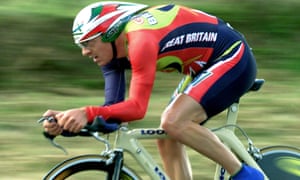
Chris Boardman at the Cycling World Championships in France, 2000.


Chris Boardman at the Cycling World Championships in France, 2000. He has asked to meet Theresa May. Photograph: Franck Prevel/AP

Britain won six golds and 12 medals overall at cycling in Rio, topping the medals table in the sport for the third successive Olympics. Yet the proportion of trips made by bike has remained constant at about 2%, with relatively little investment in bike lanes outside London and a handful of other places.


While David Cameron famously said he hoped to see a “cycling revolution”, an eventual walking and cycling strategy, released earlier this year, was written off by cycle campaigners as worthless, with the money committed around £1 per person per year, against a figure of about £28 in the Netherlands.


The Olympians’ letter urged May to “set out a timeline to address the chronic underfunding and lack of leadership which is keeping cycling for transport in the slow lane”. It added: “Only networks of segregated cycle lanes in towns and cities across the country can achieve and influence growth.”


With a chronically sedentary nation and around one in three children overweight or obese, investment in cycling would pay enormous health dividends, the letter argued, as well as boosting businesses along the routes, and making towns and cities less congested and more liveable.


“There is huge latent demand for cycling,” they wrote. “Two thirds of people would cycle more if they felt safer on the roads.” The letter asks the government to commit 5% of its transport spend to cycling, and to improve law enforcement to better protect cyclists.


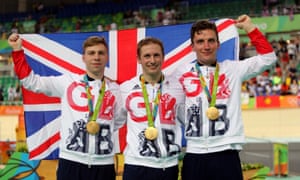
Philip Hindes, Jason Kenny and Callum Skinner with their gold medals following the Rio 2016 men’s team sprint final.


Philip Hindes, Jason Kenny and Callum Skinner with their gold medals following the Rio 2016 men’s team sprint final. Photograph: David Davies/PA

“Investment in cycling as a form of transport isn’t purely an investment in cycle lanes,” the letter concluded. “It is an investment that will pay off for the nation’s health, wealth, transport infrastructure and the vibrancy of our towns and cities. It has the added benefit of just making it easier for ordinary families to get to work and get to school.


“Our athletes have inspired the country and now we urge the government to take cycling seriously as a transport option for everyone.”


The signatories are asking May to meet Chris Boardman, whose cycling gold at the 1992 Olympics heralded Britain’s success in the sport, and who is now British Cycling’s policy adviser.


Boardman said he hoped for a fresh start after the lack of action from Cameron’s “cycling revolution” and the cycling and walking investment strategy.


“It was quite a step, so we were all pretty gutted when we saw it will amount over this parliament to less than a pound a head, which just beggars belief,” he said.


Boardman said he hoped the letter would “put some moral pressure on the prime minister to have to say either what we’re going to do, or why we’re not going to do it”.


He said: “Even in these austere times it’s such a good economic investment, it’s such an efficient spend of cash. It’s exactly what they should be doing. So what we deserve is an answer.”


At the moment, Boardman said, the government was officially committed to doubling the numbers of cyclists by 2025, but had no real means to achieve this. He said: “The question I would like to ask is, you want to double the amount of cycling, to get from 2% to 4%. Do you think less than £1 a head will achieve that target? I don’t think anybody could look you in the eye and say, yes.”


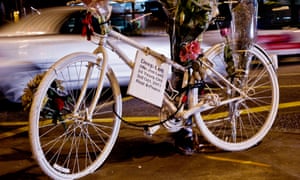
A cycle left as a protest by Bikes Alive at King’s Cross, London.


A cycle left as a protest by Bikes Alive at King’s Cross, London. Photograph: Sarah Lee for the Guardian

A Department for Transport spokesman said government investment in cycling had tripled since 2010. He said: “We are spending £300m on cycling funding and a further £500m for infrastructure in local communities which will include benefits for cyclists.


“The number of people choosing to get about by bike has grown over recent years and, following the success of our Rio Olympians, we want to see this trend continue.”


The letter to Theresa May


Dear Prime Minister,


The Great Britain cycling team athletes topped the cycling medal table for the third Olympic Games in a row at Rio 2016. It was a truly outstanding performance and enhances Britain’s status as the world’s leading elite cycling nation.


You were widely reported in the media as saying that there will be “no limits” on the honours that could be bestowed on our medal winners. But the best way to honour the achievements of our athletes would be a legacy of every-day cycling in this country – a place where cycling is the choice form of transport for people to get around in their daily lives.


Your predecessor called for a “cycling revolution” and your government’s manifesto sets out a target to “double” the number of journeys cycled. While some steps have been made, cycling is still a transport mode which does not enjoy the government investment or political leadership given to roads, rail or aviation.


The government is now considering feedback on the draft Cycling and Walking Investment Strategy (CWIS). We urge the government to publish this and set out a timeline to address the chronic underfunding and lack of leadership which is keeping cycling for transport in the slow lane. Only networks of segregated cycle lanes in towns and cities across the country can achieve and influence growth.


The success of the CWIS will be felt not only across government but in all areas of the nation’s life.


The government’s sports strategy seeks to extend the number of people living physically active lives and could be truly transformative. Active travel – walking and cycling – is the easiest way for people of all ages to fit physical activity into their lives. Currently, only one in five people achieve the recommended levels of physical activity.


Around one in three children is overweight or obese. The government’s childhood obesity strategy recognises the value of physical activity and the importance of walking and cycling to school. I am sure you know that this will seem a fanciful idea for most parents without the convenient walking and cycling routes which would give them the confidence that their children will be safe getting to school. Yet we know it can be achieved – in the Netherlands, 50% of education-age children cycle to school.


As cities like Copenhagen and New York have shown, cycling also creates better places to live and work. More cycling cuts congestion, reduces noise pollution and fuels local economies. Small businesses in New York have seen a 49% increase in business where cycle lanes have been installed.


There is huge latent demand for cycling. Two thirds of people would cycle more if they felt safer on the roads. The government’s road safety statement reiterates the manifesto commitment to reduce the number of cyclists killed or injured. The CWIS needs to set targets to improve road maintenance, enhance enforcement of the laws, and update the rules of the road to better consider the needs of cyclists.


To make this happen, we need 5% of the government’s transport spend allocated to cycling. This is the only way that cycling will be integrated into transport strategy and given the priority it deserves.


Investment in cycling as a form of transport isn’t purely an investment in cycle lanes. It is an investment that will pay off for the nation’s health, wealth, transport infrastructure and the vibrancy of our towns and cities. It has the added benefit of just making it easier for ordinary families to get to work and get to school.


Our athletes have inspired the country and now we urge the government to take cycling seriously as a transport option for everyone.


British Cycling’s policy adviser Chris Boardman would welcome a meeting to discuss this further. We look forward to hearing from you.


Yours sincerely,


Chris Boardman, policy adviser, British Cycling and Olympic gold medalist


Sir Chris Hoy, six-time Olympic gold medallist, joint most successful British Olympian


Laura Trott, four-time Olympic gold medallist and Britain’s most successful female Olympian


Jason Kenny, six-time Olympic gold medallist, joint most successful British Olympian


Mark Cavendish, Olympic silver medallist


Joanna Rowsell Shand, double Olympic gold medallist


Elinor Barker, Olympic gold medallist


Owain Doull, Olympic gold medallist


Becky James, double Olympic silver medallist


Katy Marchant, bronze medallist


Team GB"s cycling heroes call for "legacy of everyday cycling"

19 Ağustos 2016 Cuma

20 Reasons Why I Call Myself an “Anti-Vaxxer!”

20 Fast Facts About Vaccines — by T. Matthew Phillips, Esq.

1. Under American law, it is legally impossible to design a defective vaccine.


2. In 2011, the Supreme Court declared that all vaccines are unavoidably unsafe.


3. Vaccine ingredients kill human gut microbes that regulate the immune system.


4. No vaccine comes with an immunization guarantee.


5. No vaccine is ever safety-tested in combination with other vaccines.


6. There are no vaccine safety studies that compare vaccinated versus non-vaccinated persons.


7. When vaccines fail to provide immunization, medical science is never able to explain why.


8. When vaccines kill or injure, medical science is never able to explain why.


9. Vaccine injured persons cannot sue vaccine makers; no other American industry enjoys immunity from liability for selling unsafe products – that are known to kill and injure.


10. Over the past ten years, the number of American children who died from the MMR vaccine far outpaces the number who died from measles, mumps and Rubella combined.


11. The MMR vaccine is not given to infants, (i.e., newborn through 12 months), because it is considered unsafe.


12. The MMR vaccine comes in only one “size,” (i.e., volume of liquid in the syringe); children receive the same dosage as adults.


13. Persons vaccinated for measles can nevertheless develop a full-blown case of measles as a result of the vaccination.


14. Persons vaccinated for measles can nevertheless develop a full-blown case of measles as a result of contact with persons infected with the measles virus.


15. Persons vaccinated for measles can “shed” the measles virus and infect others for approx. 28 days after vaccination; those recently vaccinated for measles must be quarantined for 28 days!


16. Measles is now a disease of vaccinated persons; modernly, in all measles outbreaks, (including Disneyland 2015), the majority of those afflicted were already vaccinated for measles.


17. Once a person has had a full-blown case of “wild” measles, (i.e., from naturally occurring viral strains), he or she naturally acquires lifetime immunity to the measles virus.


18. Once a person has had a full-blown case of “laboratory” measles, (i.e., from viral strains attenuated in vitro), he or she does NOT acquire lifetime immunity to the measles virus.


19. Persons inoculated with “laboratory” measles remain forever susceptible to “wild” measles (and other “laboratory” strains).


20. All booster shots are a hoax – you can’t “boost” immunity; it is either achieved or it isn’t.


~~TMP. (Aug. 19, 2016)


T. Matthew Phillips is an entertainment attorney and part-time particle physicist from Hollywood, Calif., who advocates the abolition of vaccines, GMOs, chemtrails, and science. Phillips is now suing the State of California to halt SB 277, California’s mandatory vaccination law for schoolchildren.
[More Info: http://www.revoltrevokerestore.com/ ]


20 Reasons Why I Call Myself an “Anti-Vaxxer!”

11 Ağustos 2016 Perşembe

British Medical Association call for action on "bed blocking"

The number of days patients are spending in hospitals due to so-called “bed blocking” is at its second-highest figure on record.


New data for England has revealed that people occupying beds when they no longer needed care took up a total of 171,298 days in June. It marks a considerable rise of more than 30,000 days on June 2015, during which 139,538 days were taken up by the delays. But NHS England said that, although the figure was still “significant”, it had decreased on the previous month, when it hit a record high.


Related: NHS hospitals face record levels of ‘bed blocking’


Bed blocking occurs when someone is medically fit to be discharged, but care has not yet been organised to help them outside of hospital. The British Medical Association said that the issue – which largely affects the elderly – urgently needs addressing.


Council chairman Dr Mark Porter said: “Problems at the hospital front door are linked to delays at the back door. This is because a shortage of social care beds creates ‘exit block’ in hospitals, meaning patients who no longer need to be in hospital can’t be discharged because there is simply nowhere for them to go.


“This, together with a shortage of beds and a shortage of doctors, leads to delays in admissions and patients being forced to wait on trolleys or admitted to an inappropriate ward.”


More than half (59%) of delays were due to the NHS, while the social care sector were responsible for 32% of the delays. Both were responsible for 7.9%, the report said.


An NHS England spokesman said: “Thanks to tremendous efforts by the NHS and social care, the number of delayed transfers of care stopped increasing in June, although there were still a significant number of patients waiting for discharge from hospital.


Related: Delays in discharging older patients from hospital ‘cost NHS £820m a year’


“It’s important patients who are well enough to leave hospital can do so at the earliest opportunity, and in some parts of the country the system is working well. These figures underline the importance of joined-up care within the NHS and the dependence of hospitals on well-functioning social care services – particularly for older people living at home.”


Figures also show that major hospitals in England are failing to see almost one in seven patients within four hours, as medics warn that emergency staffing has reached crisis levels.


New statistics for June reveal that nearly 15% of people in larger A&E departments and almost 10% of people in all hospitals are not discharged within what is considered the expected time. The target of seeing 95% of patients within four hours has not been hit by an A&E at any major hospital since July 2013.


It comes the day after the Royal College of Emergency Medicine warned that a gap between supply and demand for emergency doctors is leading to a “real crisis”.


NHS England defended the figures, saying they showed “another improvement in performance” at a time when “frontline services continue to come under intense pressure”.


Related: Scottish hospitals miss key A&E waiting times and bed blocking targets


But a number of other key targets were also missed by the health service – including on ambulance response times and cancer waiting times. Hospitals across the country have been blighted by disrupted services in the wake of funding cuts. A national shortage of emergency doctors also led the Grantham and District Hospital in the East Midlands to announce it was to temporarily close its doors at night.


St Helens Clinical Commissioning Group caused outcry after suggesting financial demands could lead it to ban all non-vital operations for four months.


The Department of Health said that despite shortages in specific A&Es, there were 1,250 extra doctors working in emergency departments compared with 2010. A spokesman said: “The NHS had its busiest June ever but hospitals are performing well, with nine out of 10 people seen in A&E within four hours – almost 60,000 people per day seen within the standard.”


British Medical Association call for action on "bed blocking"

2 Ağustos 2016 Salı

Tips for when the phone scammers call | Brief letters

Your article about scammers (How a phone call from ‘the bank’ cost an unsuspecting couple their life savings, 30 July) gave much good advice. However, when advising people to take a name and ring back it should have emphasised that they should use a different phone or leave it for a while before doing so. I write from bitter experience, having called back straight away not knowing the scammers were still on the line – even when I thought I was speaking to the police, having dialled 999.
Aileen Taylor
Trowbridge, Wiltshire


• Alfred Hickling asks if anyone can recall Kander and Ebb’s “clunkers” such as Flora the Red Menace or The Rink (The World Goes Round review, 1 August). We here in Richmond certainly can. Both of these clever, socially aware musicals have had successful productions on the tiny stage of our wonderful Orange Tree theatre. Flora was such a success that it was revived at least once. As for The Rink, we have an abiding memory of an intricate dance routine by six actors on roller skates in a space about 15 feet square – and no crashes!
Sylvia and Bernard Marder
Richmond, London


• Michael Carley of the University of Bath (Letters, 29 July) claimed that our skies haven’t been clear of aircraft for 200 years. Aeroplanes were invented in the early 20th century. Before then there were hot-air balloons, but how many? Were they regularly floating over the Yorkshire moors, Snowdonia, the Lake District, Cornwall, Devon or Scotland? I would hazard a guess that most people had never seen any form of aviation until the 20th century.
Caroline Compton
Oxford


• At my gym, there’s a sign on the door leading out of the toilets that says “Now wash your hands” (Letters, 2 August). So I go back to do it again. I’m sending this letter from my smartphone while trapped in a cycle of hygiene. Please rescue me.
Roy Kettle
Hitchin, Hertfordshire


• Back in the glory days of Bronco toilet paper, in the lavatories of some public buildings, each crackly, non-absorbent sheet bore the message “Now wash your hands”. Probably not an option with today’s softer loo paper.
Margaret Waddy
Cambridge


• Join the debate – email guardian.letters@theguardian.com


Tips for when the phone scammers call | Brief letters