Underground etiketine sahip kayıtlar gösteriliyor. Tüm kayıtları göster

3 Mart 2017 Cuma

The Report from Iron Mountain Leads Back to the Mother of All Deep Underground Bases

Looking into the context of history can be instructive to realize the importance of locations and legends from the past. Only to learn what the future may hold. Sometimes these artifacts of history come in the form of myths routed in reality and steeped in mystery with no definitive point of origin. Often these stories live on long after they have been marginalized as is the case with the Report from Iron Mountain. An urban legend crops up in the public consciousness that persists only because of it’s relevance and accuracy. A publication as controversial as the Report from Iron Mountain, an admitted satire by it’s author Leonard Lewin, could evoke such mystery. A statement of the research put out by cold war think tanks? A prototype Agenda21 white paper?


Originally setting out to profile the document itself only to find the real story behind the legend. There has been so much written about this document it could easily fill ten books. This publication’s origin may be in doubt. It’s namesake certainly isn’t.


Iron Mountain. What is not in doubt is secretive nature of the original locations that bear it’s name. Few articles detail their significance and never painting a full picture. Today the company is the one of the largest physical item and data storage corporations in the world. Now with hundreds of locations. Underground and above ground. The largest and most well known being in Boyers, P.A. tunneled 220 feet underground. Where Sony and Orbis corporations store music records and film. Among many other data storage clients. Another well known underground bunker is in Greenfield, Rhode Island. It can withstand a direct hit by a 5-megaton nuclear bomb. These were acquired by Iron Mountain years after the Report from Iron Mountain surfaced.


Supplying the storage needs for 90% of the Fortune 1000 corporations in physical records and data storage. As well as records disposal in both paper and electronic data form. Performing a valuable and needed service for business and government. In no way is this article implying any nefarious purpose to any of these locations. Only to inform the reader of this fascinating history in relation to the Report from Iron Mountain and it’s context to today. It is no secret that Iron Mountain stores almost anything for the largest clients.


Including their top people in time of nuclear war or natural disaster. This is an attempt to geolocate the only two facilities in operation by Iron Mountain around the time the document was produced. In doing so this reveals a story that is perhaps more interesting and mysterious than the Report from Iron Mountain itself.


[embedded content]


The two original Iron Mountain facilities in operation around the time the Report from Iron Mountain was produced are obscured in legend and by time. This possible origin of the document is lost to history. Even if the document is real or not. More fascinating and verifiable than the Report from Iron Mountain is the geolocation of the place that spawned a legend. Iron Mountain.


In news articles about these facilities when asked locals would often say “Iron Mountain? Never heard of it.” A response a reporter from the Hartford Courant got from locals in 1999. Most are unaware they even exist. Both are on quiet country roads in upstate N.Y. and made to look like nothing out of the ordinary.


The first one is just outside of Germantown N.Y. on the east side of the Hudson River and the second one is at Rosendale N.Y.  30 miles south on the west side of the Hudson River. Hunkered under the Catskill Mountains of New York State half way between New York City and Albany. Next to the Hudson River they are accessible by car, boat or helicopter from New York City. Both deep underground bases are for the elite and their records as well as valuable property. Well away from any nuclear blast zone or resulting radiation. The I.M.A.R ( Iron Mountain at Rosendale) facility has a multi acre heliport on it’s roof that is disguised as a regular field. Where some of the eastern establishment would hide in the event of nuclear war or disaster of any kind.


ORIGINAL IRON MOUNTAIN  42° 9’50.70″N  73°49’48.12″W


424 County Road 10


Germantown N.Y. 12526


This was the original Iron Mountain. An old iron mine purchased in 1936 by Herman Knaust a German-American entrepreneur. Originally using the old mine to grow mushrooms and store records. Helping relocate Jewish immigrants who had lost their identities after WW2. Knaust officially founded Iron Mountain in 1951 as Iron Mountain Atomic Storage, Inc to store valuables and records for Manhattan Banks and elite clients. Knaust eventually sold the company and it became the huge corporation of today. This bunker contains fallout shelters, built by Iron Mountain for executives from Exxon, Shell, and other large corporations. Just one of the facilities having a sixty-five room hotel, each with a private bath, and a large dining room with chandelier and a commercial kitchen. Your average size Holliday Inn is around 70 rooms and that’s a pretty big building. Imagine several of them underground. That’s just the bunker section. A piece in the New Yorker magazine called The Many Lives of Iron Mountain in 2013 quotes Bill Mesick who manages the two underground facilities.


In the sixties and early seventies, Mesick said, people sometimes slept in the mine: it contained fallout shelters, built and maintained by Iron Mountain for executives from Exxon, Shell, and other big companies. One especially elaborate shelter, he said, had sixty-five hotel rooms, each with a private bath, and a large cafeteria with a commercial kitchen; in the mid-century-modern bedrooms, curtains obscured the concrete. According to Mesick, in the event of nuclear war, some executives, along with their families, would have been evacuated by helicopter from New York City. “They’d hired local folks to tend to them, to cook for them, to clean for them,” Mesick told me. “Their idea was to wait out the storm while the debris and radioactivity were going on overhead—then they were going to come out and sell oil to everyone who was left.” Every now and then, Mesick recalled, the executives would run a “live exercise”—essentially, they’d come and hang out for the weekend


The original 95 acre Iron Mountain is seven levels deep and has 220 sections between 200 and 40,000 square feet in size. Exxon Mobil leased a 3 level 200,000 square foot bunker for 16 years here. Having live exercises every couple of months for decades under this sleepy upstate village. All in relative secrecy. The last corporate client supposedly left in 1999 . Leaving behind what manager Bill Mesick would only say was a “large utility”. Why would the elite be consistently having these live exercises 10 years after the cold war supposedly ended? Do they know something we don’t? 


Sounds like a great place to come up with dystopian plans for the future of mankind on a weekend retreat. Mabey this was part of Leonard Lewin‘s satire to use such a place as the setting for his book. Possibly leading readers to this location and it’s part in history. If the Report from Iron Mountain was real it would be hard to imagine a better place to produce it.


It is stories such as these that have led to the legend of secret underground bases where the elite would hide in case of Armageddon. Spawning characters such as Dr. Stangelove believing in the survivability of nuclear war. Rand Corporation analyst Herman Kahn of the Hudson Institute, down the Hudson River, was one of the people the character was based on.  The famous Rockefeller Estate Kykuit is just 50 miles away in Sleepy Hollow, NY down the Hudson River. A short helicopter ride. They were the major executives of Exxon. Would they have gone to Iron Mountain if things got bad enough? This should give some indication of the serious nature of the elite’s obsession with protecting themselves and their valuables. Planning for the worst case scenario is just another form of insurance to the rich. If the poorer classes prepare as best they can for such events they are labeled as crazy. The Hudson Valley is full with the estates of the rich and famous. Some of them would head to these facilities in times of crisis. Also note you will not find the Original Germantown facility listed on Google Earth or Google maps. Use a Bing search an it comes right up. Even the YellowPages has it but not Google.


The original facility is supposedly only used for storage now. Do you really think the bunker section is now closed at the original location? A defunct cold war relic as portrayed by the Iron Mountain corporation. A place where Thirstan Howle the 3rd would have rode out the apocalypse in the 60s or 70s but no more. Think again. Whether the original bunkers are closed or not.


Most of the action has moved 30 miles south across the Hudson River to the I.M.A.R  (Iron Mountain at Rosendale). A state of the art deep underground base the size of a small city. The I.M.A.R ( Iron Mountain at Rosendale) bunker facilities are still very operational.


IRON MOUNTAIN   IMAR  41°51’3.02″N  74° 5’17.76″W


694 Binnewater Road


Kingston N.Y. 12401


The I.M.A.R. Deep Underground Base has been operational since the early 60s. This as well could have been the fabled origin of Report from Iron Mountain.  Iron Mountain at Rosendale is a state of the art underground base measuring one mile from north and south entrance and over a half mile wide. How many levels deep the facility goes is not clear. Originally a natural limestone cement mine. It has been turned into something the size of a small city underground . Most locals are unaware of the importance of this location. On the more official side of things. White non descript vans with blacked out windows bearing the classic blue pyramid logo of Iron Mountain come and go. Carrying almost any imaginable physical record or item in need of storage or disposal. When asked most think it is an abandoned cement mine adjacent to a nature preserve.


The retaining walls of the old cement kiln serve as the basis for structures burrowed into the mountain. Slightly newer walls made of the same limestone are visible at the south entrance a mile away. South entrance is a multi door entry. The bunker is complete with roads an 18 wheeler can drive through and actual street signs so deliveries don’t get lost. A huge grass heliport sits atop the compound, nicely manicured to look like a regular field. With a road from the top of the bunker to the south entrance. Awaiting it’s human cargo by helicopter in case of disaster. 24 hours a day, 7 days a week, 365 days a year. Power lines obviously feed into the complex and there is an access road from the helicopter pad to the south entrance. A high fence surrounds the place. Unmarked Security patrols the base in white non descript cars. Posted signs and cameras are at every turn. A dozen fresh water semi trucks periodically deliver at the south entrance. Google Earth aerial view does not show the trucks but street view does. Meaning the trucks come and go and are not just parked there for storage. All indications that more than data and old musty records are being stored down there.


An article in 2016 by Business Insider featured photos of the inside of the Iron Mountain at the Rosendale I.M.A.R. location from the 2013 New Yorker piece. Needless to say it is a large facility. The client list and associated infrastructure are closely guarded and security is tight. Exactly what they have down there is a secret. This was the only time the I.M.A.R. facility has ever been photographed from the inside. Judging by some of the pictures it confirms there are large accommodations for the elite in case of disaster. Underground hotels in this location as well. Once again several of your average sized Holliday Inns bunkered underground. Who knows how many or what resources are down there? Stored along side the more mundane objects that are the official story. One wonders if the first Iron Mountain bunkers were abandoned at all? No one knows what to believe because it is all secret.


Because there is no local advertising, not many Germantown residents know that the facility exists. Asked by a visitor where Iron Mountain was, a local gas station attendant said, “Iron Mountain? Never heard of it.”


“We like it that way — it’s part of the security,” Mesick said


Hiding in plain site as a dual use facility is the best way to hide large projects. As is the case with most Deep Underground Bases. Perhaps this why Leonard Lewin used one of these two locations as the backdrop for the Report from Iron Mountain. Leading the reader to this enigmatic place.


Visit RaptormanReports for news, science, and history


Sources:


http://www.theforbiddenknowledge.com/hardtruth/iron_mountain_full.htm


http://www.ironmountain.com/About-Us/History.aspx


http://www.newyorker.com/business/currency/the-many-lives-of-iron-mountain


https://www.yellowpages.com/listings/512787432/directions


http://www.businessinsider.com/inside-iron-mountains-storage-facility-2016-1/#today-a-majority-of-the-items-stored-are-in-the-form-of-paper-documents-or-tapes-in-the-70s-and-80s-however-the-space-hosted-more-interesting-valuables-including-musical-instruments-antiques-and-celebrity-memorabilia-an-art-collector-even-stored-many-of-her-paintings-here-at-the-same-time-executives-from-some-major-companies–exxon-and-shell-for-example–built-sometimes-elaborate-fallout-shelters-in-the-mine-where-they-would-stay-in-the-event-a-nuclear-war-broke-out-1


http://articles.courant.com/1999-02-22/news/9902220101_1_vaults-secrets-of-iron-mountain-facility-s-managers


The Report from Iron Mountain Leads Back to the Mother of All Deep Underground Bases

8 Şubat 2017 Çarşamba

Deep Underground Base Technology Used in SpaceX HyperLoop Supersonic Tunnel Transit System?

Some technologies are not meant for public view or accreditation until the time is right. When these amazing scientific advances are brought forth it is done slowly and presented as cool and convenient. As with computers, cell phones and the internet among many other modern technologies. Always set in boring terms so the general public doesn’t notice. One rule applies. The military gets it first. Then some civilian corporation with close ties and funding from the U.S. government just happens to “pick up” the research. Military research and development that is many years old has a second market in the public sector. This may be the case with Deep Underground Base and Tunneling technology that has been rumored to exist for decades. These documented subjects are dismissed as theory until they are no longer theory. Now the idea of underground supersonic tunnel transit connecting cities is publicized in the form of Elon Musk’s HyperLoop concept. Being originally tested above ground. Is SpaceX is thinking about taking the idea subterranean?


Elon Musk may actually be serious about tunneling under L.A.


“Traffic is driving me nuts. Am going to build a tunnel boring machine and just start digging,” he tweeted at the time, adding, “it shall be called ‘The Boring Company.’”   USA Today


Just going to slap together a tunneling machine and a supersonic train in a month?  Such a boring endeavor being undertaken. It is true he is the only one in the world that can say something like that and actually mean it. Having somehow gotten the keys to the kingdom to many technologies that used to be the sole domain of national governments it would be hard to discount the statement. What is this technology based on and what will it look like in its final version?


Exciting progress on the tunnel front. Plan to start digging in a month or so. Elon Musk ‏@elonmusk Jan 25


One Tweet states he intends to bore a tunnel under the L.A. to save time on traffic. Could there be a pilot project planned for the HyperLoop system? A prototype is currently being tested  at Space X Headquarters. Musk himself leaving much room for speculation with nebulous Tweets about underground tunnels. Possibly even pitching it as an infrastructure project to the new U.S. Administration.


Hyperloop pod race happening this weekend at SpaceX HQ (near LAX). We built a ~mile long vacuum tube on our campus big enough to fit people. Elon Musk ‏@elonmusk Jan 27


It has been speculated that this very same system has been functional for years. The HyperLoop and V.H.S.T. (Very High Speed Transit System) first proposed in 1972 are basically the same idea. Almost identical in concept. An aerodynamic train like pod configuration in a specially pressurized or vacuum sealed tunnel gliding on magnetic levitation or a bed of high speed air. Overcoming air friction. Able to carry both passengers and cargo at supersonic speeds. Crossing the entire U.S. in an hour. Almost every science fiction fan has come across ideas of a supersonic transit system underground connecting major Deep Underground Bases.


Here it is. It couldn’t possibly have existed before but now the same exact design is being tested in the form of the HyperLoop. Teams from around the world are competing for the best civilian version prototype in a SpaceX  sponsored competition.


Many designs have been put forth and all based on the work of Robert M. Salter a lead scientist with the Rand Corporation that wrote the Very High Speed Transit System about the V.H.S.T. in 1972. Another followed in 1978 titled “Trans Planetary Subway Systems: A Burgeoning Capability . These documents form the basis for theories that this technology already exists and has been in use for quite sometime by the government. Salter was interviewed in a June 11 1972 article by L.A. Times science writer George Getz as reported by Intellihub. This along with the documents and patents filed around the same time fueled a lot of questions.


A Rand corporation physicist has devised a rapid transit system to get you from Los Angeles to NY in half an hour for a $ 50 fair. He said existing technology made such a system feasible and so does a cost analysis. The essence of the idea is to dig a tunnel more or less along the present routes of U.S. highways 66 and thirty. The tunnel would contain several large tubes for East West travel of trains that float on magnetic fields, moving at top speeds of 10,000 mph. Passengers would faced forwarded during acceleration, backward during deceleration. According to R. M. Salter Jr. head of the physical sciences department at Rand, the idea of high-speed train travel using electromagnetic suspension was first put forward in 1905 and actually patented in 1912. The trains he suggested now would be single cars rather than actual trains, and would be big enough to carry both passengers and freight, including large containers and automobiles.         LA Times June 11 1972


This article has led many to speculate that Deep Underground Bases and  the Tunnel systems that connect them have been in use for many years. Precious little hard proof has come up that this system actually exists in the capacity described here. Although some of this evidence is very compelling.  The SpaceX concept is very similar to Salter’s design.


The tubes would be emptied of air, almost to the point of vacuum, so the trains would not need much power to overcome air resistance. They would not even have to be streamlined. In addition to an electromagnetic roadbeds, the opposing electromagnetic loops of wires in the floors of the gondolas would be super cooled with liquid Helium to further eliminate electrical resistance.      LA Times June 11 1972


No doubt underground bases such as N.O.R.A.D.,  Weather Mountain and many others have been popularized and tunneling projects are going on all around the world. Some more intriguing than others. Still tantalizing connections come too light from time to time reinforcing the narrative that the public is not being told the whole story.


What may be more telling could be the method of tunneling that may be used if a larger version of SpaceX’s HyperLoop were too be built. Many researchers have pointed to advanced tunneling methods and boring equipment possibly used by the Defense Department. Boring machines first patented by the Atomic Energy Commission and US Energy. These could be used to construct Deep Underground Bases. As depicted in the patents the boring machines melt the surrounding rock leaving a perfectly smooth surface behind. If such boring machines were built, they could make circular patterns at different levels connected by vertical corridors. Forming a multilevel turn key sealed Underground or even Underwater base.


Perfect for a vacuum or semi pressurized tunnel the HyperLoop system needs. Time will tell if these patents get pulled into use for a scaled up project.


Method and apparatus for tunneling by melting US 3693731 A


Apparatus and method for large tunnel excavation in hard rock US 3885832 A


Apparatus and method for large tunnel excavation in soft and incompetent rock or ground US 3881777 A


Salter said many tunnels are dug nowadays almost as they would have been in the dark ages. Drilling holes in tunnel faces, and using machines with rotary bits are methods of tunneling that can be improved, according to him. He said the tunnel could be worked on from a great many “faces,” for instance. Salter suggested, too, that electronic beams or even water be used to drill holes for blasting. The high-powered electrons would drill blasting holes almost instantaneously.     LA Times June 11 1972


Indeed the HyperLoop concept is almost identical to Salter’s work in form and function with a few minor tweaks. The SpaceX design paper gives credit to Rand and Salter’s work.  Even the justifications for such a project are mirrored almost exactly.


Is there truly a new mode of transport – a fifth mode after planes, trains, cars and boats – that meets those criteria and is practical to implement?  Many ideas for a system with most of those properties have been proposed and should be acknowledged, reaching as far back as Robert Goddard’s to proposals in recent decades by the Rand Corporation and ET3.     HyperLoop  Design Concept p 2


What form this project will take in it’s final version is unclear. If it is built to full scale at all. What is clear is that this line of research and development is based off an idea long ridiculed in the main stream. Is this another advanced technology to be mainlined to the public now that it’s time?


And we start digging the tunnel tonight Elon Musk ‏@elonmusk Jan 27


Visit RaptormanReports for news, science, and history


Sources:


http://www.spacex.com/sites/spacex/files/hyperloop_alpha-20130812.pdf


http://www.usatoday.com/story/money/2017/01/25/elon-musk-the-boring-company-tunnels/97030778/


https://twitter.com/


http://www.rand.org/pubs/papers/P4874.html


http://www.rand.org/pubs/papers/P6092.html


https://www.intellihub.com


https://www.google.com/patents/


Deep Underground Base Technology Used in SpaceX HyperLoop Supersonic Tunnel Transit System?

26 Ağustos 2016 Cuma

A journey through the first ever sound map of the London Underground

We’ve seen plenty of alternative maps of the London Underground, from those plotting average rents by station, to those charting life expectancy at every stop. But what about sound? A group of musicians and sound artists have this week launched the first ever interactive “sound map” of the London Underground, capturing the shrieks, grinds and general patter of 55 tube stations across the capital.


It’s a noisy old world down there – from the “mind the gap” announcements to Londoners’ idiosyncratic curses and drunken late night conversations over illicit tinnies. This is precisely what The Next Station project, the work of Cities and Memory and The London Sound Survey, spent three months earlier this year gathering. And as well as capturing the real-life aural experience, sound artists from around the world were then invited to remix and reimagine the field recordings and create an alternative sound map to complement the real one – you can listen to all of them in one interactive feature.


So why make a sound map of the places we would all rather spend as little time thinking about as possible? Stuart Fowkes, a sound artist and the project’s creator, says London’s underground noises are iconic: “not just nationally but on a global scale” – for residents, tourists, and watchers of London-based films alike. The tube, Fowkes says, defines London in a way that public transport networks in other cities don’t.


Clicking through the sound map, you’ll hear a surprising range of noises: a didgeridoo player at Stratford, someone offering free hugs at Brixton and a bagpipe busker at King’s Cross – as well as all the announcements and clattering train noises that you’d expect. “You might think that one underground station sounds much like another,” says Fowkes, “but they’re as characterful as pet dogs once you get to know them.” King’s Cross would be a yappy terrier, then. Brixton an affectionate labrador.


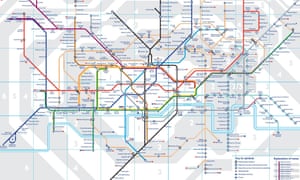
London tube map


London’s tube stations: as ‘characterful as pet dogs’? Photograph: Transport for London

And sound matters – what we hear every day on our commute is as much a part of our quotidian experience as our morning coffee. There’s the impact loud noises can have on our ears, for one. An expert working in 2004 recorded sound levels louder than a pneumatic drill on parts of the tube – loud enough to damage the hearing.


Then there’s also the psychological impact of sound: though we might classify many of the noises on the tube as stressful, Fowkes insists they can be reassuring in their familiarity, keeping the whole system moving like clockwork: “the details like the intonation of the automated announcements communicate ‘everything is well’ to commuters subconsciously … the trundle of the escalators, the closing of the sliding doors are all as rhythmic as a heartbeat, and become part of Londoners’ natural functions when they’re underground.”


This idea of the importance of acoustic ecology is not new – R Murray Schafer, considered the father of the debate around it, began talking about the (damaging) effects of sound, especially on people dwelling in the “sonic sewers” he believed cities to be, back in the 1970s. “Noises are the sounds we have learned to ignore,” he wrote. So perhaps this focus on the tube’s sounds will help Londoners’ occasionally listen, as well as simply hear, the underground aural landscape.


A man shouts while boarding a central line train at Oxford Circus station on the night of the launch of the 24-hour tube service.


A man shouts while boarding a central line train at Oxford Circus station on the night of the launch of the 24-hour tube service. Photograph: Daniel Leal-Olivas/AFP/Getty Images

“There’s no blue plaque system for preserving important sounds”, Fowkes says, even though “sounds change as much as visual cityscapes, and today’s sounds are tomorrow’s history.” Perhaps it makes sense that we should be working to archive the soon-to-be-lost sounds of our cities.


The remixed sounds on the London Underground sound map – added to “help people to appreciate how sound can form source material for some interesting art,” Fowkes says – are intriguing, if a little high concept. With the field recording made at Piccadilly Circus, Swedish sound artist Anya Trybala has crafted a composition meant to be a meditation on Brexit. Composer and artist Martin A. Smith has reimagined Moorgate by mixing recordings the Northern line with the sound of cigales and church bells recorded in forests in Provence.


And with the tube now rumbling through the night into the early hours, will we see this soundscape changing? “From a field recording perspective, the night tube is really exciting,” Fowkes says. He’s planning to head out, recorder in hand, and capture some of these nocturnal tube sounds. Who wouldn’t want to hear Londoners’ late night, post-party deep and meaningfuls mixed over the sound of Provençal cicadas?


Cities and Memory is continuing to capture sounds, not just below ground, but also above ground in London and in other cities in 55 countries across the globe. Fowkes’ ambition is to “help people appreciate the joy of the sounds that surround them every day.” So maybe then we can stop grimacing at the shriek of the Victoria line as it passes through Pimlico? Perhaps not. But maybe we can look more kindly on that King’s Cross bagpiper at quarter to nine on a Monday morning.


Listen to the London Underground sound map here. Follow Guardian Cities on Twitter and Facebook to join the discussion


A journey through the first ever sound map of the London Underground