On a hot late-July day two years ago I made my way out of the consulting rooms of the Anchor Psychiatry Group and paused on the pavement wondering what on earth to do next. I was 45 and had just been diagnosed with autism.
I went to the appointment alone. It hadn’t occurred to me to take my husband or a friend with me. I stood motionless, while others ambled past in groups, off to the pub for a Friday night drink. That moment seemed to encapsulate my whole life.
The diagnosis was both a shock and not a shock. Ever since I could remember I had been longing to find out why I behaved the way I did and why I was so unlike my peers. I find it difficult to recognise and name my emotions, but those I experienced that day seemed different to any I had felt before. Good feelings to me are pink. Bad ones are green. These were made up of all the colours of the rainbow. Not mixing together to make a sludge-brown, but rather like the flashes of colour you see when the washing machine spins a mixed load.
A few months before, I had been diagnosed with a genetic condition called Ehlers-Danlos syndrome. It’s a connective tissue disorder that causes digestive issues, easy bruising, limbs to dislocate easily and many other unpleasant symptoms. It seems many of those with EDS are also autistic. My autism diagnosis was the final piece of the puzzle for me. Having waited more than 40 years, in the space of a few short months I learned why both my body and my mind operate differently to those of most others.
With the sun warming my back, I walked slowly to my car, stopping every few moments to process the news. I thought of how in The Sixth Sense Bruce Willis’s character, Dr Malcolm Crowe, replays scenes from the past and it becomes clear to him that he is in fact dead. In my mind, I played episodes from my childhood, my teens and my later life as a mother of four, aware for the first time how my autism explained so much.
They flashed into my consciousness as individual moments. Standing away from the group of girls giggling in the playground. Sitting in tears in an exam room, unable even to write my name on the paper. Walking past bars watching a group of women on a night out and wondering what it felt like. Staring at a plate of food, knowing that because the burger bun was wet from mayonnaise, I could no more eat it than I could run a marathon. Sitting in an office being so distracted by the buzzing of an overhead strip light that I didn’t notice the phone ringing on my desk. Spending an entire Saturday researching a special interest only to realise it was 7pm and I was still in my pyjamas and hadn’t eaten. With each scene came a feeling of context and understanding.
The diagnosis came as a vindication. All my life I had tried so hard to be neurotypical, but in that one moment it became utterly clear that it was never going to happen. I was never going to fit that mould. I had stepped out of the psychiatrist’s consulting room into a new reality. The colours around me seemed brighter, the noises sharper. Finally I had the answer I had been searching for all my life.
• Odd Girl Out by Laura James, £16.99, published by Bluebird
Chas Hodges, one half of music duo Chas and Dave, has been diagnosed with cancer of the oesophagus.
Announcing the news in a Facebook post today, the statement said the 73-year-old will begin treatment immediately after the illness was fortunately spotted at an early stage.
The group have cancelled a number of dates as Hodges has treatment. “Chas expects to be back out on the road with Dave again soon, but in the meantime, the Potters Bar, Norwich, and Milton Keynes dates on the 17, 18, and 19 of February will need to be rescheduled,” reads the post.
“Apologies to ticket-holders for the inconvenience. The venues themselves will advise regarding re-scheduling/refunds etc.”
The London duo’s unique mix of rock and cockney – otherwise known as “rockney” – led to the pair rising to fame in the 1970s and 80s with hits including Rabbit and Snooker Loopy.
Before Hodges teamed up with Dave Peacock, he performed as a member of the Outlaws and backed bands such as Jerry Lee Lewis, Gene Vincent and Bill Haley in the late 50s and early 60s. He also played with Cliff Bennett and the Rebel Rousers, and appeared as special guest to the Beatles on their last British tour in 1966.
After splitting temporarily in 2009 following the death of Peacock’s wife, Chas formed his own act called Chas and His Band before reforming with his bandmate a year later.
One day during his last year at primary school, Jon Adams drew a picture of a street in Portsmouth, the city where he still lives. The scene he drew had no people in it, but its representation of everything else suggested a talent beyond his years.
The headteacher happened to see the picture, and said he wanted to put it up in the school’s entrance hall. “And that was an honour,” Adams says, “particularly for someone who didn’t think they were any good, because they’d been told they weren’t any good, every day.”
Adams was asked to write his name on the back, an instruction that threw up a choice. He had difficulties with writing, and he knew his class teacher could be cruel. “If I asked for help, I knew what he would say: ‘Oh, he can’t even spell his own name, what rubbish is that?’ So I did it myself.”
The teacher called Adams to the front of the class. “I went up, gave it to him, he held it up in front of the class, and then he tore it up. He said, ‘He’s spelled his name wrong – he’ll never be anything.’”
This happened 45 years ago. In recent years, Adams has been treated for post-traumatic stress disorder, caused at least partly by that episode, and how long it lived on, not just in his memory, but in his understanding of the world and his place in it. The story says a lot about the inhumanity that was once rife in the British education system; but it also shines light on what it’s like spending a lot of your life being not just misunderstood, but routinely insulted. “Someone telling you you’re no good every day worms its way inside your head,” Adams says. “Inside, you know you’re all right, so there’s this conflict going on.”
Since April 2013, Adams has known that he has Asperger syndrome – or, to put it another way, that he is autistic. Ten minutes online will tell you that Adams’ condition comes down to a so-called “triad of impairments” to do with social interaction, communication and imagination, or what some people call “flexibility of thought” – although the fact that Adams is a prolific artist suggests that, in his case, that last criterion might be misplaced.
Since 2013, many diagnoses of autism have also included a range of sensory issues, among them aversions to certain textures, sounds, smells and tastes, as well as a deep dislike of sudden noise. In Adams’ case, these seem to blur into a complex kind of synaesthesia: he understands music as something he can touch, and experiences the colour yellow as a profoundly unpleasant taste, like mould.
Adams sometimes talks about his condition in front of an audience, and there is one question that always comes up. “It goes: ‘My son’s eight, he sits in his room all day, he does Lego, he does complicated drawings, he won’t talk to anyone else – how do I make him socialise?’ Well, you don’t. He’s made his world. One day, he’ll show it to you. Don’t let him grow up thinking that the way he’s thinking and what he’s doing are faulty.”
***
Jon Adams was formally diagnosed at the age of 52, at an NHS clinic run as an offshoot of Cambridge University’s Autism Research Centre, after he was referred there by his GP. The initial spark had been a meeting with the centre’s founder and director, Simon Baron-Cohen (the cousin, in case anyone was wondering, of Sacha), who had spoken with Adams at the Cheltenham literature festival.
Adams had begun to realise what sat under a lot of his experiences; at the time, the biography that accompanied his work as an artist included the words “probably autistic”. From May 2012 until June 2013, he worked as the research centre’s artist-in-residence; immediately afterwards, a specialist gave him his formal diagnosis, a process that involved an interview and something akin to a questionnaire. “I got the letter through, saying I scored 18 out of 18 autistic traits, and I had Asperger’s,” Adams says.
I meet Baron-Cohen in a crowded Starbucks near St Paul’s Cathedral in London, where he wryly comments on the mixture of chatter, clattering cups and muzak – “For a lot of autistic people, this would probably be hell” – and casts his mind back over the 35 years he has been thinking about and researching autism. He started working with six autistic children in a special unit in Barnet, north London, in 1982. Fifteen years later, he set up the Cambridge research centre; two years after that, in 1999, he opened a clinic dedicated to diagnosing autistic adults.
My son received a diagnosis aged three. He had fixations with particular music or places – traits I recognise in myself
“There was a growing awareness that autism wasn’t just about kids,” he tells me. “I was receiving more and more emails saying, ‘My son’s an adult, but he’s never fitted in. Might he have autism?’ An adult couldn’t go to a child and adolescent clinic, so where were they meant to go? If they went to a learning disability clinic, and they had an IQ above 70, they’d be turned away. So these people were like a lost generation. That was a phrase I used a lot.”
The National Autistic Society estimates that there are currently around 700,000 people living with autism in the UK – more than one in every 100 of the population. Some of these people have learning disabilities. Some are what the medical vocabulary terms “non-verbal”, or unable to speak. Others are so-called “high-functioning”, a sub-group that includes those with Asperger syndrome, the condition named after the Austrian paediatrician who in the 1940s worked with a group of children he famously termed “little professors”. Asperger syndrome is distinguished by the fact that people who have it display no language delay as toddlers or small children. (Asperger died in 1980, long before the term “Asperger syndrome” entered popular usage. It has since been dropped from the relevant American diagnostic manual, but is still used in the UK.)
It is among this latter group that you will find many of the 20% of autistic people currently thought to have been diagnosed as adults. No national figures for adult autism diagnoses are available, but anecdotal evidence suggests numbers are rising: Baron-Cohen tells me that four years ago, 100 cases in Cambridgeshire were referred to his clinic; in the first four months of 2016 alone, it received 400 referrals.
Most of the terms used to describe autism don’t do justice to the nuanced, complicated traits bound up with it. Nonetheless, all its variants are covered by the catch-all term autism spectrum disorder, or ASD; people who dispute that autism is any kind of “disorder” prefer the term autism spectrum condition. The word “spectrum” was first used in this context by the pioneering British researcher Lorna Wing, who died in 2014. Baron-Cohen explains: “What she meant at the time, I think, was a spectrum within those who come to clinical attention. Where it’s gone since is that this spectrum runs right through society, out into the general population.”
My own interest in autism began when my son James received a diagnosis of ASD at the age of three. Back then, some things seemed strange: the social distance between him and his peers; his fixations with particular music (the Clash, the Beatles) or places; his pointed dislike of some foods or sounds (I still curse whoever invented the public toilet hand-dryer); his amazing facility with technology. Now, these things are simply part of the fabric of our shared life. I recognise echoes of myself in some of these traits (the music, the technology), and of plenty of other people: more than anything, his 10 years have brought me an ever-growing understanding of the complexities of human psychology, both among those diagnosed as “on the spectrum” and so-called “neurotypical” people.
Unfortunately, the everyday world has yet to catch up. Only 16% of adults diagnosed with autism in the UK are in full-time, paid employment. In 2014 Baron-Cohen’s team found that two-thirds of the patients in their clinic had either felt suicidal or planned to kill themselves, and that a third had attempted to do so. “To my mind, this is nothing to do with autism or Asperger syndrome,” he says. “These are secondary mental-health problems. You came into the world with autism, and the way the world reacted, or didn’t react, to you has led to a second problem, which is depression. And that’s preventable.”
***
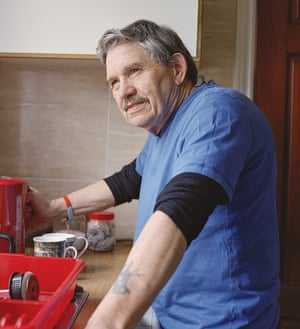
A week after talking to Baron-Cohen, I take the train to the Lancashire town of Wigan, to meet 68-year-old Peter Street, who got his autism diagnosis only 10 months ago. He is an impish, funny presence, and says he loves conversation, perhaps a little too much. “I get this deep urge – it’s a pain, almost, to talk to people. When I’ve described it to the therapist, I’ve said I’m like a bucket of water and it’s full. And then all of it comes out, and it empties.”
Peter Street: ‘I get too much for people, and they get too much for me.’ Photograph: Rosie Barnes
After 20 minutes, it becomes clear that Street has the most astonishing life story of anyone I have ever interviewed. His mother, he says, became pregnant with him when she was raped. In his native Bolton, the two of them were taken in by a man much older than her, who employed her as his housekeeper, and then married her and adopted Street to give the arrangement a veneer of normality. He grew up, he says, with no extended family and very few friends. “I get too much for people, and they get too much for me. A lot of the time, I overpower people. When I was a kid, when I made a friend, I would go and sit on their doorstep, waiting for them. I’m a really early riser, and I can’t cope with being late anywhere. I used to go and sit on the doorstep, maybe six, seven in the morning. And people obviously didn’t like that.”
His daily routine, he says, often revolved around an outside toilet, and his home’s back wall, which he would use for solo games of football and marbles. “And that was wonderful, in some sense. It wouldn’t have been wonderful for some people, but it was for me.” He also made endless trips to the cinema, where he acquired a forensic knowledge of Greek mythology; he mentions Steve Reeves, the musclebound 1950s actor who played Hercules. “I can take certain things in – really odd things, sometimes,” he says. “But I can’t take in what most people take in every day.”
At school, he found it almost impossible to tune in to the teachers. “They were shit with me,” he says. “They knew how to abuse. They were good at it. They were bullies. They used to stand me in the corner, in the wastebasket, and hit me over the head with the board rubber, to knock some sense into me. I’ve always blamed my epilepsy on that.” He started having grand mal seizures when he was 15; it is now estimated that around a third of autistic people also experience epilepsy, though the relationship between the two is something that neuroscience has yet to fathom.
Street left school unable to read or write. He passed through a series of jobs – a bakery, a butcher’s shop – some of which came to an end because he found it difficult to process complex instructions, before settling into work as a gardener and gravedigger. Along the way, he married his wife, Sandra, with whom he has three grownup children. “She doesn’t like being with people,” he says. “She’s very quiet, very introverted. In a way, she’s a mirror.”
In 1984, after breaking his neck while trying to climb into a transit van that was pulling away, Street began three years in recovery. While he was in hospital, he met a fellow patient who was an English teacher, and started to work with him on his literacy; then, through adult education, he discovered a talent for poetry.
While we talk, he hands me an anthology of his work, published in 2009, that begins with a poem titled Not Being Me, a perfect glimpse into the autistic experience of not fitting in:
Childhood nights were dreams of being a sheep then up and out of a morning, a quick check to see
if by any chance in the night there had been a change of being just like all my friends and not the odd one out
In the late 1980s, Street began to teach poetry in schools and day centres; in the early 90s, he became a writer-in-residence at the BBC in Manchester, which led to a series of assignments. In 1993, he went to Croatia to write about the war that was then engulfing the Balkans. “People with autism, it’s often said that they have no emotion or empathy,” he says. “I have too much emotion, too much empathy. It broke my heart.” Three experiences preyed on him: a meeting with an 18-year-old abandoned in a refugee camp; an occasion when he gave his water ration to an emaciated woman with a newborn child; and the experience of eating a sumptuous meal in the town of Lipik, with “three or four kids at the window, looking in. And I didn’t have the balls to get up and go and give them my food.”
By 2014, his inability to put away these memories had become too much. “I went to a therapist. And she said, ‘I want you to go and see a friend of mine. She’s a specialist in diagnosing people with autism.’ I thought, ‘I’ll go along’, as you do. And she gave me these really strange games. They were like a jigsaw puzzle: four pieces. White. They were so simple, I thought I could do them – and I couldn’t.” He was handed five plastic figures and toys, and told to make a story with them. “And I couldn’t do that, either. I couldn’t connect them together into one story. She said I was highly intellectual, but on the autism spectrum.”
His response was one of enormous relief. “I cried. It was wonderful. Wonderful. Because all my life suddenly made sense. And none of it – the beatings, the abuse – none of it was my fault. Apart from my family and Sandra, I’d put it in the top five greatest things that have happened in my life. Absolutely, incredibly wonderful.”
***
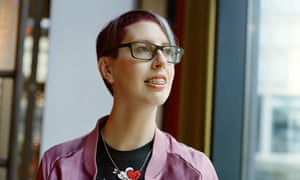
Penny Andrews got her diagnosis of Asperger syndrome (though she is perfectly comfortable with the term “autistic”) when she was 30. Back then, she was a regular user of LiveJournal, the social networking site that was a forerunner of Myspace and Facebook, and one of her online contacts had begun to write about the process of finding out he was autistic. “He wrote about it quite openly: all the reasons he’d gone for diagnosis, what the procedure was like, seeing half a dozen different psychiatrists before he found one who would refer him for diagnosis,” she tells me. “And the more he wrote about it, the more I was like, ‘Oh, God, this is me.’”
Andrews is now 35. She also has mild cerebral palsy, which manifests itself in spasms in her ankles, knees and wrists. She is a para-athlete whose specialism is the 100m, and has a punishing training schedule. She wears a vintage Bowie T-shirt, has a wood-cut picture of the Yorkshire town of Whitby tattooed on her right arm, and is a prolific and waspish presence on Twitter. Andrews is currently awaiting a decision on the funding of her PhD, which is focused on the relationships between academic libraries and “data flows, digital labour, academic social networking services and governance in research support”.
At secondary school, boys pretend to fancy you. It kills you, because you take it seriously
She grew up in Nidderdale in the Yorkshire dales and now lives in Leeds. Throughout her childhood, Andrews says she had a deep sense of “everything being wrong, somehow. Being clever and being a supposedly interesting person, but never able to maintain friendships and always, inexplicably, saying something wrong.”
Autism among women and girls is only starting to be properly understood. The male to female ratio of autistic people currently stands at around 5:1, although Baron-Cohen says he and other autism specialists are currently in a “transition period” in their research: the actual figure may eventually turn out to be very different. “There’s a whole new topic researchers are latching on to, about camouflage: whether females – for whatever reason – might be better at hiding their autism,” he says, something that is borne out by Andrews’ recollection of her time at school.
“You’re not supposed to get on with people’s parents better than them when you go round to their houses. I didn’t really want to play with people – I just looked really aloof. I read the diary of Anne Frank when I was six, and I talked about the Holocaust. But I would try to copy other people, how they talked and acted. I’d watch TV programmes that other people watched so I’d have something to talk about. Neighbours and Home And Away.” She laughs. “I got a Tamagotchi when everyone else got them, but I had no interest in it.”
In the end, teenage etiquette and the nastiness that often comes with it proved too much. “Girls are cruel. They exclude each other, and pretend to be friends with each other, as a game. And I get sarcasm, but I don’t get insincerity. And then, at secondary school, boys pretend to fancy you, because that’s the most ludicrous idea they can think of. It kills you because you take it seriously. And they invite you to things, and then they don’t show up, or they’re round the corner laughing. All of that happened.”
Penny Andrews: ‘I would try to copy other people, how they talked and acted.’ Photograph: Rosie Barnes
She has been married to her husband, Emil, for 11 years. “Because he loves me the way I am, I’m completely myself with him.” How hard does she find it to read other people’s emotions? “It sort of depends. If somebody’s actually upset, I can probably feel it quicker than other people. I can feel it too much. But I can’t usually tell if people are trying to get out of a conversation: if people are trying to leave. You have to tell me: ‘We need to stop.’ I can’t tell whether people like me or not, which is hard.”
Plenty of non-autistic people have issues with that, I say, myself included. “But they seem at peace with it. Even with people I’ve known for a long time, I won’t know whether they like me or not unless we’ve had an explicit conversation: ‘Do you actually like me?’ Which turns people off.”
When it comes to understanding autism, how much does she think the world still needs to change? “Quite a lot. Because I think a lot of people still don’t believe it, or think it’s a really mild thing: ‘Well, it just makes it a bit harder for her to make friends, makes her a bit more anxious.’ A lot of the time, it’s stressful. Painful. When the sensory stuff is happening, it’s like you’re being Tasered.” Andrews mentions people flicking their train tickets, or jangling their coins, or whistling. “It’s not just, ‘That’s annoying.’ It’s, ‘That’s unbearable.’ I have said, ‘I’m really sorry, but can you stop doing that?’ But people don’t.”
I have one last question. Self-evidently, Andrews is what some people call “high-functioning”. When she meets autistic people who are, say, non-verbal, does she feel they are part of the same community? “Yes. And I think we have a duty, as people who can speak, to make sure that those people are looked after properly, and they’re not exploited, and they don’t have inappropriate people speaking for them, or saying things like, ‘He’s got a mental age of three.’ How would they know, if they can’t communicate with them? From what I can observe, they are experiencing the same thing as me. When I’ve seen a non-verbal person have a meltdown, it looks like my meltdowns, only more physical. It looks…” She thinks for a minute. “It looks like an unrestrained version of how I sometimes feel.”
***
In Portsmouth, Jon Adams talks about what many autistic people call “passing”: like Andrews’ pretend interest in Australian soaps and techno pets, it’s about managing to blend in, even if that means submerging whole chunks of your personality. In Adams’ case, passing took its toll and, in his late 30s, he hit an emotional wall. “Not being true to yourself has an effect on you,” he says. “I’d been married, and that had failed. I had a girlfriend at the time, and that was failing. I had a bit of a breakdown, and it took me a couple of years to get used to people.”
He started out on a new path as an artist. The work he does ranges across disciplines including sculpture and music, and regularly touches on his own story. Among his most affecting works is a piece called My School Pen: an old-school fountain pen covered in spikes that perfectly evokes his struggles as a child.
You might have imperfections, but the basics of the way you view the world are right for you
In 2007, he was working on a project with a group of teenagers for a charity called the Foyer Federation. “The woman in charge said, ‘Have you ever considered you’re autistic?’” he recalls. “I said, ‘No, what’s that?’” She gave him a copy of Mark Haddon’s novel The Curious Incident Of The Dog In The Night-Time, now almost a set text for people interested in the condition. “And I went away and I read one page and I cried.”
He wells up now. “You might have faults and imperfections, but the basics of the way you view the world are right for you. When everybody tells you, ‘No, you’re thinking wrong’, you know you’re not. But if everyone tells you that, you think you’re faulty. That’s the root of the depression and the low self-confidence. So to read those things on a page was emotional. It was visual. I could see that someone understood. And I thought, ‘OK, maybe I am autistic.’” It would be another six years before he was formally diagnosed.
For most adults who receive a diagnosis, the formal recognition might make belated sense of their lives, but it tends to make little difference to their daily existence. According to the National Autistic Society, 70% of adults say they don’t get the help they need. People might just about recognise the condition’s more extreme manifestations, but as Penny Andrews puts it, “They’re probably not aware of the bulk of autistic adults: people who are sitting there, coping with a lot of stuff, and the fact that they’re dealing with all this noise and stress and uncertainty that they shouldn’t have to.”
Joblessness among autistic adults speaks for itself. Even such mundane things as the ubiquity of piped music, or inadequate signage in public spaces, attest to the same basic issue: a society averting its eyes from things that blight hundreds of thousands of lives and might easily be improved. We fetishise “awareness” of autism, but the point needs to be greater understanding – and then practical action.
Simon Baron-Cohen cites one big frustration: if autism comes down to an often profound difficulty navigating the world, only a tiny number of people currently receive the help they need to do that. “Whether it’s about how to go shopping, or how to go for a job interview, or how to reply to your girlfriend. To me, if we were a civilised society, we’d be paying for mentors. It doesn’t seem unreasonable.”
A government programme called Access To Work means that Adams does get help from a support worker called Donna, a calm and empathic woman who accompanies him to our interview. Donna is copied into all his emails, and in the course of Adams’ work as an artist and a researcher into disability and creativity at Portsmouth University, she regularly shadows him for a couple of hours a day. Among other things, her job is partly to assist him in the kind of reading between the lines that professional and social etiquette demands, but that a lot of autistic people find difficult. Very often, she explains, she is there to suggest that a particular request or instruction is put in a different way, or to remind people in authority that Adams has his own ways of working. “You might have a three-week time span to do a piece of work,” Adams explains, “and if your line manager is checking you each day to find out your progress – well, you might not do anything for two weeks: you might be mulling it over in your head.”
Adams talks a lot about “systemising”, the quintessentially autistic way in which he divines patterns in the world, often immersing himself in them. Music is a good example. He has an app called iMini, which he uses to programme sequences of electronic notes into an on-screen keyboard, which he can then use if a spurt of anxiety means he needs to readjust. He plays me a bit, which I say reminds me of the kind of experimental music that came out of Germany in the 1970s. That’s not a coincidence: “I got really into Tangerine Dream in about 1976 – the repeating sequences were heaven for me,” Adams says. He also likes the electronic pioneers Kraftwerk, which rings loud bells. My son is a Kraftwerk obsessive, and regularly zeroes in on particular segments of their songs and plays them over and over. Does that sound familiar?
“Yes,” Adams says, and his mind goes back to 1978. “I bought Mr Blue Sky by ELO. There was a track on the other side, and it had a very strange beginning. It was called Fire On High, and I’d play it over and over and over again.”
Why? “It aligned me. It made me feel that the world was right and everything was together. It felt like it was part of me. It’s like all the stars lining up.”
He smiles. “Things like that give me the feeling I’m meant to be here.”
More than half a million Britons a year will be diagnosed with cancer by 2035, making it hard for NHS services to cope with the extra demand for testing and treatment, Cancer Research UK (CRUK) has warned.
The number of people across the UK found to have cancer every year is expected to rise from 352,000 to an estimated 514,000 in less than 20 years – more than 160,000 extra cases annually – according to research in the British Journal of Cancer.
The vast majority of the expected 162,000 additional cases – 141,000 – will be caused by the ageing and growing population. However, another 12,600 will be the result of a combination of lifestyle factors, such as smoking, alcohol or poor diet, and also improved screening for the disease.
In 1993, 127,000 men and 128,000 women were diagnosed with the disease. By 2014, the numbers had risen to 173,000 and 179,000 respectively. This future trends analysis, based on examining cancer data going back to 1979, predicts that 244,000 women and more than 270,000 men will be diagnosed in 2035.
Those big rises mean there is an “urgent need to plan for the future of NHS cancer services, which are already stretched to the limit as they struggle to cope with a growing and ageing population”, CRUK said.
“The number of people getting cancer in the UK will incerease sharply in the next two decades. This is mostly the result of an ageing and growing population but, for women, lifestyle factors are playing an increasingly important role”, said Dr Rebecca Smittenaar, the study’s lead author and CRUK’s statistics manager.
Part of the predicted increase in cancer rates has been attributed to improved screening for the disease. Photograph: Getty/Caiaimage
People’s risk of developing cancer will also rise in actual terms, separate to the growing numbers diagnosed, due to increased life expectancy and population expansion.
Cancer incidence rates have risen for both sexes in an almost unbroken way since records began in 1979, though they have recently begun edging downwards for men. Men have always been more likely than women to be diagnosed.
In 1993, 783 f every 100,000 men aged 15 or over were diagnosed with cancer. That rose to 808 per 100,000 in 2014 and is predicted to increase again, albeit slightly, to 812 per 100,000 in 2035.
The number of women in that age group who developed cancer rose from 564 per 100,000 people in 1993 to 664 per 100,000 in 2014. It is due to hit 685 by 2035, according to the study.
CRUK last year revised its prediction for the number of people who would develop cancer at some point in their lives from one in three to one in two.
Sir Harpal Kumar, the charity’s chief executive, said the expected increases in cancer cases were “shocking”. However, four in 10 cancers could be prevented if people drank less, did not smoke, ate a healthy diet and took more exercise, he said.
Thirteen years ago, when Babalwa Mbono was eight months pregnant with her second child, she went to her clinic in Cape Town, South Africa, to have a routine HIV test.
“I went with confidence because my first child was negative and I was negative then,” she says. When the test came back positive, Mbono couldn’t believe it. “When the counsellor who tested me showed me the results I thought, ‘you’re joking!’ I even asked her if she was sure.”
Mbono left the clinic in a daze and went home to reflect on the news, still in denial. She looked healthy and well, unlike her sister who had died three years previously from Aids-related tuberculosis. “For me, [the result] was something that was not real,” Mbono adds.
Nowadays many people in South Africa know about HIV. The country has the biggest and most high-profile epidemic in the world, with an estimated 7 million people living with the condition, according to UNAids figures. But in 2003 it was not a big topic, and discussions usually revolved around death, says Mbono. The fear of what having HIV might mean for her unborn child started to creep in, and she worried that she would not live long enough to care for a baby who might be infected.
When Mbono found out that she had HIV, South Africa’s government was still deciding whether to make antiretroviral treatment (ARVs) available to all, despite a third of pregnant women testing positive. Today, 48% of infected South African adults are on ARVs.
Back at the clinic, Mbono was linked up to a mentor mother through Johnson & Johnson’s mothers2mothers (M2M) programme. The scheme started in 2001 and has helped 1.4 million HIV-positive mothers in nine sub-Saharan African countries. It currently operates in Kenya, South Africa, Malawi, Lesotho, Uganda, Swaziland and Zambia – seven countries where it has virtually eliminated mother-to-child transmission (MTCT) among its patients, with a 2.1% transmission rate (the UN classifies virtual elimination as less than 5%).
Mbono’s HIV-positive mentor allayed her fears about death and her anger towards her husband, whom she blamed for giving her HIV after he tested positive with a much higher viral load. Through M2M,Mbono learned about taking ARVs to reduce the risk of MTCT in the womb and during breastfeeding, and about how to change her lifestyle to live a long and happy life with her children.
Last year, South Africa was one of six priority countries (all in sub-Saharan Africa) to meet a Global Plan target of reducing MTCT by 90%, with 95% of pregnant women with HIV on ARVs and an 84% reduction in new HIV infections among children.
Over the past year, Cuba, Belarus, Armenia and Thailand – non-priority countries – managed to eliminate MTCT altogether. In South Africa, mother-to-child transmission of HIV has fallen to 3.5%, putting the country within reach of eliminating paediatric infections, although maternal mortality remains high.
The M2M programme “makes the person feel supported”, Mbono says. “It’s a sisterhood, and it makes you feel like you have a family to cry on.” Through counselling, which helps to breaks down the stigma still attached to HIV/Aids in South Africa despite its high prevalence, Mbono also found the courage to confide in her parents and siblings.
And six months ago, she decided to disclose her HIV status to her daughter Anathi, who had just turned 13. “It really felt shocking,” says Anathi, who feared that there would be no one to look after her seven-year-old brother, who was born HIV negative. “I was afraid that she would leave us.”
Mbono reassured her daughter that she had tested negative when she was 18 months old, but Anathi decided to go alone to the clinic and be tested anyway, where she also accessed free counselling from health workers.
“I was so, so scared, but eventually they just sat with me and told me to not freak out and to not think negative things about my mum,” Anathi says. Over the two days she waited for her results, she spent time with her mother and learned more about M2M, even reading her mentoring books.
Mbono’s experience with M2M made her give up unhealthy habits, such as not eating properly and drinking alcohol, and inspired her to become a mentor mother in 2003. “The [programme] gave me the strength to go out there and tell people about HIV and correct the mistakes that people are making and [that] I also made when I didn’t have any information.”
She has gone from counselling others on HIV/Aids and family planning, to training other mentors and seeing them become nurses, social workers and students.
“What makes me most happy [is] when I see a woman who had broken up in pieces when she was told about HIV … and when you see her on the next visit she is much better than the day she left.”
Some 95% of babies in M2M’s South Africa programme test negative for HIV at 18 months, and that also makes Mbono proud. “That makes me feel that I’ve done my job, because 18 months is a long time for the mother to be supported and to be educated. There are so many challenges that they come across, and we are there [for them].”
Anathi set up a counselling group at school to discuss HIV and sex with 18 girls and five teachers, as well as a drama group to perform plays to parents and pupils that discuss staying HIV negative and breaking down stigma.
“Most people don’t talk about it … Young people are not getting enough information about HIV,” she says. Anathi has a friend who she says became a recluse after she found out she is positive, and she knows two girls who have gone off the rails since their mothers recently died of Aids.
But for Anathi, dealing with her mother’s HIV has made them stronger and brought them closer together.
She still worries about how well her mother has slept or eaten when they are apart, even though learning about ARVs has lessened her fears of her mother falling ill and not recovering. “I just worry too much and I call,” she says. “She is like my daughter.”
Join our community of development professionals and humanitarians. Follow @GuardianGDP on Twitter.
A transgender identity should no longer be diagnosed as a mental disorder, according to the first field study to evaluate a proposed change in the WHO International Classification of Diseases (ICD).
The mental distress experienced by many transgender people is primarily the result of social rejection and violence, the study found. Not, as has been assumed for decades, solely the result of being transgender.
The findings, published in the Lancet, show that viewing transgender people as having a mental illness might force them to get psychiatric care rather than the physical care they seek.
Authors of the “Removing transgender identity from the classification of mental disorders” study also warned that association with mental illness could be used by governments to deny decision-making authority to transgender people, in matters such as child custody and reproduction.
According to the first report by a UK parliamentary committee to tackle transgender issues, which was published earlier this year, as many as 650,000 people in the UK are gender incongruent to some degree. The transphobia they experience undermines their careers, incomes, living standards and mental and physical health, it found.
A third of transgender adults and half of “gender-variant” young people attempt suicide, and transgender people in the UK face high levels of transphobia on a daily basis, the Commons Women and Equalities Committee concluded. MPs urgedministers to draw up a new strategy to tackle discrimination in the NHS, prison service, police and schools.
Changing the classification in the ICD, the most influential medical bible, will have a significant impact on how transgender people are treated by the medical establishment, as well as how they are viewed by society.
“Stigma associated with both mental disorder and transgender identity has contributed to the precarious legal status, human rights violations and barriers to appropriate care among transgender people,” said senior author Professor Geoffrey Reed, of the National Autonomous University of Mexico.
“The definition of transgender identity as a mental disorder has been misused to justify denial of healthcare and contributed to the perception that transgender people must be treated by psychiatric specialists, creating barriers to healthcare services. The definition has even been misused by some governments to deny self-determination and decision-making authority to transgender people in matters ranging from changing legal documents to child custody and reproduction.”
The study’s authors interviewed 250 transgender people. It is the first of several field trials and is currently being replicated in Brazil, France, India, Lebanon and South Africa.
“Our findings support the idea that distress and dysfunction may be the result of stigmatisation and maltreatment, rather than integral aspects of transgender identity,” said lead investigator Dr Rebeca Robles, of the Mexican National Institute of Psychiatry. “The next step is to confirm this in further studies in different countries, ahead of the approval of the WHO revision to the International Classification of Diseases in 2018.”
The study found 83% of participants had experienced psychological distress related to gender incongruence during their adolescence. More than three-quarters had experience social rejection related to gender incongruence, most commonly by family members, followed by school and workmates, and then friends.
Over 60% of participants had been the victim of violence as a result of their gender identity: in nearly half of these cases the violence was perpetrated by a family member. Psychological and physical violence were the most commonly reported, while some experienced sexual violence.
A WHO working group has recommended that transgender identity should no longer be classified as a mental disorder. But it would not be removed from the codebook. Instead, transgender would be moved into a newly created category: conditions related to sexual health.
This, however, has stirred further controversy. “I think there is a bit of a problem with the idea of putting it in a chapter on sexual health because it has nothing to do with sex,” said Dr Griet De Cuypere, a psychiatrist at the Center of Sexology and Gender at University Hospital in Ghent, Belgium, and a board member of the World Professional Association for Transgender Health. “If it’s possible to have it more separately, it would be better.”
Victoria Derbyshire, the broadcaster, has disclosed she has been diagnosed with breast cancer.
Derbyshire, the Sony Award-winning BBC presenter, mentioned she would be undergoing a mastectomy in the weeks to come.
She advised fans she will proceed to existing her information programme for the duration of therapy exactly where possible, as she praised medical staff for their assistance.
Hi, have been diagnosed with breast cancer & am possessing a mastectomy in a handful of wks. Family, pals, work & NHS employees are getting brilliant 1/two
— Victoria Derbyshire (@vicderbyshire) August 19, 2015
Will be performing the programme as much as achievable for the duration of treatment in the months ahead 2/two
— Victoria Derbyshire (@vicderbyshire) August 19, 2015
Derbyshire, 46, at present hosts a everyday news and recent affairs programme for the BBC, and has previously worked on Radio five Live.
She was immediately inundated with messages of assistance from supporters and colleagues, wishing her a speedy recovery.
A spokesman for the BBC stated: “We wish Victoria a full and speedy recovery and seem forward to having her back complete time as soon as possible.”
According to the NHS, breast cancer is the most common type of cancer in the Uk and can be taken care of if caught early adequate.
In 2011, just below 50,000 females have been diagnosed with invasive breast cancer. Most women who get it, 8 out of ten, are over 50.
• A single drink a day increases breast cancer danger by 15 per cent
About 30% of individuals with HIV are diagnosed properly following they must have begun therapy, according to the most current Australian data, suggesting early-testing initiatives have not worked.
Regardless of 88% of the country’s new infections happening in gay guys, unprotected sex in that group continues to be a key driver of infections, producing falling HIV testing rates between youthful gay males a concern.
There have been 1,235 new circumstances of HIV diagnosed in Australia final yr – an improve of 70% considering that 1999 when diagnoses had been at their lowest, figures from the annual HIV surveillance report by the University of NSW Kirby Institute show.
A lot of of these have been not currently being diagnosed early sufficient, enabling their immune program to fail and potentially posing a chance to other people, the report found.
The greatest indicator of how lengthy a individual has had HIV for is their CD4+ cell count per microlitre, which declines on regular by 50%–60% per year in folks with HIV. The proportion of late diagnosis cases, defined by a CD4+ cell count of significantly less than 350 cells per microlitre at diagnosis, had not improved in the 3 many years to 2013, the report found. In individuals with out HIV, the count is over 500.
“These data are suggestive of no substantial shift in the illness stage at which men and women are diagnosed regardless of recent initiatives to increase HIV testing,” the report explained.
Along with condom use, early treatment method of infections is considered essential to stopping HIV’s spread. Most of individuals taking antiretroviral treatment options lessen their possibility of transmitting the virus to other people during unprotected intercourse by up to 96%.
But in some situations, individuals were residing for many many years with HIV with out realizing, mentioned Associate Professor David Wilson, head of Kirby’s surveillance and evaluation program for public wellness.
“It is important to stage out that charges of therapy when men and women are diagnosed is much better here than in most other countries in the planet, with 60% of folks diagnosed with HIV on therapy that restores their immune technique,” Wilson said.
“But we really don’t want to commence treating men and women when their immune system has presently crumbled.”
Individuals who delayed their therapy too extended also often took longer to recover. Wilson explained it meant attempts by overall health departments to get people to test, for instance through speedy-testing by GPs and at sexual well being clinics, were not foremost to earlier diagnosis. But Wilson added he was hopeful the approval of HIV house-testing would lead to men and women becoming diagnosed sooner.
No Australian state or territory has a lengthy-term decreasing trend in HIV. Victoria recorded the largest boost in HIV situations in 2013, with 365 new diagnoses.
Condoms had been still the most effective way to avoid HIV’s spread, Wilson mentioned, and was particularly crucial for gay men.
Up to twelve% of that group is estimated to be contaminated with HIV. The prevalence amid sex staff, by comparison, is less than .one%.
But the annual trends in behaviour report by UNSW’s Centre for Social Analysis in Well being – also released Thursday – discovered the rate of unprotected anal sex among gay males with casual partners has elevated in the past decade.
Far more than 35% of males with casual partners in the six months before the survey reported having unsafe anal intercourse.
A Melbourne HIV professional physician from Monash University, Nick Medland, says HIV prices have been higher amongst gay males not just since of that, but also because the HIV epidemic hit the gay male local community initial.
“Australia has been extremely productive following the discovery of HIV in stopping it from getting to other communities like drug consumers and intercourse employees,” he mentioned.
Folks normally, including heterosexual Australians, had turn into far more complacent towards catching HIV, Wilson mentioned.
“A lot of factors have took place given that HIV very first came to light, for illustration HIV is no longer fatal in most instances,” he said. “I guess that has triggered men and women to turn out to be lax about acquiring it, folks aren’t as terrified as they have been in 1990s.
“It’s a good factor that they are not terrified and that stigma is being decreased, but it does also suggest some folks are a great deal much less mindful. I’m not saying they really do not care if they are contaminated, but twenty many years ago men and women fell apart throughout the testing method.”
The yearly HIV testing price among gay guys who are not HIV good is around 60%, according to the report, with the charge falling particularly among people who were beneath 25 many years of age.
This was partly due to the fact public awareness campaigns all around HIV had been not as powerful now, Medland said. And HIV testing was essential for the common community – not just gay guys.
“It’s about thirty many years on from the peak of HIV awareness campaigns, and it’s a bit hard for the neighborhood to sustain that level of awareness,” Medland mentioned. “People have moved on to worry about other factors.”
“It took a handful of meetings, and she informed me of some good internet sites. The MS Society has been truly valuable. But the message is that you have to find stuff out for your self. It requires a extended time and some of the solutions are scary, but it is not as scary as not understanding, and you meet other folks via charities and chat rooms who are not just surviving with MS, but thriving and residing effectively.
“My list, which I guess would be equivalent for anybody with an incurable illness, was:
one. Why has this happened to me?
two. Why now?
3. Will it kill me?
four. How soon?
five. What exactly is going on in my brain?
six. Have I done anything at all to deliver it on myself?
7. Should I stop smoking?
eight. When will men and women be ready to tell that I am unwell?
9. Are there different sorts of a number of sclerosis?
ten. Which type of I received?
11. What stage of the ailment am I at?
12. Can I fully recover or have I got it for lifestyle?
13. Will I turn into disabled?
14. Are there any drugs that will reverse the disease or slow it down?
15. What do I do if I have a flare up?
sixteen. Will I nevertheless be capable to perform?
17. Do I have to inform my function?
18. What are my rights as an employee?
19. Can I drive?
twenty. Am I going to pass it onto my children?
21. Do other people in my family members require to have tests?
22. Will it make me impotent?
23. Will it make me infertile?
24. Can I have vaccinations?
25. Is it safe to have an anaesthetic?
26. Is there some type of diet program that might assist?
27. Must I have oxygen therapy?
28. Must I have vitamin D supplements?
29. Should I keep away from dental procedures?
30. Ought to I have my mercury fillings removed?
31. Is there anything at all I can do to avoid relapse?
32. Will I go blind?
33. Will I be confined to a wheelchair?
34. Will I be in a position to speak and swallow?
35. Will my muscle groups all stiffen up?
36. Will I be in severe ache?
37. Will I drop sensation?
38. Will I grow to be incontinent?
39. Will I need to have a catheter?
40. Exactly where will the income come from when I am ill?
41. Is there any monetary help offered now?
42. Will I be capable to seem right after my young children?
43. Will my wife depart me?
44. Will I get depressed?
45. Are you absolutely confident it is multiple sclerosis?
46. Why?
47. Could it be anything at all else?
48. Will I have a horrible death, confined to bed, entirely dependent, incontinent, unable to speak consume or swallow?
49. Will I get stress sores?
50. Shall I make a will?
51. Shall I make an sophisticated directive?
52. Must I give my wife electrical power of attorney or wait and see?
53. How close are we to cure?
54. Are there any trials of new medicines I could enter?
fifty five. If I start off looking for info on-line, will it just genuinely depress and frightened me?
56. Who can I believe in to solution all these queries truthfully, kindly and accurately?
“There is a massive amount to discover if you want to get on prime of an illness like MS, but if you stick at it, you can quickly know as a lot as your GP about some issues and even a lot more about others. There’s so considerably to consider on board that I didn’t even consider at first that I may not be getting the drugs I needed right up until my (wonderful) nurse said she imagined I ought to be on a disease modifying drug (interferon beta). You presume the NHS automatically offers you the treatment method you require, wherever you occur to reside in the United kingdom. The thought of a postcode lottery, and having to fight for drugs that other men and women are given instantly, is a bit dispiriting.”
As a journalist and broadcaster, I’ve campaigned on behalf of individuals for 25 many years, and what ever condition you get, the proper expertise can be as effective as the proper drug. Approximately 100,000 folks in the United kingdom have MS. A 2013 report from the Several Sclerosis Society identified that only forty% of eligible people with MS in the United kingdom are currently on condition-modifying drugs . This report on MS treatment and care ranked the United kingdom 25th out of 27 comparator nations with regard to MS medication. Across Europe, only Poland and Romania fare worse. Accessibility to treatments varies geographically MS patients in Northern Ireland are much more than twice as very likely to be taking a DMT (ailment-modifying therapy) than people in Wales.
Knowing what treatment method you’re entitled to is no guarantee you’ll get it, but it provides you a lot more of a chance than not being aware of. In 2013, NHS England published a clear policy saying who was entitled to illness modifying medication for MS. If you’re not acquiring them and you think you’re entitled, ask why not. And preserve asking.
Shelagh had gone to the hospital alone when she obtained a diagnosis of dementia. With the medical doctor for less than five minutes, she compares the delivery of this news – which was lifestyle-altering in the excessive not only for her but her family members and pals – as ‘like getting advised I had tonsillitis.’ She refers to this day as the worst of her life but says it wasn’t the diagnosis itself, rather the lack of empathy and assistance that left her feeling so desperately alone.
Shelagh compares herself to a near buddy who was lately diagnosed with breast cancer. In that predicament, on obtaining the news she was immediately provided with a nurse who supplied comfort, assistance and, need to it be needed, a shoulder to cry on.
You would hope her experience was a one particular off, the exception rather than the norm, but sadly it isn’t. An Alzheimer’s Society survey published right now finds that a fifth of folks affected by dementia had been offered no details and assistance soon after a diagnosis – factors that are essential in assisting individuals come to terms with the problem, keep independence and strategy for a long term they hadn’t envisaged.
A single in 3 individuals above 65 will produce dementia – but dementia and despair do not have to go hand-in-hand. People with the situation inform us that with the correct data and assistance they can live properly, but it wants to be a lot far more forthcoming. It ought to by no means be the case that someone is left to trawl the world wide web (that is producing the large assumption that they have accessibility to it) to find out what their diagnosis implies how their problem is very likely to progress what adaptions can be created to their property and exactly where they can uncover help groups and providers in their regional neighborhood.
At present there is no national guidance on a minimal provision of support for folks impacted by dementia, nor is it clear regardless of whether the obligation for commissioning providers lies with wellness or social care. Just today the Association of Directors of Grownup Social Companies has launched a report warning that our social care system is dealing with monetary meltdown if budgetary pressures continue. The findings stage to a worrying imbalance between supply and demand – given that 2010 paying on social care has fallen by twelve per cent in genuine terms at a time when the variety of individuals seeking for support has improved by 14 per cent.
But to leave vulnerable folks adrift at the point of diagnosis is not only unacceptable but a false economy. The consequences of this is that individuals impacted by dementia miss out on simple support that can enable them to carry on residing the lives they want, which increases the chance of them reaching crisis stage and being admitted to hospital or into a care house.
Today Alzheimer’s Society is calling on government to ensure every single particular person with dementia has access to a Dementia Adviser, or equivalent, from diagnosis onwards. Dementia Advisers are a valued and trusted supply of expert information, advice and help. Their part is to be on hand to answer the myriad of concerns that will inevitably come following a diagnosis. They direct an personal to the most suitable supply of info, at the proper time and most importantly they can demonstrate folks that existence can and will go on after a dementia diagnosis.
Also many men and women like Shelagh are left to fend for themselves, relying on their close friends and loved ones to aid during some of the toughest moments of their lives. The health and social care method wants to be responsive to their demands, offering personalised care and support tailored to their situation. At Alzheimer’s Society we do our ideal to supply this kind of assistance and final 12 months published a dementia guide for anyone who has lately been informed they have dementia – but it is that personalized, encounter-to-encounter help that is so vitally important and we merely can’t attain every person. We need to have the government and the NHS to commit to and invest in help services which will make life less difficult for individuals residing with dementia.
This government has completed a good deal to increase awareness and commence to tackle the main difficulties that dementia presents. The recent G8 summit on dementia has offered a welcome concentrate on the search for a remedy. Nevertheless, measures like the ones we are proposing today will assist people impacted by the situation now. Everyone with dementia has a proper to information and assistance. The inescapable reality is that dementia will quickly touch every loved ones in the land – we require our health and social care providers to be prepared for it.
Jamie Dimon, CEO of JP Morgan Chase, explained in an inner letter to staff and shareholders on July one that he was just lately diagnosed with throat cancer and will soon get started getting therapy at Memorial Sloan Kettering Cancer Center in New York City.
He revealed that “the prognosis from my physicians is outstanding, the cancer was caught quickly, and my issue is curable.”
He goes on to make clear that he has obtained a biopsy, as nicely as a CT Scan and a PET scan. His cancer, he additional specifics, is confined to the unique web site, as properly as to the lymph nodes on the correct side of his neck, and that “there is no evidence of cancer elsewhere in my physique.”
Whilst his therapy program is getting finalized, he unveiled that he would be receiving each radiation and chemotherapy over an eight week time period, which is very common in situations in which the cancer is locally superior. The alternative for surgery was not specifically mentioned in any statements released at this time.
Other notable people with recent diagnoses of throat cancer contain the actor, Michael Douglas, former Texas governor, Ann Richards, as well as the late actor Ron Silver.
Background About Throat Cancer
It is critical to realize that throat cancer can be fairly tough to diagnose early in its program due to the fact the signs and symptoms might be vague and patients could not be mindful that some thing far more serious is establishing. A lingering sore throat is typical, which typically that does not enhance with pain medicine or antibiotics more than a many weeks to months duration. Crucial to know is that individuals in sophisticated circumstances can lose the ability to consume and swallow, as well as their capacity to talk.
Jamie Dimon, CEO of JPMorgan Chase (Photograph credit: jurvetson)
Key risk variables linked with throat cancer incorporate a historical past of smoking as effectively as heavy alcohol use. Shut to 85 % of all head and neck cancers are related to smoking and that risk increases with alcohol use. 85 % of all head and neck cancers are associated to smoking and that risk increases with alcohol use. Some research have mentioned that individuals who smoke and drink are up to one hundred occasions a lot more most likely to get head and neck cancer than are individuals who do not do both.
Extra danger variables include a diet program minimal in fruits and veggies, as effectively as getting contaminated with the human papilloma virus (HPV). HPV is produced up of a group of near to a hundred different viruses. HPV sorts 16 and 18 are connected with throat cancer.
Signs that may prompt a doctor to suspect throat cancer may incorporate a sore throat that does not appear to increase with continued treatment (antibiotics or ache prescription drugs or gargling), agonizing or issues swallowing, a persistent cough, or unexplainable weight loss. In addition, any masses or lumps in the throat, neck or oral cavity along with persistently tender lymph nodes or glands want to be extensively evaluated. Bloody sputum or any bleeding in the throat wants to be evaluated by an otolaryngologist or ENT doctor. Sophisticated tumors that may possibly involve the voice box or larynx might lead to hoarseness or persistent cough.
Most throat cancers are squamous cell carcinomas (SCC). In accordance to the Nationwide Cancer Institute (NCI), in 2014, it is estimated that there will be about 12,630 new circumstances of laryngeal cancer resulting in an estimated 3,610 deaths, and 14,410 situations of pharyngeal cancer resulting in two,540 deaths.
Cancers of the head and neck account for nearly 3 to 5 percent of all cancers in the US, and are far more common in men, as properly as in individuals above age 50.
The Street Ahead
Whilst we do not know the exact staging of his tumor or its spot at this time, the presence of HPV as properly as the spot (hypopharynx, pharynx or base of tongue) are essential aspects that will decide his program.
Dimon is scheduled to have eight weeks of outpatient radiation remedy mixed with numerous rounds of chemotherapy.
The software looks for facial structures that are linked to various circumstances like Down’s syndrome, Angelman syndrome and Progeria and presents an aim likelihood that a patient is suffering from each. It immediately recognises faces in ordinary, every day pictures, corrects for variations in lighting, background, pose and facial expressions. It then builds a description of the facial structure by identifying the corners of the eyes, nose, mouth and other functions, and compares this against a database of pictures of identified sufferers of each ailment.
The researchers have published their findings in the journal eLife this month.
“A diagnosis of a unusual genetic disorder can be a very critical phase. It can supply parents with some certainty and aid with genetic counselling on dangers for other young children or how most likely a problem is to be passed on,” mentioned lead researcher Dr Christoffer Nellåker of the MRC Practical Genomics Unit at the University of Oxford.
“A diagnosis can also boost estimates of how the ailment might progress, or display which signs and symptoms are brought on by the genetic disorder and which are induced by other clinical concerns that can be treated.”
The software program uses a database of images of acknowledged sufferers
The group of researchers at the University of Oxford incorporated first author Quentin Ferry, a DPhil research pupil, and Professor Andrew Zisserman of the Division of Engineering Science, who brought experience in computer vision and machine understanding.
“A doctor ought to in long term, anywhere in the planet, be able to get a smartphone image of a patient and run the pc examination to speedily locate out which genetic disorder the individual may well have,” says Dr Nellåker.
“This aim approach could support narrow the feasible diagnoses, make comparisons less complicated and permit medical doctors to come to a conclusion with a lot more certainty.”
“Until this kind of time as George is well sufficient to return to function the BBC News at Six and GMT on BBC Globe News will be presented as typical by familiar faces from BBC News.”
Alagiah has been married to his wife, Frances, for 30 years and they have two grown-up sons.
The Sri-Lankan born presenter has spoken previously about his admiration for health-related care in Britain, saying: “The NHS is the civilising and defining institution of British life.
“I enjoy it as a former foreign correspondent, possessing come from the bad globe to the wealthy planet, and obtaining spent most of my working lifestyle in nations the place individuals want they had some thing like the NHS.”
Bowel cancer is the third most common sort of cancer. If diagnosed in its earliest phases, the opportunity of surviving a additional five years is 90 per cent and a total remedy is usually attainable, according to NHS statistics.
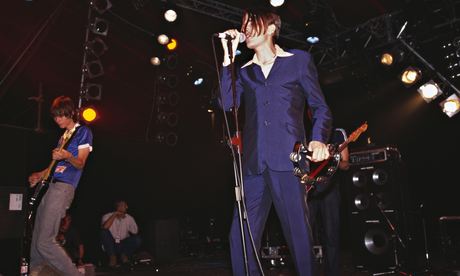
Singer Johnny Dean performs with Britpop band Menswe@r at the Reading through Festival in 1995. Photograph: Mick Hutson/Redferns
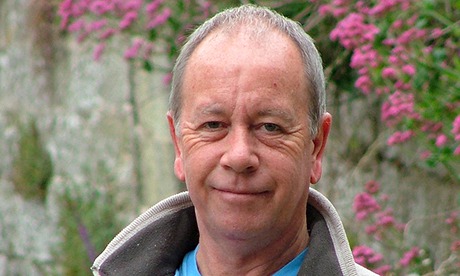
In 2009, MP Cheryl Gillan put forward a bill in parliament. The notion behind it was to guarantee far more help was available for grownups with autistic circumstances. Up to this stage, young children and their families have been becoming offered aid, but youngsters increase up. Even autistic kids. What then?
That exact same 12 months the Autism Act grew to become a reality, and I was diagnosed as being on the autistic spectrum. I was 38 years outdated. As a youngster of the 70s, autism was practically unheard of. Any withdrawn or “tough” behaviour on my part was normally observed as naughtiness. My lack of people expertise was place down to me becoming antisocial, imply, or aloof.
There need to be a multitude of grownups out there who have some type of autism but remain undiagnosed. Confused, isolated and quite usually suicidal. I know, because for significantly of my lifestyle that is how I felt.
Considering that the mid-90s, awareness of autistic circumstances this kind of as Asperger’s syndrome, higher-working autism and pervasive developmental disorder has grown, but not almost sufficient to say they are totally understood. It has been disturbing for me, considering that getting diagnosed, to uncover how minor men and women know.
Grownups seeking diagnosis are typically faced with a struggle. Not currently being taken critically looks to be a widespread occurrence. I knowledgeable a lot more than just a couple of quizzical appears and furrowed brows when I asked to be assessed. Many people basically give up at this stage. I was even asked outright, by a advisor psychologist, why I was searching for diagnosis when I was an grownup. Apparently, this happens a great deal.
It did not support that significantly of the assessment approach seemed developed specifically for youngsters. This became even a lot more exasperating when my mother’s faded recollections of my childhood were purchased into the combine, producing a very confused picture. The staff assessing me had been concentrating solely on my childhood, the really distant past, rather than me in the right here and now. Surely there is a greater way to accommodate grownups?
It took well above a yr to get diagnosed, partly because only one particular location in the southeast had the facilities to do it. But I am glad I persevered. It means that my GP is aware of my issue. It meant I was capable to get cognitive behavioural therapy to cope with the problems I encounter each and every day. It has enabled me to recognize who I am. But much more than anything, diagnosis was a enormous relief.
As far as help goes, the place I live in south London, factors are much better in contrast with 5 many years in the past when I was first diagnosed. But at the same time I have never been contacted or approached by any of the companies in my location – I had to make myself recognized. This can be a difficulty when it comes to individuals with autism. If you depart it to us, it might not come about.
Since 2009, most neighborhood authorities have set up schemes for adults in search of a formal diagnosis. Which is fine, but then what? Will a freshly diagnosed grownup get the support they want? And what about autistic young children who have grown up? Has the Autism Act completed anything to boost these people’s lives?
Here are some depressing statistics. Of all adults with autism, 70% really feel they are not acquiring the aid they need 36% explained they need support to wash and dress, but only 7% get this help from social companies and 53% say they want support to discover work, but only ten% get the support to do so.
Last 12 months the National Autistic Society started a campaign, Push for Action, to improve support for adults with autism. In October, I joined other campaigners in delivering a petition to ten Downing Street demanding a lot more action from the government, including money for new solutions, much better education for employees this kind of as GPs and care assessors, and more to be carried out to increase public awareness of autism.
Factors are gradually acquiring better, particularly with regard to awareness, but sound help is even now lacking. I hope that the government’s revised autism strategy, which will be published these days – Globe Autism Awareness Day – will tackle this and really boost the lives of adults with autistic conditions as effectively as individuals of their households.
In this day and age, I dislike to believe that anyone else would have to go through the time-consuming and frustrating procedure that I knowledgeable. Autism is a actual and severe issue, and adults have it too.
Advocate Bob Smith has made a bucket listing for 2014 with Brian and will support him achieve almost everything on it.
Brian Potts
I’m 67 years outdated and I utilized to take pleasure in operating a effective company in the motor trade. It was difficult function but exciting and I was not organizing to retire. Over the years I’ve loved foreign travel, sailing and had a really excellent top quality of life. My personal situations have transformed substantially, and I now reside alone in a sheltered flat and can feel lonely and depressed.
I have a supportive household and a tiny quantity of good pals but poor mobility has diminished my independence. My cancer diagnosis has been daily life altering. One of the largest blows has been shedding my driving licence.
My life now consists of watching the Television and searching out of the window of my flat. The minute someone says “cancer” I can not envision that anyone isn’t going to believe, “When am I going to die?”. I was diagnosed with myeloma in March two years ago and I imagined, “This is my last summer”. You wake up every day pondering about it.
I have mobility troubles and a great deal of ache as a result of the treatment. My medication prospects to side effects such as putting on a great deal of bodyweight. The Neighborhood Evaluation and Rehabilitation Team (Cart) helped me with mobility problems and suggested I may possibly like to locate out about advocacy help. I was introduced to Bob, my advocate, at residence and he has also visited me in hospital. Bob is straightforward to chat to and quite easygoing. We met up at my home and have also been out for coffee to the coast which is a place I utilized to go routinely. I would charge Bob as best of the selection.
Bob located out about the local myeloma help group and went along with me to one particular of their meetings. I am now in standard make contact with with them and attend their meetings when I can. He located out about the regional Shopmobility scooters and went with me to attempt them out. I even now require assistance to do my buying but it tends to make it a lot less difficult. Bob can aid to remind me who is concerned in my care. I’ve observed so a lot of individuals that I don’t constantly know who’s who. It really is good to share feelings with a person from outdoors of my household.
No a single should encounter the void that I did among obtaining exams and obtaining an appointment for the real diagnosis. I worried a whole lot for the duration of that time.
Bob Smith
I volunteer as Brian’s independent advocate. My role is to be there for him for the whole cancer journey, nevertheless extended that is, and to speak up for him and voice any considerations, worries, inquiries and options he may have. I have had cancer myself and comprehend the massive affect this has on people.
Brian is very intelligent, friendly and outgoing, with a wonderful sense of humour. He has been married twice, has two daughters and lives shut to his loved ones (which includes his ex-wife) who give him assistance in his day-to-day life with things like shopping, medication and companionship. He can no longer drive, is physically weak, and is in constant discomfort of various ranges. He can only walk a matter of yards with the aid of a strolling stick or frame. He lives alone in a small communal block of flats and when I first met him, he had very low self-esteem. Even though previously effectively-travelled and lively, he felt that he had number of long term prospects of a pleased existence. He found his situation very challenging to accept and suffered bouts of depression and typically grew to become upset when speaking about his predicament. The diagnosis of cancer was, and even now is, tough to bear. He has a number of good buddies but is no longer independent so can not socialise as significantly as he would like. He spends most of his time in his flat watching Tv.
Brian occasionally becomes puzzled and forgetful. He has, on occasion, taken the wrong medication or forgotten to consider them. This has led to him passing out and encountering hallucinations. I was present at one of these occasions.
I initially invested time with Brian to get to know him appropriately, his predicament now and how it used to be when he was fit and nicely to uncover out his emotions and views, his interests and hobbies, his aspirations and hang ups. I have met and spoken to members of Brian’s household to understand their viewpoint. Everyone understands the place I match in and the portion I play to assistance Brian. He often speaks openly and honestly to me, and we have a really excellent romantic relationship. He knows that I understand him, will support him wherever I can and that I will never impose my views on him. I listen to Brian and discover possibilities to conquer troubles or achieve items he wants to do. He loves to have a laugh. Brian occasionally has problems concentrating due to his drug regime and can be puzzled and forgetful. I have spoken to his nurses, medical doctors and consultants for his safety when he has taken incorrect medication. I’ve also phoned the council concerning a bus pass, arranged trials of motorised scooters and introduced him to the myeloma help group. What ever information Brian needs, I source and provide it.
Brian’s image of himself is now far much more optimistic. He smiles much more and we laugh and joke much more than we utilized to. He has started out to socialise far more and is keener to “increase his good deal” and not just accept his current circumstance. We have created a “bucket list” for 2014 and I will help him attain the factors on it and help him make a listing for 2015 as well. He ideas to check out the London boat present, go on a boat trip locally, go to France and have a social outing each and every week. Brian says he appears forward to our visits and truly values them. He didn’t frequently get in touch with his pals but now has an item on his bucket list to do this fortnightly.
When I met him at 1st he explained, “I am no longer any use to any individual. I will never ever have yet another connection with a woman.” Now he says he appears forward to me visiting and having talks with me. He feels a lot more positive about himself and he is satisfied with his 2014 bucket listing.
Brian Potts’s name has been changed
For much more data on becoming a educated advocate, go to Older individuals residing with cancer’s (Opaal) website.