factor etiketine sahip kayıtlar gösteriliyor. Tüm kayıtları göster

15 Aralık 2016 Perşembe

Sedentary lifestyles: the hidden factor in the social care crisis | Peter Walker

The current debate about the ever-growing pressure on social care services is by no means the first, and certainly won’t be the last. But it is always predicated around the same central assumption: with increasing numbers of older people, the costs can only go up. This is to miss an important point, one well known to public health experts but strangely ignored by most politicians. The problem isn’t just about an ageing population, it’s also about an increasingly sedentary one.


That far too many Britons are not physically active is well documented, even if the sheer extent can sometimes be surprising. For example, a fifth of Scottish people say they have not walked for more than 20 minutes even once over the past year. Not once. Also well known, if less discussed, is the toll this takes on the public health. The usual estimate is that about 85,000 people die early each year in England and Wales due to illnesses caused by sedentary living, mainly heart disease, type 2 diabetes and various cancers.


But callous as it sounds, what really keep senior civil servants awake at night isn’t the mortality rate; it’s the parallel issue known as morbidity: the quality of life people can expect as they age, and thus how independent they remain. Here, the near-magical effects of keeping up even a fairly minimal regime of exercise are also well documented.


Physical activity keeps people stronger and more supple as they age. It also improves balance, gives better bone density and makes them less likely to be depressed or develop Alzheimer’s. These are all things associated with needing less social care.



Cyclists in Amsterdam: ‘The Netherlands and Denmark have spent decades deliberately re-shaping their road environments away from the car culture of the 1960s and 70s towards mass cycling.’


Cyclists in Amsterdam: ‘The Netherlands and Denmark have spent decades deliberately re-shaping their road environments away from the car culture of the 1960s and 70s towards mass cycling.’ Photograph: Alamy Stock Photo

The earlier people start such a regime, the better the effect into older age. One public health expert once told me he encourages people this way: “I tell them, ‘being active throughout your life is about being able to get to the loo on time in your old age’. They can get their heads around that.”


If it’s so conclusive, why is the government not pushing this as part of the solution? Here we get into the more tricky area of what is politically acceptable, and whether ministers want to embark on what is, in effect, low-scale social engineering. Decades of experience has shown that just encouraging people to exercise has limited impact. Urging people to go to a gym or walk briskly round their local park eats into what is known to experts as “discretionary time” – when they could be doing something else. Thus they tend to give up pretty soon.


One of the few exercise regimes proved to stick is active travel, more specifically making walking or cycling to work, school or the shops sufficiently safe and convenient that it becomes easier for people to do it than not. Cycling is arguably the mode that should be encouraged the most. Aside from the fact people can cover greater distances on a bike than on foot, studies have shown that the slightly greater exertion it involves brings even more miraculous health benefits.


The mechanics of how you nudge people away from cars and on to bikes is another discussion, but there is little doubt it can be done if the political will is there. The Netherlands and Denmark, for example, have spent decades very deliberately re-shaping their road environments away from the car culture of the 1960s and 70s towards mass cycling. It’s not an accident.
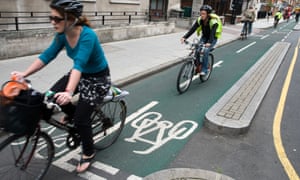


‘In his first interview as transport secretary, Chris Grayling spoke of cyclists only to complain about those who jump red lights and to say bike lanes cause problems for “road users”, a group that apparently doesn’t include people on bikes.’


‘In his first interview as transport secretary, Chris Grayling spoke of cyclists only to complain about those who jump red lights and to say bike lanes cause problems for “road users”, a group that apparently doesn’t include people on bikes.’ Photograph: Alamy Stock Photo

Yes, it would take the UK a decade or so to make similar changes. But given the vast and unquestioned public health benefits on offer, with the huge savings this would bring on social care (not to mention the NHS, which some experts predict will soon become bankrupt due to the costs of ailments linked to sedentary lives), it’s a bit depressing that we haven’t even begun the debate.


For all the occasionally hysterical media narrative on cycling, it barely exists as an issue at the top of government. In his first interview as transport secretary last week, Chris Grayling spoke of cyclists only to complain about those who jumped red lights and to suggest that bike lanes caused problems for “road users”, a group that apparently doesn’t include people on bikes.


Grayling’s predecessor in the job, Philip Hammond, now the chancellor, was reported last month to have urged London’s mayor, Sadiq Khan, to rip out one of the few properly designed and safe bike lanes in the entire country. This is not to castigate the pair personally. Barring a handful of exceptions, almost all Britain’s top politicians think much the same about cycling as everyday transport.


The debate on social care shows how blinkered this is. As part of a book I’ve been writing about the beneficial effects of more cycling, I spoke to a number of public health experts about the problem of sedentary living. Several of them used the same analogy: getting people active in their everyday lives is, they said, like “a miracle pill” in the way it wards off disease and decrepitude. That miracle pill is well known. We’re just waiting for someone with the political vision to administer it.


• Bike Nation: How Cycling Can Save the World, by Peter Walker is published in April


Sedentary lifestyles: the hidden factor in the social care crisis | Peter Walker

30 Haziran 2014 Pazartesi

To witness your child"s death is the worst factor

In the months that followed, he sank into a miasma of grief, shock, trauma and disbelief, and turned to writing a personal diary to chronicle his ideas and feelings. Two years on, with Debora’s encouragement, he has permitted it to be published.


A single can understand Thomas’s original hesitation. It is a raw and compelling read, weaving between the accident, its aftermath, valuable moments in Kadian’s daily life and the exclusive relationship amongst a father and son.


“I desired to introduce Kadian to men and women so they would know how particular he was,” he says. The guide is also a forensic analysis of bereavement, in which Thomas bares his soul. “I am naked in my grief,” he writes. “The soreness is unbearable.”


I inquire Thomas if creating had been cathartic. “Don’t say ‘cathartic’,” he replies. “It hasn’t been at all. I really do not feel greater for it. It was just some thing I had to do.”


Kadian was a impressive kid. At 10 he produced a checklist of “25 random observations about myself” on Facebook, like: “I have often wondered why we bathe instead of vacuum ourselves off.” He loved his German shepherd dog, Duke, was a computer whizz and by 14 had created a lot more than 25 podcasts and films.


Kadian pictured with Duke as a puppy


It is not simple to uncover the correct thing to say to anyone who is bereaved – and in his book Thomas criticises people who “want to say the right factor but get it wrong. Individuals come up to us and say: ‘There are no phrases.’ But there are so many phrases, including, ‘How the —- can this come about to us?’ ” Now, he says: “The greatest way to take care of it is to say: ‘I am genuinely sorry,’ and let the man or woman who has suffered the reduction drive the conversation.”


We speak in the household home in Hampshire. Debora, 49, who has US and Uk citizenship, has just had an operation on her knee and sits with her leg up on a stool. Crutches are near by.


It is their very first interview collectively since Kadian’s death, and they are vulnerable and self-protective. Everyone grieves in a various way, and I wonder if Debora agreed with everything in Kadian Journal, A Father’s Story. “I had no thought what was in the guide till it was finished,” she says, seeking tearfully at Thomas, “and I was stunned by it. It was as if he had tapped a vein and permitted himself to bleed and bleed.”


“I was extremely anxious about her reaction,” Thomas adds. “I waited downstairs for eight hours whilst she read it upstairs.”


Born in London, Thomas is a Cambridge graduate and worked in tv and journalism before becoming an author. He and Debora – who ran a cycle store in Washington – met on a charity bike ride across the US in 1987. They have been married for five many years prior to they made a decision to have a kid.


“I was originally reluctant to be a father,” Thomas admits, “but was evangelical about it when Kadian was born. It became clear to me that I needed to be at least half involved in the childcare.” In 2001, they moved to the US, exactly where Thomas published a newspaper in West Virginia, prior to returning to Britain in 2008, setting up a Tv station in Oxford.


The two mothers and fathers talk about Kadian in the present and the previous, usually in the very same sentence a small indication of how challenging it is to assimilate the brutal reality. “We were so shattered,” Debora says. “It was so atrocious and such a horror I stored thinking it cannot be. I had to understand how to talk, eat and walk once again.”


“Grief wipes out your judgment and energy ranges,” Thomas adds. “I am incapable of doing work as I utilized to. We each gave up our firms in America.”


How is their daughter coping? “Sam is so close in age to Kadian that it is quite hard, and she has a enormous selection of feelings to grapple with.”


In the autumn of 2012, Thomas identified he could concentrate on editing Hanns and Rudolf. The book, published final year, is devoted to Kadian. “It was sold to a publisher just prior to Kadian was killed, and working on phrases, spelling and grammar gave me anything useful to do,” he says.


Studying helped a little, also. “I needed a street map out of our new-identified hell,” Thomas explains. “I felt certainly there was someone who could assist us.” They discovered a connection with CS Lewis’s A Grief Observed and Nicholas Wolterstorff’s Lament for a Son.


Today, they are each undergoing treatment. “I was genuinely broken and didn’t want to live,” Thomas reveals. “It has been very good for me to uncover a person who has wisdom and viewpoint and says you have the appropriate to have gone mad.” The Child Bereavement Believe in has also been valuable.


“For the initial three months, pals sorted out our meals and it took another three just before we sat down to consume a correct cooked meal,” Debora recalls. “Neither of us had the energy or brain electrical power to believe ahead and get food in the property or function out what to cook.”


Debora has been helped by a personalized trainer. “It has transformed me from not wanting to get out of bed to providing me a alter of vitality.” She has set up a site committed to Kadian.


Thomas, understandably, no longer enjoys cycling. “I truly feel unstable and unsafe on a bike,” he says. “Walking in the countryside assists with my trauma and shock, but I cannot cope when there are autos all around. People inform me I am performing greater, but it depends on the day.


“Nor can I deal with even mild conflict. Fortunately we have designed a bubble for ourselves exactly where we really feel protected, which occasionally is as small as our bedroom. Other occasions I consider to test the edges, and if it hurts also considerably, I back out.”


They say they are “closer than ever” as a family members. “I couldn’t have received by way of this without Deb,” says Thomas.


Shortly before Kadian was killed, Thomas advised his son off for fighting with his sister. Later Thomas felt he had been also challenging at midnight, seeing the light in Kadian’s bedroom nevertheless on, he knocked at the door. They apologised to each and every other, hugged, and then Kadian explained: “Best father in the globe.” Thomas replied: “Best son in the world.”


It is a moment Thomas will often keep in mind.


‘Kadian Journal, A Father’s Story’ by Thomas Harding is published by Heinemann (£16.99). A site committed to Kadian is at kadianharding.com


To witness your child"s death is the worst factor

16 Haziran 2014 Pazartesi

Doctor"s Diary: "We have been informed there is no this kind of factor as a grumbling appendix"


The initial issues the 12-yr-outdated boy with diabetes with recurring bouts of unexplained stomach ache. The culprit, suggest several, could be foods intolerance and, in particular, sensitivity to wheat or gluten, but also onions and the sugar substitute sorbitol, which is a widespread ingredient of diabetic meals.


Two readers report that their child’s signs and symptoms had been eventually discovered to be due to appendicitis. “We have been convinced my daughter had a grumbling appendix, but had been advised there is no this kind of point,” writes a mother of yet another twelve-year-old who knowledgeable 6 months of agonising abdomen pains. “The surgeons did ultimately operate, and the problem turned out to be her appendix, which was unusually lengthy and tucked behind her bowel.”


A number of readers describe this as a function of their irritable bowel syndrome, but it could also apparently be a symptom of the inflammatory condition microscopic (or lymphocytic) colitis, which can only be diagnosed with a bowel biopsy, and diverticulitis. There are reviews of sustained improvement by excluding milk and other dairy products and coffee from the diet program. Individuals who have had their gallbladder removed in the past might be aided by taking the wonder drug cholysteramine, which has featured in this column before.


Lastly, this may be a unusual side result of the common diuretic frusemide, and importantly, a reminder from a reader that any unexplained change in bowel habit requires even more investigation: “My late husband had the exact same difficulty that he ignored at initial, but he was ultimately found to have a tumour in the colon.”


——-


Last but not least, my thanks to a reader for passing on his serendipitously found treatment for possessing to rise numerous occasions a evening to pass urine, necessitated by his enlarged prostate. He is troubled by back pain, for which his physiotherapist advised lying on the floor and thrusting his pelvis in the direction of the ceiling 40 occasions. On a single event, woken by the “urge” at 3am, he did his 40 thrusts and inside a number of minutes was ready to fully empty his bladder. He then slept uninterruptedly till morning.


Electronic mail healthcare concerns confidentially to Dr James LeFanu at drjames@telegraph.co.united kingdom. Answers will be published on the Telegraph site each Friday, at telegraph.co.united kingdom/overall health


Doctor"s Diary: "We have been informed there is no this kind of factor as a grumbling appendix"

13 Mayıs 2014 Salı

The NHS was a great factor simply because it belonged to us | @guardianletters

First NHS baby helps celebrate NHS 60th

Aneurin Bevan, the wellness minister, visits Park hospital, Davyhulme, Manchester, for the official launch of the NHS in June 1948. Photograph: PA


Dr Nick Hayes writes in praise of the voluntary technique that helped to support many of the large acute hospitals offering care in the time period just before the introduction of the NHS (Letters, 9 May possibly). He suggests that “a weekly contribution of 2d or 3d per week” would offer sufferers with the cover they necessary for treatment in the voluntary hospital. Having worked as a property surgeon in two this kind of hospitals just before July 1948, I discovered things really various. Initial, the weekly contributions were nearer five shillings and, 2nd, the lady almoner’s department was the rigorous gatekeeper, guarding accessibility to the program. Individuals have been implies-examined to make positive that they certified for hospital remedy and had been consistently getting approached, or even badgered, to see if they could, or would, pay out much more.


Dr Hayes admits that care for the old, the chronic sick and mentally sick sufferers was patchy in numerous this kind of hospitals, it was virtually nonexistent. He also says that modern surveys and polls indicated that the majority of the population were largely satisfied with this technique, and this is undoubtedly correct, but there is presently a wealth of proof to indicate that individuals are just as happy with the services provided by the NHS, and probably a lot more so. From my expertise of the United States and a lot of elements of Europe, they are largely right in this belief.
Keith Anderson
Leeds


• I was born in the 1920s and am outdated adequate to bear in mind the wellness provision just before the days of the NHS. It was minimum for panel patients, and the medication availablefor most ailments was a bottle of the “mixture” or the “liniment” in a clear blue, brown or green bottle, dependent on the problem. It was made up at the surgical treatment by the medical professional or an employee from a row of unchanging bottles and jars on the doctor’s shelves. They did their greatest but had been entirely restricted by lack of funds.Of course it could be covered by a couple of pence a week and charity, but the expectation of life for the poorest was significantly modified as a outcome.


The NHS was a great factor since it belonged to us. It was not cold as charity but was a nationwide insurance-based mostly organisation. We all paid for it from our earnings when we have been youthful, doing work and fit, and we could all count on it when we necessary it.


If the funding is removed from this and drawn from earnings tax, it can be avoided by the wealthy, along with so numerous other taxes. Money for health will be viewed as charity that must only go to the deserving poor.


There need to be no ceiling on nationwide insurance coverage payments they need to be deducted at source from all salaries, and the money must be stored for a goal separate from revenue tax. If much more is needed, the charge should be enhanced and paid by every person in proportion to their pay.


The reason the wealthy who govern us want to privatise every little thing is so they can minimize the support to the bad and acquire the ideal for themselves as takes place in the US.
Deirdre Davey
Oxford


• I was born in 1936. My father had been unemployed for seven many years, and my mother required a caesarian segment. My father was called to see the almoner and asked if he could afford to pay out the fee. Naturally, he could not so had to strategy his father to borrow the money – humiliating for a guy aged 37. Thankfully, his father stumped up I might not be right here nowadays had he not. I nevertheless have the invoice “for maternity services” in the sum of two.five guineas.
Margaret Gooch
Portsmouth


The NHS was a great factor simply because it belonged to us | @guardianletters