terminal etiketine sahip kayıtlar gösteriliyor. Tüm kayıtları göster

12 Mayıs 2017 Cuma

Doctors owe it to patients to tell the truth: the NHS is in terminal decline | Rachel Clarke

Like church and state, medicine and politics are traditionally seen as a queasy mix. The last thing you want in your flimsy hospital gown is some zealot with a stethoscope trying to sway your vote. Doctors, at the bedside, should clearly stick to doctoring. But – in a world of ever more outlandishly spun health statistics – where, outside of clinical encounters, do the limits of doctors’ duty to act in our patients’ best interests lie?


I made the sobering discovery, in my first few weeks as a doctor, that serving patients in the modern NHS was at least as much to do with advocacy as medicine. It has to be, in a system that’s stretched beyond breaking point. With resources so scarce, speaking out counts.


Once, I actually stalked a professor, in sheer desperation to provide an inpatient with decent care. He did a double take at the steely-eyed junior doctor, sat perched outside his clinic, fired up to plead her patient’s case. With everyone run ragged, overwhelmed by patients, no one had believed me or cared enough to act when I’d insisted my patient was suffering from a rare diagnosis, adult-onset Stills disease, that had left her heart swamped in fluid, her temperature soaring, her circulation so fragile it might need intensive care. “Please,” I begged. “Just see her for yourself.” As the pre-eminent professor of rheumatology in my hospital, he was the one man I knew who might act. And he did. He confirmed the diagnosis and whisked my patient off to his specialist care, possibly saving her life.


When almost every statistic about today’s NHS depicts a system quietly imploding around us, advocacy writ large has never mattered more. Doctors, like nurses, bear daily witness to the facts behind the spin. Our testimony is a vital corrective to a government hell-bent on airbrushing away the truth about today’s underfunded NHS. We look the patients in the eye as they languish on trolleys in hospital corridors. We apologise, shamefaced, to the families whose loved ones are stranded in hospital, because no social care exists to support their safe discharge home. We turn away the elderly who sob in A&E because the pain in their hip is beyond endurance, yet who haven’t even made it on to a waiting list for surgery. If we turned a blind eye and kept our heads down, would Hippocrates nod his assent?


Having to break bad news to a patient is never easy. But unflinching conversations are a cornerstone of good medicine


The state of the NHS in 2017 demands that doctors speak out about the human cost of underfunding since it clear our political leaders will not. Only this week, Theresa May made an election manifesto commitment of 10,000 more staff in mental health. Unfunded, needless to say, but also – more audaciously – a promise made on the back of the 6,700 mental health staff already culled since the Conservatives came to power in 2010. It’s this kind of political doublespeak that compels doctors to challenge loudly the government line that – despite the most brutal funding squeeze in NHS history – everything is going swimmingly.


In microcosm, we already know what happens when cost-cutting is prioritised above patient care. The scandal of Mid Staffs – a stain upon the history of the NHS, in which patients in their thousands were subjected to inhumane care – arose when one hospital trust strove to slash costs by millions. Yet currently, the government is enforcing £22bn of “efficiency savings” across the NHS, while insisting excellence of care can somehow continue.


Doctors should call out this claptrap for what it is. We are, after all – perhaps more than anyone – trusted to tell unpalatable truths. In this case, the hard medicine is more taxes. A world-class health service requires world-class funding. Either we provide the budget to fit the health care we want, or we cut the NHS to fit the amount we’re willing to spend on health. With a government too cowardly to confront this simple truth out loud, doctors should force an honest debate.


Yet – with a few notable exceptions (Taj Hassan and Neena Modi, for example, the presidents of the Royal Colleges of Emergency Medicine and of Paediatrics and Child Health respectively), the medical establishment is loath to rock the boat. Where is the joint statement from the Royal Colleges, for instance, urging increased taxation to bring our NHS and social care spend to at least the levels of Germany and France? Where are the hospital medical directors brave enough to speak out in public against the ever more fanciful diktats from on high to keep on delivering as their funding dries up?


Having to break bad news to a patient is never easy. But unflinching conversations are a cornerstone of good medicine. Nationally, doctors should be telling it like it is: without more money, our NHS is in relentless, terminal, and wholly avoidable decline.


Doctors owe it to patients to tell the truth: the NHS is in terminal decline | Rachel Clarke

16 Ekim 2016 Pazar

Could Brexit prove terminal for the NHS?

All human life is in Homerton hospital’s car park. Or at least, passing through Homerton hospital car park on the way to A&E or outpatients or maternity. A Bangladeshi woman in a wheelchair. A Hasidic Jewish schoolboy with ringlets and a limp. A bearded hipster with a newborn baby in a plastic carrycot. Inside there are nurses from the Philippines, from Spain, from Italy, from Gambia, from the Caribbean. There are doctors from India, and radiographers from Germany, and anaesthetists from Pakistan, and cleaners from Ghana, and midwives from Nigeria. To cut to the chase: there is everyone from everywhere. And of course they’re not alone in this. With more than half of all doctors coming from abroad – as they have since at least the late 60s – Homerton hospital in the East End of London is like every NHS hospital in every city in Britain.


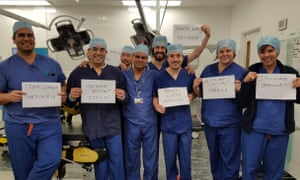
On the morning of Friday, 24 June, this was a fact that struck Junaid Masood, a Pakistani-born, British consultant urologist when he came to work at Homerton – and it struck him in particular as he looked around the theatre where he was about to operate. “It was the morning after Brexit,” he says. “Everyone was shocked and depressed and I just had this moment of clarity because I looked around and thought, ‘Oh my God, every single person in this operating room today is from the European Union. So, at the end of surgery, I got everyone to hold up a placard saying where they were from and put it up on Facebook. And then it just went nuts.”


It really feels like a loss of innocence to have a symbol of British tolerance dragged through the mud in this way


Roberta Bivins, Warwick University


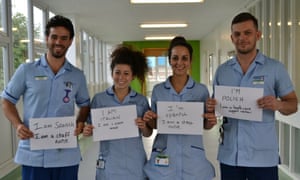
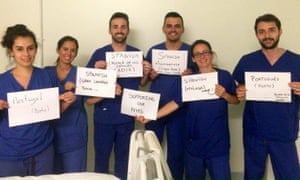
The picture of his team, smiling in their blue surgical scrubs, featured an Irish radiographer, a German consultant anaesthetist, a Greek urology registrar, three Spanish nurses and himself. It immediately went viral. The Facebook post was shared 19,000 times, tweeted hundreds of thousands of times, spawned copycat photos from NHS hospitals up and down Britain and ended up on the pages of newspapers across the world.


Their smiles, however, look almost innocent now. Last week, the rhetoric of anti-immigration became wrapped up in the survival of the NHS, an institution that has been built upon the hard work of immigrants for almost its entire history. The health secretary, Jeremy Hunt, announced to the Conservative party conference that the NHS needed to become “self-sufficient in doctors” by 2025. It needed to end its reliance on foreign doctors, and it would do this by training an extra 1,500 medical students a year.


This was news to everyone, not least those working in the NHS, or heading up our medical schools or the British Medical Association, because apart from anything else, the numbers simply don’t stack up. “It’s completely unrealistic,” Deborah Gill, the head of UCL medical school, tells me. “It’s a drop in the ocean. An extra 1,500 students is going to make no difference whatsoever.”


Medical staff at Royal London Hospital, east London.


Medical staff at Royal London hospital, east London. Photograph: @ShafiAhmed5 via twitter

But that doesn’t make it any easier to hear. Leonidas Karamountzos, the Greek registrar in Masood’s photo, looks uncomfortable when I ask him about it. “It can make you feel… look, I’m not going to say unwanted. Everyone is so polite. But if you keep hearing, ‘we don’t want any more immigrants, we don’t want foreign doctors’, it does make you feel unwanted in a way. I’ve been here six years, and of course I’m gaining from the NHS, I’m gaining experience, I’m getting paid, but it doesn’t feel fair that after six years you have people saying, ‘You know what? We don’t need you any more. We think we can do without you now, OK?’


“Because I don’t think you can do without us. That’s the thing. But then you get up and you go to work and you try to help British people get better.”


Masood and Karamountzos are telling me this in the tiny gap between their morning clinics and their afternoon surgeries. “It’s absolutely chaos this morning, I have to be honest,” says Masood when he greets me. “The clinic is massively overbooked. But this is what always happens. And you spend 10 minutes more with one patient and there’s a massive knock-on effect and this happens every week, unfortunately, and I’ve got to rush upstairs because I’ve got four patients that need surgery this afternoon.”


This is a familiar story to everyone who’s ever used the NHS. But what’s new is the toxic language of immigration coming up against the day-to-day reality of the NHS. This does feel new and ugly and unwelcome – and, for the 101,000 doctors born overseas who work in Britain, and the 140,000 nurses, and the 64 million of us who depend upon them, it’s a depressing new departure.


Until now, the NHS has been a place apart from what happens politically. It is an institution, something so fundamental to our sense of Britishness that it has somehow managed to resist the xenophobic tide that has become such a feature of British public life. It is something that survey after survey tells us we hold precious; that touches every person in the country, in the most personal, intimate way. And the whole fabric of its continued existence relies on immigration.


Roberta Bivins, a professor at Warwick University who is undertaking a major project to map the cultural history of the NHS, tells me that although the NHS has been leveraged as capital and ammunition by politicians since its very inception, there is something new at work. “We expect the NHS to be above all that. It really does feel like a loss of innocence to have something that is a symbol of British tolerance and cosmopolitanism and egalitarianism dragged through the mud in this way. It is truly shocking.”


The NHS is one of the unique things that unites us as a nation, she says. “It’s a fundamental part of British identity. It’s been something that has represented how much we believe in equality. What I’ve found is that the NHS is constantly framed as the space that proves that Britain is a tolerant nation. Where racial and class and ethnic barriers are overturned. Where you can go and expect Britain to be at its best. Your doctor may have come from anywhere, and you will be treated the same as anyone else.”


And that is still true. “I don’t see people and think, ‘You’re British. You’re Afro-Caribbean. You’re whatever,’” Karamountzos tells me. “For me, a patient is a patient. It doesn’t make any difference to me. Patients are patients and doctors are doctors. This is what counts.”


Medical staff at the University Hospital of South Manchester


Medical staff at the University Hospital of South Manchester. Photograph: @uhsmnews via twitter

And for at least 40 years it’s been where the differences between us have been erased. “The NHS would never have survived the pent-up demand from the interwar years had it not been able to import staff from Africa and the former colonies,” says Bivins. “That has always been the price of universal access, and it has been enormously benefiting to British society.


“Even by 1968, 46% of all doctors below consultant came from abroad, and 30% of all nurses.”


What’s more, for much of the UK, she says, it was the first place where middle Britain came across multiculturalism. Part of Bivins’s project is a “people’s history of the NHS”, and as such she’s been gathering stories, “talking to lots and lots of people, and for many, especially older people, they’ll say it was the first time they met a black man or so on. It was where middle Britain met migrant Britain, and in a totally non-negotiable way. It’s the one place where you’d be mixing with people who are not like you, whether in terms of class or ethnicity – and who you’ll be dependent on during some of the most intimate and important moments in your life.”


It was the opening ceremony of the 2012 Olympic games, she says, Danny Boyle’s great visual poem to the NHS, that made them start thinking about the central role the NHS plays in Britain’s cultural life. “And what is astonishing is how much the attitudes and rhetoric have shifted since then. It’s been quite amazing – and depressing – how that has happened in just four years.”


Boyle’s co-writer for the ceremony was Frank Cottrell Boyce, who tells me that the section on the NHS was “Danny’s passion”. He wanted the ceremony to be emotional. “The NHS is where British people are born and where they die… It’s a huge unifying force in British social life and the point of entry for thousands of migrants.” Boyle “really put himself on the line for it – threatening to leave when they suggested cutting it”.


By “they” he means the government, and it turns out there’s a thread here. The culture secretary at the time? Jeremy Hunt.


The BMA – which represents 170,000 doctors – knew nothing of the proposals before Hunt’s party conference speech was made. They were not consulted. The head of the Royal College of Physicians, Jane Dacre, points out to me that 40% of new consultant posts are already not being filled. At UCL, Deborah Gill says that while they welcome lifting the cap on the number of medical students they’re allowed to admit, they’ve no idea how it will be funded, if there will be enough foundation placements, or why it has anything to do with foreign doctors “coming over here, as they do, curing our patients and paying their taxes”.


Nicola Strickland, head of the Royal College of Radiologists, tells me she believes the situation to be desperate and that Hunt’s proposals cannot possibly solve it – in fact, that they are likely to make things worse. To put it into perspective, she points out that only a tiny number of the extra 1,500 students will choose to go on and qualify as radiologists, and they won’t come through the system until 2030, or 2032 for clinical oncologists who the college also represent. “And by that time,” she says, “we’ll be lucky if we have a health service for them to work in.”


Every specialism perhaps believes that its own is most crucial. But Strickland makes a convincing case for how the crisis in radiology recruitment will break the entire system. “It underlies almost every single diagnosis these days, and demand is going up exponentially. It’s increased by 29% in the last five years. But there is simply not the staff. We have hard solid data that shows that we need 260,000 extra trainees a year for the next five years even to catch up with the rest of Europe. We know this for an absolute fact. We are currently tied third bottom with Turkey. Imaging underlies every part of the health system and without it the entire health system will fall apart. I am desperate to get this message out there, and nobody is listening to us.”


Medical staff at Broomfield Hospital in Chelmsford, Essex.


Medical staff at Broomfield hospital in Chelmsford, Essex. Photograph: @shevyuk via twitter

A third of radiologists already come from abroad and they are trying to recruit more, but already one in 10 consultant positions is vacant, unable to be filled. “If you believe passionately, as we all do, in free healthcare at the point of need and you see that being destroyed… well, it’s very depressing and demoralising,” says Strickland. “Already 230,000 people are having to wait a month to get the results of their scans and that’s just not right. It causes stress and anxiety, and delays life-saving treatment. We are trying to tell everyone we can. We could train people but the money is not being made available and it’s going to break the health service. I really mean that.”


It’s hard as an outsider to understand quite how big a crisis the NHS is in – if it really is as bad as Strickland says, or if it has always gone through these sorts of episodic cycles. But Anthea Mowat from the BMA tells me that it is real and that the collapse in morale is like nothing they’ve ever seen. “We’ve just done a survey, doctors 10 years post-graduation, and 42% of them say it’s much worse than they expected, and approximately the same number plan to go to work overseas because they don’t feel valued in the NHS.


“We’ve got to the point that our own UK-trained doctors don’t feel valued. And now we don’t value our overseas doctors either.”


In fact, Masood tells me that his department, for the first time, has a vacancy for a registrar and no applicants. “This has never happened to us before. We haven’t had a single applicant.” And a university hospital in London is a more attractive proposition than many posts, such as a GP in Stoke-on-Trent, for example, where 65% of GPs are already from outside the EU. Chandra Kanneganti, head of the British Indian Doctors’ Association, who runs three practices in the city, tells me there are currently 34 vacancies. Most of them have been empty for a year.


But then, he says, because of visa changes it’s almost impossible for Indian doctors like himself (he’s originally from Hyderabad) to come and work in Britain. “Instead they go to the US, to Australia and Canada. In the 1960s, general practice in Britain was on its knees and it was my colleagues who came in droves to work in the inner cities and places no one else wanted to go. They saved the NHS, and the government needs to recognise this and not make this kind of politically motivated attack on us.”


I try to end the interview with Kanneganti, but he won’t let me go. “I am so proud of the NHS, and I love this country. I love it for the way it recognises talent and hard work. And we do work hard and we pay taxes and we do not take benefits and all we are saying is, please recognise this.”


It’s madness that someone as accomplished and hard working as Kanneganti feels the need to justify his position. Or Nancy Ifill, a sister in the emergency department of Whipps Cross hospital in East London. I catch up with her at 11pm, just after she’s arrived home in Colchester, Essex, having left the house at 6.30 that morning. She’s originally from Barbados, came here in 1989 and is now a British citizen. So does that mean she doesn’t feel the insecurity that many non-UK NHS staff feel? That they might not be able to stay.


“I would never say I feel totally secure. You just don’t know. With Brexit, it feels like if they want you to go back, they could. I don’t know if this is being fuelled by Nigel Farage and his ideologies. It’s a similar thing with Trump and Hispanics, but it makes you feel like you really don’t belong. Like you’re a lodger. And when we’ve had enough of you we’ll put you out.”


Does it upset you? “Of course it does. At the end of the day you come here, you contribute to the system. You’re not mooching off the state. And it’s a significant contribution. A society cannot function without a healthcare system. If you don’t have a healthcare system, you don’t have a society. And for people to think that you don’t matter… well, it’s a bit tragic.”


Her colleagues at Whipps Cross are from everywhere. In her team, “I can probably count the number of ‘home-grown’ nurses on one hand. ‘Home grown’! It’s such an insulting, derogatory term.


“Who is this organisation made up of? It’s foreign people. Whether they are nurses, cleaners, doctors, the great majority of people working in the largest organisation in the world are foreign people. If you remove them, you won’t have a system. This institution is at the heart of British life and it’s made up of foreigners.”


It is, and it’s where the ideology of Brexit strikes against the idea of ourselves as a people in the most intimate way possible. Because the NHS is where we are literally at our most naked and vulnerable. It’s at the heart of what we believe it is to be British. We are – as every staff room in every hospital in every British city shows – a country that depends upon the hard work and contribution of people who have come from elsewhere. Who are there when we’re born. And there for us when we die.


We hope.


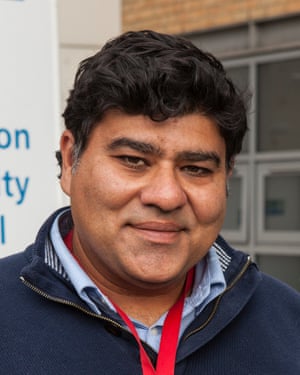
Junaid Masood


Junaid Masood

Junaid Masood, consultant urologist, Homerton hospital, London; British, born in Pakistan


“I came to Britain at a young age because my father came to work here as a doctor. The comments by the health secretary last week were almost like an anti-recruitment message. Jeremy Hunt sort of yelling to the world, ‘Don’t come to Britain because we don’t want you.’


“We’re going to really struggle massively to get skilled staff now. I’ll give you one small example. We have a vacancy for a registrar. This is a good job in a good hospital and we have not had a single application. I don’t know if that is a coincidence, but this has never happened before.”


Leonidas Karamountzos


Leonidas Karamountzos

Leonidas Karamountzos, urology registrar, Homerton hospital; Greek


“It’s made the future very uncertain. I’m not sure what I’ll do now. I’ve had so many colleagues in Greece say to me, ‘Oh, you made a mistake. You went there. Now you’re going to be kicked out.’ It’s certainly going to put other people off coming.”


Could Brexit prove terminal for the NHS?

28 Temmuz 2016 Perşembe

Doctors, patients, and the confronting conversation about terminal cancer | Ranjana Srivastava

In the years that we have known each other, she has never asked me an opinion about her brother’s cancer, so when she finally asks if I will talk to him, I can’t help but say yes. I have heard about his trajectory over several months – how he has tried one chemotherapy after another, how he is becoming increasingly fatigued, and worryingly, how much time he has spent in hospital lately, fighting one or the other complication of treatment.


“I wish we knew what the future holds,” she says, overcome by emotion.


My heart melts at her predicament.


Her brother calls me.


“The oncologist has put chemotherapy on hold while the lung specialist treats my pneumonia,” he says uncertainly.


“That’s a good thing,” I reply.


“Does my chemo sound right to you?”


Related: Invoking cancer and stress in the same breath is not the same as blaming the victim | Ranjana Srivastava


“I can assure you it’s what most oncologists would use.”


“I just can’t seem to hold my own – there’s always some problem.”


“I can see, and I am sorry.”


He goes through a charge sheet of ill-controlled symptoms, chief amongst them pain. The knowledgeable way in which he touches on targeted therapies, clinical trials and also his evident frailty tells me he is more educated than many other patients, yet he can’t seem to see that four lines of failed chemotherapy, each bout of weight loss and each unit of blood transfusion add up to a serious downturn in his prognosis that needs considering.


A discussion about his prognosis would be the entry point to a range of conversations about the futility of further aggressive chemotherapy, the value of palliative care and his wishes for care at the end of life but although he is receiving the best drugs on offer, what seems to be missing is an articulation of the goals of care at this last stage of his illness.


Having seen many patients die under a cloud of misinformation or worse, no information, I find the revelation upsetting but I recognise my bystander status. Also, I don’t know what serious news his oncologist might have shared. So in the end my growing concern manifests as a mild injunction: “Talk to your oncologist about the big picture – ask him to help you understand the future because it will help you make important decisions.”


His answer leaves me speechless: “He is not that kind of an oncologist.”


The authors of the influential Support study concluded as far back as 1995 that “the most fundamental choice that patients with incurable cancer face – the decision between life-extending therapy and comfort care – may be highly influenced by their understanding of their prognoses.”


Other studies have followed, including one in the New England Journal of Medicine showing that more than two thirds of patients with advanced, incurable, cancer mistakenly believed their chemotherapy was being given with curative intent.


In the author’s blunt but memorable conclusion, “a focus on chemotherapy was the instrument that facilitated prognostic misunderstanding.” In other words, when oncologists shift the conversation from one of prognosis to that of drug options and treatment schedules, there is a missed opportunity to provide holistic care.


That study changed my thinking, but as a new study in JAMA reveals, the vexed matter of oncologists and their discussion of prognosis shows little sign of being settled.


In the study, 236 cancer patients were asked: “What do you believe the chances are that you will live for two years or more?”


Their 38 oncologists were asked: “What do you believe are the chances that this patient will live for two years or more?”


68% of patients rated their two-year survival discordantly from their oncologist. A staggering 89% of these patients were not aware that they and their oncologist held different opinions of their prognosis, and nearly all were more optimistic than their oncologist, despite the oncologist believing that a “completely thorough” discussion had occurred.


Most patients with an inaccurate estimation of their prognosis said that they desired palliative care input when they neared the end of life but if they didn’t appreciate their prognosis, they might easily miss the opportunity and keep receiving aggressive treatment.


I found this study elegant, brave and, to be honest, worthy of the headlines it will probably never make as long as a new drug discovery waits in the wings. The patients deserve credit for answering a confronting question about their mortality and discovering that they were mostly wrong. The oncologists deserve praise for participating in a study they probably expected to highlight a failing that they share with the wider profession.


In the wake of such studies, oncologists are left to rue many things, including poor communication, denial by the patient and collusion, where the oncologist and patient have an unspoken agreement to avoid certain topics. Tellingly, there is also evidence to suggest that patients perceive oncologists as better communicators when they deliver optimistic news.


No one doubts that each side faces its own challenges to discussing prognosis and then, its consequences, but if medicine is to make good its promise of patient-centred care, the barriers must be broken.


Seven 7 million people die of cancer each year, the majority in the developing world. Unfortunately, some things in medicine change so slowly that many more will die while doctors debate the best way to deliver bad news. Where chemotherapy is unavailable and you need connections to get morphine, communicating prognosis seems an even lower priority. Elsewhere, in spite of the rhetoric, communication skills training is typically a low institutional priority.


But to a great many oncologists around the world, getting communication right is becoming personally significant. Most say they don’t deliberately withhold bad news or worse, fabricate good news, but if our patients claim they’re in the dark, we all have some soul-searching to do.


Related: When care collides with cost: an oncologist’s dilemma | Ranjana Srivastava


Patients themselves shouldn’t underestimate their power to nudge change. No doctor doubts the imperative to keep up with the science of medicine; a stronger individual and community expectation is required to finesse the art of medicine. Patients are entitled to honest, prognostic information that is delivered with sensitivity and empathy – it should be no less an expectation than informed consent about surgery or open disclosure of a medical error.


But patients who want to know the truth must be prepared to hear the truth, and not conflate bad news with an incompetent doctor, which is the fear that sets many doctors back when it comes to giving any kind of bad news.


Importantly, patients should know that misconceptions regarding prognosis transcend the boundaries of age, gender, education and income. You can be educated, wealthy and conversant with your oncologist but still be unaware of your prognosis. And if you happen to be non-white or non-English speaking, you are especially likely to be in the dark.


The desire for a dignified and peaceful death is natural and universal but we know that there is substantial disparity in how people experience end of life care – this is something we can collectively change. Since we are just as likely as the next person to not know our prognosis, it must be our common mission to improve truth-telling in medicine.


Doctors, patients, and the confronting conversation about terminal cancer | Ranjana Srivastava

10 Nisan 2014 Perşembe

Female with two rare terminal illnesses advised to deal with neither


Jo Smith, 36, of Exeter, Devon, was diagnosed with pulmonary hypertension, a degenerative blood vessel disorder that damages the heart and lungs, after the birth of her son, now aged three.


“I have my little son, Rudey, to take care of. He requires my mind off issues. I’ve only lately told him. I’ve had to tell him so he understands why I can’t run soon after him.


“He tries to care for me. He’s so sweet, he’ll come and give me a small pat on the back and stroke my hair and asks me when I’ll get much better.”


Now, Miss Smith hopes new form of immunotherapy treatment method only obtainable in Thailand could remedy her.


Physicians in Bangkok are pioneering a mixture of conventional medication with nutrition, diet program, exercise, dietary supplements and detoxification programmes to combat chronic illnesses, and her family members and pals have started out the Breath for Jo campaign to increase the £30,000 she will require for treatment method in just 30 days.


Her very best good friend, Sarah Lacey, has also teamed up with the singer Adam Isaac, a former quarter-finalist on BBC’s The Voice, to organise Breathe Fest, a concert in Exeter in July to increase money.


Female with two rare terminal illnesses advised to deal with neither

18 Ocak 2014 Cumartesi

Andrew McDonald: From dealing with MPs costs to coming to terms with terminal cancer


More than the final number of years, Andrew McDonald has grown used to getting conversations about MPs’ costs in the most uncommon spots. As chief executive of the Independent Parliamentary Requirements Authority (Ipsa), the physique charged with overhauling politicians’ shell out and pensions in the wake of the 2009 expenditures scandal, McDonald has grow to be practised at batting away awkward inquiries.


But perhaps the strangest exchange came as he was being wheeled into theatre for a second operation for prostate cancer in 2011. “The anaesthetist’s last query just before I went underneath was, ‘Come on, Andrew, who are the two most difficult MPs to deal with?’” McDonald recalls when we meet in his offices in London’s Victoria. “I will never know what I’d have mentioned.”


His great humour masks a more significant truth. That operation was not profitable. Nor was a subsequent course of radiotherapy. Three months ago, 51-12 months-old McDonald, who was also diagnosed with Parkinson’s illness in 2007, was told by his oncologist that the prostate cancer was incurable. As a result, he announced his decision to step down from Ipsa final week and will leave at the end of March.


It is, he says, the fatigue that has been the most debilitating element of his mixed illnesses. The Parkinson’s has left him with “extreme insomnia” and that, combined with the hormonal therapy he is nonetheless getting for his terminal cancer, has been “a true situation”. McDonald has observed Ipsa by means of some tricky times – most lately when it launched a report calling for an 11% pay rise for MPs, which was criticised by the leaders of all three principal events.


“I feel we knew that … the pay component was not going to get a terribly warm welcome from the public and that it was going to be challenging to get an endorsement from MPs,” he concedes.


Nevertheless McDonald stays bullish about Ipsa’s recommendations and feels “a genuine sense of loss” that he cannot see the reforms by way of. A ultimate choice about MPs’ shell out and their pensions bundle is due right after the 2015 standard election.


“But the board has explained extremely clearly that we have completed a really comprehensive piece of operate here, lasting 18 months, and for all the noise that ‘the time isn’t right’, I do not think anyone has truly been able to get problem with our underlying examination.”


McDonald’s four years at Ipsa have undoubtedly been demanding and nerve-racking. Right up until now he has been determined not to let his illnesses get in the way, using innovations this kind of as voice recognition computer software to help him type. “But if I’ve had 3 negative nights in a row, with a couple of hours’ sleep, by the fourth day I’m discovering it truly difficult to concentrate.”


Other than this, he has handful of bodily symptoms. The Parkinson’s is only noticeable to an outsider’s eye in the form of a slight tremor in his left hand – it has been a gradual deterioration given that McDonald initial became aware of it as he was studying the New York Occasions seven years in the past. When he reached to turn the web page, he couldn’t really feel the edge of the paper between his fingers. His fast concern when his GP referred him to a neurologist was that “I would not live to see my daughter expand up”. His daughter, whom he does not want to identify, is now 17.


“Getting to clarify the two Parkinson’s and prostate cancer to a teenager is difficult,” McDonald says, his voice tightening. “It truly is been extremely tough for her.” His wife, also, has found it “unquestionably” hard.


There is no certainty about McDonald’s prognosis, only that the prostate cancer is terminal. Probably the strangest portion of it all is that he feels very well.


“It truly is as although you happen to be taking part in some bizarre video game,” McDonald explains. “The medical doctor seems with this printout of blood check final results going back to 2010 and that is the only manifestation of the cancer. There is no bodily discomfort. That disjunction amongst what I know and what I come to feel is odd and it’s not at all easy.”


Lately, he was walking in the countryside in lovely sunshine “and I was asking myself: how can there be such a mismatch between the glory of the moment and the knowledge that it really is coming to an finish?”


McDonald has attempted to carry on as standard. He has turn into a passionate advocate for talking openly about illness and disability in the workplace. When he was very first diagnosed with Parkinson’s, he was chief executive of Government Expertise, the capabilities council for central government. He desired to be open with his crew, but two of his colleagues suggested him not to – “since you will be labelled as a disabled civil servant and it will restrict your occupation possibilities thereafter”.


McDonald was “genuinely shocked and I – maybe in a bloody-minded way – made a decision I needed to go ahead simply because if I did not, I felt I was generating it much more difficult for the subsequent man or woman”.


He went on to chair numerous taskforces on disability in the civil services. At Ipsa, he instigated a series of lunchtime talks in which personnel – himself included – could talk openly about disability or illness.


“It has aided me to recognize intuitively that a diverse workforce is more most likely to be an successful workforce,” he says. “I understood that intellectually prior to, but now I recognise considerably far more quickly that if men and women come to the table with a diversity of knowledge, they are a lot more very likely to make much better decisions.”


The broader want is that this will lead to a far more informed dialogue in society as a total. We will not like to speak about cancer, he says, due to the fact it is still noticed as “a battle. People have ‘brave victories’ over it or ‘plucky defeats’ … so [the vocabulary] is all about combat,” he says. “Lying behind that is the prevailing notion that, if you get cancer, you happen to be doomed.”


Parkinson’s, by contrast, is viewed considerably more passively, as an sickness men and women “suffer from” before “retreating from daily life”. McDonald recalls reading a latest guide review of a thriller written by Martin Cruz Smith which stated that the writer had just “admitted” to obtaining Parkinson’s. “The use of that verb stares out at you as getting extraordinary,” he says.


It is hard, when listening to McDonald communicate with this kind of clarity and eloquence, to keep in mind how unwell he genuinely is. All through our hour-extended conversation, his voice in no way falters. The only signal of emotion comes when he breaks eye speak to briefly and looks out of the window.


Does not it ever strike him as monstrously unfair to be diagnosed with not one but two such critical illnesses in the last 6 many years? “I never see it in those terms, oddly enough. The full extent of my profound insight on this is ‘stuff happens’. I do not really feel angry about it. I’m a Catholic and men and women have asked: has this made me question my faith? And it hasn’t. My notion of God has never been one in which God is intervening, arranging items in our daily lives like some puppeteer. You have to deal with the cards you’ve been dealt.”


Has he cried? “Oh, I have cried loads of occasions. I …” He pauses. “The prospect of not becoming ready to do issues that I want to do. I discover that quite hard.”


When he leaves Ipsa, McDonald wants to compose a book about his experiences and will give a public lecture entitled Let’s Speak About Cancer for Marie Curie Cancer Care in June. “Enticing title,” he says drily.


But he also needs to indulge in the issues he most loves performing – such as freshwater swimming. Three occasions a year, he aims to consider a distinct buddy to investigate a particular lake or river. The only stipulation is that the location must have some private resonance for either get together. So far, McDonald’s trips have taken him from the Pirin mountains in Bulgaria (he wore a wetsuit) to the River Stour in Dorset.


“I want to do a lot more of that,” he says, as we stroll out of the offices into the chilly January breeze. “I want to see more of loved ones and friends for as lengthy as my well being makes it possible for.”


It is a easy want, all the far more poignant for its modest ambition.


Family Married, 1 daughter.


Lives Muswell Hill, north London.


Schooling Emerson Park college, Essex St John’s School, Oxford, MA, modern background Bristol University, PhD on control of public expenditure.


Career 2009-current: chief executive, Ipsa 2006-09: chief executive, Government Capabilities 2006-07: senior adviser, Phillips assessment of get together funding 2001-05: constitution director and other roles, Department for Constitutional Affairs 2000-01: acting chief executive, Workplace of the Public Guardian 1986-2000: head of information management, board member and other roles, National Archives.


Interests Background, walking, swimming in freshwater lakes, travel, sport.


Andrew McDonald: From dealing with MPs costs to coming to terms with terminal cancer