Virtual etiketine sahip kayıtlar gösteriliyor. Tüm kayıtları göster

22 Mart 2017 Çarşamba

Why virtual reality could be a mental health gamechanger

Few tech topics are hotter right now than virtual reality (VR). Though it’s been around for decades, VR has at last entered the world of consumer electronics via devices like the Oculus Rift and HTC Vive and, increasingly, headsets that can be used in conjunction with our mobile phones. But VR isn’t just a technological game-changer: it could transform the way we tackle mental health problems.


Not so long ago, talking about psychological problems was taboo. Now the scale of these disorders is no longer a secret. We know, for example, that one in four people will experience mental health issues at some point in their life. The ramifications from this ocean of distress aren’t merely personal; the socio-economic consequences are profound. Nearly half of all ill health in working age adults in the UK is psychological. Mental illness costs the UK economy £28 billion every year — and that’s excluding NHS costs.


But if the problem is so huge, what are we doing about it? When it comes to funding, psychological disorders are very much the poor relation, receiving just 5% of medical research funding and 13% of NHS health expenditure. Treatment options have increased since 2007 via the Improving Access to Psychological Therapies scheme, but we’re still a long way from being able to provide timely treatment to everyone who needs it.


And the form of that treatment is crucial. Counselling can be effective to a degree, but the most powerful changes happen when individuals are presented with the situations that cause them distress and directly learn how to think, feel, and behave more constructively. That means getting out of the consulting room and into the real world, with the therapist acting much more like a personal trainer or leadership coach. Unfortunately, this seldom occurs: even when therapists recognise the desirability of the approach, time is at a premium.


The picture, then, is not a happy one — a major public health problem and an inability to provide the best therapies to the majority of those affected. And yet we may be on the brink of a startling breakthrough, thanks to a technology that has been with us for half a century.


Virtual reality was first developed at MIT in the mid-1960s. The essential elements haven’t changed greatly over the years — a computer generates an image, a display system presents the sensory information, and a tracker feeds back the user’s position and orientation in order to update the image — but what’s new is the sophistication and affordability of the technology.


Despite the massive investment in VR on the part of companies such as Facebook (who bought Oculus in 2014 for $ 2bn), the technology has so far struggled to gain a foothold beyond the gaming market. So what can it bring to the world of mental health?


The answer lies in VR’s extraordinary ability to create powerful simulations of the scenarios in which psychological difficulties occur. Suddenly there’s no need for a therapist to accompany a client on a trip to a crowded shopping centre, for example, or up a tall building. Situations that are more or less impossible to build into a course of therapy — flying, for example, or the shocking events that often lie behind PTSD — can be conjured at the click of a mouse. The in-situ coaching that’s so effective for so many disorders can now be delivered in the consulting room, with the simulations graded in difficulty and repeated as often as necessary.


VR offers another great advantage. Understandably, the thought of facing a difficult situation — even as part of a course of therapy — can be off-putting for many people. But because VR is not real that reticence tends to disappear. We’ll do things in VR that we’d be reluctant to try in normal life. Yet although the computer-generated environment is artificial, our mind and body behave as if it were natural. And that means that the lessons we learn in VR transfer to the real world.


So where do things stand with VR and psychological therapy? We’ve just completed the first review of every study that has used VR to assess, understand, and treat mental health conditions. The earliest was undertaken almost 25 years ago, at a time when the cost and complexity of the equipment and programming meant that research was confined to a very small number of specialist centres. Since then 285 studies have been published. Most of those have focused on using VR to treat anxiety disorders and particularly phobias, social anxiety, and PTSD. The results have been encouraging — VR is a proven means of delivering rapid, lasting improvements.


When it comes to other disorders, however, the story so far is one of potential. The work we’ve done on tackling the persecutory delusions often seen in psychosis suggests that VR can be of huge value, but more research is needed. Just two small pilot studies have used VR to tackle depression, which of course is one of the most prevalent psychological problems. We know that the technology is effective at triggering the cravings associated with alcohol abuse and smoking, but no one has properly tested a VR-based treatment. Similarly, because VR is able to alter the way we perceive our bodies it could be hugely helpful in treating eating disorders (one study, for instance, helped anorexia patients to experience a healthy BMI body and for a short time afterwards the individuals were less likely to overestimate their weight). But to date systematic therapeutic studies of VR for eating disorders haven’t been done.


With the exception of anxiety disorders, then, it’s early days for VR and mental health. But what we’ve already seen is that the potential is huge, not only for therapy but also for assessment: rather than relying on what people can remember of their thoughts and feelings, VR will allow clinicians to run powerful situational tests. Moreover, we may not be far off the time when we can all use VR to improve our psychological well-being from the comfort and security of our own homes. Current VR treatments require a trained therapist to be present; future versions could be delivered by a virtual therapist, making the best psychological science available to far greater numbers of us than ever before.


Getting to that point, however, will require significant strategic leadership and investment. When it comes to hardware, VR could turn out to be more important in mental health than brain scanners. Yet, to our knowledge, our mental health research team in Oxford is the only one in the UK to have a full-time VR post.


Not only does the psychological component of virtual therapies need to be appropriate, the VR experience must be up to scratch. Much so-called VR is miles away from the revolutionary immersive technology it can be. When VR is done properly it’s a breath-taking adventure for users. Virtual therapies will need to be just as exciting as the very best computer games if they are to keep us coming back for more.


Moreover, we mustn’t forget that VR doesn’t merely allow us to simulate reality — it allows us to create situations that could never happen in real life. We did just this a couple of years back when we altered people’s perceived height in a VR environment and tracked the impact on their self-esteem. VR therapies must aim to exploit the incredible imaginative capacity of the technology.


And of course, rather more prosaically but no less important, VR treatments must be tested in rigorous clinical trials.


Much work is required then. But the benefits could be extraordinary. Many have said that VR is a technology in search of a purpose. In mental health, it may just have found one.


Daniel and Jason Freeman can be found on Twitters as @ProfDFreeman and @JasonFreeman100


Why virtual reality could be a mental health gamechanger

17 Kasım 2016 Perşembe

Medical trainers look to virtual reality tech

Surgeons are embracing technology’s cutting edge, using the latest in augmented, virtual and mixed reality, to transform medical training.


Among the devices the Royal College of Surgeons is planning to explore is the Microsoft HoloLens, a mixed reality headset, released to developers this year, which shows hovering 3D holograms.


The college said it was teaming up with education group Pearson, to harness immersive technologies for training students.


Mark Christian, global director of immersive learning at Pearson, said that with the HoloLens headset they could explore the possibility of creating realistic holograms to allow students to practise surgical procedures.


He said the approach could avoid traditional cadaver-based training. “You have schools like Case Western Reserve University that have that as their stated goal – within two years to do away with wet labs,” he said.


The potential for such technologies, he added, would be further boosted through the development of haptic technologies, which let wearers of the HoloLens and other devices, such as virtual reality headsets, experience other sensations, such as touch.


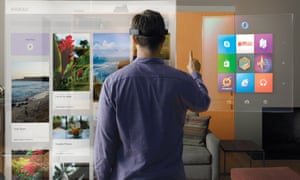
Impression of ‘augmented reality’ seen with a HoloLens device.


Impression of ‘augmented reality’ seen with a HoloLens device. Photograph: Microsoft/Rex

Immersive technologies could also prove a boon in the field of imaging; using the HoloLens doctors could explore entire brains, in images built up from MRI scans, floating in front of their eyes. “It’s there, [in] actual 3D,” he said.


Shafi Ahmed, council member of the Royal College of Surgeons, said the technologies were the future when it came to education. “[In the next five years] I think most people will be taught with this AR, VR, mixed reality,” he said. “Learning will change immeasurably.”


He added: “We are rebuilding [the college] for 2020. In that new classroom environment there will be no space for cadavers, it’ll be case-based anatomy, it’ll be teaching and learning using HoloLens and virtual reality – really disrupting 200 years worth of surgical training.”


But it might be some time before cadavers are completely replaced by technology. Andrew Reed, chief executive of the Royal College of Surgeons, noted the college would continue to offer cadaveric courseselsewhere in the UK in partnership with other faculties.


Ahmed, who is a cancer surgeon at Barts Health NHS trust and co-founder of Medical Realities, a company working with augmented and virtual reality, is a pioneering figure in the world of medical technology. In April 2014 he live-streamed an operation using the augmented reality device Google Glass, and in May this year he live-streamed the first 360-degree video of an operation.


He stressed that that approach was not a gimmick. His vision, he said, was to shake-up surgical training, and do away with traditional approaches whereby students in theatre barely caught a glimpse of procedures, while democratising access to training across the world. “Two-thirds of the population, five billion people out of seven billion do not have access to safe and affordable surgery,” he said.


Among other devices under development around the world are alternative approaches to hologram technology, such as that from the company Holoxica, which aims to project 3D holograms into a space without headsets.


And augmented reality is also finding its niche. Xpert Eye by Ama is based on smart glasses that allow doctors to remotely provide advice and support to those wearing the glasses, in what the creators dub a “see what I see solution”.


It was not only doctors that could benefit from the new wave of technology, said Ahmed, pointing out that immersive approaches could aid patients too.


“The real value of this stuff is already shown in patients with anxiety attacks, phobias, pain relief, and also in patient education,” said Ahmed, pointing out that VR headsets offered patients a chance to see what would happen to them during a procedure, or even watch their own surgery in retrospect.


Christian agreed, saying technologies like the HoloLens could offer patients a view of the inside of their own bodies. “I think people rationalise things more in a visual way,” said Christian. “We know that an informed patient [has] better outcomes.”


Medical trainers look to virtual reality tech

19 Ekim 2016 Çarşamba

How virtual reality is changing the game in healthcare

In a small operating theatre underneath University College London hospital, a team of cardiologists are in a race against time. They’re performing an angioplasty, a delicate and dextrous procedure where tiny wires are inserted into the heart to widen coronary arteries narrowed by plaque buildup. Things have gone badly wrong.


One of the wires has perforated the artery walls, causing a rapid leakage of blood. With fluid building up around the heart, the team must act quickly. A microscopic balloon has to be blown up inside the artery to stop further blood loss, before a drain is inserted through a tiny keyhole incision to remove the excess. This has to be done in less than five minutes to prevent the patient going into cardiac arrest.


While the mood is one of grim urgency, this time it isn’t quite life and death on the line. The patient is an actor and the damaged heart, a sophisticated robot. It’s all part of a highly immersive virtual simulation, the likes of which are rapidly changing the way surgeons, doctors and nurses are trained in the NHS.


Emmanuel Ako, a senior cardiologist, is leading the team performing the operation. Like almost all his colleagues, he learnt his trade, the equipment, communication, and the fine motor skills required for the job, through real life operations, chaperoned at all times by a consultant. “Your first puncture or procedure would literally be on a live patient,” he says.


[embedded content]

A virtual endoscopy procedure is performed using a robot programmed with haptic technology, so it feels as it would do in real life for the surgeon.

But the system is changing, and fast. Owing to greater patient awareness and involvement in healthcare, operations are increasingly being led and performed by senior consultants. Trainee surgeons can assist and observe but hands-on experience is harder to come by. “There’s more pressure from patients to have access to the best trained person available,” says Fernando Bello, a researcher in the department of surgery and cancer at Imperial College, London. “Of course this is positive in many ways but, along with reduction in working hours, it makes it harder for trainees to get the exposure they need.”


Over the past four years, hospitals across the UK have increasingly been turning to simulation and the virtual world for answers. Bello works at Imperial’s specialist centre for engagement and simulation science alongside Professor Roger Kneebone, who has pioneered the field over the past 15 years. Kneebone first began looking at ways to simulate various scenarios in clinical medicine for training purposes, based on his experiences first as a trauma surgeon and then as a GP.


For surgeons, he uses an array of theatrical techniques to recreate an operating theatre. The sights, sounds and lighting are exactly the same as the real thing, along with the staff. To increase the sense of immersion, trainee surgeons take part in the simulations along with anaesthetists, nurses and various technological and visual effects. For cardiologists performing angioplasty, the robot they’re operating on is draped with an actor sitting underneath it at the head end, to look like a patient lying down. The robot and operating tool are embedded with the latest haptic technology, so it feels exactly as if the tiny wires are being pushed through a real person.


“When you push a wire into an artery it’s not smooth,” Ako says. “There’s some resistance. And that’s programmed into the system, as is the slight resistance you feel when you make the initial puncture. In front of you they have real life x-rays to navigate, as you would use on an actual person, so you’re getting not only a visual feel, but also the tactile and haptic feel of the equipment. It’s very realistic, very high definition.”


To test the ability to react in real time to challenges, trainees can face any of a range of pre-programmed scenarios. For trainee cardiologists there are 52, ranging from the wrong drug being accidentally injected, to an artery perforation, to the patient having an allergic reaction to various dyes used to look at their arteries. In the latter case, monitors around the operating table start showing that blood pressure and heart rate are going down, and those running the simulation will instruct the actor via headphones to display difficulties in breathing.


In future there are plans to combine the existing robotics and haptic technology with Occulus Rift from the gaming world. Surgeons will conduct the simulated operation while wearing goggles, transporting them into a virtual environment containing larger, more complex equipment such as x-ray scanners.


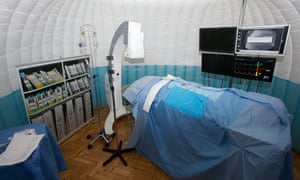
An AngioSuite at Imperial’s specialist centre for engagement and simulation science


Hospitals across the UK are increasingly turning to simulation and the virtual world for answers. Photograph: University College London

“There have been studies of surgeons during these immersive simulation and you see that they get a physical response,” Ako says. “So the heart rate’s racing, the adrenaline is up, it’s like an emergency is actually happening. And then in real life it just takes the stress away, you go into that mode and just do exactly what you’ve done in the simulation.”


The simulations also allow the often overlooked human side of surgery to be rehearsed and improved. With sometimes 10 or more people involved in an operation, Ako says that most of the time serious mistakes in theatre occur due to poor communication. With large operations increasingly being done on patients who are consciously awake and under local anaesthetic, surgeons are having to learn to communicate with those undergoing the operation.


Kneebone is also looking to use simulations to allow prospective patients who are waiting to undergo a procedure to experience the operation environment beforehand as a way of reducing anxiety. At St Mary’s hospital in London, a new patient experience hub allows them to experience what the operating theatre will look like and even what certain procedures, such as angioplasty, would feel like.


“The idea is that patients can experience the procedure first through simulation, to demystify it and get used to it,” Kneebone says. “And it allows us to assess things from reducing delays to reassuring patients, and look at how we might do them a bit better.”


There are now more than 20 specialist simulation centres across the UK using these techniques to train those across the medical profession, from surgeons to GPs. Kneebone says this is only going to increase. “There’s going to be big pressures on the educational system with many thousand more doctors coming into the system in the next few years,” he says. “I think simulation offers huge potential to help with that … it’s completely changing the way cardiologists and cardiothoracic surgeons work.”


Join the Healthcare Professionals Network to read more pieces like this. And follow us on Twitter (@GdnHealthcare) to keep up with the latest healthcare news and views.


How virtual reality is changing the game in healthcare

23 Ağustos 2016 Salı

Virtual fracture clinics enable patients to receive care online

A physiotherapist and orthopaedic surgeon are transforming the way patients with fractures are treated and saving the NHS more than half a million pounds in an initiative which could become a national model.


Physio Lucy Cassidy and consultant James Gibbs have established a virtual follow-up clinic for patients with simple fractures or soft tissue injuries. In the past these patients would have come through A&E and have to return for a follow up appointment at a consultant-led fracture clinic. But today these patients receive all their post A&E care online.


The patient’s x-ray and injury is assessed within 24 hours by a physiotherapist and an orthopaedic consultant to decide if they can self-manage their recovery remotely. Patients are then phoned by the physio and offered a virtual clinic referral.


Virtual clinic patients are emailed a video message from the consultant talking through the injury and the prognosis and a link to an individual rehabilitation video – one of 27 which have been produced – with a six-week exercise plan to follow. Patients can phone a specialist physiotherapist if they have any problems; the option to come into a traditional face-to-face consultant outpatient clinic remains open.


Cassidy, an extended scope practitioner says: “This is a no brainer – it works for the patient, it works for the consultants and physios and it’s cost-efficient. Patients absolutely love the virtual clinic they say ‘What, I don’t have to come in?’ They really appreciate the service and they have a safety net.”


Some 12,000 patients have been referred to the virtual clinic run by Brighton and Sussex University hospitals NHS trust since it began three years ago. Fifty seven per cent of those patients are discharged without ever having to return to hospital; 37% have a follow up appointment at a consultant out-patient clinic and 6% are seen by a specialist physio. The service has already saved the NHS around £500,000 as the cost of a virtual referral is £67 – half the price of a traditional clinic appointment. Those savings are expected to double in the next year because since May the service has expanded to include wrist and hand injuries which account for almost half of all fracture clinic referrals.


Under the virtual system patients who require a face-to-face appointment are now booked in with the most appropriate specialist consultant at an outpatient clinic. Cassidy explains: “Under the old system it was a bit of a lottery who you saw. The patient would come to the fracture clinic and if it was run by the shoulder consultant on that day, but you had broken your ankle, you would still be seen by the shoulder consultant. One of the complaints I get from the consultants now is that ‘all my clinics are now full with people that need to be seen.’ ”


Gibbs first had the idea of a virtual fracture clinic when he was a junior doctor: “I would sit in the fracture clinic and feel exasperated for me, and for the patients, because the majority of injuries you see heal on their own with the passage of time and we were seeing people in clinic unnecessarily.”


He admits his consultant colleagues were sceptical at first about the changes but there would be a “hue and cry” now if the trust reverted to the old system: “It’s standardised treatment for specific injuries, it’s freed up consultants’ time and we are working smarter.”


The virtual clinic – which is being showcased at the NHS Health and Care Innovation Expo 2016 in Manchester next month (September) – is already being adopted by others. Virtual clinics are now run at Western Sussex hospitals NHS foundation trust and Maidstone and Tonbridge Wells NHS trust in Kent; others in Hastings and Eastbourne are due to launch in January.


A free “plug and play” package – an electronic virtual clinic blue print – is available for trusts to use as a starting point. Computer software which will allow hospitals to run their own branded virtual clinic on their own system – to be sold under license – is due to be launched next February.


Cassidy and Gibbs believe the virtual clinic – which was recognised in the NHS Innovations Challenge awards this year – could become a national model. That ambition is shared by the Chartered Society of Physiotherapists. Society professional advisor Priya Dasoju says: “We would like to see this model rolled out but it’s key that it is a physio-led service because it’s physios who can provide the rehabilitation service. It’s such a simple concept but makes such a massive difference.”


Virtual fracture clinics are new to the UK but others already exist worldwide – particularly in rural areas of Scandinavia, according to orthopaedic surgeon Stephen Cannon, vice-president of the Royal College of Surgeons.


He says: “It does require resources in terms of time from the physio and the consultant and is a huge change for patients. But it is patient-centred, it works in other parts of the world – it’s a great idea.”


Health and Care Innovation Expo in Manchester on 7 and 8 September will explore the Five Year Forward View in action. High profile health leaders will speak across two stages, while feature zones will explore digital health, personalised medicine and new models of care. NHS colleagues can attend free-of-charge. Click here to register.


Do you work in the NHS? Please take our survey and tell us whether bullying is a problem and how it affects your work.


Join the Healthcare Professionals Network to read more pieces like this. And follow us on Twitter (@GdnHealthcare) to keep up with the latest healthcare news and views.


Virtual fracture clinics enable patients to receive care online

18 Haziran 2014 Çarşamba

Virtual Surgical procedure: doctors employing Google Glass


Dr. Selene Parekh is element of a tiny group of surgeons who have begun testing Google Glass in operating rooms.


He explains how physicians wearing Glass can instantaneously deliver health care records, x-rays and MRIs into see.


It can broadcast live video of uncommon operations and even use virtual-actuality-sort applications to allow a remote expert help with a difficult surgery.


Virtual Surgical procedure: doctors employing Google Glass

15 Ocak 2014 Çarşamba

Virtual actuality theatre puts first-hand experience of brain harm centre stage

In 2007, Jane Gauntlett was preparing for a job in theatre when she was violently mugged and fell into a coma for 3 weeks. She suffered a traumatic brain damage (TBI), the lengthy phrase legacy of which includes epileptic seizures and brief phrase memory and communication difficulties.


“When I woke from the coma I had no notion how serious the damage was. I was adamant that I was to become a freelance theatre producer,” says Gauntlett, who had completed the Royal Court Theatre’s Youthful Writers Programme even though doing work previously for mental well being charities. At first, she stayed on track, gaining encounter with interactive theatre makers at Battersea Arts Centre and making demonstrates in Edinburgh, London and Margate.


However, work was disrupted by epilepsy. Worse than the seizures themselves was the alarmed reaction of colleagues, and this was compounded by the humiliation of not being in a position to remember and talk as freely as she as soon as had in the course of the inventive approach.


Daily life will in no way be the same 


The very first step toward accepting her lifestyle post-damage was to volunteer as a mentor for youthful folks with related concerns. She worked to facilitate understanding in between people she mentored and these who could in no way relate to the daily knowledge of TBI, which can be frustrating and scary. People whose injuries leave no physical trace face the biggest challenge, given that their difficulties are so effortless for other folks to overlook. Gauntlett says the young folks had to accept that existence would in no way be the very same because “communication with families, friends and strangers was frequently challenging.”


It was this imperative for empathy in between people with and with no brain injuries that gave Gauntlett her route back into theatre. But to achieve her goal, she had to look past the spacial and relational conventions of functionality. The outcome was a piece called In My Shoes which lacks anything a single may recognise as actors or an audience and is also non-website distinct. In fact, the immersive and single-consumer knowledge relies mainly on technological innovation.


Daily life becomes theatre with the help of technology


The piece recreates the producer’s own disorientating knowledge of waking up in Slough right after a seizure, with no notion how she received there. The audience – or rather the a single person encountering the display – is put “into Gauntlett’s shoes by wearing Vuzix 920 Eyewear, wrap-all around video glasses, and earbuds connected to an iPod Touch which deprive them of their personal, familiar senses. Virtual reality takes more than and is augmented more by the manipulation of touch, taste and smell, even though exactly what transpires should probably be saved for the efficiency itself.


“We have our eyes peeled for technology that will improve our experiences – we want to keep up to date,” says Gauntlett. “In My Sneakers experiments with substitute strategies of communication. My aim is to place audiences as near to becoming in the sneakers of a stranger as I can, I use virtual actuality computer software, touch, taste, sound &amp smell to make it as real to lifestyle as attainable.”


The achievement of the 1st incarnation – reactions run the gamut of emotion but are by no means underwhelmed – led to the evolution of the piece. Gauntlett formed a collective called Sublime and Ridiculous, to share the perform of exploring a assortment of complicated, delicate or controversial subjective realities. They have so far put hundreds of inclined participants into the shoes of a folks with post-traumatic pressure disorder, bi-polar disorder and stroke, as nicely as these of a paramedic and a trans-gender person. They have strategies to adapt the piece and its technology to investigate the perspectives of an astronaut, a politician, a dominatrix and a murderer.


Though Gauntlett had no prior knowledge in the discipline, engineering is now integral to her function: “I am fascinated by how rapidly factors are evolving and have my eyes peeled for new inventions. In My Footwear is an ever-expanding collection of audio and audio-visual experiences and I am keen to expand it, and for it to evolve utilizing cutting edge technologies as it gets to be available.”


Different versions of My Shoes have been performed by the Sublime and Ridiculous collective in New York and London. Photograph: Amy Hart
Different versions of My Shoes have been carried out by the Sublime and Ridiculous collective in New York and London. Photograph: Amy Hart

Technological innovation is part of theatre’s long term


In spite of this kind of a unique genesis and manufacturing, she is quick to stage out that the symbiosis of theatre and tech is frequent in contemporary functionality. “Interactive theatre plays a big part in the fringe scene,” she says, even though elsewhere, engineering is employed to deepen knowing in other distinct contexts: “Large tech Kabuki theatre in Japan uses transportable monitors [for the audience to study] subtitles in order to better understand an artform that is frequently hard to comprehend.”


As effectively as illuminating intensely private experiences, Gauntlett hopes this kind of advances will lead to more international collaboration and theatre that is accessible to a lot broader demographics. Nevertheless, she says: “I don’t feel theatre’s survival and relevance depends on embracing technological advances.” The point is there is space for every thing, and technological innovation-driven theatre will acquire momentum as technological innovation turns into ever a lot more integral to people’s day-to-day lives.


Such innovation, she says, “is at times frowned upon by critics. However, if the operate is excellent it should not matter.”


Sublime and Ridiculous will carry out In My Shoes at Battersea Arts Centre, London on eight February 2014, as component of Freshly Scratched


Virtual actuality theatre puts first-hand experience of brain harm centre stage