Texas etiketine sahip kayıtlar gösteriliyor. Tüm kayıtları göster

17 Ocak 2017 Salı

Healthcare without Planned Parenthood: Wisconsin and Texas point to dark future

In the remote western plains of Texas, the Midland-Odessa region is separated from the nearest major city by hours of open road. So when the Planned Parenthood clinic in Midland closed down in late 2013 – a casualty of legislative cuts that targeted Planned Parenthood directly – it served as an isolated experiment in what happens when the government defunds the largest women’s healthcare provider around.


“I hate to say it, but I think an awful lot of women just opted to go without care,” said Mike Austin.


Austin is chief executive of Midland Community Healthcare Services (MCHS), a federally-funded network of providers that has emerged as the only major alternative to Planned Parenthood in the area. His clinic offers all of the same services the Midland Planned Parenthood once did, including contraception, cancer screenings and STI tests, to the same kind of patients, low-income women who rely on the public safety net for their healthcare.


In fact, just before the Planned Parenthood clinic shut down, the two providers made a plan to minimize the fallout. Planned Parenthood sent nearly 5,000 patient medical records – up to 1,000 belonging to active patients – directly to MCHS.


But to Austin’s dismay, only about 100 former Planned Parenthood patients ever showed up at his door.


“We are seeing a subsequent rise in STDs and a subsequent rise in unplanned pregnancies,” Austin said. He believes they could be linked. “And I’m sitting here going, ‘See? I told you so. This is what happens.’”


In the weeks ahead, members of Congress will replicate Midland’s experiment on a grand scale by defunding Planned Parenthood across the country. They will do so in the form of a budget that blocks Planned Parenthood from accepting Medicaid, the government-funded insurance for low-income individuals.


It’s a move Republicans have long framed as a rebuke of Planned Parenthood’s role in providing abortions – even though Medicaid is prohibited from covering abortions by law, and only half of Planned Parenthood clinics even offer the procedure.


What Medicaid does do is allow Planned Parenthood to provide contraception, cancer screenings and STI tests to 1.5 million patients in the public safety net at some 650 health centers for no cost. About two-fifths of the organization’s $ 1.3 billion annual budget derives from public funding. Without the reimbursements Medicaid provides, a spokeswoman for the Planned Parenthood said, an unknown number of those centers will have to close.


House Speaker Paul Ryan of Wisconsin recently predicted that federally funded health centers – like the one in Midland – could pick up where Planned Parenthood left off. “They’re in virtually every community,” he said at a recent town hall, “providing the same kinds of services.”


But public health officials such as Austin, who work in states where Planned Parenthood’s presence is already in decline, are sounding the alarm. They say the loss of Planned Parenthood would imperil the health of thousands of women who already face high barriers for care.


And some of the strongest voices in opposition come from Ryan’s own backyard.


“They’ve never replaced the services of Planned Parenthood,” said Gail Scott, director of health in Jefferson County, Wisconsin. Her county, which lost the Johnson Creek Planned Parenthood in 2013, bumps up against Ryan’s congressional district. “I’m not pro-abortion or anything,” she said. “But I can tell you nothing ever replaced those services for uninsured people.”


The clinics in Johnson Creek closed because lawmakers in Wisconsin, as in Texas, approved a series of family planning cuts targeted directly at Planned Parenthood. Today, Scott said, when the Jefferson County health department gets calls from low-income women looking for a place to obtain contraception, staff recommend they travel to another county – where there’s still a Planned Parenthood.


Chippewa County, Wisconsin, also lost its Planned Parenthood clinic. Jean Durch, the county health director at the time who is now retired, recalled that after the closure, there was no place in Chippewa for women to receive STI tests, even though her department sought the funding to make it happen.


“We never were able, before I retired, to pick up the full complement of services” of Planned Parenthood, she said.


And Shawano County, Wisconsin, which is experiencing a flare-up in gonorrhea and which the state government recently designated a hot-spot for new chlamydia infections, is still feeling the pressure. After the Planned Parenthood there closed, former patients faced significant waiting lists to see a doctor at local community health clinics. The health department didn’t know where to send women for certain services.


“The clinic that closed in Shawano served the whole county,” said Jaime Bodden, the Shawano County health director. Not just women on Medicaid, she said, but women with stingy insurance and women with no insurance at all. Now, the county health department is virtually on its own as it combats the region’s rising STI rates.


“It’s something that we still often talk about,” she said. “We say, ‘Wouldn’t it be nice to have Planned Parenthood in town?’”


‘A national healthcare disaster’


Planned Parenthood officials say Wisconsin would continue to be hard-hit if Congress went through with its plans for defunding. A disproportionate number of its patients there are Medicaid beneficiaries and women of color – groups of people who already face barriers to accessing care.


Already, some of their patients are worried about gaps in their health care if Planned Parenthood were to disappear.


“I have to get that care,” said Courtney Kessler, 22, of Madison, Wisconsin, who has a family history of ovarian cancer and has gone to Planned Parenthood for cancer screenings and contraception for seven years. She is on a public safety net program that covers the costs. “I don’t know where else I would go. I would have to spend time finding somewhere else to go, and worry about, can I afford it? And worry about, am I getting the same quality of care I get with Planned Parenthood? It’s only making it more difficult for people already having struggles.”


Planned Parenthood operates 22 locations in 15 Wisconsin counties, with just two providing abortion services. A new survey conducted by Health Management Associates, a healthcare consulting firm, and paid for by Planned Parenthood, concluded that in seven of those counties there are no viable alternatives to Planned Parenthood for family planning services. In four other counties, there is only one viable alternative. Two counties that would have no alternative if Planned Parenthood were to close – Racine and Walworth – comprise part of speaker Ryan’s district.


The notion that overnight they can serve two million more people who need reproductive health services is absurd


Sara Rosenbaum, professor of health policy


The survey also concluded that many alternatives offer limited hours and do not stock all the most effective contraceptives – making it questionable that they are truly alternatives to Planned Parenthood.


Raegan McDonald-Mosley, Planned Parenthood’s chief medical officer, said this pattern holds across the country. In 332 of the 491 counties where it had locations in 2010, the latest year numbers were available, Planned Parenthood served at least half of the women obtaining contraception through the public safety net. In 103 of those counties, Planned Parenthood was the only safety net provider for family planning.


“We play a hugely important role in family planning safety net around the country,” said McDonald-Mosley. If those clinics were no longer options for many women, “It would truly be a national healthcare disaster.”
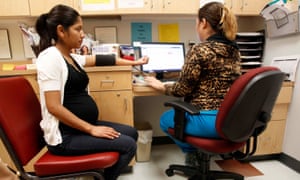


A woman has her blood pressure checked at a women’s clinic in San Juan, Texas.


A woman has her blood pressure checked at a women’s clinic in San Juan, Texas. Photograph: Delcia Lopez/Reuters

Proponents of defunding Planned Parenthood have circulated their own surveys. In 2015, lawmakers and anti-abortion activists distributed maps and lists claiming there were thousands of government-funded health clinics able to take on Planned Parenthood patients. Several news outlets revealed that these lists included dentists, jails and food banks.


Still, many of the dots on such maps represent clinics that really do offer the same services as Planned Parenthood. The question is, can they take on potentially millions of new patients?


Many public health advocates are skeptical.


“Planned Parenthood treats about 2 million women on Medicaid and community health clinics in total serve about 25 million – everybody from infants to 90-year-olds,” said Sara Rosenbaum, a professor of health policy at George Washington University who has worked in the field of community health for several decades.


“They have wait lists for the people they’re serving today, much less having to absorb all of Planned Parenthood’s patients as well,” she continued. “The notion they can suddenly ramp up their capacity to absorb all of the services Planned Parenthood can offer, the notion that overnight they can serve two million more people who need reproductive health services is absurd. It displays, to my mind, an astounding ignorance of how the health system works.”


‘Texas illuminates what may happen’


Planned Parenthood hasn’t produced an estimate of how many of its clinics might close, and where if the group were defunded.


In Texas, though, a nascent body of research suggests that excluding Planned Parenthood from the safety net has negative consequences even when the cuts don’t force clinics to shut their doors.


These studies have measured what happens not when Planned Parenthood clinics closed, but when women enrolled in Texas’ Medicaid-like program can no longer use their insurance at Planned Parenthood. One study, from the Texas Policy Evaluation Project of the University of Texas-Austin, followed women in Midland (before the clinic shut down) and Houston who relied on Planned Parenthood for Depo Provera, an injectable contraceptive. They found that 20% of women who wanted to stay on Depo-Provera missed their next dose.


These women faced a small but real increase in their odds of getting pregnant. About 25% became pregnant – versus just 8% of the women who didn’t miss their next dose.


The other four out of five women in the survey who wanted another dose, got one. But it wasn’t always free, and it wasn’t always straightforward. Forty-three percent of these women reported that it cost them time or money to find a new provider. In Midland, because other providers were scarce, 65% of the women surveyed kept going to Planned Parenthood, even though it now meant paying out of pocket.


Republicans trade blows with Planned Parenthood president Cecile Richards, in a congressional hearing in September 2015.

Defunding Planned Parenthood, in other words, didn’t necessarily stop women from relying on Planned Parenthood for health care – it just forced them to replace the state’s money with their own.


“These results should be cautionary to states considering similar measures,” the study warned. “They contradict the claim that Planned Parenthood could be removed from a statewide program with little or no consequence.”


Another study found that after Texas kicked Planned Parenthood out of the Women’s Health Program, there were drops of more than 30% in reimbursement claims for some of the most effective methods of contraceptives (although not birth control pills). The drops were only observed in counties where women had previously used local Planned Parenthood affiliates. That study also measured a small but real uptick in births by women on Medicaid, although there are other explanations besides the loss of Planned Parenthood.


“Texas’s experience illuminates what may happen on a larger scale,” said Joe Potter, a UT Austin researcher. “Each person involved in the program had to go find a new provider. And whether or not the new providers have the training, experience, and bureaucratic set up so women can get care promptly is a big question mark.”


Austin, who runs the clinic in Midland, says the problem isn’t just that local health clinics might not have the capacity. In fact, he was one of few public health officials interviewed who felt that federally funded healthcare clinics really could provide for Planned Parenthood’s patients – eventually.


“Logistically, yes, it can happen,” he said. “But it can’t happen for free or overnight. In Dallas or Austin, you could be talking about 10,000 people being displaced into the community health system. I’m sure [local clinics] would do their best, but it would take a ramp-up to do it.”


A Texas health department survey of the state indicates that the capacity to absorb Planned Parenthood patients might exist. But the problem, as Austin’s experience attests, is getting all of the same patients that Planned Parenthood once served through the door. Clinics like his also have an extremely limited ability to advertise their existence. Women know what Planned Parenthood is and the services it offers. And MCHS doesn’t employ the same medical professionals as Planned Parenthood – people that patients have trusted for years with personal and sometimes embarrassing issues.


All these could be reasons why hundreds of Planned Parenthood patients, unless they moved or found other care, never transferred to Austin’s clinic.


Recently, MCHS moved most of the 5,000 records it inherited from Planned Parenthood into storage.


“It broke my heart,” Austin said. “Here’s 5,000 people who have basically been thrown out on the street. What happened to them? I can only account for about a hundred of them. What happened to the rest?”


Healthcare without Planned Parenthood: Wisconsin and Texas point to dark future

19 Aralık 2016 Pazartesi

Texas measure requiring burial of fetal remains may herald wave of similar laws

A controversial new rule requiring Texas abortion clinics to bury or cremate fetal tissue won’t go into effect Monday as planned, after a judge temporarily blocked the rule Thursday.


But abortion advocates warn the lawsuit has teed up a battle that could open up a brand-new front in the abortion wars.


“This is Texas once again trying to decrease women’s access to abortion care,” said Vicki Saporta, the president of the National Abortion Federation, a member organization for independent abortion clinics. “And Texas, in recent memory, has been leading the way on anti-abortion restrictions.” She predicted that a wave of states with anti-abortion legislatures would soon follow suit. “They don’t do anything one at a time.”


The rules, which Texas’ health department quietly introduced this summer, require healthcare facilities to dispose of fetal remains from abortions and miscarriages through burial or cremation, with the only exceptions for miscarriages and abortions that take place in the home.


Whole Woman’s Health, a group of abortion clinics with several locations in Texas, filed suit, claiming the logistics of following the new rules could force clinics to close or drive up the cost of the procedure.


“It imposes a funeral ritual on women,” the suit claims. “It also forces healthcare providers to work with an extremely limited number of third-party vendors for burial or scattering ashes, threatening abortion clinics’ provision of care and their long-term ability to remain open.”


The rule was slated to take effect on 19 December. But on Thursday, a federal judge temporarily blocked the rule until a hearing on the Whole Woman’s Health lawsuit could be held in January.


Texas is not the first state to pass requirements for how abortion clinics deal with fetal remains. But because the state often sets the agenda for others seeking to curtail abortion rights, its court fight could signal that a wave of similar laws is coming.


Louisiana passed a similar measure which has been blocked pending the outcome of a lawsuit. And in March of this year, Indiana governor Mike Pence, the vice-president elect, signed a bill requiring individual women to seek funerary services for fetal tissue – regardless of whether they have had a miscarriage or an abortion. A federal judge blocked that law from taking effect.


Clinics typically dispose of the contents of a pregnancy through medical waste companies. The new rules, say Texas abortion providers, would force clinics to do business with funeral homes and pass on steep costs to abortion patients. According to one estimate, the rules would double the cost of the procedure.


“For women who are already struggling to pay, it could be a barrier and a burden that they can’t overcome,” said Saporta.


Saporta also pointed out that funeral homes would have the power to prevent abortion clinics from offering the procedure by refusing to handle their fetal tissue.


Anti-abortion protesters have been known to harass companies that do business with clinics as a way to interrupt the clinics’ operations. As a consequence, many companies are reluctant to work with abortion clinics.


The recent wave of proposals to regulate clinics’ medical waste may have been touched off by Americans United for Life, an anti-abortion group that provides lawmakers around the country with legal advice and model legislation.


In 2015, it introduced a new model bill called the Unborn Infants Protection Act, requiring all fetal tissue from abortions to be buried or cremated. Under the bill, either the woman must make the arrangements herself, or she or an “authorized representative” must decide which method the clinics use. It prohibits the donation of the tissue to medical research – an endeavor that has produced vaccines for deadly viruses such as polio.


“The momentum for creating a culture that respects life in the law increases each year,” Charmaine Yoest, the group’s president, said in a statement accompanying the draft legislation. The bill, she said, “ensures that mothers are given the opportunity to ensure that their deceased infants receive respectful treatment, and that the bodies of aborted infants are not exploited”.


AUL circulated the draft bill to state legislators late last year. At the time, many anti-abortion lawmakers were seeking to build on the outrage over a series of sting videos that falsely accused Planned Parenthood officials of illegally selling fetal tissue from abortions for profit.


One state where legislators seem to have embraced the model is Ohio. Following on the heels of the sting videos, the state’s attorney general accused Planned Parenthood of disposing of fetal remains in a general landfill – a charge Planned Parenthood denied.


Lawmakers responded by introducing a bill that


requires women who have had an abortion or a miscarriage to decide whether the clinic or hospital uses cremation or burial to dispose of the remains. “The idea of respectfully treating the remains of an infant who has been aborted, I think, is critical,” said one of the bill’s sponsors. So far, it has failed to pass the legislature.


Bills such as these may be an attempt to exploit uneasy feelings about fetal tissue. Even Planned Parenthood, in the wake of the sting videos, acknowledged that the topic was an emotional one. While denying that Planned Parenthood broke the law, Cecile Richards, the group’s president, apologized for the clinical tone used by Planned Parenthood officials when discussing fetal remains.


Saporta acknowledged that some women might find it helpful to have the remains buried or cremated. But forcing a woman to deal with funerary options, she said, is cruel. “This doesn’t take into account women’s preferences, their wishes, their religious beliefs – it tramples on all of that,” she said.


Speaking to the Guardian earlier this year, other skeptics of the model legislation warned of its potential adverse impact.


“They intend to demean and shame a woman needing abortion,” said Kelly Baden, the policy director of the the Center for Reproductive Rights.


Elizabeth Nash, who tracks state restrictions on abortion for the Guttmacher Institute, a pro-abortion rights thinktank, said: “The language being used is all about trying to elevate the status of the fetus while questioning the women’s decision-making. It seems to me that the purpose of this legislation is to make accessing services as unpleasant as possible.”


What stands out to critics about Texas’ rule is its timing. The Texas health commission proposed the rule on 1 July, just days after the US supreme court struck down a health restriction that would have shuttered half of the state’s abortion clinics.


“They didn’t like the fact that they lost, and now they’re looking for new ways to limit women’s access to abortion care,” said Saporta.


In a fundraising email, Greg Abbott, Texas’ Republican governor, said the rules would “help make Texas the strongest pro-life state in the nation”.


Texas says its critics are blowing the impact of the rules out of proportion. The annual cost to each clinic probably won’t exceed $ 500, the state claims, because it will be offset by a reduction in medical waste disposal costs.


But a spokesperson for the Texas Funeral Directors Association said each burial could cost clinics and hospitals more than $ 1,000. (The way the rule is written, some believe that even remains that are cremated would have to then be interred.) He also worried that the rules could prove burdensome to funeral homes, which usually offer their services for free to parents who are grieving for a miscarriage and want to hold a funeral. If every miscarriage in the state were subject to these rules, he said, that practice could become unsustainable.


Saporta said she was confident that Whole Woman’s Health would prevail in court. The June supreme court ruling that struck down several Texas restrictions held that states regulating abortion for health reasons had to show evidence that its regulations were medically necessary.


“There’s no health reason whatsoever for these requirements,” she said. “All the state health department wants to do is increase costs for women and make abortion care less accessible. It’s not even disguised as anything else.


“I think the courts will strike these laws down,” she continued. “But that doesn’t preclude other states from passing the same legislation, and wasting a lot of money and effort.”


Texas measure requiring burial of fetal remains may herald wave of similar laws

12 Aralık 2016 Pazartesi

Texas rule requiring burial or cremation of fetal tissue shames women, suit says

A women’s rights group has filed a lawsuit in an attempt to block a new Texas rule that requires fetal remains to be cremated or buried.


Accusing the state of a politically-motivated ploy to make it harder for women to have abortions, the Center for Reproductive Rights launched the legal action on Monday, one week before the regulation is set to take effect on 19 December.


The lawsuit against the Texas department of state health services (DSHS), filed in federal court in Austin, alleges that the regulation has no medical benefits, will pose practical burdens by increasing the cost of healthcare services and is an attempt to stigmatise abortion and heap shame on women seeking the procedure.


Whole Woman’s Health, an abortion provider, is the lead plaintiff in the suit. It claims that the new regulation “burdens women seeking pregnancy-related medical care. It imposes a funeral ritual on women who have a miscarriage management procedure, ectopic pregnancy surgery, or an abortion.


“Further, it threatens women’s health and safety by providing no safe harbor for sending tissue to pathology or crime labs. It also forces healthcare providers to work with an extremely limited number of third-party vendors for burial or scattering ashes, threatening abortion clinics’ provision of care and their long-term ability to remain open, as well as cost increases for women seeking pregnancy-related medical care.”


Current Texas regulations on disposal by healthcare facilities do not generally distinguish between fetal remains and other kinds of human materials that would typically be disposed of in a sanitary landfill. The new rule changes that, creating a category for “fetal tissue” and ordering it to be buried or cremated regardless of how far along the pregnancy is. Miscarriages or abortions that happen at home are exempt and birth or death certificates are not required to be issued.


The plan, strongly promoted by Texas’ Republican governor Greg Abbott, was publicly announced last July, four days after the supreme court struck down key parts of an onerous 2013 abortion law that prompted a drastic drop in the number of clinics in Texas. The court found that the law, which mandated that clinics have standards akin to surgical centres, caused an undue burden on women seeking an abortion and did not offer sufficient medical benefits. Abbott, though, has vowed to continue efforts to restrict abortion.


“I believe it is imperative to establish higher standards that reflect our respect for the sanctity of life. This is why Texas will require clinics and hospitals to bury or cremate human and fetal remains,” Abbott wrote in July in a fundraising email to supporters reported by the Texas Tribune. He said the proposal would “help make Texas the strongest pro-life state in the nation”.


According to the DSHS, the rule will benefit public health and safety “by ensuring that the disposition methods specified in the rules continue to be limited to methods that prevent the spread of disease” and by “protecting the dignity of the unborn”. Texas’s Republican-dominated legislature is expected to formally enshrine the regulation in state law during the 2017 session, which starts in January.


Texas governor Greg Abbott has said the proposal would ‘help make Texas the strongest pro-life state in the nation’.


Texas governor Greg Abbott has said the proposal would ‘help make Texas the strongest pro-life state in the nation’. Photograph: Mike Stone/Reuters

“These regulations are an insult to Texas women, the rule of law and the US supreme court, which declared less than six months ago that medically unnecessary restrictions on abortion access are unconstitutional,” Nancy Northup, president and CEO of the Center for Reproductive Rights, said in a statement. “These insidious regulations are a new low in Texas’ long history of denying women the respect that they deserve to make their own decision about their lives and their healthcare.”


The question of how to handle fetal remains became a rallying point for anti-abortion activists after an organisation released a video in 2015 that falsely appeared to show employees at a Planned Parenthood clinic in Houston illegally selling fetal tissue.


Mike Pence, the Indiana governor and now vice-president-elect, signed a restrictive abortion law in March this year that included a fetal remains provision similar to Texas’s plans. It was stopped by a court in June shortly before it was scheduled to take effect.


Another law in Louisiana is on hold because of an ongoing legal challenge.


Texas rule requiring burial or cremation of fetal tissue shames women, suit says

28 Kasım 2016 Pazartesi

Texas faces first case of Zika transmitted by local mosquitoes, officials say

Health officials have announced the first case of Zika transmitted by local mosquitoes in Texas, the second state in the country to find local mosquitoes apparently carrying the virus.


The tropical virus country-hopped through Latin America and the Caribbean in the last year, first arriving in the United States in the territory of Puerto Rico, before arriving in Miami, Florida. Zika can cause severe birth defects in pregnant women infected with the disease.


“We knew it was only a matter of time before we saw a Zika case spread by a mosquito in Texas,” said Dr John Hellerstedt, the state health commissioner.


Until Monday, Texas had 257 confirmed cases of Zika, though all were associated with travel or sexual transmission. Zika is most commonly spread by infected mosquitoes.


“We still don’t believe the virus will become widespread in Texas, but there could be more cases, so people need to protect themselves from mosquito bites,” Hellerstedt said. “Especially in parts of the state that stay relatively warm in the fall and winter.”


The announcement comes one week after Florida governor Rick Scott sought to quell Zika anxiety in Miami.


The governor held a press conference to announce that three miles of Miami Beach, a popular winter tourist destination, was “cleared” of active Zika transmission. Pregnant women are still advised to postpone travel to about 1.5 miles of Miami Beach, and a nearby area of Miami-Dade county called Little River.


The World Health Organization also dropped Zika from the category of “global health emergency”, instead settling in for a long fight against the disease.


However, tools to fight the mosquitoes that carry Zika remain scarce. Mosquitoes can grow resistant to pesticides, and the widespread application of common airborne sprays has prompted outcry in some places, such as Puerto Rico.


Further, alarming discoveries about the virus have continued.


For example, a study released in mid-November found some babies of Zika-infected mothers may develop microcephaly after children appear normal at birth. Children with microcephaly are born with abnormally small heads and suffer severe developmental disorders. Microcephaly is considered the most severe birth defect associated with Zika.


One Texas-based epidemiologist also criticized politicians’ focus on small geographic areas, such as Miami Beach, noting that public health officials are not surveilling for the disease, and that four out of five patients are asymptomatic.


“The idea that Zika is confined to a small, circumspect area of Miami is ridiculous,” said Dr Peter Hotez, dean of the National School of Tropical Medicine at Baylor College of Medicine in Houston, Texas. “There’s probably a lot of transmission going on in Texas, Louisiana, Alabama and Florida that we’re not aware of because we’re not really doing active surveillance, so this is not a surprise at all.”


Though Zika infection is believed to be widespread in Puerto Rico, officials said they did not expect the disease to spread as far in Texas. Many epidemiologists believe that widespread window screens and air conditioning in Texas is responsible for hindering the spread of mosquito-borne diseases.


The infected area, in Brownsville, tends to be a hotspot for mosquito-borne diseases, Hotez said, including a recent case of Chikungunya.


The city is one of the poorest in Texas. Brownsville is the southernmost city in Texas, on the Gulf of Mexico bordering the Mexican state of Tamaulipas. In Cameron County, where Brownsville is located, almost half of children live in poverty, according to the Texas Tribune – the highest rate in the state.


Texas faces first case of Zika transmitted by local mosquitoes, officials say

23 Ağustos 2016 Salı

Politics is killing mothers in Texas | Jessica Valenti

When it comes to women’s progress, the United States doesn’t exactly bring home the gold. We rank 72nd in women’s political participation, with women holding less than 20% of congressional seats. Paid maternity leave? The United States comes in last. But at long last, we’re number one at something: Texas has the highest maternal mortality rate in the developed world.


This dubious honor is a recent one, with a study showing that the rate of women dying from pregnancy complications doubled from 2010-2014. It’s not a coincidence, of course, that there was another major happening around women’s health in Texas during those years: the deliberate closure of clinics that provide abortion and a drastic funding cut to the state’s family planning budget.


As my colleague Molly Redden points out, Texas gutted the state’s family planning budget by more than $ 73m in 2011, forcing clinics to shut down and dramatically reducing the number of women they could provide services to. By 2014, 600 women had died from pregnancy-related complications.


It’s almost as if what feminists have been saying for years is true: limiting reproductive rights hurts women across the board. Access to reproductive care is necessary not just to prevent or end pregnancies, but to ensure healthy outcomes for those who choose to carry their pregnancies to term.


Sarah Wheat of the Planned Parenthood of Greater Texas told the Dallas Morning News that these clinics were “an entry point into the health care system” for many women, especially those with fewer resources.


“Chances are they’re going to have a harder time finding somewhere to go to get that first appointment.”


It’s an ironic but telling turn of events for the activists and legislators in Texas who insisted that laws shuttering abortion clinics were about protecting women’s health – a claim that the supreme court thoroughly debunked.


In the decision to overturn Texas’ extreme anti-choice law, the opinion read: “When directly asked at oral argument whether Texas knew of a single instance in which the new requirement would have helped even one woman obtain better treatment, Texas admitted that there was no evidence in the record of such a case.”


Instead of helping women, the law hurt women. But for the politicians and activists who want to stop them from accessing their right to abortion at all costs, women’s health was never really the point.


If Texas wants to turn this horror show around, officials need to start supporting women’s choices, give up their transparent and cruel war on reproductive rights, and stop rejecting the expansion of Medicaid, which could provide much-needed help and care to the state’s vulnerable communities. And with Zika becoming more of a risk for Americans, these steps cannot come soon enough.


Women’s health is not a political chip to be played; it’s not an afterthought. Our health and lives – whether we choose to have children or not – are central to the health of our country and communities. Women in Texas, women in America, deserve better than this.


Politics is killing mothers in Texas | Jessica Valenti

20 Ağustos 2016 Cumartesi

Texas has highest maternal mortality rate in developed world, study finds

The rate of Texas women who died from complications related to their pregnancy doubled from 2010 to 2014, a new study has found, for an estimated maternal mortality rate that is unmatched in any other state and the rest of the developed world.


The finding comes from a report, appearing in the September issue of the journal Obstetrics and Gynecology, that the maternal mortality rate in the United States increased between 2000 and 2014, even while the rest of the world succeeded in reducing its rate. Excluding California, where maternal mortality declined, and Texas, where it surged, the estimated number of maternal deaths per 100,000 births rose to 23.8 in 2014 from 18.8 in 2000 – or about 27%.


But the report singled out Texas for special concern, saying the doubling of mortality rates in a two-year period was hard to explain “in the absence of war, natural disaster, or severe economic upheaval”.


From 2000 to the end of 2010, Texas’s estimated maternal mortality rate hovered between 17.7 and 18.6 per 100,000 births. But after 2010, that rate had leaped to 33 deaths per 100,000, and in 2014 it was 35.8. Between 2010-2014, more than 600 women died for reasons related to their pregnancies.


No other state saw a comparable increase.


In the wake of the report, reproductive health advocates are blaming the increase on Republican-led budget cuts that decimated the ranks of Texas’s reproductive healthcare clinics. In 2011, just as the spike began, the Texas state legislature cut $ 73.6m from the state’s family planning budget of $ 111.5m. The two-thirds cut forced more than 80 family planning clinics to shut down across the state. The remaining clinics managed to provide services – such as low-cost or free birth control, cancer screenings and well-woman exams – to only half as many women as before.


Related: The biggest US city without an abortion clinic: El Paso’s sole facility faces closure


At the same time, Texas eliminated all Planned Parenthood clinics – whether or not they provided abortion services – from the state program that provides poor women with preventative healthcare. Previously, Planned Parenthood clinics in Texas offered cancer screenings and contraception to more than 130,000 women.


In 2013, Texas restored funding to the family planning budget to original levels. But the healthcare providers who survived the initial cuts reported struggles to restore services to their original levels.


Indeed, the report said it was “puzzling” that Texas’s maternal mortality rate rose only modestly from 2000 to 2010 before doubling between 2011 and 2012. The researchers, hailing from the University of Maryland, Boston University’s school of public health and Stanford University’s medical school, called for further study. But they noted that starting in 2011, Texas drastically reduced the number of women’s health clinics within its borders.


The report comes just as public health advocates are raising questions about Texas’s ability to prepare for the Zika virus, which is transmitted by a common species of mosquito and has been linked to severe birth defects. The World Health Organization has advised women in areas of local transmission to delay pregnancy.


Texas is one of several southern states where health officials say there is a risk of a local outbreak. But about half the state lacks ready access to OB-GYN care, making it difficult for women to obtain contraception or for pregnant women to confirm the health of their babies. Just this month, Texas’s health department drew fire for allocating $ 1.6m of the $ 18m the state budgets for low-income women’s family planning to an anti-abortion group that does not provide basic health services.


“There is a need to redouble efforts to prevent maternal deaths and improve maternity care for the 4 million US women giving birth each year,” the authors said.


Texas has highest maternal mortality rate in developed world, study finds

17 Ağustos 2016 Çarşamba

There may already be a Zika outbreak in Texas, but we probably wouldn"t know

If you were bitten by a mosquito, and within two weeks had a fever, bloodshot eyes, a rash and felt generally achy, you would have four classic symptoms of Zika. But if you or your sexual partner didn’t travel to Latin American, you might also have a hard time getting tested.


That’s because Zika tests are complicated, time-consuming, sometimes inaccurate and expensive. These obstacles have led some scientists to believe that several states at risk for spread of the disease may already have Zika outbreaks, without even knowing it.


“There is not active surveillance going on in the at-risk states in the United States,” said Peter Hotez, dean of the National School of Tropical Medicine at Baylor College of Medicine in Texas. “I think there’s not just Zika transmission going on in Miami, it’s going on all up and down the Gulf Coast and in Arizona, it’s just that nobody’s looking.”


The only confirmed cases of Zika caused by local mosquitoes in the continental United States are in Miami, Florida. Federal officials have since issued a travel warning for the area, asking pregnant women or those hoping to become pregnant to avoid the Wynwood neighborhood. There, local mosquitoes infected 15 people with the virus.


Other Gulf coast states are also considered to to be at high risk for local transmission of Zika virus. That is because Aedes aegypti mosquitoes are endemic, and multiple travelers have returned with the infection. But with laboratory limitations, even states with disease-spreading Aedes aegypti mosquitoes may not be able to surveil non-travelers for the virus.


“There is a limitation, and local transmission could slip through, but it’s the best we’ve got,” said Frank Welch, the medical director for Louisiana’s center for community preparedness.


Related: Zika virus scare is turning Miami’s hipster haven into a ghost town


Louisiana, long-known to be a haven for mosquitoes, is considered a state at-risk of Zika transmission. There, 22 cases of travel-related Zika has been confirmed by the Centers for Disease Control and Prevention (CDC).


“The big fear, of course, is we’ll figure this out seven, eight, nine months from now, in the spring of 2017, when we start seeing babies show up with microcephaly,” said Hotez.


Meanwhile, for community health centers in another Gulf Coast state, Texas, the virus recalls an earlier epidemic that left public health officials flat-footed.


“We’ve never faced something like Zika before. We faced, what was it? H1N1,” said José Camacho, executive director of the Texas Association of Community Health Centers. Member clinics serve about 1.3 million low income Texans. “Over night we were overwhelmed, and I guess nobody was ready for that either. And we’re fearful that some of the same things are playing out here.”


When H1N1 broke out in Texas, the CDC told doctors that they were required to test for the flu strain before prescribing antivirals, Camacho said. He recalls the first H1N1 case occurred on a Friday night. By the weekend, the CDC arrived. Then, it was discovered a standard flu test couldn’t detect the strain.


So the CDC provided new H1N1 tests. Five of them. For all 1.3 million of the Texans served by Camacho’s member organizations.


“Number one, in terms of screening, there’s very limited resources,” Camacho said. “We saw the same thing in H1N1, where the flu test did not work. They actually had to develop a test and eventually change the protocols to not require a test, but delegate it more to the physician’s knowledge at screening.”


Officially, the CDC recommends that patients with three of the aforementioned Zika symptoms be tested if the patient is a pregnant woman, or a woman trying to get pregnant, who lives in or has traveled to an area where Zika is being actively spread.


That means that many people who do not fit this profile, especially men, may be left untested even though the disease is spread sexually.


Some public health officials, like Welch, said testing more Americans would require exorbitant resources.


“Let’s say this test was incredibly available – we would have to test every single person in the US where there is the possibility of Aedes,” said Welch. “We would not only have to test them today, we would have to test them for the duration of the summer.”


“A once a week Zika test for everyone in the southern United States and California –that would be more expensive than building a wall across both our Mexican and Canadian borders,” he said. “So, you would have to decide, since the test is in fact limited in availability and expensive.”


Hillary Clinton talks to a pregnant woman during a health center visit in Miami, Florida.


Hillary Clinton talks to a pregnant woman during a health center visit in Miami, Florida. Photograph: Chris Keane/Reuters

Scientists don’t expect large-scale outbreaks in the continental US, like those that have taken place in Puerto Rico or Brazil. Texas also recently updated its guidance to include recommendations to test people who are symptomatic, but haven’t traveled to Latin America.


Even so, Zika presents its own challenges. Only one in five people infected with the disease are symptomatic. So in order for public health officials to locate a Zika case transmitted by local mosquitoes, a symptomatic patient (already just 20% of the infected population) would need to seek medical treatment. There is no guarantee a patient would even feel the need to see a doctor, since symptoms are generally mild. Then, doctors would have to rule out all other causes of such common symptoms.


“Say, for example, that person did show up at a healthcare provider,” posits Welch, “They wouldn’t be automatically turned away,” he said. “[But] you probably know the symptoms of Zika are pretty close to about 6 million other diseases.”


In the Wynwood neighborhood of Miami, for example, clinicians went over and above CDC guidelines to test a symptomatic patient who showed up at an emergency room without traveling abroad.


“We’re not going into community health centers, we’re not going into emergency rooms, we’re not going into clinics identifying people with fever, or a rash, and seeing if they have Zika,” said Hotez. “It’s not being done.”


In part, this is because of the limitations on Zika testing methods. The two most common ways to test for the virus are both manpower intensive.


“They absolutely take a specialized skill,” said Kelly Wroblewski, director of infectious diseases for the Association of Public Health Laboratories. Tests for past infections can be particularly tricky. “You’re going to get more false positive results, that’s just the way it works with any kind of assay.”


In the meantime, Camacho is rationing 50,000 bottles of donated mosquito repellant to the roughly 400,000 women of child-bearing age served by his organizations. Hotez is meeting about testing guidelines, and cities and states are increasingly broadening their testing guidelines.


“It’s still patchwork quilt,” said Camacho.


There may already be a Zika outbreak in Texas, but we probably wouldn"t know

13 Haziran 2014 Cuma

What we speak about when we speak about abortion: truth, science and not the Texas way | Jessica Valenti

Lauren Peterson is a senior advisor at Planned Parenthood Federation of America and speechwriter for the organization’s president, Cecile Richards. Peterson travels about the country with Richards, going to rallies, occasions – or wherever the politics necessitate.


I met Peterson at a Planned Parenthood occasion in San Diego last yr, when I spoke on a panel with Richards and Sarah Weddington (the attorney who argued Roe v Wade prior to the Supreme Court). Peterson had some things to say about careers in speechwriting (by way of the Obama administration), abortion politics (by way of Texas) and, of course, The West Wing – all although en route to Des Moines to mark the retirement of Jill June, president of Planned Parenthood of the Heartland.


How did you know you wished to go into speechwriting?


Following I graduated from college, I was actually into audio documentary – the sort of issue you’d hear on This American Lifestyle or All Items Considered. I would interview folks, then edit the interview into a piece for the radio. Which is how I discovered that I adore helping other people tell their stories – asking queries, listening to what they have to say, then creating some thing that displays their personality and their tips. And that’s essentially what speechwriting is.


You worked for the Obama campaign – can you talk about who you wrote for? What was that like?


I was on the digital group, so I wrote for everybody – from assisting the man who won “Dinner with Barack” and regretted not taking the French fry provided to him by President Obama (hi, Scott!), to sending an e mail to supporters, to writing video scripts for just about every person, to doing work on our website. I tweeted, blogged, produced audio pieces, realized from our remarkable speechwriting group and, best of all, traveled close to the nation to campaign rallies exactly where the president was speaking.


It could be aggravating at occasions – when you happen to be functioning on a campaign of that scale, you sometimes have to compromise on problems you genuinely care about. We had been all exhausted all the time.


And how did you begin doing work for Planned Parenthood?


I heard Cecile speak on the campaign trail in 2012, when she had taken time off to volunteer as a surrogate for President Obama. She had this hilarious top-ten checklist of the motives why females were absolutely going to make the big difference in the election, and why they need to assistance the president. As the campaign was wrapping up, men and women began asking me what I wished to do subsequent. I would say, “I want to work for a person like Cecile Richards!”


That turned out to be an real job posted on the Planned Parenthood website.


It truly is my knowing that there are not specifically a ton of female speechwriters. Why do you believe that is?


I feel like something else, it requires some bravado to break into speechwriting if you are not already there. And a disproportionate variety of the folks who are previously “there” are guys. I will say this: in my knowledge, they are exceptionally great, generous guys who understand that our discipline is not catching up to the rest of the globe as swiftly as any of us would like.


The 4 individuals who pushed me to try out my hand at speechwriting, who encouraged me throughout my work search, and who now reply my frantic emails with topic lines like “How do you compose a commencement speech?!” – they are all very talented feminist speechwriters … who occur to be men.


Right now, there is not exactly a lack of issues to write about when it comes to reproductive rights – particularly in areas like Texas and Louisiana, states exactly where abortion care may be completely obliterated. How do you stability relaying the urgency of these problems while nevertheless remaining upbeat and inspiring – not just in speeches, but in lifestyle … for your own sanity?


Two methods for this, each of which I blatantly stole from Cecile.


We invested a lot of final summer season in Texas, the place I noticed how desperate the circumstance is for ladies who dwell there and have to go to extraordinary lengths just to get basic health care or accessibility secure and legal abortion, which is – hello! – a constitutional correct and has been for a hundred% of the time I’ve been alive. At the exact same time, I also got to see men and women flip out by the 1000′s to rallies all above the state. … In states that undoubtedly do not make it effortless, individuals are performing extraordinary issues that inspire me even on the toughest days.


Two: I take a deep breath and a phase back and consider about how far girls truly have come. Much less than a hundred years ago, girls couldn’t even vote. I acquired the opportunity to function on a presidential campaign, and now I get to travel all more than the nation writing about women’s rights. Just in situation I neglect, I have a tattoo of the date of the ratification of the 19th Amendment on my wrist.


Poor science – like the erroneous hyperlink among abortion and breast cancer or mental overall health difficulties – has manufactured its way to policy. How do you see battle back towards that?


This by no means ceases to enrage me! You’re entitled to your own opinion, not your own facts, correct?! I think it is difficult for an individual without having a background in medication or science to come in and fact-check out the junk science that has been the justification for every thing from medically needless admitting privileges to mandatory “data” that physicians in some states need to distribute, by law, to women searching for an abortion.


What do you know now about speechwriting that you wish you would have acknowledged 5 years ago?


Five years ago I was functioning for the Wisconsin Film Festival, so I consider it truly is risk-free to say that every thing I knew about speechwriting at that stage in my daily life, I realized from Sam Seaborn.


What we speak about when we speak about abortion: truth, science and not the Texas way | Jessica Valenti

24 Ocak 2014 Cuma

Texas hospital acknowledges brain-dead status of pregnant woman

The hospital maintaining a pregnant Texas girl on lifestyle support, against her families wishes, acknowledged for the 1st time on Friday that she is brain-dead and that the fetus in her physique is not viable.


Marlise Munoz has remained on daily life support for the previous two months because John Peter Smith hospital in Fort Really worth claimed it would be illegal to withdraw therapy considering that the fetus would die as a consequence. In court paperwork launched in anticipation of a hearing on Friday, the hospital acknowledged that the fetus was in impact gestating inside a dead entire body, but that Texas law insisted Munoz be kept on a respirator.


Lawyers for the Munoz household will consider to persuade a judge in Fort Worth that the hospital has misinterpreted the law and that lifestyle-assistance machines need to be turned off.


Erick Munoz found his wife unconscious on their kitchen floor in the early hrs of 26 November. The cause of her collapse was reportedly a pulmonary embolism. At the time she was 14 weeks pregnant with their 2nd youngster. Erick and Marlise Munoz the two qualified as paramedics, and Erick mentioned this resulted in frequent discussions about serious injuries. He says they the two clearly expressed to loved ones and pals that they would not want to be resuscitated if they had been ever diagnosed as brain-dead. 


But the hospital has refused to comply, citing a line in the Texas Advance Directives Act of 1999 which states that “a man or woman might not withdraw or withhold existence-sustaining treatment … from a pregnant patient.”


The Munoz loved ones argue that this clause does not apply considering that the 33-yr-old is brain-dead and consequently legally dead. A number of health-related ethics authorities have backed this stance, like Thomas Mayo, an associate law professor at Southern Methodist University near Dallas, who assisted draft the 1999 law.


“It never ever would have occurred to us that anything in the statute utilized to anybody who was dead. The statute was meant for making remedy selections for patients with terminal or irreversible circumstances,” he advised the Fort Well worth Star-Telegram.


Texas law states: ”The particular person is dead when, in the announced viewpoint of a doctor, in accordance to ordinary requirements of health care practice, there is irreversible cessation of all spontaneous brain function. Death happens when the appropriate functions cease.”


The lawsuit contends that the hospital’s continued treatment “amounts to nothing much more than the cruel and obscene mutilation of a deceased physique against the expressed will of the deceased and her household” and is a violation of her civil rights under the fourteenth amendment of the US constitution.


The hospital has declined to comment on the case considering that the family filed a lawsuit on 14 January. As a public hospital it is getting represented in court by the neighborhood district attorney’s workplace. Just before the lawsuit the hospital issued a statement saying it “will adhere to the law as it applies to healthcare in the state of Texas”.


Attorneys representing the hospital acknowledged in a court document that “Ms Munoz met the clinical criteria for brain death on November 28, 2013″ but argued that withdrawing “daily life-sustaining treatment” would be “contrary to this state’s expressed dedication to the life and well being of unborn kids”.


In the absence of situation law, they explained, the “affordable inference” is that the clause referencing pregnancy in the 1999 act “was enacted to safeguard the unborn kid towards the wishes of a decision maker who would terminate the child’s lifestyle along with the mother’s”.


They extra: “The Texas Legislature has strongly demonstrated its commitment to defend unborn children. The Texas Penal Code, for example, defines an individual as a human getting who is alive, including an unborn kid at every stage of gestation from fertilization right up until birth … This implies 1 may possibly commit the offense of criminal homicide by causing the death of an unborn child.”


The fetus is practically 23 weeks outdated. In the US, a fetus is generally regarded as “viable” – having the likely to reside outside the uterus – from 24 weeks. However, Munoz’s attorneys issued a statement this week claiming that the fetus is severely deformed and critically unwell.


“Even at this early stage, the reduced extremities are deformed to the extent that the gender are not able to be established. The fetus suffers from hydrocephalus [water on the brain]. It also appears that there are additional abnormalities, like a feasible heart difficulty, that can’t be especially determined due to the immobile nature of Mrs Munoz’s deceased physique,” it study.


“Quite sadly, this details is not surprising due to the fact that the fetus, right after getting deprived of oxygen for an indeterminate length of time, is gestating inside a dead and deteriorating entire body, as a horrified loved ones appears on in absolute anguish, distress and sadness.”


The family’s predicament has attracted nationwide and international headlines and grow to be a touchstone for professional- and anti-abortion rights campaigners. Protestors on both sides of the situation have demonstrated outdoors the hospital. It appears to be hugely uncommon: in a study, researchers at the University of Heidelberg identified only thirty related instances among 1982 and 2010. The researchers discovered that a viable youngster was delivered in 12 of the 19 cases for which details was offered.


A 2012 report by the Center for Girls Policy Research noted that about thirty US states have statutes limiting the conditions in which daily life-sustaining therapy of a pregnant woman can be withdrawn. Twelve states, like Texas, have strict laws which “automatically invalidate a woman’s advance directive if she is pregnant.”


Another situation that has prompted a debate more than the legal and ethical concerns surrounding care of brain-dead sufferers is ongoing in California, the place the family members of Jahi McMath has fought to keep the 13-yr-outdated on a ventilator even however she was declared brain-dead on 12 December.


Texas hospital acknowledges brain-dead status of pregnant woman

14 Ocak 2014 Salı

Family of brain-dead Texas woman sues hospital over appropriate-to-die law

The husband of a brain-dead, pregnant Texas woman on Tuesday sued the hospital trying to keep her on existence assistance, saying doctors are doing so against her and her family’s wishes.


The lawsuit filed in state district court asks a judge to purchase John Peter Smith hospital in Fort Worth to take away life help for Marlise Munoz, a north Texas girl who fell unconscious in November while pregnant.


Erick Munoz has stated a medical professional informed him his wife is regarded brain-dead. Munoz says that he and his wife are the two paramedics and are really acquainted with finish-of-existence problems. He says his wife had created her wishes clear to him that she would not want daily life help in this sort of circumstance. Marlise Munoz’s dad and mom agree.


But John Peter Smith hospital in Fort Really worth says it cannot adhere to Erick Munoz’s directive due to a state law that prohibits daily life-conserving treatment from becoming denied to pregnant patients. Experts familiar with the Texas law say the hospital is incorrectly applying the statute since Munoz would be considered legally and medically dead.


Munoz located his wife unconscious in the early morning on 26 November. The family members says it does not know the actual lead to of her situation, though a pulmonary embolism is a probability. Marlise Munoz was 14 weeks pregnant at the time.


The health of the fetus is unknown. Munoz is believed to have been with no oxygen for some time prior to her husband found her.


The hospital has cited a provision of the Texas Advance Directives Act that reads: “A person may not withdraw or withhold daily life-sustaining treatment method beneath this subchapter from a pregnant patient.”


Experts interviewed by the Linked Press, including two who aided draft the legislation, stated a brain-dead patient’s situation wouldn’t be covered by the law.


“This patient is neither terminally nor irreversibly sick,” mentioned Dr Robert Fine, clinical director of the office of clinical ethics and palliative care for Baylor Overall health Care Method. “Below Texas law, this patient is legally dead.”


Tom Mayo, a Southern Methodist University law professor, said he did not think the law utilized in this case. He explained the hospital would not have absolute immunity from a civil or criminal case if it went outside the subchapter referenced by the law, but mentioned “most health care choices” are manufactured without immunity.


“To me, the subchapter isn’t going to need what they’re performing,” Mayo explained. “It basically says that if you were to get the life support away, you’d be outdoors the subchapter. It does not have an affirmative command in it that you need to preserve lifestyle support going.”


Hospital spokeswoman J R Labbe has said hospital officials stand by their choice: “This is not a challenging decision for us. We are following the law.”


Labbe did not right away return an e mail message in search of comment on the lawsuit filing Tuesday.


Family of brain-dead Texas woman sues hospital over appropriate-to-die law