status etiketine sahip kayıtlar gösteriliyor. Tüm kayıtları göster

1 Nisan 2017 Cumartesi

NHS recruits must be given special status after Brexit, MPs urge

The government is under intense cross-party pressure to guarantee that EU nationals will still be able to work in the NHS, as concern grows that Brexit will cause a critical shortage of nurses and doctors.


Tory, Labour and Liberal Democrat MPs said ministers must not only guarantee that EU staff already working in the NHS can stay, but also that recruitment from EU countries can continue.


The calls for NHS workers from the EU to be given special status as Britain heads towards Brexit were echoed by former Tory health minister Dr Dan Poulter, who now combines his role as an MP with work as an NHS psychiatrist. Poulter told the Observer that unless action were to be taken on both fronts – to reassure those already here and to ensure a future flow from the EU – services to patients would be soon be seriously affected.


“The NHS is heavily reliant on the contributions made by many dedicated EU healthcare professionals, and without them, our health and care system simply wouldn’t be able to cope,” Poulter said.


“Protecting the rights of EU nationals to continue to live in the UK and care for patients is essential, but it is also important that we look after the best interests of the patients of tomorrow. Having the right work visa rules to ensure that in future, healthcare professionals from within the EU can continue to contribute to the NHS and care for patients, must be a priority.”


Poulter said he knew of many colleagues from EU countries who were concerned and of two fellow doctors who were planning to return to Spain by the end of the year. Fears that there could be a mass exodus from the NHS are growing as evidence mounts that EU nationals are already beginning to leave. Some 17,197 EU staff, including nurses and doctors, left their posts last year, compared with 11,222 for 11 months in 2014.


Merkel calls on all sides to protect everyday lives of EU citizens in UK – video

The supply of doctors is already a serious worry. A total of 10,363 – nearly 10% – of those working in England’s NHS Hospital and Community Health Services (HCHS) last year were from other member states.


Labour’s health spokesman, Jon Ashworth, highlighted NHS data showing that there are 22,081 EU nationals working as nurses in an NHS which is struggling to fill 26,000 vacancies.


Ashworth said: “This NHS crisis will be compounded if the 140,000 EU nationals working in the NHS and social care sector walk away. It’s time for an ‘NHS guarantee’ for these workers ensuring their rights – offering these workers who care for our sick and elderly the certainty that they deserve.


“What’s more, we need urgent guarantees that the NHS will be able to continue recruiting from the EU as it currently does. Yet we have no clarity whatsoever from the prime minister. Will health professionals from the EU be able to come to work in the UK after Brexit, will there be a cap on their numbers? The government need to tell us their plans and quickly.”


The Liberal Democrats are also demanding that the government grant an urgent “NHS passport” to every EU citizen working in our health service to encourage them to stay.


Theresa May has so far refused to guarantee that EU nationals will be allowed to stay after Britain leaves the EU. The prime minister reiterated last week when article 50 was triggered that she would not do so unless the rights of UK citizens living in other EU states were also guaranteed.


A total of 2,348 doctors from the 27 other EU states left NHS England between July and September 2016 compared with 1,281 in the same period in 2015. That is a rise of 83%.


There were also warnings yesterday that a potential exodus of EU workers could hit other sectors. A spokesman for the CBI said: “Since the referendum, we have heard from members in sectors who depend on EU workers to fill local shortages that they are having difficulties filling.”


As the growing season approaches for ​Britain’s £3bn horticulture industry, recruiters warned that it would be hit particularly hard by staff shortages. The head of the largest Romanian employment agency for temporary workers in the UK called on the Brexit secretary, David Davis, to be clear that EU workers still enjoyed the same rights.


“There was a lot of talk about restricting the rights of Romanians on the day article 50 was triggered but that did not happen in the end. For the next two years of negotiations there should be clear messages​,”​ said Alexandru Barbacaru​ of Est-Vest Services​​.


NHS recruits must be given special status after Brexit, MPs urge
20 Mart 2017 Pazartesi

Has your immigration status affected your care from the NHS?

Hundreds of pregnant women without legal status are avoiding seeking NHS antenatal care because of growing fears that they will be reported to the Home Office or face high medical bills, according to charities that work with vulnerable migrant women.


The Guardian has seen letters from one NHS trust sent to women with complex asylum claims warning they will have their antenatal care cancelled if they fail to bring credit cards to pay fees of more than £5,000 for maternity care. These letters contravene NHS guidelines, which state that maternity care should never be denied.


We’re interested in hearing from other undocumented migrants or people with a complex asylum situation about their difficulties with accessing NHS care.


Please share your experiences in the form below. We understand that this is a sensitive issue and you can respond anonymously if you prefer. We will do our best to keep your responses secure. We will contact you before we publish your responses.


Please share your experiences in the form below and we’ll use a selection in our reporting. We understand that this is a sensitive issue and you can respond anonymously if you prefer. Please do not include any information that you would not want to be published. We will contact you before we publish your responses.


Has your immigration status affected your care from the NHS?

Pregnant women without legal status "too afraid to seek NHS care"

Hundreds of pregnant women without legal status are avoiding seeking NHS antenatal care because of growing fears that they will be reported to the Home Office or face high medical bills, according to charities that work with vulnerable migrant women.


The Guardian has seen letters from one NHS trust sent to women with complex asylum claims warning they will have their antenatal care cancelled if they fail to bring credit cards to pay fees of more than £5,000 for maternity care. These letters contravene NHS guidelines, which state that maternity care should never be denied.


Doctors of the World, which runs clinics for trafficked women, undocumented migrants and asylum seekers whose claims have been rejected, is seeing increasing numbers of women seeking medical help at its clinic in east London in the late stages of pregnancy, who say they are too scared to go to the NHS for fear of high bills or of being reported to the Home Office.


In January, a woman came to the charity’s east London clinic already in labour, having received no antenatal care. “She was very fatigued, she was pale. She had been too frightened to go to hospital because of her immigration status,” said Deman Le Déaut, who runs the women’s and children’s clinic in Bethnal Green.


She was the second woman in four months who had come to the clinic for the first time, at the end of the pregnancy, who had not sought mainstream healthcare. “We are seeing a lot of women six months’ pregnant onwards not accessing medical care. That is incredibly dangerous,” Le Déaut said.


One patient, an asylum seeker from Eritrea, was homeless and living in a bus shelter when she visited the clinic in early pregnancy, having been wrongly turned away from a GP because she had no proof of address.


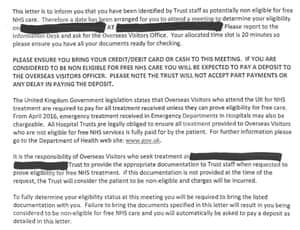
A number of women have visited the clinic, alarmed by debt-collection letters they have been sent by NHS trusts that instruct them to come to their antenatal appointments with money to make deposit payments of several thousand pounds for maternity care.


An extract from a letter sent out by the NHS.


An extract from a letter sent out by the NHS.

“Please ensure you bring your credit/debit card or cash to this meeting. Please note the trust will not accept part payments or any delay in paying the deposit,” one letter sent by Barking, Havering and Redbridge University Hospitals NHS trust states. “Failure to pay a deposit for treatment may result in your future appointments being cancelled. In addition, overseas visitors who incur costs for treatment and do not pay will be reported by the trust to the Home Office and debt collecting agencies. The Home Office will review all records of bad debt and this could be detrimental to any future applications to visit the UK.”


NHS rules stipulate that it is legitimate to ask for payment from those who are not eligible for free care (because they are not ordinarily resident in the UK or because they are living here illegally), but emergency treatment cannot be withheld if a patient cannot pay.


A Department of Health spokesperson said staff should be “especially careful to inform pregnant patients that further maternity healthcare will not be withheld, regardless of their ability to pay … our guidance specifically says that maternity care should never be denied or delayed while a patient’s eligibility is established”.


The Barking, Havering and Redbridge University Hospitals NHS trust said that it had recently “updated” the standard letter to make “it clearer that maternity care would never be withdrawn or appointments cancelled”.


Le Déaut said: “It is bad practice to send these letters demanding credit cards. You are not supposed to threaten pregnant women – documented or undocumented – that you are going to withhold services. We are seeing this kind of letter quite often now. These people have no means whatsoever to pay this debt.”


One patient was telephoned weekly by a debt collection agency, which had a negative effect on her mental health, according to staff at the charity.


The pregnancy discrimination charity Maternity Action runs a helpline for women in this situation and has also noted a rise in demand for its services. “We regularly hear from women who are very distressed about receiving large bills from the NHS for their maternity care. It is pointless sending letters of demand to women who can’t afford to pay for their food and housing,” said its director, Ros Bragg.


The Department of Health spokesperson said no one should be denied urgent treatment and “vulnerable people, including those seeking asylum and refugees, are not charged for NHS care they receive”.


The case of a Nigerian woman who gave birth to quadruplets at London’s Queen Charlotte’s and Chelsea Hospital and incurred a bill of several hundred thousand pounds triggered popular hostility earlier this year, but the charity stressed that its patients had not travelled to the UK in search of free medical treatment.


Sarah Pillai, a volunteer GP who works at the east London clinic, said: “This is not health tourism by any stretch of the imagination. These are people at the outer reaches of society, cleaning, cash in hand jobs, providing the infrastructure for society, but unable to access healthcare.


“The women I’ve seen tend to be very anxious and nervous. A lot of these have been women in hiding until now. Lots of these women present late in pregnancy, which has an adverse effect on their pregnancy because delayed antenatal care can create problems for the mother and baby.”


Staff said there was growing awareness among patients of a controversial memorandum of understanding jointly published by the Home Office and NHS Digital that came into effect on 1 January and set out how the Home Office could request information on immigration offenders from the NHS.


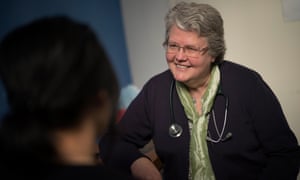
Dr Sarah Pillai


Dr Sarah Pillai, a volunteer at the east London clinic: ‘A lot of these have been women in hiding until now.’ Photograph: Sarah Lee for the Guardian

“When they hear if you go to the doctors, the Home Office might be knocking on your door, they choose to stay away,” Le Déaut said. “The results have serious implications; we see women who are nine months’ pregnant coming to our clinic. We assume that some people are giving birth at home”


She said she understood the need to ensure health tourists paid “but a trafficked woman or an undocumented migrant, who has no way of paying bills should be refused care when she is at her most vulnerable?”


Binta, a pharmacist from Sudan, arrived in 2010 to visit her husband, a doctor from Sudan who had a British passport and who had fled Sudan for political reasons. While she was trying to organise permanent residencyshe became pregnant. She was told by the Home Office that she needed to return home to apply for a new visa but did not feel able to travel because she was in the late stages of pregnancy. She was given leave to remain on appeal, but the papers did not come through immediately so she found herself ineligible for NHS treatment.


When the GP referred her for a scan, she was sent a bill for £2,669. “I was very frightened. I thought that they would deport us or that I would be sent to jail,” she said.


Her husband, who has now requalified and is working as an NHS doctor, was unemployed while he studied for UK medical exams and was receiving only £65 a week. “They kept resending the invoice; we received many letters. We couldn’t afford to pay. It distracted me from that beautiful moment of giving birth – all the time I was thinking about the money, are they going to take me to court? It is a part of my life I don’t want to remember again.”


Li arrived in the UK in 2012 after fleeing China because she was being targeted for promoting Christianity. She paid traffickers to get her out of China and arrived in the UK on a false passport. She spent more than a year locked in a house, forced to work for her traffickers, who produced illegal DVDs, to pay back some of her debts. Later she was freed and moved to live with a boyfriend. During her pregnancy, she was wrongly turned away by a GP when she tried to register because she had no papers.


“They asked me to pay £5,000 before I delivered the child. At one of my antenatal appointments, they brought me to a small room and explained I would have to pay more if I needed a caesarean. I felt very scared. There’s no way I can pay that much. I thought about not going to hospital, but I knew I couldn’t deliver a child by myself. I couldn’t cut the umbilical cord.


“When I was in the little room, explaining about the payment plan, I had to fill in a form with my immigration status, my names and address. They said they would hand that to the Home Office. I didn’t know what the Home Office would do – if they could deport me back to China. When I was in labour I was thinking about money all the time.”


She has subsequently begun the process of applying for asylum. She is not working because she is looking after a baby, so is not yet able to begin paying back her debts to the NHS.


Pregnant women without legal status "too afraid to seek NHS care"

7 Mart 2017 Salı

Medical couriers launch case challenging self-employed status

Couriers carrying emergency blood supplies to hospitals and samples to laboratories are to challenge their self-employed status in the first gig-economy test case to hit the healthcare sector.


The five cyclists, motorcyclists and van drivers, who all work for The Doctors Laboratory, a company which provides pathology services to the NHS, argue that they are employees and not independent contractors.


“I risked my life every day to get emergency blood to people, but the company won’t even recognise my basic employee rights without a fight,” one claimant, Ronnie De Andrade, said.


“I have been working for them for over five years and I don’t see my life progressing like this. I can’t get a mortgage, I have no pay when I go on holiday and I can’t get sick because I won’t get paid.”


TDL said it had not received formal notification of any employment tribunal claims brought by any of its couriers.


“We keep the working arrangements of our couriers under constant review to ensure that we comply with the latest standards and legal requirements,” a spokesperson said.


The couriers’ claim for employee status, which was filed on Tuesday at the London central employment tribunal, goes a step further than previous gig-economy cases – against taxi hailing app Uber and courier firm City Sprint – which both successfully argued drivers were officially “workers”.


Workers, who are employed under a contract in which they must always turn up for work even if they don’t want to, are entitled to employment rights including the national living wage, holiday pay and protection against discrimination, and may also miss out on other benefits including sick pay and maternity leave.


Employees have those additional rights guaranteed as well as protection against unfair dismissal, statutory redundancy pay and the right to request flexible working.


A self-employed person receives no entitlement to employment rights, beyond basic health and safety and anti-discrimination framework.


Jason Moyer-Lee, general secretary of the Independent Workers’ Union of Great Britain, said the TDL case was a “black and white example of bogus employment status”, as the couriers were required to work regular shifts dictated by the company, had to request time off and were not allowed to reject deliveries they were told to do. They are also not allowed to take outside employment while working for TDL.


The case has emerged as employment experts call on the government to tackle exploitation of the lower paid by abolishing different categories of worker after a string of scandals concerning the treatment of lower paid workers in the UK. The chancellor Philip Hammond is also expected to announce a consultation on the taxation of the self employed in Wednesday’s budget.


Speaking on Tuesday at the first hearing into the future world of work by the Commons business, energy and industrial strategy committee,


Hannah Reed, a senior policy officer at the Trades Union Congress, said: “There should be a floor of rights for all working people – a single worker definition.” Sue Tumblety, founder and managing director of the employment human resources consultancy HR Dept Ltd, added: “I would like the ‘worker’ category to go.”


Moyer-Lee said there was clarity between the different classes of worker but there needed to be better enforcement of the rules. He said: “I’m not in favour of eliminating worker status. I think there are are people who are in between an independent contractor and an employee.”


He added that getting rid of worker status might also make it harder for those currently classed as self-employed to win more rights from their employers – because the hurdle of proof was higher.


Medical couriers launch case challenging self-employed status

1 Mart 2017 Çarşamba

Eggs lose free-range status on Pancake Day

On Shrove Tuesday, the biggest egg-buying day of the year, UK consumers are being warned that eggs branded as free range have actually been laid by housed hens because of emergency measures to combat the spread of bird flu.


All free-range egg boxes will carry a sticker explaining that the box contains “eggs laid by hens temporarily housed in barns for their welfare”.


But consumers, who will be stocking up on eggs to make pancakes on Tuesday, will still be charged a premium for free-range eggs.


The UK consumes an estimated 52m eggs on Pancake Day, more than double the normal rate. About half the eggs sold in supermarkets are usually free range.


On 6 December poultry farmers were ordered to house their flocks to protect the UK from a virulent outbreak of avian flu.


The stickers are being introduced because, under EU rules, if hens have been housed for more than 12 weeks they cannot be sold as free range.


Andrew Opie, the director of food policy at the British Retail Consortium, said: “What we will start to see is stickers appearing on boxes of eggs to indicate that the hens that have produced those eggs are no longer free range. The likelihood is that all egg boxes will be stickered.”


Asked by BBC Radio 4’s Farming Today programme whether prices would fall as a result, he said: “We would hope that customers would recognise that this is a challenge beyond the control of the farmers themselves and will continue to support British free range farmers through this difficult time.”


There have been several confirmed outbreaks of the H5N8 strain of avian flu this year, including on farms in Northumberland, Suffolk, Lancashire and Lincolnshire.


About 20% of egg producers have flocks in areas classed as a high risk of contagion. From Wednesday, the restrictions will begin to be eased.


All farmers in the high-risk areas will be required to continue to house birds. Those outside the area will be allowed to let birds out, but many are expected to continue to house their flocks as a precaution.


The UK consumes an estimated 52m eggs on Pancake Day.


The UK consumes an estimated 52m eggs on Pancake Day. Photograph: Alamy

The H5N8 strain of bird flu poses no risk to humans. The British Free Range Egg Producers Association said birds were not being be kept in battery farm conditions.


It said: “While free-range egg farmers would prefer their birds to be outside, they also wouldn’t want to risk the health of their birds. Their sheds have plenty of room for the birds to move around freely and include scratching areas so birds can still display their natural instinctive behaviour.


“Farmers have also put in additional stimulants like footballs, cabbages and even Christmas trees to keep the birds happy.”


It added eggs “will still taste great and will have been laid by birds who were allowed outside before 6 December, and that will be allowed outside again as soon as it is safe”.


Opie said: “We expect more farmers to be bringing hens indoors than might be anticipated from those higher risk areas that have been identified by Defra [the Department for Environment, Food and Rural Affairs].


“That’s a genuine concern from farmers to prevent the virus entering their flocks and destroying their livelihood. We anticipate that all eggs will be stickered for that reason.”


Eggs lose free-range status on Pancake Day

22 Eylül 2016 Perşembe

Personality influences lifespan as much as socioeconomic status. Why is that?

On this day in 1930, the Mother Superior of the School Sisters of Notre Dame in Milwaukee, Wisconsin, sent a letter asking every member of the sisterhood to write an autobiography. She offered few further instructions, and so left it up to each member of theorder to decide how to describe the most important episodes of their lives. Some nuns chose to insert emotional details about how their experiences had affected them. Others recounted only bald facts.


Seven decades later, researchers at the University of Kentucky found that these differences were strong predictors of how long the 180 nuns in their study lived. The more the sisters couched their accounts of personal responses to major life events in positivity, the greater their longevity.


The great benefit of studying nuns is that on all the common lifestyle factors that tend to affect longevity – living conditions, access to health care, marriage (or lack of it) – nuns live virtually identical lives to one another. The autobiographies were written when the Notre Dame sisters were around 22 years old. So this study suggests that enduring tendencies and coping mechanisms, when extended throughout our adult lives, matter substantially for health and lifespan.


These days, psychologists have reached a consensus on a more thorough way to measure personality than merely degree of positivity: they score individuals along five dimensions.


These dimensions, known as the Big Five, are each continuums: from pure introversion to exaggerated extraversion, for example, or neurotic nervousness to complete confidence. Together the Big Five compose the acronym Ocean –openness to experience, conscientiousness, extraversion, agreeableness and neuroticism (or emotional stability) – and are typically assessed using a questionnaire. Over time, researchers have come to realize that personality is at least as good at predicting longevity as socioeconomic status.


That may sound implausible, but records of 1,500 Hawaiian students illustrate how personality types can play out. In the early 1960s, some elementary school teachers in Hawaii were asked to assess each member of their young class for the Big Five dimensions.


Forty years down the line, early childhood scores for a few of these dimensions correlated strongly with a roster of risk factors for chronic illness: smoking, alcohol consumption, and excessive body mass among them.


For both sexes, the more conscientious elementary schoolers were the ones who grew into healthy adults at middle age.


For women only, smoking in one’s 40s was associated with low agreeableness (or conformity) scores in elementary school – perhaps, the study authors suggest, because these women became hooked on nicotine when smoking was considered a more rebellious behavior for women than it was for men.


Conscientiousness is undoubtedly the personality trait that matters most for longevity. It is also a remarkably stable trait across whole lifetimes. The direct health benefits of being an orderly, goal-directed person, able to control your impulses, are intuitive: not only do they mean you are psychologically equipped to resist a second slice of cake, but also that you do a good job of adhering to a doctor’s advice when you get sick.


Conscientiousness is what separates Sardinians with lots of “good cholesterol” from those with too much “bad cholesterol”; it is what predicts which patients with poorly functioning kidneys are going to snuff it first.


There are indirect advantages to conscientiousness, too. It is an excellent predictor of college GPA, even when the influence of high school SAT scores is removed using statistics. As a result, the conscientious tend to get better jobs, and in turn, better healthcare. The overall medical advantages that stem from conscientiousness are so substantial that possible methods to instill the trait have been put forward as public health policies, and medical researchers have called for measures of conscientiousness to be included in patient records.


For the remaining Big Five, the relationship with lifespan is less straightforward. Neuroticism implies never waiting long to see a doctor about a niggling medical worry, although – and unlike the long-lived nuns – a tendency towards low mood and poor ability to manage life’s stressors. Extroverts are probably good at seeking support when they need it, but they can be drawn into risky behaviors.


For agreeable people, the world is a more trustworthy place, and so they often enjoy high quality personal relationships. Yet in their obedience, the agreeable can do things they may later regret. (For example, agreeable people were especially willing to deliver a high-voltage electric shock in a Milgram-like experiment.) The fifth member of the Big Five, openness (aka creativity), can also be good or bad for health, depending on what exactly it is that an open person seeks to explore.


To clarify the health impacts of these conflicting influences, groups of Big Five researchershave mushroomed all over the world, with the intention of figuring out the common personality traits among longevity’s high achievers: the world’s centenarians. These scholars have accessed of personalities of people over 100 years of age living in Tokyo, Sweden, and the southern state of Georgia, among other places. In Australia, researchers used one-hundredth birthday letters from Queen Elizabeth II as proof of age.


Although not all centenarian studies have found the same results, generally, people who make it to very old age are predominantly emotional stable (ie non-neurotic) extroverts – in addition to being highly conscientious. In Baltimore, researchers studying the elderly calculated exactly how much this combination of traits contributed to survival. Having scores for extraversion and conscientiousness one standard deviation above average, and a score for neuroticism one standard deviation below average, adds two or three more years of life, they report.


Like the sisters of Notre Dame – many of whom wrote their autobiographies from a convent in Baltimore – these retirees were blessed with the intrinsic skills to navigate what life threw at them with aplomb. Their lesson to the unconscientious, to the natural introverts and hypochondriac wallowers out there, is to recognize how your own behavioral tendencies could be impacting your health, and take steps to address them. One day, your life may depend on it.


Personality influences lifespan as much as socioeconomic status. Why is that?

18 Şubat 2014 Salı

Schoolboy, 11, tells of determination to refuse cancer therapy in Facebook status

He broke the latest news in a posting, final Thursday, entitled “The Beginning of the End”, creating: “As you know soon after the most current scan benefits I was sent house to rest and believe over the 2 attainable options …


“I could opt for another trial, but this would suggest travelling a great deal to the hospital and coping with the side effects, but could also hopefully lengthen my life, or …


“I could basically do practically nothing, remain at home and allow nature get its program which would lead to me loosing my existence slightly earlier than if I’d had far more remedy.”


He then stated he was taking the second option. His mom, Kay Puddington, who assists him to publish his website, stated: “The complete family members was in agreement, it would be unfair on him to continue trying to treat him.


“I had to know when ample was ample. Reece has been so great, he in no way moans really. Reece is exhausted. He favored currently being home and just got exhausted of the entire regime. So the rest of the family members took on board how he felt and we made the decision to finish his treatment.


“He would have gone onto new medicines, but they all are created of something related. The side influences are usually sickness, fatigue and nausea. He didn’t want to maintain performing it, he was fed up.”


She additional: “The choice has been a breath of fresh air for Reece, not to have to go to the hospital implies a good deal to him.”


Following his diagnosis in Could 2008, Reece underwent chemotherapy remedy at the Royal Marsden Hospital, in Sutton, Surrey. After remedy, the cancer, which had started out in a gland over his kidney, went into remission.


Nonetheless, he fell unwell yet again in August 2012 and his family were told that this time the condition would be terminal. Tests uncovered it had spread to his bone marrow, chest, the left side of his pelvis and his proper thigh bone.


Considering that then, Reece had drawn up a “bucket list”, of items he needed to do before he died. This integrated seeing his mother learn to drive so they could go out on day journeys, and also go out for a breakfast at a Wetherspoons.


Mrs Puddington, forty – who is her son’s full time carer – passed her check when she was 17, but forgot how to drive when she could not afford a auto. It meant that she and Reece were housebound in the course of the day when her husband Paul, 48, was at operate as a income assistant for Sainsbury’s.


She has now learned to drive after far more. “I’m so glad I learned to drive in that time. We haven’t been capable to go on any journeys just yet, as Reece has had a rough number of days. But we’re hoping to go on a drive along the coast,” she added.


The only excellent objects on Reece’s record are: a bedroom of his personal, to see the film, The Hobbit: The Desolation of Smaug, a vacation to Sun City, South Africa, and to meet the actor Johnny Depp, dressed as the character Captain Jack Sparrow, from the Pirates of the Caribbean.


Mrs Puddington additional: “Unfortunately Reece will not be in a position to control the holiday. He has been so extremely brave and I’m so proud of him.”


Reece mentioned: “I’ve been overwhelmed by all the help. It’s genuinely made a difference to me. All the letters and small presents folks have sent have truly assisted me by means of every little thing. I’m quite grateful.”


Right here is Reece’s “Bucket List” in total:


An Alienware Laptop …(as I can no longer get out of bed)


A bedroom of my very own.


An Xbox one particular (I am gaming mad)


To see the Hobbit – Desolation of Smaug film.


To acquire £1000 in £20 notes (I’ve presently acquired to £540!)


A cash clip to hold all the cash


A vacation to Sun City in South Africa (I have usually wanted to go given that seeing the destination on Worlds Strongest Man)


Meet Johnny Depp dressed in character as Captain Jack Sparrow (my favourite films)


A Whetherspoons(sic) breakfast with my favourite individuals


A Wikipad gaming pad (just lead to they appear very awesome)


To have a Hobbit House in my back backyard (how cool is that )


I’d enjoy to see my mum understand to drive (it is been too extended)


A black beats pill.


A blue PS4 controller.


To go to Reece’s Facebook website, click here


Schoolboy, 11, tells of determination to refuse cancer therapy in Facebook status

Schoolboy, eleven, tells of determination to refuse cancer treatement in Facebook status

He broke the latest news in a posting, final Thursday, entitled “The Beginning of the End”, writing: “As you know following the latest scan final results I was sent property to rest and consider in excess of the 2 possible alternatives …


“I could opt for an additional trial, but this would suggest travelling a whole lot to the hospital and coping with the side results, but could also hopefully extend my daily life, or …


“I could merely do absolutely nothing, keep at property and allow nature get its program which would lead to me loosing my existence somewhat earlier than if I’d had a lot more treatment.”


He then mentioned he was taking the second choice. His mom, Kay Puddington, who assists him to write his website, explained: “The total family was in agreement, it would be unfair on him to proceed striving to treat him.


“I had to know when adequate was adequate. Reece has been so very good, he never ever moans actually. Reece is exhausted. He preferred becoming residence and just received exhausted of the complete regime. So the rest of the loved ones took on board how he felt and we produced the determination to finish his treatment.


“He would have gone onto new drugs, but they all are created of one thing related. The side has an effect on are always sickness, fatigue and nausea. He didn’t want to preserve undertaking it, he was fed up.”


She added: “The determination has been a breath of fresh air for Reece, not to have to go to the hospital implies a great deal to him.”


Following his diagnosis in May 2008, Reece underwent chemotherapy remedy at the Royal Marsden Hospital, in Sutton, Surrey. Soon after treatment method, the cancer, which had commenced in a gland over his kidney, went into remission.


Nevertheless, he fell unwell once more in August 2012 and his loved ones were told that this time the issue would be terminal. Exams unveiled it had spread to his bone marrow, chest, the left side of his pelvis and his correct thigh bone.


Since then, Reece had drawn up a “bucket list”, of things he wanted to do just before he died. This included seeing his mom learn to drive so they could go out on day journeys, and also go out for a breakfast at a Wetherspoons.


Mrs Puddington, 40 – who is her son’s full time carer – passed her test when she was 17, but forgot how to drive when she could not afford a vehicle. It meant that she and Reece have been housebound during the day when her husband Paul, 48, was at function as a sales assistant for Sainsbury’s.


She has now learned to drive as soon as far more. “I’m so glad I realized to drive in that time. We haven’t been capable to go on any journeys just nevertheless, as Reece has had a rough handful of days. But we’re hoping to go on a drive along the coast,” she extra.


The only exceptional objects on Reece’s checklist are: a bedroom of his own, to see the movie, The Hobbit: The Desolation of Smaug, a vacation to Sun City, South Africa, and to meet the actor Johnny Depp, dressed as the character Captain Jack Sparrow, from the Pirates of the Caribbean.


Mrs Puddington added: “Unfortunately Reece won’t be able to control the vacation. He has been so incredibly brave and I’m so proud of him.”


Reece explained: “I’ve been overwhelmed by all the assistance. It is really produced a distinction to me. All the letters and tiny gifts folks have sent have truly aided me through every little thing. I’m really grateful.”


Right here is Reece’s “Bucket List” in full:


An Alienware Laptop …(as I can no longer get out of bed)


A bedroom of my own.


An Xbox one particular (I’m gaming mad)


To see the Hobbit – Desolation of Smaug film.


To acquire £1000 in £20 notes (I’ve already received to £540!)


A funds clip to hold all the cash


A holiday to Sun City in South Africa (I have usually desired to go considering that seeing the location on Worlds Strongest Guy)


Meet Johnny Depp dressed in character as Captain Jack Sparrow (my favourite movies)


A Whetherspoons(sic) breakfast with my favourite folks


A Wikipad gaming pad (just lead to they search really cool)


To have a Hobbit House in my back backyard (how amazing is that )


I’d enjoy to see my mum understand to drive (it is been as well lengthy)


A black beats pill.


A blue PS4 controller.


To check out Reece’s Facebook website, click here


Schoolboy, eleven, tells of determination to refuse cancer treatement in Facebook status

24 Ocak 2014 Cuma

Texas hospital acknowledges brain-dead status of pregnant woman

The hospital maintaining a pregnant Texas girl on lifestyle support, against her families wishes, acknowledged for the 1st time on Friday that she is brain-dead and that the fetus in her physique is not viable.


Marlise Munoz has remained on daily life support for the previous two months because John Peter Smith hospital in Fort Really worth claimed it would be illegal to withdraw therapy considering that the fetus would die as a consequence. In court paperwork launched in anticipation of a hearing on Friday, the hospital acknowledged that the fetus was in impact gestating inside a dead entire body, but that Texas law insisted Munoz be kept on a respirator.


Lawyers for the Munoz household will consider to persuade a judge in Fort Worth that the hospital has misinterpreted the law and that lifestyle-assistance machines need to be turned off.


Erick Munoz found his wife unconscious on their kitchen floor in the early hrs of 26 November. The cause of her collapse was reportedly a pulmonary embolism. At the time she was 14 weeks pregnant with their 2nd youngster. Erick and Marlise Munoz the two qualified as paramedics, and Erick mentioned this resulted in frequent discussions about serious injuries. He says they the two clearly expressed to loved ones and pals that they would not want to be resuscitated if they had been ever diagnosed as brain-dead. 


But the hospital has refused to comply, citing a line in the Texas Advance Directives Act of 1999 which states that “a man or woman might not withdraw or withhold existence-sustaining treatment … from a pregnant patient.”


The Munoz loved ones argue that this clause does not apply considering that the 33-yr-old is brain-dead and consequently legally dead. A number of health-related ethics authorities have backed this stance, like Thomas Mayo, an associate law professor at Southern Methodist University near Dallas, who assisted draft the 1999 law.


“It never ever would have occurred to us that anything in the statute utilized to anybody who was dead. The statute was meant for making remedy selections for patients with terminal or irreversible circumstances,” he advised the Fort Well worth Star-Telegram.


Texas law states: ”The particular person is dead when, in the announced viewpoint of a doctor, in accordance to ordinary requirements of health care practice, there is irreversible cessation of all spontaneous brain function. Death happens when the appropriate functions cease.”


The lawsuit contends that the hospital’s continued treatment “amounts to nothing much more than the cruel and obscene mutilation of a deceased physique against the expressed will of the deceased and her household” and is a violation of her civil rights under the fourteenth amendment of the US constitution.


The hospital has declined to comment on the case considering that the family filed a lawsuit on 14 January. As a public hospital it is getting represented in court by the neighborhood district attorney’s workplace. Just before the lawsuit the hospital issued a statement saying it “will adhere to the law as it applies to healthcare in the state of Texas”.


Attorneys representing the hospital acknowledged in a court document that “Ms Munoz met the clinical criteria for brain death on November 28, 2013″ but argued that withdrawing “daily life-sustaining treatment” would be “contrary to this state’s expressed dedication to the life and well being of unborn kids”.


In the absence of situation law, they explained, the “affordable inference” is that the clause referencing pregnancy in the 1999 act “was enacted to safeguard the unborn kid towards the wishes of a decision maker who would terminate the child’s lifestyle along with the mother’s”.


They extra: “The Texas Legislature has strongly demonstrated its commitment to defend unborn children. The Texas Penal Code, for example, defines an individual as a human getting who is alive, including an unborn kid at every stage of gestation from fertilization right up until birth … This implies 1 may possibly commit the offense of criminal homicide by causing the death of an unborn child.”


The fetus is practically 23 weeks outdated. In the US, a fetus is generally regarded as “viable” – having the likely to reside outside the uterus – from 24 weeks. However, Munoz’s attorneys issued a statement this week claiming that the fetus is severely deformed and critically unwell.


“Even at this early stage, the reduced extremities are deformed to the extent that the gender are not able to be established. The fetus suffers from hydrocephalus [water on the brain]. It also appears that there are additional abnormalities, like a feasible heart difficulty, that can’t be especially determined due to the immobile nature of Mrs Munoz’s deceased physique,” it study.


“Quite sadly, this details is not surprising due to the fact that the fetus, right after getting deprived of oxygen for an indeterminate length of time, is gestating inside a dead and deteriorating entire body, as a horrified loved ones appears on in absolute anguish, distress and sadness.”


The family’s predicament has attracted nationwide and international headlines and grow to be a touchstone for professional- and anti-abortion rights campaigners. Protestors on both sides of the situation have demonstrated outdoors the hospital. It appears to be hugely uncommon: in a study, researchers at the University of Heidelberg identified only thirty related instances among 1982 and 2010. The researchers discovered that a viable youngster was delivered in 12 of the 19 cases for which details was offered.


A 2012 report by the Center for Girls Policy Research noted that about thirty US states have statutes limiting the conditions in which daily life-sustaining therapy of a pregnant woman can be withdrawn. Twelve states, like Texas, have strict laws which “automatically invalidate a woman’s advance directive if she is pregnant.”


Another situation that has prompted a debate more than the legal and ethical concerns surrounding care of brain-dead sufferers is ongoing in California, the place the family members of Jahi McMath has fought to keep the 13-yr-outdated on a ventilator even however she was declared brain-dead on 12 December.


Texas hospital acknowledges brain-dead status of pregnant woman