Let us imagine that you would like to redistribute hundreds of billions of dollars from working class people to the rich, and wouldn’t hesitate to risk the lives of tens of thousands of people to do so. Well, as luck would have it, there is a bill— the “American Health Care Act” (AHCA)—that does precisely that.
On Thursday, it squeezed through the House of Representatives. Trumpcare – at least for the moment – has been triumphant.
Many of us thought – or hoped – that Paul Ryan’s bill was as good as dead on 24 March, when, in a pleasurable political moment (a rare event these days), he admitted he lacked the votes to push it through. But where there is a will to degrade the healthcare safety net, there is a way. And, to the House Republicans’ credit, they indeed found a way to ram this grotesquerie through.
To do so, the hard right had to compromise with the harder right, which made the current version of the AHCA fouler than the original.
The harder right found much to like about the original bill – like its historic gouging of Medicaid. The problem was that it left too much of the regulatory infrastructure of the Affordable Care Act (ACA) intact. Rules that insurers must cover 10 “essential health benefits” and cannot discriminate against those with pre-existing conditions? Eliminate those provisions, and let healthcare freedom reign.
The compromises worked. First, there was the MacArthur amendment, which permits states to redefine “essential health benefits” (this would allow insurers to exclude coverage of some types of healthcare, such as maternity care), or to allow insurers to charge people with pre-existing conditions higher premiums if they failed to maintain coverage.
Trump lauds House vote to repeal and replace Obamacare – video
As Timothy Jost noted on the Health Affairs blog, the latter provision “could effectively make coverage completely unaffordable to people with pre-existing conditions”, notwithstanding the clearly inadequate high-risk pools.
So far, so good.
However, in appeasing the harder right, the House leadership risked estranging the less hard right. But the latter proved to be a cheap date: they were bought off by the Upton amendment, added at the eleventh hour, which gave another $ 8bn to the fund theoretically designed to cover those left behind by the AHCA. Though this was a drop in the bucket relative to the size of the problem created by the AHCA, it brought just enough moderates back on board to secure a winning vote.
If the AHCA were signed into law by Trump – an unlikely but not impossible proposition given the headwinds it faces in the Senate – the negative impact on ordinary Americans would be enormous.
Given that the House GOP didn’t bother to wait for the Congressional Budget Office (CBO) score before voting, we don’t know just how bad it will be. But relying on the CBO’s initial estimates, we can say that the AHCA will, over a decade, reduce spending on Medicaid alone by more than $ 800bn.
Together with savings from having less adequate, skimpier insurance subsidies, these reductions will allow hundreds of billions of dollars to be channeled to the wealthy and corporations in the form of tax cuts.
US House passes Republican healthcare bill – video
By enriching the rich in this manner, the AHCA would leave an estimated 24 million more uninsured by 2028. Similar calculations have already been done, but it’s worth briefly revisiting the blood-arithmetic on this.
Colleagues of mine recently reported estimates, in the American Journal of Public Health, of how many newly insured people there would have to be to prevent one death per year. These estimates, which, being estimates, aren’t perfect, were based on five studies. The numbers ranged from 300 to 1,239 people.
If we were to pick a round number on the conservative end of that range – say 1,000 – we would estimate that stripping insurance from 24 million people would produce an estimated 24,000 additional deaths annually. That is 40% more than the sum total of all murders, estimated by the FBI at 14,429 for 2014 (using somewhat different numbers, Vox’s Julia Belluz makes this point and comes to the same figure).
Now, in all fairness to House Republicans, as a critical care physician, I too get blood on my hands when I go to work. The only difference is I can wash mine off.
Modern medicine saves lives, while stripping healthcare coverage from millions to fund tax breaks for millionaires takes lives. There’s no way around it, whatever some may tell themselves to help them sleep at night.
This, of course, raises an even larger issue, namely the injustices of the healthcare status quo, wherein 28 million remain uninsured and even more without adequate coverage – shortcomings that leave open the door to continued attack from the right.
This execrable, homicidal bill must obviously be stopped. But that’s not all we must do. The most enduring defense against the rightwing saboteurs is not continued championship of a flawed status quo, but instead the promise of a better tomorrow: healthcare for all, through a single-payer universal system. That alone will put an end to these deadly assaults on healthcare.
Despite living in the US in Trump end times, I’m not often shocked. Scandalised, depressed, outraged, yes; but not really shocked. But I was at the weekend, standing in the playground with another mother when she said something so outlandish I couldn’t believe what I’d heard: that she’d had a tough month, what with getting the city to exempt her kids from having vaccinations.
Now, getting into it with another parent about vaccinations is like bringing up the Middle East on a Guardian comment thread. People go insane. There’s a debate raging right now on one of the mummy blogs I read, in which a handful of women are losing their minds, having been mauled by other users for their decision to “space out” their kids’ vaccinations.
But this wasn’t spacing out. This was full-on exemption, which I didn’t even know was legal. “Oh yes,” she said, “the city of New York permits it on religious grounds, even for kids in the public school system.” She wasn’t doing it for religious reasons, as it happened, but because she believes vaccines are dangerous.
“That’s nuts!” I said, and she looked taken aback and told me that the Centers for Disease Control is suppressing evidence because it’s in the pay of the drug companies. I couldn’t have been more surprised if she’d said the moon landings were faked. “There’s no scientific evidence whatsoever,” I said and used the term “anti-vaxxer”, and she looked angry and things got more socially awkward from there. Honestly, it was thrilling.
“You know Trump’s on your side?” I said, which in New York should be enough to end any argument.
“Yes!” she said and gave me a dark look. “And he’s been silenced.”
Grief by algorithm
Sheryl Sandberg is everywhere this month with the release of her book, Option B, a chronicle of her grief after the death of her husband. Something about it struck me as curious.
A few caveats first. People are, of course, entitled to grieve any way they like. And Sandberg isn’t trying to be Joan Didion. Plus I like Sandberg. I think a lot of the criticism directed at her has been spiteful.
But when I read the interview with her in Time magazine last week, it gave me the creeps. Partly because it was full of horrible lines (“suddenly, Superwoman became very human”). And partly because, a few days earlier, I’d finished reading Dave Eggers’ novel The Circle, a vicious takedown of Facebook.
Sandberg was talking about the mistakes she thinks she made while in the depths of her grief, labouring under the misapprehension of the three Ps: the idea that adversity is personal, pervasive and permanent. There was nothing wrong with this, except that it sounded like the application of a business rationale – a “scalable solution” – to personal experience. It had the bright ring of someone searching for an algorithm to manage human emotions. Given her power and position, it made my blood run a little cold.
First date soup
Then again, maybe we need it. A man and a woman at the soup bar in my local supermarket this week, on what was clearly a first date: “What are you having?” he said, solicitously.
Scrolling through Twitter last night, I wondered why I felt so well. Not smug, just mystified by a mental and physical glow that made me strangely impervious to the toxic aspects of social media.
It had been an unmemorable weekend. I’d had a distressing argument with one daughter over her disinclination to go swimming; visited a garden centre without buying anything; spotted a marsh harrier; and played “the wheelbarrow game” in the garden, which involves carting one child in a wheelbarrow in pursuit of the others.
Then I read an interview with Florence Williams, author of The Nature Fix, who mentioned that we spend on average 5% of our day outdoors. I totted up my 15-hour Sunday: I’d spent exactly half outside.
We’re oblivious to one of our most obvious requirements. Homo sapiens is supremely adaptable, but westerners have lived predominantly inside for 10 generations at most. We need air, sky and some kind of engagement with the earth – but we’re bouncing off mental and physical walls.
There’s no intrinsic moral blessing to it. We may be shooting grouse, paintballing, cycling, gardening or climbing rocks, but a big portion of the pleasure is simply being outdoors.
There’s a furore about Donald Trump playing golf so often in the first weeks of his presidency. This might just be keeping him calm and sane. Play on, Mr President.
The west does not need the grinding physical labour that sent farm labourers to an early grave, but we must reimagine work and schooling to permit more time outdoors. We’d be wise to protect green space in cities and allow more of the solar-powered, pollution-fighting machines otherwise known as trees, which enhance our wellbeing more than we realise.
These are not new arguments. Octavia Hill, a co-founder of the National Trust, was banging on about “open-air sitting rooms” for the urban poor in the 1870s. But we now have neuroscience to prove what we overlook: we need nature far more than it needs us.
The nitrogen nightmare
‘Thuggish’ species such as nettles thrive on excessive nitrogen and ammonia, smothering rarer wildflowers Photograph: Alamy
Detoxifying the air is our most immediately pressing environmental challenge – for obvious, self-interested reasons. Less obvious is the impact of air pollution on plants. Nitrogen and ammonia unleashed by burning fossil fuels, traffic and farm fertilisers are having a devastating impact on plants, according to the charity Plantlife. A staggering 90% of nature-rich habitats in England and Wales are suffering from excess nitrogen. In such conditions, a few “thuggish” species such as nettles thrive, smothering rarer wildflowers, fungi, lichen and the invertebrates that depend on them.
We need to talk about nitrogen, says Plantlife. We do. And somewhere in a parallel, enlightened world, politicians sport baseball caps embossed with the vote-winning slogan: Reduce nitrogen Deposition Now.
Notes on a very small island
The British Isles is an archipelago of about 6,000 islands but we lost a big one, Doggerland, 8,000 years ago. Our neolithic forebears would have been delighted by plans to rebuild a 2.5 sq mile island on Dogger Bank, in the North Sea. The old Doggerland was swamped by rising seas; Doggerland 2.0 will be devoted to renewable energy, helping to lessen the sea-level rise caused by global warming.
Sadly for romantics, this idealistic island is called the North Sea Wind Power Hub, and will be built by energy companies from Denmark, Germany and the Netherlands. This is our ancestral home. We must participate, if only to preserve the Doggerland brand. But I suppose Brexit means we’re a lonely set of small islands these days.
A fishing boat in the North Sea, where there are plans to build a 2.5 sq mile island on Dogger Bank. Photograph: Owen Humphreys/PA
You’re the world’s most powerful man, moving into the world’s most famous address. Your staff includes five full-time chefs, which is four more than most cafes. So what’s top of president Donald Trump’s shopping list? Lay’s potato chips and Doritos, that’s what.
Ah, crisps! Just the ticket for powering through a day of dubious decision-making and 3am tweets, no? Jo Travers, a dietitian and author of The Low-Fad Diet, is unconvinced. She is particularly worried about the impact of Trump’s diet (heavy on the fast food, easy on the veg) on his ability to think straight.
For starters, Trump barely touches anything containing omega-3s – the fats found in nuts, oily fish and flax seeds that our brain cells need to function. “His body will substitute with other types of fats, which are less fluid, making it harder for neuro transmitters to get through. This is linked to mood disorders,” she says – which might explain a thing or two …
On the off chance Trump is up for a delayed new year health kick – we get it, he has been busy – Travers has a few pointers based on what he likes best.
On breakfast, which Trump skips if he can, or eats bacon and eggs if pushed, Travers thinks he should be “replenishing the nutrients his body can’t store overnight”. And cut down on the bacon. “It’s a processed pork product, which has been linked with cancer, so his risk of developing the disease will go up.” She would rather see a more even balance of protein and carbs. “His high-protein diet can put added pressure on his organs if he doesn’t drink enough water.”
When lunch is meatloaf, one of his favourites, Travers says it’s OK if he eats it in a sandwich (and apparently he does), again for the balance. She also advises brown bread. “Meatloaf is essentially just meat. There’s no roughage. And no fibre impacts on gut health. If you don’t feed your gut bacteria with fruit and vegetables, that can impact the immune system and lead to infections.”
For dinner, Trump’s favourites include a Big Mac or KFC bucket. Unsurprisingly, Travers warns that he risks overloading his body with trans fats, “which act like saturated fats, and they are linked to heart disease”. An overdone steak, Trump’s preferred choice, “isn’t necessarily bad, but burned food is linked to changes to our DNA, which can also cause cancers”.
She suggests his White House chefs might encourage Trump to embrace a few basic fractions when filling his plate. “It should be half-filled with fruit and veg, a quarter with carbohydrates and a quarter with proteins.” If that’s the key to thinking straight, it’s got to be worth a shot.
After an election dominated by rhetoric and anti-establishment sentiment more than policy specifics, the upset of 8 November left open many questions as to how President-elect Donald Trump would steer the nation. More questions still were raised when it was suggested that, contrary to his campaign promise, some aspects of the Affordable Care Act might, indeed, be salvaged. Such hopes have been dashed.
Among Trump’s cabinet announcements this week is that of health and human services, for which he has chosen representative Tom Price, a staunch ACA and reproductive choice opponent. While qualified for the position as a long-time physician and member of Congress, much of his political record is deeply troubling in looking to the future of the American healthcare system.
To a long-time observer of American politics, it comes as little surprise that there is ample politics in policy. But that can be troubling when it comes to healthcare. After all, cancer, heart disease and diabetes do not discriminate among Democrats and Republicans. Physicians treat patients of different ideologies and socioeconomic status, and following the Hippocratic oath, they look after the safety and wellbeing of those who are in their care.
To be sure, physicians have their own policy and partisan preferences, though typically they are not (or should not be) on display in an exam room. Indeed, there are matters of healthcare that may well be in contest with a doctor’s partisan politics, such as the virtues of Medicaid expansion under the ACA or access to women’s health clinics that provide abortions alongside cancer screenings. While scaling back the ACA and restricting access to clinics such as Planned Parenthood is a popular talking point for members of the Republican party, many physicians see the benefit that their patients reap from obtaining insurance regardless of preexisting conditions.
Yet Price’s voting history places partisanship above patient wellbeing. In 2015 he co-sponsored HR 3134, the Defund Planned Parenthood Act of 2015. He has additionally voted against Infant Mortality Pilot Programs (2010), Funding to Combat Aids, Malaria and Tuberculosis (2008); Children’s Health Insurance Reauthorization Act of 2007, and he has voted in favor of repeals of provisions of the ACA.
Among the most deeply partisan issues of the recent election cycle was the expansion versus repeal of the ACA which – for all its faults, like the continued underinsurance of millions – expanded the number of insured Americans by approximately 20 million. Price, who practiced as an orthopedist for over 20 years, should know the impact that insurance coverage has on someone’s willingness to pursue treatment for injuries, and the sometimes dire consequences of going untreated due to lack of insurance.
Despite this, he has sought to repeal the ACA, challenging the “stifling and oppressive federal government,” with the GOP replacement plans, which are all estimated to reduce the number of insured Americans. If there were any doubt as to Trump’s seriousness about dismantling the ACA, those doubts have now been vanquished.
Moreover, while opposition to abortion access is a position commonly held among those on the right, the Planned Parenthood clinics that Price has sought to defund provide a range of affordable family planning services that contribute to the physical and economic well-being of the nation. The National Campaign to Prevent Teen and Unplanned Pregnancy estimated that the cost to taxpayers associated with teen childbearing was $ 9.4bn in 2010 alone.
My own research has demonstrated that greater access to Planned Parenthood clinics is associated with marked declines in teen childbearing, with additional effects of curbing sexually transmitted diseases and HIV. These are outcomes that are surely beneficial from both medical and economic standpoints, and yet even as a physician this information has yet to sway Price from his vehement support for defunding the organization. He has even going so far as to dispute that any women struggle to afford birth control.
One cannot expect a cabinet appointee to be devoid of partisan preferences. And unlike the selection of Jeff Sessions for attorney general, Price, for all his staunch conservatism, does not present existential threats to democratic institutions, but rather strident challenges to policy issues.
But the consequences of Price consistently ignoring empirical evidence in favor of widely-used healthcare programs – despite his medical expertise – have both vast economic and human consequences that will be all the graver upon his presumptive confirmation.
Full moons are always a time of heightened hormonal energies. Police departments and hospital experience rises in incidents of aggressive behavior and lunacy during the pull of the full moon. As the tides rise, so do our emotions, pulled by the same energetic forces. The Supermoon on November 14th comes on the heels of an already tense and divisive (s)election cycle in the United States.
Exposing Corruption
Evidence of profound corruption by the Clinton Foundation and the disclosure of financial support for both ISIL and Hillary Clinton by the Saudi Royals has fueled momentum to the public unwillingness to accept corruption as “politics as usual”.
Accusations of hacking made by Clinton against Russia have been proven false but the build-up of NATO troops along the Russian border and a recent cyber-attack against Russia from inside the United States are real, as President Obama and our former Secretary of State Clinton moves us closer to a deliberate war with Russia.
Agents within law enforcement and national security agencies bravely honored their oaths to defend our constitutionally guaranteed rights from enemies, foreign and domestic; leaking the proof of corruption that permeates the Clinton Foundation, and manifested as system of “pay for play” in the Office of the Secretary of State under Hillary Clinton.
Julian Assange, WikiLeaks, the internet and social media have been the voices for the people in this election. Journalism has returned to the people and to the streets.
The Trump Card
Trump’s candidacy may have been politically strategized or even manufactured to make a corrupted Hillary Clinton appear to be the more tolerable choice. Then again, the millions of silent voters who have studied the corruption in government are using this unlikely wildcard to literally trump the Presidential selection process. With protest support from George Soros’ Move On, and Hillary Clinton’s challenge to the Electoral College, Donald Trump’s wildcard Presidency may continue to be so divisive that States may secede from the Union and realign with neighboring States, into Regional Governments. Such an outcome has long been desired by forces for Globalization and consolidation of power. If George Soros wanted to harvest a revolution on American soil to institute global governance, he must have assumed that we had forgotten our roots…and grossly underestimated our instinct for reason and independence.
The wide base of support for a Trump presidency, unrecognized by the MSM, came from those discarded and disaffected by long failed democratic socialist and Neocon policies alike. It came from those whose recognition of criminality in media and government stirred their consciences to disconnect from the status quo. It came from those who understood that freedom of speech has room to include the venting of suppressed resentments and suffering. It came from the lessons of the past beginning with the fact that all peoples who have given up the right to defend their persons and their property have been overrun by tyrants. The Second Amendment is key to the defense of our freedom. The tyranny of theocracy such as Islamic Sharia are incompatible with our constitutional, democratic Republic in as much as it is an obligation, particularly in the Saudi fundamentalist version of Islam to aggressively conquer and repopulate a host land as their own.
Trump’s support came from a vast range of people who realized that politically correct speech is a censure of the ability to sound an alarm when a threat is faced. His support came from those whose consciences demanded a break from corruption and were willing to work within a system of checks and balances to temper the blustery storm. Support came from those who recognized the build up to another unwanted and catastrophic war. Making no excuses for the bombastic behavior of Trump or his most vocal supporters, real support came from the reasoned logic that is unwilling to submit to the racism, sexism and violence inherent in the acceptance of Sharia law on American soil. Lastly, support came from those who believe in local and national government, in that order and who refuse to submit sovereign authority to the influence of either the Saudi terror network or to a global elite.
Supermoon November 14th
As the Supermoon approaches, it would be too simple to surrender to the impulse to anger, to revenge, to hatreds and violence. The provocateur most dangerous is the one that resides in our own frustration; the one who is justified is seeking or meeting out justice but will not find it in harming himself or others. Instead, the moon that heightens our assertive drive and our sexuality is also the moon that heightens our creativity, our ability to redirect energy into a positive idea or invention or way of interacting with another person. This is the energy that is a gift to each of us and a gift that we can share.
Traditionally, the November moon always marks a time of preparation for winter. It is a time of responsibility, of evaluation and looking forward. The seeds we have sown, both physical and spiritual, have come to harvest and now our stores are laden with the products of our intentions, our actions and the lessons of conscience.
As we prepare for winter and the deep reflection of the long night, let us reflect on the seeds that we have planted with our words and our intentions, with our actions and our inaction. Let us consider what we can learn from those whose voices have been ignored by the MSM. We have been too long distracted by propaganda, by revival tent politics, by twerking and texting and trusting others to tend to our lives. We’ve been told how to think and how to teach and how to depend on the Church and the State, when neither will tend our gardens. The seeds they’ve planted have tainted the harvest. What we now harvest is burdened with bitter weeds and hurtful, bitter words born from gardens poorly tended and starving from neglect. The harvest is heavy with rotted fruit and withered vines and with the stones that weigh down our hearts. Now we fear one another and the long cold nights with rancor and disillusionment. As tenders of our souls, like tenders of the land, we have reaped the harvest sown.
Consequences of Compliance
Our land and our homes, our water and our skies have been co-opted by corporate and government jurisdictions, treaty agreements, liens and lies. The water of life carries nourishment to plant and beast alike. It too has been tainted by our treatment of it as a lifeless resource. We have allowed its contamination with our waste and by use of chemicals, by fracking and by privatization to corporations owned by the political elite. We are made of water and minerals and the spirit that resides within. Without living water, we too will wither and the children will die. The awaited rains of winter will not save us if the water is not safe to drink.
Nature herself has been forced to adapt to the carcinogenic chemicals in Geo-engineering. Aluminum, barium and strontium fall from our skies damaging our bodies, our water and our soil. We’ve been forced to accept the raping of our land and our spirits to draw forth every resource past the point of regeneration and threatening the roll of these resources to maintain an ecological balance. The black snake pipeline trespasses the planes and promises to poison the garden. The protectors of the water are trying to save us all.
Our rights as free people have been weighed against threats to our freedom back room terror and false flag events. For too long we trusted in the globalization of care, when it was the globalization of corruption at play on our land. Our lives and actions are under constant surveillance, monitored and cataloged for control. We have been played, manipulated and nearly harvested as fodder in an effort to make permanent the cycle of a forever war.
As we process the harvest of this season, sorting that which nourishes from that which does not, we can give thanks for the disclosure of corruption, its tentacles reaching deep within our political and economic structures. We can give thanks that there are still those whose voices and discernment have challenged us to see and understand our world….and one another with clarity and truth.
It is said that we should never go to sleep angry. As we settle in for the contemplative sleep of winter, we are angry at one another in large part because we trusted others to tell us how to think and behave. We forgot that we are individuals whose unique points of view cannot be duplicated or replaced by an imposed consensus. Likewise, responsibility is first and foremost, personal. Giving authority away diminishes our potential to connect with the consciousness that underlies all of existence. Instead, it feeds the tentacles of a pale simulation of our reality. We mourn for those who have been lost to war, lost to lies and corruption. We mourn for those whose faiths have been manipulated by propaganda and war to hate one another. We mourn for the land and water and sky. We mourn because it took us this long to say “that’s enough” and “no more!”
As we sort our harvest in this season of change, remember that we must salvage our souls from the corruption into which we all grew complicit. Healing requires that we must address those whose participation in deceit made possible the bombing of children, the starving of continents and the genocide of cultures. Forgiveness will come only with contrition, reparations and the cessation of crimes.
An Agenda for Healing
Abolish fracking and restore the damaged waterways and lands. Make reparation to all those injured by the imposition or employment of fracking.
Revisit, replace or dismantle NAFTA, CAFTA and all global corporate treaties and trade agreements such as those who have driven Mexican farmers off of their land shifted American manufacturing out of the United States. Eliminate any and all trade agreements that supersede national laws with international decrees.
Dismantle the monopolies of corporate agriculture. Abolish terminator seeds and chemical herbicides. Encourage a return to family farms, non-GMO crops and urban gardening.
Restore non-chemical methodologies and natural technologies for the healing of our water, our skies and our land.
End the American Medical Association’s monopoly on defining health care. End the influence of the pharmaceutical industry on the standards of health care in the United States. Effective non-invasive and non-pharmaceutical healing modalities must be recognized and restored.
Rescind the Patriot Acts and other 911 legislation that militarized our law enforcement and created a surveillance state. The war on terror was manufactured to manipulate our participation in unending wars of profit by fostering, arming and radicalizing religious extremism and by sacrificing American lives in false flag events.
Restore to the inventors and families of inventors, the suppressed patents and inventions that may have long ago given us energy independence, free of “fossil fuels”.
Respect and restore all treaty agreements made between the Native American tribes and any agency or department of the United States Government. Stop the Dakota Access Pipeline.
American involvement in and military support for the endless wars in the Middle East must end. American and British involvement in the radicalization of terrorists now paid for by Saudi Arabia must end. The Middle East must come to a negotiated peace that respects all parties and persons without violence. China, Russia and the United State working in concert can encourage a negotiated peace in the Middle East. Healing and rebuilding must replace radial terror and eternal revenge.
American Christian support of Israel for the sake of forcing the fulfillment Biblical prophecy must be abandoned. Bring our troops home and help them to heal.
Saudi Arabia has spread fundamentalist Islamic Jihad by means of its extreme wealth and influence, weaponizing religion as a tool of conquest. Saudi inspired Muslim refugees who wish to maintain Sharia customs should be repatriated to the Saudi homeland.
End the Federal Reserve banking system. Abolish the debt money system controlled by those who own the Federal Reserve. Globalization projects, Agenda 21 and Agenda 2030, which seek the abolition of private property and the consolidation of resources under the authority of wealthy elites, must also end.
Climate change science must consider the influence of commercial weather manipulation for stock market profit on our weather cycles and climate change. Temperature shifts on other planets in our solar system indicate that our climate change discussion needs to consider the ramifications of climate impact our housing and lifestyles.
Disclose the pay for play system of corruption that has infiltrated our government and tainted our interactions with global powers and corporations. Hold all parties responsible, without Presidential pardon.
Conclusion
We can be grateful to have one another in this time of division, so that we can reach our arms out to reconcile our differences and seriously discuss those issues that divide us. We need not be of one voice, or one faith or one political persuasion. Consensus, like division, is for control or the many by the few. Personal sovereignty, personal responsibility and the protections of our rights as guaranteed by the Constitution and Bill of Rights……that is what we need.
In this time of reflection and contemplation, consider the potential for truly healing our world, our nations and ourselves. We may not have a better opportunity than we do at this juncture in time to “trump” the corruption, contamination and globalization of our nation and our world. As we contemplate under the light and strength of November’s Supermoon, let us find the light and strength within ourselves to disengage from corruption, restore our Constitutional rights, and restore our health and the health of the land, water and sky.
After the incredulity, the despair, and then the cautious return to optimism, the presidential campaign has entered a phase of almost intolerable anxiety. National polls that don’t signify much are instantly interpreted as omens of the apocalypse; tiny anecdotes about early voting figures induce heart-stopping panic, or get clung to like life-rafts, depending on the direction in which they point. Until Tuesday, no new information is likely to bring any sense of closure, only more stress, but that doesn’t stop us from seeking it compulsively.
Never mind that a victory for Donald Trump, at this point, would still require him to have executed a turnaround unknown in living memory, or that the nervous comparisons with Brexit have been so overblown. (Plenty of polls predicted a victory for Brexit – and there are many reasons to assume the tapestry of state and national US polls is less error-prone than for a simple majority referendum.) In the closing days of an election that has kept Americans and non-Americans alike in a state of clenched-stomach tension for months, allowing yourself any confidence in a victory for Hillary Clinton feels like mocking the gods.
Even assuming Trump loses, the relief will be superficial: Trumpism will remain, and the world will have to contend with the fact that about 40% of the US electorate saw little wrong with his racism and misogyny, alleged sexual assaults, business scandals, lies, misrepresentations of his wealth and charitable giving, probable failure to pay taxes, lack of impulse control, profound ignorance and tiny attention span.
But the relief will still be real.
In a way that feels unprecedented in modern politics, Trump has burrowed deep into our psyches, stimulating anxiety that isn’t confined to the borders of the US, or to those who are the direct targets of his bigotry.
A survey for the American Psychological Association published in October found that the election was a source of stress for 52% of American adults; during the summer, 70% of registered voters – that is, including Trump supporters – said the prospect of a Trump presidency made them anxious, according to a Washington Post poll. (The figure for Clinton was 50%.) There have been multiple reports of election-related fears arising on therapists’ couches as never before, along with anecdotes of relationships damaged by political disagreement.
“I think what’s been so uniquely distressing isn’t just that there’s one person out there who thinks like that, but that there are clearly so many people who agree,” says Joan Cook, an associate professor of psychiatry at Yale University and an expert in traumatic stress. (She thinks Trump’s hardcore supporters, meanwhile, are in the grip of “traumatic bonding”, as with Stockholm syndrome – an emotional dependence forged through abuse.)
This is a kind of psychological entanglement with national and international news that most of us, most of the time, are spared; but the Trump candidacy has removed the possibility of such distance. The Rape, Abuse and Incest National Network reported a 33% increase in calls to its support hotline during the weekend following the release of Trump’s notorious Access Hollywood tape.
Armchair diagnosis: dos and don’ts
Alongside its psychological impact on the rest of us, the campaign has also felt distinctive – and distinctively disturbing – in the ways that Trump’s own psychology has come to dominate it.
While Hillary Clinton’s inner life remains largely mysterious, information about Trump’s insecurities leaks from his every public statement – even before the New York Times obtained tapes of interviews with a biographer in which Trump’s morbid fear of public humiliation was made plain. His former ghostwriter, Tony Schwartz, has pointed out how Trump’s attacks on others aren’t random, but constitute a precise inventory of his own faults: “unstable”, “reckless”, “bigoted”, “trigger-happy”, exhausted and prone to lying.
As Sheena Monnin, the former Miss Pennsylvania sued by Trump after she criticized his Miss USA pageant, put it in an interview with CNN: “I have a degree in psychology, and I understand that underneath the bullying tactics, there’s usually a lot of emptiness, and a strong need to feed the ego.”
Trump told his biographer Michael D’Antonio: “I don’t like to analyse myself, because I might not like what I see.” But the rest of us haven’t had much choice. Like a traffic pile-up, the candidate’s involuntary self-exposure has been impossible not to gawp at. (On that note, the October APA survey found that the election was having a significant negative impact on productivity.)
Yet throughout this intensely psychological election, psychology professionals have been restrained by a widespread, though fragmenting, consensus that Trump’s mental health ought not to be discussed at all.
This stance is most clearly expressed in the American Psychiatric Association’s so-called Goldwater rule – the prohibition on diagnosis-at-a-distance introduced following the incident in 1964 when 1,100 psychiatrists told a news magazine they believed that Barry Goldwater, the Republican candidate for president, was unfit for office.
In a finger-wagging statement released in August (“The Goldwater rule: why breaking it is unethical and irresponsible”), the APA’s president, Maria Oquendo, reaffirmed the ban. But while there are certainly strong arguments in favour of it – it risks undermining public confidence in psychiatrists, and stigmatising people with mental illness – it’s been far from obvious, in 2016, that these outweigh the ethical arguments for flouting it.
Writing in Vox, the psychologist Cedar Riener compared psychiatrists disregarding the rule to a doctor diagnosing cancer “just by looking at my behaviour or public statements”. But in the case of psychological disorders, unlike physical illnesses, behaviour and speech are always the primary sources of diagnostic data. And it has often seemed as if we might have more direct access to the darkest recesses of Trump’s mind than to some of our closest friends.
“Like many Americans, I was more amused than alarmed by Trump at the beginning,” says Bill Doherty, a marriage and family therapist from Minnesota. But as the Trump movement picked up steam, Doherty happened to be travelling in Austria, where he encountered a neo-fascist political demonstration and visited a concentration camp. “So I did some reading about the responses of mental health professionals in Germany and Austria in the 1930s, and they were largely silent, and some were complicit.”
Upon his return, he wrote a manifesto – Citizen Therapists Against Trumpism – which more than 3,300 of his colleagues have now signed. Doherty insists this doesn’t violate the Goldwater rule – he’s condemning Trumpism as a threat to public health, not diagnosing Trump as, say, a narcissist or sociopath, the disorders most frequently attributed to him.
As “citizen therapists”, Doherty says, “we must be willing to speak out on issues that affect the mental health of our clients, instead of just sitting in our offices and dealing with the fallout.”
Trump-induced distress is especially acute, he says, for anyone who has been exposed to a personality style like his – focused on bullying, scapegoating and the kneejerk demeaning of critics – earlier in their personal lives. His status as a presidential candidate “brings legitimacy to his way of relating to other people. There have always been personalities like Trump, but his power and the hundreds of people at his rallies say to anyone who has any psychological vulnerability that, yes, their fears were legitimate, and that there’s no accountability for anyone who says and does these things. And that’s exactly what’s happened in their lives: there’s been no accountability for the people who harmed them.”
Daddy issues: ‘a fantasy of being rescued by a powerful father figure’
Beyond the confines of therapy, the rise of Trump has demonstrated more broadly how bad we are at understanding politics in psychological terms. For months, an almost entirely futile debate between pundits has sought to establish whether Trump’s supporters are motivated by economic anxiety or by racism, as if the two could be neatly distinguished and measured.
For Jonathan Shedler, professor of psychiatry at the University of Colorado school of medicine, his appeal is better understood through the lens of “transference”: in times of stress, whatever the complex blend of causes for that stress, people revert to a childhood desire for an omnipotent protector – an understandable need in young children, but dysfunctional in adulthood.
“Trump is benefiting from a childlike fantasy of being rescued by an all-powerful, larger-than-life father figure, so all of these qualities get attributed to Trump,” he says. If the candidate’s serially outrageous behaviour fails to alienate them, that’s at least partly because the appealing qualities they’re seeing aren’t really in him; instead, “they’re in the minds of the people who are doing the attributing, expressing their not-quite-conscious yearnings.”
Meanwhile, the question of whether Trump himself is suffering from a personality disorder is beside the point, Shedler argues – the consequence of trying to force our thinking about personality into a “medical model” in which narcissism or antisocial attitudes, like cancer, are discrete diseases, invading an otherwise healthy body. But Trump’s narcissism, insecurities and viciousness are intrinsic components of who he is, and they’ve already damaged the world’s wellbeing – whether or not they’re best thought of as formal disorders.
At a rally in Henderson, Nevada, earlier this month, Trump told supporters: “If I don’t win, this will be the greatest waste of time, money and energy in my lifetime, by a factor of 100.”
It was a fairly typical statement from Trump, in its profound self-absorption and total lack of interest in the impact of his victory or defeat on the country he proposes to lead. But it was also an especially infuriating one, given the extraordinary quantities of attention and emotional energy Trump has already squandered – not his, but ours.
If he loses on 8 November, that won’t mark the end of the problem he represents. But it may nonetheless be a rich source of delight to savor the departure of the toxic uninvited guest who has spent the last year so stubbornly resident in our brains.
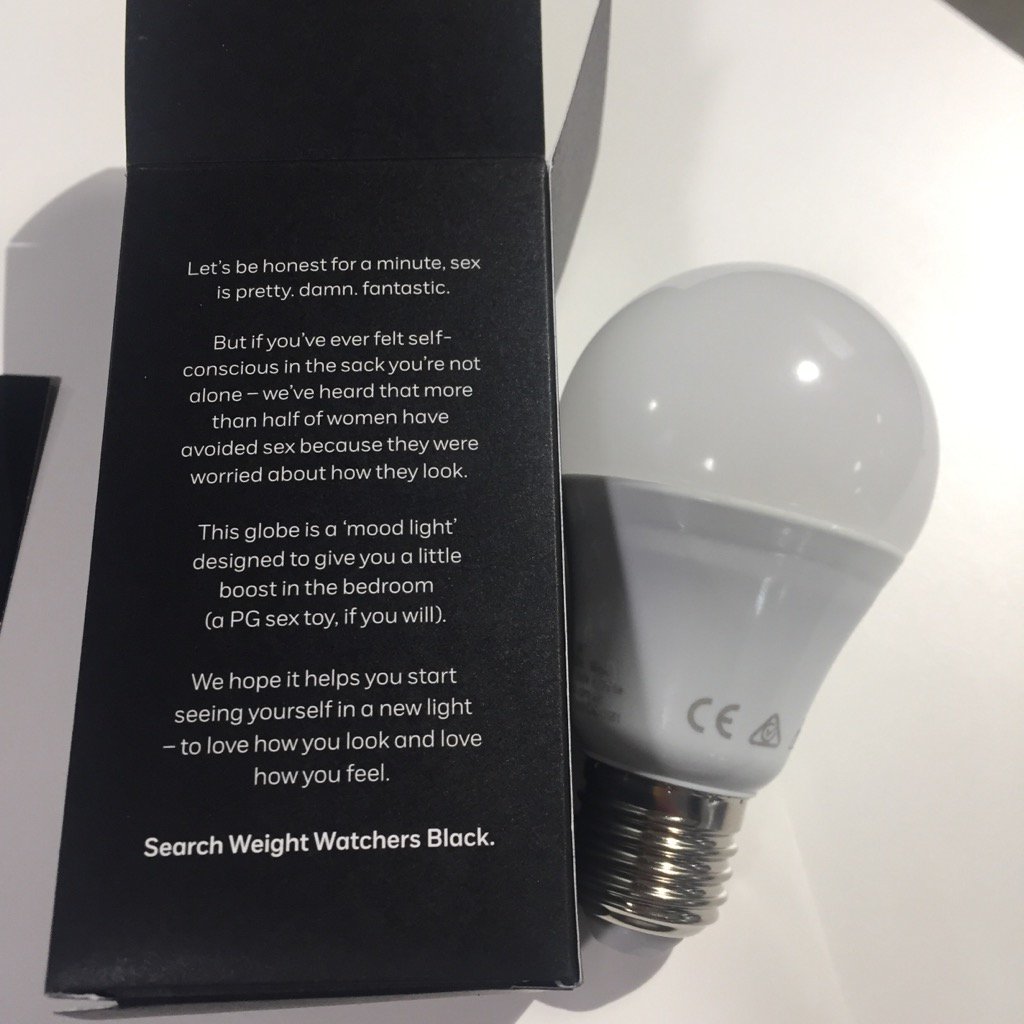
Last week I had a package delivered to my desk containing a lightbulb suggesting I may prefer to have sex with it on because it is dimmer than the average bulb.
It was not a piece of fanmail, but a PR push that began with “research” about how many women felt self conscious about their body during sex.
“We hope this helps you start seeing yourself in a new light – to love how you look and love how you feel,” it said.
The product it was promoting? Weight loss. Specifically, Weight Watchers.
First the weight loss industry came for our enjoyment of the beach intoning “bikini body” from the last day of winter onwards, and now they are coming for the bedroom.
I was inclined to tweet a photo and forget about it. But a week later I am still getting furious responses from women, a visceral reaction which shows this is still something women want to talk about … despite it being something they are sick of talking about.
Bridie Jabour (@bkjabour)
How many people thought this was an okay idea before it arrived on my desk as a piece of PR pic.twitter.com/7tH37yyqsS
October 14, 2016
This wasn’t just one of the numerous petty insults we are used to every day but something that was thought out for months, strategised, okayed by multiple people.
What is there to be said about weight loss campaigns that hasn’t already been said? Reams have already been written. We know insecurities are exploited for financial gain.
We know there is a relentless and unrealistic pressure put on women to look a certain way from when they were girls.
We know that more often than not, the product being sold just doesn’t work. Women either do not lose weight, or a much smaller number lose the weight and then discover all of their problems are not solved by being thin.
And yet, it is 2016 and I am still receiving a lightbulb in the mail suggesting I might prefer to have sex with the lights off for fear that my partner might, shockingly, see my body.
It’s almost embarrassing to have to write such an obvious point – overweight people enjoy sex, it is not just the domain of the thin. But this campaign isn’t just saying overweight people may not be inclined to show their bodies, it’s also saying any woman could, and perhaps should, be self-conscious taking her clothes off.
No matter your size you are susceptible to this campaign, whether you think you should lose 10kg, 30kg, or 2.5kg there is something in here for everyone. It’s not just about being overweight, it’s about every woman who has ever wished something about their body was different. Which is pretty much all women.
It’s so boring.
This is the thin edge of the Donald Trump wedge, the insidious everyday misogynistic messaging we are telegraphed about how we should look, how it matters. It is the other end of the sexism spectrum to Trump who trumpets it, says bluntly: “She is a fat piglet.”
If there is any silver lining, it is that more and more women are not putting up with this any more. Trump is actually losing votes over his comments and treatment of women. Weight Watchers was forced to respond to the backlash – it hasn’t pulled the campaign but Weight Watchers’ senior marketing manager, Rebecca Melville, conceded it could cause offence.
“We launched in stages and that has fuelled the conversation without context,” she told Mumbrella.
What context do we need? We already know the context: the company commissions the research that says we have a problem with our bodies during sex and, surprise, that company has the product to solve our problem.
It feels like we are stuck in this infinite loop, doomed to keep trying to tell the world our bodies are fine, we are fine.
We are tired. Tired of the commentary on how desirable we are, tired of being warned about summer bodies, tired of being told hair removal and makeup is a statement no matter what our decision on it. We’re tired of all that because there are so many more interesting things we could be talking and thinking about. We have better things to do.
On 15 August 1975, the Indian government hosted a lavish party. It had good reason to celebrate: not only was it marking 28 years of independence from British rule, but the prime minister, Indira Gandhi, had declared the date “Independence from Smallpox Day”. For decades, India was considered the endemic home of the disease, accounting for some 60% of globally reported cases. Yet in the space of just one year, infections had fallen from 188,000 to zero, thanks to a combination of disease surveillance, vaccination and publicity.
Yet as Donald Henderson, head of the World Health Organisation’s (WHO) global smallpox eradication programme, who has died aged 87, left the celebrations in order to catch a flight to Bangladesh, he received word that the borders were closed. The Bangladeshi military had staged a coup; the president and his family were dead.
It was a pivotal moment in the global effort to eradicate smallpox, a disease that had until recently killed some 2 million people each year. To get this far, Henderson and his team had overcome political resistance, ineffective vaccine stocks, floods, famine and civil war. They had stopped cars in the streets of the former Yugoslavia to vaccinate people, and gone house to house in remote regions of India to nip outbreaks in the bud. Now, eight years into the campaign, Bangladesh was the final refuge for Variola major, the most infectious form of the virus, and the country was threatening to fall apart.
Fearing that a tide of refugees might trigger fresh outbreaks, or even reimport the disease to India, Henderson deployed large numbers of health workers to the border to step up surveillance, and vaccinate as required. Fortunately, the predicted influx never arrived. A few weeks later, the borders reopened and WHO’s teams went back to work. In November 1975, Bangladesh reported its final case of smallpox and, two years later, the world’s last case was identified in Ali Maow Maalin – a Somali cook from the port city of Merca. The world was finally declared smallpox-free in 1979.
Despite our best efforts, smallpox remains the only human disease to have been completely eradicated from the planet. “If the Nobel prize in medicine was not so focused on basic science, Henderson and the smallpox team would surely have shared it,” said Chris Beyrer, Desmond Tutu professor of public health and human rights at the Johns Hopkins Bloomberg School of Public Health in Baltimore. “The eradication of that ancient, disfiguring and often fatal viral scourge is surely one of the single greatest triumphs of public health in human history.”
Known as “DA” to many, Donald Ainslie Henderson was born in Lakewood, Ohio, the son of David, an engineer, and Eleanor (nee McMillan), a nurse. He graduated from Oberlin College in Ohio in 1950, which is where he met his future wife, Nana Bragg, whom he married the following year. After obtaining a medical degree from the University of Rochester in 1954, Henderson started a residency at a hospital in Cooperstown, New York, but was then required to do two years of military service. Fearing that as a newly qualified physician he would spend his time conducting relatively mundane assessments of new recruits, he instead opted to join the US Epidemic Intelligence Service – a boots-on-the-ground disease detective unit at the then Center for Communicable Diseases (CDC), responsible for identifying the source of outbreaks and clearing them up.
In 1961, Henderson became chief of the surveillance section at the CDC, and established a smallpox surveillance unit in 1962. It was the beginning of a relationship with smallpox that would come to dominate his life.
In 1966, the World Health Assembly narrowly voted in favour of undertaking a global eradication campaign for smallpox. When Henderson was approached about leading it, he was initially reluctant: he had only recently been given the green light for a smallpox eradication and measles control programme in west and central Africa which he would lead, and the $ 2.7m allocated for global eradication was not even enough to buy the required vaccine. The prospects of success seemed doubtful, and many – including the director general of the World Health Assembly – expected it to fail.
Nevertheless, Henderson accepted the challenge, and moved his family to Geneva to work at WHO headquarters. Having already worked on plans to eradicate smallpox from parts of Africa, Henderson believed that trying to vaccinate everyone against the disease was futile; there wasn’t enough funding nor, as he soon discovered, enough effective vaccine – quality control tests revealed that just 10% of available vaccine actually protected against smallpox.
Instead Henderson focused on surveillance and containment. Understanding that smallpox spreads like wildfire, he asked every health centre and hospital to produce a weekly report; as soon as a case of smallpox was identified, a team was dispatched to identify and vaccinate everyone that that person had been in contact with, and their contacts. He also insisted that everyone regularly rotated through the field, regardless of their seniority. “No one was allowed to dictate policy from Geneva or Washington who was not out regularly in the field and engaged in the actual work of the effort,” Beyrer recalled.
Henderson himself regularly visited smallpox-affected countries and filed detailed progress reports, although he primarily viewed his role as a catalyst: it was the countries themselves that defeated smallpox.
Even then, as Henderson often pointed out, they barely succeeded – and he was sceptical about the potential for ridding the world of other diseases. Three months after the world was declared smallpox-free, Henderson was asked to address a meeting convened to decide which disease should be eradicated next. He said he didn’t think there was any candidate disease. Smallpox was unique in that it was always transmitted person-to-person; you could easily identify who had the disease and who had been successfully vaccinated against it; and there was an effective, heat-stable vaccine that worked even after someone had been exposed to the disease.
With smallpox all but gone, Henderson accepted a position as dean of Johns Hopkins School of Hygiene and Public Health (now Johns Hopkins Bloomberg School of Public Health) in 1977, although his relationship with the virus continued; he later worked to contain stocks of smallpox in laboratories worldwide, and served as director of the US Office of Public Health Emergency Preparedness in the wake of the September 11 attacks, which involved guarding against the possibility of smallpox being used as a biological weapon.
However, he considered his greatest achievement to be establishing the base and impetus for the WHO’s expanded programme on immunisation, the goal of which is to provide universal access to all relevant vaccines for all at risk. “I believe that the important, longer-term contribution of smallpox eradication … was its demonstration of how much could be accomplished with how little in the control of infectious diseases through community-wide vaccination programmes,” he wrote in his autobiography, Smallpox – the Death of a Disease (2009).
Henderson is survived by Nana, their daughter, Leigh, and two sons, David and Douglas.
• Donald Ainslie Henderson, epidemiologist, born 7 September 1928; died 19 August 2016
On 21 May this year, Lynne Sandford contacted the Foreign Office and the police. She was worried about her 20-year-old son’s safety: Michael was a vulnerable adult, alone in America. He had been there for over a year, and his behaviour – in Skype calls home – had become increasingly erratic. Michael called every other day; after not hearing from him in a week, Lynne reported him as a missing person.
On 18 June, she was woken by a phone call at 11.30pm from the Foreign Office. She remembers every detail. They had found Michael. “I was like, ‘Brilliant – where did you find him?’ And that was the first shock. They said Las Vegas. I thought he was in New York. I said, ‘How did you find him?’ And they said he’d been arrested for trying to take a police officer’s gun in a casino. I said, ‘What was he doing in a casino?’ And they said he was at a Donald Trump rally. They said, when questioned, he had said he intended to assassinate Donald Trump. And my world just stopped.”
Michael Sandford arrested at Trump rally in Las Vegas
On 30 June, Michael Sandford was charged with disrupting an official function, and two firearm offences. He told police he had been planning to kill Trump for a year; the previous day he had been to a gun range to learn how to shoot. He was living out of his car and was in the US illegally, having outstayed his visa. A month on, he faces up to 30 years in jail and his mother is still in shock.
***
Michael was two when Lynne realised there was something different about him. His speech was delayed and his coordination was poor; he was referred to speech and physical therapists. He had a tremor in both hands – ironic, Lynne says, in light of the charges. She imitates his shaking hands. “Trying to grab a policeman’s gun? He wouldn’t have stood a chance.”
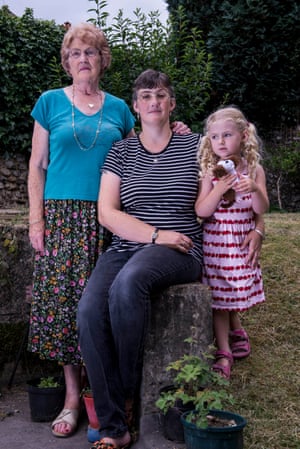
Lynne Sandford (mother of Michael), centre, with her mother, Christine, left and Lynne’s daughter, Jessica. Photograph: Mimi Mollica for the Guardian
We are in the sitting room of Lynne’s flat in Dorking, Surrey. Her mother, Christine, brings tea and biscuits. The room is small and stuffed with the paraphernalia of family life. Lynne also has a four-year-old daughter, Jessica, whose favourite colour is clearly pink: there’s a pink scooter, a pink doll’s house. Michael moved out four years ago, but his toy racing cars are still on the mantelpiece. In the family photos, he looks slight and sweet and a little otherworldly. Mother and son were always close. When he was five, Michael’s father left home; Lynne raised him largely as a single parent, with a huge amount of help from Christine. Michael, Mum and Nan: they were a team.
After his wobbly start, Michael made rapid progress at primary school, outperforming most of his classmates. He was unusually knowledgable: they used to say he was like an old man in a boy’s body. And yet in other ways he was very young: he had friends – Alex and Jack were the closest, Lynne says – but he didn’t like going to their houses. His gross motor skills (running, jumping, playing sport) were poor, but his fine motor skills were exceptional. He was great at Lego, for instance, and won a number of competitions. On the mantelpiece there is a cutting from the Dorking Advertiser with a picture of a young Michael holding a matchbox. “Creative Beaver Scout Michael Sandford is celebrating a winning strike after stuffing 210 items into a matchbox,” it reads.
He liked to make fellow pupils laugh, but there were other things Lynne struggled to explain. He took everything literally, and was punishingly honest. “He’d always say, ‘Well, I don’t mean to be rude – I’m just saying it as it is.’ He had a lack of empathy.” Lynne remembers a child in his class whose father died when he was nine. She had lost her own father at a young age, and explained to Michael how the boy might be feeling. “But he shrugged and said, ‘Well, he’ll get used to it.’”
Michael went on to a comprehensive with more than 1,000 pupils, where he was lost. There were detentions for not doing his tie tightly enough, and not having his shirt tucked in. It was only later, when Michael was diagnosed with hypersensitivity, that Lynne made any sense of it: the shirt and tie had been uncomfortable. “A lot of clothing made him itchy. Bedding, too. Sometimes he’d stay up all night. I remember one time going to Gatwick Tesco, a 40-minute drive away, just to buy him cotton bedding at 3am so he’d go to sleep.”
Michael refused to sign a home-school agreement promising to do his homework and wear uniform. “He was the only person in the history of the school who refused,” Lynne says. “I thought he was being a little bugger. But he just looked at me and said, ‘Well, quite honestly, Mum, I don’t know whether I can agree to these things. So I can’t put my name to it.”
Michael Sandford with his mother Lynne. Photograph: Mimi Mollica
He was still showing huge promise academically, particularly at maths. His teachers encouraged him to sit a mock GCSE at the age of 12, which he passed with an A. “This is the tragedy of it,” Lynne says. “He left school with no qualifications, and he has such potential.” Michael was bullied but didn’t like to talk about it. He started to truant. One day Lynne took him back to school three times. She would see him wandering around town on a winter’s day, his hands raw with the cold. She’d bring him home; if he was going to play truant, she’d rather he was somewhere safe and warm.
Michael became anorexic and developed paralysing OCD after starting secondary school. Every other weekend, his mother or grandmother would drive him to Portsmouth to stay with his father, but he became claustrophobic and unable to cope with the car, so that stopped. He became obsessed with hygiene – either not washing or brushing his teeth for weeks, or scrubbing himself until he bled.
At the age of 13, he was diagnosed with Asperger’s syndrome, a form of autism. The specialist said it was the most severe case she had seen in 30 years: his behaviour was so ingrained it would be almost impossible to change. The diagnosis explained a lot, but it didn’t help Lynne cope. Michael stopped going to school. “He said, ‘Why would I want to learn what everybody else is learning? Because everybody is going to know it. I want to learn what interests me.’ We fought tooth and nail about it. He was offered every opportunity: home school, online tuition, private tuition, a special school.” In the end, Lynne says, he sat at home watching documentaries. “I said you’re not going to have any qualifications, and he just said well, qualifications aren’t everything. I’d explain that if you want a job, they are crucial. But he couldn’t see that.”
At 14, Michael became anorexic and was sectioned. He hired a lawyer and brought a case that he should be allowed home
I ask Christine if she thinks her daughter was too soft on him. “I’m afraid I did, at times.” Michael would stay with his grandmother two nights a week, to give Lynne a break. But even she couldn’t get him to eat. “One evening he said, ‘Sorry, Nan, I can’t eat that. Don’t cook for me any more.’ He was bloody-minded.” The two women struggled to cope. “We were trying to learn about his condition, but no one was advising us.” Lynne tried the stick approach, taking away his teenage privileges; it made no difference.
At 14, Michael won a three-day scholarship to join a police training programme. “He had always said he wanted to be in the police force, and that was the last normal thing he was able to do. After that things went downhill. He did the three days, and I think that used up the last ounce of energy he had.” Michael was put on the child protection register – not because he was at risk from an adult, but because he was a risk to himself.
He became so weak from not eating that he could barely get out of bed. Later that year Lynne reluctantly agreed to have him sectioned at the Maudsley psychiatric hospital in London. How much weight had he lost? “He refused to let the doctor weigh him,” Lynne says. But she told them he wouldn’t live much longer without treatment.
“He was like a skeleton, wasn’t he?” Christine says. “Broke my heart, seeing him like that.”
A day after being sectioned, Michael escaped. Police discovered him trying to board a train home without a ticket and took him back. Lynne shows me a letter he wrote back at the Maudsley: “Dear Mum, I’m not bad or evil or naughty and I never intend to be. I try to be polite and non-rude. At the moment I have no death wishes or wanting to self-harm. My first escape attempt was meant to be peaceful and not to harm people or damage property or break the law. Any further attempts will be the same. I do not want or intend to be violent. Unless I feel I am in danger I will be peaceful and polite. I love you very very much and I am sorry that I upset you. Lots of love, Michael.”
The next day she called to see how he was. “They said, ‘Oh, he’s fine. He’s in bed reading legal papers and he’s acquired himself a lawyer!’” Even in his darkest moments, she says, he could make her laugh. Sure enough, Michael brought a legal case that he should be allowed to return home. He lost, but made progress at the Maudsley. While he did not attend the hospital school, Michael agreed to one-to-one sessions with a teacher. The report he received on leaving said: “Michael is a very polite and articulate young man who is confident and pleasant to talk with.” After four months, now 15, he was released.
That year, Lynne was surprised to find herself pregnant with Jessica. She says Michael was fantastically mature about it. “The pregnancy was the result of a brief relationship. I didn’t think I could keep her – I didn’t think it would be fair to Michael. Then he said, ‘Mum, you have to have that baby, and I’ll do everything I can to help you.’”
But life was not easy. Michael had become abusive. “He was never violent, but he would be very verbally aggressive. He’d shout and swear at me, and then he’d be so apologetic. He’d just unleash. I spent most of my time in my bedroom. It wasn’t sustainable.”
At 16, he found himself a one-bed flat to rent a few minutes away. “It was perfect. Clean, modern, a nice outlook over the hills.” How could he afford to live independently? “He was on disability living allowance, employment and support allowance and housing benefit. He didn’t do anything, go anywhere, so he had few other expenses.”
Michael was more content than he had been in a long time. He would visit his mother every day, have something to eat and play with his baby sister, whom he adored. “But after two or three hours, you could see his anxiety levels rise and he’d need to get back.” Lynne shows me a photo album: Michael holding Jessica when she was an hour old, reading to her, helping her on the trampoline, the two of them having a picnic.
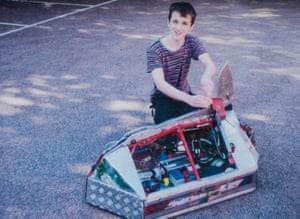
In the early days, he let Lynne and Christine come to the flat. It didn’t last; he continued his daily visits home, but barred them from visiting and withdrew into himself. Like many people with Asperger’s, Lynne says, he was a whiz with computers. She worried that he would befriend the wrong sort of people. Another passion was the TV series Robot Wars. Michael once paid £1,000 for a robot and his mother drove him, Jessica and the 16 stone robot to roadshows across the country so it could do battle.
Michael Sandford with Steel Avenger used for Robot Wars.
As Lynne talks, I notice a tattoo on her upper arm, with Michael’s name and date of birth attached. What is the design? She lifts her sleeve and laughs, embarrassed. It’s a playful devil with a pitchfork. “I had it done when he was born. It was just tongue in cheek, because all parents say ‘He’s a right little …’ She trails off. “In hindsight, perhaps I shouldn’t have.”
When he was 17, Michael decided he would learn to drive. His mother was delighted and offered to book him lessons. No need, he said: he had signed up for an intensive two-week course.
“We were terrified, weren’t we?” Christine says.
“Horrified,” Lynne says. Michael had a lesson every day for a fortnight, took his test and passed. He bought a car on eBay for £500, “which is every parent’s worst nightmare. I got the RAC to check it out and they said, ‘Well, it’s not bad,’ and he said, ‘OK, I’m off out.’” Thirty seconds later, he had over-accelerated into another car and written his off.
On New Year’s Eve 2014, Michael told his mother he had news – and she wasn’t going to like it. He was going to New York. “I just collapsed on to the sofa. I said, ‘This is insane – what the hell are you on about?’” Lynne asked her GP and local mental health services how she could stop him. “They said, ‘He’s 18; there’s no way short of having him declared mentally incompetent,’ which clearly he was not.” She tried to see it from his point of view. “His old school friends were at university or having gap years, and we thought he felt left behind. It was his way of being normal – do a bit of sightseeing.”
On 18 January 2015, he left. The next day, she received a call. “All I heard was, ‘Are you Michael Sandford’s mother? This is an American hospital emergency room,’ and again everything in me just stopped. I started yelling, ‘Oh my God! Is he dead? Is he dead?’”
Michael was not hurt, but he had been found by the road in a state of extreme distress. He was forcibly given a drugs test, because the police thought he was high. In fact, he was having a meltdown, and was sectioned overnight. But the hospital discharged him the next day, and he continued his two-week trip in a rental car.
By the time Michael returned home, he was a wreck. “He just broke down and came out with this…” Lynne shudders to a stop. “I can’t say ‘tale’ or ‘story’; I’ll say ‘version of events’.”
“He was terribly, terribly distressed,” Christine says. “He said that, unbeknownst to us, between the ages of 16 and 18, he’d had a girlfriend, and got her pregnant. He said they’d had a scan and it was a boy. And the day after Michael’s 18th birthday, this girl was killed in a car crash. He said that after this he’d attempted to commit suicide twice.”
Michael told them he had a new girlfriend, who had recently moved back to America; but when he got there, a friend had texted to say she was in prison on a drugs charge.
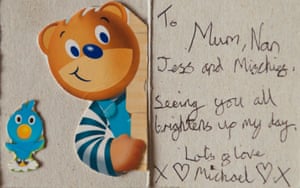
A card from Michael Sandford to his family (including the cat). Photograph: Mimi Mollica for the Guardian
Lynne didn’t know what to think. She still doesn’t know what to think: she has been unable to corroborate the story of the girlfriend and the fatal accident. She has no idea if any of it is true, but says Michael had no history of lying to her, and no history of psychosis. She pauses, and says there was one incident when he was eight and convinced aliens were coming to get him. “He was shaking and cowering, and we took him to hospital. It was like he was possessed.” But nothing since.
Michael told Lynne and Christine he wanted to be there for his girlfriend, Lauren, when she came out of jail. He said he would move in with Christine and save to get back to America. But he couldn’t save quickly enough; he asked his grandmother to mortgage her house.
“He plagued us for money.” Lynne’s voice is quivering. “He said, ‘I’m going to have to either commit suicide or turn to illegal measures.’ We said, ‘We love you, but we can’t do this. I’m a single mum on the minimum wage, and Nan can’t mortgage her house.’”
Lynne looks at her mother, just about holding her tears back. “If you’re OK with me saying this? Quite by chance my mum came into an inheritance. Her sister had left a reasonable sum of money, which Mum was going to split four ways: her, me, Michael and Jessica.” Christine and Lynne agreed to forfeit their shares and pay for a year’s rent for Michael in New York. It was a last resort.
They made Michael sign an unofficial document stating that the money was a one-off to help him turn his life around; that over the year he would come home regularly (he needed to sign on every 90 days for his benefits, for one thing); he would live in the flat; he would not break the law; and he would not attempt to kill himself. It was agreed that his first visit home would be in five weeks’ time, for Jessica’s third birthday.
But Michael never came. He told his mother there was a warrant out for his arrest in the UK (he had left a few utilities bills unpaid). Lynne contacted the police, who assured her there was not, but Michael said he believed his source rather than her. He lost his benefits. Lynne pleaded with him to come home for Christmas, but Michael said it wasn’t an option. He told them Lauren’s friends were now his friends. She began to worry that he had come under the influence of a cult; she also feared that he was simply ill and delusional.
Michael’s Skype calls were becoming less frequent. When he rang, his face was always blurry and against the same white background. Lynne asked him to show her around the flat, but he refused. Just before Christmas 2015, he rang home and said he’d moved into a cheaper flat. It didn’t make sense; the rent had already been paid. But he told them he’d got a refund on the outstanding time, and preferred the new flat.
On 17 April, he told them he’d been kicked out of the new flat, and needed money for a hostel. His father had been sending him £60 a month, and Lynne and Christine sent what they could. They begged him to come home. “He said, ‘I can’t – I’ve been very ill and run up lots of medical bills.’” A month later, Lynne reported him missing.
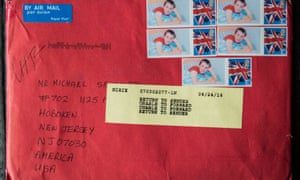
A letter Sandford’s mother sent to his old flat in New Jersey.
The night after Lynne was told of her son’s arrest, a friend rang. “She said, ‘I think you’d better turn the telly on.’ It was midnight and I saw pictures of him being arrested. Headlines going across the screen. I couldn’t believe it. My son, headline news for something so awful, and something just so not him. It broke my heart because it was the most I’d seen of him in a year. I just wanted to wrap my arms round him and never let him go .”
A few weeks ago, a tabloid newspaper offered to take Lynne and her ex-husband, Paul Davey, to Las Vegas, where Michael is in custody, in exchange for an interview. But Jessica did not have a passport and Lynne did not want to leave her, so Paul went alone. The newspaper promised to take Lynne as soon as Jessica’s passport came through, but then decided not to. Subsequent reports suggested Michael had a thing for guns. Lynne says this is misleading: there was a brief period when he was into airsofting (a game similar to paintball, in which participants shoot at each other with non-metallic pellets). Yes, at one point he had camouflaged his bedroom and hung replica guns on the wall, with help from his father; but three months later the room had returned to its motor-racing theme.
Paul tells me that the first time he talked to his son, via video link, at the detention centre he was unrecognisable. “Michael said, ‘Someone had to stand up for America,’ and was going on about how dangerous Trump’s policies were – building the wall, banning Muslims. He didn’t seem to know what the consequences were, what he had been charged with. He thought it would blow over and he’d be home soon. I saw him again a few days later and he was calmer, much more like his old self. We were talking about what we used to get up to. He never mentioned Trump once.” Paul has not been in touch with him since that second conversation.
Had Michael ever talked to Lynne about politics? “Not once,” she says. “Not to Mum, not to me, his father, his friends. He never had any interest.”
She and Christine talk about his despair in the weeks leading up to the Trump rally. I ask them if they think his attempt to grab the gun might have been a bid to die, while still keeping his promise that he would not commit suicide. “No,” Lynne says instantly. “I think this was his way of getting help. He was always a bit of baby on the physical side of things, so I wouldn’t think he’d choose to be shot. I also think he would have sent me a goodbye letter.”
Why Trump? Did Michael ever talk politics? ‘Not once. To Mum, me, his father, his friends. He never had any interest’
His grandmother seems less sure. “He did tell the police that he thought he’d be dead.” She mentions the most recent messages he had sent her. “One night, just before we got in touch with the police, I said, ‘Look after yourself,’ and he said, ‘I can’t.’ Then he sent me another message saying, ‘I can’t live like this much longer.’”
Did they ever suspect he might do something like this? No, she says. Apart from the verbal outbursts, he has never been violent. “I asked his friend Alex,” Lynne says, “‘You know him in a different way to me; did he ever give you any indication he could do something like he has done?’ And he said no, never. His other friend Jack went on Facebook and said, ‘I want to tell the world Michael isn’t like that.’”
For the past three weeks, Lynne has received calls every night from the detention centre in Las Vegas. All she hears is a crackling and beeping like a fax machine. She knows it is Michael. The detention centre has told her there is a technical issue with international calls.
“Then on Friday night, something incredible happened.” Her face lights up. “Eleven pm, an unknown number rang, and I just heard, ‘Hi, Mum.’ He’d been allowed to call from an office as a one-off. I spoke to him for five minutes. I asked him how he was and he said, ‘Well, not good, obviously. It’s prison.’” Did she ask him what happened? No, she says – she knew time was short. “I said, ‘Your nan loves you, your dad loves you, I love you.’”
She has been told he is on three medications: for anxiety; to help him sleep; and for hallucinations. “He’s hearing voices. He said in that call, ‘I just want to come home and get psychiatric help.’ Obviously I can’t condone what he attempted to do, but he was not in control of his mind. Yes, a sentence by all means, but a sentence over here where his family can visit him and where he can get the help he needs.” Lynne has been warned that US courts are not sympathetic to mental health problems; it is unlikely to affect his sentencing.
Lynne knows she is running on empty. Since she heard the news, she has been unable to sleep and eat properly. Fighting for her son is the only thing keeping her going; she has launched a CrowdJustice page to help with legal fees.
The trial is due to start on 22 August, though Lynne has heard that the case is more likely to be settled before that with a plea bargain. “I assume he will be asked to admit his guilt, and in return be offered a lesser sentence.” In a way, she says, she hopes it does go to trial – so a jury can see how helpless he is. But the danger is that they throw the book at him anyway.
Last week the Foreign Office told Lynne that Michael had been put on suicide watch. Does she think he is at risk of killing himself? “One hundred per cent. If he gets a lengthy sentence and he stays out there, he will commit suicide. He won’t see the point.”
On Friday, a day before this article was published, Michael managed to phone home successfully for the first time. “He was extremely distressed, and begged me to get him home,” Lynne says. “He said, ‘I can’t cope. I can’t last out much longer.’”