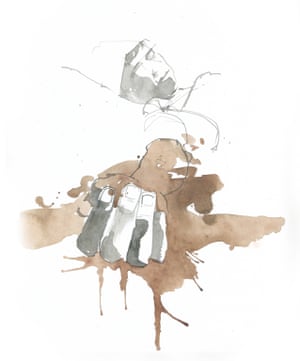
‘Life drawing”, “still life” and “life class” are all fairly mundane terms I thought only applied to nude figures or fruit bowls in an art studio. However, in November, I stood and drew in the corner of a plastic surgeon’s theatre in Lalgadh hospital, near Janakpur in Nepal. The theatre was set up to operate on the paralysed hands of leprosy patients. “Life drawing” became very appropriate very quickly.
Like many infectious diseases that predominantly affect those in poverty, leprosy is alive and well; there were more than 200,000 new cases were reported in 2015. The sad fact is that the disease is difficult to contract and relatively straightforward to treat. Many patients present late, when paralysis sets in. Although medication can make patients non-infective, the paralysis requires surgery to correct.
A patient being cleaned with iodine before his operation.
Each year, Working Hands – a Bristol-based charity run by hand surgeon Donald Sammut – spends two weeks, pro bono, operating on the backlog of patients in Lalgadh, training staff and providing hundreds of kilos of medical equipment and consumables. The work is highly skilled, but in many cases the objective is simple: to generate enough movement and power in a hand for the patient to go back to work, or to eat, or to look after themselves in a society where stigma is attached to those with the disease. Most of these patients are illiterate farmers whose only means of support depends on how much they can dig, or carry.
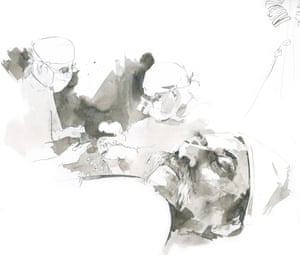
Raj undergoing an opponensplasty to give more strength and movement to his right thumb.
As I was drawing Raj, a 60-year-old man having an opponensplasty (an operation to restore strength and movement to a paralysed thumb), it occurred to me that there have been many crossovers between surgery and art. Leonardo da Vinci and Henry Tonks were two of them, both using drawing as a way of comprehending the human body.
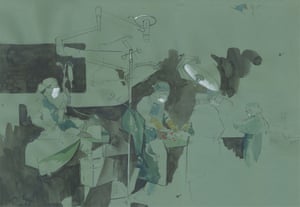
The team amputating a lower limb under local anaesthetic.
Watching Sammut, I could see why surgeons often make great artists. The value of being bold, with highly tuned hand-eye coordination, an obsessive understanding of what looks beautiful and a consideration for symmetry were all tips from the drawing books. But it doesn’t end there. Surgery is also performed under great time pressure; these procedures are all done under local anaesthetic, including the amputations, with a tourniquet to stem blood flow. The shorter the tourniquet time, the less damage to the tissue.
Gulshan, a 21-year-old, was having the gangrenous and mummified fingers removed from both of her hands – a procedure done under local anaesthetic.
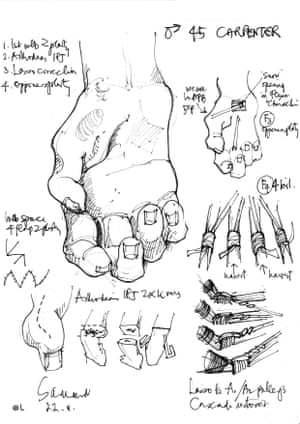
Before each surgery, Sammut spends several minutes drawing the patient’s hand; scar tissue shown with cross-hatching, deformity by weight of line, cut lines with dotted lines. “Those few minutes of examining and drawing the hand are invaluable,” he says. “While drawing, one is obliged to examine every millimetre, the texture and suppleness of the tissues one is about to rearrange. And it also gives one a few moments to plan the surgery, running it through one’s head like choreography steps.” The drawing is the beginning of a relationship built on trust, and a life-changing procedure.
Surgery notes for a 45-year-old male carpenter needing Lasso correction and opponensplasty. Drawing by Donald Sammut, Working Hands charity.
Leprosy patients here are treated at Lalgadh hospital for free, supported by the 400 paying outpatients the hospital treats each day.
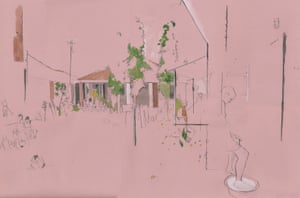
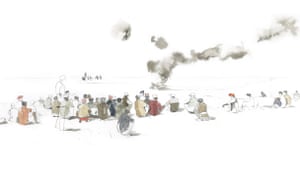
An entire family collecting hay, typical of the sort of agricultural society that many of the leprosy patients work in.
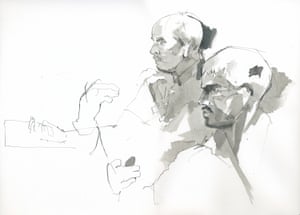
Two patients waiting in line for physiotherapy after corrective surgery on their hands.
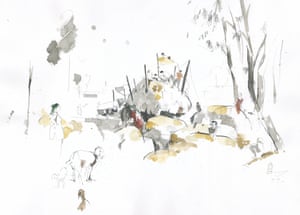
A Hindu funeral pyre for 55-year-old Krishna Bikram Chauhan on the bed of the river Sundari near Janatpur. The names of those watching the pyre are taken and they are invited to a celebration 10 days later.
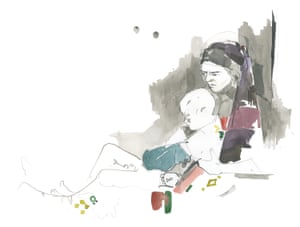
A mother comforts her child after his operation.
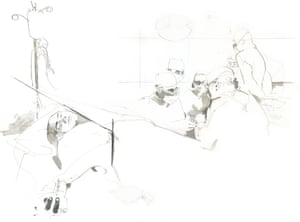
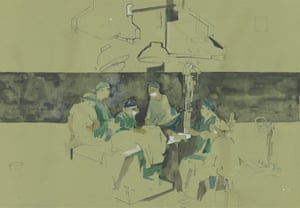
Working Hands team and local doctors in the middle of a procedure in Lalgadh hospital.
The first lesions appeared on teenager Rammurat’s feet. To those in his village near Gorakhpur, in the vast Indian state of Uttar Pradesh, the cause of the pale sores was clear.
“Some said it was black magic. Some said it was the spirit of the dead catching us,” he recalls.
“What will people think? What will the neighbours think?” he wondered when finally diagnosed at a nearby mission hospital – too late to entirely save his feet. “People used to hate looking at a leprosy patient. You see a lady [with symptoms] coming into the village, they will run away.”
India is officially leprosy free, meaning the disease afflicts fewer than one in 10,000 people. But specialists understand the true infection rate to be far higher, and the disease is still endemic in some of the country’s poorest districts.
Today India accounts for more than 60% of the world’s new leprosy cases and health officials have quietly moved to a “war footing” against it, one senior researcher says.
This week the government announced a major step: the world’s first leprosy vaccine, developed in-country but tied up for years in testing, will be rolled out in Gujarat and Bihar, two states where the problem is sharpest.
Among the oldest recorded references to leprosy – the ulcers, the gnawing away of a fingers, eyes and noses – appear in 4,000-year-old Hindu epics, the disease christened kustha, Sanksrit for “eating away”.
Long associated with sin and contagion, one Vedic legend holds that even a king was banished after developing the telltale sores. Rammurat, a 14-year-old when his symptoms appeared, sought treatment, but stood no chance against the stigma.
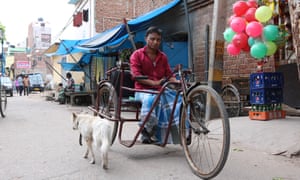
The government has provided residents of Tahir Pur who have leprosy with hand-operated rickshaws. Some have lost tissue in their feet due to leprosy-related injuries. Photograph: Michael Safi for the Guardian
Older now, Rammurat lives in a 30-hectare slum on Delhi’s north-eastern fringes. Rubbish collects in open sewers along the tight lanes of the neighbourhood and children mingle with tethered goats and chickens in the midday heat. It could be any poor community in the capital, but for the preponderance of wounds: missing toes, fingers, or entire limbs wrapped in white gauze.
Allotted to people with the disease a half-century ago, these blocks in Tahir Pur have grown into Asia’s largest leprosy colonies, home to 2,000 patients and their families, and a remnant of centuries of official policy to segregate them from the world. Rammurat arrived 25 years ago, seeking acceptance and access to treatment. “I moved here to save myself,” he says.
A few hundred metres away is the Leprosy Mission’s Delhi hospital, one of 14 specialist care centres the Christian group runs in India. Inside, hundreds crowd around waiting rooms and dispensary windows awaiting medicine, among them up to 150 leprosy patients each day.
It diagnoses on average one new case of the disease per day. “That’s alarming,” says Stephen Levi, the hospital’s superintendent. “And when we ask them to bring their other family members in, they don’t.”
Beside psalms and lists of symptoms on the hospital’s tiled walls there are, less congruously, pictures of the nine-banded armadillo: the north American mammal the only other species to naturally host leprosy, and a boon for researchers, who are still unable to grow the disease in labs.
For all the fear it conjures, leprosy, caused by the pathogen Mycobacterium leprae, has been effectively treatable since the 1940s. It isn’t particularly contagious either, its spread requiring regular contact with an untreated sufferer, and an immune system already compromised by genetics or poverty. Nor is it “flesh-eating” – limbs more likely to rot away because of injuries sustained by repeated use after the sensation of pain is lost.
“The real problem is the level of stigma,” says Dr Sunil Anand, the executive director of the Leprosy Mission. “Those who get leprosy tend to be ostracised and stigmatised by the community, they tend to hide away.”
Children work packing balloons in Tahir Pur, home to the largest leprosy colonies in Asia Photograph: Michael Safi for the Guardian
That makes containing the disease, or treating it before disfigurement sets in, harder. “Discriminatory practices then come into play. Like schools not giving admission to children with leprosy, or from a leprosy family. It’s the same in jobs, even healthcare,” he says.
About 16 national Indian laws still discriminate against people with leprosy, he says, a legacy of the ancient aversion to the disease, but also an 1898 colonial law that segregated patients and prevented them having children, passed in response to British panic an epidemic would spread back home.
A eight-year treatment drive by the Indian government shrunk the number of new cases four-fold by 2005. That year the government celebrated the official elimination of the disease, meaning a rate of fewer than one in 10,000 new cases a year. “Maybe that’s possible,” Levi, the hospital superintendent, says of the official rate. “But only because India has such a huge population.”
One of India’s leading leprosy researchers, Dr Uptal Sengupta, is more sceptical. The elimination figure trumpeted by the government and World Health Organisation was produced “in a hurry”, the 75-year-old says from his office, a bobble-headed armadillo on the desk.
More recent leprosy surveys produced by the Indian Council of Medical Research (ICMR) have a much greater prevalence, he says, but the Indian government has declined to release the exact estimate. (A source with access to the research told the Guardian the research showed a national rate of “roughly five to six cases per 10,000”.)
Battling high rates, health officials are also racing against time: leprosy strains are slowly becoming resistant to the multi-drug therapy that so successfully brought the Indian infection rate crashing down.
“When there was a monotherapy, it took only 30 years for the disease to develop resistance,” Sengupta says. “And we are already seeing resistance cases [for the multi-drug therapy].”
An aerial view of one of Tahir Pur’s 29 leprosy colonies in east Delhi. Spanning 74 acres, the colonies make up the largest leprosy complex in the world. Photograph: Michael Safi for the Guardian
The rollout of the vaccine, announced earlier this month, is part of a return to a “war footing” against the disease, he says. “The vaccine is the most important thing for elimination. It’s the best answer.”
Beginning in five hotspot districts in Bihar and Gujarat, the vaccine will be administered both to people with leprosy and those in close and regular contact with them, in combination with the antibiotic Rifampicin. Trials of the vaccine have shown it could bring existing rates down by 65% over three years, according to Dr Soumya Swaminathan, the director-general of the ICMR.
The rollout is accompanied by a new round of “active case detection” – health workers going house-to-house “to hopefully detect new leprosy cases which were undiagnosed in the community”. Fifty districts have already been swept, turning up 5,000 previously undetected cases.
“It’s a multi-pronged attack on leprosy, we’re looking to eliminate it” – a second time – “in the next five to 10 years,” Dr Swaminathan says.
That the vaccine is Indian-developed is also a source of pride. “It shows exactly how Indian research and development can solve our own problems,” she says.
In Delhi at least, efforts to remove the stigma around one of the world’s oldest diseases are also paying off – but not without cost.
As the capital expands, the giant leprosy colonies of Tahir Pur suddenly find themselves on prized land. Businesses are illegally setting up shop and developers are eyeing an area society once spurned. “Now, the non-leprosy people are trying to move in,” Levi says.
Nina Goad, a spokesperson from British Association of Dermatologists stated: “When people hear the term leprosy, they usually believe of leper colonies and references to the condition in the Bible or films like Monty Python’s Daily life of Brian.
“They are almost certainly not aware that it can still take place right here in the Uk. Diagnosis in western populations this kind of as the United kingdom is typically delayed due to the fact physicians are unaware of the disease’s presence in their country, or of its signs and symptoms.
“Dermatology is hugely underrepresented in GP training to begin with, so uncommon ailments like leprosy are seldom taught.
“Even so, early diagnosis and remedy are essential in limiting the nerve damage that triggers the numbness that can in flip lead to loss of limbs or digits.”
The condition, recognized as Hansen’s Illness, is a chronic infection by Mycobacterium leprae and Mycobacterium lepromatosis.
Despite the fact that it is not contagious, it can trigger tissue to fall off, rot away, and grow to be deformed.
The way it is passed on is by close and regular speak to amongst a contagious sufferer and a particular person who is genetically vulnerable to creating the illness.
Scientists feel that similarly to a cold, it can be passed in droplets of saliva from the nose and mouth.
The illness which dates back to 600 BC can strike decades after initial infection and lead to lesions on the skin, loss of sensation in affected areas.
Historically lepers have typically been ostracised by their families and communities, major to the setting up of leper colonies for the duration of the middle ages to quarantine individuals.
Dr Ausama Atwan, from Cardiff University explained: “Our aim is not to alarm folks unduly as leprosy is nonetheless uncommon in the United kingdom, but it is undoubtedly one thing that medical doctors need to be mindful of if they experience individuals, particularly people initially from endemic countries, with persistent or unexplained lesions, alterations to skin pigmentation and sensation.
“Leprosy might masquerade as various other skin problems, given its variety of symptoms. Due to its rarity in Europe, it may possibly very easily be misdiagnosed and consequently pose long term overall health risks for individuals if missed.
“A thorough health-related background, like elements like travel to locations in which the condition is a lot more typical, and examination of the skin and peripheral nerves, with each other with a higher degree of suspicion in men and women at risk, are essential towards diagnosis and the eventual remedy of leprosy.
“The potential prolonged incubation period need to also be borne in mind.”
In June this yr, US researchers announced that they are developing a vaccine towards the condition that is due to be trialed following 12 months.
The study will be presented to the Association of Dermatologists’ Annual Conference in Glasgow tomorrow in front of one,300 doctors.
Leprosy can be treated, but dermatologists from Cardiff reported two situations that had been at first misdiagnosed. Photograph: Issouf Sanogo/AFP/Getty Pictures
Individuals with leprosy may possibly be becoming misdiagnosed since of the rarity of the ailment in Britain, doctors will be told on Monday.
Dermatologists from Cardiff reported two cases in which guys who had moved to Britain from Asia were initially considered to have much more widespread skin complaints.
They say the illness – historically one particular related with stigma and worry, although it is now curable – could be “masquerading” as other problems simply because of the broad assortment of symptoms.
Ausama Atwan, who will outline the issues at the Glasgow conference of the British Association of Dermatologists, said the team were not out to alarm people “but it is undoubtedly something that doctors must be mindful of if they encounter individuals, specially people initially from endemic nations, with persistent or unexplained lesions, changes to skin pigmentation and sensation.”
Given the disease’s rarity in Europe, Atwan mentioned “it could very easily be misdiagnosed and consequently pose future wellness hazards for sufferers if missed”. There have been no situations confirmed of patients acquiring the illness or catching it from someone else in England and Wales for 60 years. Nonetheless there had been 129 instances “imported” from people who had lived in endemic nations, usually in south Asia, reported among 2001 and 2010. Public Overall health England(PHE) stated an additional 38 occurred amongst 2011 and 2013. Almost 233,000 situations have been reported globally in 2012.
The circumstances recognized at the University Hospital of Wales at 2010 and 2013 were in males who came from Asia. 1 was 25 and had experienced adjustments to his skin colour and sensation on the left side of his face. He had at first been taken care of for a skin infection and a rash. The other, aged 35, had patches of skin lightening over his entire body, raised red locations on his forehead and circular lesions on his legs. He had been initial diagnosed as having a type of eczema.
Leprosy is not very contagious and the bacteria accountable multiply slowly so the illness can take twenty years to grow to be obvious. Diminished circulation, muscle reduction, and in the long run limb deformity and disability only occur in a minority of circumstances. With early detection and the proper multi-drug therapy, it is curable. American researchers hope to start off trials of a vaccine next year.
Prof Ibrahim Abubakar, PHE’s skilled on leprosy, stated: “Leprosy is an incredibly unusual condition in England and Wales, and all cases are imported. Nonetheless it remains an essential condition globally with 232,857 instances diagnosed in 2012. Although rare in the Uk, it is important that folks with suspected leprosy receive early diagnosis and specialist therapy, employing the Public Wellness England guidance published in the Memorandum on Leprosy”.
To mark planet leprosy day on Sunday, campaigners and sufferers go over how Brazil’s network of colonies have excluded individuals with the condition and hampered efforts to raise awareness. The government has been urged to allocate far more funding to support eradicate the problem and increase the lives of individuals affected by it