Man's etiketine sahip kayıtlar gösteriliyor. Tüm kayıtları göster

19 Şubat 2017 Pazar

Doctors condemn delay in brain-damage man"s move to care home

Doctors and health experts have condemned the “shocking” delays in moving a brain-damaged man to his new care home as further evidence of serious bed shortages in intensive care.


Malcolm Steward, 63, has spent months more than 100 miles from his wife. He cannot go to a care facility in Devon because of limited space at the nearby Torbay hospital. It does not have enough room in its intensive care unit to let Steward, who is severely ill, stay while he recovers from his journey down to the area.


Steward’s wife, Philippa, said that the situation had put a huge strain on the couple and their two sons, aged 19 and 27. “It’s outrageous,” she said. “A hospital cannot just choose who it treats.”


The Stewards’ case has emerged after weeks of troubling news for the government on NHS capacity issues. Leaked figures showed that January was the worst months for A&E delays on record. And last week, a coroner said the bed shortages in intensive care had led to the death of Mary Muldowney, who was refused surgery at three hospitals last year because of a lack of space.


Dr Mark Porter, who chairs the British Medical Association, said the “shocking” case of Malcolm Steward was further evidence that patients were “repeatedly and unfairly being let down by an overstretched system”. Porter added that delays for vulnerable patients were now the norm.


“The NHS is at breaking point and unfortunately demand is so great that in many hospitals there is simply no capacity left in the system,” he said. “When the appropriate care isn’t available in the right setting, patients can experience delays. This can affect the quality of the care they receive, and in this instance have a profound effect on the patient and their family’s experience of the NHS.”
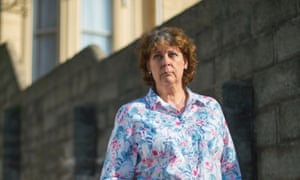


Philippa Steward at her home in Torquay, South Devon.


Philippa Steward at her home in Torquay, South Devon. Photograph: Jim Wileman for the Guardian

Dr Gary Masterson, president of the Intensive Care Society, said: “It is difficult to comment on this case specifically but in general terms a delay of several months resulting purely from critical care bed shortages is clearly unacceptable.”


Steward was left brain-damaged after having a stroke while driving in 2015. The crash left him with multiple injuries and he spent more than a year in hospital – moving between Southampton and Guildford.


Last month he was moved to a rehabilitation unit in Salisbury, but in the meantime his wife moved to Devon, where the couple had planned to relocate to before the accident. She found a local home that would take him and the move was set for last November. When this failed to happen, she was told that Torquay hospital, which backs up the care home, had blocked the move.
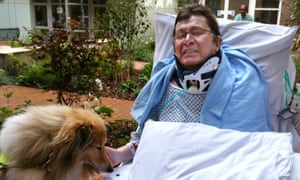


Malcolm Steward at a facility in Salisbury.


Malcolm Steward at a facility in Salisbury.

A letter from the hospital’s chief operating officer, sent at the end of October, said: “Torbay hospital has a small unit and if we are to accept people who may need long-term care we will significantly limit our ability to meet the needs of our local population.” It added that the hospital, which is south Devon’s main one, was to open in the spring and would be willing to accept a further referral then.


It currently has a nine-bed intensive care unit, which is almost 30 years old. The hospital has said that when the new unit opens in the spring it will add one new bed and then a further four over the next two years.


The hospital is concerned Malcolm Steward may need long-term care in one of their private rooms because of the complexity of his needs, limiting their ability to serve the local population. Doctors, however, said having long-stay patients was not unusual.


Philippa Steward travels four hours once a week to see her husband, which she says is affecting her health. After his accident she does not like driving at night but has no other option.


“I get no sleep because I am so worried about him,” she said. “If Torbay hospital don’t change their mind soon I fear I will lose my care home bed in Devon. There’s only one space available, which they may have to give to someone else. Another one might not come up in Malcolm’s lifetime.”


While her husband is unable to talk, he knows that she is there during these visits, she said. “He smiles and holds his hand out to me when I visit. He tries to give me a hug. He writes messages to me saying, ‘I want to come home and be with you.’”
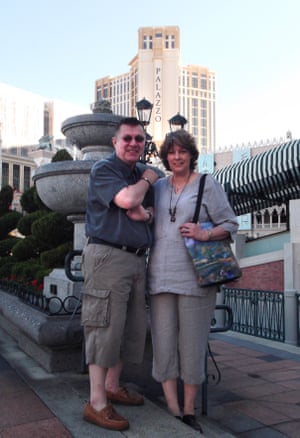


Philippa Steward and her husband, Malcolm, before his stroke and car crash.


Philippa Steward and her husband, Malcolm, before his stroke and car crash.

Kevin Foster, the Conservative MP for Torbay, agreed the case had taken too long to resolve. “Although the case is with the [health service] ombudsman, I am still seeking a meeting with our local NHS to work out a quicker way to bring this matter to a satisfactory conclusion, which means bringing Malcolm nearer to his family here in the bay,” he said.


A spokesman for Torbay and South Devon NHS foundation trust said it could not comment on individual patients, but that its top priority in accepting a patient from another hospital “would be to ensure that we are able to put in place a safe pathway of care appropriate to that individual patient’s clinical needs”.


The spokesman added: “We regularly liaise with [the care home] Douglas House to ensure that any patient being transferred there has plans in place to ensure their safe care and treatment. We would never refuse a patient treatment in an emergency.”


The Stewards’ case will add further pressure on the government to address NHS bed shortages. In January Hull and East Yorkshire Hospitals NHS trust ran out of intensive care beds at its two hospitals and was struggling to provide normal care to the many patients needing treatment for life threatening conditions. Senior doctors told the Guardian that intensive care units were becoming so full that patient safety was increasingly at risk because life-saving operations were having to be delayed.


The BMA’s Mark Porter said: “We urgently need the government to look at the long-term funding, capacity and recruitment issues facing the system as a whole if we are to get to grips with the extreme pressure hospitals are now facing.”


Doctors condemn delay in brain-damage man"s move to care home

12 Ocak 2017 Perşembe

Man"s best friend, bacteria"s worst enemy: dog sniffs out superbug in Canada hospital

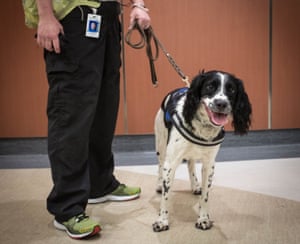
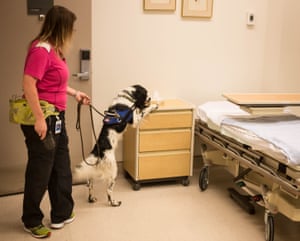
Hospital ID badge dangling from his neck, Angus considered the empty bed in front of him. After a few strong sniffs, he moved on.


Nearing the next bed, his floppy ears perked up before he stopped dead in his tracks, tapping his paw and eyeing his handler expectantly.


The two-year-old English springer spaniel is believed to be the only canine hospital employee in the world trained to sniff out the notorious superbug Clostridium difficile, or C difficile.


The seeds of Angus’ unlikely career were planted three years ago, after Teresa Zurberg, a Vancouver resident, suffered a C difficile infection. Her bout with the bacteria – which attacks people whose immune systems have been weakened by antibiotics – left her in the hospital for five days and she lost 20 pounds.


“It was awful. I almost died,” Zurberg said.


Her husband, Markus, a nurse who works in patient safety and quality care, stumbled across an article on a beagle in the Netherlands who had been specially trained to check patients for C difficile.


Could Zurberg – a canine handler who trains bomb- and drug-detecting dogs – do the same thing in Vancouver? he wondered. “I told him, ‘If it’s got a smell, I can teach a dog to find it,’” Zurberg said. Their new beagle pup might be perfect for the job, she suggested.


The pair approached Vancouver Coastal Health, the health authority that oversees the city’s general hospital – and were surprised by the enthusiastic reaction they received. “I was expecting them to laugh at us but they were like: ‘Hey, that’s really cool.’”


Once Angus detects the bacteria, the area is cleaned with a robot that uses ultraviolet light to disinfect 99.9% of the C difficile spores.


Once Angus detects the bacteria, the area is cleaned with a robot that uses ultraviolet light to disinfect 99.9% of the C difficile spores. Photograph: Vancouver Coastal Health

Working with the health authority, Zurberg and Angus became part of a one-of-a-kind pilot program. The hope, said Nancy Desrosiers of Vancouver Coastal Health, was to find an innovative approach to address what has become a global concern.


“It really is one of those vicious cycles,” she said, pointing to a steadily rising number of infections that result in longer hospital stays and increase the likelihood of further infections. “In Canada, 64% of all of our C difficile cases are hospital-acquired.”


Unlike the patient-sniffing beagle in the Netherlands – who is now retired – Angus, it was decided, would focus exclusively on searching for C difficile in the hospital environment.


Hospitals normally use ultraviolet light to find the bacteria, but Angus can move much more quickly and efficiently through rooms. Once he detects the bacteria, the area is cleaned with a robot that uses ultraviolet light to disinfect 99.9% of the C difficile spores.


The decision to have him work on environments rather than patients minimised the chances of Angus triggering patients who may have allergies or sensitivities to dogs.


With the dog’s role in the hospital now clearly laid out, Zurberg began training Angus, mimicking the techniques used to train dogs to detect bombs or drugs.


“All of the detection work for the dogs, it’s just a game. To them, it’s just a way to get what they really want, which is their toy or their food, depending on what they’re rewarded with.”


As she taught him to associate the scent with a food reward, researchers from the hospital kept her stocked with a steady supply of the scent of C difficile – isolated from the bug – on cotton swabs.


Angus, the C difficile sniffing dog.


Angus, the C difficile-sniffing dog. Photograph: Vancouver Coastal Health

The training took about 10 months. After passing a series of detection tests in a local nursing college with mock patient wards, Angus was brought into the hospital this summer.


Easily excitable when he’s not focused on work, Angus is accompanied by Zurberg at all times during the four days a week he spends at the hospital.


“It’s a very multi-ethnic health authority and I have to be really conscious of who’s around me and what issues they may have with dogs,” she said. “That’s part of the reason we chose a floppy-eared dog as opposed to a pointy-eared dog, because he’s not so intimidating-looking.”


Like any other member of the hospital staff, Angus faces a slight risk that he could be infected by C difficile. “He’s young and he’s not autoimmune compromised, so his risks are extremely low,” Zurberg said. His health is carefully monitored through regular veterinarian visits, she added.


His stint at the hospital has attracted global attention, and health authorities from Finland to Chile have contacted Zurberg with questions about replicating the idea. The aim, said Zurberg, is to develop a program that would train other dogs to sniff out C difficile and make them available to hospitals around the world.


Zurberg’s voice raises with excitement as she contemplates the possibility that Angus might hold the key to regaining control over a superbug that has affected so many people around the world.


“So many people come up to me and say: ‘My dad died of C diff,’ or ‘This person in my family has C diff,’ and they thank me for what we’re doing,” she said. “It opens the doors to other possibilities – what else can we have a dog detect? We’re only really limited by our imagination.”


Man"s best friend, bacteria"s worst enemy: dog sniffs out superbug in Canada hospital

13 Eylül 2016 Salı

Serious failings in medical care led to man"s death, inquest finds

The NHS has apologised after a coroner criticised “serious failings” in medical care that led to a man dying hours after an ambulance crew failed to diagnose his heart attack and take him to hospital.


Gary Page, 54, died at home in Essex in February, 12 hours after the senior member of the crew of a private ambulance working for the NHS dismissed the pains in his chest and arm as possible signs of heartburn, indigestion or a pulled muscle.


The East of England ambulance service offered its condolences to Page’s family and “a formal apology for not providing the patient with the care which was expected”.


A spokesperson said that after discussion of the case with Ambulance Service Limited, the private contractor whose crew responded to the 999 call, “it was identified that the seriousness of Mr Page’s condition was not recognised and further advice not sought”.


Caroline Beasley-Murray, who presided over the inquest into Page’s death at Chelmsford coroner’s court on Tuesday, recorded a narrative verdict. She found that his death was preceded by “serious failings of medical care” provided by the private ambulance service.


The inquest heard that Lauren de la Haye, the emergency medical technician on the ambulance, misread an electrocardiogram and wrongly concluded that Page was not in the early stages of a heart attack.


She ignored the concerns of a more junior colleague, Darren Rudge, who believed the ECG reading meant Page needed to be in hospital. Page died at home early the next morning despite efforts to save him.


Stephanie Prior, the solicitor representing the Page family, said: “Gary’s death has been life-changing for [his widow] Kim Page and it is clear today, as endorsed by the coroner, that his death was contributed to by negligence of the private ambulance service personnel and clearly could have been avoided.


“She has suffered and continues to suffer significant anguish knowing that more could and should have been done to treat him and that her husband’s death could and should have been prevented.”


A serious incident report commissioned by the East of England ambulance service found a litany of failures, mostly involving De La Haye. “Service delivery problems” revealed by the death included the lack of a fully trained paramedic on the ambulance; “complacency” by De La Haye in not acting on her colleague’s concerns about her diagnosis; and her wrongly advising Page that he was well enough to stay at home.


De La Haye’s “incorrect analysis of the patient’s ECG and presenting signs and symptoms” was the “root cause” of Haye’s death, the investigation concluded.


De La Haye has been retrained in the correct reading of an ECG and the private contractor’s performance monitored more closely than before as a result of the death.


Serious failings in medical care led to man"s death, inquest finds

27 Haziran 2014 Cuma

Inquest blasts immigration centre"s "shambolic" records in US man"s death

Harmondsworth immigration detention centre

Harmondsworth immigration detention centre. Personnel there testified that they obtained restricted mental wellness awareness training. Photograph: Adrian Dennis/AFP/Getty Pictures


An inquest into the death of an American tourist who was detained on arrival at Heathrow has criticised an immigration centre’s medical data technique for currently being “shambolic”.


Returning a verdict of death by natural leads to compounded by neglect, the jury at West London coroner’s court thorough a catalogue of errors in Brian Dalrymple’s care.


The 35-12 months-old US citizen flew into the Uk in June 2011. He was stopped by Uk Border Agency personnel due to the fact his behaviour appeared uncommon. Dalrymple had schizophrenia and dangerously higher blood pressure.


He was carrying only a little cardboard box containing a coat, a minimize-throat razor and $ two,000 in cash. Immigration officers denied him leave to enter the nation and eliminated him to Harmondsworth elimination centre. Just before he could be returned to the US, he claimed asylum.


The jury’s narrative verdict stated: “The United kingdom Border Company contacted the House Workplace at Harmondsworth to request a psychiatric assessment and repeated the request on a quantity of occasions. No action was taken. The US Embassy were not notified of Mr Dalrymple’s detention.”


It continued: “Throughout Mr Dalrymple’s detention at Harmondsworth, healthcare record-maintaining was shambolic.”


Dalrymple was detained for 6 weeks. A handful of days ahead of he died he was transferred to another detention centre, Colnbrook, run by the personal operator Serco, but with out his healthcare information.


Workers at Colnbrook identified him as currently being mentally sick but by the time they had arranged a psychiatrist, Dalrymple was dead. His higher blood strain had brought on an aortic rupture.


The inquest had earlier heard that the physician at Harmondsworth had not had any induction training and did not know of the duty health-related practitioners have to inform the House Workplace of detainees with health-related motives for currently being released. There were no computerised health-related data all the detention centre’s records have been handwritten.


Detention centre staff from Harmondsworth testified that they received limited psychological overall health awareness training. 1 mentioned she felt underneath-equipped to deal with the vulnerable people she had to seem following. Two officers explained they had been not concerned about folks in Harmondsworth “muttering to themselves” simply because a great deal of individuals did that.


Dalrymple was taken to Hillingdon hospital nearby but then discharged himself against medical guidance. No clinician saw him following his discharge. His mother was represented at the inquest by Jocelyn Cockburn, of the law firm Hodge Jones &amp Allen, who said: “This situation shines a light on the perilous state of immigration custody in the Uk. It is anything that the British government can no longer disregard.


“There is a worrying trend emerging in these varieties of circumstances, specifically with the enhanced privatisation of what have always typically been public functions, that the standard care and healthcare remedy of detainees gets to be fragmented and specified essential actions are ignored, typically major to devastating consequences and it has to stop now before much more lives are lost.”


Deborah Coles, co-director of the organisation Inquest, which supports family members in coroner’s courts, stated: “This is a shocking death of a mentally and physically sick man who died in his cell as a outcome of corporate neglect and indifference. The catalogue of failings are not special to this situation but expose the plight of people held in immigration detention and the systemic neglect of detainees’ mental and bodily ill well being, as evidenced by the high numbers of deaths, suicide attempts and self-harm.”


A jury at the inquest into the death of Muhammad Shukat, who died at Colnbrook a month earlier, also concluded that neglect contributed to his death.


Responding to the verdict, Lorraine Dalrymple, Brian’s mom, mentioned: “The Uk Border Agency took away my son’s freedom that day and by putting him in a detention centre therefore accepting responsibility for his care. It would be a care so fragmented and disorganised that his psychological problem would deteriorate to the stage of him losing his dignity … and lastly due to lack of appropriate healthcare ultimately led to his death.


“I have accepted my accountability concerning my son’s death. I ignored my mother’s intuition and listened to other folks regarding England not being a third planet nation and Brian being protected … This was a mistake I will have to live with for the rest of my life … If I had acknowledged what I know now of what was happening, I’d have contacted absolutely everyone achievable, carried out every little thing attainable to support my son. My son did come house, but in a box.”


Inquest blasts immigration centre"s "shambolic" records in US man"s death

27 Ocak 2014 Pazartesi

The Garbage Man"s Guidebook to Obtaining Out Of The Dumps

Two males in the garbage business might seem to be like unlikely authors of a psychological wellness self-help book. But, spend a couple of minutes speaking with Norm LeMay and Steven Kaufman and you will rapidly learn the value of their wisdom. They are in a position to use their experience in the waste business to educate  people how to rid themselves of mental garbage.


These two surely are not your standard garbage guys. LeMay converted his family’s waste management enterprise into an asset really worth much more than $ 300 million. He also became a recycling pioneer that assisted convert the State of Washington into one particular of the most productive recycling areas in the United States. Kaufman is an entrepreneur and advisor who helped launch a high-tech business that developed an automated route tracking system for the waste business.


Their guide, The Garbage Man’s Guidebook to Lifestyle: How to Get Out of the Dumps, offers a sensible but amazing message – get rid of the trash that gets in the way of your relationships, your perform and your dreams. As a psychotherapist, I come to feel their book offers some sound advice.


garbagemansguide

Image courtesy of thegarbagemansguide.com


I interviewed the two of them about the approaches in which men and women can clean up their mental garbage. They supply seven simple concepts that can aid men and women rid themselves of the mental garbage that will get in their way of private and professional good results.


1. Locate the worth and toss that trash – Make a decision which ideas, beliefs and opinions you ought to keep and which ones are garbage.  “Garbage is anything that doesn’t have worth and just cluttters your mind,” says Kaufman.


two. Hold it empty – Once your thoughts is clear of mental clutter, maintain space accessible for new thoughts and concepts. “Determine what to do with that empty area by choosing what you want to let into your existence,” suggests LeMay.


three. Produce your route to success – Just like a garbage guy has to comply with his route, they recommend men and women keep on their path to reach their goals. “Identify garbage thoughts that don’t line up with your route,” explains to Kaufman. Toss any thoughts that belong in the trash and proceed on your journey.


4. Park your ego – Developing humility and examining your own shortcomings can be difficult, but the approach is necessary to reach your targets. “Sometimes the most productive men and women have the most garbage because they have a complex existence,” says LeMay.


5. Depart it in the landfill – Do not enable those garbage ideas to continue creating difficulties in your life. Alternatively, get rid of them for very good. When you observe thoughts that are holding you back, LeMay recommends, “Label those ideas as garbage and depart them in the landfill exactly where they belong.”


6. Get away from toxic waste – Steer clear of the people and circumstances that lead to difficulties and interfere with your goals.  “Try to avoid toxic relationships and toxic ideas,” advises Kaufman. Staying away from toxic waste may possibly indicate ending a relationship or offering up harmful habits that’s preventing you from reaching your goal.


7. End hoarding – Get rid of the ideas and things that really do not have value and hold them out. “Start noticing what you are contemplating and doing. Then, you can pick if you want to maintain undertaking it or toss it out,” says Kaufman.


eight. Consider care of your truck – Just like any good garbage man must care for his vehicle, getting rid of the psychological trash needs you to get care of your body. “If you don’t take care of your truck, it will fall apart,” warns LeMay. Trying to keep your entire body in very good working buy will support you hold your mind working smoothly.


Their wisdom helps make a lot of sense. Following all, most of us do carry all around some additional trash that could be greater off in the landfill. LeMay and Kaufman offer you more ideas and equipment about receiving rid of psychological garbage on their site.


The Garbage Man"s Guidebook to Obtaining Out Of The Dumps

10 Ocak 2014 Cuma

Pride and discomfort of Patti Lomax, the Railway Man"s wife

Now his harrowing tale has been created into a critically acclaimed film, which went on general release yesterday. Eric is played by Colin Firth and Jeremy Irvine, who portrays him in his younger days as a Royal Signals officer. Patti is played by Nicole Kidman. Eric died before the film was finished, and so it has fallen to her to inform and retell her husband’s story.


It took a lot of many years to recognize the terrors buried deep inside of Eric’s memory. “I was mindful that he had been, as he place it, ‘caught’ in Singapore, but I’d been a wartime youngster so it didn’t mean that significantly to me,” says Patti, 76. Some twenty years younger than Eric, she is now expanding frail herself, a slip of a girl who sinks into the chair in the London hotel in which we meet. But in this, the sharing of her husband’s expertise, she steels herself. Her voice is measured, her eyes nevertheless dark with grief.


They have been on honeymoon when she 1st realised Eric suffered from Post Traumatic Tension Disorder (PTSD). On their very first night collectively, she awoke to locate him thrashing and screaming in discomfort. “The nightmares had been horrible,” she says. “He had flashbacks, extended silences, if I happened to say something that triggered a memory.” Program duties this kind of as going to the financial institution reminded him of currently being in an interrogation room. He would walk out of a restaurant if diners there have been Japanese.


“It’s quite scary and perplexing if you really do not realize what’s going on,” explains Patti. “He couldn’t talk to me and it took a prolonged time to finally get him to realise, and myself to realise, that he needed help.”


This came in the type of an assessment at the former RAF hospital in Ely, Cambridgeshire, in the late Eighties, which noticed Eric diagnosed with PTSD. But he nevertheless struggled to communicate about his knowledge, and quit counselling following just one session. Soon afterwards, he spotted an write-up in The Daily Telegraph about a new charity, the Medical Basis for the Care of Victims of Torture, and acquired in touch. So started two many years of counselling, and, little by tiny, Patti – who accompanied Eric – started to learn the horrors of what he had been by means of.


Eric was 22 when he was captured by the Japanese. He was incarcerated at Kanchanaburi, western Thailand, and set to perform on the railway meant to carry war supplies. Hundreds of thousands of prisoners of war toiled for twenty hrs a day in 100F (38C) heat, malnourished and diseased. They had poor products, couple of rations and have been beaten by their guards if they stepped out of line.


In August 1943, his captors identified that Eric had built a radio so that he and his comrades could keep track of the progress of the war. As punishment, he and 6 other people were forced to stand in the heat for days. At night, they were stamped on and beaten unconscious with pickaxe handles. Two died. Eric survived, remembering only the crack of his personal bones snapping and teeth breaking. As the ringleader, he was taken to another camp for interrogation. There, he was waterboarded and left to die in a cage the dimension of a coffin.


Of all his captors, the face of one particular lodged in Eric’s thoughts like shrapnel. A younger officer, Takashi Nagase, worked as an interpreter. “You will be killed what ever transpires,” Eric remembered him saying. Out of the blue, halfway by way of his counselling sessions in London, he received a letter from a pal. It contained a cutting from a Japanese newspaper, a evaluation of Crosses and Tigers, Nagase’s autobiography. His tormentor stared out at him from the web page. Incensed, Eric acquired hold of a copy in English and started out reading.


“It described Eric’s tortures, and an knowledge that the author had had that created him come to feel he had been forgiven for his sins [in which Nagase felt he was encompassed in a golden light whilst standing in a war cemetery],” says Patti. “When Eric read the guide, the curtains came down. I was incandescent. It is really uncommon for me to be angry but to feel this terrible man had felt this even though Eric was suffering…” She composes herself. “So, with Eric’s permission – I by no means did something with no his permission, as it was his life – I wrote Mr Nagase a letter.”


To her shock, Nagase replied. “I had asked him how he could probably believe he was forgiven. I wished to give him a real kick in the butt, metaphorically speaking,” Patti explains. “His initial letter back was really apologetic, touching truly. We learnt that in atonement for the atrocities he had committed he had completed a remarkable sum of charity function. We corresponded for a lot of months prior to Eric felt prepared to compose back – and one more two many years before Eric wanted to meet him.”


Patti accompanied Eric back to Thailand in 1993. The meeting with Nagase – then, like Eric, in his seventies – took location close to the bridge over the River Kwai, the infamous stretch of Death Railway immortalised in a 1957 film. Footage from the day demonstrates two grey-haired guys tentatively shaking hands. “I need to say some thing to you,” Nagase pleads, bowing. “I am extremely sorry for what I have completed. You have to have suffered quite considerably.” Eric basically nods. “Thank you,” he says. “Thank you.”


He hadn’t meant to be so forgiving. Up till the meeting, Patti admits, Eric planned to kill Nagase. “Eric meant to do him harm,” she says, quietly. “He told me that he had fully meant to kill him. He would have garrotted him. My suspicions that he wasn’t getting fairly trustworthy about his factors for wanting to meet this guy were correct. He desired revenge. But then he realised this was one more human currently being he clicked into British officer mode. And, rather, he shook his hand.”


As time passed, Eric was in a position to forgive Nagase, who died in 2011, and the pair grew to become friends. “We met him a couple of instances,” smiles Patti, “him and his wife, Yoshiko. She and I became very good buddies. She can speak as much English as I can Japanese – practically nil.”


Eric’s autobiography was published in 1995. He had started creating it on scraps of paper in Changi the rest he completed in the course of counselling. The last words in the book are those he uttered to Patti when the couple were standing in Kanchanaburi War Cemetery between the graves of Allied PoWs. “Sometimes, he explained, the hating has to stop,” says Patti. “And that sums up the man.”


In the final year of his lifestyle, Eric went to observe a scene of The Railway Guy currently being filmed close to their property in Berwick-upon-Tweed. He was gravely sick with myasthenia gravis, a muscle-wasting problem, and his wheelchair was hoisted on to the town’s walls to view. “Eric did not want to see the finished film,” says Patti. “He was proud and touched. But he knew they would do this kind of a excellent task that it would get him back to places in his memory that he wouldn’t want to go.”


Patti, as well, has suffered. Her only solace because Eric’s death has been the hope that the film will raise awareness of PTSD, and its results on veterans young and old. For the premiere, Patti had her husband’s kilt, a wealthy green tartan, created into a dress. These days, she wears a poppy – and Eric’s gold watch.


“He is with me constantly,” she says. “This is the last point I can do for him. He taught me what accurate forgiveness implies. For that I owe him almost everything.”


‘The Railway Man’ is in cinemas now


Pride and discomfort of Patti Lomax, the Railway Man"s wife