Superbug etiketine sahip kayıtlar gösteriliyor. Tüm kayıtları göster

21 Nisan 2017 Cuma

Almost untreatable superbug CPE poses serious threat to patients, doctors warn

Doctors are warning that the rise of an almost untreatable superbug, immune to some of the last-line antibiotics available to hospitals, poses a serious threat to patients.


The number of lab-confirmed cases of the bug, called carbapenemase-producing Enterobacteriaceae (CPE), rose from three to nearly 2,000 in the 12 years to 2015, according to Public Health England (PHE). But that may be far short of the real number because hospitals are not compelled to report suspected cases. PHE admits it does not know where the infections are coming from or how many people are dying.


Freedom of information requests made by the Bureau of Investigative Journalism reveal that at least 81 people infected with CPE have died since 2009 at 66 NHS trusts in England – although the bug may have been a complicating factor rather than the main cause of death in some cases.


But the real figure is almost certain to be much higher. Many trusts did not respond to the requests or were unable to supply complete data. Out of 136 NHS hospital trusts that were asked for the numbers of infections and deaths between 2009 and 2016, 97 responded but nearly half did not have data on CPE or could not extract the details.


In Manchester and London, dealing with CPE has cost NHS trusts almost £10m. There have also been confirmed outbreaks in Liverpool, Leeds, Sheffield, Birmingham, Nottingham, Colchester, Edinburgh, Belfast, Dublin and Limerick, among others.


Elsewhere, Italy had only sporadic cases of CPE in 2009 but by 2014, the bugs were rife across the country. “If you look at Italy they’ve suspended bone marrow transplant programmes,” said Dr Matthew Laundy, consultant medical microbiologist at St George’s University Hospitals NHS Foundation Trust. “If you’ve got no antibiotics to treat CPEs you’re stuck.”


Experts are calling for reports of suspected CPE infections to be made mandatory. The numbers revealed by the Bureau are “shocking,” said Val Edwards-Jones, emeritus professor of microbiology at Manchester Metropolitan University.


“It should absolutely be mandatory for trusts to report this,” she said. “If you go back to the 1990s MRSA [reporting] wasn’t mandatory. It was only when hospitals did proper surveillance and began looking at the bugs in the blood that we knew the scale of the problem. Then it was found that there were certain things that weren’t being done correctly.”


Dr Michael Cooper, a consultant microbiologist and director of infection control at the Royal Wolverhampton NHS Trust, said: “If something’s not mandatory, it’s the places doing well that take care to report. You don’t get figures from the trusts with their head in the sand, the poor performers.


“Public Health England have no idea how many people are dying, they’ve no outcome data. This is a serious mistake.”


CPE is carried harmlessly in the gut, but may kill if it enters the bloodstream through a wound of a patient who is already sick or frail, which makes it a real danger in hospitals. About 40-50% of patients with a CPE bloodstream infection die. CPE is not untreatable, but it is difficult as antibiotic combinations or older, more toxic drugs have to be used.


CPE, dubbed the “nightmare bacteria” by Tom Frieden, former head of the Centers for Disease Control and Prevention in the USA, has developed resistance to the carbapenems, a group of “last resort” antibiotics that are used in serious infections when other drugs will not work. They include KPC (Klebsiella pneumoniae carbapenemase) and NDM (New Delhi Metallo-beta-lactamase).


Experts have warned that antibiotic resistance is a major threat to the world and could turn the clock back on medical advances by making some surgery, such as heart transplants, impossible.


There are high levels of CPE in India, Bangladesh, Pakistan, the Middle East, south and Central America, China, southeast Asia, Taiwan, Japan, some countries in southern Europe and the USA. In February the World Health Organisation named carbapenem resistant bugs a “critical priority” for which new antibiotics are urgently needed.


In 2014, the medical directors of both Public Health England and NHS England took what they called “the unusual step” of writing to all NHS Trust chief executives, urging them to take action to prevent the spread of CPE.


“CPE represents one of the most serious emerging infectious disease threats that we currently face, and the failure to control their spread now, while we still have the opportunity, could have substantial human health and financial consequences,” wrote Dr Paul Cosford and Sir Bruce Keogh.


However, Professor Alan Johnson, head of the department of healthcare-associated infection and antibiotic resistance at PHE, said patients should be reassured that infections caused by CPE can usually be treated with other antibiotics. Fewer than 2% of E coli or Klebsiella bloodstream infections are resistant to carbapenems, he said.


“We carry out enhanced surveillance on carbapenem-resistant bacteria to determine the numbers and different types of CPE. Although reports of CPE have increased recently, part of this may reflect increased laboratory testing of many sample types other than blood stream infections, as awareness of CPE has grown,” he said.


Manchester


New figures show that four times as many people have died as had previously been reported in an outbreak in Manchester.


In 2009, the first cases of a type of CPE called Klebsiella pneumoniae carbapenemase were detected. In 2014, the hospital trust confirmed that 14 people had died from this infection, contracted within the hospital, in the previous four years.


But the Bureau’s research shows that there have been 61 deaths in the last seven years, including a six-year-old boy with leukaemia who caught the infection while undergoing a bone marrow transplant.


Many of those affected were very ill and had underlying medical problems and so it is not known whether the infection directly caused their death. Some may have died with a CPE infection rather than from it.


An investigation into the outbreak found in 2015 that CPE bacteria were living in the hospital kitchen sinks and handwash basins, which had drains that allowed splashback. Hugh Pennington, a leading microbiologist who chaired official inquiries into E coli outbreaks in 1996 and 2005, said such basins elsewhere in the NHS should be replaced. “It’s all about sound plumbing. It’s not rocket science. If your sink is going to spread the bug, get rid of it.”


Almost untreatable superbug CPE poses serious threat to patients, doctors warn

12 Ocak 2017 Perşembe

Man"s best friend, bacteria"s worst enemy: dog sniffs out superbug in Canada hospital

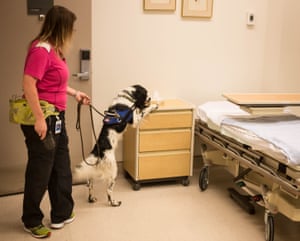
Hospital ID badge dangling from his neck, Angus considered the empty bed in front of him. After a few strong sniffs, he moved on.


Nearing the next bed, his floppy ears perked up before he stopped dead in his tracks, tapping his paw and eyeing his handler expectantly.


The two-year-old English springer spaniel is believed to be the only canine hospital employee in the world trained to sniff out the notorious superbug Clostridium difficile, or C difficile.


The seeds of Angus’ unlikely career were planted three years ago, after Teresa Zurberg, a Vancouver resident, suffered a C difficile infection. Her bout with the bacteria – which attacks people whose immune systems have been weakened by antibiotics – left her in the hospital for five days and she lost 20 pounds.


“It was awful. I almost died,” Zurberg said.


Her husband, Markus, a nurse who works in patient safety and quality care, stumbled across an article on a beagle in the Netherlands who had been specially trained to check patients for C difficile.


Could Zurberg – a canine handler who trains bomb- and drug-detecting dogs – do the same thing in Vancouver? he wondered. “I told him, ‘If it’s got a smell, I can teach a dog to find it,’” Zurberg said. Their new beagle pup might be perfect for the job, she suggested.


The pair approached Vancouver Coastal Health, the health authority that oversees the city’s general hospital – and were surprised by the enthusiastic reaction they received. “I was expecting them to laugh at us but they were like: ‘Hey, that’s really cool.’”


Once Angus detects the bacteria, the area is cleaned with a robot that uses ultraviolet light to disinfect 99.9% of the C difficile spores.


Once Angus detects the bacteria, the area is cleaned with a robot that uses ultraviolet light to disinfect 99.9% of the C difficile spores. Photograph: Vancouver Coastal Health

Working with the health authority, Zurberg and Angus became part of a one-of-a-kind pilot program. The hope, said Nancy Desrosiers of Vancouver Coastal Health, was to find an innovative approach to address what has become a global concern.


“It really is one of those vicious cycles,” she said, pointing to a steadily rising number of infections that result in longer hospital stays and increase the likelihood of further infections. “In Canada, 64% of all of our C difficile cases are hospital-acquired.”


Unlike the patient-sniffing beagle in the Netherlands – who is now retired – Angus, it was decided, would focus exclusively on searching for C difficile in the hospital environment.


Hospitals normally use ultraviolet light to find the bacteria, but Angus can move much more quickly and efficiently through rooms. Once he detects the bacteria, the area is cleaned with a robot that uses ultraviolet light to disinfect 99.9% of the C difficile spores.


The decision to have him work on environments rather than patients minimised the chances of Angus triggering patients who may have allergies or sensitivities to dogs.


With the dog’s role in the hospital now clearly laid out, Zurberg began training Angus, mimicking the techniques used to train dogs to detect bombs or drugs.


“All of the detection work for the dogs, it’s just a game. To them, it’s just a way to get what they really want, which is their toy or their food, depending on what they’re rewarded with.”


As she taught him to associate the scent with a food reward, researchers from the hospital kept her stocked with a steady supply of the scent of C difficile – isolated from the bug – on cotton swabs.


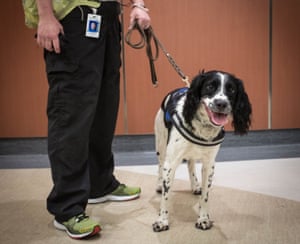
Angus, the C difficile sniffing dog.


Angus, the C difficile-sniffing dog. Photograph: Vancouver Coastal Health

The training took about 10 months. After passing a series of detection tests in a local nursing college with mock patient wards, Angus was brought into the hospital this summer.


Easily excitable when he’s not focused on work, Angus is accompanied by Zurberg at all times during the four days a week he spends at the hospital.


“It’s a very multi-ethnic health authority and I have to be really conscious of who’s around me and what issues they may have with dogs,” she said. “That’s part of the reason we chose a floppy-eared dog as opposed to a pointy-eared dog, because he’s not so intimidating-looking.”


Like any other member of the hospital staff, Angus faces a slight risk that he could be infected by C difficile. “He’s young and he’s not autoimmune compromised, so his risks are extremely low,” Zurberg said. His health is carefully monitored through regular veterinarian visits, she added.


His stint at the hospital has attracted global attention, and health authorities from Finland to Chile have contacted Zurberg with questions about replicating the idea. The aim, said Zurberg, is to develop a program that would train other dogs to sniff out C difficile and make them available to hospitals around the world.


Zurberg’s voice raises with excitement as she contemplates the possibility that Angus might hold the key to regaining control over a superbug that has affected so many people around the world.


“So many people come up to me and say: ‘My dad died of C diff,’ or ‘This person in my family has C diff,’ and they thank me for what we’re doing,” she said. “It opens the doors to other possibilities – what else can we have a dog detect? We’re only really limited by our imagination.”


Man"s best friend, bacteria"s worst enemy: dog sniffs out superbug in Canada hospital

22 Ağustos 2015 Cumartesi

How DNA detectives are assisting resolve the rise of superbug

This piece was first published on The Conversation


It is now twelve many years given that the first set of genetic guidelines in a human was sequenced. Numerous of our hopes for using understanding about the human genome to better fight the likes of heart ailment and cancer even now lie many years and decades in the potential, but DNA sequencing in healthcare is not all about tomorrow. It is currently revolutionising clinical microbiology. Most thrilling of all, it is offering us an essential tool in our battle with drug-resistant strains of bacteria. These strains are 1 of the key growing threats to human overall health, and have just prompted new recommendations in the Uk on how GPs ought to prescribe antibiotics.


Relevant: Antibiotic resistance: the race to quit the ‘silent tsunami’ facing contemporary medication


Clinical microbiology is the branch of medicine concerned with stopping and treating infectious illnesses. It depends on rapidly identifying the pathogens that result in illness – bacteria, virus and fungus. Identification helps make it achievable to treat individuals individually and keep track of the outbreak and spread of a ailment efficiently.


The standard way of identifying most bacterial pathogens is to expand a patient’s specimen in a culture, testing its susceptibility to antimicrobial drugs and evaluating it with other bacterial strains. It can take days in the case of swiftly expanding bacteria such as E.coli, and months in the case of slower developers like Mycobacterium tuberculosis.


In the early years of the 21st century there were some major technical advances in this area, but difficulties continue to be. Identifying the exact strain of pathogen continues to be challenging, even though there are also several obstacles to monitoring their routes of transmission and monitoring mutations.


DNA sequencing could properly be the solution. Developed in 1975 by a group led by Fred Sanger – whose operate is the subject of a new on the internet exhibition – DNA sequencing was not routinely utilised in clinical microbiological laboratories until really lately. It was very expensive and entailed laborious manual laboratory function and painstaking reading of the benefits. However less costly rapid DNA sequencers and massive reference databases are more and more shifting this scenario.


The typical expense of bench-leading sequencers is now US$ 125,000 (£80,000). This kind of machines can sequence numerous bacterial genomes in a day at a cost of about $ 150 per sample. As lately as 2007 the cost of sequencing just 1 bacterial genome could be $ 800,000. It is now achievable to sequence 100 bacterial genomes in a single run.


Rosie Hospital


The technology’s possible with drug-resistant infections very first came to the fore in the course of an MRSA outbreak at the Rosie Hospital in Cambridge, United kingdom in 2011. When 3 babies all examined good at the very same time in the little one unit, the hospital’s infection-management crew reviewed the earlier 6 months’ records and identified babies had been contaminated sporadically by MRSA – at times months apart.


But was this an outbreak of MRSA or simply unrelated infections? Because conventional methods were small aid, experts in complete genome sequencing at the Wellcome Believe in Sanger Institute and Cambridge University have been named in. They quickly established that the samples were all relevant at the genome degree, suggesting an outbreak. By sequencing other bacteria in the hospital’s microbiology laboratory database with the same antibiotic susceptibility profile, they confirmed this was a new strain of MRSA with twice as a lot of infections as very first believed and that it was also prevalent in the wider community.


Two months following the previous infections were discovered, yet another child tested positive despite the unit possessing just been thoroughly cleaned. So the staff sequenced bacteria from swabs taken from workers on the unit and discovered that a particular personal was carrying the exact same strain of MRSA. As soon as that personnel member was taken care of, the outbreak ended.


Developments since


There was much speak at the time about the possible for this success to be duplicated elsewhere – and this appears to be bearing out. In 2014 the same Cambridge staff working collectively with researchers from Thailand and Australia demonstrated using whole genome sequencing to track and determine MRSA on two intensive-care units in an beneath-resourced hospital in north-east Thailand.


What was striking was how numerous diverse variants of the infection the staff detected in the hospital at the exact same time, one thing traditional typing had failed to select up. The function also aided recognize clinically crucial genes such as people coding for antiseptic resistance and antibiotic resistance. Drug-resistant bacteria are particularly a difficulty in poorer countries, so the benefits looked particularly important.


Past MRSA, whole genome sequencing thwarted one more variety of drug-resistant bacteria at the Queen Elizabeth Hospital in Birmingham, United kingdom in 2013. This was an outbreak ofAcinetobacter baumannii, an opportunistic bacteria which causes pneumonia and bloodstream infections in critically sick individuals with compromised immune methods. A new strain of the bacteria had been plaguing the hospital for a lot more than 18 months. As soon as it was sequenced, researchers at Warwick and Birmingham universities have been able to display that the earlier theory that the infection was currently being transmitted inside of 1 ward had been wrong: they had been picking it up from a specialised burns-care bed elsewhere.


This yr Imperial College London researchers have been in a position to resolve a tuberculosis mystery concerning two individuals who had contracted drug-resistant strains of the infection. The initial had worked in healthcare in South Africa in an region where there had been a critical outbreak of drug-resistant TB in 2005, but had been healthier when coming to England. The 2nd had never travelled abroad and, as is typical with TB, knowledgeable no signs and symptoms for 4 many years. It was only through entire genome sequencing that they could be linked with each other: it turned out they had spent eight days on the very same medical ward in 2008. With drug-resistant TB instances rising in the United kingdom from 28 circumstances in 2000 to 81 in 2012, this also is an important improvement.


Despite all these positives, a main obstacle blocks the widespread adoption of complete genome sequencing against drug-resistant bacteria. Presently there are handful of resources to immediately analyse and interpret sequenced data from clinical samples so that it can be understood and clinically utilized by non-specialists. This tends to make it tough to roll out the program and prevents charges from falling even lower.


Stanford University in California may be pointing the way to a answer, nonetheless. Researchers there have developed a world wide web-based mostly system for monitoring drug-resistant HIV. If this can be applied to other infections, such as bacterial ones, genome sequencing could grow to be schedule in hospitals throughout the world.


Lara Marks is the managing editor of whatisbiotechnology.org and author of the Lock and Important of Medicine: Monoclonal antibodies and the transformation of healthcare. She has senior research affiliations with King’s University London, Cambridge University and University School London.


How DNA detectives are assisting resolve the rise of superbug

7 Mart 2014 Cuma

Superbug kills 16 in Manchester hospitals

NHS hospital

The BBC stated 1,241 patients have been impacted inside the Central Manchester University Hospitals NHS foundation trust region from 2009 to 2013. Photograph: Nick Ansell/PA


Sixteen people have died in the Manchester spot in the past 4 many years from a highly resistant “superbug”, in accordance to figures launched beneath the Freedom of Details Act.


Klebsiella pneumoniae carbapenemase (KPC) has been accountable for hundreds of infections, with 17 men and women dying, like 16 in Manchester, the BBC has reported.


It mentioned 1,241 individuals have been affected inside the Central Manchester University Hospitals NHS basis trust area from 2009 to 2013, with the numbers rising yr on yr.


Sixty-two patients at the trust have suffered blood poisoning – with 14 confirmed deaths inside of thirty days of infection. Two other deaths have been confirmed this year.


KPC is resistant to carbapenems – a group of antibiotics that, in several situations, are regarded as the last effective defence towards multi-resistant bacterial infections.


The believe in mentioned the enzyme, which KPC utilizes to render antibiotics ineffective, had entered other bacteria, including E coli and enterobacter.


The believe in explained all the individuals who had died have been seriously sick, this kind of as with diabetes, kidney difficulties or transplant rejection. Other folks had leukaemia or other forms of cancer.


It explained: “This trust has and continues to make strenuous efforts to control and minimize this infection. We continue to work really closely with Public Overall health England at both a regional and national level to develop answers for the lengthy-term management of individuals.”


The Christie NHS foundation believe in in Manchester, a specialist cancer hospital, explained nine patients had been colonised with KPC last 12 months.


Two circumstances of KPC have also been located at New Cross hospital in Wolverhampton, with 1 patient dying in the past two many years. Its microbiologist, Dr Mike Cooper, explained the patient was 96 and her form of KPC was nonetheless vulnerable to some medication.


“There’s a large element of luck in this,” he said. “Either Manchester has been extremely unlucky or we have been incredibly lucky not to have much more cases.”


Ten patients have also been colonised at the University Hospital of Stoke-on-Trent. Two had urinary tract infections, but neither patient died of blood poisoning.


Stoke microbiologist Jeorge Orendi explained: “In contrast to the situation in specific hospitals in Manchester and London, thankfully in our hospital and catchment location, carbapenemase producers have remained uncommon to date.”


Superbug kills 16 in Manchester hospitals