Rights etiketine sahip kayıtlar gösteriliyor. Tüm kayıtları göster

16 Mayıs 2017 Salı

If basic healthcare is a privilege, what rights do we have? | Jamie Peck

A right-wing hero was born this past Sunday during the combination bikini contest and civics test that is the Miss USA pageant. In an effort to probe how she’d solve our nation’s problems, host Julianne Hough asked Miss Washington DC (aka Kara McCullough) if she believed “affordable healthcare for all US citizens” was “a right or a privilege,” and why. McCullough answered by saying:


“I’m definitely going to say it’s a privilege. As a government employee, I’m granted healthcare and I see firsthand that for one to have healthcare, you need to have jobs. So therefore, we need to continue to cultivate this environment that we’re given the opportunity to have healthcare as well as jobs to all American citizens worldwide.”


Currently unemployed people, as well as those with bad jobs that don’t provide healthcare, are presumably out of luck. That McCullough wants to help women find work in Stem jobs is admirable, but does nothing to help the vast majority of people.


Of course, her statement is technically true. As things currently stand in the US, healthcare is a privilege, and one you likely need a job to access. (And not just any job … a salaried and/or union one, a holy grail that’s fast disappearing.) As a person with both a job and healthcare, she’s observed this firsthand. But as Ms McCullough is a nuclear scientist, I will assume she understood the question was about how she believes things should be, not how they are. In which case, she’s as wrong and out of touch as any DC royalty currently making policy on this issue.


Now, I’ll admit it’s tough to prove beyond the shadow of a doubt that people deserve basic levels of physical safety simply by virtue of being human. To do so would require a philosophical deep dive above my level of expertise. But our founding documents — which I’d hope someone with the surname “USA” respects — have already sided with the “yeas” on the existence of certain inalienable rights, chief among them “life.” And an estimated 45,000 Americans die each year from lack of health insurance. This is not just another commodity, but a necessity on the level with food and shelter. Which, to be fair, Republicans also want to take away from the poor.


Beyond that, it comes down to a simple matter of preference: do you want to live in a society that codifies some level of responsibility to our fellow citizens, or would you rather roll the dice on a Randian dystopia where the lazy, unlucky or otherwise uncompetitive are liquefied into paleo shakes for rich people? Maybe I can’t objectively prove which is “better,” but I know which I’d prefer. Contrary to what social Darwinists would tell you, one cool thing about being human is we (theoretically) get to decide which ideals we want to pursue.


When healthcare is a for-profit enterprise, costs skyrocket and access plummets. While the Affordable Care Act reined in some of the industry’s worst abuses, an estimated 27 million are left uninsured under it, a number that’s slowly climbing as companies raise premiums and pull out of exchanges.


Even those who are insured report problems paying for care due to high deductibles, and, more generally, to being insured by companies whose business model is to dole out as little coverage as they can legally get away with. The Republican party is currently in the process of turning 27 million into 52 million with their ironically named “American Healthcare Act.” Soon, 45,000 deaths a year will seem like the good old days.


As every other country in the developed world knows, the only way to increase coverage to 100% — as well rein in absurdly high per capita spending on a bloated private industry — is with a system of state-funded healthcare. It works everywhere else, and many experts say it would work here.


The American people are on board. A 2017 Economist/YouGov poll found about 80% of Democrats and 40% of Republicans — yes, Republicans! — favor a federally funded health insurance system that covers all Americans. All race, age, income, and gender demographics favor it by simple majorities, and many — particularly the most marginalized — by strong ones. Even Republicans and conservatives approach 50%. Those who voted for Hillary Clinton favor it at a rate of some 85%.


Unfortunately, this is one of many areas where the country’s political class refuses to even remotely entertain the will of the people. Neither Democrats nor Republicans are willing to do the empathetic, fiscally responsible thing.


We all know Republicans will happily let people die to pay for oligarchs’ tax breaks. But even most elected Democrats remain irrationally committed to compromising with an industry that wants you dead. This becomes more comprehensible when you look at the amount of money the insurance lobby gives to both parties. Despite its immense popularity with voters, single-payer will be on neither party’s agenda in 2018.


In stating that affordable healthcare is a privilege that should be reserved for gainfully employed people, McCullough showed she’ll fit in just fine with the other undemocratically elected rulers in DC. President Trump might not own the Miss USA pageant anymore, but his cutthroat spirit lives on.


If basic healthcare is a privilege, what rights do we have? | Jamie Peck

12 Mart 2017 Pazar

Sarah Weddington, Roe v Wade attorney, on Trump’s threat to abortion rights

Sarah Weddington is the lawyer who, aged just 26, represented “Jane Roe” in the landmark case Roe v Wade, which in 1973 effectively legalised abortion in the US. The daughter of a Methodist minister, she was born in 1945 in Abilene, Texas. Having graduated with a degree in English from McMurry University, she enrolled at the University of Texas Law School in 1964, one of 40 women among a student body of 1,600. “I thought I would be teaching eighth graders to love Beowulf,” she recalls. “But that wasn’t working out so well, so I decided to go to law school instead. In this, I was encouraged by the dean of my college, who told me that it would be far too tough for a woman. ‘As sure as dammit I am going,’ I thought.”


After graduating, she joined a group of students who were seeking to challenge anti-abortion laws, agreeing to file a suit against the state of Texas on their behalf. Soon after, 21-year-old Norma McCorvey was referred to Weddington and her colleague Linda Coffee, now actively looking for pregnant women who were seeking abortions. McCorvey became the plaintiff “Jane Roe”, though by the time the supreme court issued its ruling, her baby had long since been born and given up for adoption. McCorvey later became an evangelical Christian and vocal anti-abortion campaigner, and claimed to have been the “victim” of the Roe v Wade lawyers. She died last month aged 69.


I was very nervous. It was like going down a street with no street lights. But there was no other way to go


Weddington remains the youngest person ever to have argued a successful case at the supreme court. In 1973, she was elected to the Texas House of Representatives, where she served for three terms. In 1973, she became the first female General Counsel at the US Department of Agriculture. From 1978 until 1981, she served as assistant to President Carter, directing his administration’s work on women’s issues. She now runs the Weddington Center, Austin, whose work focuses on women and leadership. She recently told NBC news that the election of Donald Trump may pose the biggest threat yet to abortion rights in the US.


Where were you on election night? Did you sense that Trump was going to win?
Austin is one of the more liberal towns in Texas, though the state itself is barely liberal. Most people I know strongly expected Hillary to win. But I’d been on a panel a few weeks before where a man had said: “You liberals think Hillary is going to win. Well, let me tell you, there are a lot of people out here who are voting with our finger – the middle finger.” So I knew there was… resistance. There were a lot of parties on the night, but I had enough concerns to be afraid that going to one might turn out to be too depressing. So I came here to my office, and watched it on the New York Times website.


What’s your impression of the president so far?
I thought he would be terrible, and he has proven me correct. In Texas, we have a lot of people from Mexico and El Salvador, and a lot of them are worried family members will be deported.


What do you make of the growing fear that under this administration Planned Parenthood [a 100-year-old nonprofit organisation that is the largest single provider of reproductive health services, including abortion, in the US] will lose its federal funding?
The federal government has never given money to Planned Parenthood for abortion. It gives money to it for the provision of contraception and well woman care: for the treatment of venereal disease, mammograms, and so on. The anti-abortionists recognise that the money is not used for abortion, but they want it cut off anyway. It is a real threat. But Planned Parenthood may ultimately benefit from what Trump is doing and saying. Last week, I was in Houston for a Planned Parenthood event. Usually, there would be about 1,000 people in the audience. This time, we had 2,500. People are very worried, and they are giving more generously.


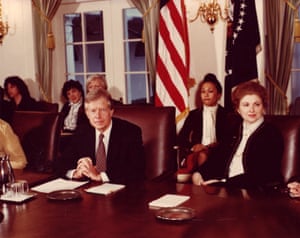
Sarah Weddington with president Jimmy Carter. She served as his assistant from 1978 to 1981.


Sarah Weddington with president Jimmy Carter. She served as his assistant from 1978 to 1981. Photograph: Courtesy Sarah Weddington

What about abortion? Is it possible it could become illegal again in the US?
Trump has always said that he would try to appoint people who were strongly against abortion to the supreme court. But Neil Gorsuch [a conservative judge, and Trump’s nomination to the supreme court] has never said that much about abortion. States can’t make abortion illegal. But some have been passing laws that make it much less available, for instance by saying that no abortion can be done except in a facility that meets the requirements for emergency care. In other words, they make the cost of abortion much higher. A lot of women are already crossing state lines, and in that sense, a lot of what is happening is just like it was before Roe v Wade was decided. You’ve got one vacancy now on the supreme court. But Ruth Bader Ginsburg, who is helping to keep abortion available, is 83, and there are a couple of older male judges too. If Gorsuch’s nomination is approved, will abortion be illegal the next day? No. One new judge won’t necessarily make much difference. But two or three might.


How did you feel on hearing that Norma McCorvey had died?
Well, I was sad. I appreciate that she was once concerned with overturning the law on abortion. But on the back of being Jane Roe, she ended up going on all these pro-choice tours. I learned to be very careful about believing what she said.


You worked somewhat against the odds on the case in which she became involved.
That’s right. There was a building across the street from the University of Texas and a lot of student organisations had cubby holes there, with desks rescued from the garbage. In one little nook, women and some men were trying to work on women’s issues. One thing that was upsetting was that the university health centre did not give out information about, or prescriptions for, anything relating to contraception. A couple of these women had gone to New York and got a copy of Our Bodies Ourselves [a landmark book of 1971 that dealt plainly and openly with women’s health and sexuality] – I still have this mental image of them in a closet with a flashlight reading this book – and they began to give the relevant information out to women. As they did, women would sometimes say: “I’m already pregnant. Where can I get an abortion?” So they started going to places where abortion was available, and they’d write up that information, too. Sometimes, for instance, they’d write: “This person does not seem very skilled: never send anyone here.” A lot of women were going to Mexico. Abortion was illegal there, too, but it was close to Texas, and sometimes women ended up in the wrong hands because people there wanted to make money out of the situation.


The upshot of all this was that the women students were getting worried the police might arrest them for being accomplices to abortion. We were sitting at the snack bar in the law school one day and one of them, Judy Smith, said: “We need to get a lawsuit filed and try to overturn the Texas law. Would you be willing to do it?” I told her she would be better off with someone with more legal experience. I’d only done uncontested divorces, wills, one adoption for my uncle; I had no experience at all in federal court. “How much would you charge?” she asked. When I admitted I would do it for free, she said: “OK, you are our lawyer.”


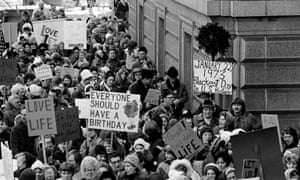
Protest marchers form a ‘ring of life’ around the Minnesota Capitol building protesting the US supreme court’s Roe v. Wade decision, 22 January 1973.


Protest marchers form a ‘ring of life’ around the Minnesota Capitol building protesting the US supreme court’s Roe v. Wade decision, 22 January 1973. Photograph: AP

Were you nervous?
I was very nervous. It was like going down a street with no street lights. But there was no other way to go, and I didn’t have any preconceived notions that I would not win. In 1965, there was a case, Griswold v Connecticut, involving doctors and the supply by doctors of contraceptive devices to a married couple. [Connecticut was then one of two states where contraception was effectively illegal, even if the law was rarely enforced.] Yes, neanderthal. That case was won in the US supreme court, and in its ruling, the court had talked about the right of privacy under the constitution. It was, the court said, for the married couple to decide whether or not to use contraception. So there was a precedent. But I certainly was not confident.


You won in the federal court, but the case still went to the supreme court. Why?
In Dallas, the court ruled there was a right of privacy, that abortion should be legal. Henry Wade, the district attorney, then unwittingly helped us. At a press conference, he said: “I don’t care what any court says; I am going to continue to prosecute doctors who carry out abortion.” There was a procedural rule that said if local elected officials continue to prosecute after a federal court had declared a law unconstitutional, there would be a right to appeal to the supreme court.


Did you have any hint at all as you addressed the supreme court that you might win?
No, it was impossible to read the justices’ faces. The attorney on the other side started by saying something inappropriate about arguing a case against a beautiful woman. He thought the judges would snicker. But their faces didn’t change a bit.


It was a while before the verdict was released, wasn’t it?
I had to argue it twice in the supreme court – in 1971, and again in 1972. On 22 January 1973, I was at the Texas legislature when the phone rang. It was a reporter from the New York Times. “Does Miss Weddington have a comment today about Roe v Wade?” my assistant was asked. “Why?” she said. “Should she?” It was beginning to be very exciting. Then we got a telegram from the supreme court saying that I had won seven to two and that they were going to airmail a copy of the ruling. Nowadays, of course, you’d just go online. I was ecstatic, and more than 44 years later we’re still talking about it.


When you published your book A Question of Choice in 1992, you decided to reveal that in 1967 you’d had an abortion yourself, while you were still a law student. Why did you wait so long to reveal this?
Just before the anaesthesia hit, I thought: I hope no one ever knows about this. For a lot of years, that was exactly the way I felt. Now there’s a major push to encourage women to tell their stories so people will realise that it is not a shameful thing. One out of every five women will have an abortion. I was lucky because the man I was planning to marry [Ron Weddington; they divorced in 1974] was with me. He drove me to Mexico. We had gotten information from a woman he knew about where to go, and luckily I was working three jobs so I had the money to pay. It was anxiety-inducing. You’re going across the border to see someone you don’t know. But it turned out that my doctor was very good. I wish I had his name, so I could thank him.


Are you still able to get in touch with the young woman you once were, or does she feel very far away?
Well, my hair is white now, so in one way, I don’t see myself as her at all, even if, whatever else I do in my life, the headline on my obituary is always going to be: “Roe v Wade attorney dies.” But in terms of my emotions, yes: I think most women of my generation can recall our feelings about the fight. It’s like young love. You may not feel exactly the same, but you remember it.


Sarah Weddington, Roe v Wade attorney, on Trump’s threat to abortion rights

20 Şubat 2017 Pazartesi

Roe v Wade: plaintiff"s death highlights weakening of abortion rights in US

In 1998, Norma McCorvey, the “Jane Roe” in the Roe v Wade supreme court decision, testified before a group of senators about the case fought in her name 25 years earlier. “I am dedicated,” she said, “to spending the rest of my life undoing the law that bears my name.”


McCorvey did become an activist against abortion rights, although she wouldn’t live to see Roe, which in 1973 established a right to abortion, overturned. She died on Saturday in Katy, Texas, at the age of 69.


Knowing the end was near, McCorvey gave her friends and fellow activists a mission the day before she died, according to her friend Janet Morana. “She wanted to tell everyone to continue the fight,” said Janet Morana, executive director of Priests for Life.


But while McCorvey died in a country still shaped by the case that bears her pseudonym, the practical realities of abortion access may more closely resemble the country of her youth than she imagined.


Anti-abortion activists began to chip away at Roe v Wade almost as soon as the supreme court handed the decision down. In 1976, Congress began prohibiting poor women from using Medicaid to cover abortions. Conservative state lawmakers have unleashed a tidal wave of abortion restrictions, such as an Ohio law signed in December, that make the procedure more difficult to obtain. The most effective of these laws forced abortion clinics to close down. Since 2011, abortion clinics have closed at a record pace of more than 30 clinics per year.


McCorvey wasn’t a soldier in the early battles. In the 1980s, she revealed her identity publicly and spent time volunteering in a Dallas abortion clinic and taking part in abortion rights rallies. It wasn’t until 1995, when she converted to evangelical Christianity – later, to Catholicism – that she began to join activists who wanted abortion to be abolished.


For the most part, she was active with religious groups and ordinary people who wanted to see abortion outlawed as quickly as possible. Occasionally, she lent her name to legal efforts that challenged Roe head-on. In 1997, she wrote a friend-of-the-court brief in a long-shot case claiming Roe had led to untold numbers of coerced abortions, and must be overturned.


The most successful contingent of the anti-abortion movement had long since left those tactics behind. In 1984, at a conference sponsored by Americans United for Life, a participant proposed what would become the movement’s most powerful weapon against Roe: laws that allowed the courts to chisel away at its doctrine.


It is a strategy that has proved highly effective. Activists have sufficiently narrowed Roe so that states can require women seeking an abortion to attend anti-abortion counseling; require minors seeking an abortion to receive the permission of one or both parents; require women to wait 24 hours or more before receiving an abortion; extensively regulate abortion after 20 weeks; and block public funding for abortion.


All the while, fewer women have found they needed abortions. This year, US researchers announced that the proportion of pregnancies that ended in abortion had reached its lowest point since the supreme court decided Roe v Wade. The decline was largely due not to new abortion restrictions, they believed – with the exception of unconstitutional laws that forced clinics to close – but to more effective and widely available methods of contraception.


Anti-abortion activists have credited the low abortion rate to the triumph of their tactics and rhetoric, and have largely hailed the Republican takeover of Congress and the White House. The party has historically aided their fight against abortion rights, and its leaders have announced plans to gut widespread access to contraception and place new restrictions on abortion.


All of this, of course, is achieved with an eye toward overturning Roe v Wade. Donald Trump, in his election-season efforts to win the support of anti-abortion groups, promised to appoint judges to the supreme court who would be open to overturning the decision. Many legal experts are skeptical, however, given the amount of precedent that now exists to protect abortion rights, that overturning Roe v Wade is even possible.


With this in mind, anti-abortion campaigners have noted the difference between overturning Roe v Wade and making it as though Roe v Wade had never happened. Activist groups and conservative lawmakers have shown that they can achieve one without the other.


Twenty-one states have laws allowing a parent to all but prevent minors from having abortions. The ban on using Medicaid to cover abortion has foreclosed the option of abortion to at least 1 million women. The closure of half of Texas’ abortion clinics, under a law that was later ruled unconstitutional, caused a 50% drop in abortions in areas where the distance to the nearest clinics suddenly increased by more than 100 miles.


Owing to a record number of clinic closures, thousands of women each year travel great distances for abortions and even cross state lines. An unknown number of women have attempted to perform their own abortions, including some who have tried to do so with sharp objects. The difficulties begin to recall a time before abortion was legal in all 50 states.


Two years ago, one abortion provider reflected on the changes, saying: “Sometimes, I feel like I’ve gone back 40-some years.”


Roe v Wade: plaintiff"s death highlights weakening of abortion rights in US

31 Ocak 2017 Salı

Air pollution crisis ‘plagues’ UK, finds UN human rights expert

Air pollution is a crisis that “plagues” the UK, particularly children, according to the UN’s special rapporteur on hazardous substances and wastes.


Baskut Tuncak, who was appointed by the UN human rights council and completed a 15-day mission to the UK on Tuesday, said there was an “urgent need for political will by the UK government to make timely, measurable and meaningful interventions”.


Most air quality zones in the UK breach legal limits and the government has twice had its plans to tackle the issue declared illegal by the courts. It is now developing a new plan but Tuncak’s strong criticism is a further embarrassment for ministers.


“The UK has repeatedly not been among the more progressive EU member states on debates over the development of stronger health and environmental protections,” he said.


Tuncak also said Brexit was a threat to environmental protection given that most current regulations come from the EU. “I found no indication of a political commitment to retaining current standards for health and environmental protection,” he said.


The government says it will transpose all EU laws into UK law via a “great repeal act”, but the environment secretary Andrea Leadsom has said that about a third of the 800 pieces of EU environmental legislation would be difficult to transfer. A cross-party committee of MPs said earlier in January that the government must pass a new Environmental Protection Act before it begins the formal process of leaving the EU.


Tuncak also found that less than 1% of workers made sick by exposure to toxic chemicals receive compensation in the UK. “For victims of toxic pollution, seeking remedy in the UK is very difficult,” he said. “Cuts in legal aid have made it near impossible for victims of pollution and contamination to seek remedy for civil suits.”


Tuncak’s fact-finding mission to the UK was at the invitation of the government and assessed the measures taken by the government to protect the human rights of people that can be infringed by pollution, such as the rights to life, health and safe housing.


The visit coincided with a severe air pollution episode in London and he said between 30,000 and 40,000 early deaths every year are caused by toxic air across the country.


“Air pollution plagues the UK,” Tuncak said. “Children, women of reproductive age, the elderly, and those of poor health are the most threatened by toxic air, with poorer communities often exposed at higher levels. Paediatricians refer to the present state of the impacts of pollution and contamination on children’s health as a ‘silent pandemic’. I encourage the UK government to fulfil its human rights obligations on air pollution.”


Regarding the changes that will result from the UK leaving the EU, he said the UK has an obligation to progress, not to slide backwards: “The forthcoming plan for Brexit should ensure that it does not open a Pandora’s box, freeing the way for deregulation and posing a threat of regression from existing standards of protection.”


Areeba Hamid, clean air campaigner at Greenpeace, said: “It is imperative that the UK government ensures that EU safeguards on air pollution are protected and prioritised throughout the Brexit process. So far the UK government has failed to protect the public from air pollution, much of which is caused by diesel vehicles.”


Tuncak said the UK’s “pivot” away from the EU towards closer cooperation with the US, pursued by prime minister Theresa May in Washington DC last week, risked a weakening of protection. “Rights that are often impacted by pollution and contamination are not recognised by the US while they are by the UK,” he said.


During Tuncak’s mission, he met representatives of the national government. But regarding assurances that Brexit would not weaken protections, he said: “I was pointed to statements that I could not find and political commitments that were not clearly expressed.”


Tuncak also reported a series of other findings:


  • Communities concerned about fracking, sewage disposal and industrial expansion had “severe difficulty” accessing information directly relevant to health and safety.

  • Budget cuts for local authorities had made it “problematic” for them to carry out their responsibilities in managing waste.

  • The UK had inadequate laws to limit the toxic impacts of UK-based companies when operating overseas.

A full report of Tuncak’s mission will be submitted to the human rights council in September.


Air pollution crisis ‘plagues’ UK, finds UN human rights expert

15 Aralık 2016 Perşembe

Will Trump cause progressives to forget about women"s rights? | Jessica Valenti

If you were concerned that forced funerals for fetuses and zygotes wasn’t quite horrific enough, rejoice! In the last week, Ohio has passed a law banning abortions after 20 weeks and Oklahoma wants to mandate that businesses post anti-abortion signs in women’s public restrooms.


In the wake of Trump’s win, reproductive rights opponents have not wasted a moment in their plan to roll back access to abortion and birth control. And, as has been the case for some time, these harmful policies are being presented as wins for women.


When Governor John Kasich of Ohio passed the 20-week ban, for example, he also vetoed a six-week ban – the hope being that the move would be seen as moderate in comparison. But 20 weeks is around the time that women find out about fetal abnormalities – a leading reason for later abortions. And while the Oklahoma plan is being touted by pro-life groups as a way to offer women “alternatives”, what it’s really doing is shaming women and requiring that businesses spend money on ideological propaganda. (Also, so much for the Republicans caring about women’s privacy in bathrooms!)


The research is clear: women suffer when you deny them access to birth control and abortion. In fact, despite anti-choice rhetoric to the contrary, the only kind of negative mental health impact that abortion has on women occurs when someone seeks out the procedure and is denied.


The challenge we have in front of us, though, is not just the danger of Trump’s administration or the emboldening of Republicans. In a time when bad news for progress is around every corner – as Slate writer Jamelle Bouie put it, “what disaster to write about today?” – we have to make that sure that women’s rights don’t get lost in the shuffle.


It wasn’t so long ago that gender and race were considered ancillary or distracting topics in progressive politics – a notion still being bandied about as people blame “identity politics” and “political correctness” for Trump’s win. If history is any indication, it won’t be long before we start hearing murmurings from so-called progressives that women should sacrifice working on issues that affect them in service of “the greater good”.


It’s vital that we not forget or lose the momentum feminism has had over the last decade, especially on reproductive rights. The stakes are just too high. Hundreds of thousands of American women have already sought out illegal abortions, in part because of state-level restrictions. And as the Affordable Care Act comes under fire, it could leave millions without coverage for contraception.


These are not small things, these are not side issues or special interests. Women’s ability to control their bodies and plan their family size is a human rights issue. And while we have a tremendous amount of work to do on so many fronts, Americans cannot afford to treat feminism and women’s progress as something that can be pushed aside for a time and picked up later. Let’s not allow our the fact that we’re overwhelmed to get the better of us – not now, and not for the next four years.


Will Trump cause progressives to forget about women"s rights? | Jessica Valenti

22 Kasım 2016 Salı

Abortion rights are already under siege – and it"s only going to get worse | Jessica Valenti

Imagine being so desperate to end a pregnancy that you sit in a bathtub, gird yourself, and stick a wire hanger up your vagina and into your uterus. You don’t have anesthesia, but you do it anyway. You start to bleed, badly. After you go to the hospital for help, you don’t get sympathy – you get arrested.


I don’t describe this horrific scenario to remind you of a time when abortion was illegal and how bad it was for women. Because this didn’t happen in the 1950s; it happened last year.


Just a few months before Donald Trump said women who have abortions should be “punished”, a woman in Tennessee was arrested for trying to end her pregnancy with a hanger. And on Tuesday, a week after Trump was elected to be the next president of the United States, this woman was charged by a grand jury with aggravated assault with a weapon, attempted procurement of a miscarriage, and attempted criminal abortion.


Jessica González-Rojas, executive director at the National Latina Institute for Reproductive Health, said: “These new charges seek to punish her even more severely and are an affront to justice and basic human dignity.


“No woman should fear arrest or jail time because she ends her pregnancy or seeks medical help in this situation.”


“Women and reproductive rights organizations should be doing all they can to steel themselves for the battles to come”

This is not an isolated case. Before her conviction was overturned, Purvi Patel in Indiana was sentenced to 20 years in prison for inducing an abortion. Bei Bei Shuai, also in Indiana, was charged with murder after a suicide attempt resulted in her pregnancy ending. So let’s be clear: women are already being punished for abortion.


This Handmaid’s Tale nightmare will only get worse once Trump takes office. Whatever his personal beliefs on abortion – like everything else, this is a topic he’s flip-flopped on over the years – he has vowed to appoint supreme court justices that will overturn Roe v Wade, leaving the issue up to the states. When questioned about this, he callously remarked that women who live in states where abortion is illegal could just travel to a different state.


Mike Pence, the incoming vice-president, signed one of the most restrictive abortion laws in the country as governor of Indiana, and has said he wants to see Roe “consigned to the ash heap of history where it belongs”.


These are not men who are thinking about – or who even understand – the consequences of banning abortion.


The woman in Tennessee, who has already been in jail for nearly a year, is one of countless American women who try to self-abort. I say “countless” because we literally do not know the number of people who attempt their own abortions. We just know that it’s a lot.


One study found that in Texas alone, more than100,000 women had tried to end their own pregnancies. You will not be shocked to find out that abortion is extremely difficult to access in Texas. The same is true in Tennessee, where 96% of counties have no abortion provider.


Not all women induce their own abortion because of a lack of access. Some simply want to forgo seeing a doctor, and would prefer home abortions. Last year, Daniel Grossman, an obstetrician-gynecologist and vice-president for research at Ibis Reproductive Health, told me that some women self-induce because they’re “the kind [of person] who like to do herbal treatments or take vitamins for their healthcare in general”.


If reproductive rights were not in such imminent danger, now might have been a good time to start expanding options for women who don’t want clinic care but instead want to end their pregnancies at home. But now it’s hard to imagine that pro-choice organizations will be doing anything other than protecting rights already won.


“No woman should fear arrest or jail time because she ends her pregnancy or seeks medical help in this situation.” – Jessica González-Rojas

In fact, women across America are preparing for the worst. The news of Trump’s win sparked an increase in the number of women seeking long-term birth control measures such as IUDs, fearing that their insurance coverage for contraception would soon be a thing of the past.


The defensive crouch right now is a smart strategy. Women and reproductive rights organizations should be doing all they can to steel themselves for the battles to come – not just on a policy level, but in terms of everyday needs. Those of who can afford to do so, for example, might consider buying large quantities of Plan B while it’s still available over the counter – stockpiling the medicine in the event that it becomes inaccessible and other women need it. And if it were not illegal, I might encourage doctors and nurses to start putting aside misoprostol (the drug used in medication abortions) in the event that abortion is banned in their state or others.


Someone who wants an abortion will find a way to get one, no matter what the law is. So let’s make sure they can do that safely, no matter who the president is.


Abortion rights are already under siege – and it"s only going to get worse | Jessica Valenti

20 Kasım 2016 Pazar

Victorian abortion law ‘breaches human rights’

A campaign to push for abortion to be removed from the justice statutes and decriminalised is to be launched this month by the country’s newest political party.


Sophie Walker, leader of the non-partisan Women’s Equality party, said it was time that abortion was made a sexual health and human rights issue, rather than left languishing under “Victorian criminal law”, where a life prison sentence still exists for procuring a termination. This is a flagship policy for the party, which will hold its first conference in Manchester next weekend. It hopes that with pressure from its supporters, other political parties will take up the issue.


The current legislation governing abortion is the 1861 Offences Against the Person Act, which came into force decades before women had the vote.


Abortion is part of life in mainland Britain: one in three women will have an abortion before the age of 45, with the highest rate among 21-year-olds. Rates have remained fairly constant over the past few years, higher in England and Wales than in Scotland, with 197,906 Britons and 5,190 non-British residents having an abortion last year. About 98% are NHS-funded and the vast majority, 80%, carried out at less than 10 weeks pregnant.


Under the 1861 act, and as amended by the Abortion Act 1967, abortion remains a criminal offence; only cases that meet certain caveats are exempt from prosecution. Two doctors must sign to confirm that a woman’s or her unborn child’s health and welfare is at risk, resulting, say campaigners, in the law simply being circumvented in many cases. And it is also open to political interference. The British Pregnancy Advisory Service believes the rules work only because health professionals work around them.


The WE party has grown to more than 65,000 members and 65 regional groups since its inception last year. It fielded its first political candidates at local and regional elections this year, including for the London mayor.


“This is really about making it very clear that women’s healthcare rights are human rights,” said Walker. “That is why we want to debate this motion at our first conference and to put a focus on prioritising and funding sexual health and wellbeing. If you are denied control over your own body then you are denied so many other controls over your life. Any denial of reproductive rights is a form of violence against women, and the massive funding cuts ongoing in the UK are part of a real trend that is de-prioritising equality.”


Former Progressive Unionist party leader Dawn Purvis is on the advisory board of Marie Stopes International, which provides contraception and safe abortion services. She is to give a keynote speech at the WE party conference on the position in Northern Ireland, where several prosecutions are under way of women who have used the so-called “abortion pill”.


“The situation in Northern Ireland is different to mainland Britain in that, basically, a woman has to be about to die before she is allowed a termination,” Purvis said. “Rape or incest or foetal abnormality are not circumstances under which an abortion will be allowed. We’re seeing women being prosecuted and convicted as criminals – one was reported by her GP after she had gone to him for help, another is a woman being prosecuted for helping her daughter.


“But thankfully we are seeing more and more legal challenges – late last year we had a ruling that the stance of the Ministry of Justice was incompatible with international standards on human rights.”


Diana Johnson, Labour MP for Kingston upon Hull North, has tabled a 10-minute bill for the spring when she will also raise the issue of decriminalising abortion. She does not want to change time limits but wants medical procedures to be governed by clinicians, rather than the criminal law.


“That any woman procuring an abortion is potentially facing a prison sentence of life under legislation dating from 1861 is patently something that needs looking at carefully,” she said. “Decriminalising abortion, for both health professionals and for women, would put the issue with clinicians and health experts, where it belongs.”


Victorian abortion law ‘breaches human rights’

18 Ekim 2016 Salı

Why a porn star is fighting California"s condom law: "It"s a women"s rights issue"

What does a porn star wear when she hits the campaign trail?


A smile.


And a black net brassiere with intricate straps. A very short, peach satin romper open to the waist. A whole lot of deeply tanned skin. And a fist full of “No on Proposition 60” pamphlets.


Not familiar with Proposition 60? Neither were most of the students Tasha Reign (her nom de scène) encountered on a sunny Monday at the University of California, San Diego (UCSD).


The measure, one of 17 on the California ballot in November, would require adult entertainers to wear condoms while filming sex scenes. To the 27-year-old feminist with a fan base she calls her Reigndeers, Proposition 60 is an assault on her human rights, her artistic freedom and the very constitution itself.


Not to mention that it is often anatomically impractical.


“I do acts where I literally could not use condoms, whether that be anal, whether that be double penetration, whether that be multiple guys,” Reign told the Guardian. “I cannot even imagine having a group sex scene like that.”


I hate the idea that some man is going to tell me what I can and can’t do


Tasha Reign


The logistical hurdles are endless. How do you ensure that the same condom doesn’t find itself inside more than one woman? Do you stop filming while an actor swaps latex? What if the condom breaks during a particularly rigorous outing? This isn’t, she notes, regular sex, 20 or so comfy minutes and it’s over.


“It’s extremely difficult for somebody to be able to maintain an erection for 45 minutes, and to be able to pop with a condom, especially,” she said. “The bigger issue for me is that it opens up the gateway to mandate my body. I hate the idea that some man is going to tell me what I can and can’t do.”


Reign is a practitioner of gonzo porn – none of the cuddly couples stuff for her. Her Twitter feed is filled with political activism and waxed genitalia. As she campaigns in front of UCSD’s Geisel Library, she attracts attention, if not always votes.


Ten minutes before every hour, as one class ends and another is set to begin, the tree-lined walkway fills with students. Young women weighed down with heavy backpacks slide their eyes Reign’s way before hurrying off. A young man on a skate board does a double take fast enough to cause whiplash.


Tasha Reign talks to UC San Diego students about Proposition 60, which would require adult entertainers to wear condoms during sex scenes.


Tasha Reign talks to UC San Diego students about Proposition 60, which would require adult entertainers to wear condoms during sex scenes. Photograph: Ariana Drehsler for the Guardian

She walks up to student after student, leading with a smile, campaign literature in her outstretched hand. More often than not on this day, her targets scurry by. The young men at the fraternity table across the path rebuff her.


“It’s like a lot of rejection,” Reign says with a pout. “When they say no, I’m not used to it, actually.”


But she is not deterred. “Are you going to vote on Prop 60?” she begins, over and over. “Let me tell you about it. I’m an adult film star.”


The day after her UCSD foray, she arrives at California State University, Long Beach. In her first hour, she gives her pitch 18 times – 19 if you count the guy who said he wasn’t voting but hung around to talk to her anyway – and posed for a selfie with a young man in full Dodgers regalia.


I want to be able to say: I’m a sex worker. I have a choice in the way that I protect my genitals


Tasha Reign


“This would take away the choice we have to use condoms or not,” Reign tells them. The measure, she says, “incentivizes people to sue adult film stars, giving them access to their personal names, their personal home address, taking your tax dollars and putting it toward regulating an industry that does a really good job at self-regulating itself.”


“It’s a women’s rights issue,” she says. And “it’s also a freedom of speech issue.” And “it’s something the performers, the majority of us, don’t want passed.” And “we just want you guys to vote no.” And “tell your friends.”


Michael Weinstein, president of the Aids Healthcare Foundation, is the measure’s major backer. Neither he nor his organization responded to repeated requests for comment.


The Vote Yes on Prop 60 website says “condoms in porn is about protecting California employees at work.” Although Reign and other adult film actors undergo regular screening for HIV and other sexually transmitted diseases, such testing is voluntary.


The state’s Republican, Democratic and Libertarian parties have officially come out against the measure, along with Aids Project LA, Equality California, the Transgender Law Center and the San Francisco Aids Foundation.


Most major newspapers in the state recommend a no vote. The Los Angeles Times’ editorial against the measure points out that “any resident who spots a violation in a pornographic film shot in the state could sue and collect cash from the producers and purveyors if they prevail in court.”


Reign is a registered Democrat who supports Hillary Clinton for president. She had planned to vote for Bernie Sanders in the primary, but her mother persuaded her otherwise. She lives in the hills above Los Angeles with her Chihuahua mixes, Cinderella and Bambi, and her pot-bellied piglets, Harley and Quinn.


She graduated from UCLA with a degree in women’s studies. And she did not get into adult entertainment, she said, so she could be pushed around by a man like Weinstein “who has never been a sex worker” and doesn’t respect the choices she and her fellow performers make.


She doesn’t believe that such a person “should come in and tell me, on my own adult film set that I’m producing in my own home that I need to use a condom”.


“I want to be able to say: I’m a sex worker. I have a choice in the way that I protect my genitals. This is a huge issue for me.”


Why a porn star is fighting California"s condom law: "It"s a women"s rights issue"

16 Ekim 2016 Pazar

Planned Parenthood is 100 years old, but the fight for reproductive rights goes on | Alexander Sanger

My grandmother served a month in jail 100 years ago. Her crime? Opening the first birth control clinic in the US. Her name was Margaret Sanger, and she was the founder of Planned Parenthood. That first clinic was open for just 10 days in 1916 before the police shut it down; its very existence was considered a “public nuisance”. Today, Planned Parenthood is the single-largest provider of reproductive healthcare services in the country.


At 81, when she was very ill, I saw her give her last speech. “The law was wrong,” she said, standing in front of a crowd in the ballroom of the Waldorf Astoria hotel in New York City, “and I broke it.” She recounted her early struggles and the multiple arrests she endured, all to bring reproductive healthcare to women. I have never forgotten that day. Even into her 80s, my grandmother was always on the move. No sooner would she come to visit us in the suburbs than she would hop on a train to New York, an hour away, to attend a meeting, give a speech or lobby her supporters. She was indefatigable.


Her example led me to join her unfinished fight. As chair of the International Planned Parenthood Federation (IPPF) council for the past 15 years and president of Planned Parenthood of New York City for a decade before that, I have helped continue my grandmother’s legacy. However, she would be appalled that, a century after the founding of Planned Parenthood in Brownsville, Brooklyn, the fight for reproductive rights is far from over.
When you live to be 100, you have either good genes or are doing something very right. For an organisation, it is both. Three million women a year, every year, need Planned Parenthood in the US. We have no national health service. Women are forced to rely on charities to fill the gaps that our federal, state, county and municipal clinics don’t cover. Its mission, to get birth control information to the poor and needy, should have been taken over by government health services, much like countries in western Europe. In the rare US cities where municipal clinics do offer birth control, like New York City, women still come to Planned Parenthood because they know they will get unbiased advice and full options.


It shouldn’t be this way. But Planned Parenthood is doing something right and the US government is doing something, if not exactly wrong, then certainly inadequately. This is made all the more plain by a recent report showing that Texas, a state in the richest country on Earth, has the highest maternal mortality rate in the developed world.


Let all women decide for themselves: that is Planned Parenthood’s mantra


Of course, the severe stigma surrounding women’s reproductive rights and health isn’t limited to the US. At least 47,000 women die every year from unsafe abortion, many in countries where it is legal. US political posturing around reproductive rights negatively impacts countless women beyond US borders.


The Helms amendment, passed in 1973, prohibits US foreign aid from going to organisations that provide safe abortion among their reproductive healthcare services – even if abortion is legal in the recipient country. The exportation of a policy inconsistent with US law means women suffer, whether in Syria, where rape is a weapon of war, or in Latin America, where the Zika virus threatens the health of women and babies. The US should prioritise policies that help to reduce, not exacerbate, the severe health challenges and unnecessary deaths caused by limited access to reproductive healthcare services – including safe abortions – in all countries.


My grandmother insisted that women could not call themselves free until they could decide whether or not to be a mother. That was her mantra. Born poor, Irish, Catholic, tubercular, with an 11th-grade education, my grandmother was a tough and determined woman. She witnessed injustice and was determined to fix it. As a nurse, she saw women having children they didn’t want or, all too often, dying from illegal abortions. “Enough,” she said. Her eye was on women and their babies.


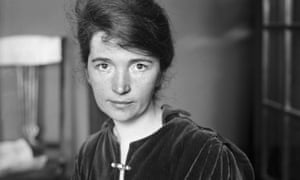
Margaret Sanger


When Planned Parenthood founder Margaret Sanger opened a family planning clinic in Brooklyn in 1916, it was promptly shut down. Photograph: Bettmann Archive

Let all women decide for themselves: that is Planned Parenthood’s mantra, and it transcends national borders. My grandmother was also one of the founders of International Planned Parenthood, launched in 1952. Just last week, I visited IPPF’s member association in Morocco, called the Association Marocaine de Planification Familiale. The association not only operates a reproductive health clinic, but also runs a community school for orphans and offers training facilities in hairdressing, dressmaking and cooking, providing career paths for underprivileged boys and girls. The Moroccan people trust and respect our organisation, as do people in 172 countries where IPPF operates.


To the poor and underserved, to the young and marginalised, to the minorities and immigrants that the US government doesn’t reach, my grandmother said: “We are here for you, all of you, no questions asked.”


A century ago, she was persecuted for this by the government, the churches, and many of her fellow citizens. She went to jail. When she got out, she continued the fight. At Planned Parenthood, we have fought the government, politicians, protestors and many anti-choice institutions, including churches and corporations. We have plenty more to do, nor least repealing the Hyde amendment, which prohibits Medicaid – social healthcare for US citizens of limited resources – from including abortion services, thereby depriving poor women of the right and means to decide on whether and when to have children.


Our international movement has never backed away from the fight to give women a choice. And we aren’t tired, even at 100 years old.


Planned Parenthood is 100 years old, but the fight for reproductive rights goes on | Alexander Sanger

28 Ağustos 2016 Pazar

Sydney"s "Rose of Tralee" shakes up Irish pageant with abortion rights speech

For almost six decades the Rose of Tralee – a pageant “which brings young women of Irish descent from around the world to County Kerry, Ireland for a global celebration of Irish culture” – has managed to avoid anything more political than expressing a desire to help the less well off.


That cozy consensus changed this week, when the Sydney entrant to the competition, Brianna Parkins, told presenter Dáithí Ó Sé, live on television: “I think we can do better here in Ireland. I think it is time to give women a say on their own reproductive rights. I would love to see a referendum on the eighth coming up soon. That would be my dream.”


Parkins was referring to the eighth amendment to Ireland’s constitution, passed in 1983, which guarantees the “right to life of the unborn and, with due regard to the equal right to life of the mother, guarantees in its laws to respect, and, as far as practicable, by its laws to defend and vindicate that right.”


— Marian Keyes (@MarianKeyes) August 27, 2016

Oh lads! This is an AMAZING article from @parkinsbrea. I’m in awe of her courage


Sydney"s "Rose of Tralee" shakes up Irish pageant with abortion rights speech

26 Temmuz 2016 Salı

Clinton leads way on abortion rights as Democrats seek end to decades-old rule

On a biting day in January, Hillary Clinton climbed the stage at a New Hampshire rally and accepted an endorsement from Planned Parenthood.


It was a day of unusual events. The country’s largest reproductive healthcare provider had never before made an endorsement in a presidential primary. But it was the Democratic presidential candidate who made the truly surprising announcement: a call for the repeal of the Hyde amendment, which bans the use of federal Medicaid dollars to pay for abortions.


Related: Abortion access still strained even after landmark US supreme court ruling


“Any right that requires you to take extraordinary measures to access it is no right at all,” Clinton said. “And not as long as we have laws on the book like the Hyde amendment making it harder for low-income women to exercise their full rights.” She supported repealing the amendment, she said the next day, “and actually I have for a very long time”.


The announcement made Clinton one of the only modern presidential candidates to oppose the nearly 40-year-old ban on federal abortion coverage. And this week, the rest of her party will follow suit. In what is the first significant shift to the party line on abortion in decades, Democrats will approve a platform at the Democratic national convention in Philadelphia that explicitly calls for elected officials to overturn Hyde.


But in a sharp departure from how abortion issues normally percolate, the loudest calls for the repeal of Hyde did not originate with groups such as Planned Parenthood or Naral Pro-Choice America – groups that have set the agenda for abortion rights supporters for decades. Instead, the calls originated with groups such as the National Asian Pacific Women’s Forum, the National Latina Institute for Reproductive Health and SisterSong.


“Women of color leaders have been calling for the repeal of Hyde for decades when most mainstream reproductive rights groups did not prioritize this issue,” said Jessica González-Rojas, director of the National Latina Institute and an All Above All co-chair.


The result is a movement that overtly fuses one of the modern Democratic party’s most established positions – support for abortion rights – with the interests of the activists who increasingly represent the demographic future of the party.


Hyde is one of the biggest barriers to abortion left standing, after the supreme court in June struck down health restrictions with no basis in evidence.


It is not a law, but a rider that has been attached to every one of Congress’ annual appropriations bills since 1976, when it was first introduced by the congressman Henry Hyde of Illinois. Today, the amendment prevents abortion coverage for some seven million women, about half of whom live below the federal poverty line. The only exceptions to the ban are when a woman’s health or life is in danger or the pregnancy is the result of rape.


“I would argue that it’s the harshest abortion restriction still on the books today,” said Destiny Lopez, who is co-director of All Above All, a network of reproductive rights advocates that is leading the first serious push to repeal the Hyde amendment in decades.


An All Above All letter addressed to the Democratic platform drafting committee read, “Coverage bans represent a deeply entrenched injustice, where issues of economic injustice, racism, and gender inequity come together.”


Democrats’ platform first outlined a position on abortion in 1976, three years after the supreme court case Roe v Wade established a right to the procedure. Acknowledging that some Americans had “religious and ethical concerns” about abortion, the party nevertheless said it was supportive of the justices’ ruling. In 1988, without specifically mentioning abortion, the platform declared, “The right of reproductive choice should be guaranteed regardless of ability to pay.”


But for 28 years, Democratic conventions were silent on how to actually guarantee that poor women had access to abortion. In Congress, even when the party firmly controlled the legislature, Democrats continued to approach the Hyde amendment as a forgone conclusion.


“This was really the third rail of abortion politics for a long time, even for folks who supported access to abortion,” said Destiny Lopez, the co-director of All Above All. “It involved both poor women and government funding, and that made people very nervous to talk about it.”


What changed, said Lopez, was more women of color forming their own reproductive rights groups and Democrats realizing their reliance had increased on nonwhite voters, young voters and women. Such is the makeup of most of the groups All Above All has organized to oppose the Hyde amendment. “It’s not a coincidence,” said Lopez, that this year those groups are succeeding in altering the Democratic platform.


All Above All was forged out of a frustration many activists felt after politics embroiled abortion coverage in the Affordable Care Act. It notched its first victory in 2015 when the California representative Barbara Lee, a longtime abortion rights supporter, led the introduction of a bill to guarantee abortion access for women on Medicaid. The bill also covered women insured by the government through the military, Peace Corps and veterans affairs.


This spring, Lee wrote the demand to repeal Hyde into the Democratic platform, as well as a call to overturn the Helms amendment. Many presidential administrations have interpreted the amendment, named for the former North Carolina senator Jesse Helms, as prohibiting US foreign aid from covering abortions. (Clinton has also promised to seek the repeal of Helms.)


It is a sharp reversal from the 90s, when the Democratic platform called for “less necessary, more rare” and “safe, legal, and rare” abortions. The latter was Clinton’s stated position on abortion for years on end.


Hyde still has stalwarts within her party. Senator Joe Manchin of West Virginia has said that for the party to oppose the Hyde amendment is “crazy”.


But the most high-profile supporter within the Democratic party may be Tim Kaine, the Virginia senator Clinton selected last week as her running mate for president.


Related: How Mike Pence wrote the Republican Planned Parenthood attack playbook


Although Kaine has a 100% rating from Planned Parenthood, he has said he opposes public funds for abortion. “I have traditionally been a supporter of the Hyde amendment,” Kaine told the conservative magazine the Weekly Standard in July. He added he wasn’t aware of a call to repeal Hyde in the platform, “but I’ll check it out”. Neither Kaine nor the Clinton campaign has said if he now supports Clinton’s position.


Anti-abortion groups immediately denounced the Democrats’ position when a draft of the platform was released.


“The platform Democrats are expected to ratify in Philadelphia is unrecognizable compared to twenty years ago, when the party claimed to ‘respect the individual conscience of each American’ on the abortion,” said Marjorie Dannenfelser, the president of Susan B Anthony List, an anti-abortion political action committee. “This is a gross violation of conscience rights.”


But proponents of repealing Hyde cite polls which show that public opinion is creeping in their favor.


“The pressure has been put on us by this electorate, by 18- to 30-year-olds, and women of color,” said Lee, the congresswoman. “I give them credit for insisting on it and holding us to it. It’s long overdue, but there’s finally a critical mass.”


Clinton leads way on abortion rights as Democrats seek end to decades-old rule

2 Temmuz 2014 Çarşamba

The Mexican "germ invasion" is just the right"s latest anti-immigration myth | Laura Murphy

Late last week, prior to President Obama gave up on pressuring Congress on extensive immigration reform in favor of his acquainted executive actions, media retailers began pressing a familiar non-information item.


The regional CBS station in Dallas/Fort Really worth reported that “four or five [US Border Patrol] agents have examined positive” for illnesses such as chicken pox or tuberculosis, ostensibly contracted at their border posts. With in excess of 18,500 agents stationed along the Mexican border, the headline probably ought to have been some thing like “Border Patrol Agents Unusually Healthful Between Americans”. Matt Drudge favored, as normal, a far more pernicious threat: BORDER PATROL AGENTS Check Constructive FOR Disease CARRIED BY IMMIGRANTS.


Channel eleven in Dallas also reported that one of the young children among the 52,000 who have crossed US borders in the last handful of months has been diagnosed with H1N1 virus (also acknowledged as “swine flu”). Congressman Henry Cuellar blamed the possible issue on “some of these countries the place they don’t have fantastic health care methods.” Perhaps he was speaking about the United States: Now that H1N1 is the predominant flu strain in the US and Canada, the Centers for Illness Manage reviews that two,008 of the two,815 reported instances of the flu in the US this season have been recognized as H1N1. That indicates that if you had the flu in the US in the past 9 months, it is much more than 70% likely that you have been contaminated with the swine flu, just like the sick little one trapped in Texas.


A little informed comparison can be beneficial: a examine of mortality among US school teachers suggests that they contract autoimmune illnesses at a fee disproportionate with the common population. Also: the subway is a significant conduit for the spread of influenza, including swine flu.


Thankfully, we haven’t begun a Typhoid Mary-style campaign against each and every American who employed public transportation, taught a middle-college class and/or sneezed this 12 months. But the myth of diseased hordes of immigrants has a long background in the American imagination, and now it is inflaming anti-immigration sentiment at a time when we need to tackle the genuine humanitarian requirements of the men and women who cross our borders in search of chance.


Even though President Obama said on Monday that he is doing work to “handle the urgent humanitarian challenge on the border”, the conservative radio host Bryan Fischer suggests that the genuine “humanitarian disaster” is the risk the young children pose to US citizens’ health. (He also thinks “children are now dying at the border due to the fact of Obama”.) Dr Marc Siegel preemptively declared on Fox News that the immigrant children had been “a big overall health crisis” – despite the reality that the US Department of Wellness and Human Services vaccinates and screens every recovered kid.


The consequence of this false reporting is widespread public anxiousness that immigrant populations pose a risk to the well being and safety of US citizens. And the normal “not in my neighborhood” cries have gone up on social media, insisting that the girls and kids who have just lately migrated in huge waves need to not be allowed a protected area to dwell in the United States while their situations get sorted out.


The howls are specifically egregious if it means the latest migrants to America reside anyplace close to the apparently complete-blooded Americans who do not recall their very own immigrant heritages or their ancestors who had been wrongfully accused of contaminating the nation in the 19th and early 20th centuries.


Let’s place this summer’s rhetoric into viewpoint: 1918 noticed a worldwide flu pandemic in the course of which at least 20m men and women died globally and as many as 550,000 died in the US alone. At times known as Spanish influenza simply because the first circumstances have been diagnosed in Spain, tiny was identified about who carried the flu and in which it originated. But the infection knew no age, class, race or ethnic bounds – folks all above the globe succumbed to a simple but deadly flu.


Nonetheless, US reporting on the Spanish flu and other diseases that arose at that time suggested erroneously that a surge in immigration caused the enhanced infections. In Denver, the Ku Klux Klan promoted anti-Italian sentiment by suggesting that the recent immigrants from Europe were responsible for the flu. Germans have been accused of employing the flu as germ warfare. Irish immigrants have been charged with spreading cholera. Tuberculosis was dubbed the “tailor’s disease” since men and women connected it with Jewish immigrants. Italians had been blamed for polio, too, despite the fact that they had been least most likely to contract it.


The terror of immigration-born epidemics was largely imagined, of course, but it fueled extremely real anti-immigrant fears and resulted in discrimination and oppression. These when-racialized groups are now folded into “whiteness” such that their histories of immigration have largely been erased from nationwide memory. Without considerable immigration reform, I concern the stigma connected to immigrants on the Mexican border could not fade so fast.


The Mexican "germ invasion" is just the right"s latest anti-immigration myth | Laura Murphy

30 Haziran 2014 Pazartesi

Reactions to the supreme court"s ruling on corporation"s religious rights

The supreme court ruled in a bitter, split choice that some companies must have a religious exemption concerning certain contraceptives. Conservatives cheered for the victories of Pastime Lobby and Conestoga Wood, even though condemnation came from liberals, foremost among them justice Ruth Bader Ginsburg, who wrote a scathing dissent


Reactions to the supreme court"s ruling on corporation"s religious rights

22 Haziran 2014 Pazar

Somaliland"s major lady for women"s rights: "It is time for guys to phase up"

Edna Adan

Edna Adan Ismail, the former initial lady of Somalia, in front of the maternity hospital she constructed in Hargeisa, Somaliland. The hospital has given that been completed. Photograph: David Gough for the Guardian


Edna Adan has led a daily life filled with firsts. The 76-yr-outdated was the initial woman from Somaliland to research in the United kingdom and the first experienced-nurse midwife in her country, as well as the initial female foreign minister and one particular of the very first in the world to talk out publicly about the horrors of female genital mutilation (FGM).


Now she is experiencing one more first: a cautious hope that the balance of energy is ultimately tipping in the fight towards violence against girls and girls, specifically towards FGM. But this veteran campaigner is aware of too nicely the dangers of above-optimism.


“I want I could say emphatically that I had real hope now that factors have been going to adjust, but we have had resolutions before in Cairo, Nairobi, Copenhagen,” says Adan, who has spent her daily life fighting for women’s rights, even cashing in her Globe Overall health Organisation (WHO) pension to develop the 1st maternity hospital in her nation. “But I am optimistic now: this is the initial time that the British government is entirely on board in making an attempt to place a stop to FGM. That can make a large difference.”


She praises Britain – a “strong ally” – for its function on targeting wellness specialists who carry out the unlawful process, which involves the partial or full removal of a girl’s outer sexual organs and can result in lifelong physical and psychological problems.


“The fight towards FGM has been the most significant battle of my life,” says Adan, “and each and every moment of my daily life has been a battle.”


It is no exaggeration. As a young lady, Adan left the autonomous area of Somaliland, a breakaway area north of Somalia that is not recognised by the UN, to study at the London’s South Bank University. She returned in the 60s to find she was the only educated midwife in the country, and it took 22 months for the government to spend her.


“There just wasn’t a salary scale for a woman,” she says. “They could have paid me as a cleaner, but not as an individual who ran the total maternity department. I just refused to leave, refused to back down and sooner or later they paid me.”


Following marrying former president Mohamed Egal, Adan became grew to become 1st lady of Somaliland and then its first female foreign minister. She had worked for WHO as an expert on nursing for more than a decade and did not want to end functioning rather, she cashed in her pension and sold most of her possessions in order to accomplish a lifelong dream – opening a dedicated maternity hospital in her property town of Hargeisa, opting to reside in a modest flat above the hospital.


The hospital had no employees so Adan recruited thirty trainees, who started their coaching prior to the hospital opened. It now has two operating theatres, a laboratory and a instruction wing, as effectively as a completely qualified workers that consists of two female medical doctors initially recruited as nurses. Their careers are her greatest supply of pride. “They commenced on my nursing programme as 18-12 months-olds. I sponsored them by way of health care school and now they are searching after and healing the sick – practically nothing can beat that,” says Adan.


Adan – whose life’s function was depicted on movie at last week’s Global Summit to End Sexual Violence in Conflict – spoke to the Guardian after launching an appeal to fund operations at her hospital on Humanity Direct.


Asked about the continual personal sacrifices she can make to ensure its survival, she thinks for a second. “When I very first imagined about creating a hospital, I believed of it as providing and sacrifice, but having qualified hundreds of students and possessing seen thousands of lives saved, I now know that I have gained so considerably more than I have provided,” she says.


“There is absolutely nothing to evaluate to seeing a lady coming in with a fistula and currently being healed there is nothing much more rewarding than seeing a premature little one who can only survive in an incubator, leave breathing for itself and in a position to go residence. These rewards, they are immeasurable.”


Adan may possibly not be filled with hope but she is heartened that violence towards ladies is gradually making its way up political and media agendas.


“Violence towards girls and women has constantly been there, no country is immune to it, but this collective cruelty against ladies is at last gaining the consideration of the world – this kind of as this tragedy in Nigeria [the kidnapping of 200 schoolgirls in Chibok], exactly where we have observed young women utilized as weapons, it has shocked the total world,” she says. “It is time to say enough is ample. Issues are acquiring greater, but not on the ground as speedily as I would like to see.”


Adan is unapologetic in her belief that men must phase up to the mark in the fight for gender equality. “Fathers must join this battle. This is taking place to their daughters, their mothers. Ladies have suffered for lengthy adequate, it is time for men to perform a higher role,” she says. “We require a worldwide movement to make this a central concern, so it is no longer confined to the borders of debate.”


Somaliland"s major lady for women"s rights: "It is time for guys to phase up"