Sarah etiketine sahip kayıtlar gösteriliyor. Tüm kayıtları göster

11 Mayıs 2017 Perşembe

To improve mental health, start with benefits system | Sarah Chapman

Two-thirds of British adults have experienced mental health problems at some point in their lives, according to the Mental Health Foundation. For people forced to use a food bank like ours, the figures are even higher.


It’s no wonder. The NHS says depression can be caused by “an upsetting or stressful life event, such as bereavement, divorce, illness, redundancy and job or money worries”. People who use food banks face many of these – often at the same time.


A blister from new work boots leads to an ulcer; you’re struggling to walk round the building site and the foreman lays you off with no warning and no sick pay. It takes weeks to access sickness benefits. Your marriage breaks down and you’re suddenly homeless. This is just one story, of a man in his 60s facing an onslaught most of us would struggle to withstand.


Our research highlights that poor mental health is both a cause and a consequence of poverty. Of 20 food bank users we interviewed during one week, 18 said they had experienced poor mental health – stress, anxiety and depression – in the last 12 months. Six said they had considered or attempted suicide in the past year.


Philip*, for instance, had just left hospital when he came to us, after being sectioned six weeks earlier when he attempted to take his own life. Sue*, a grandmother in her 50s, told us, “I’ve had suicidal thoughts. Sometimes I do feel it is the answer. I constantly think of different ways, you know – that can take up a whole evening”.


This is the reality of food banks across the country. Research with referrers to our food bank (such as GPs, mental health services, schools and children’s centres) highlights the same issue; nine out of 10 cite seeing poorer mental health as a direct consequence of poverty.


Time and time again, research [pdf] shows that poverty exacerbates mental health issues by increasing feelings of humiliation, fear, distrust, isolation, insecurity and powerlessness.


Insecurity when you lose your low-paid temporary job or you don’t get the hours you need in a zero-hours contract; when your benefits are due to change as a child turns five, or your Disability Living Allowance needs replacing with Personal Independence Payment; when your private landlord calls time and you join the queue at the council, desperate to be accepted on to the housing list.


Humiliation when your benefits are sanctioned for missing one appointment and “you can’t complain because they’ve got control of you by the money”, as one lady told us after being referred to our food bank by the job centre that sanctioned her. “They can do what they want with you, unless you say please and thank you, and beg.”


Policies that create appalling situations that damage people’s health make me more angry than I can say


Isolation when your “one offer” of temporary accommodation is miles away in another borough, where you don’t know anyone but you’ll still need to get your children back to primary school every day (and you’ll receive no financial help for the extra travel costs).


Fear and distrust when you are called for a medical assessment and the report bears little relation to the interview you had, and even less relation to the expert testimony of your GP, hospital consultant or support worker. Your benefit stops.


We listen to these stories every day at the food bank, keeping how we feel to ourselves as we nod, hand out tissues and make more tea. The short-sightedness of policies that worsen – sometimes even create – appalling situations that damage people’s health makes me more angry than I can say.


You try it. “The job centre told him he needed to do his job in a wheelchair,” says Asha*, mum of three, about her husband, a supermarket delivery driver whose back problems mean he can’t walk properly. “His job? It doesn’t make sense. But to even get to work, he needs to get out of his depression first. Last week he took an overdose.”


“It’s like a nightmare,” she continues. “The system makes it worse and in the end they just leave you with your problems. Any small change and you can lose everything. When it will stop?”


If politicians are serious about tackling poor mental health, our social security system needs to be strong – and for those lining up at our door every day to put food on the table for their kids, it just isn’t.


We should be a country in which people are treated with humanity, fairness, respect and compassion. We need a safety net that is more responsive to unexpected changes in circumstances and health, and less quick to penalise people for whom, at one particular moment in time, life has become an unbearable struggle. That would mean a benefits system which actually boosts people’s chances of improving their life prospects. Until then, we’ll have to keep training our volunteers in mental health issues, because we’re not just handing out food – we’re a source of solace.


* Some names have been changed


Sarah Chapman is a trustee at Wandsworth food bank


Talk to us on Twitter via @Gdnvoluntary and join our community for your free fortnightly Guardian Voluntary Sector newsletter, with analysis and opinion sent direct to you on the first and third Thursday of the month.


To improve mental health, start with benefits system | Sarah Chapman

27 Mart 2017 Pazartesi

What are your experiences of getting help for gynaecological problems? | Sarah Marsh

GPs are failing to treat women with common gynecological complaints, according to MPs. A report by the all-party parliamentary group on women’s health (WHAPPG) said female issues are not being treated with dignity or respect. They discovered that many women were left feeling they were “going mad” after being turned away by doctors despite painful symptoms.


A survey of 2,600 women found that 40% of those with endometriosis, when the womb tissue grows outside the uterus, had to visit their GP 10 or more times before getting treatment. This is a condition that affects about 2 million women, with symptoms including stomach aches and painful bleeding.


As a result, women were left doing their own research to understand the illness. The WHAPPG recommended more training for GPs, calling for more information for women in surgeries.


What are your experiences with your GP? Were you turned away or did you get really good care? Did you eventually get the help you need? Share your stories with us in the form below.


What are your experiences of getting help for gynaecological problems? | Sarah Marsh

12 Mart 2017 Pazar

Sarah Weddington, Roe v Wade attorney, on Trump’s threat to abortion rights

Sarah Weddington is the lawyer who, aged just 26, represented “Jane Roe” in the landmark case Roe v Wade, which in 1973 effectively legalised abortion in the US. The daughter of a Methodist minister, she was born in 1945 in Abilene, Texas. Having graduated with a degree in English from McMurry University, she enrolled at the University of Texas Law School in 1964, one of 40 women among a student body of 1,600. “I thought I would be teaching eighth graders to love Beowulf,” she recalls. “But that wasn’t working out so well, so I decided to go to law school instead. In this, I was encouraged by the dean of my college, who told me that it would be far too tough for a woman. ‘As sure as dammit I am going,’ I thought.”


After graduating, she joined a group of students who were seeking to challenge anti-abortion laws, agreeing to file a suit against the state of Texas on their behalf. Soon after, 21-year-old Norma McCorvey was referred to Weddington and her colleague Linda Coffee, now actively looking for pregnant women who were seeking abortions. McCorvey became the plaintiff “Jane Roe”, though by the time the supreme court issued its ruling, her baby had long since been born and given up for adoption. McCorvey later became an evangelical Christian and vocal anti-abortion campaigner, and claimed to have been the “victim” of the Roe v Wade lawyers. She died last month aged 69.


I was very nervous. It was like going down a street with no street lights. But there was no other way to go


Weddington remains the youngest person ever to have argued a successful case at the supreme court. In 1973, she was elected to the Texas House of Representatives, where she served for three terms. In 1973, she became the first female General Counsel at the US Department of Agriculture. From 1978 until 1981, she served as assistant to President Carter, directing his administration’s work on women’s issues. She now runs the Weddington Center, Austin, whose work focuses on women and leadership. She recently told NBC news that the election of Donald Trump may pose the biggest threat yet to abortion rights in the US.


Where were you on election night? Did you sense that Trump was going to win?
Austin is one of the more liberal towns in Texas, though the state itself is barely liberal. Most people I know strongly expected Hillary to win. But I’d been on a panel a few weeks before where a man had said: “You liberals think Hillary is going to win. Well, let me tell you, there are a lot of people out here who are voting with our finger – the middle finger.” So I knew there was… resistance. There were a lot of parties on the night, but I had enough concerns to be afraid that going to one might turn out to be too depressing. So I came here to my office, and watched it on the New York Times website.


What’s your impression of the president so far?
I thought he would be terrible, and he has proven me correct. In Texas, we have a lot of people from Mexico and El Salvador, and a lot of them are worried family members will be deported.


What do you make of the growing fear that under this administration Planned Parenthood [a 100-year-old nonprofit organisation that is the largest single provider of reproductive health services, including abortion, in the US] will lose its federal funding?
The federal government has never given money to Planned Parenthood for abortion. It gives money to it for the provision of contraception and well woman care: for the treatment of venereal disease, mammograms, and so on. The anti-abortionists recognise that the money is not used for abortion, but they want it cut off anyway. It is a real threat. But Planned Parenthood may ultimately benefit from what Trump is doing and saying. Last week, I was in Houston for a Planned Parenthood event. Usually, there would be about 1,000 people in the audience. This time, we had 2,500. People are very worried, and they are giving more generously.


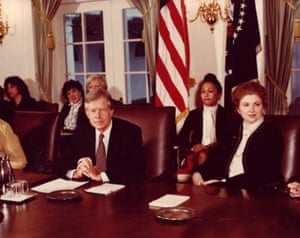
Sarah Weddington with president Jimmy Carter. She served as his assistant from 1978 to 1981.


Sarah Weddington with president Jimmy Carter. She served as his assistant from 1978 to 1981. Photograph: Courtesy Sarah Weddington

What about abortion? Is it possible it could become illegal again in the US?
Trump has always said that he would try to appoint people who were strongly against abortion to the supreme court. But Neil Gorsuch [a conservative judge, and Trump’s nomination to the supreme court] has never said that much about abortion. States can’t make abortion illegal. But some have been passing laws that make it much less available, for instance by saying that no abortion can be done except in a facility that meets the requirements for emergency care. In other words, they make the cost of abortion much higher. A lot of women are already crossing state lines, and in that sense, a lot of what is happening is just like it was before Roe v Wade was decided. You’ve got one vacancy now on the supreme court. But Ruth Bader Ginsburg, who is helping to keep abortion available, is 83, and there are a couple of older male judges too. If Gorsuch’s nomination is approved, will abortion be illegal the next day? No. One new judge won’t necessarily make much difference. But two or three might.


How did you feel on hearing that Norma McCorvey had died?
Well, I was sad. I appreciate that she was once concerned with overturning the law on abortion. But on the back of being Jane Roe, she ended up going on all these pro-choice tours. I learned to be very careful about believing what she said.


You worked somewhat against the odds on the case in which she became involved.
That’s right. There was a building across the street from the University of Texas and a lot of student organisations had cubby holes there, with desks rescued from the garbage. In one little nook, women and some men were trying to work on women’s issues. One thing that was upsetting was that the university health centre did not give out information about, or prescriptions for, anything relating to contraception. A couple of these women had gone to New York and got a copy of Our Bodies Ourselves [a landmark book of 1971 that dealt plainly and openly with women’s health and sexuality] – I still have this mental image of them in a closet with a flashlight reading this book – and they began to give the relevant information out to women. As they did, women would sometimes say: “I’m already pregnant. Where can I get an abortion?” So they started going to places where abortion was available, and they’d write up that information, too. Sometimes, for instance, they’d write: “This person does not seem very skilled: never send anyone here.” A lot of women were going to Mexico. Abortion was illegal there, too, but it was close to Texas, and sometimes women ended up in the wrong hands because people there wanted to make money out of the situation.


The upshot of all this was that the women students were getting worried the police might arrest them for being accomplices to abortion. We were sitting at the snack bar in the law school one day and one of them, Judy Smith, said: “We need to get a lawsuit filed and try to overturn the Texas law. Would you be willing to do it?” I told her she would be better off with someone with more legal experience. I’d only done uncontested divorces, wills, one adoption for my uncle; I had no experience at all in federal court. “How much would you charge?” she asked. When I admitted I would do it for free, she said: “OK, you are our lawyer.”


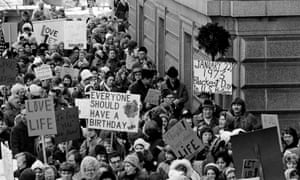
Protest marchers form a ‘ring of life’ around the Minnesota Capitol building protesting the US supreme court’s Roe v. Wade decision, 22 January 1973.


Protest marchers form a ‘ring of life’ around the Minnesota Capitol building protesting the US supreme court’s Roe v. Wade decision, 22 January 1973. Photograph: AP

Were you nervous?
I was very nervous. It was like going down a street with no street lights. But there was no other way to go, and I didn’t have any preconceived notions that I would not win. In 1965, there was a case, Griswold v Connecticut, involving doctors and the supply by doctors of contraceptive devices to a married couple. [Connecticut was then one of two states where contraception was effectively illegal, even if the law was rarely enforced.] Yes, neanderthal. That case was won in the US supreme court, and in its ruling, the court had talked about the right of privacy under the constitution. It was, the court said, for the married couple to decide whether or not to use contraception. So there was a precedent. But I certainly was not confident.


You won in the federal court, but the case still went to the supreme court. Why?
In Dallas, the court ruled there was a right of privacy, that abortion should be legal. Henry Wade, the district attorney, then unwittingly helped us. At a press conference, he said: “I don’t care what any court says; I am going to continue to prosecute doctors who carry out abortion.” There was a procedural rule that said if local elected officials continue to prosecute after a federal court had declared a law unconstitutional, there would be a right to appeal to the supreme court.


Did you have any hint at all as you addressed the supreme court that you might win?
No, it was impossible to read the justices’ faces. The attorney on the other side started by saying something inappropriate about arguing a case against a beautiful woman. He thought the judges would snicker. But their faces didn’t change a bit.


It was a while before the verdict was released, wasn’t it?
I had to argue it twice in the supreme court – in 1971, and again in 1972. On 22 January 1973, I was at the Texas legislature when the phone rang. It was a reporter from the New York Times. “Does Miss Weddington have a comment today about Roe v Wade?” my assistant was asked. “Why?” she said. “Should she?” It was beginning to be very exciting. Then we got a telegram from the supreme court saying that I had won seven to two and that they were going to airmail a copy of the ruling. Nowadays, of course, you’d just go online. I was ecstatic, and more than 44 years later we’re still talking about it.


When you published your book A Question of Choice in 1992, you decided to reveal that in 1967 you’d had an abortion yourself, while you were still a law student. Why did you wait so long to reveal this?
Just before the anaesthesia hit, I thought: I hope no one ever knows about this. For a lot of years, that was exactly the way I felt. Now there’s a major push to encourage women to tell their stories so people will realise that it is not a shameful thing. One out of every five women will have an abortion. I was lucky because the man I was planning to marry [Ron Weddington; they divorced in 1974] was with me. He drove me to Mexico. We had gotten information from a woman he knew about where to go, and luckily I was working three jobs so I had the money to pay. It was anxiety-inducing. You’re going across the border to see someone you don’t know. But it turned out that my doctor was very good. I wish I had his name, so I could thank him.


Are you still able to get in touch with the young woman you once were, or does she feel very far away?
Well, my hair is white now, so in one way, I don’t see myself as her at all, even if, whatever else I do in my life, the headline on my obituary is always going to be: “Roe v Wade attorney dies.” But in terms of my emotions, yes: I think most women of my generation can recall our feelings about the fight. It’s like young love. You may not feel exactly the same, but you remember it.


Sarah Weddington, Roe v Wade attorney, on Trump’s threat to abortion rights

6 Mart 2017 Pazartesi

NHS staff: tell us about the impact of social care cuts | Sarah Marsh

The government’s austerity programme is squeezing funding to both social care and the NHS – leading to serious problems in both. The Care and Support Alliance this month has found almost 9 out of 10 GPs think reductions in social care are leading to extra pressures in their surgeries. Even more (93%) think that the lack of social care is leading to extra pressure on A&Es and contributing to increased delayed hospital discharges.


We’re looking for NHS staff who have been affected by the cuts for Frances Ryan’s Hardworking Britain column, which looks at the stories of individuals whose lives have been negatively impacted by government policy.


Share your experiences


Are you a GP seeing the impact of social care cuts? Or do you work in A&E and cannot discharge patients because there’s no support for them at home? Share your stories and views.


NHS staff: tell us about the impact of social care cuts | Sarah Marsh

13 Şubat 2017 Pazartesi

Do you have any cosmetic surgery regrets? | Sarah Marsh

The cosmetic surgery industry has seen relatively consistent growth over the years, but in 2016 the number of people going under the knife fell to a near-decade low. So what’s going on?


The British Association of Aesthetic Plastic Surgeons, which compiles the annual audit, put the decline down to financial constraints in a climate of global fragility. But industry observers think social media-savvy presenters and models have been shifting the focus away from appearances to “relatability”.


The news comes as some celebrities are turning their backs on cosmetic surgery. Take Katie Price, for example, who has had earlier work reversed.


We want to hear from people who have had cosmetic surgery about how they feel now. Do you have regrets about going under the knife? Or do you feel happy with what you had done? Do you think the landscape has now changed? Why do you think cosmetic surgery numbers are down? Please tell us your thoughts and share your experiences.


Do you have any cosmetic surgery regrets? | Sarah Marsh

22 Aralık 2016 Perşembe

A toxic leak left Corpus Christi with no water for days. A taste of things to come? | Sarah McClung

Corpus Christi, Texas, calls itself the “sparkling city by the sea”. But lately it doesn’t feel very sparkling. The city imposed a four-day ban on consuming any tap water last Wednesday. No one could drink the water, shower, bathe, do dishes, wash laundry, hands, faces or children with it. There were fears that a corrosive asphalt emulsifier Indulin AA86 had snuck all the way from the city’s industrial district into our homes due to a “back-flow incident”. There was water, water everywhere, and not a drop to drink.


On 1 December, the Corpus Christi city hall received the first report of dirty water from Refinery Row. On 7 December the city hall received their second, on 12 December their third. By then the water was shimmery, sudsy – just the kind of sheen we would soon fear creeping into our commodes.


On 14 December, city hall told us not to consume tap water. If it was contaminated with Indulin AA86, then drinking it could sear our stomachs, light up our lungs and burn any bodily organ it contacted through water or air.


Where were the men and women who would put public safety before all else? Where were the leaders who would make sure that the companies in charge installed and maintained a backflow preventer that would have kept Indulin AA86 where it belonged: out of our tap water.


But this is only Corpus Christi, a forgotten scab of a city. A tiny, immaterial industrial outpost marking naught but the dwindling Texas shoreline as it slopes and surrenders on its muddy fall to Mexico. This is the small potatoes of municipal incompetence; until it isn’t. Until we look to the future of the Trump administration and see the shimmering signs of far worse to come.


Streets need their protectors, cities need them too. And countries? Most notably, a country that’s among the biggest environmental offenders, a country whose ties to big business, big oil, big money are notorious for putting profit before the public good? That kind of country doesn’t need Scott Pruitt, it doesn’t need Rex Tillerson and it certainly doesn’t need Rick Perry.


Had Corpus Christi taken as much care with its public facilities as it does with the maintenance of private residencies, my two-year-old daughter might not have known what it was to be thirsty on the morning of 15 December, 2016. But with a Trump administration around the corner, I have to check myself: four days without water is nothing compared to the damage that four years without oversight, without vigilance, without care could do to our water and to our land.


Four days of thirst. Will it foreshadow the harm that Trump’s fossil fuel friends in the cabinet will bring? We all know the line-up: Scott Pruitt, a climate change denier and advocate for fossil fuel, at the helm of the EPA; Rick Perry, a climate change denier and apostle of Texas oil and gas directing the department he famously forgot he wanted to eliminate; and Rex Tillerson, a man whose successful devotion to commercial profit as the CEO of ExxonMobil is the absolute epitome of placing private over public good.


This is the very formula for successful municipal management that helped land me and my family thirsty and hunting for water last week. This is the very mindset that may have introduced Indulin AA86 into our water supply. This the very philosophy that sent me scouring supermarket shelves for four hours in three towns while my daughter cried in her carseat.


Our water is back now; the ban has been lifted. But every time I turn on the tap I hesitate, I hope for the best. That feeling will only grow stronger the closer we get to a Trump administration.


A toxic leak left Corpus Christi with no water for days. A taste of things to come? | Sarah McClung

14 Aralık 2016 Çarşamba

What are your experiences of accessing mental health services in the UK? | Sarah Marsh

This week, the Guardian reported that NHS England is sending patients who are seriously ill with eating disorders to Scotland for treatment. Chronic bed shortages mean there is nowhere for them to get help closer to home.


Mental health experts have expressed concern about this, saying it’s compromising the quality of care for those in need.


It’s not the first time there have been reports of mental health patients being sent miles from home for treatment. Earlier this year, research by Community Care and BBC News found that in 2015 more than 5,400 mental health patients had to travel out of area for a psychiatric bed.


There are also reports of specialist mental health services turning away almost a quarter (23%) of children and young people seeking help. The Education Policy Institute Independent Commission on Children and Young People’s Mental Health, which did the report, said it is often because there are “high thresholds” for accessing services.


Research suggests that cultural factors can make it harder to get help too. Professors at Brighton and Sussex Medical School found black and minority ethnic groups struggle to access services, partly because of a communication breakdown between healthcare users and providers.


What are your experiences of accessing mental health services? We want to hear from people of all ages and backgrounds, across the UK, about any challenges you faced or help you received. Were you able to access help as soon as it was necessary, or was there a waiting period? If you had to wait, how did this affect you? Were your concerns met by your GP? Were you moved miles from home for treatment? Or perhaps you want to thank professionals for looking after you. What were the best aspects of your care? Share your stories and experiences with us in the form below.


What are your experiences of accessing mental health services in the UK? | Sarah Marsh

26 Ekim 2016 Çarşamba

NHS staff lay bare a bullying culture | Sarah Johnson

Bullying is a pernicious problem in the NHS. That’s the stark finding from exclusive research by the Guardian. The online survey of more than 1,500 doctors, nurses and other health workers in hospitals, primary care and community settings, found that 81% had experienced bullying and for almost half of them (44%), it is still ongoing. Close to nine out of 10 bullying victims who responded have been left with their cases unresolved.


Although the survey on bullying was self-selecting, the findings underline the results of the official annual NHS staff survey. The 2015 survey of nearly 300,000 healthcare professionals across England found that a quarter of staff in NHS trusts had experienced bullying, harassment or abuse in the previous 12 months.


Some 87% of respondents to the Guardian survey, carried out between August and September, think bullying is a big problem within the NHS, while almost three-quarters said they felt the health service did not take bullying seriously. “The culture is driven by exerting undue pressure on others to get things done. If you don’t, you are targeted and eventually you end up with stress and depression,” one NHS manager said.


Respondents who have been bullied take on average 108 days off work and a third have contemplated leaving their jobs


“The organisation becomes defensive and takes the corporate line to protect themselves from a legal challenge and puts it down to your perception. You are then managed out of your job through contrived actions designed to make you leave. All this leaves you broken and with no strength to fight. You go if you can find another job. Otherwise you suffer in silence.”


The devastating impact of bullying is all too apparent. A third of victims said they had been pushed out of their jobs, with many developing serious mental health problems as a result, while almost three-quarters reported increased stress and panic attacks. As a result, some 41% said they needed counselling or treatment after being bullied. The survey also shows the adverse impact of bullying on the NHS, with those respondents who have been bullied taking on average 108 days off work and almost a third (31%) saying they were signed-off sick. A further third said they had contemplated leaving their job.


Sue Covill, director of development and employment at NHS Employers, (the employers’ organisation for the NHS in England) admits the results are worrying. “Bullying is completely unacceptable and the ongoing work to tackle it is vital for all NHS organisations, leaders and staff,” she says. “To improve the working lives of our staff and deliver the best possible care to patients, we need to create supportive, positive, open and collegiate cultures in our organisations across the health system.”


According to the 1,355 anonymous survey respondents who said they had experienced or witnessed NHS bullying, the most common forms of abuse are undermining behaviour and persistent criticism. Just over a third said they were persecuted through fear or threats, saying their career was deliberately sabotaged. One in 10 bullying victims was subjected to violent behaviour and aggression.


Asked if a particular incident triggered the bullying, 55% said raising a concern prompted the abuse. Fear of reprisals means that only 54% reported the bullying. For the 43% who chose not to report it, two-thirds felt scared that to do so would make things worse. Of those who did report their bullying, 44% said it persisted afterwards, sometimes for as long as a year.


“My experience left me feeling as though I had been manipulated, that I was a liar and had made it all up,” said one NHS administrator. “I had a meeting with my bully and came away from it feeling worse than before. I’m now left feeling desperately unhappy in a job I now despise.”


Only 17% of those who reported bullying said they received pastoral support from their organisation – and less than a quarter of these were satisfied with the result.


A YouGov survey commissioned last year by the TUC showed that nearly a third of people had been bullied at work.


Concerns have been raised by health professionals and academics that the hierarchial structure of the NHS facilitates a culture where bullying can flourish.


“Medicine is a hard taskmaster but made worse by those around you who see you as a threat that rocks the hierarchy where everyone should know their place,” an anonymous hospital consultant says in response to the results of the Guardian survey. He warns: “It may well impact on patient care if those who perpetuate the abuse look for an opportunity to trip you up and blow any minor omission out of all proportion.”


Dr Anthea Mowat, chair of the British Medical Association’s representative body, says the survey results should act as an urgent wake-up call to employers. “If more staff are to speak out, they must be able to raise concerns without fear of being harassed or victimised, and there need to be clear and supportive systems of reporting in place,” she says. “We need to put an end to the climate of fear that has built up in the NHS over a number of years, with those in senior positions in the NHS leading by example to make this a reality.”


The survey, by the Guardian’s Healthcare Professionals Network, was sent out to network members via an email newsletter. It was also promoted via Twitter and Facebook. Network readers were also invited to take part through the website.


Nurse who left the NHS: the loss of my role was like a bereavement


I was an experienced nurse working in a fantastic team of staff. Following a reshuffle, our ward manager was replaced by someone who was known for being a bully. She frequently made comments and used language inappropriate for the role. Her victimisation of me began immediately. On one occasion, due to staff sickness I was expected to do the jobs of four other people and was reprimanded when I objected. I was expected to attend meetings on my days off. I was constantly ridiculed and told that medical staff had criticised me even though, when questioned, they quite clearly had not. On one occasion I was physically pushed out of the way. This went on for over a year and, along with the treatment of me that followed, had a devastating effect on my psychological health. I was having panic attacks and suicidal thoughts.


I took out a grievance and was immediately moved to an area where I had no previous experience or expertise. Unable to continue working I was signed off sick with work-related stress. My bullying complaint was not investigated properly and not upheld. I believed that I had been targeted as I had previously raised concerns about patient care. I appealed against the decision and with the support of a union representative and witnesses, I won. But the bully remained in post and I was offered a job in another area, at a lower grade. I was advised by my union that I was being constructively dismissed and not to return to work. I negotiated an exit strategy with payment of a tax-free lump sum under one of the now-outlawed compromise agreements. I am now in receipt of an NHS permanent injury benefit which guarantees me a tax-free income, in excess of what I was previously earning, for the rest of my natural life. I now work for a private company in a non-clinical setting. The loss of my clinical role has been like a bereavement and not a day goes by when I do not think about the injustice of my case.


NHS manager: the bullies have wrecked my career


There is an endemic culture of bullying at the hospital trust I work at. Colleagues have been suspended for raising concerns over unsafe patient care and allegations of abuse towards patients. One colleague had to leave her job after whistleblowing and is undergoing counselling for post-traumatic stress disorder. In my case, the bullying was incessant – my line manager would call me in the evening at home telling me to take time off work and encouraging me see my GP as, in her opinion, I was unwell – I wasn’t. She insisted that I had to contact her every morning to tell her where I was, even at work. Other senior people soon started to target me and I would be admonished for the smallest of errors and for things I hadn’t done. Because of the seniority of these people, other members of staff began to pull away, and I soon became isolated. By this time, I had gone to see my GP who had diagnosed me with severe depression. I have had suicidal thoughts – occasionally I still do. I’ve been demoted and moved into a job where I have no experience and I’ve been offered no training; I’m being set up to fail. I’m resigned to the fact that I will have to leave the trust at some point, as I can’t carry on. The bullies have wrecked my career in the NHS, and my confidence in my ability has evaporated. The whole experience has had a profound effect on me – cheerful confidence has been replaced by paranoia and distrust; I will never be the same person again. To this day I do not know what I did wrong – if anything.


NHS staff lay bare a bullying culture | Sarah Johnson

14 Ekim 2016 Cuma

The pressure of perfection: five women tell their stories | Guardian readers and Sarah Marsh

Do you look at other people’s lives and compare them to your own? Does this make you question whether you are smart, fit or happy enough?


If so, then you may be a perfectionist. Writing for the Guardian earlier this year, clinical psychologist Linda Blair described a perfectionist as a person: “who strives for flawlessness, for a perfect creation, outcome or performance … They find it difficult to delegate, even if that means neglecting their health, relationships and wellbeing in pursuit of a ‘perfect’ outcome.”


According to some studies, this is something that largely affects women. A US survey in 2009 found that women are also more likely than men to experience feelings of inadequacy at home and at work, and a larger proportion felt they failed to meet their own high standards.


These insecurities are well-documented in the world of work: in 2011, the Institute of Leadership and Management found half of female managers, compared with fewer than a third of the male ones, reported self-doubt in their performance. An internal survey of women working at Hewlett-Packard also found women applied for a promotion only when they met 100% of the qualifications. Men applied when they met just 50%.


The desire to be perfect seems to influence thinking from a young age: research by Girlguiding UK found that a quarter of seven- to 10-year-old girls felt the need to be perfect.


Perfectionism can have serious implications: it’s been linked to anxiety and depression, and the health and happiness of young women is a growing concern. In fact a NHS study found 28.2% of 16- to 24-year-olds have a mental health condition, with one in four women aged 16 to 24 experiencing anxiety, depression, panic disorder, phobia or obsessive compulsive disorder.


We decided to explore this topic with our readers, asking for young women’s experiences and stories of perfectionism. We received 134 responses – with an average age of 25. For a lot of young women who contacted us, body image was a huge preoccupation and many said they felt undervalued unless they met society’s expectations of beauty. The pressure to be perfect also extended to the workplace, withmany respondents talking about feeling inadequate at their jobs or experiencing impostor syndrome. They also complained of feeling the pressure to have it all: juggling being a mother with career and other personal pressures.


Social media has a big role to play in influencing women’s outlook on this issue. Miranda, 18, from Cambridge summed this up: “I certainly feel the pressure to be perfect and it has got to the point where it’s damaging my health. Social media is the main culprit. I had to delete my Instagram account because it would actually make me cry. I am a mature person with a firm grip on reality, but I have so many peers whose lives seem so perfect and sociable that it left me feeling worthless and lonely.”


The impact of all this pressure on women’s mental health and wellbeing was notable, with many experiencing anxiety, eating disorders and depression. We approached five women to find out more. Here are their stories:


Chardine Taylor-Stone, 31, who works in the arts in London


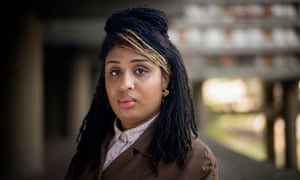
Chardine Taylor-Stone


‘The pressure to be perfect feels heightened to me as a black woman.’ Photograph: Sarah Lee for the Guardian

As a child I felt pressure to be a certain kind of perfect, so I wanted to look pretty and nice while my male cousins were running riot, that sort of nonsense. I wanted to marry a man and get a job.Now I am an adult my aspirations have changed and I am a lot more confident about who I am. I’ve broken out of those narrow expectations, but I still feel a lot of pressure in terms of my career.


I am one of few black working-class womenin my industry,which is dominated by white men. Most of the black women I see in the arts are personal assistants;none of them are working in a position that gives them autonomy – although they usually end up running a lot of things anyway.


I definitely have impostor syndrome; that’s defined as self-doubt and a sense of intellectual fraudulence thatoverrides any feelings of success. I didn’t have this so much before, when I was working in call centres, but I feel it now in a predominantly upper-middle-class environment. It’s weird being the only person of colour or the only one with a certain accent – it makes you feel as though you shouldn’tbe there. I sometimes suffer so much anxiety about sending an email, worrying about whether I will phrase it correctly. It’s silly because I’ve done well and proven myself, I have my own flat and a good job, yet that doesn’t feel good enough.


The pressure to be perfect feels heightened to me as a black woman because my mum always told me I would have to work harder than a white person to get ahead. It is true but it’s a self-defeating aspiration.


Perfection, or what society deems perfect, is not attainable for everyone, but it feels even further away for a woman of colour. The image of perfection is a certain physical type: a skinny woman with blond hair etc. Those things are not even half attainable to you, and you sometimes feel you were born imperfect.


Salma Al-Hassan, 18, student at Warwick University, from Oxford


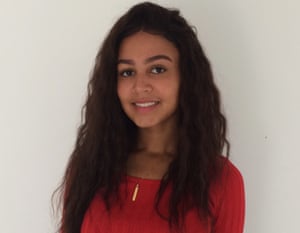
Salma Al-Hassan


‘I wish I could be more relaxed about how I look.’

I feel the need to look perfect all the time. I am not sure where this obsession comes from but social media definitely makes it worse.


I got Instagram when I was 14 and growing up with it has really affected me. I spend ages scrolling through the site and seeing images of women with perfect hair and makeup, thinking I should look like them – even though a lot of the time the pictures have been altered. I have always felt self-conscious about my hair because it wasn’t long and straight like the girls I saw online. I would see all my friends with their silky long hair, so easy to brush, and think: “I want that.” I got hair extensions to make my hair longer, which cost a lot but now I am trying to love my natural afro hair again. I want to embrace my natural curl.


Social media also brings the pressure of getting lots of likes; a lot of people post at “prime time”, which is about 5pm, when everyone is online. I know friends who will say: “If I don’t get 40 likes I am deleting the picture.” I’m not majorly worried about this, although I have deleted photos before, but afterwards thought: “That was stupid and I shouldn’t care what other people think.”


Another source of pressure for me, personally, comes from the fact that the media has become obsessed with a particular aesthetic for mixed-race and black women. We are only deemed attractive if we have tiny waists and large hips and lips. Over the past few months I have started to become very self-conscious about my lips, which are not as full and beautiful as other black women’s. I don’t have plans to get plastic surgery, but if I did get anything done it would be lip fillers because it just seems to be a fashion thing now – lot of celebrities get it done.


I wish I could be more relaxed about how I look: I am getting better gradually but I still always try to look good, and always put on makeup. While nowadays there is definitely a much more diverse idea of what beauty is, there are still stupid stereotypes which people are stuck in, myself included. There is still a long way to go for women to accept themselves for who they are.


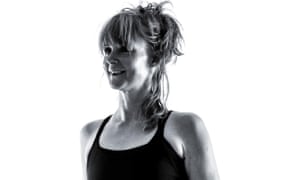
Anna Robertshaw, 37, a yoga teacher from Tunbridge Wells


Anna Robertshaw


‘From the outside my life looked great, but inside I was struggling.’

My early 20s were a bit of a whirl. I got pregnant with my eldest at 23, which was wonderful; at the time I was still together with my husband,who was my childhood sweetheart. After our son was born we set up home in Tunbridge Wells and I quit my job to become a full-time mother. My husband had a wonderful and well-paid job and so we moved into a beautiful home, and it wasn’t long before my second son came along. Then, when he was five months old, I got pregnant with my third boy.


From the outside my life looked great, but inside I was struggling. I felt a lot of pressure to be a perfect mum, and this got worse when my boys started school. I couldn’t help but compare myself to other mothers, and to think their children were really polite and wellbehaved. I felt lost and had no confidence in my ability to raise my boys in a way that was right for me.


Depression and anxiety came on thick and fast. I was prescribed antidepressants, but I soon realised they were not for me. I remember sitting out in the garden, feeling so detached from my boys. It was like I was looking at them through a screen. I stopped medication and sought other means of help, eventually finding homeopathy and yoga.


My life took a different course after this, and I separated from my husband. Part of my recovery was letting things go, and starting to take charge of my life and think about what was right for me. For so long, I had fitted into everyone else’s idea of who I should be, and I was so afraid of breaking that image, but it was making me miserable.


With age comes wisdom and now I am happy with my new partner and my life in general. I am much less harsh on myself and have realised everything cannot be perfect all the time.


The biggest lesson for me, in terms of losing the urge to try to be perfect, was becoming a mum: it taught me that it’s not all about me, it’s all about them. Kids have their own views and sometimes speak more truth than grownups. They also taught me that I couldn’t possibly maintain a tidy, clean house all the time and neither could I maintain my body shape or appearance because of the effect being pregnant for years has had on them.


My advice to young people today would be to find a hobby or passion that brings you joy and don’t compare yourself to others. Sometimes it’s our biggest failures that teach us the most valuable lessons and letting things fall apart isn’t the end of the world – it’s a chance to rebuild it.


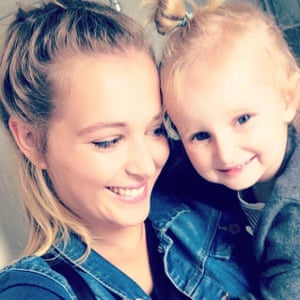
Lotta Sampson-Stone, 22, a student and single mother from Plymouth


Lotta Sampson-Stone


‘Being a mum, in particular, is a lot of pressure.’

I am quite critical of myself as a single parent. I am conscious of trying to portray myself online and to family as the perfect mother and now I am at university I also want to be a perfect student. It can be hard to juggle everything.


I moved to Plymouth from Lancashire for universitylast yearand have been desperate to make it work, but it’s hard. I worry that I’ve not spent enough time with my daughter and too much time in the library, or that I’ve spent too much time with her and not enough time socialising.


Being a mum, in particular, is a lot of pressure. On Facebook I see mothers saying: “I baked with my boy today and we made pasta necklaces.” When you’ve just plonked your kid in front of the telly it makes you think: “Should I be doing that?” But it’s hard to be a full-time student, single parent and do baking and arts and crafts activities as well.


I made a conscious decision only very recently to limit time spent on social media. I did not want it to impact on how I viewed my life with my daughter and what I could and could not provide for her. The best thing I can give her is a mum who’s totally happy and present in the here and now – she doesn’t care that her mum isn’t a size six or that the flat gets cluttered..


I hope my daughter won’t grow up as insecure as me. I hope she never negatively compares herself to others and that if she recognises differences she embraces them and does not feel they make her less of a mother, student, woman or human being.


Kate Goodrum, 18, a student at Cambridge University, from London


Kate Goodrum


‘One thing I have learned is that being perfect doesn’t always make you happy.’

Even as a girl I always had a perfectionist streak. While other children went out and got cheerfully muddy I would be held back by a fear of looking scruffy, and even in primary school I worried about not getting good grades.
So the drive for perfection was always there, but as I got older it took hold in a more negative way and led to an eating disorder. I became very critical of how I looked, to the point where my body mass index got really low and I was told by doctors that I wouldn’t be able to sit my GCSEs if my health didn’t improve.


This was so hard to take because I’ve always striven for perfection, academic as well as physical. In fact, it was the wake-up call I needed and I went for treatment. By the time my A-levels came around I’d put on weight and was much better physically, but there were still underlying issues and insecurities.


Eating disorders never really go away, and even four years later, although I’m much better, I still compare myself to others and feel bad about how I look, thinking I am too fat or not tall enough and I don’t have abs.


I have sort of come to terms with the fact that being a perfectionist is part of my personality. I’m never content with anything I have achieved. I got into Cambridge University last year and while I am excited about starting I am also worried about the workload. I hate not being the best at everything and I worry I will be the dumb one there as other people will be so clever and multi-talented. I am worried I won’t be able to keep up.


Despite this, all I’ve experienced has taught me to try to be less harsh on myself. One thing I have learned is that being perfect doesn’t always make you happy. You can have a great body and do well in exams but it doesn’t solve all your problems – even my response to getting into Cambridge has made me see that.


In my mind the perfect woman is successful, happy and not stressed. Someone with a good social life and lots of friends. I suppose someone who has everything really, but then the older I get the more I realise that this ideal probably doesn’t exist. Maybe it’s time we stopped striving for something else and started celebrating what we have now.


The pressure of perfection: five women tell their stories | Guardian readers and Sarah Marsh

26 Eylül 2016 Pazartesi

"I feel ashamed in a way I never did before": your stories of PIP assessment | Sarah Marsh

The government’s abolition of the disability living allowance (DLA) and its replacement with personal independence payments (PIP) means that people with disabilities – many of whom had been told their support would be for life – are being forced through a process of reassessment. But what’s the impact of this?


It’s a topic that Frances Ryan covered in her Hardworking Britain series last week. She wrote: “The retesting of PIP claims means, in practice, blind people, paraplegics and those with Down’s syndrome will be put through reassessment: forced to provide information about their disability that the government already has and cannot possibly have changed.”


We asked for your experiences of this. Here, five people share their stories.


‘It’s hard to understand why we have all had to go through this’ – Angelene Wright, 66, from Lincolnshire


I’m a carer for my 64-year-old husband who is in the final stages of multiple sclerosis.


My husband received a lifetime DLA award about 15 years ago. He is now unable to walk and we are dependent on our home carers for most of his personal care. I have lasting power of attorney as he can no longer sign his name. He can just about feed himself with special cutlery, as long as the food is soft and cut up small. He is totally dependent on others for all his needs.


We went through the reassessment process earlier this summer. With the help of our social worker and rehabilitation consultant, my husband was granted the new benefit without having to go through a face-to-face interview – only a phone call for extra details from the assessor was required.


The whole thing was very stressful. The initial letter, announcing that his DLA was to stop and telling us to phone the number within 14 days or face losing the benefit, was scary. I have to say that all of the people I had to speak to were extremely courteous and helpful. The 40-page form was a pain to contend with – I’m a retired teacher but it was formidable. Also my original registration of lasting power of attorney was required and was not returned – thankfully, I had it scanned. All they actually needed was our registration number.


When you have been given a lifetime award it’s hard to understand why we have all had to go through this. If a person is incapacitated to the level that a lifetime award was thought appropriate, they are not going to get better. They clearly designed it to try to catch people out and it seems to have caught a lot of the wrong people.


‘Irreversible brain damage is irreversible. I don’t understand why I am being reassessed’ – Anonymous, 31, from Glasgow


I have cerebral palsy, a visual impairment, dyspraxia and epilepsy. I’ve been on disability living allowance (high mobility and medium care), receiving around £450 a month, since I was 16. That’s all my adult life. I thought DLA would always be there and am profoundly shocked that it’s now changed and I am due to be reassessed soon.


I am so scared of what this may bring that it keeps me awake at night. When my DLA money comes in each month, I am very relieved. I have had periods when it was my only source of income and I don’t know how I will manage if it goes away.


Reassessment of lifelong conditions makes no sense to me. It is a waste of money and energy and it is cruel.


Anonymous


I am profoundly shocked about being reassessed. I do not understand why this has to happen – cerebral palsy and epilepsy do not go away. They do not change in any way. My balance is as bad now as it was when I was 16 (in fact my joints are probably in a slightly worse condition). I still don’t have a lower field of vision. I’m still having fits. Irreversible brain damage is irreversible. Reassessment of lifelong conditions makes no sense to me. It is a waste of money and energy, and it is cruel. I know I will never get better. I’ve accepted that and am getting on with my life. I feel ashamed and helpless in a way I never did before.


‘The whole process was costly and demeaning’ – Anonymous, 38, from Staffordshire


I am writing on behalf of my daughter who has a personality disorder and complex mental health needs classed as severe and enduring. She had been given a lifetime award, but last year we had to submit a claim for PIP, which meant reassessment. It was incredibly painful for her to go through this process again, and we submitted medical evidence for every question on the form.


The enhanced living component was awarded, but the standard mobility component was taken away on the grounds that she could walk 10 metres unaided. However, eventually we challenged this and won. We were very relieved and pleased, but the whole process was costly and demeaning. What’s more, no one has actually met with my daughter and every decision has been made on paper. It feels like she has no voice. I am the one who has to pick up the pieces when ignorant bureaucrats treat a fragile, seriously ill person so badly.


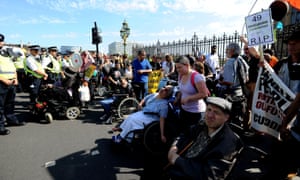
Protesters gather outside Westminster to demonstrate against disability benefit cuts.


Protesters gather in Westminster in 2014 to demonstrate against disability benefit cuts. Photograph: Nick Ansell/PA

‘The arbitrary nature of the system infuriates me’ – Charlie Saben Fox, 61, from Edinburgh


My son has autism, global learning difficulties and epilepsy.


How much help you get really is a lottery and many people seem to be losing out.


Charlie


He has been in receipt of DLA since he was two and was awarded an indefinite award at 16. He was “invited” to migrate to PIP, taking a paper-based assessment. After this he was awarded enhanced daily living and mobility components, but only for five years. I couldn’t understand the length of award as the assessor stated his condition might only change marginally. I called the Department for Work and Pensions to ask for a mandatory reconsideration and they weren’t very helpful. First they told me I couldn’t challenge the five-year award, but eventually I got it extended to 10 years.


I’m pretty strong-minded and wasn’t scared of challenging it, but a lot of people might have been bullied into submission. I’m still angry when I think about it. The arbitrary nature of the system infuriates me most. How much help you get really is a lottery and many people seem to be losing out.


‘By the time I got into the room I was a nervous wreck’ – Catherine Hart, 36, from Sheffield


I have serious mental health problems and my DLA was not a lifetime award, but a long-term one – after being assessed every three years it was extended to every 10 years. That changed under PIP. I had to fill in a very long form within three weeks, but it took them several months to tell me if I had been awarded PIP. This severely affected my mental health.


I was starting to get myself back on track when I was told I had to go in for a face-to-face assessment. My care coordinator was off work ill so I had a stranger from mental health services take me, because I don’t do well getting out of the house on my own.


By the time I got into the room I was a nervous wreck. The person I saw was very sympathetic, understanding and patient. He didn’t rush me for answers when I was struggling to speak, was delicate with his questions about my suicide attempts. He even told me he was sorry to be putting me through this.


It took less than two weeks for the letter telling me that nothing had changed in my award. The letter itself was entitled “Changes to your personal independence payment”, which scared me, until I read further and found out that it would be the same.


All the people I had contact with throughout the PIP process were kind and sympathetic. The problem I had was with the paperwork – there was a lot of it at all stages. To truly reflect how bad a mental illness can be, you have to talk about your darkest times, and this process takes you right back there.


"I feel ashamed in a way I never did before": your stories of PIP assessment | Sarah Marsh

18 Eylül 2016 Pazar

The hidden danger in your hand soap | Sarah Ades and Kenneth Keiler

A US Food and Drug Administration ruling this month bans the use of triclosan, triclocarban and 17 other antiseptics from household soaps because they have not been shown to be safe or even have any benefit.


About 40% of soaps use at least one of these chemicals, and the chemicals are also found in toothpaste, baby pacifiers, laundry detergents and clothing. It is in some lip glosses, deodorants and pet shampoos.


The current FDA action bans antiseptics like triclosan in household soaps only. It does not apply to other products like antiseptic gels designed to be used without water, antibacterial toothpaste or the many fabrics and household utensils in which antibacterials are embedded. Data suggest that the toothpastes are very effective for people suffering from gum disease, although it is not clear if they provide substantial benefits for those who don’t have gingivitis.


The FDA is currently evaluating the use of antibacterials in gels and will rule on how those products should be handled once the data are in.


Although antibacterials are still in products all around us, the current ban is a significant step forward in limiting their use.


As microbiologists who study a range of chemicals and microbes, we will explain why we don’t we need to kill all the bacteria. We also will explain how antibiotic soaps may even be bad by contributing to antibiotic-resistant strains of bacteria that can be dangerous.


Bacteria are everywhere in the environment and almost everywhere in our bodies, and that is mostly good.


We rely on bacteria in our guts to provide nutrients and to signal to our brains, and some bacteria on our skin help protect us from harmful pathogens.


Some bacteria present in soil and animal waste can cause infections if they are ingested, however, and washing is important to prevent bacteria from spreading to places where they can cause harm.


Washing properly with soap and water removes these potential pathogens.


If soap and water are sufficient, why were antibacterials like triclosan and triclocarban added in the first place?


Triclosan was introduced in 1972. These chemicals were originally used for cleaning solutions, such as before and during surgeries, where removing bacteria is critical and exposure for most people is short. Triclosan and triclocarban may be beneficial in these settings, and the FDA ruling does not affect healthcare or first aid uses of the chemicals.


In the 1990s, manufacturers started to incorporate triclosan and triclocarban in products for the average consumer, and many people were attracted by claims that these products killed more bacteria.


Now antibacterial chemicals can be found in many household products, from baby toys to fabrics to soaps. Laboratory tests show the addition of these chemicals can reduce the number of bacteria in some situations. However, studies in a range of environments, including urban areas in the United States and squatter settlements in Pakistan, have shown that the inclusion of antibacterials in soap does not reduce the spread of infectious disease. Because the goal of washing is human health, these data indicate that antibacterials in consumer soaps do not provide any benefit.


What’s the downside to having antibacterials in soap? It is potentially huge, both for those using it and for society as a whole. One concern is whether the antibacterials can directly harm humans.


Triclosan had become so prevalent in household products that in 2003 a nationwide survey of healthy individuals found it in the urine of 75% of the 2,517 people tested. Triclosan has also been found in human plasma and breast milk.


Most studies have not shown any direct toxicity from triclosan, but some animal studies indicate that triclosan can disrupt hormone systems. We do not know yet whether triclosan affects hormones in humans.


Another serious concern is the effect of triclosan on antibiotic resistance in bacteria. Bacteria evolve resistance to nearly every threat they face, and triclosan is no exception.


Triclosan isn’t used to treat disease, so why does it matter if some bacteria become resistant? Some of the common mechanisms that bacteria use to evade triclosan also let them evade antibiotics that are needed to treat disease. When triclosan is present in the environment, bacteria that have these resistance mechanisms grow better than bacteria that are still susceptible, so the number of resistant bacteria increases.


Not only are bacteria adaptable, they are also promiscuous. Genes that let them survive antibiotic treatment are often found on pieces of DNA that can be passed from one bacterium to another, spreading resistance.


These mobile pieces of DNA frequently have several different resistance genes, making the bacteria that contain them resistant to many different drugs. Bacteria that are resistant to triclosan are more likely to also be resistant to unrelated antibiotics, suggesting that the prevalence of triclosan can spread multi-drug resistance. As resistance spreads, we will not be able to kill as many pathogens with existing drugs.


Antibiotics were introduced in the 1940s and revolutionized the way we lead our lives. Common infections and minor scrapes that could be fatal became easily treatable. Surgeries that were once unthinkable due to the risk of infection are now routine.


However, bacteria are becoming stronger due to decades of antibiotic use and misuse. New drugs will help, but if we do not protect the antibiotics we have now more people will die from infections that used to be easily treated. Removing triclosan from consumer products will help protect antibiotics and limit the threat of toxicity from extended exposure, without any adverse effect on human health.


The FDA ruling is a welcome first step to cleansing the environment of chemicals that provide little health value to most people but pose significant risk to individuals and to public health. To a large extent, this ruling is a victory of science over advertising.


This article originally appeared on The Conversation


The hidden danger in your hand soap | Sarah Ades and Kenneth Keiler