Look. If you are of a delicate disposition, best not take up swimming. Don’t venture down to your local pool, strip off your clothes, wade through a slightly wet and dirty changing room and immerse yourself into what is, effectively, a communal bath full of the hoi polloi and all their bodily fluids. Just don’t do it.
If you are of a delicate disposition, you won’t end up feeling relaxed, with a sense of wellbeing and a healthy glow. You’ll be too concerned about verrucas, or cross and suffering from “lane rage”. You’ll complain about everything from people peeing in the water – which scientists have found is a frequent occurrence – to the quantity of the pool chemicals needed to counteract the peeing, to the water being too cold (or too hot).
You’ll be unhappy about the plasters and miscellaneous hairs that have sunk to the bottom of the pool. You’ll be irritated by the kids screaming and about swimmers splashing arrogantly; or women slowly breaststroking in twos and chatting while still in full makeup. You’ll feel as if your swim has been ruined.
I’ve swum in many pools – probably more than 100 – and I can tell you that every one has its fair share of annoyances. And they all, undoubtedly, have users who pee in the water. Every pool in the UK (where, for some reason, we don’t require swimmers to wear bathing caps) has great billowing clouds of hair floating around waiting to get caught repulsively between your fingers.
Many pools aren’t as clean as we’d like, but public pools are often underfunded. The staff who work at these places are often poorly paid and on casual shifts. The lifeguards who keep order, and whom we trust to save our lives, if necessary, are often required to do most of the cleaning, and to regulate the chemicals and temperatures of the water. Cut them some slack.
In most pools, just as there are cleanliness issues, there are people issues too. Every leisure centre has a weirdo who spends too much time in the shower. Every swim features a strange encounter with a near-naked stranger.
If you are of a delicate disposition you won’t end up feeling relaxed. You’ll be too concerned about verrucas
Last weekend, as I was doing lengths at my local pool, I noticed a woman standing at the end of the pool, at the deep end. She stood for about five minutes on the pool deck, with her arms folded, staring at the swimmers already in the water. It was disconcerting. Every time I swam up to the deep end, I wondered if she would jump on top of me as I reached the wall to turn.
Instead, after a while, she got into the lane next to me and swam breaststroke – badly – clad in swimwear that left little to the imagination, splendidly displaying much of her bottom as she glided along.
The weekend before, there was a strange man practising “free diving”. This moustachioed fellow would periodically swoop down to the bottom of the pool where he would stay for minutes at a time, staring in a trance at the tiles, barely moving. If you didn’t know what he was doing, you’d think he had drowned. It slightly unnerved me as I swam over the top of him, metres above.
And every week, no matter where I swim, there is always some beefy guy in beach shorts who gets in the same lane as me. This bloke will assume that he can swim faster than me because he’s a bloke and I am a middle-aged woman. So he will wait until I am about to turn at the end of the lane and push off in front of me and then hold me up by swimming more slowly than me. I take great pleasure in overtaking while simultaneously, very deliberately, eyeballing him.
But I don’t get exercised. I don’t complain to the lifeguards. It’s not my pool, I think. It’s there for us all to share. Live and let live. Your swim is just as valid as my swim. I embrace your chattering, your free-diving, your breaststroke screw-kick and your bikinis. I embrace the floating plasters and the overwhelming smell of chlorine. And if your kid (or you) have peed in the water, I don’t really care about that either.
But if the thought of urine, sweat and snot (and worse) appals you, and if you don’t want to swim too close to someone who is almost naked and cooperate with them, then do yourself – and me – a favour. Walk up a deserted mountain instead.
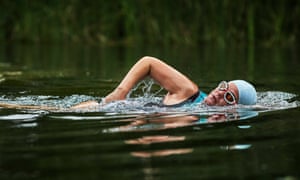
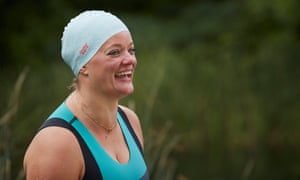
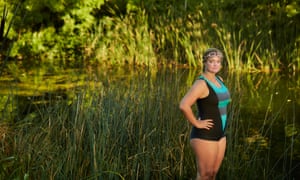
A workaholic with grown-up children, Julia found herself lonely and facing retirement without a plan. Living in Italy, she visited England to see her daughter living in Plymouth and decided to stay, but her first winter saw her hibernating from the cold and she put on 20kg. But now the 66 year old says the sea has become a symbol for her re-invigorated life, after she took up daily cold water swimming at Porthcurno beach, near Penzance – ‘it’s freedom, joy, pleasure’
I had always thought I could swim. It may have been because I could run. It may have been because I wanted to swim. Or because I only ever did 10 minutes of breaststroke at a time, or splashed off a warm beach. But I really couldn’t swim.
It took 12 months of lessons and practice before I was able to swim in open water, beyond the pool or my home beach in Brighton. Then I could let myself believe I was up to taking on a challenge I had been dreaming of for more than a year: I wanted to swim in the Greek waters of the Ionian Sea. Specifically, I wanted to swim to Ithaca, the island home of Greek hero Odysseus.
Since childhood, I had been fascinated by Greek myths and the heroic tales of the Trojan war. As I grew older and read classics at university, it became Odysseus who captured my imagination more than any other. Legend has it that Odysseus was within sight of Ithaca when he was blown hundreds of miles off course. It took him several years to get home after that. Meanwhile, his wife Penelope stayed at home on Ithaca, spending every night unpicking the embroidery she had completed during the day, having promised her suitors that she would marry one of them just as soon as her sewing was finished. Eventually, a decade after Odysseus set out from Troy to return home, they were reunited. Sometimes you have to wait for the one you love.
I never wanted to be Penelope; instead, I had fought for years to be my own hero, my own Odysseus. I wanted my sense of belonging to come from within, and as soon as I found that, I found D, my husband. Now that I had my own Ithaca, I wanted to see the real one.
There was a deadline to contend with: after a year of marriage and even longer of trying for a baby, we had recently been referred for IVF treatment. I was shaken by the news. My relationship with my body had changed radically over the last few years. Finally learning to have a little faith in what it was capable of had been one of the most rewarding experiences of my life. Now, I was being told that positive thinking was not going to be enough.
Six weeks later, I was on my way to the island of Lefkada, where I was going to spend a week on a guided swimming trip around the islands of the Ionian. It would be an opportunity to see what I was capable of in the water, and to remind myself of the barriers I had overcome, even as I was now confronting a new one.
The evening I arrived was heavy with heat. We all gathered on a terrace overlooking the sea to introduce ourselves and eat together under the vines. J, the leader of the trip, encouraged us to go around the table saying a little about ourselves.
“Hi, my name is Jess and I recently swam the English Channel as part of a relay with some mates.”
“Hi, my wife and I are regular Masters swimmers in the south of France; these are our times…”
“Hi, I’m on this trip with my teenage daughter as a rest before her Olympic tryouts.” And so it went, on and on. These were people who had swum for their country, across their country and to their country. They may as well have been a different species.
The first morning, we boarded a beautiful wooden boat with a taciturn Greek captain who made no effort to hide the fact that he despaired of us all and our sanity. The pattern for the week was quickly set. The boat headed out to wherever the swim was to begin, then we would be briefed on deck about what type of swim it would be. Some were coastal, all the way around an island, with plenty to look at below us; some would be crossings from island to island – more satisfying, but potentially much harder work. And some would be a combination of the two. For most of the week, we would have a morning swim, lunch somewhere nearby, then a bit of time on the boat before a second swim. Friday would be the exception, because that was the day of the heroic 5km swim from Kefalonia to Ithaca.
‘The barriers were not merely physical, but mental.’ Photograph: Chris Floyd
Being in an entirely unfamiliar environment was all-consuming. I was used to wading into the water; a slow walk with a gradual drop-off. Now, we were clambering or jumping off a boat, straight into deep water. The most striking thing was its clarity. I had never seen anything like it. In Brighton there are only a few days when the water is clear enough to see through, and even more rarely is the ocean floor visible. Now, I could see a whole new universe. In our underwater world, body type had little effect on how we moved. The strength, the glide, the ease of the reach through the water was all that counted.
I found the sensation of travelling between two bodies of land dizzyingly intimidating. Once, managing a single length of the pool had been too much for me. Then, swimming in open water, albeit close to the shore. Then, the unknown length and depth of the river. Each time, I had persuaded myself that if I could relax and focus, I could do it. Each time, I had been proved right. The barriers were not merely physical, but mental.
This was something else entirely. As we reached the farthest point between the islands, the sea became so deep, it was beyond blue; a dark purple, almost charcoal, with shimmers of yellow as the current moved on and on below us. We found ourselves righting and re-righting our course, having to fight to stay straight, rather than being dragged somewhere else. That pull in the water, begun as a ripple on the other side of the world, reached me then, in that moment, as if gently to tug my sleeve and let me know that, perhaps, I was reaching the limitations of what my body could do. And the thought stayed with me all week as we approached Friday, the day of the 5km swim.
We had a pre-6am start that morning, to be ready for a boat trip of more than two hours. I was tired and beginning to ache in places I had never felt before. The mood on the boat was noticeably quieter than usual. Until now, I had enjoyed conversations with the group, getting tips on my technique, as well as hearing stories of their entrancing swims around the world. Today’s early start and the task ahead, though, had left us all but silent.
It’s all about the breath, I reminded myself. Keep the breath steady and you’ll keep yourself steady
My nerves were mounting. Not only was it farther than I had ever swum continuously – by more than a kilometre – but we would be negotiating a busy channel, competing with swells and currents, as well as holidaymakers’ boats and billionaires’ superyachts. And there was the added pressure that we had been told to swim tightly in our groups during the crossing, directly alongside each other for safety: there was no option to slow down to catch my bearings or indulge in panic. I would either let the team down or find myself drifting dangerously alone in the currents.
I sat in the prow of the boat, my legs dangling over the water as she moved slowly through the still, flat, unbroken surface, the sun rising behind the distant islands, and I felt horribly alone. I missed home with a longing I was sure only Odysseus had ever felt. For the others, this was an energetic holiday, but for me it felt like a last chance to prove to myself what I was capable of before I faced the uncertainties of IVF.
As I stared down into the water, a dolphin’s fin broke the surface and danced ahead of us. I yelped; the captain cut the engine. In that instant, I saw that I had been a fool. Only seconds before, I had been feeling so utterly alone while mere metres from such a magnificent sight. The dolphin leapt and pranced ahead, before approaching the boat and swimming alongside it for a little while. I sobbed, overwhelmed at how appallingly close the lowest and the most beautiful moments can be to each other. Yes, we swim alone. But we can never truly know what swims alongside us.
Half an hour later, people started to ready themselves to head into the water. My heart was hammering. It’s all about the breath, I reminded myself. Keep the breath steady and you’ll keep yourself steady.
Now it was time to swim. I became lost in sensory overload within the first few minutes. The light seemed liquid, leaping up and circling me every time I drew my hand through the water, trying to push against the current that was moving with such strength beneath me.
The first hour or so went smoothly, the group moving steadily as one. About halfway, something changed. We were approaching a tiny island, barely big enough to lay a picnic blanket on, and until this point we had been using it as a sighting point, keeping it in view in order to steer a straight course. We were to swim north of it as we passed, which we were all on course to do. As we approached, the ocean floor came up and back within sight. There was some comfort in seeing the sloping patterns of the underside of the island beneath us. Until I realised that it wasn’t moving.
‘I had never stood toe to toe against nature in this way before.’ Photograph: Chris Floyd
We were swimming at our hardest. Perfectly in rhythm, well warmed up, pulling hard, breathing hard. At last, I felt like a real swimmer. Except I was going absolutely nowhere. An anxiety dream come to life. I was pulling and pushing at the water with all my might, but we had hit the point where the currents were at their strongest. The harder I swam, the less I moved. The rocks below me were entirely static.
I continued like this for five or 10 minutes before panic set in. I knew that to stop was instantly to slide back, away from the group. Exhale. Keep going. Exhale. Believe. Exhale. Glide. But the demons were chasing me now. I had never stood toe to toe against nature in this way before. You can’t fight nature, I thought, and felt tears choke in my throat. I forced an exhale. I wouldn’t let myself think it. But I did. If you can’t fight nature, what about pregnancy? And with that I was lost in a world of worry. Would I ever get pregnant? What would IVF do to me? What would IVF do to us? Would it be worth it? Would we get there? When would I know?
The water swirled around me and roared in my ears. I forced the air out of my lungs, again and again. The salt water was crusting my mouth, and every breath felt like a punch as the sunlight hit my eyes.
Your body might never be the same after this summer, I told myself. Enjoy what you have
Think of home. Be your own hero, be your own Odysseus, be ship, cargo and crew. I repeated these things to myself again and again, forcing physical relaxation until mental solace came. I made myself feel the power in my limbs and lungs, and love it. I was strong. Your body might never be the same after this summer, I told myself. Enjoy what you have.
Eventually, I won the battle. The rocks beneath me slid slowly out of sight. The deep blue returned. I have never been so glad to be swimming so utterly out of my depth. But the horror wasn’t over. About half an hour later, a sort of fizziness began in the tips of my fingers. I had only felt it once or twice before, in the final few metres of running events. I knew it meant that I needed oxygen, and fuel. I realised what was happening and tried to power my way through with positive thinking. Success was limited. My mind had got me thus far, but my lungs had not had the chance to catch up.
I needed help. I called to the rescue boat, and clung to it. J told the others to carry on, while I hauled myself in. My breathing was laboured and erratic, my head spinning and the tips of my feet and fingers numb. I breathed. I gulped at the orange juice on board to get some sugar into my system. I grabbed a handful of nuts. Devastated not to be in the water, I sat, breathing, for five minutes. We were so close to Ithaca. I could make out individual trees on the mountainside. Ten minutes later, I knew I couldn’t let the dream go.
“Can I get back in?” I asked.
J checked me over, to make sure that I wasn’t still delirious.
“I have to reach Ithaca. It’s why I came.”
She nodded. I leapt off the boat and headed for the grey rock. I couldn’t believe there was any strength left in me, and I vowed never to forget the moment that the island’s sea life started to make itself apparent to me. Once again, the sea shallowed, and fish shimmied between crags, sea urchins perched on ridges and starfish danced on the side of the island.
Finally I touched the rock, and burst into tears. Huge sobs, shaking my shoulders, forcing me to cling on to the island to keep myself steady. I had done it. I had discovered a grit I hadn’t known I had. I had slowly, over a year of marriage and a year spent in the water, learned that strength does not always mean merely ploughing forward in the face of adversity; it means changing your plans when what you’re doing isn’t getting you where you need to go; and it means nurturing the confidence to adapt without panicking. The relaxation that swimming demanded of me had taught me that calmness is strength. As I clung to that rock, I had no idea of the extent to which my adaptability and survival skills were about to be tested.
***
As the plane landed back on English soil, I smiled, knowing that I would be home soon and that there were still a few months before the most difficult stages of the IVF swung into action. I was gleeful to be returning to my Penelope, but it was tinged with the melancholy of knowing this summer was past full bloom. I wanted to carry on swimming outdoors, putting my new-found strength and confidence into practice.
I was sure I would be pregnant soon. I was anxious about the side-effects of doing a cycle of IVF, but I was not anxious about it failing.
I was wrong. It proved a brutal and disorienting experience. The cycle ended in early September with me battle-scarred, exhausted and with a streak of red blood that confirmed that I was not pregnant. The Saturday morning after we realised the treatment had not been successful, I woke up at 6am and stared at the ceiling as the tears rolled slowly, silently, down the sides of my face and on to the pillow. What now?
Slowly, the overwhelming duvet of sadness that had swamped us began to shift. While the summer had not been the idyllic sea frenzy I had hoped for, once I looked up and beyond myself, I saw that we were being treated to an exceptionally beautiful autumn. We had agreed to try one more round of IVF, but for now I had a chink of time in which to use my body for as much adventure as it could manage.
As autumn progressed, I swam and I swam, feeling the strength flowing gently back. I had been utterly unprepared for the havoc that the drugs and surgery would wreak on my body. There were extra rolls of flesh that seemed to have sprouted within a fortnight. The belly that appeared as I grew eggs stayed, as did the soft pouches sitting on my hips. My boobs were uncontrollably enormous – the sort of thing mothers-to-be so often take delight in. But, for me, they did not represent an exciting new life change, merely a daily reminder of what I didn’t have. As did the significant amount of internal pain in which the egg collection surgery had left me and which meant that running, and its associated jiggle, was out of the question.
Slowly I emerged from this body that bore no relationship to the one I had built for myself over the previous five years, and took on more and more swims, enriched weekly by the sights, smells and sounds.
Soon, we had a second round of IVF scheduled. I felt fiercely protective towards my own body. Ours was a relatively new love, hard won over miles run and distance now swum. It had taken years to accept that, yes, my body had value, but that value lay more in where it could take me, what it could show me, than in any perceived visual pleasure it could provide for others. I tried to approach this latest quest with the spirit of adventure that had sprung so late in me but proved such a source of joy. I would not yield to any suggestion that my life or my body were lesser if they didn’t incorporate motherhood.
Resolute about keeping my fitness up, I swam lengths twice a week in the pool and continued to swim in the sea, even as the heat slowly started to ebb from it. The day before my second egg collection surgery, I swam in the mouth of Shoreham harbour, feeling my muscles read the movement of the water and warm my blood against the autumn chill. I had rebuilt myself. I was ready.
This time, the treatment went well, and a few weeks later we had a positive pregnancy test. It was followed by the heartbreak of miscarriage. The first round had been disappointment, a setback. This round was crushing grief. My body had betrayed me. Where I had found strength, I now saw inadequacy, insufficiency, weakness. Where I had found beauty, I now saw flesh that served no purpose: a nascent belly, swollen from medication but aching with emptiness, uncontainable breasts bursting with anything but sexuality. Where I had felt self-love, I now saw an unwelcome stranger in the mirror. My body had been rejected, and in turn I rejected my body.
‘I have learned not to be frightened.’ Photograph: Chris Floyd
The first time I felt strong enough to get back into the water was in December. I underwent a full winter of cold-water swimming. I never chose to do it; I just chose not to stop doing it. Where so many other plans around me had turned to dust, in one area at least I just had to keep going.
Jumping into cold water if you are not accustomed to it can put huge pressure on your heart, send your breathing into potentially unrecoverable erratic fits and starts, and leave you woozy with hypothermia – too sleepy to swim, too cold to recover. You can’t fight thermodynamics any more than you can fight infertility. But you can adapt. You can acclimatise. You can find joy where others see pain. And this was what I chose. To keep swimming, week in, week out, until what had seemed like an impossibility became golden, a delight.
Through January, February and on towards March, the coldest month, I carried on swimming. Though the sea temperature dropped incrementally each week, my body, as it slowly acclimatised, felt the same each time. After five minutes or so, my body would start to warm me from within, the hard work of the swimming pushing heat as far as it could out into my limbs. My skin would glow red, as if I’d received a thousand tiny slaps. Within half an hour, I would be glowing from within, warm for the rest of the day. Like a hangover in reverse, I had done something that was painful for moments but that left me feeling well for hours. I had made the difficult habitual, the habitual easy and the easy beautiful.
That winter of swimming was a sort of inadvertent exposure therapy. A type of behavioural therapy used to treat anxiety disorders, exposure therapy usually involves helping people to confront their fears by exposing them in tiny, almost insignificant amounts to the thing they are most afraid of.
There are people all around us dealing with sickness, injury and upset, but they choose to keep moving
Over the winter, I repeatedly exposed myself to the elements. As I hit the water day after day, I took myself to a place I never thought I could go. Previously distressed at having reached the limits of what my body could do for me, I rediscovered pride in what it could achieve and where it could take me.
More importantly, I was exposing myself to myself. That winter, I was the heaviest I had ever been. At the time, it felt like weakness, like surrender, but now I see that what felt like unnecessary blubber from hormones, grief or greed was keeping me warm, keeping me in the water to do what I needed to do. To thrive at the weight I was felt not just subversive, but a triumph.
I was emerging from the water calm but energised. I could do more than I’d imagined, and the more I swam, the more I witnessed others experiencing this alongside me. As I glided along in the lido, I saw women slowly easing themselves down the steps, scars the length of their thighs. I saw injured shoulders ahead of me, struggling to swing their arms around but finding fluidity and peace in the water. I saw women who arrived at the seafront jangling with panic or sadness, leaving it serene an hour later.
These quiet, everyday gladiators battling the wet and the cold showed me time and again that it wasn’t just me who headed for the water in times of distress. There are people all around us dealing with sickness, injury and upset, but they choose to keep moving instead of standing at the edge of life, peering in.
When I think about never having a child, a sort of breathlessness, almost a vertigo, comes over me. The same metal vice tightens around my ribcage, the one I felt as I entered the sea those first few times. I don’t know if we will ever have a child. I don’t even know if we have it in us to try IVF again. But I never know for sure what swims beneath me as I push myself through open water.
Swimming has taught me about my adaptability. It is not enough simply to train hard. You must adjust how you move, refine how you approach the water and embrace your environment. In swimming, as in life, I found fortitude and resilience when I needed them most; but I also found the courage to change depending on the weather, the tide or my own body. I have learned not to be frightened; that life is to be lived as a participant, not a spectator.
The most useful thing anyone said to me about grief is that you never really get over it. When you have difficulties with fertility or staying pregnant, the whole experience is a process of accepting that grief might be round the corner. But is that not the very nature of love? To fall in love is to expose yourself to infinite potential for rejection or pain, and to be a parent is to accept a lifelong commitment to the unknown. To love truly is to know that you might lose it in a heartbeat. In the same way that you never know if the wind will change when you’re half a mile from the shore, or the waves might smash you in the face just as you gasp to breathe. We must stand on the shore, proud of the life our bodies offer us, and accept that we’ll never truly know what lies beneath the surface any more than we’ll know what lies ahead. And then we must leap in.
• This is an edited extract from Leap In: A Woman, Some Waves And The Will To Swim, by Alexandra Heminsley, published next week by Hutchinson at £12.99. To order a copy for £10.65, go to bookshop.theguardian.com, or call 0330 333 6846.
A three-yr-outdated boy is getting taken care of in hospital for ”life-threatening injuries” following getting identified ”unresponsive” in a swimming pool.
The child, who had been reported missing to police in Wiltshire moments earlier, has been airlifted to hospital in Southampton.
Officers have been named shortly after 7pm this evening to reports of a missing little one in Upavon, among Salisbury and Swindon.
A police spokesman mentioned: ”Sadly, the child was identified shortly right after 7.20pm in a nearby swimming pool.
”He obtained emergency health-related treatment at the scene but was unresponsive.”
The spokesman mentioned the kid remains in a existence-threatening condition.
Some of the chemicals produced sperm release also early a cocktail of digestive enzymes required to break by means of the egg’s outer coating. Photograph: Corbis
Typical chemical additives located in sunscreens, meals packaging, toothpaste and toys can harm sperm and may possibly influence the fertility of some couples, scientists say.
Exams on 96 ubiquitous and supposedly non-toxic substances located that nearly one particular third disrupted the way sperm functioned, affecting their swimming and navigational capabilities, and their ability to fertilise an egg.
The findings – from an experiment carried out on sperm in dishes in the lab – are the initial to demonstrate how the chemical compounds, which are so widespread they are detectable in people’s blood, can influence on sperm and possibly harm reproduction.
Researchers in Denmark and Germany centered on chemical substances that are identified to mimic normal hormones in the body. Prior research have linked such endocrine disrupting chemicals (EDCs) to fertility difficulties in the western globe, but the paucity of human scientific studies has left question marks above the harm they pose.
“This is genuinely the very first report on the direct effects of endocrine disruptors on sperm function,” Niels Skakkebaek at Copenhagen University Hospital informed the Guardian. “The effects we see could make clear these not uncommon circumstances the place individuals can not have a youngster even if they are found to be standard by the usual examinations at fertility clinics.”
With scientists at the University of Bonn, Skakkebaek examined EDCs used in a huge variety of providers and merchandise. Some are added to sunscreens to filter out UV rays. Others make plastic meals packaging less complicated to form, or are offered to livestock to make them grow more quickly. Even now much more are biocides, additional to toothpastes, soaps, cosmetics and even children’s toys.
In a series of experiments, the researchers extra various amounts of the chemical compounds – singly and in blend – to dishes of close to a quarter of a million sperm, to see what result they had.
Close to 30% of the chemical compounds led to abnormally high calcium levels in the sperm, which harmed their overall performance. Their swimming suffered and they launched too early a cocktail of digestive enzymes that are necessary to break by way of the egg’s outer coating.
Skakkebaek mentioned that EDCs in the female reproductive tract may also impair fertility by swamping the hormonal signal that sperm typically adhere to to find the egg. “Hormones created by the egg tell the sperm the place to uncover it, but if you have other chemicals mimicking that hormone, the ‘GPS’ on the sperm may possibly tell them to go somewhere else,” he stated.
“This is a entirely new facet of investigation into endocrine disruptors. Like always, this must be repeated and expanded. We have examined only 96 chemicals and if there are 800 that may possibly be harmful, there’s a good deal of function to do,” explained Skakkebaek. The European Commission is reviewing its approach on endocrine disruptors amid concerns over their wellness impacts.
One particular area that demands more investigation is highlighted in the scientists’ report in the journal, EMBO. Exams showed that some chemical compounds had no obvious effect at lower doses, but when mixed with other people at similarly lower doses, the cocktail was harmful to sperm.
Allan Pacey, senior lecturer in andrology at Sheffield University, mentioned the findings have been “intriguing”, but warned that it was also early to modify tips to sufferers. “Although sperm calcium alterations could be witnessed in the laboratory, this is a extended way removed from what may well come about in living folks,” he stated.
There has been substantial innovation in flea handle more than the previous 20 years: powdering pets with toxic dust is now consigned to historical past. Fleas really don’t drown very easily, so even if your puppy dipped his head underneath the surface of the estuary, the difficulty would not be solved. There is a general rule that the most effective products have a tendency to be launched by means of vet clinics initial, just before trickling down to pet stores. There is a wide decision, from spot-ons to sprays and as soon as-month to month tablets. Examine the predicament with your vet so that the ideal item can be matched to your wants. By the way, vets are often cheaper than other retailers for many retail items: do a value comparison and you’ll see what I mean.
You mentioned travelling with dogs the other week, but what about cats? We are moving 200 miles to a new house. We have a 15-year-old Siamese, Cleo, who has in no way been in a auto except to the vets (she cries all the way). What can you advocate – for our sanity as considerably as Cleo’s – for a four-hour automobile drive?
K & JJ, Somerset
Produce a cat-friendly area for her to travel in, rather than squashing her into the cat cage that she associates with the vet. Attempt a massive wire cage, with loads of her favourite bedding and a microwaveable heat pad (e.g. Hotties, from petlifeonline.co.uk) to preserve her snug throughout the journey. Place brown paper on the windows beside her so that she can not see the planet rushing by. Use cat pheromones (Felifriend spray) to make the car more welcoming. Give soothing sounds for her: you can buy CDs or MP3 downloads of “music cats love” if you search on Amazon. When you attain your new property, don’t allow her outside for at least a week, and make confident she’s identifiable in case she gets lost. Go to icatcare.org for far more tips on travelling with cats.
I have had two Miniature Appleyards (a duck and a drake) since final summer season and we have had no eggs. When will she start off to lay? I want to hatch ducklings and attempt to prepare dates.
CD, Wexford, Ireland
Ducks are sexually mature by six months of age, but egg laying is affected by ambient temperature and day-length: the cold, dark, winter months have delayed your duck’s egg laying. She’ll start off in the springtime, with the arrival of warmer climate. Offer her a breeder/layer feed, so that she has loads of protein vitamins. Appleyards are exceptional egg-layers, making all around 250 eggs every year if you maintain removing them from the nest. If you depart the eggs in the nest with her, she’ll flip broody when she has a dozen or so, sitting on the eggs for 4 weeks when (hopefully) your ducklings will hatch.
Retaining an eye on your pets using technological innovation
Motorola have just launched the Scout one Pet Monitoring Camera, which uses your home Wi-Fi to send video photos and sound to your sensible mobile phone. The two-way audio system even allows owners to talk to their pet. Scout 1 is extensively offered at £99.99, and Motorola will be donating a percentage of every single sale to the RSPCA.
Rescue pets of the week
Dasher, Frost and Noel are eight-week-previous guinea pigs which can be rehomed separately. Get in touch with Bath Cats & Canines Property on 01225 787321 or see bathcatsand dogshome.org.uk
Send pet issues to pete.wedderburn@telegraph.co.united kingdom. All sick animals must, of program, be taken to a vet.To discover the outcomes of the rescued pets featured in this column, see Pet Topics Rescue
For each action, there is an equal and opposite government system. —unknown
Jerry Brown and Linda Ronstadt, 1979 (Photograph credit score: Jack Snell)
1 the heels of a West Virginia water contamination crisis, California hosts a grave water emergency.
Gov. Jerry Brown delivered the news, calling the drought emergency there an “unprecedented, severe scenario.”
The western climate is largely irrigated desert, yet, gallons of H2O value less than a penny, and scarce water fills opulent swimming pools and quenches California desert lawns.
The very good news is water is not acquiring a lot more scarce general it is an earthly consistent. The Massive Thirst by Charles Fishman referred to:
Olympian springs of fresh water — every single day, the sun, the sea and evaporation mix to make 45,000 gallons of rainwater for every guy, lady and kid on Earth….Even in the United States, the place we use water with profligacy, the oceans are making a lot more fresh water for each of us in a month than we’ll use in a decade.
But allocation and pricing of that bounty do matter. On boring days when the swimming pool seems to be inviting, water’s total utility is large and “marginal utility” minimal compared to diamonds, as the outdated lesson in economics illustrates.
But, wow, does that marginal utility of an extra gallon skyrocket in the course of a shortage. Water’s cost trajectory rapidly tops that of chainsaw following a hurricane.
Western and California landscapes and waterscapes are organic wonders but so too is the outstanding manmade infrastructure western environments are some of the most artificial on earth (sorry, resident greens).
Offered that, no shock will ensue on hearing that all the western states frequently beat a path to Washington for federal drought relief funding and planning.
The most recent was the late 2013 reauthorization of the Reclamation States Emergency Drought Relief Act, on which I testified in the Residence of Representatives.
This kind of federal efforts won’t break the fiscal financial institution.
But they gravely distract from the infrastructure and regulatory liberalization actually necessary for adaptable, plentiful water in arid areas.
Plus, politics encourages resource management principles at odds with an adaptable and lightly regulated water sector, and critical infrastructure wellness typically.
Pet agendas like desalination do boast remarkable doing work applications, but they are frequently vitality-intensive, by-product-laden approaches to make costly drinkable water. They’re not sustainable, however.
Politics has difficulty with tradeoffs: Why brackish groundwater desalination alternatively of seawater desalination, or smaller scale solar nonetheless-kind projects, or why not a great number of different water investments and approaches?