Young etiketine sahip kayıtlar gösteriliyor. Tüm kayıtları göster

11 Mayıs 2017 Perşembe

Social media and bullying: how to keep young people safe online

For all the benefits to mental health a digital world can bring, such as a sense of belonging and information and support for those with problems, there are also myriad dangers associated with online activity. In the very worst cases, people have live-streamed their suicide and had people cheer them on in the comments section.


Meanwhile, cyberbullying and trolling, along with communities and groups on social media that foster, glamorise or even encourage self-harm are pervasive. Stephen Buckley, head of information at the charity Mind, acknowledges these risks: “It is vital to recognise the huge danger created by any site or social media trend that promotes self-harm, suicide or eating disorders. They can be hugely damaging and possibly dangerous to someone in a crisis.”


This has come to the forefront over the past decade as more and more children use smartphones and tablets. A Young Minds report, Resilience For the Digital World, says half of Europe’s nine- to 16-year-olds now own a smartphone; the vast majority go online at least once a week, and most daily.


Buckley says that people are now used to following their friends on social media and sharing news of a new job, relationship, or a holiday presented in the best possible light. But this can have an impact on individual self-esteem. “While low self-esteem is not a mental health problem in itself, the two are closely linked. If lots of things are affecting your self-esteem for a long time, this may lead to depression or anxiety,” says Buckley.


Pressure on young people may also come from situations where they are being bullied in daily life that then cross over into their digital lives, says Marc Bush, chief policy adviser at Young Minds. “For instance, victimisation in the school playground is replicated on their Facebook pages or their WhatsApp or Snapchat groups, so they relive the distress they’re experiencing in real life on the digital platform.”


So, what’s to be done? Bush says industry has an important role to play. Today, if you search certain hashtags on Instagram, for example, a helpline pops up. He also cites the report from the House of Lords communication committee, Growing Up With the Internet, which calls for a national digital champion who can look at the rights of young people online, educate parents and teachers on how to look out for warning signs, and support young people to understand the consequences of bullying someone online.


The greater part of the solution, though, lies with young people themselves. “Ultimately,” says Bush, “young people are active in the creation, consumption and distribution of these images or forms of behaviour, so they have to be part of the solution.”


Tamanna Miah: ‘I developed severe anxiety after being bullied online.’



Tamanna Miah


Tamanna Miah is now a prominent anti-bullying activist

Tamanna Miah, 23, is a campaigner and public speaker from Kent. She describes how she coped with being bullied on social media and what it has been like to grow up in a digital world.


“I grew up in Sevenoaks, Kent, which is a very conservative, middle-class area. I suffered from severe bullying and racism from primary school to my all-girls secondary school until university. When I went home, the abuse continued online. It happened on my social media networks – Facebook, Bebo and MSN. People would comment on photos, status updates, anything that I was doing. Sometimes it was racist or Islamophobic, or attacking my appearance or the way I acted – anything. People would find a fault and take advantage of the situation.


I was a very shy, quiet child, I couldn’t stand up for myself, or look people in the eye. I would be bullied at school, come home and log on to the laptop and it would continue. You wake up in the morning to check again and it’s never-ending torment and hate. I couldn’t escape. I hated school and my time in education. I was never happy.


I developed severe anxiety and depression as a result. I tried to get support from my school and was unsuccessful. I visited my GP and they dismissed me and didn’t take me seriously. They said nothing was wrong and told me to do some exercise. It wasn’t until university that I was diagnosed.


Now I try and be careful when using social media, but I also use it for networking and meeting people. I’ve been through bullying online and offline, but I’ve also had a wealth of opportunities through social media.


I make sure that my personal activity, photos and comments are restricted, to avoid anyone attacking me publicly or harassing me. I don’t want to experience more abuse so I’d rather keep personal things private. I’d say to others in similar situations to always be careful about what you post and where.


Your online life is always going to be present. Google yourself to see what’s out there so you can check your settings and change them if needed. If someone is bullying you, always tell a responsible person as soon as possible. Make sure you have evidence of everything. Take screenshots or make audio recordings.


Whatever happens, don’t give up – just keep going. We absolutely need to speak about these issues, because if we don’t, who will?”


Social media and bullying: how to keep young people safe online

6 Mayıs 2017 Cumartesi

More than a quarter of young adults in the UK do not drink alcohol – in data

Young adults in the UK are more likely to be teetotallers than their older counterparts, according to figures released this week. More than a quarter of 16- to 24-year-olds do not drink, compared with just over a fifth of the broader adult population.


Last year, just under 21% of people surveyed in England, Scotland and Wales said they did not drink alcohol, equivalent to around 10.6 million adults aged 16 or over. That’s two percentage points higher than in 2005, when the ONS first collected data on alcohol consumption.


But the proportion of 16- to 24-year-olds who say they do not drink has accelerated at almost four times that pace. Ten years ago, 19% of young adults said they did not drink alcohol, compared with 27% last year.


Conversely, teetotalism among those aged 65 and over is falling: in 2005, almost 30% of people in that age category said they did not drink; last year, it was 25%.


But while people in the youngest age group (16-24) are increasingly likely to be teetotal, drinkers in this age category were also more likely to binge drink – defined as men who exceed eight units of alcohol on their heaviest drinking day, and women who exceed six units.


When teetotallers are excluded, women aged between 16 and 24 were more likely than any other group to have binged in the week prior to the survey: 41% admitting to doing so, compared with 34% of men of the same age.


More generally, the proportion of adults who say they drink alcohol is at its lowest level since 2005. In 2016, just under 57% of Britons surveyed said they had drunk alcohol in the previous week, compared to almost two thirds (64.2%) in 2005.


In its commentary, the ONS noted that drinking behaviour is likely to be impacted by characteristics such as culture and ethnicity: the wider survey found that teetotalism is lower among white respondents (15.7%) than all other ethnic groups (56%).


alcohol use in the UK – in data

More than a quarter of young adults in the UK do not drink alcohol – in data

13 Nisan 2017 Perşembe

One in four young women in UK report mental health problems, study shows

A quarter of young women in the UK have suffered from anxiety and depression, according to a new survey released by the Office for National Statistics (ONS).


The figures were collected as part of a wide-ranging survey gauging the wellbeing of people aged between 16 and 24. They show that, despite an increase in the number of those who said their quality of life had improved since 2009, one in four young women said they had faced symptoms linked to poor mental wellbeing in 2014-15.


The report said that young women were “significantly more likely” than their male counterparts to recognise and admit being anxious or depressed, with less than one in six young men reporting similar symptoms.


The ONS report used data taken from surveys that focused on a person’s overall happiness – shown by their attitudes to issues such as relationships, work, education and finances – to create a nationwide picture.


The results show that while more than a third of young people aged between 16 and 19 who were questioned said they had a “very high” level of life satisfaction, this dropped to just a quarter among people aged between 20 and 24.


The study also reveals that in the four years from 2009-10 to 2013-14, the number of young people saying their mental health had “deteriorated” rose from 18% to 21%.


Tom Madders, campaign director at the mental health charity YoungMinds, said: “There is still a huge amount of misunderstanding about mental health conditions, making people less likely to open up to others if they are struggling to cope. This is particularly difficult for young people who face pressure, including stress at school, college or university and body image issues.”


He said that an environment of 24-hour access to social media led to some young people feeling they needed to “keep up the pretence of having a perfect life”.


Other figures from the study show that the number of young people who believe they are financially comfortable has increased since 2009-10. Seven years ago, 15% said they were struggling to get by, while by 2014-15 the number reporting financial hardship was 7% – and a significantly higher percentage (45%) said they were satisfied with their household income, up from about 30% in 2009-10.


The report added that levels of “general health satisfaction” had risen, with 56% saying they were “mostly or completely happy” in 2014-15, compared with about 52% the year before.


However, the figures also show a rise in households deemed to be living in poverty, based on families who earn less than 60% of the average UK income. One in four said they lived in a household at such a level, compared with 20% in 2008.


YoungMinds recently called on teachers, parents and carers to sign an open letter to the prime minister, Theresa May, urging her to place an increased emphasis in schools and colleges on improving young people’s mental health, and to recognise the pressures caused by exam stress, cyberbullying and fears over employment when they leave education.


Madders said: “A good quality of life includes having positive mental health and wellbeing, so it’s crucial that the problems which young people report are taken seriously and supported to prevent them escalating and going into crises.”


One in four young women in UK report mental health problems, study shows

31 Mart 2017 Cuma

Young people and mental health: "Since diagnosis, I have taken massive strides"

Holly, 22, Sydney, Australia
I have suffered from depression and suicidal ideation since I was about 12. If my parents did not have private healthcare, I would probably be dead.


Vulnerable young people shouldn’t have to wait for months to see a psychiatrist, or to compensate for the lack of communication between specialists. Help-seeking behaviour should be supported and encouraged.


Young people in distress presenting to emergency rooms and hospitals should not be viewed as a problem. You don’t want us to kill ourselves, well, here we are. Mentally ill kids are often really intelligent. We can sense when you feel we are being a burden. Saying there are not enough beds, putting us in wards with elderly dementia patients or adults with drug-induced psychosis will ensure we do not ask for help again.


Malcolm Turnbull and Theresa May have the chance to make a real difference in the lives of vulnerable young people, who have a lot to offer the world in return. Don’t let us down.


Lindsay, London, 24
I am currently detained under section three of the Mental Health Act, and have been in hospital since 22 July 2016. Before this, I had a full-time job and always managed to keep my mental distress under control. I never imagined I would become a person to whom the psychiatric ward was home.


Amy-Hannah Charman, Cheltenham, studying A-levels
This poem was written in 2014 between two stints in psychiatric hospital with psychosis.


I want you to cry, I want you do die,


I don’t want to get hurt, I want to fight’


You need to hurt yourself so you can be free,


You need to ignore him, or in sin you will be,


If you don’t do what I say, I’ll make life hell,


You don’t want to slip; you’re doing so well,


Do this do that, you will be happier then,


Please just draw on yourself in a sharpie pen,


Arggg! Arrg! Cry cry cry,


Please! Please! I want to live life!


You’re a failure; this is not very hard,


Think of your friends, remember Mum’s card,


Cut cut cut, harm harm harm,


Relax relax, calm calm calm,


You need to scratch, you stupid cow,


Just go and find Mum she can save you now,


Cover your evidence, you must be sly,


Don’t do what he says, just look to the sky,


Listen to me, let me take over you now,


No I can’t, I need help, but how?


I hate you and you must hate yourself,


No I don’t want to get help,


You have nothing, nothing at all,


Actually I do like friends and all,


You don’t deserve to be happy like this,


Yes I do, think of that Taylor Swift gig,


You deserve everything I’ve done to you,


I don’t want this, I won’t listen to you,


I want to squish everything out of you,


Little, innocent me please shine through,


I will scar you and hurt you, I will do what I like,


I won’t let you win, I will always fight.


Caitlin Kitchener, 22, PhD student, York
It took an attempted suicide to gain access to therapy. I had been taking antidepressants for a few months, but they weren’t particularly working. It happened during the first year of my undergraduate degree and I remember being picked up in an ambulance outside the halls of residence, with people having a peek to see what was occurring.


Things worked out OK for me, but they didn’t for one of my best friends. She was utterly wonderful, witty, sassy, an absolute star of a woman. After my suicide attempt, she didn’t let me sleep alone for a week and made sure I looked after myself. She even helped arrange a surprise birthday party just four days after my attempt. Underneath all this charisma and humour and kindness was someone who was dreadfully sad. In the third year, she killed herself. She had attempted before, gone to hospital, had a review with a therapist, but faced excruciating waiting times. During her four-month wait for therapy, while she was also waiting for access to university services, she killed herself.


No one from the university or the NHS should be blamed. Maybe reduced waiting times wouldn’t have stopped her. But I can’t help it when I sit on her beautiful memorial bench to feel anger towards Tories whose actions are having real-life implications.


Anonymous, 19
I’ve had depression on and off since I was 11. Over the years, I’ve tried various coping mechanisms: self-harm, restrictive eating, bulimia – you name an unhealthy coping mechanism, and I’ve tried it.


The one that’s been the most constant is alcohol. It’s now got to the point where I’m drinking a small bottle of vodka pretty much every day, sometimes as early as 9am. Needless to say, this doesn’t help my depression, but I’m too dependent on it to give it up. I know I’m in desperate need of professional help, but it terrifies me thinking of my friends and family knowing I’m depressed. I worry that people will be awkward around me, feel guilty for not being able to help me or utter the dreaded phrase: “What have you got to be depressed about?”


I hope that one day the stigma surrounding mental health issues will be non-existent and I will have the courage to deal with my problems in a healthy way.


Anonymous, 17
At secondary school I was taught about religious education, maths, science, English and a plethora of other subjects. But there was one thing missing. After countless sleepless nights, and episodes of self harm, depressive thoughts and suicidal ideation, I had no idea what was wrong with me. I went to the top of a car park and watched the people walk past below like nobody in the world cared.


A woman spoke to me and saved me. After that, I got a correct diagnosis. Learning about mental health and that it is OK to ask for help is important.


Anonymous, 23
Over the years my depression and anxiety has come and gone in waves. After a friend who was having similar problems was diagnosed with Asperger syndrome, I visited a doctor and told him my symptoms. He laughed at me and said I simply had social anxiety, and put me on beta blockers.


When I was at university, a different doctor suggested I see a counsellor. After the first session the counsellor said she’d follow up and make a second appointment, which never happened. My confidence was shook, and I tried a second service. The session went well, and she said she’d make a second appointment for me. She never did. I was convinced that they didn’t think I was worth their time.


I called a mental health charity, when my depression got particularly bad. They arranged a time for them to call back and do a full assessment. They never called back.


I have a great family, and got a first in my degree, and a distinction in my postgraduate degree. Still, I constantly feel numb and almost completely emotionless. My few friends have all cut ties with me for unknown reasons.


Dolly Z, New Jersey
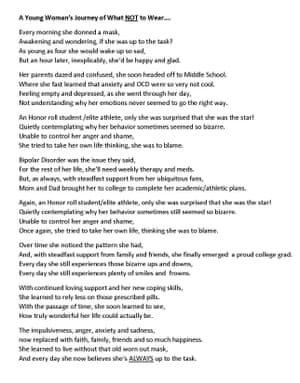
As a young adult, I wanted to share my life’s journey with mental illness in verse.


Dolly Z reflects on her mental illness.


Dolly Z reflects on her mental illness.

Laura Vale, 18, student on a gap year
“I’m so OCD about that, I have to have everything straight.” Or, “I’m such a clean freak, I’m so OCD.”


People don’t say these things maliciously, however, they do cause upset to actual sufferers of obsessive compulsive disorder. There are four main categories of OCD: checking; contamination/mental contamination; hoarding; ruminations/intrusive thoughts.


My OCD falls into the category of contamination/mental contamination. I cannot eat cold savoury food, and without medication I could not even be in a room with cold savoury food without having a panic attack. This is the main feature of my OCD, but I also can’t deal with foods touching, or sharing food and drink.


When it’s really bad, I cannot eat because I feel as though I am contaminating myself with food. I have to feel mentally clean, too, which kind of means mentally organised. This can be with relentlessly cleaning myself or tidying or harming myself because I was not clean enough.


Once (while taking Prozac, which really messed with me), I had to empty my room and paint it white. I knew this was illogical, I was crying because I felt insane, and yet I felt that this was the only way for me to be safe and comfortable. Intrusive thoughts control my life. From basic anxieties to more obscure ones, such as my absolute terror of ever having a child and then starving the child through my OCD. But it can be manageable and, for those who know me, since diagnosis I have taken massive strides.


The main issue with OCD is the lack of understanding in mainstream society. By making statements such as: “I am so OCD about that,” you are trivialising a mental illness that is so controlling, manipulative and horrible, and making the sufferer feel as though their struggle is not real and their feelings are irrelevant. Education is key.


In the UK, the Samaritans can be contacted on 116 123.
In the US, the National Suicide Prevention Hotline is 1-800-273-8255.
In Australia, the crisis support service Lifeline is on 13 11 14.


Young people and mental health: "Since diagnosis, I have taken massive strides"

6 Mart 2017 Pazartesi

Pollution responsible for a quarter of deaths of young children, says WHO

Pollution is responsible for one in four deaths among all children under five, according to new World Health Organisation reports, with toxic air, unsafe water and and lack of sanitation the leading causes.


The reports found polluted environments cause the deaths of 1.7 million children every year, but that many of the deaths could be prevented by interventions already known to work, such as providing cleaner cooking fuels to prevent indoor air pollution.


“A polluted environment is a deadly one – particularly for young children,” says Dr Margaret Chan, director-general of the WHO. “Their developing organs and immune systems – and smaller bodies and airways – make them especially vulnerable to dirty air and water.”


The harm from air pollution can begin in the womb and increase the risk of premature birth. After birth, air pollution raises the risk of pneumonia, a major cause of death for under fives, and of lifelong lung conditions such as asthma. It may also increase the risk of heart disease, stroke and cancer in later life.


Children playing football on an open stove used for smelting woods into charcoal at an unregulated charcoal factory locally known as ‘Ulingan’ in the slums of Manila, Philippines.


Children play on an open stove used for smelting woods at an unregulated charcoal factory in Manila, Philippines. Photograph: Ted Aljibe/AFP/Getty Images

The reports present a comprehensive review of the effect of unhealthy environments and found 570,000 children under five-years-old die each year from respiratory infections such as pneumonia, while another 361,000 die due to diarrhoea, as a result of polluted water and poor access to sanitation.


The WHO estimates that 11–14% of children aged five years and older currently report asthma symptoms, with almost half of these cases related to air pollution. It also suggests that the warmer temperatures and carbon dioxide levels linked to climate change may increase pollen levels, making asthma worse.


“Investing in the removal of environmental risks to health will result in massive health benefits,” said Dr Maria Neira, WHO director of environmental and social determinants of health. For example, tackling the backyard recycling of electrical waste would cut children’s exposure to toxins which can cause reduced intelligence and cancer.


In October, the UN’s children’s agency Unicef made the first global estimate of children’s exposure to air pollution and found that almost 90% – 2 billion children – live in places where outdoor air pollution exceeds WHO limits. It found that 300 million of these children live in areas with extreme air pollution, where toxic fumes are more than six times above the health guidelines.


The WHO announced in May that air pollution around the world is rising at an alarming rate, with virtually all cities in poorer nations blighted by unhealthy air and more than half of those in richer countries also suffering.


Pupils from Bowes Primary school in Enfield, north London, protesting about levels of air pollution outside their school, which is adjacent to the North Circular ring road. Tens of thousands of children in a quarter of all London’s schools are exposed to illegal levels of air pollution that can cause permanent damage to their health, a study has found.


Pupils from Bowes primary school in Enfield, north London, protesting about levels of air pollution outside their school. Photograph: Chris Radburn/PA

Research in 2015 revealed that more than 3 million people a year die early because of outdoor air pollution, more than malaria and HIV/Aids combined. Chan told the BBC on Monday that air pollution is “one of the most pernicious threats” facing global public health today and is on a much bigger scale than HIV or Ebola.


Pollution responsible for a quarter of deaths of young children, says WHO

1 Mart 2017 Çarşamba

Young men and mental health: how do you cope with anxiety?

A quarter of young men self-harm to cope with depression, stress and anxiety, according to a survey by YouGov.


The poll of 500 men aged between 16 and 24 found that 24% had turned to self-harm to deal with difficult emotions. Additionally, 22% said they had considered doing so.


When under pressure, the survey also found a large number of young men resorted to exercising excessively, controlled eating, pulling out their hair, punching walls and abusing drugs.


Dr Marc Bush, senior policy adviser at a leading youth charity, Young Minds, said that men also increasingly feel pressure to look a certain way these days, often lacking self-esteem. He warned about body image issues which affect some young people, leading to excessive exercising and even working out through injury, which could cause damage.


We want to hear from young men about this topic. Do you agree with the findings? Have you self-harmed to deal with stress? What are your biggest worries and concerns? Do you struggle with anxiety and depression? What ways have you found to cope? What can be done to tackle stigmas around men and their mental health? Share your views and experiences.


You can do so by filling in our encrypted form below – anonymously if you wish – or We will do our best to ensure your responses are kept secure and confidential. A selection of contributions will be featured in our reporting.


Young men and mental health: how do you cope with anxiety?

A quarter of young men self-harm to cope with depression, says survey

One in four young men are turning to self-harm as a result of depression, anxiety and stress, according to a YouGov poll.


Of the 500 men aged 16 to 24 surveyed, 24% said they had intentionally hurt themselves. The poll commissioned by three leading youth charities – the Mix, Self-Harm UK and Young Minds – also found a further 22% said they had considered self-harming.


Many said that when they felt under pressure they would turn to exercising excessively, controlled eating, pulling out their hair, punching walls and abusing drugs. When asked how they cope with stress, 21% admitted to drinking heavily, while 19% said they had punched walls and 16% admitted to controlled eating.


Experts say the figures are further evidence that self-harm is not confined to young women. They support NHS figures obtained by the Guardian last year which showed a sharp rise in hospital admissions for self-harm over the past decade.


The charities said the figures may be even greater, as many young men are unaware some of their negative behaviour is self-harm.


Chris Martin, chief executive at The Mix, a charity for under-25s, said: “What’s shocking about these results is the percentage of young men who are self-harming. Lately, we’ve seen a rise in young men accessing our mental health content, services and self-help tools.”


Chris Curtis, the chief executive of Self-Harm UK, said the issue needed to be urgently addressed “to help teenage boys deal constructively with the pressures they face”.


Dr Marc Bush, senior policy adviser at Young Minds, said: “Young men can find it hard to express their emotions because they need to be with the lads and have a sense of belonging. But they can have lots of issues with self-esteem and then have difficulty processing their emotions.”


Bush noted that many young men struggle with self-esteem issues due to the pressure to have a certain type of body. “Ten years ago we were worried about starvation, over-exercise and yo-yo dieting among women, but now we are seeing this in men. Young men think that these bodies are achievable and are doing anything to get them.”


Bush said some men become obsessed about exercise to cope with anxiety, working out to the point of doing physical damaging. “There are cases of men over-exercising and acquiring an injury and then carrying on despite their body saying ‘you’re hurting me’. Lots of young men in their 30s and 40s have done damage that way so they cannot do sports that they used to. Over-exercise can be a injurious activity.”


He added that more needed to be done to raise awareness about men’s mental health concerns, so young people can to talk about their experiences and learn ways to cope.


James Downs, 27, from Cardiff, turned to controlled eating and over-exercising to deal with difficult emotions as a teenager.


He said: “I started to retreat more and more into my eating problems and self-harming behaviours as a way of avoiding having to cope with my feelings. It was to numb the emotional pain I felt with physical pain.Things got so bad that I lost my friends, had to leave school and gave up my university place. I felt like I was a failure and this only made my damaging behaviour worse.


“Instead of blaming myself and isolating myself with my feelings I wish that I had been able to open up to others without feeling ashamed. Mental health and self harm weren’t topics that were ever mentioned in school or at home. They weren’t on the radar and that there needs to be much greater awareness and openness of these issues so that people don’t have to cope alone.”


The survey findings come after a dramatic rise in the number of children and young people self-harming in the past 10 years. There have been major rises among boys and girls.


An NSPCC spokesperson said: “A frightening number of children and young people are being driven to self-harm as a way of dealing with unresolved feelings, tensions and distress in their lives. Last year 18,778 children and young people in England and Wales were admitted to hospital for treatment for self inflicted injuries – a 14% increase over the last three years.


Sir Simon Wessely, of the Royal Psychological Society said it was worrying that reliable data also showed rates of self-harm among young men steadily increasing since 2000.


Downs said: “Life for a young person today is full of challenges that our parents didn’t have to experience. It’s fast paced, competitive and puts immense demands on our ability to remain resilient and cope in positive ways.”


A quarter of young men self-harm to cope with depression, says survey

9 Şubat 2017 Perşembe

Five ways Britain wrecks young people’s mental health – and how to stop it | Emily Reynolds

A study from the Varkey Foundation has revealed that young people in the UK suffer from some of the “lowest levels of mental wellbeing in the world” – second only to Japan.


This won’t be a shock to anyone familiar with statistics on child and adolescent mental health in Britain. Some 75% of mental illnesses begin before the age of 18, and the charity MQ estimates that on average, there are three children in every classroom with a diagnosable mental illness. This, combined with a continuing crisis in mental healthcare in Britain, means young people are not getting the help they need or deserve. But how exactly are young people being failed?


Slashing NHS budgets


Cuts to the NHS aren’t new – the Conservative government has been slowly dismantling the health service since 2010. And it shows no sign of slowing – a 2016 investigation by the Guardian and 38 Degrees revealed that trusts around England were “drawing up plans for hospital closures and cutbacks” in an attempt to avoid a £20bn shortfall by 2020.


Mental healthcare has suffered disproportionately: unmanageably long waiting lists for secondary care, to take one example. Referrals to therapy or specialist units are hampered by a lack of available staff or by ward closures – which means that diagnosis of more severe conditions are delayed even further.


This is particularly striking when you consider that most young people wait on average 10 years between the onset of illness and an eventual diagnosis – and means that many are slipping through the cracks with neither diagnosis nor adequate care.


Similarly, cuts to community care have meant that more children than ever – 20,000 in 2015 alone – have been seeking emergency mental healthcare in A&E, in wards that are often staffed by stressed, overstretched teams who have no specialist psychiatric support to help them cope.


Treating children miles away from home


Cuts have led to the closure of many child and adolescent mental health wards – which, combined with a severe shortage of beds, has led to children being admitted to adult psychiatric wards and being sent hundreds of miles away in order to receive outpatient care.


A 2014 investigation from Community Care and BBC News found that 350 under-18s were admitted to adult wards in the first nine months of 2013 – a 36% increase from the previous 12 months; 10 out of 18 NHS trusts surveyed had sent children to units more than 150 miles away from their home in 2013-14, making compassionate and consistent care for young people impossible.


Cuts to school budgets


One of the key themes of Theresa May’s speech on mental health was a focus on the prevention of these problems, particularly in young people. Research backs this up – a recent study published in Lancet Psychiatry suggested that early intervention was a significant factor in presentation of depressive symptoms in young people.


What May’s speech didn’t mention, however, was how exactly this would be implemented, beyond a mention of “mental health first aid training”. Unsurprisingly, May also failed to mention the grimly inevitable cuts to school budgets that will make this strategy near to impossible anyway.


Earlier this week, a TES investigation found that a third of secondary schools are planning to “cut back” the mental health support offered to pupils because of what one headteacher described as “budgets at breaking point”. Early intervention is vital, but if teachers are untrained in mental health – because the resources aren’t there – then it simply isn’t going to happen.


There’s a research budget of just £8 per person affected by mental illness – compared with £178 for cancer


Lack of adequate research


Mental health research is, in general, an underfunded area. In 2014, the UK Clinical Research Collaboration found that mental health was only allocated £112m a year – which sounds like a lot, until you consider the nearly 15 million people in the country affected by mental illness. In context, this means a research budget of just £8 per person affected by mental illness – a startlingly low sum, especially when compared to less common conditions like cancer (£178 per person) or dementia (£110 per person).


Less than 30% of this research is focused on young people – meaning we haven’t even started to understand how to tackle mental illness in young people.


Failing to take adolescent mental health seriously


Young people are now pretty used to being the punchline of unfunny jokes made by Telegraph readers and the over-45s. Millennials, eh? We’re stupid! We’re narcissistic! We look at our phones all the time! We’re mollycoddled snowflakes! We expect to be given the moon on a stick! These might be hilarious ideas to people without crushing student debts and who have the means to own property – sure, but it’s all fairly tiring for young people.


It might sound facile – typical millennials, complaining about nothing – but it is an undeniable fact that young people are not being taken seriously and that this, in some cases, is severely impacting on their mental health. While researching my book, I spoke to young people up and down the country who told me they felt consistently let down by parents, teachers and healthcare professionals who wrote off their symptoms or failed to take action to prevent distress.


There was an understandable sense of reticence, caution and disappointment about the behaviour of supposed adults. This conversation has continued to follow me – only last week, a teenager messaged me on Twitter to eloquently and despairingly talk about how they and their friends had been consistently and systematically let down by their school.


It’s a familiar story to me – even as a confident young adult with a medical history full of psychiatric wards and prescriptions for antipsychotics, I’m often questioned by GPs and support workers on the veracity of my own experiences. The difference is that I’m used to overcoming barriers to care – younger people are not, and often fall at these completely unnecessary hurdles.


This isn’t just a social problem, either – failure to acknowledge symptoms is a structural problem too. In 2015, the NSPCC suggested that nearly 40,000 young people were unable to meet the “too strict” criteria for receiving help – so even if teenagers pluck up the courage to ask for help, they still aren’t getting any.


Interactive

Young people are telling us that they’re unhappy. They are asking for help. What they want is simple too. For a start, don’t send them hundreds of miles away from home for treatment. And they don’t want GPs to tell them that their clinical depression is just “being a teenager”. They certainly don’t want to sit down with their neighbour and have a cup of tea, as Theresa May ridiculously suggested on Time to Talk – their focus, on the whole, is not on stigma at all.


What young people really want is actual, actionable, well-funded support. They want to be taken seriously; they want to receive the help that they need in a timely, compassionate, efficient and effective manner. They’re asking for it already – when are we going to start listening?


• Emily Reynolds’ A Beginner’s Guide to Losing Your Mind is out on 23 February


Five ways Britain wrecks young people’s mental health – and how to stop it | Emily Reynolds

8 Şubat 2017 Çarşamba

UK second only to Japan for young people"s poor mental wellbeing

Young people in the UK have the poorest mental wellbeing in the world – with the exception of Japan – and list money, getting on in life and the rise of terrorism among their greatest concerns, according to an international survey of 20,000 youngsters.


The study ranks the UK 19th out of 20 countries in its survey of wellbeing, with young people in the UK aged 15-21 lagging behind comparable cohorts in France and Germany, as well as those in countries such as Israel, Turkey, Russia and China.


Indonesia, India and Nigeria scored highest on the wellbeing scale, with scores of 56.2, 54.4 and 53.9 respectively (the highest possible score being 70), whereas Japan scored the lowest at 41.3, followed by the UK (47.3), New Zealand (47.6), and Australia (47.9).


Mental wellbeing graphic

Just 15% of UK youngsters surveyed felt they had good physical wellbeing, measured by regular exercise, sufficient sleep and time for rest and reflection – which was comparable with France (14%) but lower than most countries including Germany (21%), Italy (21%), and Nigeria which scored highest at 41%.


The report was compiled by the Varkey Foundation education charity and used the Warwick-Edinburgh Mental Wellbeing measure, which asks respondents whether they feel optimistic, confident, loved, and interested in other people. The results found a significantly greater sense of wellbeing among young people in emerging economies compared to those in Europe, North America and Australasia.


Extremism and the rise of global terrorism was the issue which made young people in the UK more fearful for the future than any other factor (83%) – a position shared by young people in 13 of the 20 countries, though young Chinese people who took part in the survey identified climate change as their greatest concern.


Moral outlook graphic

Vikas Pota, chief executive of the Varkey Foundation, said: “At a time of nationalist and populist movements that focus on the differences between people, the evidence shows that young people – whatever their nationality or religion – share a strikingly similar view of the world.


“Teenagers in Nigeria, New Delhi and New York share many of same priorities, fears, ambitions and opinions. There is far more unity among young people than a glance at the headlines would suggest. Young people are passionate believers in the right to live the life that they choose, whatever their background, free of prejudice of all kinds.


“However, they are a generation that is deeply pessimistic about the future of the world. They are not strongly influenced by politicians and think that governments are doing far too little to solve the refugee crisis – one of the greatest challenges of our age.”


On global challenges facing the world, nearly half of young people (48%) in the UK said they thought the government was doing too little to solve the international refugee crisis – compared to 72% in Brazil and 16% in Turkey, which scored the lowest on this measure of any country surveyed.


There were mixed responses to questions about immigration, with 31% of British youngsters in favour of the government making it easier for immigrants to live and work in the UK, while 26% thought it should be more difficult. There was greater support for legal migration in Germany (37%), Italy (38%) and the US (38%), but less in France (27%).


More than half of young people in the UK (54%) said money worries were among their top three causes of anxiety. And asked about their most important value, more UK youngsters chose “working hard and getting on in life”, rather than honesty, tolerance, kindness to others, helping their family, or looking after the world beyond their community.


Fears for the future graphic

Young people in the UK are however noticeably enthusiastic about their country, with more than two-thirds (67%) agreeing it is a good place to live, compared to just 4% who think it is a bad place to live. In France the comparable positive figure was 51%, in Germany 75%, and in Canada 87%.


Nevertheless the report suggests a strong sense of pessimism about the future among young people worldwide with 37% overall convinced that the world is getting worse, compared to 20% who think it is getting better. Young people were at their most pessimistic in France, Italy and Turkey where more than half (53%) feared the world was deteriorating.


In contrast, the most optimistic youngsters are to be found once again in emerging economies – 53% of young people who took part in the survey in China and 49% in India believe that the world is becoming a better place.


And on a positive note, the survey, conducted by Populus, showed widespread support from young people around the world for liberal values of tolerance and equality – 63% support legal same-sex marriage; 89% support equal treatment for men and women and 74% are in favour of equal rights for transgender people.


The report, called What the World’s Young People Think and Feel, compares the experiences of teenagers and adults known as Generation Z, who were born around the turn of the millennium in Argentina, Australia, Brazil, Canada, China, France, Germany, India, Indonesia, Israel, Italy, Japan, New Zealand, Nigeria, Russia, South Africa, South Korea, Turkey and the US, as well as the UK. It is thought to be the first international comparative study of the attitudes of young people on this scale.


UK second only to Japan for young people"s poor mental wellbeing

18 Ocak 2017 Çarşamba

Young people’s mental health services need cash not empty promises | Clare Allan

It’s good to talk, and at the moment there’s a lot of talk about mental health and, in particular, about the mental health of young people.


I’m thinking, of course, of Theresa May’s recent speech, in which she announced a government green paper on children and young people’s mental health services, mental health first aid training for schools and a few other measures – to be funded apparently out of thin air – because mental health has been “a hidden injustice in this country” for far too long. From whom this injustice has been hidden was not specified.


BBC Radio 1, 1Xtra and Asian Network on Wednesday launched a year-long campaign “to encourage young people to explore issues surrounding their mental health”. My Mind and Me aims “to get young people talking about mental health, to reduce stigma around mental illness, and to raise awareness and understanding of mental health issues that affect young people”.


To assist them in this, they have partnered with the National Citizen Service (NCS) to create a group of “social action champions”, a group of young people from across the UK, who will work with the stations to help shape the campaign, sharing their own experience and leading discussions on “the key issues around mental health”.


Giving young people a platform to discuss these issues is certainly important. There is nothing more powerful than hearing directly from people about their experience, especially from people who are far too often stereotyped or simply ignored altogether. To hear an individual talk on their own terms and in their own words allows for a human-to-human connection that cuts through cliches and stereotypes. The result can be transforming. And as Ben Cooper, controller at Radio 1, 1Xtra and Asian Network, put it:“From prime ministers to our young listeners, we all recognise the need to change attitudes to mental health.”


It’s good to talk, but I cannot help feeling there is something of an elephant in the room. I confess that I listened to Theresa May’s speech, and much of the discussion that followed it, with my jaw hanging apishly open.


This government and the previous one have presided over the decimation of mental health services – “a car crash”, according to Prof Dame Sue Bailey, former president of the Royal College of Psychiatrists, speaking in 2014. She was just one of a chorus of voices, from patient groups to professional bodies, carers and mental health charities, all shouting the loudest, most urgent of warnings – it certainly wasn’t hidden from the government.


And between 2010 and 2015 funding for Child and Adolescent Mental Health Services (Camhs) was slashed by £50m, despite massively increasing demand.


Even setting aside both of those things, consider how, as a society, we are failing our young people.


However inconvenient the fact may be, mental health is not some discrete entity. The mental wellbeing of young people cannot be considered in isolation from the issues that affect their lives: the education system, benefits, housing, employment practices. In all these areas, the needs of young people have been trampled on over and over again by the boots of political expediency. And now they are supposed to believe we care about their mental wellbeing.


It may be that My Mind and Me is going to address these issues and I very much hope it does.


In 2016, winners of Radio 1’s Teen Awards, which included a mental health category, were invited to meet the Duke and Duchess of Cambridge, who praised their “inspirational work”. All fine, except that mental health problems have repeatedly been shown to be most prevalent in those countries with the highest levels of financial and social inequality.


And I know it seems churlish to point that out, but it would really be the bitterest of ironies if raising awareness of mental health issues became a means of avoiding confronting the factors that contribute to them.


Young people’s mental health services need cash not empty promises | Clare Allan

13 Ocak 2017 Cuma

Library cuts harm young people"s mental health services, warns lobby

Public libraries’ significant role supporting the mental health of young people risks being undermined by swingeing budget cuts forced on local authorities, the head of their professional body warned this week. He added that, if funding is not protected, the work of libraries as frontline information resources for young people in need will be pushed on to the already overstretched police, health and social services.


It is estimated that one in 10 UK children experience mental health problems, as do one in four adults. Nick Poole, head of the Chartered Institute of Librarians and Information Professionals (Cilip) providers, told the Guardian that cuts to local library services would “continue to bite the availability of dedicated resources such as advice on anxiety, stress, exams and bullying”.


He warned: “Under-investing in our libraries simply pushes costs elsewhere and means that a young person growing up today has less help and is more vulnerable to the impact of mental health problems on their life.”


His comments follow prime minister Theresa May’s announcement this week of a raft of measures to “transform” attitudes towards mental health, including an extra £15m for community care, extra training for teachers and improved workplace support.


Wellbeing initiatives run by libraries around the country include the Association of Senior Children’s and Education Librarians’ autism–friendly libraries, the Cilip-backed reading for pleasure and empowerment scheme as well as yoga and mindfulness sessions run as part of Oldham libraries’ mental health and wellbeing support. Birmingham, Devon and Bolton city councils are also among library authorities that run dedicated mental health services.


I would like to think that the powers that be recognised the role of libraries in helping vulnerable people.


Sarah Lungley, Suffolk libraries mental health coordinator


The Shelf Help scheme, which is dedicated to children and young people and was launched in 2016 by the Reading Agency, provides a list of 35 books selected by mental health experts and young readers that range from self-help and information guides to comics, memoirs and novels including The Curious Incident of the Dog in the Night-Time by Mark Haddon and The Perks of Being a Wallflower by Stephen Chbosky. Subjects covered range from body image to depression and self-esteem.


Suffolk library authority said that 68% of the books on the scheme had a 30% or higher loan status than other stock. Last year, 10,000 wellbeing inquiries were handled by the county’s libraries. Although it did not have an official breakdown of who sought help through its branches, Sarah Lungley, mental health and wellbeing coordinator, said anecdotal evidence suggested that the majority of enquiries came from concerned parents of young people experiencing difficulties.


“We are in a really good position to connect people to the help and services that they need,” Lungley said. “I would like to think that the powers that be recognised the role of libraries in helping vulnerable people. A lot of people in the community who struggle with mental health will be left vulnerable and lonely if their local library shuts.”


Poole added: “Children, young people and their parents are simply going to find it harder to find a well-stocked library where they can find information about the issues they face.” Without access to professional librarians trained in mental health resources, he said, those struggling would be more reliant on unmediated internet searches to gain information. “As a parent myself, I would be worried about my children using Google like that.”


Public libraries have been caught in the crossfire of a ferocious funding battle being fought between local councils and central government. Official figures released at the end of 2016 revealed that library budgets had fallen by £25m in a year, as a result of councils raiding their resources to shore up frontline services such as social care.


According to an annual survey of library authorities in the UK undertaken by the Chartered Institute of Public Finance and Accountancy (Cipfa), total expenditure for the sector fell from £944m to £919m over the year, a 2.6% fall. Over the same period, 121 libraries closed, taking the total number open down to 3,850.


Before Christmas Poole predicted that over the next five years, a further 340 libraries will face closure if proposed cuts go ahead. Libraries in Warrington, Lancashire, Edinburgh, Denbigh and Swindon are among those facing the most severe losses.


Poole said: “We have to find a way of making our political stakeholders understand that a big part of what libraries do is making sure that people with a whole range of issues feel safe and can access information.


“If we remove that function from communities, all you are doing is pushing those library users on to the police and healthcare professionals. If Theresa May isn’t aware of that, her comments are nothing more than an empty soundbite.”


‘The library was a calm, quiet and safe place for me to be’


Fifteen-year-old Josh is adamant that his local library has saved his life. A year-and-a-half ago, school felt like a prison for him, as he struggled to keep up with his classmates due to a variety of issues including severe anxiety and Irlen syndrome, a problem that affects his ability to read and process information. He was also suspected to be on the autism spectrum.


Two years earlier, anxiety attacks and vulnerable feelings had begun to make him dread each school day. “School became an oppressive place to be,” he says. “I was scared and upset and everything just became too much. Everything made me worried and afraid.”


The troubled teen was not a victim of bullying, but the normal noise and chaos to be found in any classroom were a daily nightmare he had to confront.


Only one place made him comfortable: his local library. “The library was a calm, quiet and safe place for me to be,” he says.


Already a regular user, Josh welcomed the available support and guidance when he needed it. Based in a deprived part of Suffolk, his library benefits from a coordinated county-wide health and wellbeing policy funded by the Mental Health Pooled Fund, which is a combination of Suffolk County Council and Suffolk’s Clinical Commissioning Group.


He was eventually allowed to swap school days for days in the library – and the impact on his learning has been considerable: “Because I don’t have to go into school much, I use the library to do my revision. It’s quiet and I find it much easier to study. I am relaxed and calm when I am working because I can take as much time as I want without being constantly rushed.”


When stuck on a difficult maths or English problem, librarians are at hand to guide him towards answers. “They have really supported me,” he says. “They are always there to talk to and help me through a basic part of a question and then will find me a book to help me with the rest. It has given me a lot more confidence.”


A sign of how positive an experience it has been for Josh is that he has now begun volunteering, leading groups of eight to 12-year-olds who have been bullied by older children. “I wanted them to get off the street and come into the library and have a safe space to be,” he says. His idea was to set up an after-school club; by the end of 2016, 20 children were attending every Wednesday.


“It’s great,” says the teenager. “It has given them their own space where they aren’t being picked on by the older children. Before it was a struggle to talk to people because it really scared me. But now I am much more calm and confident.” He smiles: “I seem to be smiling a lot more and am feeling a lot better about life.”


Library cuts harm young people"s mental health services, warns lobby

15 Aralık 2016 Perşembe

Smoking and drinking among young people at lowest level on record

Young people in England born since the turn of the century are the most clean-living generation in recent times, with the rates of those choosing to smoke cigarettes and drink alcohol the lowest on record.


Fewer than 5% of children aged eight to 15 have smoked, down three-quarters since 2003, while only about 17% admitted ever drinking alcohol, a fall of two-thirds, according to an annual survey of health trends.


At the same time, the proportion claiming to eat five portions of fruit and veg has almost doubled in the same period to a fifth. Despite that, 28% of children aged two to 15 were overweight or obese in 2015, and only one in five were as physically active as they ought to have been.


Nine in 10 mothers and eight in 10 fathers of overweight children did not recognise the problem, according to the Health Survey for England 2015, published by NHS Digital on Wednesday, with charities warning that obesity is still an urgent public health epidemic.


The dramatic fall in the number of young smokers follows a cultural shift in the perception of smoking, as well as significantly tighter restrictions on tobacco sales.


In the past decade, the government raised the legal age for buying tobacco from 16 to 18, banned smoking in enclosed public spaces, introduced graphic health warnings and introduced rules that hide tobacco products from view in shops.


At the same time, off-licences have become far stricter about sales to teenagers, and bars and clubs have introduced stringent ID requirements for entry.


Gillian Prior, the head of health at the National Centre for Social Research, which carried out the survey of 8,034 adults and 5,714 children on behalf of the NHS, said: “Changes to the law mean that under-18s are prohibited from buying cigarettes and the Challenge 25 policy adopted by many retailers has meant that these laws are more rigorously enforced than they have been in the past.


“But we should not underestimate the importance of changes in the nature of childhood; changes in technology and society mean that teenagers in particular spend their time in a very different way compared to teenagers 15 years ago.”


A Department of Health spokesperson said: “We are committed to helping people lead healthier lives so it is encouraging to see a decline in smoking rates and fewer children drinking alcohol.


“However, this survey reaffirms that we can’t let up in our efforts to tackle childhood obesity – and we are confident our world leading plan will make a real difference in the long term.”


Smoking and drinking among young people at lowest level on record

30 Kasım 2016 Çarşamba

Growing crisis in children and young people"s mental health demands action

Self-harm among young people, particularly girls, has rocketed in the last decade. The number of girls admitted to hospital after cutting themselves has quadrupled, incidents of poisoning have risen by more than 40%, and demand for university counselling services has mushroomed. Behind these figures are young people and families struggling to cope with toxic levels of mental distress.


In part these numbers reflect a greater awareness of mental health and willingness to seek help but more is going on than that. These figures are also evidence that the today’s generation of young people are facing unprecedented levels of social pressure leading to serious psychological distress. Our response, as a society, has not, as yet, been anywhere near sufficient to answer this cry for help.


At the Tavistock and Portman specialist mental health trust, we have been engaged for nearly 100 years in understanding the causes of psychological distress among young people and, in particular, the impact of childhood experience, relationships and trauma, on mental health. It is why we feel strongly that it was the right thing to do to let the cameras in and help tell the story of young people, their families and clinicians working with them.


Channel 4’s documentary Kids on the Edge, screened over the last month, is the result. For us it has captured, with great sensitivity, the challenges faced by young people and their families, and which our services are working through on a daily basis. Some of what is shown is shocking but not in a sensationalist way. Only by better understanding, both intellectually and emotionally, the level of distress that can drive a young person to self-harm or to think of taking their own life can we begin to move forward.


Ash, featured in Channel 4’s documentary Kids on the Edge


Ash, featured in Channel 4’s documentary Kids on the Edge. Photograph: Jude Edginton/Channel 4

There is a growing crisis in children and young people’s mental health. It demands a response, it requires urgent action. We would highlight three priorities.


First, demand for help is outstripping supply. A target has been set that 30,000 more young people are able to access help by 2020. That is welcome. However, the treatment gap is enormous. It is estimated that only 25-35% of young people who need help for mental health difficulties receive it. If this was true for cancer there would be a public outrage. Furthermore many services are seeing year-on-year increases in demand of more than 10%, often combined with a rise in case complexity. If the goal is to get good quality and timely help to the young people who need it, the new money promised by the government for children’s mental health must reach the frontline. So far the story on this has been mixed.


Second, dealing with emotional and mental distress is part of the day-to-day business of teachers, social workers and other professionals. This workforce need the right skills, recognition and support to help build resilience in children and keep them engaged with education.


This is more than just mindfulness, helpful though that might be. Some of these challenges were brought into focus by the programme in our school, Gloucester House, which supports some of the most troubled children who have been excluded from other parts of the educational system.


As a society we must acknowledge the negative impact growing social pressures and targets are having on our children and young people, and the part our education system plays in turning up that pressure. A child’s wellbeing should never be sacrificed in the pursuit of educational achievement.


The third issue, graphically illustrated in the final programme, is the difficulty of supporting a young person in transition between adolescent and adult services. An arbitrary age cut-off can do untold harm. Mental healthcare relies on strong therapeutic relationships between service users and clinicians. Care should be organised around an individual’s circumstances not the arbitrary diktats of service boundaries and funding.


There is, in our view, no area of work in the NHS more valuable and rewarding than investing in the health and wellbeing of young people. They are our future and when we get things right there is a lifetime of benefit to be gained for individuals and society.


We have opened our doors at the Tavistock and Portman because we wanted to create a platform for the young people and families using the services and the clinicians who work with them. There is a growing public demand for children and young people’s mental health to be awarded the priority and the investment it needs. This government has made important commitments, but for kids on the edge turning sympathy into action cannot come too quickly.


Paul Jenkins is chief executive of the Tavistock and Portman NHS trust. Paul Burstow chairs the Tavistock and Portman NHS trust and previously served as minister for mental health.


Join the Social Care Network to read more pieces like this. Follow us on Twitter (@GdnSocialCare) and like us on Facebook to keep up with the latest social care news and views.


Growing crisis in children and young people"s mental health demands action

21 Kasım 2016 Pazartesi

UN calls for urgent action to protect young women from HIV/Aids in Africa

Urgent action is needed to help and protect girls and young women from Aids in sub-Saharan Africa, thousands of whom are still being infected with HIV every week, the UN says.


Many adolescent girls do not know they have the virus and do not seek help or get treatment because they cannot tell their families they have had a sexual relationship with an older man. The death rates among adolescents are high.


In 2015, 7,500 girls and young women aged 15 to 24 were infected with HIV every week. More than 90% of the adolescents infected in sub-Saharan Africa are girls. Between 2010 and 2015, the total annual number of new infections among 15- to 24-year-old women fell just 6%, from 420,000 to 390,000. The UN target to reduce that number to fewer than 100,000 a year by 2020 is way off track, says the latest report from UNAids.


Too little has been done to help girls protect themselves and stay well, according to Michel Sidibé, the executive director of UNAids. “Young women are facing a triple threat,” he said. “They are at high risk of HIV infection, have low rates of HIV testing, and have poor adherence to treatment. The world is failing young women and we urgently need to do more.”


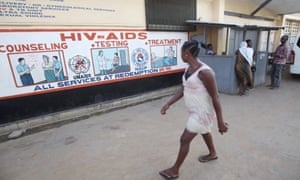
A woman looks at posters displaying information about HIV and Aids at a hospital in Liberia


A woman looks at posters displaying information about HIV and Aids at a hospital in Liberia. Photograph: Ahmed Jallanzo/EPA

Girls are particularly vulnerable in southern Africa because of their low status in a strongly patriarchal society. “Women’s and girls’ heightened vulnerability to HIV goes far beyond physiology: it is intricately linked to entrenched gender inequalities, harmful gender norms, and structures of patriarchy that limit women and girls from reaching their full potential and leave them vulnerable to HIV,” says the report.


Helping girls avoid HIV is hard because efforts must address the issues of gender imbalance and violence in societies, as well as poverty, which causes some girls to have relationships with men for money, says the report. Education is also important. Studies have shown that girls who stay in school longer are less likely to become infected.


The report says that a cycle of infection is taking place, which must be broken. Girls and young women are infected with HIV by older men. Men tend to acquire HIV later in life, from women who were infected when they were younger.


The good news from the report is that the numbers of people with HIV being put on drug treatment to keep them well has now reached 18.2 million, which is 3 million more than two years ago. UNAids says it is on track to meet the treatment target of 30 million people by 2020.


But preventing infection is proving more difficult. There were 2.1m new infections in 2015 – the same number as in each of the last three years and only slightly down from 2.2m in 2010.


Global HIV numbers

It was hoped that widespread drug treatment would make a difference to the numbers becoming infected. People who are on the drugs have a low level of the virus in their blood and are unlikely to transmit it to their sexual partners.


But many men are reluctant to go to health clinics and do not get tested, or if they do, they will not go on drug treatment until they actually fall ill, which could be months or years later. “Studies are showing that almost 61% of infections are caused by people who know they are HIV positive but they are not on treatment,” said Sidibé. While that is happening, he said, “how do we control the epidemic?”


Drug resistance is another issue highlighted in the report, which is published ahead of World Aids Day on 1 December. The basic drug combination – “first line” treatment – has become cheap, but the virus is adept at mutating. When people develop or pick up resistant strains of HIV, they need second- or third-line drugs, which are much more expensive. If resistance spreads, said Sidibé, the cost of treating millions of people with newer drugs will be prohibitive and make it impossible to end Aids.


“We need really to protect the drugs that we have. If not, we will have failed,” he said.


UN calls for urgent action to protect young women from HIV/Aids in Africa