poll etiketine sahip kayıtlar gösteriliyor. Tüm kayıtları göster

5 Mart 2017 Pazar

NHS poll finds public think service getting worse

Growing numbers of Britons think the NHS is getting worse and fear for its future, a survey has found.


Ipsos Mori polling last month found that 57% of people believe that the NHS’s ability to deliver the care and services it provides worsened over the last six months, up from 52% in January. One in four (24%) said it had got “much worse”, 33% “slightly worse”. Only 8% said “better”. The same proportion – 57% – were pessimistic about the NHS’s future. Asked how they expected it to fare in the next few years, 37% said “worse” and another 20% “much worse”; 21% said better.


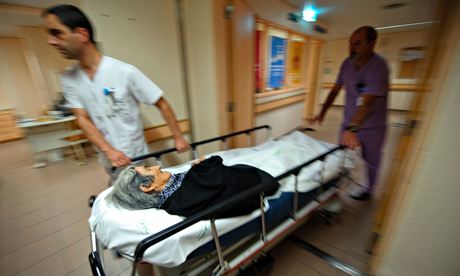
The polling may reflect the NHS’s worst winter crisis in years. Record numbers of patients were forced to endure long waits – often on a trolley – and more than half of hospitals went on alert because they could not cope.


The over-75s were the only group in which more people thought the NHS would get better (41%) than worse (35%). Conservatives were less pessimistic (50%) than Labour voters (61%).


“This survey shows the public is realising that the NHS is buckling under the strain of meeting rising demand for services and maintaining standards of care,” said Chris Ham, chief executive of the King’s Fund health thinktank.


Chris Ham of the King


Chris Ham, chief executive of the King’s Fund health thinktank. Photograph: Frank Baron for the Guardian

A separate international study by Ipsos Mori found that Britons are more pessimistic about their healthcare system than people in 22 other countries. Almost half (47%) of Britons believe the quality of the healthcare they and their families can access will get worse in coming years.


However, Britons are also among the most positive internationally about the care they currently receive. Some 69% say that they and their family get good quality healthcare, well above the 47% seen across the 23 countries.


“Britain’s love for the NHS is one of our defining characteristics, and we remain among the most positive countries in the world about the quality of care we receive. But we’re also the most worried for the future of the service. This fear has been growing and is now at record levels”, said Kate Duxbury, Ipsos Mori’s head of healthcare research.


A spokesman for NHS England said: “It’s welcome news that a far higher proportion of people in Britain than in other countries rate the quality of their healthcare highly. And it’s noticeable that those people who use the NHS most and who therefore know most about it – the over-75s – are in fact the most optimistic about its future.”


He pointed to the very high scores recorded by 12 different types of NHS services in December under the “friends and family” ratings test. Dental care got the highest patient satisfaction rating, at 97%, while even the lowest scores – 86% for both A&E and mental health care – were still high.


Meanwhile, doctors and hospital bosses want some of the £700m-£1bn of extra government money expected to be given to social care in this week’s budget to be used to help cover the cost of “bed blocking”. They want to ensure that local councils do not use the cash to fill other holes in their budgets and ensure that any extra funding benefits both social care and the NHS.


The call has come from NHS Providers, which speaks for hospitals, and medical royal colleges representing A&E doctors, surgeons and hospital physicians. They want Philip Hammond, the chancellor, to make the money conditional on councils spending it on people who have had a spell in hospital, so that it reduces the 723,000 bed-days a year lost because patients who are medically fit to leave cannot be safely discharged for lack of social care support.


“If extra money is coming into social care it should either be spent on local authority packages of care or, if this doesn’t happen, on the alternative – the cost of keeping patients in hospital,” the four organisations said, in a joint statement to the Observer.


“Any solution to benefit NHS patients must be clear, simple and not capable of being manipulated. Local authorities would receive more funding if they support the NHS and less if they don’t.”


NHS poll finds public think service getting worse

28 Şubat 2017 Salı

Poll shows 60% of European doctors are considering leaving UK

More than half of the doctors from Europe working in the UK are considering leaving the country because of Brexit, a survey by the General Medical Council indicates.


Charlie Massey, the chief executive of the GMC, told the health select committee that while a survey was “not necessarily predictive of future behaviour” the results indicated a potential serious depletion in the workforce.


“It does send a worrying signal in terms of the stock of doctors currently working in the UK,” he said while giving evidence to MPs on Tuesday.


Jonathan Ashworth, the shadow health secretary, said it was “extremely concerning that over half of doctors from the EEA [European Economic Area] feel so undervalued as to consider leaving the UK following the Brexit vote”.


The GMC said 2,106 doctors from the EEA, about 10% of the total who are working in the UK, had responded to the survey.


Of those who responded, 60% (1,280) said they were considering leaving the UK at some point in the future, and, of those doctors, 91% said the UK’s decision to leave the EU was a factor in their considerations.


Separately, a senior Department of Health official told the committee that British people claiming pensions who had emigrated to Europe were saving the UK about £350m a year in healthcare costs. Medical treatment in the most popular countries for British retirees, France and Spain, was cheaper than it was in the UK, said Paul MacNaught, the director of EU, international and prevention programmes at the DoH.


The 190,000 British retirees living elsewhere in Europe, cost the UK an average of £2,300 a year in payments to local health providers. In Britain, the cost of supporting their European equivalents was an annual average of £4,500.


“This is one of the advantages of the current arrangements,” MacNaught said.


The UK paid about £650m to EU countries to compensate for their health services to Britons. The vast bulk of that, £500m, went on the 190,000 retired Britons in Europe. Of those, 70,000 were living in Spain, 44,000 in Ireland, 43,000 in France, and 12,000 in Cyprus.


More than 1,000 respondents in the GMC survey commented on their feelings about Brexit and its impact on their practices.


Massey said two primary reasons were cited for considering abandoning careers in Britain: “Firstly, a question of whether or not doctors felt valued working in the NHS, and secondly, the uncertainty over the continuing future residency status.”


Ashworth said: “The skills and dedication of staff from around the world are integral to our NHS and the government must immediately reassure EU nationals of their right to live and work in the UK. If they don’t, we risk facing a serious staff shortage which will only further worsen pressures on our NHS.”


In a statement, Massey said: “EEA doctors make a huge and vital contribution to health services across the UK. We want to continue attracting overseas doctors in future, and ensure we do not create any unnecessary barriers that would stop them coming here. It’s deeply worrying that some are considering leaving the UK in the next few years. If they leave, this would have a serious impact on patient care and would place the rest of the UK medical profession under even greater pressure.”


Last week the health select committee heard that about 10% of doctors in the NHS were EU nationals, while 5% of nurses had trained in European countries before moving to Britain.


The BMA’s council chair, Mark Porter, warned last week that an exodus of doctors after Brexit could be a “disaster and threaten the delivery of high-quality patient care”.


The EEA consists of all 28 members of the EU along with Norway, Iceland and Liechtenstein.


Poll shows 60% of European doctors are considering leaving UK

6 Ocak 2017 Cuma

Half a million older people spend every day alone, poll shows

[unable to retrieve full-text content]


Scale of loneliness among over-60s revealed as Age UK develops scheme to provide support and companionship


Half a million people over the age of 60 usually spend each day alone, with no interaction with others, and nearly half a million more commonly do not see or speak to anyone for five or six days a week, a poll suggests.


Age UK, which commissioned the research, said the results highlighted a growing number of chronically lonely older people, which was placing increasing demand on health services.


Related: Jo Cox’s campaign to tackle loneliness lives on with help of friends


Related: Loneliness is a hazard of old age. A phone call can mean a lot | Michele Hanson


Continue reading…


Half a million older people spend every day alone, poll shows

22 Eylül 2016 Perşembe

May more trusted than Corbyn on Britain"s key issues, poll finds

Theresa May is more trusted than Jeremy Corbyn to tackle the most urgent problems in post-Brexit Britain, including safeguarding the NHS, according to a new poll seen exclusively by the Guardian.


Asked what politicians’ priorities should be, the top three choices in the Britain Thinks poll were safeguarding the health service, significantly reducing immigration and striking new trade deals as Britain leaves the European Union.


Theresa May was more trusted on all three issues, outpacing Corbyn on protecting the NHS by 38% to 30%. On reducing immigration, 46% of voters trusted May; just 12% said Corbyn.


Deborah Mattinson, the director of Britain Thinks, said: “When we look at the policies that are people’s highest priorities – the economy post-Brexit, immigration – Theresa May is more trusted than Jeremy Corbyn to deliver. She is even more trusted in Labour’s traditional heartland area: the NHS.


“Jeremy Corbyn has failed to engage with ordinary voters. Half of the people in our focus groups did not recognise him when shown a photograph – the lowest level of recognition I have ever seen for the leader of a mainstream political party.”


Corbyn’s low standing on immigration may be understandable, as he has made clear his support for continued freedom of movement within the EU, although he would like the government to take action to mitigate the impact on low-paid workers.


But it will chime with the fears of centrist Labour backbenchers, including Rachel Reeves and Stephen Kinnock, who have argued that Labour should be ready to push for curbs on immigration in the wake of the Brexit vote.


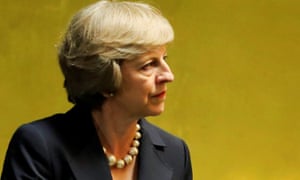
Theresa May


Theresa May was trusted more on the NHS, but less with supporting struggling families. Photograph: Eduardo Munoz/Reuters

Corbyn is more trusted by voters to implement a series of other policies, including opposing grammar schools, abolishing university tuition fees and providing “better support for struggling working families” (by 41% to May’s 28%), according to the poll.


That may suggest voters do not believe the rhetoric of the prime minister’s first speech in Downing Street, when she promised to tackle social injustice and govern on behalf of the “just managing”, instead of the “privileged few”.


Corbyn’s critics have repeatedly highlighted Labour’s low polling during this summer’s bruising leadership campaign – though he insists that large attendances at rallies up and down the country show he has a groundswell of support that will eventually be felt at the ballot box.


A separate analysis of recent polling by elections expert John Curtice, published in the journal of the IPPR thinktank on Friday, suggests Corbyn is a polarising political figure. “Mr Corbyn is more accurately described as a divisive opposition leader than as an unpopular one,” Curtice says. “More voters have had an opinion of him, either for good or ill, during his first year as opposition leader than have had a view about any of his predecessors during their initial 12 months in the post, Tony Blair included.”


He adds: “There is evidently a section of the British public, to be found particularly among younger voters, for whom the Labour leader does have an appeal; it just does not look like a section that is big enough, on its own at least, to enable Labour to win a general election.”


The Britain Thinks poll was backed up by focus group interviews in Harlow, Essex, and Leamington Spa, Warwickshire, which revealed a deeply divided Britain. “Our research tells the story of a fractured nation, with people dividing themselves into two groups – the haves and the have nots,” Mattinson said. “While the first group feel at ease with themselves and their lives, the second, larger group faces a daily struggle, and feels a deep sense of injustice.”


She added that while immigration did not emerge as voters’ primary concern, a number of other issues – including pressures on public services and the NHS – were viewed through the prism of immigration.


The polling found that delivering a well-funded and efficient NHS was the most popular choice when people were asked for their top priorities for Britain, selected by just under a third of people. Next came a significant reduction in immigration, with notably less support for negotiating strong post-Brexit trade deals, supporting struggling families or building new homes.


May more trusted than Corbyn on Britain"s key issues, poll finds

9 Eylül 2016 Cuma

Three in four Britons unclear on obesity link to​​ cancer – poll

Three out of four Britons do not know the types of cancer that are linked to obesity, a poll suggests, raising concerns that widespread ignorance is hampering efforts to encourage people to adopt healthier lifestyles. Men and poorer people are most likely not to know about the connection. However, almost 80% of women are unaware that being dangerously overweight can cause female-only forms of cancer such as ovarian and womb cancer.


“Cancer isn’t at the forefront of people’s minds when talking about obesity, and that’s really concerning,” said Alison Cox, director of cancer prevention at Cancer Research UK. “Few understand that excess weight increases the risk of several cancers, including some of the most common, such as breast cancer.”


The charity undertook a survey of 3,293 adults selected to be representative of the whole UK population. It found that 23.8% of men and 26.9% of women indicated that they knew of the link between obesity and cancer.


Broken down by social grades, 30.1% of ABs (middle and upper middle class), 19.2% of C2s (skilled working class) and 22% of DEs (working class and unemployed) were aware of the extra risks associated with obesity.


When asked about specific forms of cancer, 60.1% of respondents said they knew obesity could cause bowel cancer and 55.2% said they were aware of a link with liver cancer, while far fewer knew of obesity’s link to womb cancer (21.5%), ovarian cancer (22%), prostate cancer (27.5%), breast cancer (31.1%), oesophageal cancer (31.2%) and bladder cancer (32.4%). CRUK says obesity is a contributory factor in 10 forms of cancer, and estimates that obesity causes about 18,100 new cases of cancer each year in the UK.


Cox said: “It’s the government’s responsibility to inform the public of the link and also to take action to tackle the obesity epidemic, starting with the health of the nation’s children.” She said adverts for foods high in fat, salt or sugar should be banned during all family programmes before 9pm, not just children’s shows.


Sarah Toule, head of health information at the World Cancer Research Fund, said the survey findings confirmed its own research that “people just don’t know enough about the dangerous links between obesity and cancer”. She added: “We live in a society where we are surrounded by advertising and offers for unhealthy junk food. Just eating an extra 100 calories a day can lead to gaining a stone within a year. It is therefore important that the public understand that they need to make conscious healthy choices for themselves and their children.”


Simple, inexpensive measures could help people live more healthily and reduce their cancer risk, such as walking an extra 15 minutes or eating a piece of fruit instead of a packet of crisps, Toule suggested.


Excess body fat can cause cancer for several reasons. Fat cells release hormones such as oestrogen, which can increase the risk of cancers including breast cancer. Research has also found that storing too much fat around the body prompts the body to produce growth hormones. Higher levels of those have been linked to a higher risk of developing cancer.


A Department of Health spokeswoman said the link between obesity and cancer was part of the motivation for its recent childhood obesity “plan of action”, which has been widely criticised. “Our obesity plan is world-leading, with more far-reaching and comprehensive measures than anything pursued by any other western government”, she said.


Three in four Britons unclear on obesity link to​​ cancer – poll

19 Temmuz 2014 Cumartesi

Poll: David Cameron"s reshuffle boosts Tories

The findings came as one of the ministers whom Mr Cameron sacked launched an extraordinary assault on his political opponents.


In an article for The Telegraph, Owen Paterson, the former Environment Secretary, says that he accepts the Prime Minister’s “right to decide on his team” but argues that the jubilant reaction to his sacking from green activists displays he was demanding them “rather effectively”.


Mr Paterson mounts a vigorous defence of his record battling the influence of green groups in Brussels, fighting Liberal Democrats in coalition over wind farms, and responding to the flooding of the Somerset Ranges last winter.


In his write-up, he denounces the “Green Blob” – his phrase for environmental campaigners, renewable vitality firms and some public officials – and calls on politicians to stand up to the strain groups.


“This tangled triangle of unelected busybodies claims to have the interests of the planet and the countryside at heart, but it is increasingly clear that they are focusing on the incorrect troubles and carrying out genuine harm even though profiting handsomely,” he writes.


Some activists even sent him death threats and circulated his property handle “worldwide” on the net in the hope that it would be attacked, the MP says.


According to the Telegraph’s poll, voters strongly assistance the appointment of women like Nicky Morgan, the new Training Secretary, and Liz Truss, Mr Paterson’s substitute at the Division for Setting, Meals and Rural Affairs.


In all, 81 per cent mentioned getting a lot more ladies in the Cabinet was a good issue.


Ukip supporters were least impressed with the new female appointments: 36 per cent did not agree that getting much more female ministers is a very good point.


The appointment of Eurosceptic ministers like Philip Hammond, the new Foreign Secretary, and Michael Fallon, promoted to Defence Secretary, was meant to reach out to Ukip voters.


Mr Fallon has predicted that the new Tory crew will win back those who have “flirted” with Ukip.


The poll suggests that Ukip-inclined voters can be won back. Two thirds of voters described Ukip as a excellent way of placing strain on the principal events, but would hesitate to back them in a basic election.


The benefits also recommend that the Conservative attempt to depict Ukip as extremists has persuaded some men and women.


Some voters explained that they would struggle to back Ukip because of its “extreme” views (36 per cent) even though other people felt their vote would be wasted (21 per cent).


A single in three voters – 33 per cent – title Mr Cameron as the greatest Prime Minister for Britain, regardless of their personal voting intentions, confirming him as the most highly rated of all the party leaders.


He is far a lot more common with his personal side than Mr Miliband is among Labour supporters. Some 90 per cent of Tory voters back Mr Cameron as Prime Minister, while only 59 per cent of Labour voters feel Mr Miliband is the best leader for Britain.


Meanwhile, new specifics have emerged of the personal negotiations between the Prime Minister and his senior colleagues about which jobs they would be provided.


William Hague informed Mr Cameron a year ago that he wished to quit as Foreign Secretary simply because he did not want to be “hanging around” when the Prime Minister would commence renegotiating Britain’s relations with the EU prior to a planned in/out referendum.


A Cabinet supply mentioned: “David Cameron has known for about a year that he was going.


“He was extremely clear he wanted to stage down. You would begin to get questions about the Foreign Secretary and Europe, especially with the Europe referendum coming in the next parliament. He did not want any of that.”


Considerably of the coverage of the reshuffle centered on the “demotion” of Mr Gove from the submit of Training Secretary to the function of Conservative Chief Whip.


Mr Cameron asked Mr Gove, a single of his closest pals and allies, if he desired to move jobs to become Chief Whip two weeks prior to the reshuffle.


A senior government supply mentioned: “He went away to go and have a proper believe about no matter whether it would be a good factor. He came back and made the decision it would be good to do.”


Mr Gove spent a lot of the day just before the reshuffle acting as Chief Whip, helping Mr Cameron to finalise the new line up of government ministers, even just before it was announced that his part had transformed.


Even so, Downing Street has privately identified for some months that the Conservatives want a friendlier face than the divisive Mr Gove to current the party’s schooling policies to voters ahead of the next election.


A senior Cabinet minister privately conceded that the reshuffle was focused solely on winning following year’s common election, with small time left for introducing new reforms in government.


“You want your prime team in the middle doing the heavy lifting for the election,” the senior Tory said. “That’s what we are going to be doing in the next nine or ten months – we have acquired to get re-elected.”


Poll: David Cameron"s reshuffle boosts Tories

16 Temmuz 2014 Çarşamba

Poll displays assistance for raising taxes to sustain NHS

NHS

The NHS could encounter a funding gap of £30bn by the finish of the decade. Photograph: Graeme Robertson/Getty Pictures


Voters stay wedded to Britain’s taxpayer-funded model of healthcare even as NHS leaders query its sustainability, according to a Guardian/ICM poll.


Analysis by NHS England and by outdoors authorities factors to a huge funding gap that could reach £30bn by the finish of the decade, and final month 71 health services major lights wrote to the Guardian to warn politicians that failure to level with the public about the black hole just before polling day would jeopardise the service’s potential.


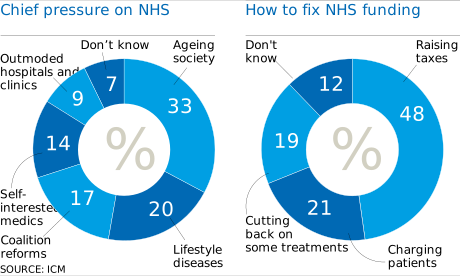
Asked how they would tackle the potential funding of medicine, voters are resolved by a margin of more than two to a single that “raising taxes for everyone, to put much more income in” is the appropriate way to go.


Tax-funded increases in expenditure are preferred by 48% of respondents, even though 21% who rather countenance expenses, such as paying to see the medical professional, and 19% think it would be greater to reduce back on the assortment of offered treatments.


On the face of it, these outcomes supply some support for the suggestion – debated in Labour circles – of going into the election pledging a ringfenced national insurance coverage rise to cover NHS spending.


Assistance for higher taxes rises to 60% among Labour voters and 61% between Lib Dems. But Ed Miliband remains decidedly wary, ruling out any “huge” paying rise just lately, not least since prolonged Labour experience suggests that voters are sometimes far more ready to assistance greater taxes in view polls than at the ballot box.


Poll benefits


Asked to pinpoint the principle supply of the strain on NHS funding, 33% highlight “growing numbers of frail previous men and women”, and twenty% “way of life diseases” linked with consuming and weight problems.


Voters would consider some persuading that a modify of administration would dramatically alter both of these, but a substantial minority (17%) believes that the “coalition’s marketplace-based overhaul” of the system is the principle problem – like 20% of individuals who backed the Lib Dems in 2010 and 27% of recent minority supporters, indicating that the opposition could stand to acquire if it can push health up the agenda.


An additional 14% blame self-serving medics a lot more interested in shell out cheques than sufferers, and 9% see a problem with “the incorrect kinds of hospitals and clinics, in the wrong areas”. This suggests that the public is unlikely to be enthused by fresh strategies to take on the professions or reconfigure services in the way that some authorities recommend.


Pressed on what they think could be tolerably rationed, voters are emphatic in saying that heart bypasses (97%), hip replacements (94%) and post-accident facial reconstruction (91%) need to often be offered. There is also powerful majority support for “costly cancer drugs that may possibly extend daily life by a handful of months” (70%) and for IVF remedy (60%).


On IVF there is an fascinating age split, with only 40% of the 65-plus age group supporting its provision, compared with 78% of those aged 18-24, which calls into query the trendy thesis that younger voters are disinclined to assistance expansive welfare providers.


Even so, a lot of much more previous (56%) than youthful (37%) voters indicate that they would be content to see taxes rise to bail out the wellness support as a whole.


The one particular discipline the place the public is inclined to help restrictions on provisions is the one particular in which the NHS rationing body, Wonderful, final week indicated that the services need to be inclined to do more. Nice proposed offering gastric band surgical treatment to any obese individual with type-two diabetes who demands it. Voters, by contrast, are inclined – by a margin of 60% to 35% – to think that this is one therapy that need to not be automatically funded.


• ICM Investigation interviewed a random sample of 1,000 grownups aged 18-plus by phone on 11-13 July 2014. Interviews have been carried out across the country and the outcomes have been weighted to the profile of all grownups. ICM is a member of the British Polling Council and abides by its principles.


Poll displays assistance for raising taxes to sustain NHS

1 Temmuz 2014 Salı

Would functioning a four-day week relieve tension? | Poll

A major medical doctor has advised that the Uk switch to a four-day working week to combat growing anxiety and permit people to devote more time with their families. Prof John Ashton stated that the Uk has a maldistribution of work, with lunch breaks disappearing, and individuals functioning increasingly long hrs. He also highlighted the issue of inequality, with numerous functioning too tough while other individuals are out of work. Would a shorter functioning week lessen anxiety in your life?


Would functioning a four-day week relieve tension? | Poll

23 Haziran 2014 Pazartesi

Poll: need to cigarettes be completely banned?

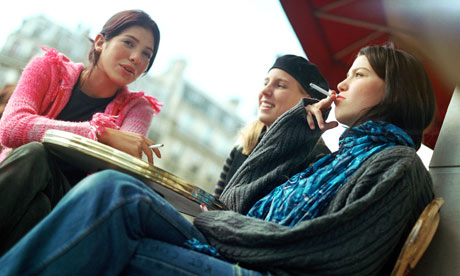
Three teenage girls sitting at cafe terrace, smoking cigarettes, low angle view

Tim Crocker-Buque, a expert registrar in public overall health medication who proposed the movement, mentioned that it is unusual for people to make an informed choice to smoke in the course of adulthood. Photograph: PhotoAlto / Alamy/Alamy


The British Healthcare Association will vote on Tuesday on whether to lobby the government to permanently ban cigarettes for any person born soon after the yr 2000. This would not stop any adults who currently smoke from carrying out so but would imply that it will turn out to be progressively illegal more than time.


Supporters of the movement at the doctors’ union say the measure is necessary due to the fact 80% of smokers who consider up the habit make the choice to do so as children. The BMA have previously successfully lobbied the government to ban smoking in public areas and in cars carrying young children. The smokers’ group Forest mentioned the thought was “preposterous and discriminatory”.


What do you believe?


Poll: need to cigarettes be completely banned?

22 Haziran 2014 Pazar

Poll: NHS decisions must be left to medical professionals, say vast majority of Britons

NHS decisions should be left to doctors, poll says

The survery found that a third of individuals are in favour of parliament setting targets for the NHS, with 42% opposed. Photograph: Hugh Macknight/PA


The bulk of British men and women feel the NHS has turn out to be a political football utilised cynically to win votes and need to be trusted to pros who recognize how ideal to provide healthcare, in accordance to an view poll carried out for the British Health care Association.


The Ipsos Mori survey, launched on the very first day of the BMA’s annual representatives meeting, also identified that a third of individuals were in favour of parliament setting targets for the NHS, compared with 42% who were opposed. The union mentioned the findings supported its insistence that selections on patient care must be free of charge from political interference and left to medical professionals.


The chair of the BMA council, Dr Mark Porter, mentioned the NHS was “one of the most politicised public solutions in the Uk. Regardless of whether it is the targets forced on doctors, GP appointments that are far more about box-ticking than clinical care, or quick-term, headline-grabbing policy initiatives – all of these are getting carried out for political expediency and to win votes. As a end result, patient care is taking a back seat to scoring factors in excess of the dispatch box.”


The survey of nearly two,000 folks across Britain, weighted to be nationally representative, discovered that 73% believe that political events are creating health policy to win votes, not to do what is very best for the NHS, and that 65% feel the NHS ought to handle itself without the involvement of politicians as it understands how very best to give healthcare.


The public also showed a preference for doctors participating in selections about how the NHS is run, with fifty five% saying they need to have “high involvement”, over managers (34%).


Motions to be debated at the annual representative meeting accuse the coalition government of facilitating privatisation of the NHS and endangering public well being via austerity measures but the survey final results indicate unease at political interference from all sides.


Porter cited Labour’s pledge to promise a GP appointment within 48 hours as effectively as the government’s strategy for doctors’ surgeries to be open 7 days a week as adjustments becoming lined up just before the up coming election that “may possibly seem very good on a leaflet” but “will not tackle the problems that have left GPs struggling to supply the care, time and appointments their individuals require.


“Physicians want to see politics taken out of the NHS when and for all. It is clear that the public really feel the identical way. Yes, politicians should be accountable for the working of the NHS, but when it comes to choices on patient care it is time to permit physicians to do what they do ideal – lead the delivery of high-good quality patient care.”


A Labour spokesman defended the party’s pledge on GP waiting occasions. “Only Labour is severe about investing in GP surgeries,” he explained. “We have pledged £100m to help patients get appointments more rapidly – too many are waiting a week beneath this government.”


Of these polled, 57% mentioned they were content with the working of the NHS, even though 25% said they have been dissatisfied.


Poll: NHS decisions must be left to medical professionals, say vast majority of Britons

18 Haziran 2014 Çarşamba

Should the e-cigarette market be restricted? - poll

E-cigarettes

The burgeoning e-cigarette industry is proving really controversial amongst public wellness specialists. Photograph: Peter Macdiarmid/Getty Photographs


A group of 129 doctors and specialists has written a letter to the director of the World Health Organisation, urging it to treat e-cigarettes as it would tobacco products, and spot stricter controls on the burgeoning industry.


Criticising the part of big tobacco in the e-cigarette market, casting doubt on the role e-cigarettes can have in assisting smokers to quit and highlighting the attraction of e-cigarettes to youngsters, the doctors create:


The two scientific evidence and best practices are obtainable to support a regulatory framework that will ideal avert initiation of use amid youth and other non-tobacco consumers, defend bystanders in public areas from involuntary exposure, regulate advertising and marketing, and prohibit unsubstantiated claims.


The public well being community is polarised in excess of the concern. This week’s letter was in response to a letter in Might from a group of scientists, who advised that e-cigarettes could be a hugely important wellness innovation. They accused WHO of “overlooking or purposefully marginalising” the role e-cigarettes have as a lower-threat alternative to cigarettes.


What do you believe? Is the growing e-cigarette market a potential danger in need to have of tighter regulatory controls, including a restriction on advertising and promotion? Or do e-cigarettes supply a lower chance option to tobacco cigarettes that could have considerable constructive public overall health implications.


Take our poll below and comment below the line – particularly if want to share experiences (great or poor) with e-cigarettes.


The social effect hub is funded by Anglo American. All articles is editorially independent except for pieces labelled advertisement function. Locate out more right here.


Join the community of sustainability professionals and professionals. Turn out to be a GSB member to get more stories like this direct to your inbox


Should the e-cigarette market be restricted? - poll

17 Haziran 2014 Salı

A single in four trusts government with NHS, poll exhibits

NHS

The Unison standard secretary stated the government has wasted billions on an needless NHS reorganisation. Photograph: Christopher Furlong/Getty


Only one particular in four people trusts the government with the NHS, according to the “damning” findings of a poll.


Unison explained a survey of far more than 2,000 grownups uncovered “bad trust” in the coalition, with just over a third saying they backed its measures to boost the economy and more than half disagreeing in excess of the fairness of taxes.


The poll, published at the union’s yearly conference in Brighton, also exposed that 1 in four ran out of income ahead of their following shell out day, with 9% getting to borrow just to pay for essentials.


The Unison standard secretary, Dave Prentis, said: “With significantly less than a year to go to the general election, the coalition is sliding down in the public’s estimation on 3 important election battleground locations.


“The public sees via government rhetoric claiming the economic system is on the up, because they are struggling day to day to keep their heads over water.


“4 in ten of these surveyed said they are worse off a end result of the government’s cuts to public investing, and public services employees have been punished by this government by denying them a spend rise for another year, despite bragging about an economic recovery.”


Prentis said that the government had wasted billions on an “needless” reorganisation of the health support.


“As an alternative of bettering patient care, we now have longer waiting occasions, including for cancer treatment method, and cuts and closures to vital patient companies. The winners are yet again these already reaping the benefits of the Tory cuts agenda. Massive organizations are queuing up to take above lucrative contracts in the public sector.”


A single in four trusts government with NHS, poll exhibits

8 Haziran 2014 Pazar

A single in twenty young children has utilised a sunbed, poll finds

But the variety of youngsters who use the machines has lowered given that the law came into force – from six.eight per cent in 2008 to 09 to four.5 per cent now, according to study which will be presented at Public Well being England’s (PHE) annual Nationwide Cancer Intelligence Network conference in Birmingham.


The survey, performed by PHE and the University of the West of England, also identified that half of people who had ever utilized a sunbed had burned at least once as a outcome.


And every single child who admitted making use of an unsupervised coin-operated bed on a typical basis said they had burned at least when.


The poll, funded by Cancer Analysis Uk, was conducted on three,000 eleven to 17-year-olds from across England, Wales and Scotland.


It also found that 4 in ten of the youngsters said they by no means been given wellness tips on the likely harms of sunbeds, or distinctions in between skin sorts.


Professor Julia Verne, lead writer and strategic public wellness lead of PHE’s Nationwide Cancer Intelligence Network, mentioned: “The quantity of youngsters making use of sunbeds in Fantastic Britain has fallen given that the underneath-18 ban was launched.


“But supervision, notably in England, wants to boost to adhere to the legislation which is made to defend younger individuals from the harms of UV injury.


“Firms that fail to verify the age of their consumers are putting younger individuals at threat of establishing skin cancer later in daily life, as nicely as breaking the law. We have to do far more and guarantee that clear well being details is provided to those grownups who select to use them.”


Sara Osborne, Cancer Investigation UK’s head of policy, extra: “It truly is encouraging to see fewer kids are utilizing them. Prices of skin cancer are disproportionately substantial in younger folks, which is why it’s so essential to shield the skin during our early many years.


“With many youngsters saying they aren’t being told about the risks or asked to demonstrate their age, it really is important the Government takes action to deliver England in line with the rest of the Uk.


“Cancer Investigation Uk urges folks not to use sunbeds for cosmetic reasons and we urge all firms marketing sunbed sessions to display responsibility and inquire any buyer they suspect is under 18 for evidence of identity.”


MPs have recently called for unmanned tanning salons to be banned in England.


The All Get together Parliamentary Group on Skin mentioned that tanning facilities where folks can just turn up and use sunbeds with no supervision need to be prohibited.


Figures from Cancer Study Uk showed much more than 13,000 individuals are diagnosed with malignant melanoma, the most severe type skin cancer, each and every 12 months in contrast with 1,800 in 1975.


Malignant melanoma is now the fifth most frequent cancer in the United kingdom and a lot more than 2,000 individuals die from the ailment each and every 12 months, a spokesman mentioned. Although much better detection strategies have contributed to the rise, the charity blamed the issue on a “dramatic explosion” of package deal holidays and the “boom” in sunbed use.


A single in twenty young children has utilised a sunbed, poll finds

7 Mayıs 2014 Çarşamba

NHS Better Care Fund: what should happen following? Poll


  • theguardian.com,


  • Heathcare professionals helping an elderly woman: the NHS Better Care fund has been delayed

    The Better Care Fund was to aid carry with each other overall health and social companies, in the belief that this would reduce the growing pressures on hospitals. Photograph: Alamy


    The Guardian reports that the Far better Care Fund – a pooled budget “to guarantee a transformation in integrated well being and social care” – has been delayed.


    The £3.8bn-a-year fund has been held up after a confidential Whitehall overview concluded it would not perform as hoped.


    Wellness correspondent Denis Campbell writes:


    The £3.8bn-a-year Greater Care Fund was supposed to have been launched last week, but its introduction has turn out to be mired in doubt following the Cabinet Workplace voiced deep disquiet about its viability and argued that there was small or no detail about how the expected financial savings would be delivered.


    A Whitehall supply mentioned the Cabinet Workplace believed that the claims for the Better Care Fund did not stack up and wished “a whole lot more operate accomplished on the policy”.


    The thought behind the plan, due to be introduced in April following yr, was to bring collectively well being and social care solutions – typically funded by neighborhood authorities – in the belief that this would decrease the growing pressures on hospitals and support keep folks more healthy in their personal houses.


    The Department of Health, nonetheless, insists the policy is even now on track. Responding to the Guardian’s story, a spokesperson mentioned:


    We have set aside time to make sure all places have designed comprehensive plans for joined up care. The Better Care programs begin from April 2015, and we asked for early versions to be finished a 12 months in advance so we could overview them, check their level of ambition and check how they would be delivered. This is what is taking place now.


    Let us know what you feel the government should do up coming by voting in our poll or commenting below.


    NHS Better Care Fund: what should happen following? Poll

    26 Mart 2014 Çarşamba

    EU workout poll: Brits and Irish volunteer most as coaches


    A Europe-wide study uncovered that Swedish men and women pick to do the most workout, with just 9 per cent claiming they in no way get element, even though at the other finish of the scale, 78 per cent of Bulgarians admitted to never exercising at all.


    Nonetheless, the report for the European Commission located 39 per cent of men and women in Britain volunteer to coach other folks, second only to Ireland, where 44 per cent stated they gave up their spare time to be a trainer.


    The research for the “Eurobarometer survey”, which was published this month, was carried out in November and December final year across the 28 member states of the European Union.


    Some 27,919 respondents from diverse social and demographic groups were interviewed face-to-face at residence.


    The report located 41 per cent of Europeans workout or play sport at least after a week, although 59 per cent in no way or seldom do so. Although the figures have not changed considerably considering that 2009, the proportion of folks who explained they never exercise or play sport at all enhanced from 39 per cent 5 years ago to 42 per cent now.


    The examine identified guys in the EU physical exercise, perform sport or engage in other bodily action far more than girls, with the disparity particularly marked in the 15 to 24 age group, with younger males (74 per cent) tending to exercise or perform sport on a typical basis significantly a lot more than young women (fifty five per cent).


    EU workout poll: Brits and Irish volunteer most as coaches

    4 Şubat 2014 Salı

    Should Disney create a plus-size princess? | Poll

    A high-school lady is petitioning Disney to generate more plus-sized characters in its films. She argues: “Disney films are very influential and wide-spread, and they impact the lives of a lot of young children, specifically girls. It would be revolutionary for Disney to display help to a group of women who are otherwise horrendously bullied by the media.” What do you feel?


    Should Disney create a plus-size princess? | Poll

    14 Ocak 2014 Salı

    Is it proper to ban sweets at supermarket checkouts? | Poll

    25min in the past


    Nobel peace prize winner Liu Xiaobo’s wife reads poem from home arrest – video


    Xia Liu, a poet and artist, reads 1 of her poems in her house. There is considerably support for her jailed husband, Nobel Prize winner Liu Xiaobo, but activists are trying to strain China to loosen up restrictions on Xia Liu


    Is it proper to ban sweets at supermarket checkouts? | Poll

    10 Ocak 2014 Cuma

    Quarter of Britons give up alcohol in January, says poll

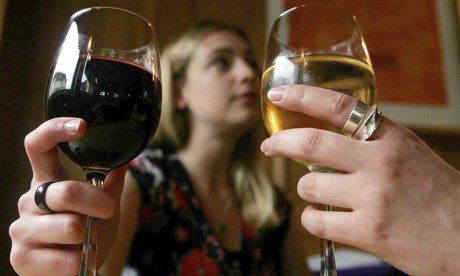
    Wine drinkers in London

    Wine drinkers at a central London pub: a single in six polled mentioned they had already broken their new year’s resolution to stop drinking. Photograph: Cathal Mcnaughton/PA


    A quarter of Britons have stopped drinking alcohol in January, even though practically a half intend to cut down on their normal consumption, a survey has proven.


    Funds-conserving site Vouchercloud polled just below 2,000 individuals. The majority – 56% – said they have been “going dry” to save funds, whilst other people stated it was to enhance their wellness. Fewer than half thought they would last the whole month with out consuming, although one in 6 stated they had currently broken their new year’s resolution to appreciate a tipple.


    Virtually a quarter – 23% – claimed they were doing it to show willpower and 19% explained it was because “no one particular else drank in January”..


    Alcohol Concern and Cancer Research Uk are encouraging Britons to end consuming alcohol in January.


    Meanwhile, supermarkets have reported powerful revenue of reduced alcohol wines and beer this month. Because 2010, Sainsbury’s revenue of wines that incorporate ten.5% alcohol by volume or significantly less have grown by virtually 26%. Tesco has reported that demand for packs of lower and no alcohol beers has risen by thirty% given that the starting of January, and 45% in the past yr compared with the preceding 12 months, with 33m bottles offered. The supermarket believes demand will soar by a more 30% this yr as a lot more lower alcohol beers come on to the market place above the following handful of months.


    Olivia Christou, a specialist beer purchaser for Tesco, mentioned the reputation of low alcohol beer was down to a “significant improvement in the taste and basic quality”. “They have proved so well-liked with drinkers that many of the main breweries are launching more beers this year,” she mentioned.


    Quarter of Britons give up alcohol in January, says poll