Lisa etiketine sahip kayıtlar gösteriliyor. Tüm kayıtları göster

6 Şubat 2017 Pazartesi

Did the Mona Lisa have syphilis?

What is the Mona Lisa’s secret? She smiles so enigmatically under the all-but-invisible transparent silk veil that covers her hair, turning her brown eyes as if she has just seen someone come into her field of vision. The fascination and fame of this portrait, begun by Leonardo da Vinci in 1503, has always related to the elusive personality it communicates. Giorgio Vasari in the 16th century claimed Leonardo employed musicians and jesters to make Lisa smile. Walter Pater in the Victorian age thought she resembled a “vampire”. Modern viewers sometimes see her face as androgynous, an observation first made by Marcel Duchamp.


I have a new theory. Perhaps the Mona Lisa had syphilis.


This painting may seem like a dream image, an unreal vision, but it is a portrait of someone real. Lisa Gherardini was the wife of a Florentine merchant called Francesco del Giocondo. Contemporary sources, including a note made in 1503 by an employee in the Florentine government at the Palazzo Vecchio, put it beyond reasonable doubt that she was Leonardo’s model (and not, as art historians used to claim, someone posher).


So, she was the wife of a merchant who lived in Florence in the age of Machiavelli, Michelangelo and the explorer Vespucci. Can we know anything else about her? The lives of women in Renaissance Italy are lost in the shadows. Only in Leonardo’s portraits and a handful of other works of art do Florentine women of this period come back to life.



A brown-lipped snail


Just add earthworms … a brown-lipped snail. Photograph: Rod Williams/Alamy

Yet, as it happens, a handful of documents have survived that give glimpses of Del Giocondo’s life. For instance, she is recorded in the ledger of a Florentine convent as buying snail water (acqua di chiocciole) from its apothecary.


Snail water? I remember finding it comical when I first read this. Beyond that, I accepted a bland suggestion that it was used as a cosmetic or for indigestion. In fact, this is nonsense. The main use of snail water in pre-modern medicine was, I have recently discovered, to combat sexually transmitted diseases, including syphilis.


Perhaps it was the disgusting, punitive nature of this concoction that made it seem a pungent cure. Snail water was still being used in the 18th century; books from the time are very specific about its medicinal value. The Pharmacopœiapauperum (1718) gives this recipe:


Take Garden-Snails cleansed and bruised 6 Gallons, Earth-Worms washed and bruised 3 Gallons, of common Wormwood, Ground-Ivy, and Carduus, each one Pound and half …


More herbs are added to give the vile brew, credited to Dr Richard Mead, a physician at St Thomas’s hospital in London, a better flavour. Other 18th-century recipes concur in the use of snail water for treating such ailments,as you can see for yourself at the excellent Old Operating Theatre Museum and Herb Garret, where examples of the recipe and its use for venereal disease are on display.


Is this why Del Giocondo needed snail water? If so, it is possible she wanted it for someone other than herself. In any case, her recorded purchase was more than a decade after she posed for Leonardo. But suppose she already had a sexually transmitted disease in 1503. What would that say about Leonardo’s most famous painting?


When Del Giocondo posed for Leonardo in 1503, syphilis was shaking Europe to its core. Some said this new disease had been brought from the new world by Columbus’s sailors in 1492. It spread like wildfire. Could there be hint of it in Leonardo’s most famous painting? The Mona Lisa is shown in front of a hilly landscape through which a road snakes towards distant water and mountains. Perhaps the far-off mountains across wide, blue water represent the new world – the source of the Mona Lisa’s secret.
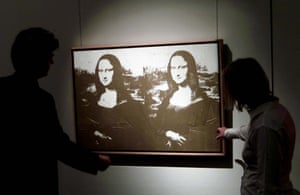


Andy Warhol’s Mona Lisa


Andy Warhol’s Mona Lisa, displayed before a sale at Sotheby’s in 2002. Photograph: Max Nash/AP

When Pater compared the Mona Lisa with a vampire, he was hinting at something macabre and morbid in Leonardo’s masterpiece: an association of sex and death. Perhaps this was not simply Pater’s overheated Victorian imagination conjuring decadence, for there are real shadows of mortality in this painting. When Andy Warhol created a black and white version of the Mona Lisa in 1963, he brought out just how much blackness underlies and undercuts the golds and browns in Leonardo’s intricate portrait. Pools of dark shadow spread across del Giocondo’s face, lending definition to her beauty, but also hinting at a melancholy behind her half-smile. The shadows around her eyes could easily seem unhealthy. The strange greenish light that bathes her could be a miasma of sickness.


If the Mona Lisa is a portrait of someone with a sexually transmitted disease, these hints of death and illness suddenly make sense. As for her half-smile, it becomes a wry acknowledgement that sex can make you sick. This macabre message fits well with Sigmund Freud’s analysis of Leonardo. Freud argued in his 1910 book Leonardo da Vinci and a Memory of His Childhood that the polymath researcher who not only painted but also filled notebooks with his scientific studies was repelled by sex. Leonardo was homosexual, he says, but afraid of intercourse with men or women. Instead, he “sublimated” sexuality into research.


Freud would surely think it interesting that the model of the Mona Lisa may have had syphilis. Of course, he made a lot of mistakes in his book about Leonardo. This is probably a red herring, too. However, there is surely something unhealthy about the obsessive allure that draws so many people to admire this beauty behind her screen of glass. Whatever the true meaning of the Mona Lisa, it is a slightly decadent masterpiece. Fin de siècle fantasies of syphilis-spreading vampires don’t seem so wide of the mark.


Did the Mona Lisa have syphilis?

18 Kasım 2016 Cuma

A moment that changed me: meeting my late love Denise, who gave me the courage to come out | Lisa Alabaksh

My university seminar had just finished, and I was standing in line at the refectory, grumbling about a man who had suggested any woman who disagreed with him must be a lesbian. “Well, I am a lesbian so I don’t know what he’d say to me,” said Denise Marshall. It was the first time we’d met. I was enchanted.


This was early 1992 and I’d been pretending to be “straight” for quite some time. I didn’t ever use the word lesbian. If my sexuality had been spoken about at all – which it definitely wasn’t – I would have used the word gay.


To meet a woman so out and so absolutely gorgeous … well … I was hooked. I didn’t know, of course, just how far my life would go with the funny, red-haired woman in a duffel coat, but we were friends immediately, laughing at both being from Tottenham, just up the road from the Middlesex University campus in Enfield, when all around us were people from proper “up north”: Tracy from Manchester, Wendy from Bradford, John and his twin from somewhere “not London”.


We were funny and flash in our north London cockiness. We thought so, at least.


Denise was profoundly political, a feminist and socialist to her core and deeply delighted by her life as an out-and-proud lesbian activist. Every Thursday afternoon, while the rest of us sat around smoking, Denise would go off to work with a group of Kurdish women who needed housing. I didn’t even know what Kurdish was at the time.


For the next three years, Denise held court after lectures and many people listened. Me most of all. She hadn’t been around heterosexuals for many years, she said. She had been a development worker for Stonewall, helping to set up housing projects for vulnerable young lesbians and gay men. University was full of straight people. She was fascinated by them and it made her fascinating. She also knew from our first meeting that I wasn’t being true to myself. She didn’t say so directly. But because she presented being a lesbian as a beautiful privilege, she made me realise I could live differently.


Denise organised a group of us to go to the May Day rally in 1992, and soon we were all reading her two favourite books: The Ragged-Trousered Philanthropists by Robert Tressell and Sour Sweet by Timothy Mo. She taught me about feminism, class oppression, the importance of caring for our communities, of working to right wrongs. Pretty soon I was out of the closet, and with Denise’s encouragement I went to Gay Pride, had some fine fun flings with fabulous women, and my life took off. Denise was an education in herself and I spent every moment I could with her.


My secret life faded and I found liberation in living honestly. Our friendship deepened, I moved in as Denise’s lodger, and then one day, it all changed. We became lovers.


This was 1995, and Denise had become the manager of a women’s refuge. I had graduated as an English teacher and the internet had just arrived. Like the rest of the world, we had no idea what that dial-up tone would mean and where it would take us. We had no idea what becoming lovers would come to mean either, but our love was wild and wonderful, and neither of us had ever been happier. It was a golden time of feminism, lesbianism, freedom and hope. We adored each other.


Ten years later, not long after I became a headteacher, I collapsed one day, insanely tired following an Ofsted inspection. An emergency brain scan led to a diagnosis of multiple sclerosis. I had to retire from my job, and was told I would soon need a wheelchair. It felt like my life was over. But it wasn’t. I still had Denise.


Denise Marshall and friend


‘Denise’s final Facebook post asked friends to look after me, and they did.’ Denise Marshall and friend. Photograph: Lisa Alabaksh

She became CEO of Eaves, a feminist charity specialising in support, advocacy and research into all aspects of violence against women. Eaves changed policy and perceptions around trafficking through its Poppy project, and the work was respected worldwide. Funding was cut with the advent of the coalition government in 2010, and Denise was heartbroken. But she was a force of nature, and kept the Eaves projects going, as well as writing two novels, travelling the world for adventure, playing poker and using social media with a political passion.


In August 2015, our life together ended. Denise died of stomach cancer, and Eaves closed two months later – a double devastation. Through sickness, diagnosis, treatment, pretty much up to the end of her life, Facebook had been Denise’s link to the outside world, and in those early minutes, hours, days and weeks of grief it became mine too. Posting on Facebook was my way of not drowning, because online, there were friends. Real friends; people I’d actually met and who knew Denise. I would write, sometimes in the dark, desperate hours of insomnia, and someone would be there. Facebook saved my life. Denise’s final post asked friends to look after me, and they did.


By the time of my first birthday without Denise, I had posted some 60,000 words. She was loved by so many and she was missed so much, personally and professionally. People told me it helped to read my posts, and that message helped me. One day, two friends brought a manuscript around, made up of the posts I’d written, and from there this became an actual book and my life changed again.


Now I am a published writer who has a life that includes people I really don’t know but who now know me. Sort of. The book is an out-and-proud story of lesbian love, feminist fire and a universal recognition that everyone can be stronger for longer with a bit of kindness and compassion. It is about surviving the swim across the oceans of grief and finding hope in the heartache. It is about love.


The moment I met Denise Marshall, I found my life’s passion – working to end violence against women and girls – and I took the first step on the path to living openly and happily as a lesbian, as who I am. Because of Facebook, I have been able to survive the greatest loss of my life. Along the way, I’ve tried to live according to a mood and a mindset I call Hahalala – health and happiness and love and laughter all. This outlook and expression came to me after my own recovery from sickness. Although Denise would often roll her eyes at my cheeriness, she too was an optimist and she loved and believed in the concept.


In the last days of her life, I asked how she had done it all, how she was still managing to raise a smile, how we were all going to survive without her. She smiled the smile that enchanted me the first time I met her, in that refectory queue, 23 years earlier. “It’s a case of having to, my darling,” she said.


A moment that changed me: meeting my late love Denise, who gave me the courage to come out | Lisa Alabaksh

25 Haziran 2014 Çarşamba

NHS believe in chief Lisa Rodrigues on why she"s shouting about mental health | Mary O"Hara

Lisa Rodrigues NHS chief

Lisa Rodrigues, chief executive of Sussex Partnership NHS Foundation Believe in, says her following role will be as a psychological health campaigner. Photograph: Andrew Hasson


In direction of the finish of last 12 months Lisa Rodrigues, a longstanding chief executive of a large NHS mental well being believe in, was driving home from perform when some thing harrowing happened. “I was acquiring some horrible stomach pains. I could not see properly. I wished to crash my auto. I really had to [attempt hard to] stop myself undertaking that.” She made it property securely but says she “cried for 3 days and 3 nights”.


Rodrigues was in the midst of the first severe episode of clinical depression she had skilled in virtually two decades but it was particularly important, she says, simply because the crisis point occurred weeks soon after she had manufactured the selection to “come out” about her background of mental well being issues.


That someone in such a senior management place in any organisation decides to speak openly about living with depression is uncommon and Rodrigues, 58, whose most trying times were in her teens and early 20s, acknowledges that speaking out was tough. As she talks about her operate and occupation, the last 13 many years of which have been as chief executive of Sussex Partnership Foundation Trust, a provider of mental well being, substance misuse, learning disability and prison healthcare companies, she exudes the fervour of somebody established to bring her own experiences to bear.


She says, as retirement approached, she realised that talking about currently being in a demanding, senior position with a history of depression could have value. “I was just about to leave the NHS and that I desired to speak about the reality that currently being a leader doesn’t suggest to say that you have to be ideal,” she says.


The concept that residing with a mental illness would exclude a person from a work they were capable of carrying out demands to be challenged, she suggests. “My experience of learning to control my very own emotions and deal with what I have just dealt with – I feel I’m a far better particular person for it with out a doubt,” she adds.


Reactions to her coming out have been primarily encouraging, but some individuals commented that she “was the extremely last individual” they would have expected to have psychological health issues, or remarked, “You’re not on antidepressants are you?” as if there was anything incorrect with it.


“There’s this whole pill shaming issue that goes on”, she says of the stigma attached to taking medication for a mental illness. “If you have received cancer and you come forward for treatment no person judges you. To be frank I would be dead if I hadn’t taken antidepressants due to the fact I was so low.”


She argues that, in spite of some progress in latest years, it is stigma across society that is a principal lead to of damaging attitudes and also affects behaviour and the way psychological well being companies are funded and organised.


“Why is it that mental well being services in this country only get twelve% of the assets that we have accessible, offered that it is at least 25% of the condition burden? I feel we begin with the stigma,” she argues. “If we can start by speaking about the stigma … that implies individuals are far more most likely to invest in providers to aid individuals people have a better daily life.”


What about the monetary strain on the health service in spite of ministerial overtures around “parity” of care for people employing mental overall health companies? Rodrigues says plainly: “Put your money in which your mouth is, politicians.”


Her analysis of the mental healthcare technique is measured and illuminating. It is clear she has relished the hard process of operating a complicated overall health believe in in a time of immense modify, and believes she has helped increase some aspects of healthcare, including advocating for far more integration amongst mental and bodily provision, in distinct for older folks.


The impact of the economic downturn and rewards modifications have been “really substantial”, Rodrigues says, simply because the most vulnerable men and women are underneath huge stress. “We have got the advantage changes affecting patients and so also the increase in charges for items and also the adjustments in housing advantage. So they’ve received a triple whammy. When we are seeing them they’re far more unwell and have a tendency to keep in hospital longer.”


In other regions cuts to funding coupled with modifications to the commissioning of youngster and adolescent mental healthcare are specially problematic, she suggests, since “early intervention” is so crucial to longer phrase psychological wellbeing and to reducing the demands on “other components of the system” this kind of as A&ampE and the criminal justice technique additional down the line. The previous 12 months has observed a “severe” jump of 10% nationally in the number of youthful folks accessing services, but there are “no hospital beds for youngsters and young individuals anyplace in the country at any 1 time” to accommodate these in crisis.


Although nevertheless evidently passionate about how the health technique operates, there is a sense that Rodrigues is steadily coming to terms with moving on and segueing into the role of campaigner. “For the up coming third of my life I will be campaigning about this stuff,” she replies. “I will not want to be operating it. I want to publish about it. I want to shout about it simply because I believe I can make fairly a big difference.”


But what helps make her believe folks will pay attention to what she has to say? “I will make certain they do. I’m really difficult to say no to,” she asserts with a smile.


Age 58.


Lives Brighton, east Sussex.


Family Married, two grown-up children.


Training Horsham substantial school for Girls, West Sussex, Dunottar school, Reigate, Surrey University of Sussex, BA in psychology, BA and MA, public sector management.


Profession 2001-present: chief executive officer, Sussex Partnership NHS Foundation Believe in (and predecessor wellness and social care trusts) June-Dec 2001: task director, psychological health, West Sussex Wellness Authority (HA) 2000–01: director, emergency arranging, South East Regional Office, NHS Executive 1995–2000: exec director of nursing, South Downs Overall health NHS Believe in 1990–95: wellness visitor, South Downs Overall health NHS Trust (and predecessor authorities) 1987–90: health visitor, East Sussex HA 1979–82: health visitor, Brighton HA 1977–78: employees nurse, Excellent Ormond Street Hospital.


Awards CBE for solutions to the NHS.


Interests Jam, bicycles, Brighton and Hove Albion FC, reading through and creating.


NHS believe in chief Lisa Rodrigues on why she"s shouting about mental health | Mary O"Hara

16 Mayıs 2014 Cuma

Lisa Rodrigues evaluations this week"s healthcare news

Soldiers in Afghanistan

Study from the charity Combat Stress uncovered a 57% rise in ex-services personnel seeking support for publish-traumatic tension disorder. Photograph: PA


The aim of Psychological Well being Awareness week, established by the Psychological Health Foundation, is to get these who wouldn’t generally speak about it to join in with those who do, growing knowing and decreasing stigma.


At Sussex Partnership, we have been functioning for a lot of many years to get psychological well being treated with the same respect as bodily illness. This involves speaking with our patients, households and the public setting goals for our employees reaching fair entry to restricted NHS sources for folks with psychological wellness situations and contributing positively to the way individuals who have mental overall health issues are taken care of by the media. My knowledge of severe clinical depression at the end of last 12 months helps make me come to feel even far more established that we should perform our portion.


The disparity amongst mental and physical care has been highlighted lately by the media. The BBC and Community Care Magazine ran a joint investigation into individuals currently being sent far away for admission to acute mental hospitals. Locally, we are working internally, with commissioners and partners to improve things, due to the fact our program across the country is not fit for objective. In most components of the Uk, the typical length of remain in psychological wellness hospitals is escalating since the alternatives to going into hospital and care to help risk-free early discharge are not obtainable 24-7. Personnel are annoyed about wanting to do the proper point for sufferers but not getting assets in the proper spot.


On the topic of parity, this piece by Martin McShane, director of long-term circumstances at NHS England, was very very good.


In Sussex we utilized Psychological Health Awareness Week to reach individuals utilizing our companies and those who are interested in what we do, including by way of a tweetchat on obsessive compulsive disorder (OCD). We needed to present it can cripple people’s lives, leaving them also afraid to go out, petrified of catastrophe if they never execute extremely repetitive checking routines or repeating the identical basic tasks, this kind of as personalized hygiene, for several hrs. Our tweetchat had a great response from the local media with The Argus, our nearby every day, running a feature, and local radio stations mentioned OCD all through the day.


Different media ran fascinating pieces on publish-traumatic anxiety disorder (PTSD) in servicemen and females. This arose from study by the charity Fight Stress about a 57% rise in ex-service personnel looking for help for PTSD. If our aim is to minimize stigma, we want to make confident people know that we can all seem soon after our psychological wellness, and that psychological sickness can have an effect on anybody. One in 4 men and women will endure from a mental well being problem in their lifetime. This is altering, in component because of weeks like this and the co-ordinated efforts of the wonderful Time to Adjust programme. But several folks nevertheless see it as taboo, most likely simply because they are frightened. We want to do lots a lot more to reach out to absolutely everyone, specifically the standard Radio one demographic and youthful men. Hearing about the experiences of ex-servicemen and females moved me and I hope it did the very same for other folks, particularly these who are struggling in silence and are not certain in which to turn. And last but not least, hurry up and view all 6 episodes of The Crimson Discipline to see how knowing of PTSD began from the terrible situations of the very first globe war.


Psychological health issues do not just impact the person, they impact their partners, children, mother and father, other loved ones and close friends. I thought this piece by Seb Baird, co-founder of the Mind Your Head campaign, was a lovely summary that I would advocate to these concerned about someone near.


Finally, a great end to Psychological Wellness Awareness Week is seeing our great pals at South London and Maudsley NHS foundation believe in (SLaM) up for a Bafta for their component in last year’s respectful, compassionate, but at the identical time difficult-hitting, documentary Bedlam. Great luck to patients and staff at SLaM.


Are you a member of our online local community? Join the Healthcare Professionals Network to obtain regular emails and exclusive gives.


Lisa Rodrigues evaluations this week"s healthcare news

3 Şubat 2014 Pazartesi

Lisa Jardine is the latest female gone in the Tory bonfire of the quangos | Polly Toynbee

Another one bites the dust. Lisa Jardine, it turns out, was successfully sacked as head of the Human Fertilisation and Embryology Authority, an additional female gone in the bonfire of insufficiently Tory quangos and regulators. At very first she went quietly, enabling men and women to feel she had stepped down: “It seemed self-concerning to complain.” But soon after Sally Morgan refused to shuffle off silently from Ofsted, Jardine has gone public too, telling me how she’s seething with indignation at how cavalierly she – and a lot more importantly her organisation – has been handled.


This sweeping away of non-Tories started with a letter from the Cabinet Workplace final autumn to all heads of government departments, telling them all chairmen and ladies ought to be removed after 3 years. This showed exceptional disregard for great governance, and was contrary to the findings of public commissions and personal sector great practice. A chair will take time to settle in, to first understand an organisation and then to grasp its levers and set it on program. An powerful chair is not, as the government suggests, “a mere figurehead”, but a guarantor of good management.


The array of seasoned and extremely regarded men and women recently ejected is really astonishing, but in an establishment so quick of senior women, it really is shocking to see a whole cadre of women who broke by way of, all poleaxed by decree: Dame Liz Forgan from the Arts Council, Dame Suzi Leather from the Charity Commission, Lady Andrews from English Heritage, all replaced with Tory males – and now Lisa Jardine and also Diana Warwick of the Human Tissue Authority. All had glowing appraisals. A male Tory donor is rumoured to be in line for the HFEA job: we might see a panicky rethink.


There may possibly be an further element of revenge in Jardine’s situation. The HFEA’s demise was announced by the health secretary: with no consultation it was to be tucked into the Care Good quality Commission. But just then the CQC fell apart, unfit to get on but another mammoth task. Jardine didn’t grandstand in public, but worked tactfully behind the scenes to impress on ministers the vital significance of this hugely technical regulator, inspector of fertility clinics, protector of vulnerable would-be dad and mom from exploitation and guardian against unauthorised tampering with embryos or genetic materials. She won – but inside days of hearing the HFEA would be saved, she was summoned to the health division and advised in spite of their current imploring of her to stay until the election, her task was to be advertised and a reapplication from her “would not be welcome”. She is universally nicely regarded as possessing carried out an outstanding work and had turned down other delivers to stay on. The final insult was a fulsome letter from Jeremy Hunt praising her fantastic perform.


Roles like these are supposed to be stored at arm’s length from government. Until final 12 months, for illustration, an independent NHS Appointments Commission picked and trained folks as chairs and non-execs to NHS boards, guaranteeing that the approach was not topic to undue political interference. But the commission was abolished – and another experienced senior lady, Anne Watts, sacked in the procedure.


Both sides of the fantastic political divide have been frantically totting up no matter whether Labour or Tories appointed far more of their very own type to quangos. But the larger question is which posts ought to be political, and which should be genuinely independent? Any government wants people in spot to carry out its policies. David Cameron came to energy promising fewer specific advisers – but has appointed however much more, discovering they are certainly a required part of governing. The Institute for Public Policy Research thinktank has advised everlasting secretaries need to be appointed by ministers, putting an end to “Yes Minister” thwarting of ministerial intent: there’s some assistance for that on the two sides, if the option were independently vetted for encounter and suitability.


What issues is that a clear line is drawn amongst political posts and those that must be left to civil servants. It may well not matter significantly if we follow the US in openly appointing previous pals as grace and favour ambassadors, given that modern communication has produced their function significantly less important. What does matter is transparency and that cash doesn’t buy positions, another very good reason to clean up party funding once and for all. How could Michael Gove have even considered replacing Sally Morgan with an investment banker Tory donor?


This government has crossed new red lines. No regulator with quasi-judicial functions ought to be a political appointment. Nevertheless the new chair of Check, Baroness Hanham, is a latest Tory minister, now in charge of policing NHS compliance with competition law so the private sector competes for NHS contracts. The new chair of the CQC is David Prior, a former Tory MP, who parrots Jeremy Hunt’s assaults on the NHS, even though inspecting it.


Another red line has just been crossed: the Division for Perform and Pensions has appointed Richard Caseby, former managing editor of the Sun and the Sunday Times, as director of communications. DWP press releases had previously turn into a disgrace, issuing questionable figures and malicious anecdotes about advantage fraud, which have been then sent only to Iain Duncan Smith’s friendly press. Everlasting secretaries should stand guard towards use of government communications for political propaganda, but the DWP’s most senior civil servant, Robert Devereux, has never ever dared say “No minister”. What opportunity of independent honesty when the head of the complete government info support, Alex Aiken, is a former Tory press officer?


Placing political placemen and stooges into bodies that need to act as independent regulators and inspectors is a corruption of government. New lines do need to have to be drawn to define where the civil support blends into politics. But undermining Ofsted, CQC, Keep track of and the Charity Commission as independent arbiters ratchets up the politicisation of every little thing. Labour spin was notorious with “eye-catching announcements” and “burying negative news”, but they were cautious, and stored in verify by a largely hostile press. This government gets away with issues Labour by no means dared. Morgan and Jardine refusing to go quietly need to make them consider again.


• Feedback on this post will be turned on later this morning


Lisa Jardine is the latest female gone in the Tory bonfire of the quangos | Polly Toynbee