chief etiketine sahip kayıtlar gösteriliyor. Tüm kayıtları göster

20 Nisan 2017 Perşembe

Virgin Money chief: "I have battled with mental health all my life"

When Jayne-Anne Gadhia was once turned down for a promotion, her boss provided two reasons for his decision: she lacked a thick skin and the ability to bullshit. Twenty five years on – and after making it to the top of the banking sector to become chief executive of Virgin Money – Gadhia reckons she still doesn’t possess either of those characteristics.


Rather than growing a thick skin, Gadhia sticks her fingers in her ears to illustrate her own “la la la” approach to put-downs. And she insists her motto of “ebo” (wanting to make everyone better off) is not nonsense.


“I hope I haven’t got a thick skin and don’t bullshit,” said Gadhia in her office above one of Virgin Money’s branches – which the lender insists are called “lounges” – just off London’s Piccadilly. “That’s for somebody else to judge. I do think the culture that required [those characteristics] has changed”.


The anecdote is one of the many in Gadhia’s autobiography, in which she also talks candidly about her battle with depression, particularly after the birth of her daughter Amy in 2002, after six attempts at IVF, and again three years ago when she had to suppress suicidal thoughts at the same time as Virgin Money was preparing for a stock market flotation three years ago.


“I judge my own mental health these days by my weight. I have battled with it all my life,” she writes in the book, the proceeds of which are going to Heads Together, the mental health charity that has recently been benefiting from the high profile support of the Duke and Duchess of Cambridge and Prince Harry.


“When I am slim and physically fit, then I am in good shape mentally,” says Gadhia. “And when I am struggling mentally, I decrease the running and increase the chocolate. But, if that is as bad as it gets, then I can manage – despite the wardrobe problems this creates.”


Gadhia says that revealing her mental health problems was not the purpose of the book, which she wrote on her Blackberry during last year’s summer holiday. The idea was to tell the story of Virgin Money, which is backed by Sir Richard Branson. The business started in 1994 when the insurer Norwich Union – her then employer – linked up with Branson’s Virgin Group to launch a savings and pensions product.
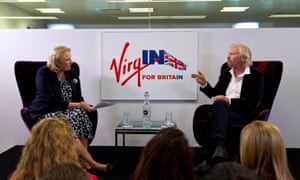


Jayne-Anne Gadhia talks to Sir Richard Branson about his views before the EU referendum.


Remain voter Jayne-Anne Gadhia talks to Sir Richard Branson about his views before the EU referendum. Photograph: Ben Pruchnie/PA

In 2001 part of Virgin Money was taken over by Royal Bank of Scotland and Gadhia went with it. But she quit in 2006, blaming the culture at the Edinburgh-based bank and returned to the core Virgin business..


At RBS she claims she raised the alarm about accounting issues, the sale of payment protection insurance, and rejected attempts to package up mortgages in the style of securitisations which were later to be the undoing of Northern Rock, the bank that was nationalised in 2008. Gadhia eventually took over the “good” part of Northern Rock in 2011.


With hindsight she points to four reasons for RBS’s demise: it grew too quickly, did not have enough capital, lacked diversity at the top – run by “white Scottish men”, she says – and developed a culture where managers thought they were masters of the universe.


The RBS bankers also partied hard, she says. Gadhia tells how she saw bankers with blisters and bandages on their thumbs after setting them alight in sambuca drinking games – events she did not attend – and describes a female colleague who believed she was expected to sleep with her manager.


Her personal profile rose after the Northern Rock deal. More accustomed to being an outsider trying to break into the City establishment – at one point in the interview she describes herself as “this rather strange woman” – Gadhia sat next to George Osborne when he was delivering his high-profile Mansion House speech two years ago, was one of David Cameron’s business advisors, and still leads a Treasury-backed initiative to boost diversity in financial services.


She was also a vocal supporter of their Remain campaign, but she insists she is not now a remoaner. While Virgin’s shares lost a third of their value in the immediate aftermath of the referendum, they have since regained much of that dip and are back above their float price. The bank’s first quarter results on Tuesday will be an indicator of any hit from Brexit.



Branson’s Necker Island home in the Caribbean


Gadhia visits Branson’s Necker Island home in the Caribbean about once a year and clearly admires the entrepreneur. Photograph: Virgin Limited Edition/PA

Gadhia says that in writing the book “I was learning quite a lot about myself” and that to be successful, you need supporters. In her own case, a key supporter was the late Sir Brian Pitman who ran Lloyds Bank before becoming the chairman of Virgin Money after he retired. Unsuprisingly, she names Branson as another supporter.


About once a a year she visits Branson’s Necker Island home in the Caribbean and she clearly admires the serial entrepreneur who appeared via video link at this week’s book launch – held in the Virgin Group’s Roof Gardens in Kensington.


“All of this – I hope this doesn’t sound naff, the whole thing is a privilege. I’ve got a completely normal background, with working class parents, married to guy who didn’t have shoes to put on his feet when he came to this country from Kenya at the age of nine.”


Her husband Ashok – she took his name on marriage – gave up his career to look after their daughter. Gadhia draws upon their experience of being a mixed-race couple for her hopes for women’s’ equality and mental health.


She wants those issues to become as unquestioningly accepted as her mixed race marriage now is. “Over the 30 years Ash and I have been married that change has been profound.”


Virgin Money chief: "I have battled with mental health all my life"

3 Mart 2017 Cuma

NHS England chief brings in new rules on ward bed closures

Simon Stevens, the chief executive of NHS England, has acted to make it much more difficult for hospitals to slash their supply of beds, after the dramatic loss of the facilities in recent years was widely blamed for exacerbating the winter crisis.


Stevens is introducing tough rules for hospitals concerning bed closures from April to ensure that patient care does not suffer.


His move comes after heavy criticism of the NHS for allowing the number of hospital beds in England to fall by 20% over the past 10 years at a time of growing demand. About 15,000 beds disappeared between 2010-11 and 2016-17, official NHS figures show.


Stevens stressed that his edict would not mean a complete moratorium on hospitals shrinking their tally of beds, but there was a need for tough criteria given the increasingly large number of beds being used by patients who could not be discharged yet were medically fit to leave.


In A Friday speech at the Nuffield Trust’s health policy summit, Stevens will say: “More older patients inevitably means more emergency admissions, and the pressures on A&E are being compounded by the sharp rise in patients stuck in beds awaiting home care and care home places, so there can no longer be an automatic assumption that it’s OK to slash many thousands of extra hospital beds, unless and until there really are better alternatives in place for patients.”


NHS trusts in England planning to cease provision of a particular service already have to pass four tests before doing so, including showing that GPs back their move and that the public has had a say.


Stevens’ intervention, in effect, creates a new fifth test that will have to be passed by NHS managers planning bed closures. They will get the go-ahead only if they can prove that NHS care in the local area outside the hospital can ensure patients will receive good care; permission could also be given if it can be shown that a new medical treatment for patients with a particular condition means beds can be safely deleted. Hospitals which are inefficient in their use of hospital beds will get the green light if they improve their performance to show that losing beds will not affect patients.


It is unclear what the impact of the new rules will have on the sustainability and transformation plans (STPs) developed recently by NHS chiefs in 44 areas of England. Many of the plans envisage a further loss of hospital beds by 2020-21 in efforts to help the NHS save £22bn. Also, the conditions will only apply to “significant bed closures”, which may not stop hospitals reducing their numbers gradually, a few at a time.


Prof Jane Dacre, president of the Royal College of Physicians, said Stevens’ plan was a step in the right direction. “However, the RCP would urge STPs to reduce the potential impact on patient care and have extra capacity in place before any bed closures occur,” she said.


Jonathan Ashworth, the shadow health secretary, said: “The number of hospital beds across the country is actually now forecast to drop again under the government’s STP proposals, with no convincing evidence that the necessary community care will be put in place to replace them. It’s not obvious therefore how health ministers will meet these new tests on bed closures Mr Stevens is setting.”


NHS England chief brings in new rules on ward bed closures

25 Ocak 2017 Çarşamba

Vatican condom row: pope prevails as Knights of Malta chief resigns

The head of the Knights of Malta, an ancient Catholic order, has resigned over a dispute with the Vatican about free condoms that has become a battle of wills between the heads of two of the world’s oldest institutions and a test of Pope Francis’s authority.


The Rome-based chivalric and charity institution said Grand Master Matthew Festing, 67, resigned after the pope asked him to step down on Tuesday. Grand masters of the institution, which was founded in the 11th century, usually hold their posts for life.


“The pope asked him to resign and he agreed,” the order’s spokesperson said, adding that the group’s sovereign council would sign off on the highly unusual resignation within days.


Festing and the Vatican have been locked in a bitter dispute since one of the order’s top officials, Grand Chancellor Albrecht Freiherr von Boeselager, was sacked in December after the charity distributed condoms as part of a medical project for the poor.


Von Boeselager and his supporters said the condom issue was an excuse by Festing and the papal envoy to the order, Cardinal Raymond Burke – an American arch-conservative who has accused the pope of being too liberal – to increase their power.


Burke has been outspoken in his criticism of Francis’s efforts to reform Catholic teaching on questions related to the family, marriage and divorce. He was one of four cardinals who signed an open letter to Francis last year questioning new guidance allowing priests to decide on a case-by-case basis whether divorced and remarried believers should be able to receive communion.


After Von Boeselager was sacked by Festing, he appealed to the pope, who appointed a five-member commission to look into the unusual circumstances of the dismissal.


Festing, a Briton who has been grand master for nine years, refused to cooperate, saying the papal commission was an illegitimate intervention in the order’s sovereign affairs. He defiantly set up his own internal commission.


The Vatican, in turn, rejected what it said was an attempt to discredit members of the commission and ordered the leaders of the institution to cooperate with the inquiry. The papal commission was due to deliver its findings to the pope at the end of January.


“Behind this dispute is an internal struggle within the Knights between reformers who want the order to focus on humanitarian work and a traditionalist clique out of step with Francis,” said Austen Ivereigh, the pope’s biographer.


“Historically, the Knights have mixed ecclesiastical policy and high finance in a way which is repugnant to Francis. He is naturally inclined to support the reformers, and seized the opportunity to encourage them.”


The all-male top leaders of the Knights of Malta are not clerics but take vows of poverty, chastity and obedience to the pope. The institution has 13,500 members, 25,000 employees and 80,000 volunteers worldwide.


The order – formed in the 11th century to provide protection and medical care for pilgrims to the Holy Land – has the trappings of a sovereign entity. It maintains diplomatic relations with more than 100 states and the EU, and permanent observer status at the United Nations.


When Festing fired Von Boeselager he accused the German of hiding the fact that he allowed the use of condoms when he ran Malteser International, the order’s humanitarian aid agency.


The church does not allow the use of condoms as a means of birth control and says abstinence and monogamy in heterosexual marriage is the best way to stop the spread of Aids.


Von Boeselager said he closed two projects in the developing world when he discovered condoms were being distributed but kept a third running for a while because closing it would have abruptly ended all basic medical services to poor people.


The order’s leadership said the scandal was serious and it was “disgraceful” that Boeselager had refused to obey Festing by resigning.


Francis has said he wants the 1.2 billion-member church to avoid so-called culture wars over moral teachings and show mercy to those who cannot live by all its rules, especially the poor.


Vatican condom row: pope prevails as Knights of Malta chief resigns

16 Ocak 2017 Pazartesi

Tory health committee chair defends NHS chief in funding row with PM

The Conservative chair of the health select committee has defended the NHS England chief executive, Simon Stevens, in his dispute with Theresa May over health service funding.


Dr Sarah Wollaston said she agreed with Stevens’ contradiction of May’s claim last Sunday that the NHS had been given more funding than it required up to 2020.


Stevens repeatedly dismissed May’s comments to Sky News when he appeared before the public accounts committee on Wednesday, showing the extent of the divisions between himself and the prime minister.


Asked on Sky News’ Sophy Ridge on Sunday programme if the NHS had been allocated more cash than it needed, Wollaston replied: “I don’t think that is strictly true.”


She said the government’s £10bn figure included transfers from other healthcare budgets. “So, you can see how the government has reached that figure. But the committee felt that a fairer figure, if we’re using the usual measure, was £4.5bn, which is a very different number,” she said.


Health had to be considered with social care “and what Simon Stevens was very clear when he spoke to the committee about, was if you have cuts to social care, that has an enormous impact on the NHS. So that is why he doesn’t agree,” she said.


“And I would agree with him that the NHS hasn’t been given everything it asked for, because it doesn’t actually consider social care, and it doesn’t consider the cuts to public health budgets, the kind of prevention work that we know is essential if we’re going to reduce demand on the NHS.”


Responding to claims that Stevens was not doing enough to alleviate the NHS crisis, Wollaston said “Personally, I think that is unreasonable. I think as a public servant and somebody who heads the NHS, the government needs to give him their unequivocal support in the very hard job he is undertaking to try to get this whole system to work.”


Wollaston, a former GP, also criticised the scapegoating of family doctors and the threat to withdraw funding unless they agreed to work longer hours.


She said it was entirely wrong to blame one section of the workforce, when administrative work, home visits and chasing test results had to be done when surgeries were closed.


GPs were “extraordinarily stretched and working under relentless pressure as bed numbers [in hospitals] are being cut,” she said.


“We now have the lowest number of beds per head in Europe. What we are finding is more and more complex conditions are coming back to primary care, so the work of the GP is changing and the pressures on them are relentless.


“The workforce simply isn’t there in many parts of the country, So I think to then be suggesting that all of this problem is due to GPs not seeing people is really stretching it,” Wollaston said.


“It’s just not the case and wrong to scapegoat them, in my view.”


Tory health committee chair defends NHS chief in funding row with PM

31 Aralık 2016 Cumartesi

Binge drinking turning NHS into "national hangover service", says chief

The NHS is being transformed into the “national hangover service” as binge drinking diverts vital resources, the head of the health service in England said. Simon Stevens condemned “selfish” partygoers in a stark warning as the nation gears up for one of the most alcohol-steeped nights of the year.


The chief executive of NHS England added that the health service was already facing considerable strain from the annual spike in winter emergencies.


Millions of revellers are expected to pack bars, pubs and clubs across the UK to celebrate the arrival of 2017 on Saturday night. Figures from the health service show that admissions for alcohol-related incidents rocket on the first day of the new year.


Stevens told the Daily Telegraph: “At a time of year when hospitals are always under pressure, caring for a spike in winter emergencies, it’s really selfish to get so blotto that you end up in an ambulance or A&E. More than a third of A&E attendances at peak times are caused by drunkenness. Casualty nurses and doctors are understandably frustrated about the NHS being used as a national hangover service.


“In our towns and cities this Christmas and new year, the paramedic called to a drunk partygoer passed out on the pavement is an ambulance crew obviously not then available for a genuine medical emergency.”


Binge drinking turning NHS into "national hangover service", says chief

30 Aralık 2016 Cuma

Breast cancer warning over wine was worded poorly, says health chief

England’s chief medical officer has admitted she chose her words poorly when she told women they should “do as I do” and think about the risks of breast cancer every time they reach for a glass of wine.


Dame Sally Davies was accused of nanny state attitudes when she made the comments earlier this year to MPs at a science and technology select committee hearing.


Davies also set tough guidance which cut the recommended drinking limit to 14 units a week – the equivalent of seven glasses of wine – for men and women.


Dame Sally Davies.


Dame Sally Davies. Photograph: Yui Mok/PA

But she used her guest-editing slot on BBC Radio 4’s Today programme to talk about alcohol with the wine writer Jancis Robinson.


Addressing her controversial comments, Davies told the show: “Let me start by saying I could have framed that better, couldn’t I, when I was in front of the select committee?


“And everyone knows, who knows me well, that I enjoy a glass of wine too. What I was trying to get over is: what is the low-risk guidance for drinking?”


Davies said she would be enjoying a glass of champagne on New Year’s Eve like many others, but warned there was a “straight line” in the relationship between drinking and breast cancer.


National guidelines aim to slash the risk of harm to just 1%, and the stark warning was targeted at those who were drinking so much they were endangering themselves, Davies said.


“And I think my job is to tell them the evidence. It is not to be nanny and tell them they must, but they do need to think about it.”


Davies also accused critics who have dubbed her Britain’s nanny-in-chief of being sexist. She said: “I think it’s very sexist. I’m the first female chief medical officer, the 16th – the post has been there statutorily for 168 years.


“Would they have called my male predecessors nannies, let alone nanny-in-chief?”


Breast cancer warning over wine was worded poorly, says health chief

3 Kasım 2016 Perşembe

Health chief: obesity warning letters to parents must not be watered down

School letters sent to parents telling them their children are overweight should not be watered down despite widespread anger, the chief medical officer has said, arguing against the “normalisation” of obesity.


Dame Sally Davies was speaking as new figures emerged from the child measurement programme that showed levels of obesity among children are still getting steadily worse. Twice as many children – nearly 20% – are obese in year 6 as in reception, where 9.3% are obese.


More than one in five children start school either overweight or obese, and by the time they leave primary school, that is one in three. “What on earth are we doing?” asked Dame Sally.


“What worries me is how we have started to normalise it,” she said. “In my generation it was normal to see [children’s] ribs on the beach. That was healthy. How have we lost this national understanding of what is healthy and what is unhealthy?”


There were now size 16 mannequins in shop windows and fat can be beautiful, she said, but added: “It isn’t healthy. Here, we are talking about children and children can’t talk for themselves. They need to be helped.”


When children are measured in school and found to be overweight or obese, the parents received a letter from the school, advising them on where to get help and advice. Some become angry. Postings on social media urge parents to throw the letters in the bin.


But Dame Sally said the letters should spell out the problem. “I don’t think we should water down those letters,” she said at the Childhood Obesity Summit, held in London. “There was a move to stop them saying your child is obese because people felt it was offensive and went into denial. But it is a physical description.”


Work needed to be done on how to encourage people to take action. “It is a real worry to me,” she said.


Obesity is a very serious issue for the NHS, she said, costing £5.1bn in a single year in England alone. There were further huge costs to productivity and the economy. “We are spending more every year on the treatment of obesity and diabetes than we do on the police, fire service and judiciary combined,” she said.


She is concerned by the growing snacking culture, she said. “I was absolutely aghast to read about how crisp packet sizes have increased. Food is everywhere. We are doing much more snacking and eating out.”


People are grazing rather than eating regular meals around a table with others, she said. Teenagers who came to stay with her would be found at the fridge, snacking. “Snacking is now a £375bn industry worldwide.”


Dr Sarah Wollaston, Conservative chair of the parliamentary health select committee, deplored the omissions from the government’s childhood obesity strategy. “I don’t think we should consider what is in the national plan as the job done,” she said.


“It was particularly disappointing to see promotions and price promotions fall out of the original draft – 40% of everything consumed at home is bought on promotion. A staggering amount of that is unhealthy food and drink.”


The emphasis in the strategy is on industry reformulation of food – and particularly to remove 20% of sugar over time. Wollaston wanted to know what would happen to companies that did not take part.


“What should it look like if in a year from now nothing has happened or some sections of the industry have completely ignored this? What will be the penalty to stop sections of the industry going back to where it was before?”


Alison Tedstone, director of diet and obesity at Public Health England, said that removing 20% of sugar – 5% in the first year to August 2017 – from products was only the first step. Next year the government’s scientific advisory committee on nutrition would be reporting on saturated fat in the nation’s diet – which is also too high. PHE will then be talking to industry about reducing saturated fats and also calories in foods.


Health chief: obesity warning letters to parents must not be watered down

14 Ekim 2016 Cuma

No extra money for NHS, Theresa May tells health chief

Theresa May has told the head of the NHS that it will get no extra money despite rapidly escalating problems that led to warnings this week that hospitals are close to breaking point.


The prime minister dashed any hopes of a cash boost in next month’s autumn statement when she met Simon Stevens, the chief executive of NHS England, senior NHS sources have told the Guardian. Instead she told him last month that the NHS should urgently focus on making efficiencies to fill the £22bn hole in its finances and not publicly seek more than the “£10bn extra” that ministers insist they have already pledged to provide during this parliament.


She told him the NHS could learn from the painful cuts to the Home Office and Ministry of Defence budgets that she and Philip Hammond, the chancellor, had overseen when they were in charge of those departments, according to senior figures in the NHS who were given an account of the discussion.


Senior Whitehall sources have confirmed that Hammond’s statement on 23 November will contain no new money for the NHS, despite increasingly vocal pleas from key NHS organisations and the public’s expectation of extra health spending if Britain voted to leave the EU.


NHS Providers, which represents 238 NHS trusts, last week accused ministers of perpetuating “a bit of a fantasy world” on how well the NHS is doing after the worst-ever performance figures for key waiting time targets for A&E care, planned hospital operations and cancer treatments led to warnings that it was starting to buckle under the strain of unprecedented demand.


Health experts warned that the NHS would have to ration treatment, shut hospital units and cut staff if it gets no extra money soon.


Nigel Edwards, chief executive of the Nuffield Trust health thinktank, said: “If the government has firmly decided not to revisit NHS funding, this underlines that the health service faces four very difficult years. In particular, balancing the books in 2018 and 2019 when funding will flatline looks all but impossible with the current level of services.


“If more money from tax or borrowing is ruled out, the only choices left may be even less attractive, including reducing access and services, closures and reductions in staff,” he said.


Jeremy Hunt, the health secretary, and Jim Mackey, the chief executive of the health service’s financial regulator, NHS Improvement, also attended the 8 September meeting, which was Stevens’ and Mackey’s first encounter with the prime minister.


“No 10’s message at the meeting was quite blunt and stark, that there will be no more money. Theresa May and Philip Hammond say that they presided over big efficiency programmes at the Home Office and MoD and didn’t whinge about it. Their view is that the NHS is already doing very well, but that’s head in the sand stuff,” said one NHS insider who was among those briefed on the meeting.


NHS leaders privately fear that May’s remarks indicate that she will be much tougher on the service’s pleas for more cash than David Cameron and does not appear to appreciate the extent of its deepening problems. She is said to be sympathetic to the view of many senior Treasury officials that, as one NHS source put it, “always giving the NHS more money is throwing good money after bad, like pouring water on to sand”.


May’s stance raises questions over the future of Stevens, who is preparing to give evidence on the NHS’s finances to the Commons health select committee on Tuesday. The NHS boss, who had a close relationship with Cameron and George Osborne, has recently irritated No 10 by publicly questioning the accuracy of the government’s claim – which May repeated at prime minister’s questions on Wednesday – that the NHS will receive £10bn extra by 2020.


He told the public accounts committee last month: “The government would record it as £10bn. The health committee recorded it a little differently. There is an apples and pears issue there.”


Stevens has welcomed the fact that the £8bn boost Osborne pledged during last year’s general election campaign was “frontloaded” to give the NHS £3.8bn more this year, a rise of 1.7%, as he had requested. But he highlighted that the service had not got the sums it needed for 2017-18, 2018-19 and 2019-20. On current plans, it is due to receive increases of just 0.6%, 0.2% and 0.1% respectively, even though demand for core NHS services such as A&E care is rising at 3% or 4% a year.


Chris Ham, chief executive of The King’s Fund thinktank, said that any policy of providing no more money was unwise, “simply not credible” and would threaten standards of NHS care. “If these accounts are true, then it is clear that Downing Street does not yet fully understand the impact on patients of the huge pressures facing the NHS.


“The view from the top of government appears to be that the NHS has been given the extra money it asked for and should deliver what is expected of it. But this misses the point that demand for services is rising rapidly and the NHS is managing with the lowest funding increases in its history,” he said.


A Downing Street spokesman said he could not comment on what May, Stevens and Mackey had discussed because it had been a private meeting .


No extra money for NHS, Theresa May tells health chief

11 Eylül 2016 Pazar

NHS Providers chief executive: ‘We are under the greatest pressure in generations’ – video

Chris Hopson, the chief executive of the body that represents hospitals across England, appears on the Andrew Marr Show on Sunday, following a startling warning issued by the body that the NHS is close to breaking point because of its escalating cash crisis. The warning also comes days before the Commons health select committee decides whether to launch a special inquiry into the state of the NHS in England


Read: NHS chiefs warn that hospitals in England are on the brink of collapse


NHS Providers chief executive: ‘We are under the greatest pressure in generations’ – video

31 Ağustos 2016 Çarşamba

Brains and bone saws: a day with the chief medical examiner of New York City

The smell in the autopsy room is indescribable. It lingers on your clothes and in your hair long after you leave. Staff are constantly cleaning the linoleum floors and wiping down every surface with harsh disinfectants. But if anything, it adds to the uniquely acrid odor.


You never get used to the smell, says Jennifer Hammers, deputy chief medical examiner for Kings County, New York – but you do get beyond it.


I’ve been allowed a privileged glimpse at a regular Wednesday in the Brooklyn office of the Chief Medical Examiner of New York City. The office is one of the busiest of its kind in the country.


Around 70,000 people die in New York City each year, and about 8,000-9,000 of them end up at the medical examiner, requiring further investigation. Of those, 5,000 are autopsied.


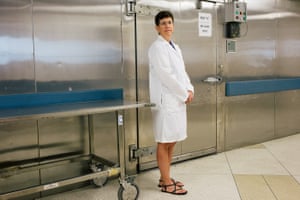
Barbara Sampson, Chief Medical Examiner of New York City


Barbara Sampson, Chief Medical Examiner of New York City Photograph: Ben Zucker for the Guardian

Only the lonely


In the basement, the staff are hard at work in the autopsy suite, carefully examining the bodies and photographing relevant organs for their reports.


Most cases brought to the medical examiner are not crime related. In a city of over 8 million people, with many immigrants and transplants from other parts of the country, there is no shortage of the lonely.


Of the seven bodies brought in today, three have died alone in their apartments. In the summer, without air conditioning, it can take as little as two days before the smell of a body causes neighbors to make a call.


One gentleman found alone in his home is now lying before me on a steel gurney. James Daniels, a lead forensic mortuary technician, is carefully removing the scalp before cutting the skull with a bone saw so the brain can be examined for any signs of aneurysm, stroke or other potential causes of death.


An examination table in the “decomposition room” of the Office of the Chief Medical Examiner of New York.


An examination table in the “decomposition room” Photograph: Ben Zucker for the Guardian

Over 60 forensic mortuary technicians like Daniels work in New York City. While the 31 medical examiners in New York City are all highly trained physicians who completed special fellowships, technicians don’t have any educational requirements.


Typically, technicians join when they are young and only have a high school education. They learn the intricacies of their job on site. Without them, the office would cease to function. They are the ones dispatched to collect the bodies for autopsy. They are often the first people from the office a family encounters when grieving.


Being the doctor’s doctor


In addition to the medical examiners, there are x-ray technicians who scan for bullets and broken bones; DNA and toxicology laboratory staff; consulting dentists for matching dental records for identification; anthropologists who specialize in discovering the race, age and height of skeletal remains and figuring out what tools caused blunt force traumas; mortuary technicians who assist with autopsies; a variety of administrators; death scene investigators; and professional photographers who take careful photos of every autopsy for detailed record keeping.


One of the photographers on staff also takes professional photos of food, Hammers tells me with a smile.


While the doctors examine the body and determine the cause of death, the technicians do a lot of careful and very skilled cutting to assist them. They also clean the bodies after the autopsy is completed, making sure that it is in a pristine state when handed over to a funeral director.


For Daniels, who started with the Office of the Chief Medical Examiner as a young man in 1989, it was an unexpected career choice, as he hated the idea of being around dead bodies and avoided funerals entirely.


Most of the medical examiners, on the other hand, said they always loved the idea of solving a mystery, of being “the doctor’s doctor”. They wanted to be the ones to determine the real cause of a death or diagnose a pathology.


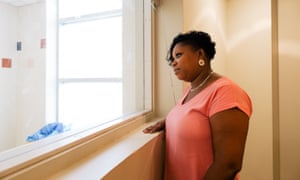
Nadia Bissette-Dolor, who works in the Office of the Chief Medical Examiner of New York City, stands by a window used by families to identify bodies of the deceased. She says family members rarely ask to view the body, but a small number do.


Nadia Bissette-Dolor, who works in the Office of the Chief Medical Examiner of New York City, stands by a window used by families to identify bodies of the deceased. She says family members rarely ask to view the body, but a small number do. Photograph: Ben Zucker for the Guardian

Daniels had a more pragmatic reason for joining the office: he needed a job, and working for the city meant stable employment. When he first started, he dreaded touching bodies and entering strangers’ homes. It was fear of the unknown, he explains. But these days, working as a lead technician, there is little left unknown when it comes to the dead.


Daniels was on the job during 9/11. He also responded to Flight 587, which crashed in Queens in November 2011, killing everyone on board. That time created his worst memories of the job. But it also gave him the greatest sense of the work’s importance: none of those families would otherwise have had closure. He now “loves the job”, he says.


The case that hits home


No matter how long they have been working at the Office of the Chief Medical Examiner, and how many bodies they have seen, everyone has a case that hits home.


For Barbara Sampson, the chief medical examiner for New York City, it was a 9/11 case. The terror attack on 9/11, which Sampson refers to as the biggest homicide in US history, was a difficult time for all of the staff at the office. They worked round the clock to identify bodies, and the images they saw still haunt most of them fifteen years later.


Identification often had to be done from DNA analysis of fragments of remains and is still ongoing as new DNA techniques are discovered.


One particular case sticks out for Sampson: a Belgian man who died during the collapse of the World Trade Center towers. His parents were elderly, and while they knew that he had died, without official scientific confirmation, they could not get closure. His remains had not been identified. They were afraid they would pass away never having his death confirmed.


Two years ago, Sampson’s office was able to identify the Belgian man’s remains through DNA analysis. “I had the honor of telling them we had found their son. That was one of the most incredible experiences of my life,” she says. Thirteen years after 9/11, the parents could finally put their son to rest.


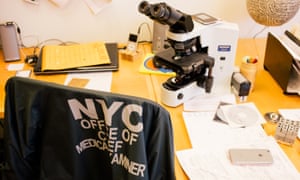
Office work station in the Brooklyn office of Chief Medical Examiner of New York


The desk of the Deputy Chief Medical Examiner Photograph: Ben Zucker for the Guardian

For Aglae Charlot, an elegant senior medical examiner with a pronounced French accent who has worked at the office since 1987, it was a teenage girl who came in a few years back. The girl died in the hospital of an unusual illness, from which her mother also suffered. The illness can be idiopathic or caused by Aids. The hospital had assumed it was idiopathic since the mother had the same illness.


When Charlot investigated, she found the teenager did actually have Aids, which she must have been suffering from for five or six years.


Upon further investigation, she discovered the mother’s boyfriend had died of Aids.


Infecting a child and causing her death is murder, she explains to me, her jaw tensing. Charlot knew she could probably trace the particular strain of Aids back to the boyfriend, but what would it change? He was dead, so could not be charged, and it would only cause more pain for the living. She put Aids as the cause of death on the certificate, and left it at that.


Seeing the lighter side


“We all have an odd sense of humor,” says Christopher Brock, a bearded young medical examiner sitting in front of a file cabinet covered by photos of his wife and two young children. “We are often smiling, and I think you have to when you are surrounded by this every day.”


In Hammers’s office, her crooked playfulness is on display in a framed, fake blood-spattered sign above her desk that reads: “Braainns.”


Humor can provide a release in an environment that is fraught with stress. “One of the things a lot of people don’t realize is that we deal with the living just as much as we deal with the dead,” says Brock. “We provide answers to families.”


Check out station at Morgue in the office of Chief Medical Examiner of New York in Brooklyn, NY


Check out station at the morgue Photograph: Ben Zucker for the Guardian

Much of the week is spent performing autopsies, and the rest of it filling out paperwork, testifying in court and speaking with the families of the dead.


At a time when primary care physicians rarely have more than two minutes to speak with a living patient, it’s strange somehow that the medical examiners can spend hours explaining their findings to the families, comforting them and helping them deal with their grief.


“Every family really wants to know what happened to their loved one and have their questions answered in order to have closure,” says Hammers. “Even if it is a hard answer like in the case of a suicide, it wouldn’t be what they prefer to hear but it allows them to have an answer and then work their grief around that and move through it.”


As Brock puts it, when it comes to the deceased: “We are their last physicians.”


Brains and bone saws: a day with the chief medical examiner of New York City

30 Ağustos 2016 Salı

Under-fire Southern Health chief quits over "media attention"

The boss of an NHS trust that was widely criticised for failing to investigate unexpected deaths of patients with mental health problems or learning disabilities has resigned, citing “media attention”.


Katrina Percy, the chief executive of Southern Health NHS foundation trust, who has been under pressure to stand down for months, announced her resignation on Tuesday.


The trust’s leadership was censured in an independent report commissioned by NHS England after 18-year-old Connor Sparrowhawk, who had learning disabilities, drowned in a bath after an epileptic seizure at Slade House in Oxfordshire in July 2013.


In December the inquiry team concluded that the trust had failed to properly investigate the deaths of more than 1,000 patients with learning disabilities or mental health problems over a four-year period, and criticised a “failure of leadership”.


In April the trust’s chairman, Mike Petter, stood down just before the publication of another critical report, this time by the Care Quality Commission (CQC), which said the trust was still not doing enough to protect people in its care.


But Percy resisted calls to quit, including from Connor’s mother, Dr Sara Ryan, and the former shadow health minister Luciana Berger, until Tuesday.


Announcing her decision, Percy said: “I have reflected on the effect the ongoing personal media attention has had on staff and patients and have come to the conclusion that this has made my role untenable.


“I know and understand that many will say I should have stepped down sooner given the very public concerns which have been raised in the past months. I stayed on as I firmly believed it was my responsibility to oversee the necessary improvements and to continue the groundbreaking work we have begun with GPs to transform care for our patients.”


Percy said she would be taking up an alternative role providing strategic advice to local GP leaders. Julie Dawes, who joined the trust in May as director of nursing and quality, will take over as chief executive on an interim basis.


Liberal Democrat health spokesman Norman Lamb welcomed Percy’s “belated” resignation, but said: “Rather than taking responsibility and doing the honourable thing by stepping down, Katrina Percy continued to put her own interests before the public interest.


“Reports that she will move into another well-paid job advising GPs on strategy are deeply concerning and will aggravate the sense of injustice felt by the families of those who lost their lives.”


Deborah Coles, the director of the charity Inquest who worked with Sparrowhawk’s family, said: “The CEO and board presided over dangerous systems and practices that cost lives. Despite repeated warnings there was a failure to act.


“Those patients and families affected have a right to be justifiably angered that this resignation is not an acceptance of responsibility for systemic failings but further denial and obfuscation by blaming ‘media attention’.”


The report commissioned by NHS England, carried out by the audit firm Mazars, concluded that failures by the trust’s board and senior executives meant there was no “effective” management of deaths or investigations and a lack of “effective focus or leadership from the board”.


The CQC, which subsequently carried out a snap inspection, said: “The key risks and actions to address them were not driving the senior leadership or board agenda.” It said the leadership did not proactively address risks “before concerns are raised by external bodies”.


In June the trust accepted responsibility for Connor’s death and agreed to pay his family £80,000 in compensation. Last October an inquest jury concluded that neglect contributed to the death of the teenager, who was known affectionately as Laughing Boy or LB.


Southern Health’s interim chairman, Tim Smart, said Percy had reached the conclusion that “due to the significant focus on her as an individual, it is in the best interests of the trust, patients and staff for her to step down”.


Under-fire Southern Health chief quits over "media attention"

16 Temmuz 2014 Çarşamba

UN chief methods up fight against Haiti cholera epidemic

MDG : UN chief Ban Ki-moon visits a cholera-afflicted village in Haiti

UN chief Ban Ki-moon leaves a home he visited throughout a journey to the cholera-afflicted rural village of Los Palmas in Haiti. Photograph: Marie Arago/Reuters


The UN secretary common has flown to Haiti on a “essential pilgrimage” to help the fight against cholera, a condition that many Haitians blame UN peacekeepers for introducing to the Caribbean country.


Ban Ki-moon is looking for assistance for a $ 2.2bn, ten-yr cholera elimination campaign that he launched in December 2012 with the presidents of Haiti and the neighbouring Dominican Republic.


“I know that the epidemic has brought on significantly anger and dread. I know that the illness continues to have an effect on an unacceptable quantity of people,” he informed parishioners at a church support in Los Palmas. “My wife and I have come right here to grieve with you. As a father and grandfather, and as a mom and grandmother, we feel incredible anguish at the discomfort you have had to endure.”


The UN has not accepted accountability for the cholera epidemic that has killed eight,500 people and contaminated much more than 700,000 considering that October 2010, regardless of proof that suggests it was brought to Haiti by Nepalese peacekeepers stationed near a significant river.


Ban’s check out was criticised by some in Haiti who mentioned the UN should accept duty for introducing the ailment and supply compensation to families. “It is an insult to all Haitians for the secretary standard to come to Haiti for a photo possibility when he refuses to take obligation for the 1000′s of Haitians killed and the hundreds of 1000′s sickened by the UN cholera epidemic,” mentioned Mario Joseph, a Haitian human rights lawyer.


Cholera, which had not been documented in Haiti in almost a hundred years prior to the outbreak, is an infection that leads to significant diarrhoea that can lead to dehydration and death, and is triggered by poor sanitation.


Donors had been slow to react to the initial cholera elimination campaign, Ban advised the Miami Herald newspaper, including that the UN had struggled to raise an initial $ 400m essential in the very first two many years.


Attorneys have filed three lawsuits towards the UN seeking compensation for Haitian victims of the epidemic. The Nepalese troops were stationed near a tributary of the Artibonite river and discharged raw sewage that carried a strain of cholera, sparking the outbreak, the lawsuit explained.


An independent panel appointed by Ban to examine the epidemic issued a report in 2011 that did not figure out conclusively how the cholera was launched to Haiti. The US Centres for Illness Management and Prevention said proof strongly recommended UN peacekeepers from Nepal were the supply.


Some senior UN officials, which includes the human rights chief Navi Pillay, have said Haiti’s cholera victims need to be compensated.


Together with Haiti’s prime minister, Laurent Lamothe, Ban also launched a sanitation campaign, noting that one in two Haitians lack entry to satisfactory sanitation systems.


The scheme seeks to train folks to build latrines, as effectively as installing water filter methods in colleges, well being centres and markets. The UN and the World Financial institution are targeting 55 communities worst affected by cholera, covering three.8 million individuals inside the up coming five years.


UN chief methods up fight against Haiti cholera epidemic

8 Temmuz 2014 Salı

NHS chief announces plan to give patients income to fund their very own care

Billions of lbs of well being services and town hall budgets are to be handed above to the most vulnerable patients to acquire overall health and social care services in the local community, in a dramatic modify of policy being unveiled by the NHS’s new boss.


Frail elderly individuals, disabled children and people with significant mental illness or understanding disabilities will from next April be offered personal pots of funds to commit as they see match on well being and social care solutions such as carers, physiotherapists and psychotherapy sessions, in an attempt, in portion, to maintain them out of hospital.


Some patients’ budgets will be as tiny as a handful of hundred pounds, though most are probably to get a lot more than £1,000, with a little quantity who have really complex wants receiving significantly more than that. Simon Stevens, NHS England’s chief executive, stated that it would assist maintain folks out of hospital and in the end save income.


These allocated the money would still get free GP and hospital care. Individuals will not instantly receive funds payments into their financial institution accounts but will manage the spending budget, which will be provided right after a care prepare is agreed with their physicians.


Stevens said that “north of five million sufferers” could each and every have a personal mixed health and social care budget by 2018, paid for by “billions” of lbs supplied by the NHS and local councils.


Stevens mentioned the dramatic extension of patient electrical power is needed to aid guarantee individuals get a far better deal from providers many find frustrating to deal with, reduce needless stays in hospital by trying to keep them healthier while nonetheless living at property, and also to conquer the shortages of cash which are increasingly visible in the NHS and social care.


“We are going to set out the largest supply to deliver wellness and social care collectively that there is been given that 1948 – a new alternative for combining them at the degree of the person,” Stevens informed the Guardian as he prepared to outline his ambitious prepare in a speech to council leaders at the Nearby Government Association’s annual conference in Bournemouth. It is his initial main policy alter since taking in excess of in April.


The initiative is driven by “a widespread sense that our Balkanised wellness and social care companies are no longer fit for purpose”, Stevens mentioned, specially when the ageing population has created developing demands for care just when Whitehall austerity programmes have produced what he has known as “two leaky buckets”.


Diminished funding for councils has led to a reduction in the availability of services which traditionally have assisted the elderly stay away from ending up in hospital, as evidenced by a 124% rise in the final 14 years in the variety of mostly older folks needing to be admitted for a day or two as an emergency, he said.


The move is meant to increase the high quality of care the 4 patient groups receive due to the fact at existing as well a lot of of them receive inadequate and “fragmented” care. That transpires simply because wellness and social care providers frequently do not perform properly together and also due to the fact the NHS is not as great as it ought to be in offering sufferers with complicated health care wants the joined-up care they require, he stated.


Older men and women with a number of distinct long-term circumstances can become baffled and daunted by dealing with an array of distinct parts of the NHS, including many departments of the same hospital.


Providing individuals direct handle in excess of these sums of funds is a lot more probably to force overall health and social care solutions to give much more joined-up and consumer-friendly solutions than people two separate techniques being merged, he stated, in a tacit rejection of the “whole particular person care” policy championed by Labour’s shadow health secretary, Andy Burnham.


“Rather than arguing for a structural reorganisation, if Beveridge was alive these days he’d clock the truth that, provided half a opportunity, men and women themselves can be the best ‘integrators’ of the wellness and social care they are provided,” Stevens extra.


In his speech on Wednesday Stevens will make clear that his technique is entirely various to his predecessor Sir David Nicholson’s habit of telling the complete NHS to employ one particular set policy. The new budgets will only be created accessible if neighborhood councils and GP-led NHS clinical commissioning groups in England agree to operate collectively and fund them, he mentioned.


While participation will be voluntary, he expects the two types of bodies to set aside their typical mutual suspicion in excess of which of them must pay out for what aspects of especially needy people’s care wants and make the budgets a reality.


“The proposition that we as NHS England are going to place on the table is that for these neighborhood authorities and neighborhood CCGs that want to operate with us, we will jointly develop combined, blended wellness and social care budgets for named folks in each area”, Stevens explained.


The Neighborhood Government Association and Age United kingdom last evening welcomed Stevens’s strategy in principle.


Katie Hall, chair of the LGA’s neighborhood wellbeing board, said the 648,000 people who have individual budgets to help pay out for their social care requirements had got higher choice and observed their lives enhanced as a consequence. Today’s announcement extends that to overall health requirements as nicely.But whilst council leaders will investigate with NHS England methods to make care more personalised, the new budgets “will not resolve the structural problems in the overall health and care program or fix the funding crisis in social care”, she warned.


Caroline Abrahams, Age UK’s charity director, said: “At the second negotiating the separate health and social care systems is for older individuals puzzling, frustrating and slow, because they have to deal with as well many people and hold telling their story to distinct individuals. For older people these personal budgets could indicate getting the assistance they need to have, tailored to their wants, stop duplication and boost their quality of lifestyle.”


However, the integrated personalized budgets will need to be designed so that they do not “current puzzling choices for some vulnerable older men and women struggling with sickness or dementia” or make individuals feel pressurised into taking one particular up, she additional.


Councillor Jim Dickson, Lambeth council’s cabinet member for health and wellbeing, explained that while most councils would welcome the enhance to integrated care, “the vital check of regardless of whether this will work is of program whether or not there is sufficient money in the new private budgets to supply high quality care”


Jeremy Hunt, the well being secretary, welcomed the plan.


“Greater out of hospital care is crucial for each individuals and the prolonged-term sustainability of NHS,” said a spokesman for Hunt.


NHS chief announces plan to give patients income to fund their very own care

25 Haziran 2014 Çarşamba

NHS believe in chief Lisa Rodrigues on why she"s shouting about mental health | Mary O"Hara

Lisa Rodrigues NHS chief

Lisa Rodrigues, chief executive of Sussex Partnership NHS Foundation Believe in, says her following role will be as a psychological health campaigner. Photograph: Andrew Hasson


In direction of the finish of last 12 months Lisa Rodrigues, a longstanding chief executive of a large NHS mental well being believe in, was driving home from perform when some thing harrowing happened. “I was acquiring some horrible stomach pains. I could not see properly. I wished to crash my auto. I really had to [attempt hard to] stop myself undertaking that.” She made it property securely but says she “cried for 3 days and 3 nights”.


Rodrigues was in the midst of the first severe episode of clinical depression she had skilled in virtually two decades but it was particularly important, she says, simply because the crisis point occurred weeks soon after she had manufactured the selection to “come out” about her background of mental well being issues.


That someone in such a senior management place in any organisation decides to speak openly about living with depression is uncommon and Rodrigues, 58, whose most trying times were in her teens and early 20s, acknowledges that speaking out was tough. As she talks about her operate and occupation, the last 13 many years of which have been as chief executive of Sussex Partnership Foundation Trust, a provider of mental well being, substance misuse, learning disability and prison healthcare companies, she exudes the fervour of somebody established to bring her own experiences to bear.


She says, as retirement approached, she realised that talking about currently being in a demanding, senior position with a history of depression could have value. “I was just about to leave the NHS and that I desired to speak about the reality that currently being a leader doesn’t suggest to say that you have to be ideal,” she says.


The concept that residing with a mental illness would exclude a person from a work they were capable of carrying out demands to be challenged, she suggests. “My experience of learning to control my very own emotions and deal with what I have just dealt with – I feel I’m a far better particular person for it with out a doubt,” she adds.


Reactions to her coming out have been primarily encouraging, but some individuals commented that she “was the extremely last individual” they would have expected to have psychological health issues, or remarked, “You’re not on antidepressants are you?” as if there was anything incorrect with it.


“There’s this whole pill shaming issue that goes on”, she says of the stigma attached to taking medication for a mental illness. “If you have received cancer and you come forward for treatment no person judges you. To be frank I would be dead if I hadn’t taken antidepressants due to the fact I was so low.”


She argues that, in spite of some progress in latest years, it is stigma across society that is a principal lead to of damaging attitudes and also affects behaviour and the way psychological well being companies are funded and organised.


“Why is it that mental well being services in this country only get twelve% of the assets that we have accessible, offered that it is at least 25% of the condition burden? I feel we begin with the stigma,” she argues. “If we can start by speaking about the stigma … that implies individuals are far more most likely to invest in providers to aid individuals people have a better daily life.”


What about the monetary strain on the health service in spite of ministerial overtures around “parity” of care for people employing mental overall health companies? Rodrigues says plainly: “Put your money in which your mouth is, politicians.”


Her analysis of the mental healthcare technique is measured and illuminating. It is clear she has relished the hard process of operating a complicated overall health believe in in a time of immense modify, and believes she has helped increase some aspects of healthcare, including advocating for far more integration amongst mental and bodily provision, in distinct for older folks.


The impact of the economic downturn and rewards modifications have been “really substantial”, Rodrigues says, simply because the most vulnerable men and women are underneath huge stress. “We have got the advantage changes affecting patients and so also the increase in charges for items and also the adjustments in housing advantage. So they’ve received a triple whammy. When we are seeing them they’re far more unwell and have a tendency to keep in hospital longer.”


In other regions cuts to funding coupled with modifications to the commissioning of youngster and adolescent mental healthcare are specially problematic, she suggests, since “early intervention” is so crucial to longer phrase psychological wellbeing and to reducing the demands on “other components of the system” this kind of as A&ampE and the criminal justice technique additional down the line. The previous 12 months has observed a “severe” jump of 10% nationally in the number of youthful folks accessing services, but there are “no hospital beds for youngsters and young individuals anyplace in the country at any 1 time” to accommodate these in crisis.


Although nevertheless evidently passionate about how the health technique operates, there is a sense that Rodrigues is steadily coming to terms with moving on and segueing into the role of campaigner. “For the up coming third of my life I will be campaigning about this stuff,” she replies. “I will not want to be operating it. I want to publish about it. I want to shout about it simply because I believe I can make fairly a big difference.”


But what helps make her believe folks will pay attention to what she has to say? “I will make certain they do. I’m really difficult to say no to,” she asserts with a smile.


Age 58.


Lives Brighton, east Sussex.


Family Married, two grown-up children.


Training Horsham substantial school for Girls, West Sussex, Dunottar school, Reigate, Surrey University of Sussex, BA in psychology, BA and MA, public sector management.


Profession 2001-present: chief executive officer, Sussex Partnership NHS Foundation Believe in (and predecessor wellness and social care trusts) June-Dec 2001: task director, psychological health, West Sussex Wellness Authority (HA) 2000–01: director, emergency arranging, South East Regional Office, NHS Executive 1995–2000: exec director of nursing, South Downs Overall health NHS Believe in 1990–95: wellness visitor, South Downs Overall health NHS Trust (and predecessor authorities) 1987–90: health visitor, East Sussex HA 1979–82: health visitor, Brighton HA 1977–78: employees nurse, Excellent Ormond Street Hospital.


Awards CBE for solutions to the NHS.


Interests Jam, bicycles, Brighton and Hove Albion FC, reading through and creating.


NHS believe in chief Lisa Rodrigues on why she"s shouting about mental health | Mary O"Hara

23 Haziran 2014 Pazartesi

Outrage above £200,000 deal for NHS chief who functions a single day a week

In the same month, the trust began paying an interim chief executive Nigel Beverley on daily rates of £1,740 a day plus expenses. The deal, which includes VAT, was paid to his company NB Health Consulting.


Mr Langley was appointed by Monitor, the regulator for foundation trusts, on a contract, which is initially for one year. His earnings and expenses are paid by the troubled hospital trust, which was found last year to be failing in four out of five areas inspected, including caring for patient safely.


His predecessor was paid £40,000 to £45,000, the typical rate for foundation trust chairmen.


Mr Langley’s contract reveals that his company is paid £14,400 a month, including VAT, plus an extra 10 per cent each month to cover un-named “out of pocket” expenses.


The total package is worth £190,000 a year – enough to employ more than eight nurses full-time.


If Mr Langley spends one day a week at the trust, it amounts to rates of £3,300 a day – plus £330 expenses.


He lives in London, 40 miles from the Kent hospital. The trust is paying the money to West Eaton Consulting, of which Mr Langley is a director.


Last night, patients groups said they were appalled that NHS regulators had agreed the deal.


Katherine Murphy, chief executive of the Patients Association, said: “It is alarming that such vast sums of money are being spent in this way. At a time when the NHS is under such huge financial pressures, this type of waste is unacceptable.


“This is taxpayers’ money that could be spent on resourcing our wards with frontline staff. What’s more, it is shocking that such vast sums of money can be claimed without having to produce receipts.”


Dr Peter Carter, chief executive of the Royal College of Nursing said: “Its astonishing to see how liberally the NHS is still prepared to dish out pay packages like this. At a time when nurses are struggling to make ends meet, these are eye-watering sums of money.”


He said it was “simply indefensible that expenses of this magnitude can be claimed without accountability” criticising those who authorised the deal.


Roger Goss, from Patient Concern, said the payments were “an insult to frontline staff.”


Chairmen are meant to provide leadership to trusts, along with other non-executives, but not to get involved in day-to-day operational matters.


Mr Langley, whose past career included stints as a managing director of Dixons, had previously been the interim chairman at two other NHS trusts.


The trust referred queries to Monitor, the foundation trust regulator which made the appointment.


A spokesman for Monitor said, “When we took action in February, Medway was one of the most challenged foundation trusts in the country and faced a range of serious issues. The trust needed the right people in place to make the urgent improvements needed for its patients, which is why the interim chair and chief executive were appointed.”


He said the regulator was made aware of the proposed package for the chairman and “sought advice to confirm that the package was legally sound.”


Outrage above £200,000 deal for NHS chief who functions a single day a week