difficult etiketine sahip kayıtlar gösteriliyor. Tüm kayıtları göster

30 Kasım 2016 Çarşamba

The morning-after pill is safe. So why is it so difficult to access?

A new campaign from the British Pregnancy Advisory Service (BPAS) is calling for emergency contraception, commonly known as the morning-after pill, to be sold directly from pharmacy shelves without a mandatory consultation. The campaign highlights the fact that the pill can cost British women up to £30, as much as five times higher than in other European countries, meaning that it could even be cheaper to fly to France and buy it there than to visit a local pharmacy.


A 2003 report published in the Pharmaceutical Journal revealed that the high price –described by BPAS chief executive Ann Furedi as a “sexist surcharge” – was a deliberate attempt to prevent women from taking it too often. As a spokesperson for Levonelle, a manufacturer of the pill, said: “The price has been set, in part, to ensure that EHC [emergency hormonal contraception] is not used as a regular method of contraception.”


BPAS also argues that the mandatory consultation women must go through with a pharmacist may be part of the reason it is so costly in the UK, compared with other countries where such consultations are not required. Given that the medication is considered very safe, even compared with other medications sold off-the-shelf, and that the NHS says it has no serious side effects, it seems likely that this is a means of influencing women’s sexual and reproductive decisions, rather than a requirement for safety reasons.


The comments of one spokesman from the Family Education Trust exemplified this rationale: “With no questions asked about previous medical history or previous use of the drug, there is a very real danger that it could be misused or overused.” The same could be said of countless other off-the-shelf products, but the extra barriers only seem to come into play when a product is associated with female sexuality. And considering the lack of medical dangers associated with the morning-after pill, the “misuse” or “overuse” seems likely to be a moral, rather than medical, judgment.


So the major arguments both for the sky-high cost and the mandatory consultation seem closely tied to the idea that women cannot be trusted to make their own decisions about their bodies and sex lives. Not to mention the terrifying risk that, should the situation change, immoral, promiscuous women might run amok, foregoing other forms of contraception, indulging in countless one-night stands and choosing to pop morning-after pills instead of taking any other precautions.


Talk of ‘misuse’ or ‘overuse’ ​being referred to here​ seems likely to be a moral, rather than medical, judg​​ment


Of course it makes sense for a consultation to be available for those who choose it, as with any other product purchased in a pharmacy. Some people might want to ask about the efficacy of the medication within a given timeframe, or seek further information about issues such as sexually transmitted diseases. But this is a decision an individual is capable of making herself – not every person taking emergency contraception needs to be subjected to these interactions, often described as “embarrassing” and “shaming”.


The moralistic overtones of this debate are the same ones that emerge during any discussion relating to women’s reproductive health – as if male lawmakers and commentators feel the need to wrestle women’s autonomy from them because “we know best”.


As a healthcare option for those who wish to avoid unwanted pregnancy, it is hugely important that women should be able to access the morning-after pill as easily and cheaply as possible. But a 2014 study found that women in the UK were nearly twice as unlikely to use emergency contraception because they were “embarrassed to ask for it” than women in other European countries. Nearly a third of all the women surveyed who used emergency contraception said they felt uncomfortable or judged when obtaining it.


That women have to jump through hoops because they aren’t trusted to use it responsibly is reminiscent of the ongoing Victorian-era legislation that means abortion is still technically illegal in mainland Britain. Rather than overturning the 1861 Offences Against the Person Act, the 1967 Abortion Act essentially created a loophole allowing the procedure only after two doctors have agreed that a woman’s mental or physical health would be harmed by continuing with the pregnancy. The law hasn’t been changed since.


Like the idea that a woman’s decision isn’t valid until two doctors have agreed to “let her off” prosecution, the notion that we need a consultation before being allowed to take emergency contraception is outdated and patronising. It’s 2016. Isn’t it time we moved away from the Victorian notion that women can’t be trusted to make their own choices about their health, bodies and sex lives?


The morning-after pill is safe. So why is it so difficult to access?

29 Kasım 2016 Salı

The squeezed NHS is responding to difficult times by innovating

Times are hard for the health service: performance is on the decline, the money doesn’t add up, morale is low, there are finite resources and increasing demand. Is it a perfect storm? Or a very long winter of discontent?


NHS Providers has published its new report, The State of the Provider Sector, which gives a clear appraisal — and the picture is, in places, quite gloomy. But we also show how hospitals, mental health, community and ambulance services are responding with ingenuity in such challenging times.


The findings in the report are drawn from a wealth of published data alongside the largest ever survey of NHS trust chairs and chief executives, carried out just a few weeks ago. We had responses from well over half of NHS trusts across England. They raised important concerns, including worries over the workforce and sustaining quality of care at current levels.


Quite rightly these are the conclusions that will capture the headlines. The NHS is seven years into the longest and deepest financial squeeze in its near-70-year history. But amid fears over staffing and funding, it is important not to overlook the work trusts are doing to deal with these challenges, sometimes with great success. In pulling together this report, we have been struck by examples of innovation and improvement. This has spurred us to search for the kernel of gold in this situation.


The key to finding that kernel is to think about patients and service users: they should be at the heart of NHS reform. So whether it’s delayed transfers of care, A&E admissions, or mental health crisis care, it is the combination of improving an individual’s experience and making the system work better that can prove a successful approach.


Overcoming delayed transfers of care is a strong reason to focus on what is keeping mainly frail, elderly people in hospital when they are medically fit enough to leave. At Oxford University hospitals, providers have struggled with one of the worst rates of delays for the past five years but under new leadership and new approaches, Oxford has halved its delays. In effect it grew its own social care provision.


It did this firstly through better collaboration with social care providers and secondly by creating its own social care workforce and capacity. This means people can be discharged straight into the community. This not only provides a better and safer experience for patients but also frees up hospital beds, which improves the flow of patients and generates capacity for planned elective work.


Sometimes navigating the myriad health and care organisations must, to a patient or service user, feel like finding your way through a maze. The whole process can be daunting, frustrating and woefully inefficient.


Southwark and Lambeth Integrated Care Programme (Slic) decided its situation just wasn’t slick enough. It embarked on a “radical” join up of services across the local NHS and local authority social care systems. So GPs, community healthcare, social care and local hospitals came together and put the patient first. Over the past four years the Slic approach has not only stabilised the number of hospital bed days used — quite a feat in the face of exponentially rising demand — it also led to a 61% reduction in the number of nursing home placements.


In terms of mental healthcare, Surrey and Borders partnership has worked with local charities and commissioners across the south to launch Safe Havens — a drop-in service that provides out-of-hours help for anyone experiencing a mental health crisis. It has close links to Frimley Park hospital and provides a safe alternative to using A&E. Six months after opening, the service has helped to reduce psychiatric admissions by 33%. Not only is that a better experience for a service user, it also helps to prevent the ongoing call on expensive resources.


We know that hospitals and other services are running at capacity levels well beyond those of other western economies. We know that the NHS is now missing most of its key performance targets. And we know that it interacts with more than five million patients and service users every week.


But that shouldn’t blind us to what’s happening. With these and other projects, services and programmes that consider the quality of individual experiences and the needs of the wider system together, NHS trusts are innovating, improving care and driving efficiencies. These are the kernels of gold.


Join the Healthcare Professionals Network to read more pieces like this. And follow us on Twitter (@GdnHealthcare) to keep up with the latest healthcare news and views.


The squeezed NHS is responding to difficult times by innovating

18 Kasım 2016 Cuma

The long, difficult search for a drug to treat Alzheimer’s and dementia

Most of us forget names, dates or places from time to time. But Hilary Doxford never did. While the rest of us smile about our common inadequacy, she knew she was experiencing a genuine malfunction of her high-performance brain. “I did have a really good memory and didn’t need to write things down,” she says. “And I used to be able to multiply two four-digit numbers together almost instantaneously.” But one day, she started getting the sums wrong.


The doctors sent her away at first. So you can’t remember names or multiply 3,765 by 1,983 any more? Oh well, that’s middle age for you. But Doxford, who was then in her late 40s, knew differently. “My benchmark is myself,” she says. “Even now, when I tell people, everybody says: ‘I would never have known.’ What I’m doing is no different from what other people are experiencing. But when I compare it to how I used to be … I can’t multiply a two-digit number by a one-digit number. I can do it if I add them – like 27 times three. It’s my short-term memory – when you need to hang on to a number because you need to use it. That’s what’s gone.”


Doxford went to the GP because her partner, Peter, had asked her to marry him. She wanted to be sure she would not be sentencing Peter to looking after a woman whose brain was deteriorating. “My GP said: ‘It’s normal – off you go.’”


Three years later, then a married woman, she went back. “All the symptoms were getting worse,” she says. Doxford is the general manager of a medical research charity.“I forgot the surnames of some of my staff. I started finding it hard to concentrate and focus. Then I started avoiding taking responsibility for things unless I absolutely had to.”


The GP said it was probably stress and sent her home again. But then she had a long, difficult business meeting with somebody, and when he greeted her three weeks later, she had no recollection of having met him before. This time she was sent for tests. She scored incredibly highly on the IQ part and incredibly poorly on memory, and was given an MRI scan. “The diagnosis was Alzheimer’s,” she says, matter-of-factly.


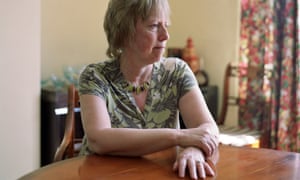
Hilary Doxford, who was diagnosed with Alzheimer’s in her early 50s.


‘My benchmark is myself. When I compare it now to how I used to be’ … Hilary Doxford, who was diagnosed with Alzheimer’s in her early 50s. Photograph: Lydia Goldblatt for the Guardian

Dementia will take hold of one in three people who passes the age of 65, and costs the UK more than £26bn a year. This week the Office for National Statistics announced it is now the commonest cause of death in England and Wales, passing cancer and heart disease. People with dementia lose the ability to care for themselves and can become malnourished, while their immune system weakens. Infections such as pneumonia may be the actual agent of death, but dementia is the underlying cause.


It is a cruel disease, which takes away the person their families love and know, leaving a stranger who looks at them with confusion. And while there are are some drugs that will temporarily alleviate symptoms in some people, there is no cure. But dementia, of which Alzheimer’s is the commonest form, has finally begun to get the attention it deserves. In December 2013, the G8 countries, meeting in London, agreed to set an ambition to cure or come up with a significant treatment for Alzheimer’s by 2025. Last year David Cameron announced that the UK would set up a dedicated dementia research institute, with initial funding of £150m, and a further £100m from Alzheimer’s charities. Although the UK was already spending £300m on dementia research, Cameron believed it should be afforded the same level of resources as Aids and climate change. That was welcome news to campaigners, although, they say, the sum is still much less than that invested in cancer research (£590m in 2010).


Doxford, now 56, was glad to have a diagnosis. “On the one hand, it was a relief, because it explained all the problems I’d been having just doing normal stuff. On the other hand, ‘Oh shit’. The first question I asked the consultant was: ‘How long have I got being normal?’ He was implying that I only had two to three years, but then he said: ‘I do know somebody who is eight years down the line and she is pretty much OK.’” Others Doxford has met have since told her of people managing fine 10 to 15 years after diagnosis. For her, it has now been nine.


Initially she was put on Aricept (the brand name of donepezil), one of the few Alzheimer’s drugs currently available. These drugs help some people by delaying the worsening of symptoms, although they progress faster later on. But they do not work for everyone.


“It was pretty horrendous,” says Doxford. “I seemed to get all the side effects on the packet.” She began falling over. The worst was when she was tying up the boat that she and her husband kept. “We were in the marina and I had the rope in my hand. The next thing I knew, I was in the water.” They sold the boat, fearing for her safety. The consultant gave her another drug, but it was worse. “The first day I took it, I thought I was dying,” she says. She decided drugs were not for her.


There ought to be big money in Alzheimer’s drugs. It is more than a century since abnormal protein deposits in the brain were identified by the German psychiatrist Alois Alzheimer as a likely cause of neurodegeneration. Over the past few decades, drug research has focused largely on attempts to clear the amyloid-beta peptides and tau proteins believed to cause these deposits, which gradually shut down the brain’s normal workings.


But there has been a very high failure rate, often at a late stage of development, when companies have spent a great deal of money – in some cases as much as $ 300m – on research and development. Dr Eric Karran, formerly the director of research at Alzheimer’s Research UK and now leading the efforts of drug company Abbvie to find a cure, says that yes, it’s difficult, but too often in these failed trials, the preparatory work has not been thorough enough.


“Some people in the field would say that [the failure rate] has been a disaster,” he says. They suggest that the underlying concept, that Alzheimer’s is caused by amyloid plaque, may be wrong. “I would not subscribe to that view. There has been some sloppy science. We would not expect such trials to work anyway. In some cases there has been a very strong commercial push. In other cases, there has been a strong desire to get something into [human trials] because we have so little.”


Nobody would say research into Alzheimer’s is easy, says Dr Mike Hutton, chief scientific officer for neuroscientific drug discovery at the pharmaceutical company Lilly. “Amyloid accumulates in the brain for 10 to 15 years before you see clinical symptoms. There is a worry that we’re focusing on populations that are too far advanced.” Ideally, scientists must figure out who is most likely to get Alzheimer’s – then see if they can prevent healthy brains from developing it. But although there are some predictive tests available, it is hardly ethical to offer them to people when medical science cannot offer them treatment.


So the trials must be done in people with the earliest stages of dementia. And this year, for the first time, the results of two separate early trials have suggested that it may be possible to find drugs that might slow down the decay for people with mild dementia. Small wonder there have been wild headlines about a cure – a bit of good news is desperately wanted. One, Lilly’s solanezumab, a monoclonal antibody, failed in a large 2012 trial to slow the deterioration in most people with Alzheimer’s, but there was some improvement in those with the mildest form of the disease. Results from a new trial of more than 2,000 people with early-stage Alzheimer’s are eagerly anticipated, and due before the end of the year.


Another drug, Biogen’s aducanumab, made headlines in September. Trial results showed it almost completely cleared amyloid from the brains of a group of early Alzheimer’s patients,and that the expected deterioration slowed down significantly. The trial was small (166 people), and at the high doses that produced the best results, there were side effects such as headaches, but there was excited talk of “a game-changer”.


There has been such hype before, but David Reynolds, chief scientific officer of Alzheimer’s Research UK, says he is reasonably confident that the solanezumab results in December will also show an improvement in the symptoms of dementia, or at least a slowing of the decline. Sadly, there still seems little hope for those who already have moderate to severe dementia, beyond care and compassion.


In a nursing home in Hertfordshire, surrounded by trees and green spaces, James Gatesman, a former coroner’s officer and enthusiastic allotment gardener, spent the last years of his life in bed, his long legs angled to the wall, under a framed photograph of his Metropolitan police class at Hendon College. A yellow spot attached to the glass identified his own face in the picture.


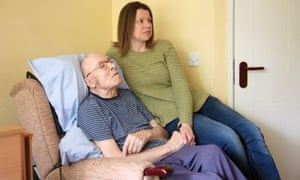
Deborah Gateman with her father, James, before he died.


Deborah Gateman with her father, James, before he died. Photograph: Lydia Goldblatt for the Guardian

You could still see the fine figure of a man that Gatesman had been – 6ft 2in with broad shoulders and a strong, handsome face. But he had ceased to speak, and could no longer move his own limbs. His daughter Deborah and his wife, Doreen, could only communicate with him through touch, or his occasional grunts, moans and howls.


“I always talk to him and treat him as if he understands us,” said Deborah, shortly before her father died. “I think of it as almost like locked-in syndrome – that he is in there. I worry about what we discuss in front of him.” When his wife paid for him to have music therapy, Gatesman responded to the Gilbert and Sullivan tunes he used to love with noises and movement of his hands. That confirmed Deborah’s belief that he was more aware than he seemed.


Gatesman was diagnosed in 2003, but Doreen recalls odd behaviour on a holiday in Australia in 1996, when he wandered away from their group and nobody knew where he was. In later years, his behaviour became unpredictable, and he refused to go to a doctor. “That was probably the worst time,” she said. “Where do you go for help?”


Eventually Gatesman had to see a GP because of an ear infection, and ended up in the memory clinic. He had a brain scan and was diagnosed with Alzheimer’s. The progression was slow but inexorable. He was on Aricept for a year, but that was stopped when he was sent to a residential assessment centre – a care home where people with dementia spend some weeks or months while their condition and needs are determined. Instead, he was put on the drugs that are too often used to control the sometimes bizarre and agitated behaviour of dementia patients – antipsychotics. “He was throwing chairs around and he did pull a handrail off the wall,” Doreen says. When they visited him, he was no longer walking, but sitting in a reclining chair. “He was a bit of a dribbling mess,” said Deborah. “The antipsychotics were turning him into a zombie.” By the time he was moved to the long-term home in Hertfordshire, he was underweight. Doreen insisted the antipsychotics were stopped, and he regained not just his weight, but his spirit. Then “they had quite a lively character on their hands. He would run off down the corridors,” said Deborah. Or he would speak to the Polish nurses in the Flemish and German he had learned while in the RAF, in the war.


The Alzheimer’s Society has campaigned to reduce the use of antipsychotics – often referred to as the “chemical cosh” – in care homes. Dr Doug Brown, the organisation’s research director, says prescriptions have markedly reduced as a result, though “we wouldn’t say the problem has gone away. We still need to keep an eye on it”. The Society has piloted staff training in more than 100 care homes for “person-centred care”, which appears to cut the use of drugs dramatically. It involves taking the trouble to understand the triggers for an individual’s distress – such as the man who gathered all his furniture in the centre of his room every day and became upset when staff put it back. He was a decorator. Given a brush and a bucket of water, he spent contented hours thinking he was painting the walls.


The overuse of antipsychotics is one outcome of the past neglect of dementia, and further evidence of the real need for a drug that will do more than just quieten patients down – one that will slow the progress of a devastating disease and eventually, hopefully, cure it.


The long, difficult search for a drug to treat Alzheimer’s and dementia

13 Kasım 2016 Pazar

My cancer diary: ‘One of the most difficult days’

Wednesday 2 November


It’s another big week for me and my cancer (aren’t they all?), but it’s Wednesday so it’s Media Show day, and things are really hotting up before the US election. We’ve got a good show. I’ve managed to persuade Piers Morgan – as one of the few British journalists who actually knows Donald Trump – to speak to us from his car while he’s filming in Florida for ITV. And he’s really interesting about what the media have and, critically, haven’t understood about the Donald. Piers is also one of the people from the worlds of journalism and broadcasting – many of whom if I’m honest I really can’t claim to know especially well – who’ve come forward to make my life easier (whether they know this or not) by offering good wishes and positive thoughts. And if my experience is anything to go by, if you know anyone with a cancer diagnosis – don’t hesitate – just drop them a line to let them know you’re thinking of them. Genuinely appreciated all!


The show went well, I think, but I’m still suffering from occasionally quite acute fatigue – I blame the radiotherapy, as I didn’t get anything like this in the course of seven cycles of heavy-duty chemo. Also since the radiotherapy, I’m really only able to sleep on my back (earplugs, earplugs, my kingdom for a pair of earplugs, can I hear despairing partners muttering?). The doctors reckon this might be because of the impact of the radiotherapy on my diaphragm, which might’ve been “clipped” by the high-energy x-ray beams.


Anyhow, all’s well with the back-sleeping malarkey except that at around five on Thursday morning I get the first signs of an unmistakable – and potentially very painful – condition. Kidney stones! I was first diagnosed with them more than 25 years ago and every now and again since a new one would get stuck in my kidney and kick off a bout of “renal colic” – the name given to the excruciating pain that can come with them. This time a couple of painkillers see it off – but stand by, if you can face it, for what happened a few days later…


Thursday 3 November


My first day on the new treatment – paclitaxel and ramucirumab (the one I’m having to pay for) and my first visit to what one of the nurses laughingly described as “business class”, otherwise known as the PPMDU (private patients medical day unit). So at 9am there I am being shown into the unit, discreetly hidden from the regular NHS day unit I’ll be visiting later for my paclitaxel infusion – and guess what? It looked very similar to its NHS equivalent; and while we’re on the subject of business class, the seats were actually identical! Staff were great, of course, and I got my first dose of the very expensive (£12,000 plus per cycle) ramucirumab, which the NHS currently won’t finance.


The treatment was first class and, as I’ve previously indicated, I’ve no problem with the principle that I should pay for it, as the NHS should be protected from additional unfunded treatment costs I choose to avail myself of – but I still struggle with the Royal Marsden taking a 20% markup simply to supply an already very expensive drug – which, by the way, is already standard treatment as part of second-line chemotherapy for my cancer in the US – and charging a private patient’s day rate as a whole day for a treatment that takes just over an hour. I’ve taken to calling it my very own “cash for treatment” scandal. I hope they’re putting the money to good use, which is perhaps something worth looking into.


Anyhow, having received my ramucirumab, I was escorted back downstairs to rejoin the rest of the human race in the NHS MDU. And do you know, aside from having identical seats to “upstairs”, I think there might actually be more space down here? But time to get reacquainted with the “cold cap”. This, as its name suggests, is a rubber cap attached to a refrigeration system that rapidly cools the wearer’s head, thus reducing the risk of hair loss that some chemotherapy drugs otherwise more or less guarantee. It doesn’t work for everyone, but it really worked for me over seven cycles of chemo.


And to be honest, a few quizzical looks from other patients more used to seeing women using it and the endurance test that is the first 20 minutes of wearing it as it literally freezes your scalp (think ice-cream brain freeze and multiply by 10) was a very small price to pay. Of course I’d forgotten how hard it would be and very nearly took it off. But in the end the name of the new machines they now have at the Marsden, Paxmans – true! – and a well-timed traquiliser from the staff got me though it. And, so far, I still have hair – on my head.


Saturday 5 November


Today would turn out to be one of the most difficult since I was diagnosed back in March – and none of it to do with my cancer or its metastases directly. For a start, I have been suffering with constipation (thousands of cancer patients do) which, once it gets to 5 or 6 days – as it has for me – can become almost painfully uncomfortable. Then there was the discomfort under my right ribs – put down to my liver playing up or, more likely, another hangover from the radiotherapy. And to cap it all was the recurring renal colic from my age-old kidney stones and their appalling sense of timing. And here’s the twist. The painkillers – co-codamol, a mixture of paracetamol and codeine – tend to work less effectively over time but, critically, make you more constipated!


To cut a long story short, Saturday was a bit of a perfect storm: in increasing discomfort and waiting until enough time had elapsed to allow me to take more painkillers which a) no longer quite do the job; and b) make the you-know-what worse. As a result, I can’t leave the house and have no desire to eat or drink. And it’s the latter that’s set to provide the biggest twist of all …


Tuesday 8 November


Due at Marsden for pre-chemo blood tests preparatory to the next dose of new chemo due Thursday. By now, after such a dreadful weekend, I can add extreme fatigue to my list of ailments – shower, dress and have to sit down, slightly breathless, for a rest. Blood tests show sharply declining level of platelets, which means no chemo for me unless they recover. Doctor also spots that my blood pressure is pretty low – and I get light-headed when standing up and so prescribes intravenous fluids to help.


Wednesday 9 November


Up at six, looking forward to Radio 4 Media Show today. Unfortunately, same thing happens – extreme fatigue and dizzy when I stand up. Decide Media Show might not be possible – the BBC, by the way, have been nothing but support itself over the course of my cancer travails. Return to hospital for more IV fluids. I think these are probably the longer-term consequences of the radiotherapy taking my appetite for food, and critically, drink away, and my simply not drinking enough for far too long


Thursday 10 November


Back to Marsden to see whether platelet levels have improved sufficiently for treatment to proceed. Not only have they gone down further – something my consultant Dr Starling and her team are unsure of the cause of – but my blood pressure’s up and down like a yo-yo.


As a result, I was admitted as an in-patient to the Marsden to try to get these things sorted out and see what might be done with my kidney stones, which are still giving me gyp!


And three days later, as I write – intravenous fluids and antibiotics and a host of new medications later – that’s where I still am.


PS: the ward staff are great and the food’s not bad at all.


My cancer diary: ‘One of the most difficult days’

16 Ağustos 2015 Pazar

How to Breathe Less difficult At Property


breathe-easier-home

Getty Photographs


Getting a healthier property is not necessarily about generating each and every surface spotless. (Phew!) But a bit of strategic cleansing protects you from germs and harmful toxins. In truth, concentrations of some pollutants can be two to 5 times higher within our houses than they are outdoors, according to the Environmental Safety Agency—a worrisome fact taking into consideration we spend, on typical, 90 % of our time indoors.


What is a lot more, ordinary objects like a dirty dish towel or neglected houseplant “can give just the correct atmosphere for harmful microbes to expand,” says Kelly Reynolds, PhD, associate professor of environmental sciences at the University of Arizona in Tucson. Fortunately, little adjustments, whether it is shaking out your welcome mat or installing a water filter, can increase the effectively-getting of your home—and everybody in it. Right here, the most important moves to make.


Stage up your doormat
About 60 percent of the dust in our property comes from outside—most of it tracked in on the bottom of our sneakers, analysis says. And people small particles are created up of a mixture of all kinds of icky factors like human skin, animal fur, foods debris, lead, and even arsenic.


“Thankfully, making use of the appropriate variety of doormats can support reduce grime, pesticides, pollen, and other pollutants in your house,” says Oluremi Aliyu, MD, assistant professor of medication at the University of Connecticut Overall health Center. Choose an abrasive one (it will grab more gunk) created of synthetic fibers like nylon yarn or polypropylene.


Then never neglect to clean it: “Vacuum or shake out your mat after a week,” advises Linda Cobb, cleansing professional and writer of Speaking Dirty with the Queen of Clean. As soon as a month, do a deep clean: Scrub it with a scrub brush and warm, soapy water, then hose it off.


Filter your tap water
Your home H2O can contain bacteria, chemical substances, and other pollutants, which includes hefty metals like lead. At least 74 million Americans in 42 states drink tap water containing chromium (a metal that in some varieties can cause cancer), a research from the Environmental Doing work Group reveals.


And though chlorine is essential to disinfect our water provide, large amounts can injury healthier cells. The chlorine can also react with other elements in water to form compounds that have been linked to cancer, miscarriages, and birth defects. Lengthy-term exposure to water contaminants—via drinking or inhalation (such as in the steam from your shower)—can also lead to blood, bone, and lung illnesses, notes Michael Roizen, MD, chairman of Cleveland Clinic’s Wellness Institute.


For further peace of mind, invest in a water filter for your kitchen faucet that is certified by the Nationwide Science Basis (this kind of as Pur or Brita). In the shower, install a carbon filter to assist get rid of chlorine as well as metals that could leach out of pipes. Bear in mind: “The longer water has been sitting in the pipes, the larger the metal content, so let it run for a handful of seconds ahead of showering,” Roizen adds.


How to Breathe Less difficult At Property

10 Temmuz 2014 Perşembe

Britain"s Youngest Carers, Channel 4, assessment: "a difficult road"


When six-12 months-outdated Ty-Reese handed his mom a glass of water for her to take her drugs, she stated: “Thank you, little one.” He replied: “You’re welcome, Mummy.” Following this formal little exchange, he went into the kitchen to load the washing machine, for he had previously spent 18 months of his existence helping to be a carer for his mother, who has kidney problems and arthritis, and is fitted with a pacemaker.


Officially there are 200,000 kids who are classified as “carers”, based on the 2011 census, but Professor Saul Becker, a Nottingham sociologist, told the camera that a more accurate variety is nearer 700,000, 1 in 12 of all kids in the country.


He was asked about this by Oritsé Williams, greatest identified as a member of the former boy-band JLS. The cause he was presenting Britain’s Youngest Carers (Channel 4) is that, from the age of twelve, he cared for his very own mother, Sonia, who has several sclerosis.


Williams wisely said, “I’m constantly suspicious of celebrity involvement” in this kind of complex difficulties, and he had no illusion that a magic wand could be waved to save schoolchildren investing forty hrs or much more caring for a mother or father on top of their scientific studies. He presented a literal shoulder to cry on for far more than one particular youngster in this brief documentary, and repeated that one particular of the most troubling problems is their getting no one particular to share their feelings with. Kids are even bullied at college if they reveal their parents’ dependence.


A single, Josh, aged 13, helps his mom and sister look right after his terminally unwell father. A critical youth, he also goes to Air Cadets, which he finds “takes your thoughts off it” but he has advised no one there of his commitment at home. “He has to slowly watch his father die,” Williams commented, “something which no one of any age ought to have to do, and not at 13.”


That sounds a sympathetic thing to say, but it cannot be true. Absolutely everyone has to see their parents die, gradually or speedily, unless they die 1st. Josh must tread a hard road, and one particular probably unnecessarily lonely, but, for all his hidden anguish, he appears to be undertaking it bravely. What’s the different?


One particular substitute is the probability that small Ty-Reese’s mom fears: that, now he has a social employee allotted to him, he will, when she gets to be even less capable to look following herself, be “taken into care”. That, in our day, is a prospect as chilling as the workhouse when was.


Stick to TELEGRAPH Tv ON FACEBOOK


Britain"s Youngest Carers, Channel 4, assessment: "a difficult road"

7 Temmuz 2014 Pazartesi

Can soaking up the sun give you a difficult head?


The prospect of a fortnight in the Aegean beckons, with the welcome possibility for heliosis, the Ancient Greek term for sunbathing, in deference to the sun God, Helios. They were apparently properly conscious of its “health benefits”, with the distinguished physician Soranus of Ephesus (popular for his treatise on gynaecology with a “truly magnificent” account of the management of a tough labour) commending sunbathing for diverse ailments of the skin and lung.


Virtually 500 many years earlier, Herodotus, in his account of the battle of Pelusium in 525 BC, commented on the big difference in the bony remains of the Egyptian and Persian casualties – identifying for the 1st time the hyperlink between sun deprivation and weak or brittle bones. “The skulls of the Persians were so thin that the mere touch of a pebble would pierce them, but it is scarcely attainable to break the skulls of the Egyptians with a blow from a stone,” he wrote.


When the outcomes of scientific investigations are “too excellent to be true”, they are usually just that. This proved to be the downfall of the psychologist Sir Cyril Burt, whose demonstration of the substantial heritability of intelligence in research of twins separated at birth had a profound influence on submit-war education policy. His findings remained unchallenged till, a handful of months right after his death, Princeton psychologist Leon Kamin drew focus to their implausible consistency more than decades: whilst the numbers of twin pairs he claimed to have studied enhanced practically nine-fold, the correlation of their intelligence scores remained exactly the same. This is impossible.


Not too long ago, scrutiny of the outcomes of the drug business-sponsored trials of statins has identified a equivalent issues. For, whilst the charges of reported critical side-effects differ significantly, it is usually precisely mirrored by the exact same figure for these taking the placebo. Therefore, for these taking rosuvastatin, the incidence of significant adverse occasions was recorded as 15 per cent, and for these taking the placebo 15.5 per cent for people taking simvastatin six per cent, placebo 6 per cent – and so on. This is improbable and, pace Sir Cyril’s correlation coefficients, as well excellent to be correct.


Gum performs


The numerous therapeutic makes use of of chewing gum have featured in this column ahead of, notably for stimulating the secretions of the salivary glands in those troubled by a dry mouth. Lately its portfolio of clinical indications has expanded to contain pregnant girls requiring a Caesarean, for whom thrice-day-to-day gum chewing reduces the possibilities of establishing transient paralysis of the gut – and, for individuals who are discomforted by bloating, advertising a speedier return of typical functioning. “This protected and economical intervention,” it is claimed, “should be incorporated in the regimen care of girls following a Caesarean part.”


Austrian gynaecologist Heinrich Husslein has located exactly the identical benefit for girls requiring keyhole surgery on the fallopian tubes and ovaries. Scarcely rocket science – but essential for the girls concerned.


Ghost reader


Last but not least, further to readers’ accounts of encounters from the other side, Hugh Foster from Hampshire recalls reading through a letter in his paper some time ago from a woman reporting how the resident ghost in her residence would hover behind her chair as she read through The Daily Telegraph. The apparition, being a slow reader, would get annoyed if she turned the pages too quickly – until ultimately she became so fed up that she summoned an exorcist to evict the ghostly intruder.


E mail your well being inquiries to drjames@telegraph.co.united kingdom answers will be published in the wellness part of the Telegraph site each and every Friday


Can soaking up the sun give you a difficult head?

12 Mart 2014 Çarşamba

NHS chief David Nicholson offers difficult medicine as he stands down

Following 36 many years operating for an employer he joined straight from university, Sir David Nicholson refers to himself half-jokingly as “an NHS lifer”. The lifer, however, is about to gain some new horizons – reluctantly, one particular suspects – after paying the previous eight years as chief executive.


These are his last days in office, as he stands down on 31 March. He gave couple of interviews during people eight many years, in spite of being the boss of a £100bn a yr organisation that has a unique location in British daily life, and grew to become nearly invisible in the wake of final year’s public inquiry report into the Mid Staffs care scandal that noticed him branded “the man with no shame”.


But as he prepares to consider his leave, he is lastly subjecting himself to public scrutiny.


By nature a private man, and someone who for months final 12 months was the concentrate of relentless, almost brutal, criticism by some in the media, MPs and patient campaigners, he is visibly more relaxed.


In Manchester last week he revealed his humourous side by recounting to an audience at the NHS’s yearly Expohow, despite efforts to preserve his anonymity at the diabetes patient group he joined near his home in Birmingham after currently being diagnosed with the condition last year, one more of individuals current appeared to have twigged who he was. “I know you, I’m confident I know you,” she told him accusingly, ahead of dragging her friend more than to verfy her obtaining. “You’re … you are … that butcher from Kidderminster”.


Still only 58, Nicholson gives the impression of becoming nowhere close to prepared to leave his post, of getting a man with unfinished enterprise who, offered his apparent passion for maintaining the NHS as a viable concept in the encounter of acute and expanding pressures – demographic, fiscal and behavioural – would relish the occupation of sticking about to administer the difficult medicine he feels is necessary to make sure the patient survives for many years to come.


He is blunt in his evaluation of the services: “The NHS in its current type is unsustainable.” That is not, he rapidly emphasises, an argument for it undergoing nevertheless another significant reorganisation. Far from it. He described the final 1, the unpopular and barely-understood masterplan dreamed up and implemented by then health secretary Andrew Lansley in 2010-twelve, as “so huge you could see it from outer room”.


In his see the NHS requirements to undergo huge changes, but to the way it delivers care rather than to its complex architecture, if it is to survive as a special model of taxpayer-funded universal healthcare that is free of charge at the point of need. “It is sector-wide alter [that is required]“, he says. “Substantial adjust, on a scale we’ve never seen before, and more than a shorter period of time than we’ve ever observed ahead of in healthcare.” The process, he adds, is “unprecedented”.


Without transforming how it cares for patients it will encounter what he calls “managed decline”.


“I never feel the wheels are going to fall off tomorrow. But we’ll see a position where people have to reduce the quantity of nurses on the wards and have to reduce the drugs that we give to individuals. I can see all of individuals things happening unless we embrace this alter.”


So what adjust, specifically? Amid a blur of bulletpoints typically wrapped in NHS technospeak, a clear program of the Nicholson-envisaged future emerges. There would be huge centralisation of services that are presently presented in numerous hospitals in order to improve the top quality of care. Rather of every single hospital possessing a standard A&ampE unit, for example, there would be “between forty and 70 main emergency centres across the country, with all other centres feeding into them in a network.”


That does not necessarily imply that people other hospitals lose their emergency division altogether, he stresses. They will just no longer deal with the most serious situations. “The others will [nevertheless] consider 70% or 80% of the individuals who currently flip up at A&ampE units and treat them as typical.”


Similarly, the 300 distinct spots which presently give specialised NHS providers, such as cardiac or cancer care or organ transplantation, ought to ideally decrease to between 15 and thirty, he says.


He recognises how controversial any planned change is locally to the assortment of services any hospital gives. But, he adds, “with numerous strokes and heart attacks, ambulances will [previously] go previous their neighborhood hospital [to a specialist centres]. There’ll be a lot more of that.”


He also understands but is frustrated by people’s attachment to the NHS’s bricks and mortar. “For clear factors we get obsessed with buildings in the NHS, but they are not services. Folks are really proud of hospitals and put plenty of time and energy into them. But they want to look beyond them. It’s like hospital beds. Folks are fixated by the variety of them, but I’ve by no means recognized a hospital bed heal the sick.”


A lot much more care needs to be delivered in or close to people’s residences, he says, especially for the 15 million to 17 million individuals with one particular or more long-phrase situations this kind of as asthma or heart difficulty whose care currently will take up 70% of the NHS’s price range. He envisages a long term in which teams of various kinds of overall health and care experts work seamlessly with each other to care for individuals in and specifically out of hospitals, concentrating on assisting them remain well


Technology will be pivotal, as will GP solutions that are obtainable about the clock each day of the week.


It is essential, he believes, for the nation to engage in a serious, urgent and challenging conversation – ideally with medical professionals as the chief persuaders of a reluctant public – about the potential of the NHS.


Without having that, and with out undertaking large alterations, the service’s future might fall into doubt, he says.


“Public support in this nation for our healthcare method is better than in nearly any other nation in Europe, and that is so crucial for a taxpayer-funded technique. My fear is that if it gets worse, just before you know it you get to a place in which a minority of the people help it and then individuals who can afford to [do so] will go elsewhere for their healthcare. In those circumstances the question of how sustainable the NHS is turns into a a lot much more challenging a single to deal with. Which is my be concerned.”


NHS chief David Nicholson offers difficult medicine as he stands down

10 Şubat 2014 Pazartesi

France"s difficult stance on female genital mutilation is functioning, say campaigners

The ladies had been ready to depart for London on Eurostar when French police arrived at the school gate to consider them into care and their mothers and fathers into custody. It is doubtful the cousins, each 6, had been advised why they had been crossing the Channel. But activists campaigning against female genital mutilation (FGM) told the Guardian they had learned that the dad and mom were preparing to have them “reduce”, and tipped off the police just in time.


“We had to cease them going,” explained Isabelle Gillette-Faye of the Gams movement. “We have been alerted by a household buddy who knew what the parents had been preparing and was towards mutilation. But we did not have considerably time. We heard about it on the Thursday and they had been travelling on Saturday morning. It was a close point.”


The story demonstrates France’s zero-tolerance in direction of FGM, a hard strategy that has jailed about a hundred people in dozens of substantial-profile circumstances.


FGM was defined as a crime underneath French law in 1983 with the risk of ten years in prison, or up to 20 many years for cutting a lady underneath the age of 15. Mother and father who oversaw FGM had been declared “accomplices” to the crime. The law also applies to dad and mom who send French-born children abroad to be minimize by generating it a crime no matter the place it is carried out. The very first conviction was secured in 1988 against a father and his two wives, who had been offered three-year suspended sentences. In 1991, a cutter was jailed for 5 many years. Two years later on a mom was jailed for the 1st time, offered a three-yr sentence, two of which had been suspended.


Linda Weil-Curiel is a lawyer who has been operating to bring the cutters and dad and mom to justice. So far there have been about 40 trials, an growing quantity of which have ended in prison sentences.


“At first the African communities didn’t want mothers and fathers prosecuted, but it is against the law and the law is the very same for all,” she stated. “We clarify to medical doctors the relevance of examining all young children. In that way they can check not just for FGM but for sexual abuse.”


Dr Emmanuelle Piet says tiptoeing around religious or social traditions has no area in the FGM debate.


“I’ve observed what FGM does and frankly I don’t give a damn about cultural sensibilities. It is a lot more crucial to stop a violent crime currently being committed towards a little one or woman.


“People talk of culture and tradition, but kids have a basic human correct not to be mutilated. It is racist to believe otherwise. Can you think about the outcry if this was occurring to white, blonde girls?”


Piet works in the north-eastern Paris suburb of Bondy, in the gritty Seine-Saint-Denis department, in which roughly a quarter of the 53,500 population was born outdoors of France – the huge majority in former French colonies in Africa. As a gynaecologist, Piet sees numerous of the mothers and children at the mother and infant safety support, which offers totally free healthcare to children from birth to 6. Among her individuals are women who have undergone FGM in former colonies, like Djibouti and Mali, exactly where Unicef says, respectively, up to 93% and 89% of women are cut.


“I request if they want the identical for their personal minor lady. Ladies and women with mutilated genitals are usually deeply traumatised and angry. I can see the concern and pain on their faces even before I touch them.”


Gillette-Faye mentioned the London-bound family members have been from a culture in which “cutting is so ingrained they believe they are doing the greatest for their daughters”.


“The mothers and fathers have been extremely cultured, educated, expert, but it was fully standard for them to mutilate their daughters,” she explained. “A woman who was not reduce was not regarded as regular or pure.”


She additional: “The mother and father wouldn’t admit why they have been travelling to London but we had been advised they have been heading for a personal clinic exactly where the ladies would be minimize.”


French medical professionals, hospital staff and teachers in regions of high immigration from countries in which it is prevalent are qualified by anti-FGM organisations to spot cutting and encouraged to report it.


As a end result, Weil-Curiel, Piet and Gillette-Faye say they have witnessed no new circumstances of FGM carried out in France for a substantial time.


“We have a triple method, preventing via education, shaming with publicity and punishing. It seems to perform,” Weil-Curiel mentioned. “We see ladies who are lower prior to they come to France, but we have not seen anybody lower in France for a while.


“You can be reasonably confident that a lady becoming taken away ‘on holiday’ in the course of the college term to a country the place FGM is rife is going to be minimize,” mentioned Gillette-Faye.


“If we believe this is going to happen, we get in touch with in the mothers and fathers and examine the children. We make clear why FGM is a crime and warn that we have recorded the little one with nothing at all missing, so if she comes back lower then they will be prosecuted.”


Piet admits mother and father nonetheless uncover techniques close to the law, but remains sceptical that several send their girls to the Uk.


“FGM utilized to be carried out mainly on infants. Now women who have been born and educated in France are being sent back to their parents’ nation, when they finish main college, exactly where they are reduce and forcibly married. They return before their 16th birthday pregnant.


“When they come to see me. They are veiled, they are terrified and they are traumatised. They appear to have lost all their French education and language. It truly is like they have just arrived in a foreign country.


“They don’t want to speak about it. As with other kinds of violence, the aggressor warns them not to say what has been done to them.”


French campaigners likesuch as Gillette-Faye, Weil-Curiel and Piet are incredulous of, and angered by, Britain’s failure to tackle FGM.


“You have a tradition of multiculturalism, but you can not accept everything in the title of tolerance, and definitely not the abuse of ladies through mutilation and forced marriage,” said Gillette-Faye.


“You have to inform mother and father cutting is not acceptable and if they do not listen you threaten them with prosecution and jail. It functions.”


The French former justice minister Rachida Dati summed up France’s attitude, saying: “This mutilation has no basis in any religion, philosophy, culture or sociology. It is a severe and violent abuse of a female. It can’t be justified in any way. FGM is a crime.”


France"s difficult stance on female genital mutilation is functioning, say campaigners

10 Ocak 2014 Cuma

It truly is time to make difficult decisions about the NHS

Meanwhile, an internal assessment of Alder Hey, the top children’s hospital in Liverpool, has resulted in an admission of “high-threat activity”, involving shortcuts on security and a systematic beneath-reporting of mistakes, all carried out in a “hostile doing work environment”.


And now fears have been raised that new NHS drug policies could see the elderly becoming denied advantageous medicines.


Really, that wasn’t a week’s really worth of scare stories, just yesterday’s quota. I could go on, but it is just as well darn depressing to revisit such minimal points as proof of compassion fatigue amid the jaded experts paid to appear after the sick or the 69p meals doled out to hospital individuals (I spend much more for a can of respectable canine meals).


Grim doesn’t start to cover it fundamentally no matter whether you are younger or outdated or in among, we’re all obtaining by on a wing and a prayer, the prayer becoming “Please Lord, don’t allow us ever need to have medicine or hospitalisation, or a trip to the GP”.


The authentic “cradle to grave” thought of wellness care has turn out to be the health care equivalent of Splatalot! as we scramble, dodge and dive to keep away from the un-dreamed of dangers in the really areas we considered would be the safest. So let’s stop with the sentimentality. There’s no finish to the stream of eminent surgeons and physicians predicting the end of the NHS as we know it.


The one who got me pondering hardest was Sir Thomas Hughes-Hallett, the former chief executive of the cancer charity Marie Curie, with no specific axe to grind. Five months ago he told us that the NHS is no longer sustainable in its current model. Possessing spent almost a 12 months talking to real folks in genuine communities in Essex about overall health care, he concluded that contrary to what politicos may well consider, there wasn’t a stubborn refusal to modify the status quo. Quite the opposite. When provided a nominal budget of £3.five billion, two groups of 50 folks lower spending on hospitals, medicines and GPs and reallocated the cash to help pharmacies and neighborhood providers that would support them to consider obligation for their personal overall health.


Of program, if you need a hospital, you need a hospital. But as nevertheless an additional story this week highlighted, 1000′s of people are making wasteful and unnecessary journeys to Casualty (in some instances much more than 200 instances a yr) because they come to feel they have nowhere else to go.


Medicines, alcohol, homelessness, loneliness and psychological well being issues are extremely real difficulties, but attending A&ampE is not the solution. Nor is shoring up a poorly performing, wasteful behemoth with 1 eye on the following election. If politicians want to gauge public viewpoint, allow them, in this 12 months of unflinching honesty and hard decisions, lay the patient out on the table, and tell us what our choices are. Ringfencing the reality positive aspects no one.


Appears like a winner: Sandra Bullock at the People’s Decision Awards this week


And my award for greatest frock goes to…


I adore the awards season the reward of specialist talent, the recognition of film-creating as a craft, the tributes to people grafting away in…. Ok, so what I enjoy, really like, Adore are the frocks. Yes, tomorrow’s Golden Globes are all about the floaty designer gowns, the up-dos, the décolletages, the cheeky bottom cleavage, the precarious side boobage or whatever other hard-to-get-at erogenous zone is de rigueur in the eyes-and-teeth rivalry for column inches.


Obviously at £30 a pop for a babysitter and double that in cinema tickets and pic’n’mix, I haven’t witnessed any of the movies. And so, like some kind of downmarket celebrity mag, my winners and losers checklist (complete with jaunty ticks and crosses) is based mostly on the type of shameful superficiality that would make most actresses want to hit me about the head with their Swarovski clutch.


Philomena star Madame Judi’s stately magnificence is a offered. Sandra Bullock seems like a cert for Gravity, but sorry, there is Amy Adams (American Hustle) to feel of. Oh and if Anne Hathaway turns up in vintage Dior she may just pip them all at the post and take the gong (nicely my gong) regardless of not even being nominated.


But I figure the 1 to watch is Australian actress Margot Robbie, who stars along Leonardo DiCaprio in The Wolf of Wall Street. Why? Since the frock she wore to the film premiere this week was so auto-crash terrible, I texted Leo and advised him to get her buying for a new one particular. To look like a winner, you initial gotta dress like a winner.


Feminine side’s ideal off in closet with his socks


My husband’s Christmas sock mountain is, irritatingly, still currently being stored in a holding pattern on the bedside table. Santa, strung out on


last-minute web purchasing, somehow forgot to edit the basket and ended up getting him 35 pairs of ho ho ho-siery. Area, I suspect, may possibly be an issue but all the very same, I’m obtaining a bit snippy about the untidiness. Whereas my side of the bed is a bona fide floordrobe, strewn with newspapers, garments and my crumpled tax return, his side is usually as neat as Kirstie Allsopp’s linen cupboard.


I also have a vested curiosity due to the fact I have reached the stage in our connection exactly where I am responsible for purchasing his socks. And his pants. I’m not sure how this underwear outsourcing happened, and I truly did fight it at the start off, but it’s all a matter of point of view. If I feel of it as a symbol of surrendered wifedom, I feel weepy. If, on the other hand, I interpret it as a type of covert domestic handle, then it cheers me tremendously.


News that slinky lingerie sets for males are being marketed in Japan is more justification. Apparently, there is a demand among a huge quantity of chaps for frills to aid them express their feminine side. That may be liberating, but if I have anything to do with it, my husband’s feminine side, like his socks, will be consigned to the closet.


The confessions of a Gummi Bear addict


Not getting a smoker, I enable myself a tiny, patronising shudder when I see office employees clustered outside the developing, puffing away as although the accuracy of their


next spreadsheet depended on it – which it almost certainly does.


Is not the public humiliation ample to make them stub it out? And, if not, how about people monstrously


gory anti-smoking posters featuring that excellent dollop of claggy, clotted, nicotine-poisoned blood?


Properly people, judge not lest you be judged, due to the fact if you’re passing Telegraph Towers any time quickly, you may well


spy me loitering outdoors, exposed to the elements and the opprobrium of passers-by, yet unable


to relinquish the get together bag of Haribo in my grasp. You see, I too am an addict – a sugar addict, as identified this week by do-excellent campaigners, the kind of superhumans who can take or depart a slice of a colleague’s birthday cake as even though it weren’t the highlight of the afternoon.


What do they know of the misery of reaching that last Rolo, the unspeakable stab of envy when a stranger bites into a Double Decker, the abject humiliation of cadging Gummi Bears from my five-12 months-previous? In reality, when you consider of it, people ursine sweeties are a gateway drug. If I’m to end the next generation from succumbing to sugar addiction, I’m duty bound to confiscate the great deal. Mmm, scrumptious.


It truly is time to make difficult decisions about the NHS