legacy etiketine sahip kayıtlar gösteriliyor. Tüm kayıtları göster

17 Mart 2017 Cuma

Hitler’s legacy continues

We know that Hitler back in WW2 implemented the eugenics or population reduction program.


When he died everyone in the world was happy and it was business as usual. But, what we didn’t know was that this plan never died when Hitler died. It was just kept in the closet.


On March 20, 1969, Dr. Richard Day, the National Medical Director of the Rockefeller sponsored “Planned
Parenthood” program and professor of Pediatrics at Mount Sinai Hospital in New York, spoke before a group of students and health professionals at the Pittsburgh Pediatric Society.


Dr. Day, an atheist and a eugenics advocate, was aware of the “Secret Agenda” hidden in the closet within organized medicine to reduce the world’s population. Despite this being a closely guarded secret or conspiracy, it was time to open the closet door whereby Day said, “…everything is in place and nobody can stop us now.


So, not too long ago, the Pope and many people in the “haves” group preached about how essential it is to greatly reduce the population. Unfortunately, all they are doing is expounding upon Hitler’s plan, which was revealed roughly five decades ago.


Despite Hitler losing the war, the Rockefellers, Prescott Bush, I.G. Farben and other “haves” including Monsanto decided to push forward with emphasis and implementation of the following:


Population control;
Permission to have babies;
Redirecting the purpose of sex to have sex without reproduction and reproduction without sex;
Contraception universally available to all;
Sex education and to direct the youth as a tool of world government;
Tax funded abortion to ease population control;
Encouraging homosexuality and introducing it in elementary schools;
Technology created for reproduction without sex;
Families to diminish in importance;
Euthanasia and the “demise” pill (Remember the movie Soylent Green);
Limiting access to affordable medical care making the elimination of the elderly easier;
Medicine would be tightly controlled;
Elimination of private doctors;
New difficult to diagnose and untreatable diseases;
Suppressing cancer cures as a means of population control;
Inducing heart attacks as a form of assassination;
Education as a tool for the accelerating the onset of puberty and evolution;
Blending all religions into one and eliminating old religions;
Changing the teaching of the Bible through revisions of key words;
Restructuring education as a tool of indoctrination;
Have kids spend more time in schools but learning less;
Controlling who has access to information;
Making schools the hub of the community;
Having books disappear from the libraries;
Changing laws to promote moral and social chaos;
Encouraging drug use to create a jungle atmosphere in cities and towns;
Promoting alcohol abuse;
Restrictions on travel;
The need for more jails and using hospitals as jails;
No more psychological or physical security;
Crime used to manage society;
Curtailment of US industrial preeminence;
Shifting populations and economies and tearing out social roots;
Sports as a tool of social engineering and change;
Sex and violence being accepted through entertainment;
Travel restrictions and implanted I.D. cards;
Know how people respond and make them do what you want;
Falsified scientific research and the use of terrorism;
Surveillance implants and televisions that watch you;
Home ownership a thing of the past;
The arrival of a totalitarian global system.


If you look at what’s happening today with government, food choices, the pharmaceutical industry and Monsanto, you can see many of the issues Dr. Day spoke about coming into play.


When discussing cancer cures they talked about numerous cancer cures sitting at the Rockefeller Institute and withheld from the public and the medical profession. While Dr. Day spoke about this, he also said, “You will forget most or much of what I’m going to tell you tonight”.


Why would they forget? Do you think a huge sumptuous meal and unlimited alcohol would have anything to do with that? Even then people were dumbed down.


When talking about changing the image of the doctor it was to turn them into a high-paid technician rather than a professional who exercises independent judgment on behalf of his independent patient. Looking at today’s physician, for the most part you see a “hooker” for the Big pHarma “pimp” treating a symptom endlessly with toxic, synthetic chemicals instead of trying to dig for the cure. And what does this lifetime of filling the body with endless toxic chemicals do? It shortens the life span.


Then they compared the Americans to the Europeans and said that the Americans were too trusting and never ask the right questions while the Europeans were more skeptical and more sophisticated. The Americans had a lack of discernment and were easily tricked because they were too trusting.


In other words, if you want someone to do something and you know that initially he might balk at it because it’s against his morals or religious beliefs, you would have to substitute another reason that will be acceptable. And then, after he accepts it, it will be a done deal and there would be no turning back.


In this vein, look how quickly so-called AIDS education was introduced and ultimately accepted. If a group wanted to introduce the concept of sodomy or initiate sex earlier and earlier in children and that was the reason given, most parents would not go for it. So, you change the reason and it’s accepted. And the new reason was to protect the children from AIDS. So now, that education is available from K to 12 grades. But, it is a great boon to the homosexual network because they now have access to the kids from their earliest years.


You see, the emphasis on youth was stated explicitly because people beyond a certain age are set in their ways and they are not likely to change or discard their values. But the little kids are pliable and can be molded in any direction you want to point them in. So, you target the young because they will be around a lot longer than the old fogies that will be dying off anyway.


Dr. Day recognized homosexual activity as a bizarre abnormal behavior, but that activity was just another element in the law of the jungle because “people who are stupid enough to go along with it are not fit to inhabit the planet and they will just go by the wayside. And if you are dumb enough to be convinced by the promotion of homosexuality you don’t deserve a place and we’ll be rid of you soon enough. The people who will survive this are also smart enough not to be deluded by our propaganda”. The guy was a true humanitarian.


From this promotion of homosexuality came the concept of downgrading or eliminating God from the equation altogether. The concept of not being able to see Him led to the propaganda of doubting His existence. After all, since God heartily denounced, rejected and punished homosexual behavior, if you can take Him out of the picture than anything goes. Wait and see how long it will be before pedophilia emerges big time.


Actually, pedophilia exists right now in the Catholic Church. And what happens when a priest is found to be a pedophile? He is sent to another parish.


When Dr. Day attacked religion, because he was an atheist, he advocated creating “our own religion”, because in doing so they could then define what religion is. And their target – the Roman Catholic Church. “Once that falls, the rest of Christianity will be easy”. Along these lines there was an article in the Honolulu Star Advertiser on November 11, 2013 about a church service in Los Angeles made up of atheists finding camaraderie without religion. “The movement dovetails with new studies that show an increasing number of Americans drifting away from any religious affiliation”. The Pew Forum on Religion & Public Life released a study last year that found 20 percent of Americans say they have no religious affiliations, which was an increase from 15 percent in the last five years.


Maybe the concept of abandoning religious or spiritual values has not encompassed all of society, but as you can see it is growing. And what fruit does a Godless society bear? Chaos, quarrel and confusion. All leading to reduction.


Regarding the Bible, Dr. Day said the plan was underfoot to change wording. As he put it, “Words are weapons”. An example would be changing the word “alter” to “table” or “sacrifice” to “meal”. When you change words, you change ideas and thoughts.


Take the word “gay” for example. Years ago it meant “happy”. Today, it’s a pervert and never used in any other way. Then we have “sex education”. Is that not just a euphemism for conditioning? And why was the word “homophobe” created? The answer is obvious. That being the case, why has the word “heterophobe” never been used in the mainstream media? “Pimps. Hookers and Tricks”!


Let’s look at the reason for promoting abortion: when you kill them off early you will left with “oldies” that will die sooner with fewer behind them. Does this not blend in perfectly with population reduction?


So the concept of sex without reproduction was greatly emphasized. Hello birth control pills, abortions at will, and sense enjoyment “ubber alles”. Hitler said, “Deutchland ubber alles” (Germany over all others). Now it’s sex over morality.


The subject of population control was easily solved. The use of microchips solved that issue. By implanting microchips population control is simplified. Everything about an individual will be public. Their money, their sex lives, their contacts, their thoughts will be made available for the “haves”. Try to buck the system and your plug gets pulled. At that point you will have no life. But the “haves” will be exempt from that and will have their privacy reserved. No one else!


When it comes to music the young and the old have different tastes. The old like it quiet and the young like it loud and busy. The problem that this creates is turmoil in the family because of the sound variations in the house. So, in rebellion the youth take to the streets or vacate the house causing family dissention and distancing.


To implement these changes, the “New Authority” would have to present itself and its ideas. What better time than in the winter on a weekend. The reason for this is that in the winter people are less apt to travel and on the weekend government agencies are closed making it so no one would be able to question anything.


Also, an agreement would have to be signed. Sign and you’re good. Don’t sign any you will get any electrical impulses in your bank accounts, no impulses to pay your electric bills or your mortgage or buy food. So, when the impulses are gone, so is your livelihood and means of existence.


Your expenditures, through electronic surveillance would be tightly watched. If you spend too much money at your supermarket someone would come to you and say, “How come? What are you doing with all this food? You don’t look fat. You don’t have that many people to feed. We know you are not entertaining. What are you doing with all that food?” God forbid you reply, “I have seven people in my basement who object to the New World Order and I’m feeding them”.


Then you would be told that they do not belong there and you cannot feed them, and since you are sympathetic to them maybe your allegiance isn’t very trustworthy either.


Look what happened in China when they wanted to enforce the “one child family” concept. All education for the second child was cut off, and food rations were cut, and if someone found a way around that the government instituted compulsory abortions and compulsory plugging in of the IUD’s.


In the USA we have Planned Parenthood espousing “freedom of choice”. Really? One of the medical directors of Planned Parenthood, Dr. Allen Gootmacher, said, “Well, if people limit their families and do what we say, fine. But, if we need compulsory population control, we’re going to have it”.


The New World Order is not supportive of homeless people living in boxes on the street. In keeping with the actions of the Nazi’s and the Communists, people came in the middle of the night and by morning all those people were gone. Where did they go? Don’t ask. After all, when a person lives in a box he is littering. So, a truck comes at night and removes the litter. If you ask questions you draw attention to yourself. So, you mind your own business and step over the starving man on the street who didn’t play ball.


I was recently visiting a high school buddy who lived in a retirement home in New Jersey. I noticed that the exit was convoluted and not simple. So, here’s this little retirement community with one exit and entrance, no young people, and a hassle to get out of. Why? Maybe to minimize the times someone leaves so they stay home longer.


So, for everyone reading this, make sure that your kids see their grandparents frequently no matter how much that entails. If you see someone infrequently you forget they exist. If you forget they exist, love is lost. When that happens and you tell your child his/her grampa or gramma died, the last thing you want to hear is, “Who”?


Back in the late 30’s and early 40’s, manure was the fertilizer and the soil, being rich in sulfur, kept people healthy. The Rockefellers, under the guise of enabling the farmer to plant more crops and less time shoveling shit, switched to the petro-chemical fertilizers and killed all the sulfur in the soil. Illnesses abounded.


Then the food companies got involved and figured out if they could extend shelf life they could make more profit. This opened the door to synthetic chemicals being added to the food.


The pharmaceutical industry paid for more advertising and the mainstream media began running more drug ads in the newspapers and on television. That was unheard of in the 40’s and early 50’s.


Enter the biotech industry supplying us with heavily pesticide and insecticide sprayed foods telling us they were safe. Does anyone remember the Viet Nam war and the use of Agent Orange, which left enormous amounts of people dealing with illnesses and kids born with birth defects for the rest of their lives? Yet, Monsanto says that the corn-fields in the U.S. sprayed with 2-4-D, Agent Orange’s active ingredient is safe to eat.


Back in the 50s, fluoride used to be disposed of in lead-lined drums as a toxic waste product to the tune of millions of dollars a year. That was easily fixed. A PR campaign was undertaken and now it is dumped into the water supply as a dental cavity panacea and those polluters rake in millions of dollars a year.


There’s a couple of interesting facts about fluoride:


*NYC and Boston have been fluoridated since the 60’s and experience a dental cavity rate 4 times higher than the national average. How come no one spends time teaching people about how to brush and floss the teeth or how the ingestion of sugar leads to cavities?


*In the year 2000, Hawaii’s Dental Chief, Dr. Mark Greer, said on Hawaii Public Radio that the toxicology tests proved that fluoride was safe and effective. The problem with that statement is that the only independent toxicology report on fluoride was done by the National Research Council in 2007. They found that fluoride, in excess of .8ppm, was extremely detrimental to one’s health (at present, in addition to fluoride in the water supply and people ingesting foods sprayed with fluoridated water, people are getting 8ppm on a daily basis).


In 2003, we had a fluoride hearing in Honolulu. I followed Dr. Greer in testimony. I said that Dr. Greer was multi-faceted and that he missed his calling. He should have been president of the Liar’s Club. I then said I called our Dental Chief and liar in front of at least 300 people and said that I opened a defamation of character lawsuit. I then asked if there was a lawyer in the house and if there was, I begged him to take the case because in trial Dr. Greer would have to present the toxicology report he referred to, which does not exist.


Thirteen years later, except for the military bases, no fluoride in Hawaii’s water supply and no lawsuit.


So, here we are. All the things that Dr. Day spoke about get implemented little by little. But, we have three things we have no control over and three things we have control over. We have no control over getting old, no control over dying, and no control over karma. What we do have control over is being healthy, being fit, and actually having a relationship with God.


To be healthy we should adhere to a plant-based diet centered around organics and avoiding GMOs at all costs. So, if soy, corn, cotton or any products do not say “organic” or “non-GMO”, you must not eat them. There is no such thing as “organic” canola oil. How does an industrial solvent become “organic”?


Also, plant-based foods leave the body in two to four days, while flesh based foods leave the body in four to seven days. My question is, if flesh foods stay in the body up to seven days, where do all those poisons go?


If eating a plant-based diet not centered around organics, you will need to detoxify your system. The options are chlorella and spirulina or organic sulfur crystals, which you can read about on my website. But, the point is to take responsibility for yourself and get out from under your doctor’s grip with toxic, synthetic chemicals.


To get fit, those long things below your waist are legs and putting one in front of the other is called walking and this is the simplest form of exercise. An hour a day keeps the doctor away,


We can no longer remain complacent and simply bend over forward for the “powers-to-be”. Kind of like what Whole Foods did with Monsanto denying us the right to know what we are eating.


We have to become vocal, strong and assertive. If not, you will become a puppet on a string or a “sheeple” controlled by those that want us gone so they can “enjoy” false enjoyment.


The human form is the only form that has a choice: Derive false pleasure through the temporary gratification of the senses of the body, which puts you on a roller coaster ride for life, or try to develop a personal relationship with God by linking up with Him, following His will, and rendering service to Him. Isn’t that what Jesus did his whole life – trying to connect you with your and his father?


It will change the way you look at life and give you more actual pleasure, internal peace, a clearer position of life in the human form, and a greater clarity of what’s real and what’s illusion.


To fully understand spiritual-life you have to recognize the superficiality, hypocrisy, and duplicity of material life whereby you can accept being IN the world but not OF the world. Once you understand what this entails, you can fully understand the meaning of a peaceful life through not getting caught up in the ups and downs of happiness and distress.


Connecting with God is easy. In Psalms it constantly tells us His names will save us. He has millions of names that all refer to aspects of His personality. For example:


Jehovah means the All-Mighty One
Eloi or Eluhaynu means the Dear Friend
Krishna means the All-Attractive Person
Allah means the All-Compassionate One (Imagine blowing up people as a service to the All-Compassionate One)
Gopala means Protector of the Cows
Govinda means the One that Pleases the Senses
Abba means Father
Ajita means the Unconquerable One


So, find a name of His you like and talk to Him. As He is in your heart, He will know if you are serious.


Let you be in control of your life not some government run by uncaring dickheads.


Aloha!


Sources:
www.articles.mercola.com
www.uvm.edu
www.faculty.ferris.edu
New Order of the Barbarians: Overlords of Chaos


To learn more about Hesh, listen to and read hundreds of health related radio shows and articles, and learn about how to stay healthy and reverse degenerative diseases through the use of organic sulfur crystals and the most incredible bee pollen ever, please visit www.healthtalkhawaii.com, or email me at heshgoldstein@gmail.com or call me at (808) 258-1177. Since going on the radio in 1981 these are the only products I began to sell because they work.


Oh yeah, going to www.asanediet.com will allow you to read various parts of my book – “A Sane Diet For An Insane World”, containing a wonderful comment by Mike Adams.
In Hawaii, the TV stations interview local authors about the books they write and the newspapers all do book reviews. Not one would touch “A Sane Diet For An Insane World”. Why? Because it goes against their advertising dollars.


Hesh Goldstein

I have been doing a weekly radio show in Honolulu since 1981 called “Health Talk”. In the beginning of 2015 I started doing an internet show on americanvoiceradio.com.

In 2007 I was “forced” to get a Masters degree in Nutrition because of all the doctors that would call in asking for my credentials. They do not call in anymore.


Going to www.healthtalkhawaii.com enables you, among other things, to listen to the shows.


I am an activist. In addition to espousing an organic vegan diet for optimum health, I am strongly opposed to GMOs, vaccines, processed foods, MSG, aspartame, fluoridation and everything else that the pimps (Big Pharma, Monsanto and the large food companies) and the hookers (the doctors, the government agencies, the public health officials, and the mainstream media) thrust upon us, the tricks.


After being vaccinated with the DTP vaccine as a child I developed asthma. After taking the organic sulfur crystals (they are harvested from the pine trees in Louisiana) in November of 2008 for 3 days my asthma reversed and has not come back ever since, 29 cases, so far, of autism have been reversed, as has cancer, Alzheimer’s and Parkinson’s disease, osteoarthritis, joint pain, astigmatism, gum disease, increased sexual activity, heavy metal and radiation elimination, parasite elimination, free radicals elimination, faster athletic recovery time, increased blood circulation, reduced inflammation, resistance to getting the flu, reduction of wrinkles, allergy reduction, reduced PMS and monthly period pain, nausea, migraines, erectile dysfunction and so much more.


And it’s only possible because of the oxygen it releases that floods the cells of the body. The sulfur, as proven by the University of Southampton in England, enables the body to produce vitamin B12 and the essential amino acids. You can find out more about this incredible nutrient also on my website – www.healthtalkhawaii.com -.


My book, “A Sane Diet For An Insane World”, has finally been published. It can be viewed at www.asanediet.com.



Hitler’s legacy continues

22 Şubat 2017 Çarşamba

Steve Hewlett’s legacy could be to save lives by raising cancer awareness | Letters

Everyone who heard Steve Hewlett’s moving account of his oesophageal cancer will be sad to know that, for him, there was no cure (Report, 21 February). But I write as the wife of a survivor of this disease. My husband, now 81, was diagnosed in November 2011.


After a course of chemo, he was operated on to remove the tumour just five years ago, one of thousands who are full of thanks to the oncologists and surgeons who saved their lives. The specialist nurse at the hospital where my husband was treated told us that this cancer is becoming more common, particularly for men, and the UK incidence is probably the highest in Europe.


I do want to point out that this month is oesophageal cancer awareness month, when pharmacists and GPs aim to make people realise that it is not normal to have to continually take over-the-counter remedies for stomach acid. In that case, people should see their GP so that further investigations can be put in train. As for all cancers, early diagnosis, before any cancer has spread, gives the best chance of a cure.
Susan Chesters
Winchester


Join the debate – email guardian.letters@theguardian.com


Read more Guardian letters – click here to visit gu.com/letters


Steve Hewlett’s legacy could be to save lives by raising cancer awareness | Letters

27 Kasım 2016 Pazar

Castro"s legacy and the envy of many nations: social care in Cuba

To his critics, the late Fidel Castro was a totalitarian despot, an opponent of free speech and a man determined to preserve his hard-won revolution whatever the cost.


But to his defenders and admirers, he was a leader whose enlightened and practical approach to social care provided Cuba with enviable health and education systems.


Figures from the UN children’s agency, Unicef, show that Cuba’s youth literacy rate stands at 100%, as does its adult literacy rate. In Mexico, youth literacy is around 98.5%, while adult literacy is at 93.5%. In the Dominican Republic, meanwhile, youth literacy is at 98.1% for females aged 15-24, 96.1% for males of the same age, and adult literacy is at 90%.


Many of the educational gains were made in the early years of the revolution, not least during the 1961 literacy campaign that saw hundreds of thousands of Cubans, including schoolchildren, mobilising to educate their compatriots.


The statistics, however, tend to mask today’s commonplace shortages of housing, food and transport and the high costs of such basic items as books, soap and clothes.


Perhaps even more vaunted are claims about the standard of Cuba’s healthcare. The island’s reputation for medical excellence – a boon long enjoyed by both allied governments and countries struck by natural disaster and medical emergencies – was most recently boosted by the deployment of Cuban medical staff to parts of west Africa during the ebola crisis.


In October 2014, some 15,000 medical workers volunteered to participate in the relief effort. More than 450 specially trained Cuban doctors and nurses arrived in Liberia, Guinea and Sierra Leone to combat the disease, making them the largest single national medical force.


One doctor told Reuters at the time that he and his colleagues felt they had a responsibility to help: “We know what can happen. We know we’re going to a hostile environment. But it is our duty. That’s how we’ve been educated.”


The country’s high ratio of doctors to patients and its proactive, community-centred approach to healthcare has long been the envy of many western countries – not least the UK, which in 2000 sent 100 GPs and a delegation from the department of health to discover how it managed to deliver care on a far smaller budget. Despite serious shortages of food and drugs, the country has consistently managed to keep its population of 11 million people healthy into old age.


Life expectancy in Cuba is 81 years for women and 77 for men. In the UK, it is 83 years and 79, respectively. And while the former spends $ 2,475 per capita on healthcare, the latter spends $ 3,337. Cuba dedicates 11.1% of its GDP to health; the UK 9.1%.


Some, however, argue that the success of Cuba’s social care owes as much to politics and pragmatism as it does to equality and governmental magnanimity.


As a senior western diplomat told the Guardian in 2007: “Health and education are the revolution’s pillars of legitimacy so the government has to make them work. If they don’t, it loses all its moral authority.”


Castro"s legacy and the envy of many nations: social care in Cuba

15 Eylül 2016 Perşembe

Junior was a London Paralympics Games Maker. Don’t talk to him about ‘legacy’ | Frances Ryan

Exactly four years ago, surrounded by placards saying “Equality” and “Rights”, Junior Sterling was performing to millions of people in London’s Paralympic opening ceremony. But despite all the talk of the Games’ legacy for disabled people in Britain, the 55-year-old, who was born with a muscle-wasting disease and club foot, has been left to live in a kitchen covered in mould and with a bucket for his bathroom.


In his one-bed council flat in Shepherd’s Bush, west London, Junior talks avidly about London’s Paralympics in 2012. He was a volunteer Games Maker, working as a steward at the wheelchair tennis, and part of the famed “Spasticus Autisticus!” segment of the opening ceremony. In the run-up to the Games, Junior even had his photo taken with Sebastian Coe after creating a sign spelling out 2012 in braille. What no one realised, however, was that after spending his day around Paralympians, as Junior puts it to me: “I’d go back to my home infested with bugs.”


Junior has been in this flat for 20 years; his first home after eight years of, in his words, “living in cardboard boxes” on London’s streets. The flat is on the top floor of the block, up three flights of steps and there’s no lift, which isn’t ideal for someone who struggles to walk. But Junior took the flat, afraid that if he didn’t he’d be sent to the bottom of the council’s housing list.


Junior Sterling’s toilet

‘The toilet in his bathroom flushes but because of the damp and the smell, he’s afraid to go in there.’

The problems inside the flat started several years later, in 2002. At first it was a simple problem with his shower. By the time of London 2012, the plumbing had got so bad through the whole flat it had flooded Junior’s downstairs neighbour causing their shower tiles fall off. Filter flies, drawn to drains and sewage, contaminated his bathroom.


Since then, little has changed. In fact, it’s got worse. As of this summer, Junior has been without a working bathroom or kitchen for five years. The shower is disconnected and the bath has a panel missing. Damp and mould cover the ceiling and walls. The housing association responsible for the accommodation, Peabody Trust, got rid of the fly infestation but the stench remains, Junior says. The kitchen sink is still bust; Junior’s been told by the manager of his housing block not to use it (water leaks down the walls of the neighbour beneath him).


The effects of the damp then spread into the front room. The carpet is cut up – a scrap left in the middle of the floor – and a loaf of bread, tinned milk, tuna, and corn flour are stacked on the furniture. The water and mould in the kitchen means Junior has to keep the food where he sits, but flies are attracted to it, especially when it’s hot.


Junior has contacted Peabody housing association repeatedly over the years – he shows me a journal he’s kept of it all, 10 pages going back over a decade – but says he’s barely heard a whisper back. Still, they keep collecting the rent: £129 per week, paid straight from Junior’s council. He says when he does hear back from them, Peabody claims it’s not been able to get in touch with him. “They make so much money, but this? They can’t sort this.”


Junior Sterling’s bathroom


‘With no working shower, if he wants a shave, he gets water from a hose.’

A Peabody spokesman offered to put the wheels in motion to sort the problems out, stating that the team had already tried to resolve them, but that the last contact they had with Junior was in March 2015. “Prior to that we worked extensively with the council and our contractors to draw up a specification of works. These were unable to be completed as the contractor was repeatedly refused entry by the tenant,” he added. “Mr Sterling has declined to deal with us directly, insisting that all communication went through his solicitor. If Mr Sterling would like our contractor to make fresh inspections and carry out repairs, he will need to get in touch and let them into the home.”


Junior says someone from Peabody​ came to take pictures of his flat but he is unaware of anyone trying to the carry out the necessary work. He had a solicitor to help him for three years, but without legal aid he was unable to take the case to court. In the meantime, he can barely keep clean. The toilet in his bathroom flushes but because of the damp and the smell, he’s afraid to go in there. Instead, a toilet for Junior is now “a bag and a box”. With no working shower, if he wants a shave, he gets water from a hose outside the flat. Two buckets for when he needs a wash.


Because of the kitchen leak, it’s the same routine each time he has a hot drink. “If I want tea or coffee, I have to fill up a water bottle,” he says. “Go down [to the hose]. Fill it up with water. And then do it again.”


Anyone’s health would get worse from living like this, but when you’re disabled, it’s devastating. Junior’s two stone lighter now (“I can’t eat in the flat”) and the mould gives him recurring chest infections. Not being able to shower or bathe for years has led to him losing his hair through dry skin, and his feet – already vulnerable – are now covered in callouses.


Junior still has his London 2012 Paralympic band around his wrist. “I can’t tell you the tears I’ve cried,” he says. “I may as well be homeless again.”


Junior was a London Paralympics Games Maker. Don’t talk to him about ‘legacy’ | Frances Ryan

1 Eylül 2016 Perşembe

Team GB"s cycling heroes call for "legacy of everyday cycling"

A group of Britain’s medal-winning cyclists from the Rio Olympics have written to Theresa May to tell her the best way to honour their achievements would be for the government to invest heavily in everyday bike-riding.


The signatories, including Laura Trott, Jason Kenny, Mark Cavendish, Joanna Rowsell Shand and Becky James, as well as Sir Chris Hoy, jointly with Kenny the country’s most successful Olympian, told May: “You were widely reported in the media as saying that there will be ‘no limits’ on the honours that could be bestowed on our medal winners.”


They continued: “But the best way to honour the achievements of our athletes would be a legacy of everyday cycling in this country – a place where cycling is the choice form of transport for people to get around in their daily lives.”


The letter was organised by British Cycling, which as well as being a sporting body also campaigns for better everyday bike provision. It pointed out the disparity between Britain’s vast success in sports cycling and the relatively tiny numbers who use bikes for transport, arguing cycling should be treated as consistently and seriously by government as the roads, rail or aviation.


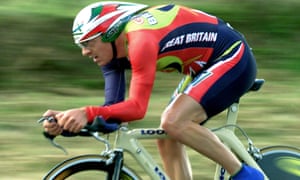
Chris Boardman at the Cycling World Championships in France, 2000.


Chris Boardman at the Cycling World Championships in France, 2000. He has asked to meet Theresa May. Photograph: Franck Prevel/AP

Britain won six golds and 12 medals overall at cycling in Rio, topping the medals table in the sport for the third successive Olympics. Yet the proportion of trips made by bike has remained constant at about 2%, with relatively little investment in bike lanes outside London and a handful of other places.


While David Cameron famously said he hoped to see a “cycling revolution”, an eventual walking and cycling strategy, released earlier this year, was written off by cycle campaigners as worthless, with the money committed around £1 per person per year, against a figure of about £28 in the Netherlands.


The Olympians’ letter urged May to “set out a timeline to address the chronic underfunding and lack of leadership which is keeping cycling for transport in the slow lane”. It added: “Only networks of segregated cycle lanes in towns and cities across the country can achieve and influence growth.”


With a chronically sedentary nation and around one in three children overweight or obese, investment in cycling would pay enormous health dividends, the letter argued, as well as boosting businesses along the routes, and making towns and cities less congested and more liveable.


“There is huge latent demand for cycling,” they wrote. “Two thirds of people would cycle more if they felt safer on the roads.” The letter asks the government to commit 5% of its transport spend to cycling, and to improve law enforcement to better protect cyclists.


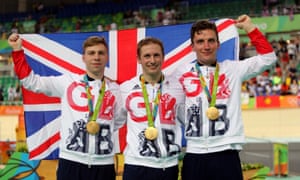
Philip Hindes, Jason Kenny and Callum Skinner with their gold medals following the Rio 2016 men’s team sprint final.


Philip Hindes, Jason Kenny and Callum Skinner with their gold medals following the Rio 2016 men’s team sprint final. Photograph: David Davies/PA

“Investment in cycling as a form of transport isn’t purely an investment in cycle lanes,” the letter concluded. “It is an investment that will pay off for the nation’s health, wealth, transport infrastructure and the vibrancy of our towns and cities. It has the added benefit of just making it easier for ordinary families to get to work and get to school.


“Our athletes have inspired the country and now we urge the government to take cycling seriously as a transport option for everyone.”


The signatories are asking May to meet Chris Boardman, whose cycling gold at the 1992 Olympics heralded Britain’s success in the sport, and who is now British Cycling’s policy adviser.


Boardman said he hoped for a fresh start after the lack of action from Cameron’s “cycling revolution” and the cycling and walking investment strategy.


“It was quite a step, so we were all pretty gutted when we saw it will amount over this parliament to less than a pound a head, which just beggars belief,” he said.


Boardman said he hoped the letter would “put some moral pressure on the prime minister to have to say either what we’re going to do, or why we’re not going to do it”.


He said: “Even in these austere times it’s such a good economic investment, it’s such an efficient spend of cash. It’s exactly what they should be doing. So what we deserve is an answer.”


At the moment, Boardman said, the government was officially committed to doubling the numbers of cyclists by 2025, but had no real means to achieve this. He said: “The question I would like to ask is, you want to double the amount of cycling, to get from 2% to 4%. Do you think less than £1 a head will achieve that target? I don’t think anybody could look you in the eye and say, yes.”


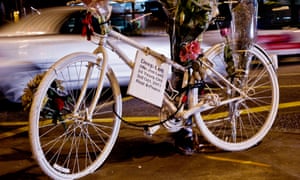
A cycle left as a protest by Bikes Alive at King’s Cross, London.


A cycle left as a protest by Bikes Alive at King’s Cross, London. Photograph: Sarah Lee for the Guardian

A Department for Transport spokesman said government investment in cycling had tripled since 2010. He said: “We are spending £300m on cycling funding and a further £500m for infrastructure in local communities which will include benefits for cyclists.


“The number of people choosing to get about by bike has grown over recent years and, following the success of our Rio Olympians, we want to see this trend continue.”


The letter to Theresa May


Dear Prime Minister,


The Great Britain cycling team athletes topped the cycling medal table for the third Olympic Games in a row at Rio 2016. It was a truly outstanding performance and enhances Britain’s status as the world’s leading elite cycling nation.


You were widely reported in the media as saying that there will be “no limits” on the honours that could be bestowed on our medal winners. But the best way to honour the achievements of our athletes would be a legacy of every-day cycling in this country – a place where cycling is the choice form of transport for people to get around in their daily lives.


Your predecessor called for a “cycling revolution” and your government’s manifesto sets out a target to “double” the number of journeys cycled. While some steps have been made, cycling is still a transport mode which does not enjoy the government investment or political leadership given to roads, rail or aviation.


The government is now considering feedback on the draft Cycling and Walking Investment Strategy (CWIS). We urge the government to publish this and set out a timeline to address the chronic underfunding and lack of leadership which is keeping cycling for transport in the slow lane. Only networks of segregated cycle lanes in towns and cities across the country can achieve and influence growth.


The success of the CWIS will be felt not only across government but in all areas of the nation’s life.


The government’s sports strategy seeks to extend the number of people living physically active lives and could be truly transformative. Active travel – walking and cycling – is the easiest way for people of all ages to fit physical activity into their lives. Currently, only one in five people achieve the recommended levels of physical activity.


Around one in three children is overweight or obese. The government’s childhood obesity strategy recognises the value of physical activity and the importance of walking and cycling to school. I am sure you know that this will seem a fanciful idea for most parents without the convenient walking and cycling routes which would give them the confidence that their children will be safe getting to school. Yet we know it can be achieved – in the Netherlands, 50% of education-age children cycle to school.


As cities like Copenhagen and New York have shown, cycling also creates better places to live and work. More cycling cuts congestion, reduces noise pollution and fuels local economies. Small businesses in New York have seen a 49% increase in business where cycle lanes have been installed.


There is huge latent demand for cycling. Two thirds of people would cycle more if they felt safer on the roads. The government’s road safety statement reiterates the manifesto commitment to reduce the number of cyclists killed or injured. The CWIS needs to set targets to improve road maintenance, enhance enforcement of the laws, and update the rules of the road to better consider the needs of cyclists.


To make this happen, we need 5% of the government’s transport spend allocated to cycling. This is the only way that cycling will be integrated into transport strategy and given the priority it deserves.


Investment in cycling as a form of transport isn’t purely an investment in cycle lanes. It is an investment that will pay off for the nation’s health, wealth, transport infrastructure and the vibrancy of our towns and cities. It has the added benefit of just making it easier for ordinary families to get to work and get to school.


Our athletes have inspired the country and now we urge the government to take cycling seriously as a transport option for everyone.


British Cycling’s policy adviser Chris Boardman would welcome a meeting to discuss this further. We look forward to hearing from you.


Yours sincerely,


Chris Boardman, policy adviser, British Cycling and Olympic gold medalist


Sir Chris Hoy, six-time Olympic gold medallist, joint most successful British Olympian


Laura Trott, four-time Olympic gold medallist and Britain’s most successful female Olympian


Jason Kenny, six-time Olympic gold medallist, joint most successful British Olympian


Mark Cavendish, Olympic silver medallist


Joanna Rowsell Shand, double Olympic gold medallist


Elinor Barker, Olympic gold medallist


Owain Doull, Olympic gold medallist


Becky James, double Olympic silver medallist


Katy Marchant, bronze medallist


Team GB"s cycling heroes call for "legacy of everyday cycling"

15 Mayıs 2014 Perşembe

Stephen Sutton"s legacy to consist of further beds and nurses for teenage cancer individuals

His JustGiving webpage broke all information for the website, like the most funds raised by an individual and the most donors – more than 162,000 – who have sent money from 94 different nations from Andorra to Zimbabwe.


The Teenage Cancer Trust stated these days that the cash raised by Stephen would go to assisting the seven younger people diagnosed with cancer each day in the United kingdom.


His legacy will incorporate building new Teenage Cancer Trust units in hospitals, exactly where expert beds and widespread rooms will be supplied for sufferers aged 13 to 24. The cash will also be utilised to pay for additional teenage cancer professional nurses and youth support staff in hospitals.


A spokesman for the charity said: “Donations made to Stephen’s Story will be spent on supporting and building our vitally critical providers created to assist the 7 young folks, like Stephen, who are diagnosed with cancer each day.


“This involves the advancement of new Teenage Cancer Trust units as properly as supporting our existing network of 28 units in NHS hospitals across the United kingdom. We will also be in a position to enhance the variety of expert nurses and youth help coordinators we give, as properly as keep our schooling operate.”


Teenage Cancer Trust units guarantee that youthful men and women are handled alongside folks their personal age, by nurses who specialise in the healthcare and emotional requirements of teenage cancer individuals. With out the charity’s work, sufferers beneath the age of 16 would be taken care of on children’s wards, alongside toddlers, although in excess of-16s would be on adult wards, alongside pensioners, in line with NHS policy.


The units can value anything at all from £250,000 to much more than £3 million, based on the variety of beds and no matter whether an current ward is refurbished or an entirely new developing is needed.


The charity money 27 specialist nurses and 21 youth assistance co-ordinators, who are all primarily based in NHS hospitals. The 28 Teenage Cancer Believe in units in England, Scotland and Wales have all around 220 beds, though numbers vary based on demand. The units also have common rooms with computers, pool tables and other actions the place individuals can meet every other and socialise.


The Nationwide Institute for Clinical Excellence (Nice) has endorsed the TCT model as the best way of caring for teenagers and young adults with cancer.


Stephen, of Burntwood, Staffs., was taken care of in a Teenage Cancer Trust unit at the Queen Elizabeth Hospital in Birmingham, exactly where he eventually died.


Stephen Sutton"s legacy to consist of further beds and nurses for teenage cancer individuals

14 Nisan 2014 Pazartesi

The Worldwide Fund"s China Legacy

Last week, twelve African nations met in Windhoek, Namibia to examine the new funding model of the Global Fund to Battle HIV/AIDS, Tuberculosis (TB) and Malaria. With its emphasis on real disease burden and flexibility, the launch ofthe new funding model put the final nail in the coffin of the previous strategy, which allocates grants based on the require of person nations and the top quality of every single proposal. Indeed, even prior to the unveiling of the new funding model, the International Fund had manufactured China and several other G20 upper-middle earnings countries ineligible due to their “less than an extreme illness burden.” China, which started receiving Worldwide Fund support in 2003, rapidly became one of the Global Fund’s biggest recipients. This determination hit China difficult, as China had been expecting to be eligible for some $ 880 million in grant renewals for the duration of the 2012-sixteen time period. Since China also decided to forego transitional funding from the Global Fund, the Fund officially closed its portfolio in China rather unceremoniously at the end of 2013.


In our working paper, Jia Ping and I clarify how the Worldwide Fund’s one particular-decade presence in China has left behind a deeply mixed legacy. The Fund’s cash has played a crucial function in boosting sources to fight AIDS, TB, and malaria in China. It has contributed to reduced growth in new HIV infections and considerable drops in TB and malaria infections. And at the same time, the International Fund has also assisted bridge the normative gap among China and the worldwide community in disease prevention and management, and, for the very first time, enabled China’s civil society groups to formally participate in well being policymaking.


But for the numerous successes, the problems and difficulties are equally glaring. The Fund’s vertical, ailment-particular interventions are hardly scalable or conducive to nationwide health technique strengthening. The funding model incurred considerable chance fees and, with its emphasis on quantifiable indicators, produced moral hazard. Equally important, by overemphasizing the amount of civil society organizations working with the Fund and the share of funding channeled to such organizations, International Fund applications have, at times, unintentionally hindered the healthful improvement of Chinese civil society. In the absence of an exit technique for emerging powers, the International Fund runs the risk of seeing China repeat the Russian missteps in submit-Fund condition prevention and manage.


Consider a look at the paper and allow me know what you consider.


This article originally appeared on the Council on Foreign Relations’ Asia Unbound website and can be found here.


The Worldwide Fund"s China Legacy

3 Mart 2014 Pazartesi

"My legacy will be a celebration of NHS care"

“Cancer came out of the blue,” explains Kate. “Everything in our lives was going swimmingly. At 29, I was on track to grow to be a consultant” – Kate must be qualifying later this yr – “and Chris and I had just bought a house in Wakefield, in which I was functioning at the stroke unit at Pinderfields Hospital, and we have been talking about when to start a household.” She adds wryly: “Everything seemed best.”


Unbeknownst to Kate, items had been far from perfect inside her. “I started to come to feel a bit poorly. I’d been a bit exhausted, my tummy was tender and I felt sick. But even when I received truly poor soreness in my back, I took some painkillers and carried on.”


At some point, Chris, 36, a supermarket provide chain manager, insisted they went into an emergency department in a Californian hospital, as Kate was plainly turning out to be extremely sick certainly. Right here, her kidneys failed, and after blood tests, medical professionals quickly warned that she had cancer that had spread to her bones. They had been also very clear it was severe and Kate may possibly not recover.


“At very first they imagined it was ovarian cancer, despite the fact that it had currently spread, and tumours have been compressing my ureter tubes, which get urine from the kidneys. A surgeon operated to open the tubes by inserting stents, and that helped stabilise me.”


All through, Kate was “pretty calm, considering”, though Chris went by means of stages of grief and anger. Right after scans, Kate knew she had to get house. Chris sorted the insurance coverage, which paid the US$ 35,000 (£21,000) hospital bill, and the couple were back in Yorkshire by August. “I felt safer I had all my assistance system about me.”


Admitted to St James’s University Hospital in Leeds, Kate underwent much more exams. “It took the pathologists a extended time to function out what sort of cancer I had, but it turned out I didn’t have ovarian cancer alternatively, it was a unusual sort of sarcoma referred to as a desmoplastic small round cell tumour. This is a cancer of the connective tissue that supports internal organs. They determined it had possibly begun in the tissue around my ovaries.”


This sarcoma is so unusual, it is estimated to have an effect on one individual in every single two million, and there is no understanding of its result in or threat variables. “It truly is a single of those factors,” says Kate.


That autumn, Kate’s kidneys failed again as the tumours grew back into the ureter tubes and blocked the stents. She underwent 3 agonizing procedures when tubes had been inserted, via her reduce back, into the kidneys to drain them.


Her oncologist determined to start off chemotherapy, warning her that this kind of cancer was so aggressive that it wouldn’t respond to a little dose. “I had to go the whole hog,” she says.


Every three weeks, Kate invested three to 4 days in hospital on a drip, suffering uncontrollable vomiting. About 10 days later, her bone marrow would fail and she would develop a fever and infection, which meant getting hospitalised once more for strong antibiotics and transfusions.


“Chemo helped with the discomfort in my abdomen, and shrank the tumours,” she says. “But it was clear that the remedy was creating me truly feel far more poorly than the cancer did.”


That New Year’s Eve [2011], Kate lay in a hospital bed viewing the fireworks in excess of the Leeds city skyline, and created a choice to cease the drug regime. “I imagined: ‘I can not do this to myself any longer.’ ”


Amazingly, as the results of the chemo wore off, she felt far better, and inside of 3 weeks was back at perform among her elderly individuals. “I love currently being with individuals,” she says. “When I was a youngster, I constantly knew I wanted to be a medical doctor.”


Her passion meant that even when she returned to function in January 2012 – a patient now, as effectively as a medical doctor – she identified the inevitable fatigue was bearable: “I enjoy my occupation I don’t feel full when I’m not undertaking it.”


That year, Kate settled into a really lengthy – and unexpected – time period of stability lasting about 20 months. “I knew that typical existence expectancy for my cancer was about 14 months from diagnosis. I was undertaking actually properly.” For the duration of that time, she launched her #hellomynameis campaign, and had the joy of seeing so many medics consider up the result in in her name.


Her blog – and two self-published books about her experiences with cancer, The Other Side and The Vibrant Side – had presently caught the focus of fellow medics, as effectively as the public the website has 848 followers and 985 comments to date. With posts about the actuality of end-of-life care, Kate tackles the topic with thoughtful candour and emotional honesty.


Of exceeding her oncologist’s longevity expectations, she wrote: “I fully expected to be pushing up the daisies by now and it genuinely feels like I have hit a brick wall mentally. There is an overpowering feeling of residing on borrowed time.”


Her luck has not held. Last October 2013, Kate located a lump in her neck: scans showed the cancer had quickly progressed. She was warned not to assume a lot longer than 12 weeks – which took her to Christmas. “To be sincere, that appeared this kind of a brief time,” she says. Kate took the “heart-wrenching” decision to return to chemo.


Chris, as ever, has been in continuous support. “He wished me to have it, but it was my determination. He knew how awful it had been before. We’d hid it from the world the make-up went on and the brave face went on. But Chris had watched me suffering near-up.”


The second regime has been produced a little more bearable than just before, as the hospital has produced its procedures, so that Kate (and other patients) can have chemo as an outpatient, and sleep in their own beds at night.


The day I interview Kate is her last planned session for now. The lump in her neck has gone and her tummy feels significantly less tender, she says. But it won’t be until finally later this month, when a scan is due, that Kate will know how significantly extra time her chemo has bought.


Until then, she has #hellomynameis to preserve her occupied. Its influence is spreading – Kate was extremely amused when her own oncologist launched himself to her one particular day. “He explained: ‘Hello my title is…’ – and I laughed. I said: ‘I know who you are.’ ”


She is searching forward to presenting the awards, too, which had been the concept of the chief nursing officer Jane Cummings, and embody, Kate hopes, her values as a clinician. “I want to celebrate excellent care.”


She admits: “It feels remarkable, mind-boggling. I am a regular Yorkshire lass there is absolutely nothing unique about me. Yet these awards have recognised me and my values.”


Also younger, all would agree, to have to think about what she will leave behind, Kate is sanguine about her circumstance. “I would like a legacy that celebrates the care we can supply in the NHS private care that recognises people, not just ailments or individuals.”


For far more, visit drkategranger.wordpress.com and theothersidestory.co.uk. Follow Kate Granger on Twitter (@GrangerKate)


"My legacy will be a celebration of NHS care"