A second outbreak of bird flu has been confirmed in Lancashire, the Department for Environment, Food and Rural Affairs has said.
The H5N8 avian flu strain was confirmed in a flock of about 1,000 pheasants at a premises in Pilling, Preston, by the UK’s deputy chief veterinary officer, Graeme Cooke.
Defra said there was a business link between the site and a nearby farm where the infection was found in a flock of about 10,000 pheasants earlier this week.
A 3km (1.8 mile) protection zone and a 10km (6.2 mile) surveillance zone had been put in place around both infected premises to limit the risk of the disease spreading.
A Defra spokesman said: “This case was proactively identified as part of a routine investigation of premises traced as a result of confirmation of the disease in Lancashire earlier this week. There is a business link between the two premises.”
A number of the birds in the latest case had died and the others would be culled humanely.
Public Health England has advised that the risk to public health from the virus is very low, and the Food Standards Agency made clear that bird flu did not pose a food safety risk for UK consumers.
On 16 January, Defra confirmed a case of bird flu in a flock of about 6,000 turkeys at a farm in East Lindsey, Lincolnshire.
Earlier in the month, the strain was discovered in two small backyard flocks of chickens and ducks on a premises near Settle, in North Yorkshire, and Carmarthenshire, south-west Wales.
An avian influenza prevention zone was declared on 6 December and would remain in place until February 28. It required owners to keep poultry and captive birds indoors or to take steps to separate them from wild birds.
Health officials have announced the first case of Zika transmitted by local mosquitoes in Texas, the second state in the country to find local mosquitoes apparently carrying the virus.
The tropical virus country-hopped through Latin America and the Caribbean in the last year, first arriving in the United States in the territory of Puerto Rico, before arriving in Miami, Florida. Zika can cause severe birth defects in pregnant women infected with the disease.
“We knew it was only a matter of time before we saw a Zika case spread by a mosquito in Texas,” said Dr John Hellerstedt, the state health commissioner.
Until Monday, Texas had 257 confirmed cases of Zika, though all were associated with travel or sexual transmission. Zika is most commonly spread by infected mosquitoes.
“We still don’t believe the virus will become widespread in Texas, but there could be more cases, so people need to protect themselves from mosquito bites,” Hellerstedt said. “Especially in parts of the state that stay relatively warm in the fall and winter.”
The announcement comes one week after Florida governor Rick Scott sought to quell Zika anxiety in Miami.
The governor held a press conference to announce that three miles of Miami Beach, a popular winter tourist destination, was “cleared” of active Zika transmission. Pregnant women are still advised to postpone travel to about 1.5 miles of Miami Beach, and a nearby area of Miami-Dade county called Little River.
The World Health Organization also dropped Zika from the category of “global health emergency”, instead settling in for a long fight against the disease.
However, tools to fight the mosquitoes that carry Zika remain scarce. Mosquitoes can grow resistant to pesticides, and the widespread application of common airborne sprays has prompted outcry in some places, such as Puerto Rico.
Further, alarming discoveries about the virus have continued.
For example, a study released in mid-November found some babies of Zika-infected mothers may develop microcephaly after children appear normal at birth. Children with microcephaly are born with abnormally small heads and suffer severe developmental disorders. Microcephaly is considered the most severe birth defect associated with Zika.
One Texas-based epidemiologist also criticized politicians’ focus on small geographic areas, such as Miami Beach, noting that public health officials are not surveilling for the disease, and that four out of five patients are asymptomatic.
“The idea that Zika is confined to a small, circumspect area of Miami is ridiculous,” said Dr Peter Hotez, dean of the National School of Tropical Medicine at Baylor College of Medicine in Houston, Texas. “There’s probably a lot of transmission going on in Texas, Louisiana, Alabama and Florida that we’re not aware of because we’re not really doing active surveillance, so this is not a surprise at all.”
Though Zika infection is believed to be widespread in Puerto Rico, officials said they did not expect the disease to spread as far in Texas. Many epidemiologists believe that widespread window screens and air conditioning in Texas is responsible for hindering the spread of mosquito-borne diseases.
The infected area, in Brownsville, tends to be a hotspot for mosquito-borne diseases, Hotez said, including a recent case of Chikungunya.
The city is one of the poorest in Texas. Brownsville is the southernmost city in Texas, on the Gulf of Mexico bordering the Mexican state of Tamaulipas. In Cameron County, where Brownsville is located, almost half of children live in poverty, according to the Texas Tribune – the highest rate in the state.
Senior public health officials said Congress’s months-late $ 800m-short Zika funding bill will seriously damage research budgets for heart disease, cancer and diabetes.
Officials with the federal Health and Human Services Administration called on Congress to consider an emergency health fund for future emerging diseases, similar to the way natural disasters are funded.
“We had to use money we were going to spend within our own institute on malaria and tuberculosis,” said Dr Anthony Fauci, director of the National Institute of Allergy and Infectious Diseases.
Fauci has headed up the development of vaccines for Zika. There are currently at least nine vaccines the National Institutes of Health is hoping to shepherd through early clinical trials.
Funds from, “cancer, heart disease, diabetes and mental health allowed us to prepare sites to do the phase two trial,” said Fauci. “None of that money is going to come back to us … We are going to be able to continue rather smoothly, but it comes at a significant cost.”
Zika is a primarily mosquito-borne disease first identified in Uganda in the 1940s. Initially, Zika was considered benign because symptoms were mild and only affected one in five infected people.
It was not until winter 2015 that the virus was considered a serious threat to human health, because of an astronomical rise in the rate of microcephaly cases in Brazil. Microcephaly is an uncommon birth defect where children are born with abnormally small heads and severe developmental problems.
The White House called for $ 1.9bn in Zika funding as early as February, but Congress was unable to pass a bill to fund efforts to combat the disease until late September. Earlier efforts were thwarted by so-called poison pills, such as riders that would have eliminated federal funding to Planned Parenthood and lifted a ban on Confederate flags in veterans’ cemeteries.
Now, local transmission is widespread in Puerto Rico, and has flared up in Miami. More than 25,000 cases have been reported nationally, including more than 2,000 cases in pregnant women. The disease has also continued to surprise scientists, who recently reported that Zika was spread through sweat or tears in Utah, and that the virus lingers in semen and saliva.
“We won’t be able to backfill for the cancer research we had to take from to keep things going,” said the health and human services secretary, Sylvia Burwell. “There was a reason we asked for the $ 1.9bn, and that was important uses of money.”
Officials said research into diagnostic tests and long-term impacts on children born to infected mothers of the disease were delayed because of congressional bickering.
Fauci called the congressional funding a “tried and true, but sometimes seriously delayed appropriations process”. He said that, “at least from our standpoint, [an emergency fund] is something that should be seriously considered.”
Department for Education (DfE) officials appear to have been working to sack Natasha Devon, the government’s schools’ mental health champion, over her criticism of government policies even as they publicly denied doing so, according to internal emails obtained by Devon.
Devon, who was dropped from her role after she repeatedly argued that the government’s own education policies were contributing to poor mental health among young people, said the DfE emails confirmed her fears that the department had been trying to silence her.
In March, two months before her role was axed, one DfE official wrote that although they wanted to avoid the appearance that the department was dropping her because of her criticism, “it cannot be feasible that she continues”.
In another email a month later, an official writes: “Every day is another day she could be saying something damaging – and if that happens we will kick ourselves for not acting sooner.” But after the Guardian broke the news that Devon would be axed, she received a text that read: “What the Guardian have printed is ludicrous – We want to work with you more, not less!”
After reading the emails, Devon said they showed that the government’s policies on children’s mental health was little more than “a PR exercise” and confirmed her fears at the time that the department had been trying to silence her.
She said the emails revealed a government more worried about her comments on Twitter than the crisis in mental health among young people. “I can’t believe the ineptitude,” she said. “It’s like a script from [the BBC political satire] The Thick of It.”
Devon, who was appointed with some fanfare by the government in August 2015 to raise awareness of and reduce the stigma surrounding young people’s mental health, put in a subject access request to see government emails concerning her role after her dismissal in May.
At one point one official exclaims: “I know I keep saying this but please can everyone monitor her Twitter?”
Elsewhere the tone changes. After the news broke that her role was being cut, one DfE email read: “I think we now need to take ND down a peg or two.” A couple of days later, another said: “She is having her fifteen minutes and hopefully she is nearly at the end.”
Devon, who has almost a decade of experience of working in schools as the founder of the Self-Esteem Team and Body Gossip which deliver mental health education to young people, said her experience of working with government had “played havoc” with her own mental health.
When she was appointed she was told it was an important role – though unpaid to ensure impartiality – and would give her an opportunity to influence policy. In the end, it was “window dressing”, to help the government get coverage on GMTV and in other lifestyle media, she said.
Though Devon was hired because of her ability to talk to young people, department officials objected to her choice of language on social media.
When she uses the word “dickwad” in response to a story about a young woman being bullied for speaking out about sexism, one DfE email reads: “It is obviously totally unacceptable for a government-endorsed champion to swear and use offensive terms as she does … I have just called Natasha and she was surprisingly unapologetic.”Asked on Friday to respond to the internal emails and Devon’s criticism of the government’s policies on young people’s mental health, a DfE spokesperson said: “Natasha did a great job of helping us to raise the profile of young people’s mental health during her appointment.
“Since that time, the independent NHS taskforce report has been published which recommended that a cross-government mental health champion be created – for this reason we had to reconsider the department’s own role.”
Devon has now compiled a comprehensive report on children’s and young people’s mental health based on what she uncovered during her nine-month tenure as government mental health champion and her own work in schools.
She said of the government’s approach to young people’s mental health: “They talk a good game but they don’t get it. There was no real understanding of the severity of the situation. They would say the words, but I did not feel there was any kind of urgency.”
Every time it rains in San Juan, Dr Brenda Rivera-Garcia walks around her home emptying containers of standing water, likely wearing long sleeves, and almost certainly wearing mosquito repellant. Rivera-Garcia is the state epidemiologist in Puerto Rico, a woman tasked with tracking every single Zika-infected pregnant woman in the US territory.
Less than two weeks after the US health and human services administration declared the spread of Zika on the island an epidemic, Rivera-Garcia said it’s not frustration or anger that overtakes her when she adds a new woman’s name to a list of roughly 700 confirmed to be infected with the disease.
It’s sadness.
“Every time I have to add a pregnant woman to that list, I just think of what’s going to be of this pregnancy,” she said, her eyes visibly wet. “What’s going to be of this child later on, and, it’s, it’s – it breaks my heart.”
As much as 25% of the island’s population could have the disease by the end of mosquito season, the Centers for Disease Control and Prevention estimates, and up to 50 pregnant women each day are infected on the island.
A recent study projected as many as 270 babies could be born with the debilitating birth defect microcephaly, between now and mid-2017. In a normal year, doctors expect 16.
The defect causes infants of mothers infected with the virus to be born with abnormally small heads, and suffer life-long developmental disorders. Some will have trouble walking. Others may have hearing or vision loss, trouble swallowing or seizures. Many are likely to have shortened life expectancy.
But health officials have had difficulty translating those projections into urgency among many Puerto Rico residents, who have been dogged in the past by tropical diseases with more apparent symptoms, such as Dengue and Chikungunya. Indeed, the government’s efforts to control the virus seem hampered at every turn, thwarted by apathy, lack of trust, misinformation, insecticide resistance and even architecture.
“The system doesn’t work so of course people are going to be skeptical,” said Joe Torra, 40, a professional driver in San Juan.
Referencing colonialism, Torra said: “The best way to control minds is to control bodies.”
A health worker prepares insecticide before fumigating a neighborhood in San Juan on 27 January 2016. Photograph: Alvin Baez / Reuters/Reuters
‘False alarms’
Denisse Velazquez, 36, stood under the shade of a tree in Old San Juan, one of the hardest hit municipalities, as she said that the government “created false alarms”.
Juan Martinez, 43, said that with “all these diseases we have seen, it’s something normal”, referring to periodic outbreaks of Dengue the island has struggled with since the 1980s, and the recent Chikungunya outbreak. “In the Caribbean there has always been mosquitoes.”
Even tourism officials have reinforced the view that Zika risk has been overblown.
“From the very beginning the numbers that were given were based on projections. The reality is that as of today, less than half of 1% of the population has the virus,” Clarisa Jimenez, CEO of the Puerto Rico Hotel and Tourism Association, told CNBC’s Squakbox. “The only issue here is if you’re pregnant.”
Jimenez focused on the roughly 10,600 Puerto Ricans who had, at the time, been diagnosed with Zika by the CDC. The figure is an underestimate, because four out five infected people have no symptoms and likely do not know they are ill.
Now, near the end of August, the health department of Puerto Rico and the CDC have diagnosed 12,800 Zika infections, including more than 670 in pregnant women, believed to represent only a fraction of actual infections.
So far, only one child has been born with microcephaly. But experts expect that number to increase dramatically in coming months, particularly from September to December.
Health professionals believe the most dangerous time for a pregnant woman to be infected is in her first trimester, though more research is needed. Those pregnancies are expected to begin coming to term this fall.
“Right now, most of the births we have seen are among second and third trimester infections,” said Rivera-Garcia. “For us, it’s not just a number. There’s a family behind that number.” Doctors suspect that even these cases, which are less dramatic in appearance, could result in problems that won’t manifest until much later.
The island’s timetable of epidemic infection is about one year behind Brazil’s. In December 2015, as cases of microcephaly began to surge in Brazil, cases of locally acquired infections were just beginning to show up in Puerto Rico.
“When you’re involved in major epidemics, and particularly this one for some reason, I’ve been unable to disconnect,” said Dr Francisco Alvarado-Ramy, a senior CDC official and native Puerto Rican who helps lead the federal government’s response to the epidemic. He is stationed at the Dengue Branch, an outpost in San Juan established to combat another virus spread by the same mosquito as Zika, the aggressive Aedes aegypti.
“The moment that I go to the sleep to the moment that I wake up, my mind seems to be around Zika all the time, trying to think if there’s any other thing we can do,” he said.
“When something goes wrong, it’s also a very fast way down, downstairs in terms of your emotional well-being. We’re trying to prepare our staff, as well, if we start seeing a lot of people with bad outcomes how to handle that emotionally.”
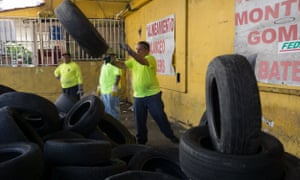
Employees with the municipal government collect used tires on 7 August 2016 in the Rio Piedras section of San Juan, Puerto Rico. Photograph: Angel Valentin/Getty Images
Cat, Dog, Mosquito
“We have in Puerto Rico a dog, a cat and a mosquito,” said Carmen Deseda, the former state epidemiologist who battled several epidemics of Dengue, a hemorrhagic fever that can incapacitate a person for weeks. “The problem is not the mosquito, it’s the virus.”
Deseda expressed a view common among Puerto Ricans: the mosquito is here to stay, fumigating won’t work, so the government better find some other way to deal with this.
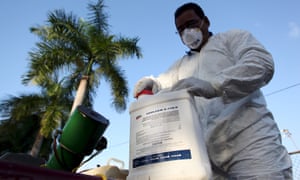
She was among many prominent opponents of fumigating the island with an insecticide called Naled, a solution proposed by the CDC and used on about 6m acres of land each year in Florida. Many residents were outraged that the federal government would, in their view without permission, spray chemicals over the island.
“When they said that I was very upset,” said Miguel Pellot, 48, the owner of a smoothie stand called Fruta Fruit in San Juan. “¿Como se dice, una falta de respeta?” he said, asking how to express lack of respect in English.
“For people here, this is nothing new. We’ve had mosquitoes here since we were born,” Deseda said. “They don’t feel threatened by the mosquito, because it’s been always with them.”
Deseda said government fumigation encourages apathy among the population. “The government is doing something so they don’t have to anything.”
Ceda Velez, a 36-year-old woman working a juice stand near San Juan’s cruise ship ports said she was in favor of government fumigation.
“We use repellant, but at least it would help with where the mosquitoes breed, to kill the mosquitoes,” she said in Spanish. “I worry.”
Puerto Rico won’t fumigate with Naled from planes, as Florida does. And even if Puerto Rican authorities decided to fumigate street-side from trucks, only about 12 on the island are outfitted to spray for mosquitoes. Regional resistance to insecticides has also confounded eradication efforts.
Some residents believe the island was a guinea pig for past federal government experiments, that Zika was mild and posed no risk, that they weren’t going to stop “living”, or were simply misinformed about how to prevent exposure.
“I had, yes, but I drink Tylenol, y ya,” said Naara Nieves, 39, who stood outside at noon in San Juan proselytizing, a gregarious evangelist of Jehovah’s Witness. “I think the women who are pregnant, is bad, but for me, no.”
Marylin Vigo, who was visiting her sister on the island from Brooklyn, New York, said her relatives called her “paranoid” for even slathering on mosquito repellent.
“She goes, ‘Ugh! That doesn’t mean you’re going to get Zika, because of mosquito bites,’” Vigo said, describing her sister’s reaction. This is despite her sister’s belief that Vigo’s 29-year-old nephew just contracted the virus.
A cultural gulf
One of the most cited differences between Puerto Rico and the mainland is the lack of screened windows and air conditioning, which hamper mosquito-borne diseases spread in places like Texas.
Tropical breezes course uninhibited through flung open doors, patios and unscreened louvre window shades. The open roofs of Spanish-influenced architecture let in rain drained away by a floor grate.
“If you go to the communities, people love to sit out on their patio, play dominoes, play music, have a barbecue, and that’s difficult to do in a screened in porch, or take advantage of the Caribbean leeward breezes,” said Rivera-Garcia. “It certainly changes your way of life.”
So the Puerto Rico Department of Health is focused on behavioral and cultural change.
River-Garcia said past epidemics of diseases with severe symptoms like Chikungunya have not driven people to engage in practices like wearing repellant and investing in screened windows.
“That’s why we – from the get-go in January – we said, ‘OK, we need behavioral science studies. We need to understand what will be that one driver, or the drivers, to effect behavior change.”
Even for those who might want screens, it could be a real burden.
Nearly half the population, 46%, lives in poverty. The average per capita income is just $ 19,600, making an air conditioned bedroom unattainable.
A raft of other science conducted on the island is looking at other solutions. Children of Zika-infected mothers will be followed until they are three years old. Alvarado and his team collect blood and placenta samples from Zika-infected women who give birth and miscarry.
Traps are being reengineered at the Dengue branch, including the promising, pesticide-free innovation of a bucket that uses fermenting hay and water to trap mosquitoes.
“It drives me to keep trying and see where can we improve, what else can we do,” said Rivera-Garcia. “I think for all the responders both local and stateside with many Puerto Ricans in various areas of expertise – they’re coming back, donating their time, or asking for deployments in Puerto Rico.”
Britain’s eight million smokers have been urged to start off ‘vaping’ soon after a government-backed report identified that the electronic gadgets are 20 times much less dangerous than traditional cigarettes.
So far no electronic cigarette has been licensed by the Medicines and Healthcare merchandise Regulatory Company (MHRA) or the National Institute for Overall health and Care Excellence (Nice).
But a new report launched these days by Public Well being England, Kings College London and Queen Mary London, discovered e-cigarettes carry just 5 per cent of the risk of tobacco and must be broadly adopted by smokers.
If each smoker in Britain switched to vaping, all around 75,000 lives a year could be saved, they estimate. The authorities known as for e-cigarettes to be prescribed on the NHS as soon as regulated.
Nagy Memes Szabolcz and Georgia Samuels at Vapefest, Shrewsbury
Nevertheless several scientific studies have identified that the flavours employed in e-cigarettes may result in respiratory issues and damage the immune technique while analysis published on Tuesday by the University of Southern California advised they could encourage youngsters to take up smoking.
“E-cigarettes are not completely threat totally free but when compared to smoking , evidence displays they carry just a fraction of the harm,” mentioned Professor Kevin Fenton, Director of Well being and Well-getting, at PHE.
“We’re encouraging smokers to look at e-cigarettes as a way to help them to lessen publicity to harm from smoking.
“At the moment there are no licensed goods that can be utilized for medicinal purposes and that’s why we are extremely supportive of the MRHA seeking at the pathway for making certain that there are safe and regulated e-cigarettes that can be promoted for health care purposes.
“Smoking continues to result in the biggest numbers of preventable deaths every single 12 months. Our ambition remains to see the 1st smoke free of charge generation by 2025.”
“Concerns do remain as to the prolonged-phrase well being impact of e-cigarettes…”
Penny Woods, Chief Executive of the British Lung Basis
The Division of Wellness mentioned it was “confident” the NHS could make the cost savings required.
In a statement, it mentioned: “The NHS is on track to make £20 billion cost savings this parliament and we are assured that it will carry on to make the cost savings essential to meet rising demand.”
But the well being regulator Keep track of claims there is a funding gap of a lot more than £5bn for the following fiscal yr in the NHS England’s commissioning price range for all secondary healthcare which accounts for about three quarters of the total budget.
Right after all reasonable efficiency financial savings have been created, a deficit of £1.6bn will remain for that section of the price range which involves hospitals and mental health providers, Monitor mentioned.
Anita Charlesworth, chief economist at the Health Basis, said the NHS had been producing efficiency savings of about two.five per cent every yr but that following 12 months it would want to make cost savings of 6.five per cent to stay away from a shortfall.
She stated: “Whitehall should be really worried about this.
“We’ve ended up with hospitals actually caught between a rock and a tough place, they’ve got swiftly rising charges, people will know that off the back of worries about quality at Mid Staffordshire the NHS has substantially enhanced the variety of nurses it is using.
“Hospitals fees generally are nurses and medicines and the two of individuals are genuinely rising quite quickly and their earnings is due to fall since of the shift of cash to social care.
“There’s not a whole lot you can do short term however out of that there are efficiency financial savings but not on the scale that is necessary so with no decreasing solutions or good quality, the only other resolution actually is to find far more money and £2billion – even though it is only two per cent of the total NHS spending budget – you do not locate that down the back of the sofa and even for the Treasury that is not tiny modify.”
The warning comes just days after investigation recommended NHS Wales was dealing with a £2.5bn funding gap in excess of the subsequent decade.
The report by the Nuffield Believe in, commissioned by the Welsh government, found the health service outgoings would outstrip funding by the equivalent of a lot more than 43 per cent of its present budget.
But health minister Mark Drakeford insisted the report had recognised long-term financial savings could be produced via reform of companies.
Public wellness officials warn that whooping cough poses the best danger to younger kids as California discounts with its worst outbreak of the respiratory disease because 2010, with almost three,500 reported victims so far this year.
“Prevention of pertussis is specifically critical in youthful infants simply because they are the ones at chance for serious ailment and death,” Dr Gil Chavez, state epidemiologist and deputy director of the California Department of Public Well being, stated on Monday.
Infants, in certain, are the most vulnerable to the disease which triggers severe, uncontrollable spasms of coughing that can make breathing tough, and public well being officials urged parents to make sure their youngsters are appropriately vaccinated.
Vaccines also are advisable for pregnant women and adults who have increased make contact with with young young children.
California public wellness officials mentioned on Friday whooping cough, also identified as pertussis, has reached epidemic proportions in the state.
A lot more than 800 circumstances have been confirmed statewide in the initial two weeks of June alone, with Napa, Sonoma and Marin counties close to San Francisco Bay reporting the highest costs of infection per capita.
The highly contagious bacterial infection strikes 30 million and 50 million individuals each year around the world and kills about 300,000 annually, largely young children in the creating planet.
In the United States, the place outbreaks have a tendency to run in cycles, most kids are immunized against pertussis with a vaccine provided as a series of shots starting as early as six weeks of age. Pregnant women should get the vaccine in their third trimester because antibodies will be passed on to their newborns, Chavez stated.
Pertussis in youthful kids normally starts with a runny nose and occasional coughing for up to two weeks, escalating into bouts of extreme coughs punctuated with a characteristic “whooping” sound.
Infants typically do not exhibit the traditional signs and symptoms but may gag or gasp, and their faces may possibly turn red or purple for the duration of these spells, Chavez mentioned.
As of June 10 of this 12 months, 3,458 circumstances of pertussis have been reported during California, far surpassing the 2,530 folks diagnosed with the ailment statewide for all of 2013.
Of this year’s tally, 119 sufferers have been hospitalized, most of them under four months of age, and one, a five-week-previous infant, has died.
This year’s outbreak so far pales in comparison to a whooping cough epidemic that struck California in 2010, when 9,000 instances, such as 10 infant deaths, have been reported.
Figures were worst for sufferers with lung cancer, urological cancers, and gastrointestinal cancers than for these with breast cancer or skin cancer, the document from the Department of Well being shows.
Mike Hobday, director of policy and investigation of the charity Macmillan Cancer Help, mentioned: “It is of great concern that the amount of trusts missing this target has doubled above the last yr. All around 1 in 4 of the trusts that have been hitting the target at the start of 2013/14 are now missing the target.
“This is the initial breach of any cancer waiting time in England considering that 2009 and is a clear warning indicator that the NHS is under huge strain.
“The United kingdom previously has some of the worst cancer survival charges in Europe. More patients are now facing delays, which implies much more individuals are facing nervousness for longer and more lives are becoming place at chance. We’re very concerned that the co-ordination of cancer care is obtaining worse and that cancer is currently being overlooked in the new NHS.
“The variety of cancer patients is set to improve from two to 3 million by the finish of the next Government in 20204, and we can not afford to see far more and more folks waiting longer. Ahead of next year’s general election Macmillan Cancer Help is urging all political events to commit to delivering cancer outcomes that match the ideal in Europe and to make cancer a leading priority for the following government.”
Andy Burnham, the shadow wellness secretary, stated: “David Cameron claimed his NHS reorganisation would enhance cancer care. The reality is that he has in reality created it worse.
“Families across England are now dealing with longer, agonising waits for treatment. Professionals are now warning that lives will be put at threat.
“Cancer individuals and their households will be waiting to hear an unequivocal pledge from the Prime Minister that he will quit the slide in requirements and get cancer solutions back on track. Nothing at all less will do.
“This is however an additional warning signal of an NHS that is heading in the incorrect course. It is now clear that David Cameron’s reorganisation has triggered actual damage to patient care and is why so numerous folks will never believe in the Tories with the NHS.”
A Department of Wellness spokesman said: “The NHS is treating much more cancer individuals than ever – given that 2009, we’ve observed the amount rise by 15 per cent.
“We want the NHS to have the extremely ideal cancer providers in the world, and are investing £750 million to assistance early diagnosis and access to treatment method.
“All sufferers fighting cancer must have higher good quality, compassionate care and we count on each and every part of the NHS to deliver towards national targets. The NHS should search urgently at any dips in local performance and take action to make positive all sufferers get access to cancer remedy as speedily as achievable.”
An extremely unusual, polio-like ailment has appeared in much more than a dozen California youngsters inside the past year, and each and every of them suffered paralysis to a single or a lot more arms or legs, Stanford University researchers say. But public wellness officials haven’t recognized any common leads to connecting the circumstances.
The illness is nonetheless being investigated and seems to be quite unusual, but Dr Keith Van Haren at Lucile Packard Children’s Hospital at Stanford University warned Monday that any kid exhibiting a sudden onset of weakness in their limbs or signs of paralysis need to be right away witnessed by a medical doctor.
“The ailment resembles but is not the same as polio,” he said. “But this is critical. Most of the kids we’ve witnessed so far have not recovered use of their arm or their leg.”
But medical professionals are not positive if it’s a virus or some thing else, he mentioned. Van Haren said he has studied 5 situations from Monterey up by means of the San Francisco Bay Region, such as two that have been identified as the illness enterovirus-68, which is from the same family as the polio viruses. He mentioned there have been about twenty instances statewide.
“We want to temper the concern, simply because at the second, it does not appear to represent a main epidemic but only a very uncommon phenomenon,” he said, noting similar outbreaks in Asia and Australia.
But for some youngsters, like Sofia Jarvis, 4, of Berkeley, rare doesn’t indicate risk-free.
She very first developed what looked like asthma two many years in the past, but then her left arm stopped moving, and it has remained paralyzed ever since.
“You can think about. We had two boys that are quite healthy, and Sofia was wholesome until finally that level,” said her mother, Jessica Tomei. “We did not understand what we were in keep for. We did not realize her arm would be completely paralyzed.”
Van Haren, who diagnosed Sofia, explained polio vaccines do not safeguard kids from the illness, but he stressed that it is nonetheless critical for children to acquire that vaccine.
Dr Jane Seward of the Centers for condition manage and prevention in Atlanta said Monday that the research is nevertheless underway in California, and there are a range of infectious illnesses that can result in childhood paralysis.
Any of a number of illnesses could be at work, and it is achievable some of the instances had 1 infection and some had another. Relating to the presence of EV-68 in at least two circumstances, “it could be an incidental finding”, Seward mentioned.
Till officials get a lot more details, Seward said they are not hunting close to the country for similar instances of EV-68.
The California division of public overall health has not identified any frequent brings about that suggest that the situations are linked, said Dr Gil Chavez, the deputy director of the Center for Infectious Disease and state epidemiologist.
“Physicians and public wellness officials who have encountered similar illnesses have submitted twenty reviews to CDPH, and CDPH has performed preliminary tests on 15 of these specimens,” he said. “Thus far, the department has not identified any widespread leads to that propose that the instances are linked.”
University of California, San Francisco, neurology professor Emmanuelle Waubant mentioned doctors think, but really don’t have proof, that it’s a virus that for most young children displays up only as a benign cold. She explained a handful of young children, due to their biological makeup, are having significantly much more serious signs and she hoped medical professionals would seem for them.
“For a lot of the neurologists who have skilled in the last thirty many years, it’s very unusual to see polio or polio-like syndrome,” she mentioned.