An Ebola outbreak has been declared in north-east Democratic Republic of the Congo, the World Health Organization (WHO) has said, after the virus caused three deaths since 22 April.
WHO said the outbreak had affected an equatorial forest region in Bas-Uele province, bordering Central African Republic.
The last Ebola outbreak in Congo in 2014 was quickly contained and killed 49 people, according to official figures.
In a television address, the country’s health minister, Oly Ilunga, confirmed the outbreak and urged the population not to panic.
“[The DRC] has taken all necessary measures to responde quickly and efficiently to this new outbreak,” he said.
WHO said it was working closely with Congolese authorities to help deploy health workers and protective equipment in the remote area to “rapidly control the outbreak”.
In 2013, an Ebola epidemic began in west Africa that killed 11,300 people in Guinea, Sierra Leone and Liberia and has left thousands more survivors with long-term health problems.
WHO was criticised at the time for responding too slowly and failing to grasp the gravity of the outbreak. An experimental vaccine was recently developed that WHO said could be used in emergencies.
A doctor acted dishonestly when she lied to investigators about the dangerously high temperature of a nurse who went on to develop Ebola, a tribunal has found.
Dr Hannah Ryan, who had been working in Sierra Leone during the west Africa Ebola outbreak of 2014, was one of the medics who assessed Pauline Cafferkey following the Scottish nurse’s return to the UK in December 2014.
Ryan did not raise the alarm when a colleague wrote down Cafferkey’s temperature as 1C lower than it actually was during a “chaotic” screening process at Heathrow airport on 28 December 2014, a medical practitioners tribunal found on Monday.
A raised temperature can be the first sign of Ebola, which can kill within five days. Cafferkey, who twice nearly died from the virus, went on to develop one of the worst cases on record for people treated in the west.
During screening at Heathrow, Cafferkey insisted she was feeling fine and was eventually allowed to catch her connecting flight to Glasgow. The following day, she developed further Ebola symptoms and was admitted to hospital for urgent treatment.
The tribunal found that Ryan had acted in a “misleading” manner when she agreed that the form recording the lower, wrong temperature be submitted to screening staff from Public Health England (PHE) at the airport.
But Ryan, who had only just graduated from medical school, did not intend to conceal Cafferkey’s real temperature at the airport, knowing it to be at least 38.2C – higher than the 37.5 considered normal – the panel found.
However, the tribunal decided that the doctor had later been “dishonest” when she concealed her role in taking Cafferkey’s temperature during a conversation with Dr Nick Gent on 2 January 2015. Gent, deputy head of the emergency response department at PHE, had phoned her during PHE’s investigation into when Cafferkey’s symptoms first emerged.
Ryan did not tell him she had taken Cafferkey’s temperature and told him words to the effect that the nurse’s temperature was “normal”, the panel found.
The tribunal heard that Ryan and Cafferkey were one group among many British medics who put their own lives at risk by volunteering their medical skills and going to west Africa to help fight the outbreak.
Deployed on 22 November 2014, they were based at an 80-bed treatment centre in Kerry Town, a village in Sierra Leone, working “tirelessly in dangerous and highly pressurised conditions” during which they “formed a strong bond of friendship”, according to Fraser Coxhill, representing the General Medical Council.
The medical practitioners tribunal, which is independent of the GMC, will decide later this week whether Ryan’s fitness to practice as a doctor was impaired due to her actions and whether to impose sanctions.
The history of Africa’s oldest psychiatric hospital is written on the walls of its isolation units, desperate messages chiselled into the woodwork like scars. “I came here for I don’t have any money,” reads one note in a corner of the room. “People want me to run from my father’s house,” reads another. “You go nowhere,” announces a third. “Stay out.”
Since the hospital opened in the early 19th century, most Sierra Leoneans have aspired to do exactly that, avoiding this imposing building perched high on a hill above the capital, Freetown.
Still the country’s only mental healthcare facility, the Sierra Leone psychiatric hospital is known in the local Krio language as the “crase yard” or “place for crazy people”. During the civil war in the 1990s, rebel fighters got as far as the staff quarters before turning back, too afraid of what they might find inside, witnesses say.
We do counselling, though it’s not the type of counselling they do in America or Europe
When the world’s worst Ebola outbreak began there two years ago, Sierra Leone had just 136 doctors working in the public sector, according to the World Health Organisation, a massive shortfall for a population of 6 million.
There was only one psychiatrist: Edward Nahim, a wry, Soviet-trained 70-year-old who spent his mornings scribbling prescriptions in the foyer of the hospital, where many patients were kept chained and treatment consisted of little more than a daily dose of expired antipsychotic drugs. Electricity flickered and rusting buckets served as makeshift toilets on the days the pipes ran dry, which was most of the time.
The mental health toll that Ebola exacted – depression, anxiety and post-traumatic stress disorder – was massive. But the hospital’s fearsome reputation meant few of those affected considered looking there for support. In the early days of the outbreak, many people considered hospitals to be dumping grounds for the dying or, worse, the places that had made them sick.
Those suffering from the virus’s psychological side-effects viewed the psychiatric facility in a similarly negative light.
“Because we have so few professional resources, people are used to understanding mental illness in their own way and most would never even think of coming to a hospital for psychiatric treatment,” says Stephen Sevalie, who this year became the country’s second psychiatrist, working for the Sierra Leone armed forces.
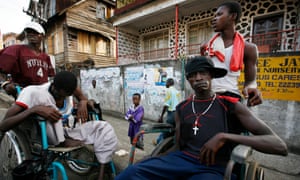
About 25% of disabled people in Sierra Leone are amputees who were wounded in the civil war. Photograph: David Levene for the Guardian
But Nahim says this caution may not be entirely a bad thing. Places such as Sierra Leone needs fewer formal mental health services than western countries, he says, because its people are able to rely so heavily on community structures – families, traditional healers and religious leaders – during times of emotional distress.
“We do counselling, though it’s not the type they do in America or Europe,” Nahim says. “Here, if you have a problem, someone talks to you. Your parents talk to you. Your church talks to you. Your traditional healers treat and counsel you. In America they need professional counsellors because no one talks to anybody – if you try to talk to somebody, they’ll probably call the police.”
But a lack of formal treatment options for those struggling the most has led to desperation, too. Bars selling cheap sachets of gin and whisky are crowded long before noon, and weather-battered men wander the streets of Freetown, mumbling to themselves and begging for change and discarded food. Drug abuse is rampant, particularly among the war veterans, many of whom were children when they fought.
For those working in the mental health sector, this is not the way things were supposed to be. In the years after the decade-long civil war which, according to the UN, led to the deaths of more than 70,000 people and to hundreds of thousands being maimed by amputation, international charities poured into Sierra Leone with promises to heal its emotional wounds.
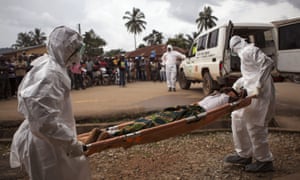
Healthcare workers carry a man suspected of having Ebola to an ambulance in Kenema, the country’s third largest city. Photograph: Tanya Bindra/AP
“Many of these programmes were excellent,” says Dr Florence Baingana, who works for the World Health Organisation’s Sierra Leone office. But they were also temporary. “You can’t run a mental healthcare system with outsiders – NGOs have a life cycle; they come and they go.”
Mental health in particular proved a hard sell to international donors over the long term – the wounds it healed were largely invisible and the progress drawn out.
Slowly, the international money dwindled, says Edward Bockarie, executive director of the Community Association for Psychosocial Services (Caps), a Sierra Leonean NGO that has provided counselling since the end of the war.
Map
On a recent morning, counsellors at one of his regional offices in the eastern province of Kailahun hunched over a few shared computers, planning projects. None of them had been paid for nearly six months, after their last spurt of funding ran dry.
“This is our initiative. We can’t just leave it,” says Maxwell Makieu, a counsellor who has worked with the association since its launch in a refugee camp in Guinea 20 years ago.
Back then, he and the other Caps counsellors were refugees fleeing conflict in Sierra Leone, hired by an American nonprofit organisation to provide peer counselling to others in the camp. When the centre retreated from Sierra Leone a few years later, its local counsellors started their own group.
For the past decade, they have scraped together grants to keep their shoestring operation running in two districts in the war-ravaged east.
That meant that when Ebola broke out they were among the only counsellors prepared to respond. Their staff were quickly scooped up by Médecins Sans Frontièresand other international charities to work in their treatment centres.
But when the outbreak ended, predictably, so did most international interest in their work.
At the Kailahun district hospital, there are signs that changes to the mental health system are at last being institutionalised.
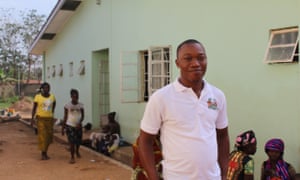
Martin Senesie is referred to as the ‘crase doctor’ by locals. Photograph: Ryan Lenora Brown
Martin Senesie, Kailahun’s first trained mental health nurse, arrived last year as part of a programme that placed 21 such nurses at hospitals around the country, and now has a bright office.
However, he admits the work at times feels never-ending. He has grown used to whispers of “crase man doctor” when he walks through town. His pay of approximately 750,000 leones (about £108) a month, feels like a slight, given the many years he spent earning his qualifications.
Each month, dozens of Ebola survivors and their families queue outside his office seeking help for depression and anxiety. Without him, he wonders, where would they go?
In Freetown, Sevalie hopes the enthusiasm around mental health services will continue. “Whether Ebola is here or not, these systems are essential. This is an opportunity for us. It could be the turning point.”
A version of this article first appeared on Bhekisisa, centre for health journalism
A vaccine for Ebola which has completed successful trials in Guinea and Sierra Leone means the virus should never again be able to wreak the havoc it did during the recent epidemic in west Africa, say scientists.
More than 11,000 people died in the outbreak, which began unnoticed in December 2013 and spread across the region, infecting at least 28,600 people and triggering a global response, including a race to get an effective vaccine tested and into use.
Final results for the vaccine that was rushed into trials in Guinea and later Sierra Leone show that it was highly effective against one of the most lethal known pathogens in existence. Ten days after vaccination, none of the trial subjects developed Ebola virus disease. The very few who did, in the days immediately following vaccination, are thought to have been infected already.
“While these compelling results come too late for those who lost their lives during west Africa’s Ebola epidemic, they show that when the next Ebola outbreak hits, we will not be defenceless,” said Dr Marie-Paule Kieny, the World Health Organisation’s assistant director general for health systems and innovation, and the study’s lead author.
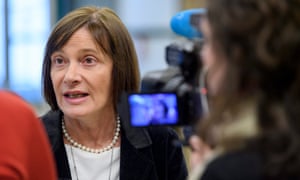
Dr Marie-Paule Kieny of the WHO announces the results at the United Nations in Geneva on 22 December. Photograph: Martial Trezzini/EPA
Merck, Sharp & Dohme, the company manufacturing the vaccine, has received permission to go through fast-track procedures for a licence from the US and European regulatory authorities. It has committed to making 300,000 doses that will be ready for any emergency even before formal approval, with $ 5m (£4m) in funding from Gavi, the Vaccine Alliance.
The trial began in the coastal region of Basse-Guinée, which still had cases in 2015, even though the numbers were abating across the region. Writing in the Lancet medical journal, the scientists say it was not easy.
“A devastating outbreak of Ebola virus disease is clearly not the ideal situation for doing a vaccine trial. The healthcare system in Guinea was strained, potential trial participants were worried about a candidate vaccine made by foreign people, and the Ebola virus disease response teams were facing security issues,” they write.
They collaborated closely with the government and local authorities in Guinea and chose a “ring vaccination” design for the trial, which was unusual but had been successful in helping stamp out smallpox decades ago.
When a new case of Ebola was diagnosed, the teams offered vaccination to everybody who had been in contact with that person in the previous three weeks, from family to friends and neighbours. They also offered vaccination to the closest contacts of those contacts. This cluster – or ring – amounted to around 80 people on average. Altogether, 117 such rings or clusters were identified. At first, adults were randomly assigned to get the vaccine immediately or three weeks later, but when it became clear that the vaccine was protecting most people, everybody was offered immediate vaccination, including children.
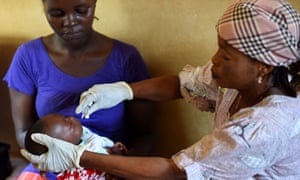
A baby receives a vaccine in Freetown, Sierra Leone, November 2014. Photograph: Francisco Leong/AFP/Getty Images
Among the 5,837 people who received the vaccine, still known only as rVSV-ZEBOV, no Ebola cases were recorded 10 days or more after vaccination. Among those who were not vaccinated, there were 23 cases. There were very few serious side-effects – one case of fever and one of anaphylaxis (allergic reaction) thought to be related to the vaccine.
The authors of the study say the ring design was also helpful in ending the outbreak and suggest it could be a useful way to tackle the disease in future.
Co-author John Edmunds, professor of infectious disease modelling at the London School of Hygiene and Tropical Medicine, whose team helped design the trial, said: “This novel and historic trial, conducted under the most difficult of circumstances, has demonstrated that the rVSV-ZEBOV vaccine is safe and effective. When Ebola strikes again we will be in a much better position to offer help to affected communities, as well as protect the brave volunteers who help control this terrible disease.”
Jeremy Farrar, director of the Wellcome Trust, which supported the trial, said the outcome was “simply remarkable” and demonstrated what was possible even in the midst of a raging epidemic.“We’ve shown that by working collaboratively, across international borders and sectors, we can develop and test vaccines rapidly and use them to help bring epidemics to an end,” he said.
“Had a vaccine been available earlier in the Ebola epidemic, thousands of lives might have been saved. We have to get ahead of the curve and make promising diagnostics, drugs and vaccines for diseases we know could be a threat in the future. My hope is that this success story provides the inspiration we need to make this happen and change the way the world prepares for epidemics.”
Dr Sakoba Kéita, coordinator of the Ebola response and director of the National Agency for Health Security in Guinea, said: “Ebola left a devastating legacy in our country. We are proud that we have been able to contribute to developing a vaccine that will prevent other nations from enduring what we endured.”
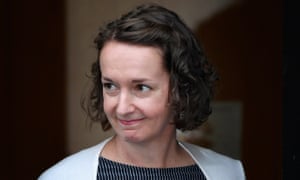
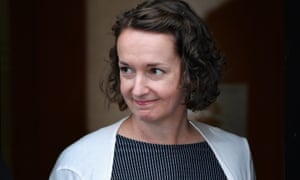
Pauline Cafferkey, the Scottish nurse who nearly died twice from Ebola, has called on Public Health England to “recognise their own failings” in a botched Heathrow airport screening process that has led to one of her colleagues being suspended for two months.
She said she was “extremely disappointed” that PHE had employed a “blame culture” that highlighted the possible mistakes made by volunteers who risked their own lives to help Ebola patients but did not acknowledge its own.
Cafferkey made her remarks as Donna Wood, a nurse who was part of the same volunteer group who travelled to Sierra Leone in November 2014, was suspended by the Nursing and Midwifery Council (NMC) after it found she had concealed the nurse’s temperature during the screening process in Heathrow on 28 December 2014.
Najrul Khasru, the chair of the NMC panel, told Wood: “The seriousness of your misconduct … could have contributed to the risk of Ebola, a very serious and dangerous illness, spreading in this country.” The panel described Wood’s “dishonesty” as extremely serious and called it “a momentary lapse of judgment”.
Cafferkey said: “I am very sorry to hear the outcome of Donna Wood’s hearing. I still feel extremely disappointed that in making complaints against volunteers who willingly put themselves in danger for the benefit of others, Public Health England employed a blame culture and failed to recognise their own failings – which were many – on the day the volunteers arrived at Heathrow.
“I hope that Public Health England will now acknowledge their mistakes and accept that as a result of these, they took the decision to allow me to fly on to Glasgow, rather than transferring me to hospital in London. I look forward to this continuing ordeal eventually being concluded.”
During the eight-day disciplinary hearing, it emerged that PHE had run out of screening forms and monitoring kits and had only four cubicles for about 50 passengers.
It emerged during the hearing that Wood and Cafferkey were among five volunteers who decided to take their own temperatures to get out of the “uncomfortable” and “chaotic” screening area more quickly.
Donna Wood was cleared of falsification but the panel found she was aware of Cafferkey’s higher temperature and had failed to escalate the situation. Photograph: Yui Mok/PA
Wood denied she had falsified Cafferkey’s temperature, which a fellow volunteer recorded as over 38C, a degree higher than average body temperature and a potential early warning sign of Ebola. The panel cleared her of falsification, but found she was aware of Cafferkey’s higher temperature and had failed to escalate the situation.
Later, the doctor who took Cafferkey’s temperature raised the issue with an infectious diseases expert in their group and they agreed that Cafferkey should return to the screening area.
Her temperature was taken three more times by the lead clinician on the PHE team, Deepti Kumar, but she told the disciplinary hearing that she had not been told Cafferkey had taken paracetamol, which can mask a high temperature. Kumar then cleared Cafferkey to make her connecting flight to Glasgow.
The manager of the screening team, David Carruthers, a former police officer, told the panel that Cafferkey had told him she had taken paracetamol and that he had passed this information on to Kumar. However, he was not sure if the doctor had picked up that information.
It also emerged that the PHE manager had mistakenly phoned a hospital switchboard rather than an infectious disease team that was mandated to deal with any referrals from the screening team. Carruthers told the panel he had passed on enough information to those he spoke to get help but he never heard back.
All five of the volunteers were referred to their regulatory bodies by PHE following an early investigation into the screening on that day. The volunteer doctor who took Cafferkey’s temperature will go before a medical disciplinary tribunal in March.
Cafferkey faced being struck off but was cleared of any misconduct in a disciplinary hearing in September after an NMC panel found no evidence that she had set out to mislead PHE. Her solicitor at the time said she had found the proceedings stressful and upsetting.
The nurse who was found to have concealed her colleague Pauline Cafferkey’s raised temperature before she tested positive for Ebola in 2014 has been suspended from practising for two months.
An independent Nursing and Midwifery Council (NMC) panel had found that Donna Wood was a low risk to future patients but that her fitness to practise had been impaired and a sanction was in the public interest.
Najrul Khasru, the chair of the panel, told Woods that an aggravating factor was that: “The seriousness of your misconduct … could have contributed to the risk of Ebola, a very serious and dangerous illness spreading in this country.”
The panel described Wood’s “dishonesty” as “extremely serious” but told her it was “not premeditated but a momentary lapse of judgment”.
The sanctions were imposed after an eight-day hearing in Stratford, east London, after Public Health England, which was running the screening process in Heathrow, reported her for allegedly falsifying a document recording Cafferkey’s temperature as one degree lower than it was.
Wood was returning from Sierra Leone, where she and Cafferkey had volunteered to work in an Ebola treatment centre at the peak of the epidemic in December 2014.
Khasru said her misconduct had been an “isolated incident in an otherwise unblemished nursing career … and unlikely to be repeated”.
The panel found that Wood had not misrecorded Cafferkey’s temperature on a health screening form, but said she had known it was elevated and had not escalated this despite knowing that a high temperature was a potential early warning sign for Ebola.
In not doing so, she had “put Ms Cafferkey and anyone coming into contact with her at at unwarranted risk of harm”, said Khasru.
In considering what sanctions to impose, Khasru said the panel took into account the stress and exhaustion of the nurses, who had been working up until the day they left Sierra Leone.
It concluded that striking Wood off would be have been disproportionate, and it was in the public interest to retain a highly skilled nurse. Wood currently works as an end-of-life nurse in Burslem, Stoke-on-Trent.
Among the mitigating factors were Wood’s previous good record and her “selfless act” to volunteer to help Ebola patients in Sierra Leone.
The panel also noted the “less-than-ideal environment in the screening area” at Heathrow airport when the passengers returned from west Africa on 28 December 2014.
Khasru noted that Wood had worked as a nurse for two years since the incident without any concerns raised during this period or throughout her 29-year career.
But the panel said her behaviour, though a momentary lapse of judgment, warranted a suspension in order to uphold the public’s confidence in the profession.
“The panel was mindful of its duty to protect the public interest. This includes the protection of patients and others, maintenance of public confidence in the profession and the regulatory body,” Khasru said.
It emerged during the disciplinary hearing that the group of five volunteers including Cafferkey and Wood had decided to take their own temperatures in order to get out of the “uncomfortable” and “chaotic” screening area more quickly.
Cafferkey and her colleagues were cleared to go through to the baggage area but Cafferkey later returned to the screening area after a doctor in their volunteer group raised concerns.
She was subsequently given the go-ahead to take her connecting flight to Glasgow, but the senior clinician on the team was not aware she had taken paracetamol, which can mask a high temperature, the tribunal had heard.
The nurse who was found to have concealed her colleague Pauline Cafferkey’s raised temperature before she tested positive for Ebola risked her life for others in Sierra Leone and has an otherwise unblemished record, a tribunal has heard.
Donna Wood’s lawyer told an independent panel at the Nursing and Midwifery Council that he accepted their findings but said her actions amounted to a brief “lapse of judgment” by a professional who had given almost 30 years of “distinguished” service to the NHS.
Ben Rich was speaking the day after Wood had been found guilty of misconduct following allegations that she knew Cafferkey had a high temperature and that she failed to escalate this during the screening process at Heathrow airport when they returned from six weeks volunteering in Sierra Leone in December 2014.
Before the panel retired to consider whether her misconduct amounted to an impairment in the nurse’s current fitness to practice, Rich told them: “On your findings it would be incorrect to find that any of those professionals, Donna Wood included, really thought that Pauline Cafferkey had Ebola.”
He told the panel that several witnesses including the lead clinician on the screening team, Deepti Kumar, had said that Cafferkey did not seem unwell on the day.
“Had there been the slightest suspicion that actually Pauline Cafferekey was ill, you know that witnesses you found to be honest, thought that Pauline Cafferkey seemed completely well,” Rich said.
Cafferkey initially passed the screening process after her temperature was found to be over 38C but was recorded on a form as normal. When she returned to the screening room her temperature was taken three more times and found to be normal.
Cafferkey had told the manager of the screening process, David Carruthers, a former Metropolitan police officer, that she had taken paracetamol about an hour before, which could have masked her real temperature.
But Carruthers, who had no clinical training, did not understand the significance of this and failed to pass the information on to Kumar, who was assessing Cafferkey in the second screening.
Rich pointed out that Kumar was among several witnesses who had nonetheless said that Cafferkey appeared well despite her temperature.
He told the panel on Thursday that the findings amounted to a “momentary lapse of judgment in a nurse who has an otherwise distinguished record of service to the NHS, to the public, a distinguished period of service to Ebola patients before this during which time she risked her own life for the benefit of others”.
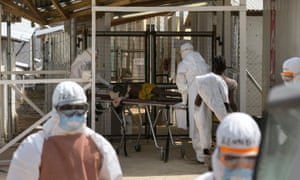
An Ebola treatment centre outside Freetown, Sierra Leone, in December 2014. Photograph: Baz Ratner/Reuters
Wood was brought before the NMC on three misconduct charges, including recording Cafferkey’s temperature reading dishonestly in order to hide it from public health officials.
It transpired during the hearing that the group had decided to take their own temperatures because the screening team were not equipped to do so. They had run out of screening forms and only had four screening cubicles for about 50 people.
On Wednesdsay the NMC found that she had not recorded an incorrect temperature as alleged but found that she had suggested that Cafferkey’s temperature be recorded lower so that the volunteer group could leave the “uncomfortable” and “chaotic” area more quickly.
Wood is facing a professional sanction, which could involve being struck off or a suspension.
Aja Hall, the case presenter for the NMC, told the panel the case was “particularly serious” as “Pauline Cafferkey was in the starting stages of Ebola and in an extremely busy and public place”.
She said it was “well established” that a high temperature was the “first sign that there may be infection which is why so much significance was placed on the taking of temperature, both in Sierra Leone but more crucially through the screening process at Heathrow airport”.
The panel is expected to to conclude its deliberations on Friday.
A nurse once described as a hero after she volunteered to work in an Ebola treatment centre in Sierra Leone faces the possibility of being struck off after being caught up in a botched screening at Heathrow.
Donna Wood has been found by the Nursing and Midwifery Council to have concealed the high temperature of her fellow volunteer Pauline Cafferkey when they landed at Heathrow a day before the Scottish nurse tested positive for the virus.
An independent panel of the NMC had charged her with recording a temperature for Cafferkey one degree lower than it was during a “chaotic” screening process on 28 December 2014.
At the end of a six-day hearing, the panel found this was not proved, but found that she was guilty of two other charges – that she had known Cafferkey had a high temperature and dishonestly concealed this and had failed to escalate the situation, knowing that a high temperature could be seen as a first indicator of Ebola.
Najrul Khasru, the chairman of the panel, said it had fully accepted that Wood’s desire to get out of the area quickly was the primary motivation of her actions. He said: “The panel found you made the suggestion to record Ms Cafferkey’s temperature 37.2C with the intention to conceal that Ms Cafferkey had a temperature higher than 38C from PHE screening staff in order to allow yourself and your group to leave the area sooner rather than later, and deal with it later.”
The panel will now consider whether the findings against Wood are serious enough to involve a sanction, which range from being struck off to having conditions imposed on her future practice as a nurse in Stoke-on-Trent, where she works in end-of-life care.
Wood categorically denied that she falsified Cafferkey’s records and raised questions about the competence of the screening system, which was described as “chaotic”.
The panel heard that in an attempt to help doctors and staff conducting screening at Heathrow airport, the medics decided they would take their own temperatures. Wood said she recalled seeing volunteer doctor Hannah Ryan with the thermometer, and that she had held it up to her at least once.
She said she could not remember whether she had written on any screening forms herself.
The panel could not prove she had written the incorrect temperature on Cafferkey’s forms but said it was satisfied she had dishonestly suggested it be recorded as such.
After the group left the screening room and made it to the arrivals hall, Ryan reported Cafferkey’s high temperature to another doctor, who recommended the Scottish medic return to be screened again.
Cafferkey’s temperature was checked again three times by a Public Health England consultant and was found to be a maximum of 37.6C, meaning she was given the all-clear to travel on to Glasgow.
But at some point before getting to arrivals, Cafferkey had taken paracetamol, contributing to the lower readings.
Pauline Cafferkey was cleared of misconduct in September. Photograph: Jeff J Mitchell/Getty Images
PHE says it learned lessons from the Cafferkey case, but denies its process was chaotic or deficient or that its system had failed to detect the one person who did come into the UK on a commercial airline carrying the Ebola virus.
“Screening was not designed to catch someone with Ebola. It was about getting relevant information from people and giving them information so they could be clinically referred if necessary,” said a spokeswoman.
Cafferkey, who nearly died twice from Ebola-related complications, also faced NMC disciplinary proceedings but was cleared of all misconduct after a hearing in September.
Wood was brought before the employment tribunal after a third volunteer told PHE, the body that designed the screening process, that Wood had falsified Cafferkey’s temperature on the form she had to fill out on arrival at Heathrow.
The tribunal raises questions about the efficacy of the screening process. With the disease out of control in west Africa at the time, there was fear and panic in some quarters that the virus could easily be brought into the UK by plane.
About 14,500 people, including aid workers, medics, press and Sierra Leoneans, arrived in Heathrow during the Ebola crisis.
The PHE contended that it was the nurses’ fault Cafferkey passed through undetected as they did not comply with the screening process, referring them to their regulatory authorities. However, those who gave evidence at the NMC spoke of deficiencies in the screening process.
Only half the team in Heathrow on the day had any clinical background. The clinical lead, Deepti Kumar, told how volunteers from the “Cabinet Office” and other government departments were drafted in to the process.
Kumar and the screening manager, David Carruthers, a former police officer, told the panel they were not prepared for the high number of volunteers returning, despite the heavy publicity surrounding their trip to Sierra Leone.
Carruthers admitted they were a bit “disorganised” on the day and that they ran out of screening forms and monitoring kits and had just four screening cubicles for about 50 people.
The future of volunteer doctor Ryan is still in the balance as she faces a separate Medical Practitioners Tribunal Service hearing on 20 March.
A nurse who faces being struck off over a botched Ebola screening in Heathrow airport has said it is “preposterous” that she would have concealed knowledge that Pauline Cafferkey was unwell.
Donna Wood, an NHS nurse who volunteered along with Cafferkey to work in Sierra Leone in 2014, said she would never have put her country, her family or herself in such danger.
She faces being struck off after being charged by the Nursing and Midwifery Council (NMC) with falsifying Cafferkey’s temperature as they passed through the Heathrow screening process on 28 December 2014.
“I absolutely dispute the allegation because if I had been aware of anybody having a temperature it would have been a complete danger, a red alert in my mind,” she said.
She said “alarm bells” would have gone off in her head and she would have immediately taken action if a colleague had had a high temperature, as this is the first symptom of Ebola.
It is alleged that Wood, a reluctant poster girl of the government’s Ebola volunteer recruitment drive, dishonestly recorded Cafferkey’s temperate as 37.2C when she knew it was 38.2C.
Pauline Cafferkey. Photograph: Jeff J Mitchell/Getty Images
Under the Public Health England protocols, anyone who presented themselves with a temperature above 37.5C should have been referred for further assessment by a special infectious diseases expert.
The charges were brought after an investigation launched by Public Health England two days after Cafferkey fell critically ill with Ebola.
A doctor in the returning volunteer group, Hannah Ryan, alleged that Wood had said she would write the temperature down as one degree lower so they could get out of the “chaotic” screening area and “sort it out” themselves later.
“It would be preposterous to even contemplate that I would allow myself to be put in danger, or someone else, or my family or my country,” Wood said. “I just spent six weeks protecting myself from contracting Ebola, ensuring my colleagues working around me were protecting themselves against Ebola. The reason I had gone out to Sierra Leone was to control the spread of Ebola. There is no way I would have let someone else be at risk,” she said.
Wood told an NMC hearing in Stratford, east London, that she had no recollection of filling in Cafferkey’s form, as alleged by a doctor who had previously given evidence. Nor did she know that Cafferkey had taken paracetamol, which could possibly mask an elevated temperature, she said.
She said she remembered that Cafferkey had said she was feeling “warm” when they got off the flight and went to the toilet “to freshen up”. Cafferkey had ascribed her feeling to the fact that she had slept wearing a hoodie on the plane.
Wood said she remembered very clearly telling Cafferkey not to take paracetamol because it could affect her temperatures recordings, which were universally used as the first barrier of infection prevention with checks taken several times a day while they were in Sierra Leone.
“As we were leaving the toilets, we were on a very wide corridor, a lot of people around us. She said it very clearly so that I heard her: ‘I think I’m going to ask Dr Hannah if I should take some paracetamol.’
“Absolutely without a second at all, I responded staight away: ‘Gosh, no, you mustn’t do that. That could mask any temperature or symptoms,’” said Wood.
She told the NMC independent panel that none of the protocols of infection prevention and control were in place at Heathrow. Temperatures of passengers arriving at the airport were not taken as they disembarked from the plane from Sierra Leone, she said.
Although the volunteers were classified as being at the highest Ebola risk level under Public Health England protocols because they had worked on the frontline, Wood told how she was allowed to queue up with hundreds of other passengers arriving from all over the world in passport control before being taken to the Public Health England screening area, where she was again in close proximity to members of the public.
At the time America and Europe were gripped by panic over the potential spread of Ebola from west Africa to other parts of the globe.
The Ebola virus is spread through bodily fluids including saliva and sweat, and those who had worked in Sierra Leone were operating under the same strict “no touch” protocols as the public under the state emergency laws.
Wood told how the volunteers were banned from going to shops or churches or meeting locals in Sierra Leone and were under strict instructions to stay in the beach resort hotel that had been hired by Save the Children, which ran the Kerrytown hospital they were working in.
Describing how she felt standing close to others who had come from Sierra Leone in the screening area, she said: “I remember this wasn’t right. Through my training, you weren’t allowed go out to shops, churches, and here we were in a crowded area with people I didn’t know. They had come from Sierra Leone but thoughts were entering my head: could this person be unwell? Or could this person have been with someone who had Ebola?
“I remember being uncomfortable being that close in a crowded area.”
Under cross-examination Wood said she could recall a doctor holding up a thermometer but no one called out a temperature reading. She said she would have been gripped by panic if she had seen a temperature of 38.2C as it would have been an early warning.
“I would have been putting them at risk, myself at risk, my family at risk, all their families at risk, everyone in that room at risk”, which was something she would not have done “bearing in mind we had just had six weeks seeing horrific deaths”, she said.
An Ebola health screening programme that was put in place at Heathrow airport to protect Britain against the spread of the deadly virus was hampered by poor organisation, lack of training and lack of resources, a tribunal has heard.
The breakdown in the system was so great that the manager of the screening system called the wrong number for the specialist on call at the infectious disease hospital when concerns were raised on 28 December 2014 when the Scottish volunteer nurse Pauline Cafferkey passed through the airport.
Passengers deemed to require further observation or assessment were to be sent to Northwick Park hospital in north-west London. But the screening manager revealed he rang an incorrect switchboard the day Cafferkey arrived, rather than the infectious disease consultant on call.
David Carruthers, the shift manager the day Cafferkey returned from Sierra Leone, admitted in the tribunal that his team had run out of screening kits and monitoring kits, and that half the staff on the screening team were not clinically qualified and were “office workers” previously.
He was giving evidence at a Nursing and Midwifery Council hearing where one of Cafferkey’s volunteer group, the nurse Donna Wood, is facing being struck off for allegedly concealing the Scottish nurse’s high temperature on the day. Wood has denied the charges.
Pauline Cafferkey. Photograph: Jeff J Mitchell/Getty Images
Carruthers described how the screening team was given passenger numbers for the two indirect flights coming in from Sierra Leone where NHS workers had volunteered at the peak of the Ebola outbreak.
However, he was not aware of how many passengers had actually worked on the Ebola frontline and would therefore have been deemed to be “category 3” passengers with a risk profile.
He said the screening team was unable to cope with the high numbers of category 3 passengers arriving on the Royal Air Maroc flight. But he claimed the Scottish nurse only got past the checks put in place by Public Health England to check travellers entering the country from west Africa after a deception.
“Chaotic is a bit of a harsh term, it was busy and it was a little disorganised,” he said.
Carruthers conceded that the screening system was flawed on some fronts, under cross-examination by Wood’s counsel, but said he was not clinically qualified to manage a health risk.
He said he was reliant on border control and PHE managers to provide passenger lists for any given day. “It wasn’t an exact science, I’m afraid,” said Carruthers, who worked as a Metropolitan police officer from 1984 to 2013.
He said they had only four cubicles in Terminal 4 to deal with passengers arriving on the Royal Air Maroc flight. He said passengers from Ebola-hit countries were not isolated at Heathrow.
Those, like Cafferkey, who had come from “high risk” environments were allowed to mingle freely with other passengers in the screening zone, the tribunal heard. Transit passengers were also able to move freely between terminals before being screened.
“We are talking about a highly infectious and dangerous disease,” said Ben Rich, for Wood.
Carruthers described how he had arrived in the screening area in Terminal 4 the day Cafferkey and her volunteer group returned from Freetown, the capital of Sierra Leone. He noticed that some people were agitated and unhappy with what was going on. Staff also complained that some of the forms had not been filled out properly.
However, he said he did not talk to passengers as he felt this would “exacerbate” things. His job was to manage the process, he said.
The former police officer learned that Cafferkey had been allowed through the screening process with a temperature above 38 degrees at about 6.20pm.
It is alleged that Wood recorded her temperature a degree lower in order to escape the “chaos” at the screening area and “sort it out”.
He said he learned of the alleged “deception” after he received a call from an infectious diseases nurse and then had a telephone conversation with Cafferkey directly.
At this point she was in either the arrivals hall or on the train platform to take her to Terminal 5 for a connecting flight to Glasgow.
“Pauline Cafferkey confirmed her temperature had been recorded as lower than it was,” said Carruthers. “I told her she should return to screening and have her temperature recorded. I assured her there was plenty of time for her flight [to Glasgow] and assured here there was nothing to worry about.”
He told the independent panel that he remained calm and courteous with her as he did not want to panic her as he escorted her from arrivals back to the screening area.
“I did summarise to her that the temperature had been taken at 38.3 degrees but recorded as lower than his. She did not disagree with this. I would describe her as tail between the legs or sheepish,” he said.
He later said: “Ms Cafferkey got through the screening area with what I would call as deception.”
He told how the screening team was made up of eight staff on the day, including a communicable disease expert, three clinically qualified professionals and four non-professional screeners.
In addition, an infectious diseases clinician was on call at Northwick Park hospital in the event of a high-risk patient arriving.
When alerted to Cafferkey’s temperature, he took responsibility in place of the PHE clinician on the team, to contact the expert at the hospital. By mistake, he phoned the switchboard and did not get a reply.
“That’s a breakdown in communication and for that I am partly responsible without a shadow for a doubt,” he said.
After Cafferkey was tested positive for Ebola on 28 December, Nick Gent, a doctor and deputy dead of PHE’s emergency response department was drafted in to assess the efficacy of the body’s screening process.
He interviewed volunteers in Cafferkey’s group as part of a fact-finding rather than evidential operation, he told the tribunal. Gent added that along with Cafferkey and Wood, doctors Hannah Ryan and Mark Willcox were referred to their regulatory bodies.
Pauline Cafferkey has tested negative for the Ebola virus, NHS authorities have said, after she was rushed to hospital for a fourth time since her return from Sierra Leone in 2014.
The 40-year-old nurse underwent further tests under the care of the infectious diseases team at Queen Elizabeth University hospital, Glasgow, where she was taken under police escort on Thursday morning.
A spokesperson for the hospital said: “Following a detailed assessment we can provide reassurance that there is no risk to the public.”
Police Scotland confirmed that they had provided an escort “as a matter of course” for the ambulance taking Cafferkey from her home in South Lanarkshire at 9.30am.
Nicola Sturgeon (@NicolaSturgeon)
Sending my very best wishes to Pauline Cafferkey. She has already suffered way too much – & all for trying to help others. Thoughts with her
October 6, 2016
Cafferkey, 40, first became ill from the Ebola virus on her return from Sierra Leone in late December 2014. She flew on from Heathrow to her home in Glasgow, where she was admitted to hospital with a fever later confirmed as Ebola infection. She was flown to London’s Royal Free hospital, which has a specialist isolation unit for Ebola patients.
She nearly died, but when she was pronounced out of danger in January 2015, it was thought the virus had been cleared from her system. That October, however, she became critically ill again and was readmitted to the Royal Free. Her case astonished experts, as the first in which the virus had lurked in her brain or spinal cord undetected and then attacked again, causing near-fatal meningitis.
She has had long-term problems as a result of the second attack, including muscle weakness in one leg, which has meant she is unable to run as she used to do.
Nurse Pauline Cafferkey relieved to be cleared of misconduct over Ebola virus – video
A third admission to the Royal Free turned out to be a false alarm, but the experts have no idea whether the Ebola virus is still lying undetected in her body because too little is known about the virus and the disease.
Three weeks ago, Cafferkey was cleared by her regulatory body, the Nursing and Midwifery Council, which had investigated allegations that she concealed her high temperature at Heathrow on her return from Sierra Leone.
The NMC, which could have struck her off the nursing register, said Cafferkey’s judgment had been compromised by her developing illness, and so she could not be held responsible for putting the public in danger. Cafferkey said she reported her high temperature, but was allowed to fly on to Glasgow.
The British nurse who twice came close to death after contracting Ebola while working as a volunteer in Sierra Leone in 2014 should not face charges of dishonesty, a misconduct hearing has heard.
Pauline Cafferkey, 40, could be struck off by the Nursing and Midwifery Council if the remaining charges against her are proved. Those charges are that she allowed an incorrect temperature to be recorded on her return to the UK, and that she failed to report her elevated temperature to screening staff or tell them she had recently taken paracetamol.
On Tuesday morning the panel at an NMC misconduct hearing in Edinburgh was urged by the case presenter for the council to strike out a charge that she had acted dishonestly.
Anu Thompson, for the NMC, told the panel that expert evidence suggested Cafferkey’s “ability to make decisions and reason properly were affected at the relevant time”. She referred to one medical expert, Dr Thomson, who submitted that: “I have no doubt that a combination of early Ebola virus infection and fatigue resulting from a busy night shift followed by a lengthy journey [from Sierra Leone] would have impaired Pauline’s judgement at the time of entering the screening process at Heathrow airport.”
The hearing was told that on 28 December 2014 Public Health England’s Ebola screening facility at Heathrow airport had not been prepared for such a large influx of passengers, and that the screening area was “busy, disorganised and even chaotic”.
An agreed statement of fact described how each person was given a port of entry Ebola health assessment form, on which their temperature and other relevant information was to be recorded by medical staff. As the delays continued and frustrations grew, one member of Cafferkey’s group suggested they take their own temperatures.
The hearing was told that a member of that group, Doctor 1, took Cafferkey’s temperature and found it to be 38.2C, then 38.3C when she took it again a few minutes later.
Doctor 1 stated that she read out both numbers in the presence of Cafferkey and Registrant A, another group member, who said that she would record the nurse’s temperature as 37.2C then they would “get out of here and sort it out”.
Cafferkey, who sat quietly with her representative throughout the hearing, has stated that she remembers somebody using the words “let’s get out of here” but cannot remember who said them or who entered the temperature of 37.2C on her screening form.
Any temperature above 37.5C was considered to be elevated and should have been reported to a consultant for further assessment.
Cafferkey left the screening area, the hearing was told, but later returned after Doctor 1 raised further concerns about her elevated temperature. Her temperature was taken three more times, by Doctor 2, but only one reading was above 37.5C, and that by 0.1C. Cafferkey did not volunteer to Doctor 2 the information that she had recently taken paracetamol, nor was she asked directly about it, and she was cleared to travel home to Glasgow.
The following day she was diagnosed with Ebola, suffering one of the highest viral loads ever recorded.
Earlier on Tuesday, Cafferkey’s representative, Joyce Cullen, applied for the hearing to be held in private, arguing that the “intrusive nature of press and media has already had a significant psychological impact on Miss Cafferkey”.
Cullen added that an error by the NMC in publishing draft charges on their website last month had had an additional adverse effect, after which Cafferkey had required medical treatment and been forced to move out of her home for a period. Cullen argued that Cafferkey had a right to privacy regarding medical records that would be referred to during the hearing.
The assembled media objected to the application for the hearing to be heard in private. A decision was due later on Tuesday after hearing submissions from the media’s legal representatives.