midwives etiketine sahip kayıtlar gösteriliyor. Tüm kayıtları göster

19 Ekim 2016 Çarşamba

"Dangerous and unsafe" care driving midwives out of NHS

Inadequate staffing levels are driving midwives to leave the NHS, with some looking after as many as 15 mothers and babies at a time, a report has found.


The study of more than 2,700 midwives uncovered fears about making mistakes because they were working 12-hour shifts with no break.


Midwives reported not being listened to when they told managers they feared for the safety of mothers and babies, while others experienced bullying from senior staff.


The respondents to the poll, for the Royal College of Midwives, were made up as follows: 31% were midwives who have left the profession in the past two years and 69% were intending to leave in the next two years.


The top reasons for leaving were not being happy with staffing levels at work (52%), not being satisfied with the quality of care they were able to give (48%) and being unhappy with the workload (39%).


A third (35%) were unhappy with the level of support from their managers while 32% were unhappy with working conditions.


Of those who intended to leave the profession, 62% were unhappy with staffing levels, 52% were not satisfied with the quality of care they were able to give, 46% were unhappy with the workload, 37% were unhappy with conditions and 30% did not agree with the model of care they had to work in.


When asked if they might return to midwifery, only 18% said they would consider doing so.


When asked to expand on their experiences, one midwife who left more than 18 months ago said she was stressed “trying to provide good as well as safe midwifery care despite ridiculously low staffing levels and having to complete endless paperwork just to prove I was there”.


Others reported feeling depressed and under-valued, while one who intended to leave midwifery in the next 12 to 18 months said: “I am tired and worn out and am concerned that if this continues that I might make a tragic mistake.”


A midwife who left after 40 years said the “stress of under-staffing and the ever-increasing workload” had left her burnt out.


One who left the profession in the past six months said: “I was often working 12.5 hours with no breaks. My unit was struggling with employing enough midwives – we had a shortage of 30 full-time midwives in the unit. I was not able to deliver the care I wanted as decisions were often made about women’s birth without her full involvement.


“It was not safe to look after 15 mums and babies on a postnatal ward by one midwife. We were not listened to when we raised issues over staffing and safety.”


Others described in detail “dangerous and unsafe” working conditions.


One who left more than six months ago said: “I felt scared with the care I was able to deliver. I was left in a dangerous position on many occasions due to a lack of staff and a lack of support from managers when escalating concerns.”


Another said: “Maternity is the most litigious area in healthcare, yet we cannot actually practice safely and in a way that makes us proud, due to chronic staff shortages and cost-cutting.”


Some midwives with young children said their applications to work flexibly or part-time were denied, forcing them to leave. Others described bullying bosses and said they were working in a “culture of fear”.


One said: “Changes are put in place after serious incidents – ie more staff in those specific areas – but as soon as the workload reaches capacity these staff are moved to cover other areas once again leaving you in a vulnerable position.”


Another said: “I have seen midwifery colleagues destroyed by management if something goes wrong and yet they had worked 12-hour shifts without breaks and no one will accept that the system has caused the failure.”


Cathy Warwick, chief executive of the RCM, said the findings were “saddening, dispiriting and worrying”. She added: “Maternity services are performing as well as they are on the backs of the selfless dedication of midwives and other maternity staff, and their capacity to go that extra mile for mothers and babies, day after day. However, this shows that many cannot fight that battle any longer.


“Enormous demands are being made on midwives and the services they work for, yet investment in these services from the government remains inadequate to provide the quality of care that women deserve.”


The RCM has repeatedly called for more midwives, saying there is a shortage of 3,500 across the NHS.


Conservative MP Dr Dan Poulter, who was the maternity services minister in the coalition until May 2015, said that the risks involved in delivering babies could be prompting some midwives to leave.


“Delivering babies is a very rewarding job, but also a very risky one, so it is unsurprising that chronic understaffing in some already overstretched maternity units is resulting in midwives feeling unable to deliver safe care to the women they are caring for. It is perhaps unsurprising that this has resulted in a demoralised maternity workforce,” he said.


Jonathan Ashworth MP, Labour’s shadow health secretary, said: “This is yet more evidence of the staffing crises in the NHS affecting staff morale and patient care. Midwives want to do the best for their patients but as this survey shows, pressure on services and staff shortages mean too many are unhappy with the quality of care they are able to give. The government needs to do something to relieve this crisis and ensure that no exodus occurs that will make the current situation even worse.”


"Dangerous and unsafe" care driving midwives out of NHS

28 Eylül 2016 Çarşamba

Births led by midwives rather than doctors linked to greater risks – NZ study

The health outcomes for babies born in New Zealand where primary care is led by midwives are significantly worse when compared with care led by doctors, a major new study has found.


New Zealand and the Netherlands are the only two western countries to operate under a midwife-led birthing system. Midwives are the dominant care-giver for four out of five births in New Zealand – from pregnancy through to delivery and post-natal care.


However a new study released today by The University of Otago has found health outcomes for babies cared for by a midwife rather than a GP or obstetrician are significantly worse. The ministry of health said in a statement the results of the study were “unexpected” and required further investigation.


The study examined 244,000 births in New Zealand between the years 2008 to 2012, and found an “unexplained excess of adverse events in midwife-led deliveries in New Zealand where midwives practice autonomously”.


The study found that mothers who had medical-led care had a 55% less chance of the baby suffering oxygen deprivation during the delivery, a 39% less chance of neonatal encephalopath (a condition that can result in brain injury) and a 48% lower chance of having a low Apgar score, which is a measure of infant wellbeing immediately post-delivery, with a low score being indicative of an unwell baby.


Lead researcher Ellie Wernham – a former midwife who is studying to be a doctor – said further study into the reasons for the discrepancies needed to be conducted immediately, and a detailed review should be led by the ministry of health.


“Contributing factors could include high-risk mothers receiving midwife care inappropriately, staffing issues, collaboration issues, the level of training midwives receive and delays in mothers being referred to a medical professional,” she said.


Sweeping health reforms in the early 1990s transitioned New Zealand mothers from medical-led births to midwife-led births. Wernham said the changes were designed to empower women and give them greater autonomy and be subject to less frequent medical intervention, but the “significant changes” had yet to be analytically studied, and a review was overdue.


However, Karen Guilliland, chief executive of The New Zealand College of Midwives, criticised the study, saying it lacked “high evidence” and did not take into account the added challenges midwives often faced with their patients.


“Essentially the study has compared midwife care with obstetrician care. And studies have found midwives are more likely to look after poorer, sicker patients, who may register later, smoke or are Maori or Pacific. If you can afford to have an obstetrician you are not in that demographic.” said Guilliland.


“Most of our maternity hospitals are understaffed and often struggle to provide immediate response when midwives request medical input. This means that often women in labour have to wait to see a specialist causing unacceptable delays for them and their babies. None of our main maternity hospitals have an obstetric consultant on site after hours or weekends which are when the majority of births occur.”


The ministry of health said in a statement that adverse outcomes for births in New Zealand are low, and comparable to countries like Australia and Britain. The statement said the ministry had referred the study to the national maternity monitoring group for advice.


It also said the study did not explore the reasons why higher adverse outcomes were recorder for midwife-led births, but contributing factors could include that women under the care of midwives were more likely to be “younger, overweight, non-European, to have higher deprivation and to smoke”.


Births led by midwives rather than doctors linked to greater risks – NZ study

29 Ağustos 2016 Pazartesi

Giving birth in Guinea: a life or death lottery bereft of midwives and medicine | Ruth Maclean

A baby was born, took one breath, then left the world again. No amount of the midwife pumping his legs up to his ribcage and back, or poking a finger hard and fast at his chest, would bring him back.


His 17-year-old mother lay in pain on the delivery table as her son was wrapped up in a yellow cloth. There was no time even for her to hold him, as another woman was about to give birth. The midwives quickly changed their bloodied robes and gloves. Because there was no other table, the second woman gave birth lying on the floor.


This time, the baby yelled as soon as she came out. She was healthy. While the midwives moved on to the next urgent case, their small delivery room filling up, she spent her first few minutes screaming on the concrete slab.


Welcome to life in Guinea, baby Katherine.


The situation for newborn babies and their mothers in this west African country is dire. Of every 1,000 babies born in Guinea, 123 die before their fifth birthday. For every 100,000 live births, 724 women die. Guinea has the world’s second-highest rate of female genital mutilation (FGM), after Somalia – 97% of women between 15 and 49 have been cut. Women who have had FGM are twice as likely to haemorrhage during childbirth, and haemorrhage is the leading cause of mothers dying in Africa.


Medicine is in short supply, and health workers’ salaries rely on selling enough of it. This leads to staff shortages; most health centres have one or two health workers when they should have eight.


The Ebola outbreak, which killed more than 2,500 people in Guinea, revealed how little access to medical care rural Guineans had. The health situation has improved slightly post-Ebola, but without donor money, the system would grind to a halt.


“The needs are identified, but the money is just not coming from the government,” says Guy Yogo, Unicef’s deputy representative in Guinea. After Ebola, the government increased its contribution to health from 2.66% to 4.66% of GDP, and has committed to 7% for next year. According to Yogo, however: “The minimum is 11-15% if you really want to have an impact.”


Katherine is one of nearly 5,000 babies officially born each year at Doko health centre in the Kankan region of north-eastern Guinea, but about 2,000 more are born to unregistered mothers who come to the area to search for gold in artisanal mines.


Births take place in one small room, with its single delivery table presided over by two midwives.


“Lots of women come, and there’s nowhere to put them all. They often have their babies on the floor. Better there than next to sick people – at least it’s clean,” says Bernadette Mansaré, a midwife.


Sayon Keita, who is pregnant with her seventh child, is examined by a midwife at a health post near Doko, Siguiri


Sayon Keita, who is pregnant with her seventh child, is examined by a midwife at a health post near Doko, Siguiri

When there is a moment between deliveries, she lectures the dozen pregnant women waiting outside on the importance of coming in for checkups.


Doko’s midwives have not had any training in 20 years. If they had, they might have known how to give the baby who died mouth to mouth resuscitation or proper compressions. Thousands of babies die from preventable causes each year.


One of the things that the response to Ebola brought was medical supplies, the like of which had not been seen in a generation.


Kondiadou health centre is near Kissidougou, one of the towns to which the UN started regular flights during Ebola. Before, reaching south-east Guinea from the capital involved a bumpy car journey lasting several days. Now, because of the flights, it is easier to get supplies and staff in, although the UN is expected to cancel the flight as soon as the threat of Ebola is completely over.


“It’s the first time we’ve got equipment like this since the centre was built in 1990,” says Therese Soropogui, a community health worker at Kondiadou, as she pulls out standard latex gloves and yellow washing-up ones and explains the difference.


Why do women still die in childbirth?

A small camping stove, some sterilising kit, bandages and a few hundred pairs of gloves have been donated by the Spanish government and Unicef. And a red plastic bucket. It does not take much to save lives in remote Guinea.


“Before, we burned tools in the fire, and that took too long,” Soropogui says. “And if you had two women giving birth at the same time, you had to use our one set of tools for both women, one after the other. That was very difficult. Now we have three or four sets of tools and, at the end, you can sterilise them.”


Not all of the equipment seems to have been used, however, showing up what many see as an endemic problem with the UN’s approach.


“They give out supplies like sweets,” says Yolande Hyjazi, the country director of Jhpiego, an international health organisation. “The UN system is: what the government asks for, they buy, and that’s it. We’ve seen a lot of vacuum extraction equipment, but if you ask the staff about it they say: ‘I don’t know [what it is], the UNFPA [UN population fund] sent it.’ They give equipment without training.”


Even when staff do know how to use it, obstetric equipment does not solve a problem many women have – getting to a clinic.


Harriet Somadouno, a 20-year-old farmer in her third trimester, walked 17km to Kondiadou for a checkup, carrying 10kg of peanuts on her head to sell at the market en route.


“I walked with my friends, but I carried the peanuts myself,” she says. “It took me six hours. I’m going home tonight but I think it’ll be a quicker journey as I sold all the peanuts – perhaps four hours.”


Somadouno, exhausted after her walk, barely seemed to take in the information given by the nurse.


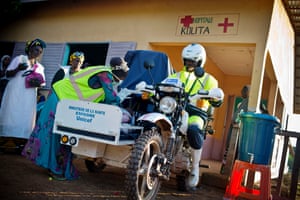
One scheme to help women involves what looks like a giant old-fashioned pram, which is attached as a sidecar to a motorbike. Spain has given 15 of them to health centres in Guinea.


Mamady Berete doubles up as Doko health centre’s broken bones specialist and the moto-ambulance driver. Dressed in high-vis from head to toe, he bumps up and down bush tracks and through enormous puddles, picking up pregnant women, strapping them in his sidecar and taking them to Doko.


The giant pram turns heads, but brings fresh problems, such as how to pay for petrol or maintenance.


“We have someone here who can fix it but, if a tyre breaks, we have to send to Conakry for a new one. It’s a bit difficult,” Berete says.


On his trips to the villages, Berete spreads the word about the health centre and encourages more people to use it.


Mamady Berete heads off to collect a pregnant woman from a remote outpost


Mamady Berete heads off to collect a pregnant woman from a remote outpost and bring her to the Doko health centre

Trust in Guinea’s health system was in short supply during Ebola, when clinics closed their doors, doctors and nurses died, and infected people seemed to disappear into hospitals never to return.


“People were afraid of our health centre – they said if you came here you’d catch Ebola. So people avoided coming,” says Berete. Because nobody came, salaries could not be paid, so the clinic had to shut, leading to even less trust in the service.


According to Yogo, the lack of working health systems meant the death toll from “collateral” diseases and health complications outpaced that of Ebola.


“More people died from malaria, diarrhoea and in childbirth than of Ebola,” he says. “The country did not have enough ambulances. They were all used for Ebola patients – nobody else.”


Now, people are trying to take advantage of the supplies and attention that Ebola brought, and keep people coming through the doors so staff can afford to keep those doors open.


Berete and his colleagues are succeeding: several health centres, including Doko, are recording pregnant women coming in greater numbers than before Ebola.


Somadouno, who left school aged nine and had her first child at 16, plans to repeat her gruelling 17km journey to give birth.


“I gave birth to my first child here and, because it went well, I’m coming back for this one,” she says. “My mother-in-law will come with me, but we’ll be on foot then too. My plan is to try to catch it early.”


Giving birth in Guinea: a life or death lottery bereft of midwives and medicine | Ruth Maclean

2 Haziran 2014 Pazartesi

Midwives can take top role in abortions

The move cames as Royal School of Nursing and abortion suppliers have lobbied for a change in the law to enable nurses full handle of abortion induced by medicines or some other strategies.


The Division of Overall health said the new tips produced no distinction to the law and simply clarified the current rules from the 1980s. A spokesman explained nurses and midwives can “administer abortion drugs” if medical professionals remain “in charge all through”.


Nonetheless Fiona Bruce, the Conservative MP, informed the Day-to-day Mail the new suggestions have been a “clear liberalisation of abortion law which people do not want.”


“Moreover, I do not feel that it is what Parliament intended.”


Labour MP Jim Dobbin, Labour MP and the co-chairman of the all-celebration Parliamentary Professional-life Group, stated the Department of health get “every opportunity to make daily life less complicated for the abortion industry”.


He extra: “The Abortion Act is crystal clear that a certified medical doctor is the only individual in a position to complete an abortion.”


Nonetheless Ann Furedi, chief executive of the greatest abortion supplier, BPAS said nurses had been the “best people” to perform early abortions.


She explained: “They should be carried out by certified folks, including nurses.”


A Division of Wellness spokesman said: “There has been no change in the role nurses and midwives perform in abortion because the 1980s. Recent suggestions only clarified current law.


“Nurses and midwives can administer abortion medicines but medical professionals have to approve abortions and continue to be in charge all through.”


Midwives can take top role in abortions

24 Nisan 2014 Perşembe

Midwives shortage? You bet, my hospital advised me there could not be a midwife on duty when I give birth

Huh? I left feeling puzzled and concerned.


At my subsequent appointment with a hospital medical doctor, I raised the situation of the non-anaesthetist – “are you really telling me there’s a possibility there will not be any person to administer an epidural?” – and waited for her reassuring response.


“Oh,” she mentioned. “The problem’s not with the anaesthetists. It will probably be the case that there will not be a midwife close to.”


HUH? Come yet again? No midwife?


“Yeah, specially if you give birth in the wee small hrs of the morning, or at the weekend, there may not be any midwives to assist you.”


Forgive me if I’m becoming stupid, but aren’t midwives the only men and women that can actually supply infants? If there are not any around, what am I supposed to do? I can hardly say to my unborn boy, ‘hang on in there, darling, can you just wait until Monday morning previous 10am so there are loads of employees about to help’.


Knowing my luck I will go into labour on a Sunday morning at 4am, right when the hospital is at its most understaffed.


Immediate ideas of lying in hospital corridors becoming unattended to, in agony, filled my thoughts. Significantly, I asked, am I going to be left alone in a hospital corridor till a midwife turns up?


“Properly, in situations the place there are not enough midwives, we generally wait right up until the female is 8cm dilated, then assign a midwife,” she said, all matter of fact.


The cervix only requirements to go to 10cm before dilation is total. So I’m waiting in a corridor, in discomfort, with out a midwife, and with out an epidural, for probably hours and hours – days, even – ahead of the really ultimate phases of birth, when someone finally comes along who’ve I have in no way met ahead of, and delivers the infant?


The doctor just smiled and shrugged this situation off. But she gave me no convincing cause to feel otherwise. My birth previously sounds like a nightmare and it truly is nonetheless two months away.


But it appears I am not the only one particular. Nowadays, hospital chiefs have been accused of “burying their heads in the sand” in excess of midwife shortages.


Figures recommend that a quarter of NHS Trusts had not assessed their workforce wants for at least four many years. Eighty per cent of the 99 trusts responding to a Freedom of Info request by BBC Radio 4′s Woman’s Hour even now had vacancies in funded midwife positions.


This is despite births in England increasing by a quarter in the previous decade.


How is it, in this day and age, in the 21st century, in the West, the midwives shortage is acceptable? It is not. It is appalling.


And how dare hospital physicians place the worry of God into me so early on into my pregnancy? Like I say, I’ve been pretty relaxed about most items so far. But this will take the biscuit.


Dr Dan Poulter, responding to the midwives shortage story right now, said the NHS is a “protected location to give birth, with ladies reporting large ranges of believe in and self-confidence in workers”.


Properly I misplaced all self-assurance in this certain hospital and its workers. It might be ‘normal’, even boring, to them that births are not constantly as you picture them – with personnel shortages an daily truth of existence. To them, I am just an additional statistic. But to me, this is my initial little one. I want to make sure I get basic, normal care.


Needless to say, I transferred hospitals and am now at University University London Hospital a teaching institution that already appears a million miles ahead of the one I came from.


When I raised the problem of no anaesthetists or midwives at UCLH, a physician merely laughed. “No, you don’t want to fret about that here.” Phew.


But how can a single hospital be so different in support to another that is only a handful of miles down the road? 1000′s of ladies threat receiving inadequate therapy due to the fact they never know there are other alternatives out there. So, girls, when the time comes – feel free to store close to.


And as for the Government? We need yet another 4,800 midwives in England, in accordance to the Royal University of Midwives. Which is not a huge quantity, in the grand scheme of items. And yet a lack of midwives is a recipe for significant disaster. The females of Britain deserve better.


Are you pregnant? What type of support have you had from your NHS hospital? Are you worried about the midwives shortage? Have you been advised to put together for underneath-staffed labour wards? Join the debate on Twitter @louisapeacock and @teleWonderWomen


Midwives shortage? You bet, my hospital advised me there could not be a midwife on duty when I give birth

23 Nisan 2014 Çarşamba

Hospital chiefs "ignoring midwives shortage rather than paying out to fill gaps"

The figures, compiled by BBC Radio 4’s Woman’s Hour, showed that 80 per cent nonetheless had vacancies in funded midwife positions. Even so, the rate was now at its lowest for three years.


Births in England have increased by a quarter in the previous decade, according to current statistics.


In the 99 trusts, there had been 561 vacancies at the flip of the 12 months, ranging from a 17.eight per cent vacancy price at West Hertfordshire Hospitals NHS Believe in to the entirely-staffed Hull and East Yorkshire Hospitals NHS Trust.


Cathy Warwick, the college chief executive, mentioned the figures on the delays in assessments have been “worrying”.


“Four in every single five NHS trusts say they have midwife vacancies, a scenario that we truly feel is obtaining worse, not better,” she explained. “This has to change.


“The stress on maternity units becomes worse when there is a combine of insufficient midwives to commence with. On top of this, midwifery vacancies are not getting filled.


“This is a recipe for disaster and can have a disastrous affect on staff morale, burnout and sickness prices, which only make a maternity services even much more short staffed.


“We hear from some heads of midwifery that trusts are not conducting suitable assessments of staffing specifications simply because they know they will not be in a position to afford to put into action the findings.


“So they bury their heads in the sand and stick with their out-of-date assessments that no longer bear relation to their requirements and the requirements of mothers and babies.


“Our evaluation is that we want close to four,800 a lot more midwives in England. The Government is escalating the amount of midwives, and that is welcome, but more wants to be carried out.”


Dr Dan Poulter, the health minister, explained: “The NHS is a secure spot to give birth, with ladies reporting high ranges of believe in and self confidence in staff.”


Hospital chiefs "ignoring midwives shortage rather than paying out to fill gaps"

Four out of five hospitals quick on midwives, NHS figures reveal

Maternity Wards Not Coping With Demand

Nationwide Audit Office said in November that NHS necessary 2,300 a lot more midwives, though the Royal School of Midwives puts the figure at four,800. Photograph: Christopher Furlong/Getty Photographs


4 out of five hospitals have also number of midwives, despite the ongoing child boom, official NHS figures reveal.


Midwife shortages are so acute in some elements of England that hospitals have practically one in five posts in their maternity units unfilled, in accordance to responses to freedom of details requests.


In January, West Hertfordshire Hospitals NHS Trust had a vacancy fee of 17.eight%, the highest in England, which means it is 32 midwives under the 208 it wants, according to investigation carried out by BBC Radio 4′s Woman’s Hour.


10 other hospital trusts, which includes 6 in London, where significantly of the maternity care offered has been judged inadequate in surveys and reviews, also had consistently high vacancy rates amongst 2011 and the commence of this yr.


The 99 trusts which responded to Woman’s Hour’s inquiries employed 14,550 midwives in January, even though in between them have been 561 midwives quick. Even though that was the lowest it had been considering that 2011, the true vacancy price is very likely to be increased as about 60 other trusts with maternity units did not react.


The National Audit Office said in November that the NHS required 2,300 much more midwives, even though the Royal College of Midwives (RCM) puts the figure at 4,800.


Cathy Warwick, the RCM’s chief executive, said the truth that midwifery vacancies are not being filled “is a recipe for disaster and can only have a disastrous impact on personnel morale, burnout and sickness rates, which only make maternity services even more quick-staffed.”


Some hospitals “bury their heads in the sand” by not reviewing their maternity staffing requirements for as extended as 10 many years as they know they can’t afford to retain the services of additional midwives, Warwick claimed.


Dr Dan Poulter, the overall health minister, mentioned the government was determined to guarantee that the maternity workforce was big enough to cope with growing demand, and that a record total of six,000 midwives are being trained.


“The NHS is a safe area to give birth, with girls reporting higher levels of trust and confidence in staff,” Poulter mentioned.


Four out of five hospitals quick on midwives, NHS figures reveal

5 Ocak 2014 Pazar

Older mothers placing much more strain on midwives

Midwife

The quantity of complete-time-equivalent midwives in the NHS in England rose by 6.5% between May possibly 2010 and July 2013. Photograph: David Jones/PA


Older, far more obese mothers are putting an enhanced strain on midwives who feel they are previously conducting close to 130,000 deliveries a 12 months for which they do not have sufficient sources, the Royal School of Midwives has explained.


Births in England peaked at almost 700,000 in 2012, the highest level given that 1971, and despite the fact that a fall in the initial half of 2013 suggests a decade-extended child boom may possibly be above, a increasing amount of females are offering birth in their 40s, demanding larger levels of care.


The variety of this kind of women rose 85% in England in between 2001 and 2012, equivalent to an further 13,000 middle-aged mums, while Scotland saw a 165% rise in mothers aged much more than 44 over the identical time period.


The only age bracket for which birth rates are falling is the underneath-20s, down by more than twenty% in England, Scotland and Wales in excess of the last 11 years. In 2012, 30,000 infants – 4.one% of all dwell births – were born to mothers aged over forty, the Office for Nationwide Statistics has calculated.


The places with the most older mothers are East Renfrewshire, south-west of Glasgow, Windsor and Maidenhead and Wokingham in Berkshire, Brighton and Hove on the south coast, and the affluent commuter county of Surrey in which thirty% or a lot more of all births in 2012 were to girls aged 35 or older, the RCM said. In Luton the share of births to ladies aged 35 or above jumped from 16% in 2011 to 20% in 2012.


“Older females demand more help from midwives,” stated Louise Silverton, the RCM’s director for midwifery. “They have a ideal appropriate to all that further care, of course, but it has an undeniable knock-on result on workload, and that requirements to be reflected in the variety of midwives in the NHS total.”


The variety of females displaying maternal obesity was also up, the midwives stated. Instances of initial-trimester obesity doubled from 7.6% to 15.6% between 1989 and 2007. It implies shut to 50,000 ladies have necessary a lot more demanding care in the course of their pregnancies, the RCM mentioned in its annual State of Maternity Solutions report (pdf).


The RCM, a trade union and specialist organisation, remains concerned that there remain “enormous shortages” of midwives in England, with four,800 more necessary to meet demand. And it is not just mothers who are acquiring older, midwives are also, foremost to fears of a retirement crunch that could exacerbate the shortage. The greatest single age group amid midwives is now 45-49.


Even so, the numbers getting into the profession are bettering. In between May possibly 2010, when the coalition government was formed, and July 2013 the variety of full-time-equivalent midwives functioning in the NHS in England rose by one,311, or six.5%, that means the variety of midwives is increasing quicker than the number of births.


Student midwife numbers have topped 6,000. If the trend continues the shortfall ought to be eradicated, but some areas are struggling. The quantity of midwives in the north-west of England fell by 117 in between 2001 and 2012, although the number of babies born in the area jumping by 14,010 above the exact same period.


“England does not have to be the UK’s difficulty little one for maternity care,” mentioned Silverton. “Nevertheless it stays close to four,800 midwives short of the quantity necessary to provide mothers and infants with the high-high quality support they need to have and deserve. Midwives in England have been run ragged for years as the amount of babies born has gone up and up and up. 1000′s of midwives short, as we are nowadays, they are nevertheless running to catch up.”


Older mothers placing much more strain on midwives