numbers etiketine sahip kayıtlar gösteriliyor. Tüm kayıtları göster

12 Nisan 2017 Çarşamba

Time for a rethink on GP numbers | Zara Aziz

General practice is in a state of crisis. Despite the promises and the optimism of proposed plans to reform primary care over the next five years, the reality on the ground offers little comfort.


The GP Forward View (GPFV) published 12 months ago promised us 5,000 more GPs by 2020. So one year on, where do things stand? Yes, there was a rise in GP trainee recruitment in 2016 (167 more trainees than in 2015), but overall, GP numbers are falling. According to the latest NHS England figures, 92 practices closed in 2016, up 114% on GP surgery closures in 2014. While 34 merged with other practices, the remainder shut completely. And the number of GPs fell by more than 400 between October and December 2016 alone.


While the lure of jobs abroad, early retirement and locum jobs explain some of these figures, there is a growing crisis in retention. In the south–west, a survey of more than 2,000 GPs, published today, has found that around two in five GPs intend to quit within the next five years. More than half report low morale.


Poor retention is also both a cause and effect of staff shortages and escalating workload (with 12- to 14-hour days). A recent British Medical Association poll showed that 84% of GPs find their workload unmanageable. Reduced take-home pay, particularly for partners as practice costs increase, is also a factor, as is red tape. There is more paperwork than ever before, as work is shifting from secondary to primary care. Resources are stretched and rationing more widespread. I see a greater influx of patients, a faster turnaround from earlier hospital discharges, more limited access to outpatient referrals and longer waits for elective surgery. A significant amount of work also goes into preparing for Care Quality Commission visits, with the bulk of the responsibility on the shoulders of practice managers and partners. And where the government has given primary care more funding on the one hand, it has taken away with the other by cutting investment in other areas or linking it to extending access or seven-day services.


The effect on patients of this shortage of GPs is stark. The scale of practice closures meant that 265,000 patients had to register with a new surgery last year and now often face travelling further to see a doctor. Yet the government is still keen to develop super-practices of 30-50,000 patients, despite GPs and patients not being in favour of these models that reduce continuity of care and autonomy. It feels like we are being pushed towards privatisation and a salaried GP model, stripped of the sense of ownership for our practices and responsibility that we feel for our staff, premises and patients.


As one of the antidotes to the retention crisis, the practitioner health programme (PHP), commissioned by the government for GPs, was rolled out earlier this year and in only four weeks it saw the number of GPs it was commissioned to see for the whole year. The PHP has cited stress, burnout and post-traumatic stress disorder as some of the commonest problems faced by GPs, often from “practice meltdown”.


One year on from the GPFV we have seen little change when it comes to improving the working lives of GPs, who may be independent contractors but nevertheless work for the NHS and provide a crucial and cost-effective service.


Retention schemes to keep over-55s in work by allowing them to work more flexibly, or giving “golden hellos” to trainees to work in under-doctored areas are all a drop in the ocean. The PHP is certainly welcome and well overdue. But it would also make sense to increase core funding of general practice to reflect the explosion in workload. This will improve retention and recruitment. As things stand, it seems a herculean task for the government to rescue something it has little understanding of or empathy with.​ It may be time to go back to the drawing board.


Time for a rethink on GP numbers | Zara Aziz

19 Mart 2017 Pazar

Record numbers of EU nurses quit NHS

The number of EU nationals registering as nurses in England has dropped by 92% since the Brexit referendum in June, and a record number are quitting the NHS, it can be revealed.


The shock figures have prompted warnings that Theresa May’s failure to offer assurances to foreigners living in the UK is exacerbating a staffing crisis in the health service.


Only 96 nurses joined the NHS from other European nations in December 2016 – a drop from 1,304 in July, the month after the referendum.


At the same time, freedom of information responses compiled by the Liberal Democrats from 80 of the 136 NHS acute trusts in England show that 2,700 EU nurses left the health service in 2016, compared to 1,600 EU nurses in 2014 – a 68% increase.


The haemorrhaging of foreign staff is being blamed by the Royal College of Nursing (RCN) on the failure of the government to provide EU nationals in the UK with any security about their future. May has claimed that Britain cannot act unilaterally to guarantee residency as it would weaken her hand in the coming article 50 negotiations over Brexit.


Janet Davies, chief executive and general secretary of the RCN, said the government’s tactic was backfiring, and now threatened the sustainability of the health service.


“The government risks turning off the supply of qualified nurses from around the world at the very moment the health service is in a staffing crisis like never before,” she said. “As she pulls the trigger to begin negotiations, the prime minister must tell EU nurses and those in other occupations that they are needed and welcome in the NHS. Sadly, it is no surprise that EU staff are leaving – they have been offered no security or reassurance that they will be able to keep their jobs. Few are able to live with such uncertainty.


“The government has failed to train enough British nurses and cannot afford to lose the international workforce on which the NHS so heavily relies.”


There are an estimated 57,000 EU nationals working for the NHS, including 10,000 doctors and 20,000 nurses. On Saturday the Liberal Democrats passed a motion at their spring conference in York calling for a guaranteed right to live and work in the UK for all EU citizens working in the NHS and care services.


The former Lib Dem health minister Norman Lamb said that the government’s attitude to EU nationals in the UK was “deeply damaging”, and that the creation of a so-called “NHS passport” could be a vital step. “These shocking figures show you can’t have a strong NHS and a hard Brexit,” he said. “The government’s refusal to guarantee that nurses from the EU can stay here is not only morally unjustifiable, it is deeply damaging for the NHS.


“Theresa May must urgently give EU nationals the certainty they need before we see an even bigger exodus of nurses on whom our health service relies.”


Joan Pons Laplana, a Spanish national and a senior nurse at the James Paget Hospital in Great Yarmouth, who came to the UK 17 years ago, told the Observer that he had personally witnessed the collapse in morale of foreign nurses.


“Since Brexit, I feel like a second-class citizen,” he said. “My son asked me if I was going to be forced back to Spain and my daughter doesn’t want to visit her grandparents because she fears I will not be able to come back.


“The UK is no longer the first choice for EU nurses. The uncertain future means many they are starting to leave. We are people with feelings, not a commodity at the Brexit table.”


The NHS is already under pressure because of a long-term failure to hire enough people. Applications for nursing courses plummeted by almost a quarter in a year after the government axed bursaries for trainees in 2016. Numbers fell by 9,990 to 33,810 in 12 months, according to figures released in February by the university admissions service Ucas. Meanwhile, one in three nurses is due to retire in the next 10 years and there are 24,000 nurse jobs unfilled, RCN figures show.


The Department of Health said: “While the stock of nurses is broadly stable, some of the changes described are owing to the introduction of more rigorous language testing. The secretary of state has repeatedly said that overseas workers form a crucial part of our NHS and that we value their contribution immensely.


“We continue to invest in the frontline, with 13,400 more nurses on our wards since May 2010 and over 52,000 nurses in training.”


MPs vote to reject Lords amendments to Brexit bill

Record numbers of EU nurses quit NHS

7 Mart 2017 Salı

Smoking numbers hit new low as Britons turn to vaping to help quit cigarettes

The number of smokers in Britain has reached its lowest point since records began in 1974, according to new data, while more than a million people say they are using e-cigarettes to help them quit smoking.


The latest data from the Office for National Statistics shows that 17.2% of adults in the UK smoked in 2015, down from 20.1% in 2010.


Smoking levels are highest in Scotland, at 19.1%, followed by Northern Ireland, where it is 19%, Wales on 18.1% and England on 16.9%. The numbers have been dropping fastest in recent years in Scotland and Wales. Among local authorities, Blackpool is the only one to feature consistently in the 10 heaviest smoking areas between 2012 and 2015. In 2015, 25.3% of adults in Blackpool smoked.


Smoking by country

The data also shows that 2.3 million people were e-cigarette users in England, Scotland and Wales in 2015, about 4% of the population. Their survey also shows that 4 million more people describe themselves as former e-cigarette users. A further 2.6 million say they have tried them but not gone on to use them regularly.


Half of the 2.3 million who were current users of e-cigarettes at the time of the survey said they were doing it to quit smoking. A further 22% said they were vaping because it was less harmful than smoking. Only 10% said they chose to vape because it was cheaper than buying cigarettes. Others – 9% – said they used e-cigarettes mainly because they were permitted indoors.


The figures will bolster the arguments of those who believe e-cigarettes have a major role to play in ending the tobacco epidemic. The issue has been hugely controversial among public health doctors and campaigners, some of whom consider e-cigarettes to be a stalking horse for the tobacco industry which hopes to make smoking acceptable again and has invested in vaping.


e-cigarette users

The World Health Organisation has expressed concern over e-cigarettes, but Public Health England has said vaping may be 95% safer than smoking tobacco.


Half of current smokers say they have tried e-cigarettes, and 14.4% of current smokers also vape.


Some of the statistics suggest that it is often the heavier smokers who turn to e-cigarettes. Those who also vape smoke marginally more cigarettes per day on average than those who do not – 11.8 versus 11.3. Smokers who have given up on e-cigarettes smoke 12.2 per day versus 10.6 among those who have never used an e-cigarette. Smokers who have children at home are also more inclined to use e-cigarettes.


The ONS vaping data is from the opinions and lifestyle survey 2014-15 and relate just to Great Britain. The ONS figures on general smoking trends include northern Ireland.


smoking graphic

Men are more likely to smoke – 19.3% do, compared with 15.3% of women. Smoking is most common in the 25-34 age group, where 23% smoked in 2015. It is least common in the over-65s, among whom 8.8% smoke. But the biggest decline since 2010 has been among the 18-24 year-olds, where it has dropped five percentage points to 20.7% in five years.


Figures for Great Britain also show that smokers have been cutting back on the numbers of cigarettes they consume. Average consumption is down to 11.3 cigarettes per day, the lowest number since 1974.


Deborah Arnott, chief executive of ASH said: “The decline in smoking is very encouraging and shows that strong tobacco control measures are working. However, the government can’t leave it to individual smokers to try to quit on their own. If the downward trend is to continue we urgently need a new tobacco control plan for England, and proper funding for public health and for mass media campaigns. That’s essential if the prime minister is to live up to her promise to tackle health and social inequality.”


Smoking numbers hit new low as Britons turn to vaping to help quit cigarettes

6 Ocak 2017 Cuma

NHS on brink of winter crisis after increase in patient numbers

The NHS is on the brink of winter crisis after a larger than expected increase in patient numbers caused a third of hospital trusts in England to warn they needed urgent action to cope last month.


The BBC commissioned the Nuffield Trust health thinktank to look at four weeks of hospital data in the run-up to Christmas and found that 50 of the 152 English trusts were at the highest or second highest level of pressure.


During the time period seven trusts had to declaring the highest level of emergency 15 times, meaning they were unable to give patients comprehensive care.


Nigel Edwards, chief executive of the Nuffield Trust, said the situation could deteriorate further in the next two weeks when the NHS was usually most stretched.


“The real crunch point generally comes in week two or three after the Christmas break … there are early signs that there is a problem,” he told BBC Radio 4’s Today programme.


NHS England insisted hospitals were coping, but Edwards said “there are reasons to be really quite concerned”.


He pointed out that hospitals were having to cope with a 4% increase in A&E attendance, which is more than expected from population growth. At the same time problems in social care was making it “really tricky” for hospitals to free up beds, he said.


“If you can’t get patients out of the back of the hospital, home, then obviously, the whole system begins to seize up,” he told Today.


“Anecdotally, what you are hearing from chief executives of trusts is that they are experiencing very, very high levels of pressure in their A&E departments.”


The Nuffield Trust found that some of worst problems were in Berkshire, the West Country, and parts of the east Midlands. But Edwards pointed out: “This pattern of increase demand is spread right across the country.”


Dr Taj Hassan, president of the Royal College of Emergency Medicine, warned that hospital emergency departments “are in an absolute acute state of distress”. “This is on the background of chronic underfunding, understaffing, both in health and social care and failures in the wider urgent emergency care system.”


Hassan said the issue was the “number one item on the agenda” in a meeting the college had on Thursday with the NHS chief executive, Simon Stevens. “Our four hour performance in A&E departments is the worst in 15 years. We entered this winter in the worst state of affairs possible and we predicted that this situation would arise,” he told Today.


Hassan called for emergency funding to resolve problems in social care to help free up hospital beds.


He said: “There is an absolute and urgent need to address the patients who are fit to be discharged from hospital, which in some systems is running between 10% or 20%.


“We need to move those patients back into the community so that we can create flow in our hospitals and our significantly overcrowded emergency departments which are struggling badly.”


In a statement NHS England said: “The NHS’s tried and tested plan is currently managing the ongoing pressures of winter. The public can play their part avoiding going to A&E and using their local pharmacy and NHS 111.”


NHS on brink of winter crisis after increase in patient numbers

13 Ekim 2016 Perşembe

Tuberculosis kills three people a minute, as case numbers rise

Tuberculosis is killing more people than thought, yet governments are not doing enough to bring the debilitating infectious disease under control, the World Health Organisation has said.


The latest WHO figures show TB has been taking a much greater toll in India than previously believed and that the number of cases worldwide last year was 10.4m , up from the 9.6m estimated before more detailed investigations were done.


The disease claims the lives of 1.8 million people worldwide each year, not the 1.5 million it was previously thought.


Drug-resistant TB, which is more difficult and very expensive to treat with combinations of the latest antibiotics, has also risen, to more than half a million cases globally.


Dr Margaret Chan, director general of the WHO, warned that much more needed to be done if the world was to have any hope of stopping the disease in its tracks.


“We face an uphill battle to reach the global targets for tuberculosis,” she said. “There must be a massive scale-up of efforts, or countries will continue to run behind this deadly epidemic and these ambitious goals will be missed.”


The UN has set a target of cutting TB deaths by 90% and cases of the disease by 80% between 2015 and 2030.


Unlike Aids and malaria, most TB cases are not in the poorest countries so there is less funding available from the rich nations, which donate through conduits like the Global Fund to fight Aids, Tuberculosis and Malaria only to the poorest – even though they face the threat of the disease which spreads in water droplets and cannot be confined to specific countries in an age of global travel.


The US does not have special funding for TB programmes as it does for HIV, whilethe EU puts in little by comparison with contributions for HIV and malaria.


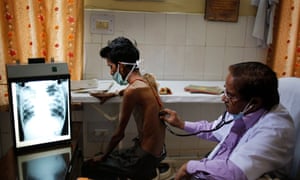
A doctor examines a tuberculosis patient in a government TB hospital in Allahabad, India.


A doctor examines a tuberculosis patient in a government TB hospital in Allahabad, India. Photograph: Rajesh Kumar Singh/AP

India has about a quarter of all the cases in the world, followed by Indonesia and then China, which have about 10% each. Nigeria and Pakistan each account for 5% of cases and South Africa has a little less.


“These [six] countries have 60% of the burden. TB is not like malaria, which is 90% in Africa, or HIV,” said Dr Mario Raviglione, director of WHO’s global TB programme. “It is a disease of the Brics [Brazil, Russia, India, China and South Africa] and middle-income countries. We are talking of a disease that eventually is financed largely by domestic funding.”


But health ministers cannot argue the case for funds for TB with governments that feel they have other priorities. WHO is hoping that a meeting of the UN general assembly will be held to focus heads of state on what must be done to end the threat of TB.


“We are saying there is dismal progress on commitment,” said Raviglione. “TB is not something that will just come down if you have development. It is a dangerous game. It is not going to go away slowly. It will take generations.”


The true scale of TB in India has remained hidden because no national survey has been carried out. The government has now agreed to conduct one but the results will not be known until at least 2019. But a survey in Gujarat, one of the richest Indian states, established a far higher prevalence of TB than had been thought and together with other evidence, it has been possible to come up with a better estimate than in previous years.


Work has been going on to encourage doctors in the private sector to report TB cases, which they are not obliged to do and have not done in the past. In the slums of Mumbai, Ayurvedic doctors and healers who see most of the patients have been encouraged to give out the free antibiotics to treat TB alongside traditional remedies, and to report the numbers of patients they see. A digital reporting system has been introduced with some success.


India wins praise from WHO but its actions have served to highlight the scale of the problem. Of the 10.4m cases worldwide, only 6.1m were detected and treated in 2015. Those undetected risk passing the bacteria that causes TB to their families. Countries do not have the rapid testing equipment they need.


There is particular concern over drug-resistant TB, which affects 580,000 people. Only half of those who get a strain resistant to the standard antibiotic combination of drugs survive. Only one in five of those with resistant TB get the newer combination of antibiotics that can cure it.


“We absolutely must solve the crisis of drug resistance – both treating it and preventing it by implementing basic TB programmes effectively,” said José Luis Castro, executive director of the International Union Against Tuberculosis and Lung Disease.


“There’s an effective new regimen available for treating multidrug-resistant TB and that needs to get to patients as quickly as possible. If we are to end the TB epidemic by 2035, we need to triple our rate of progress in a short period of time and that means tackling MDR-TB head on.”


Tuberculosis kills three people a minute, as case numbers rise

28 Eylül 2016 Çarşamba

Care home residents deprived of liberty in record numbers

Record numbers of care home residents are being deprived of their liberty by being put in straps, locked in or given behaviour-controlling drugs, fuelling fears that some are being mistreated.


Campaigners have voiced concern that some residents, including dementia patients, are being wrongly denied their freedom and treated as “second-class citizens” – for example, by being locked in their rooms.


In 2015-16, care homes in England asked local councils to approve 195,840 applications to deprive a resident of their liberty – most of them older people – under the deprivation of liberty safeguards (DoLS) legal framework. The figure was the highest since the system began in 2009 and a big jump on the 137,540 applications in the previous year.


Hospitals occasionally seek permission to keep a patient locked up, but care homes make by far the most DoLS applications and have been entering requests much more regularly since a supreme court ruling in March 2014. That judgment, which clarified the form of an “acid test” for what constitutes a deprivation of liberty, sparked an immediate and sustained increase in the number of applications.


DoLS requests are usually made to avoid someone harming themselves. Councils have to assess if applications have fulfilled six criteria and respond within 21 days, or within seven days if it is an urgent case. The system is meant to ensure independent assessment of decisions to deny the liberty of people deemed to lack the mental capacity to consent to the care they receive.


Of last year’s 195,840 applications, councils processed 105,055. They approved 76,530 (73%) of those and rejected the rest as inappropriate – a big rise on the 10,520 rejected in the previous year. However, applications are usually considered only after someone has been denied their freedom, which means that last year about 28,500 people were restrained, locked in or given medication before the move was deemed inappropriate.


Martina Kane, senior policy officer at the Alzheimer’s Society, said: “The safeguards granted by deprivation of liberty safeguards are an essential part of protecting the right to liberty of people with dementia. It is disgraceful that nearly 30,000 people were wrongfully deprived of their liberty, and in over a quarter of cases practitioners are still locking people in, sedating them, restraining them or otherwise treating them as second-class citizens.


“Depriving someone of their liberty should always be a last resort and only ever done in someone’s best interests. It is crucial that the quality of care provided to people with dementia is improved to ensure that.”


Understaffing in care homes could lead to every door in an entire premises being locked overnight, Kane added.


The latest annual DoLS figures collated by NHS Digital show that applications are more likely to be made for older age groups; 44% are for people aged 85 or over. Many of these older people suffer from dementia.


The Local Government Association, which represents councils, said the figures were of great concern. “These alarming figures are further evidence of the significant added pressure facing local government as a result of increased DoLS assessments, which is estimated to be costing councils more than £170m a year,” a spokeswoman said.


“The government needs to fulfil its promise to overhaul the system as a matter of urgency and provide adequate funding so that councils have the time and money to do this properly.”


Care home residents deprived of liberty in record numbers

4 Eylül 2016 Pazar

Bargain hunting and how the brain understands numbers

If you are among the lucky ones returning from a summer holiday this week, you might have brought back some souvenirs from markets where you bargained hard to get a good deal – or so you thought.


Even if you think you’ve got a brilliant price, the brain can easily be influenced to pay more – even by as little as a random number. In a study based on work by the psychologist Daniel Kahneman, a scientist went for a walk with a bottle of champagne in one hand and a bag full of ping-pong balls in the other. He told passers by that the balls had random numbers on, and asked them to pick one, which said 10 on it. When he asked the most they’d pay for the champagne, they said around £25. In fact, while the subjects believed the balls were random, they weren’t: every ball had 10 on. When the experiment was repeated with balls saying 65, the maximum amounts raised to around £45.


This is called anchoring, and occurs because the brain works with relative amounts rather than absolutes. It’s why the start of bargaining is so important, and why even keen bargain-hunters can be persuaded to pay above the odds.


Dr Daniel Glaser is director of Science Gallery at King’s College London


Bargain hunting and how the brain understands numbers

20 Temmuz 2014 Pazar

Are you one particular of the increasing numbers of the "worried well"?

Are You Addicted to Your Physician?, a Channel 4 Dispatches documentary, due to be aired up coming week, features 1 female who has called 999 for an emergency ambulance 20 times in the past yr to deal with nervousness attacks, and others for whom a GP or A&ampE appointment is a month-to-month or even weekly occasion.


Dr Laurence Buckman, a former chairman of the British Medical Association’s GPs committee, who practices in London, says: “There has been an extraordinary rise in the anxious well. I do not mind individuals who do their very own investigation and are making an attempt to inform themselves, but it is intriguing that most individuals wouldn’t dream of going to their accountant or attorney and telling them how to do their task, and but they come to feel fine about doing it to their doctor.


“My heart does sink when an individual comes in with a sheaf of papers with the Google emblem at the best, definitely convinced they know what is incorrect with them just before you have even talked about their symptoms. And typically there is absolutely nothing incorrect with them at all.”


And it would seem that nowhere are the concerned effectively far more prevalent – and more puzzled – than when it comes to foods.


The marketplace for meals items marketed as “free from” gluten, sugar, lactose and other ingredients has much more than doubled in the last five many years, according to research launched final week. A lot more than half of shoppers now get “free from” products, according to industry experts Kantar Worldpanel, generating the sector really worth £355 million and one of the quickest-increasing sectors in the foods world.


Significantly of this enormous development centres on gluten-totally free meals – Marks &amp Spencer says product sales of its products have risen by 100 per cent in the previous 12 months alone. M&ampS is expanding its gluten-totally free selection to much more than 150 merchandise, even though the other large supermarkets are giving ever much more shelf area to “free from” brand names. Nevertheless only one per cent of the population is believed to have coeliac ailment, an autoimmune condition triggered by gluten that signifies sufferers need to stay away from the ingredient entirely. And there is scant evidence that the illness is becoming much more widespread.


So why do so several people think gluten is to be prevented at all charges? Gluten is a protein identified in wheat, rye, barley and oats. Its elasticity is an vital component in bread, pasta and cakes. Gluten-cost-free products have to use other components, such as rice and tapioca flour to create the very same impact, which means larger charges for producers – which are, inevitably, passed on to customers.


The gluten-totally free trend, led by celebrities this kind of as Gwyneth Paltrow, Victoria Beckham and Stella McCartney, has fuelled the market place. Tennis champion Novak Djokovic says he believes his form improved massively after adopting a gluten-cost-free diet.


Tesco buyer Lauren Tredgett says demand is soaring because customers are getting to be “more mindful of their intolerance to wheat and gluten intolerance” – but medical specialists are a lot more sceptical.


“Anyone who hasn’t acquired a double First from Oxford and is not managing director of their very own multi-million pound organization by the age of thirty desires to blame it on a meals intolerance,” says Dr Buckman. “I get men and women coming in, saying they’ve self-diagnosed with a dairy or wheat allergy. When you look at their diet plan, they’re consuming ten Mars bars a day but they do not want to speak about that – they want to label themselves with an allergy and these merchandise are helping them to indulge that.”


Doctors are also concerned that unregulated and underqualified nutritionists are supplying testing and diagnosis for meals allergic reactions and intolerances with no any scientific basis. Australian research has discovered that most men and women who say they are avoiding wheat simply because of their “intolerance” to it are doing so on the basis of self-diagnosis.


Another controversial region is a new term referred to as NCGS – Non Coeliac Gluten Sensitivity – a issue a lot of sufferers are now obtaining on Google. But authorities are divided above how prevalent the disorder is – or even whether or not it exists at all.


NCGS, very first reported in 2011, was the initial indication that non-coeliacs could suffer from the same symptoms. But in a research at Monash University in Australia last yr, sufferers claiming to have NCGS followed diet programs that contained various levels of gluten. In the double-blind research, the individuals did not know which diet program they have been on. Even the people on the entirely “free” diet claimed they could feel gluten sensitivity, foremost some medical doctors to conclude that the problem was “all in the mind”.


And it’s not just gluten. Melanie Leech, chief executive of the Foods and Drink Federation, has warned that some lobby groups are making excessive claims towards certain substances, such as sugar, with no the science to back them up, and are puzzling consumers in the procedure.


Margarine versus butter, the rewards of red wine, whether or not we should be eating meat – the tips looks to modify on a every day basis. Last month, Time magazine’s cover story was The Reality About Excess fat, which cited investigation exhibiting that the removal of fats from our diets has led to a rise in carbohydrates, fuelling the boost in weight problems.


“There are amazingly mixed messages about foods and meals promotion,” says Dr Sue Bailey, senior lecturer in human nutrition at London Metropolitan University. “People might feel they are adopting a healthier diet plan by cutting out items like gluten, but that is not necessarily the situation.”


She factors to study published in the Journal of the Academy of Nutrition and Dietetics that identified that some gluten-cost-free merchandise had a lot more calories than traditional items, and that gluten-free of charge diet plans can lead to fibre deficiency.


Frank Furedi, emeritus professor of sociology at the University of Kent, believes the contemporary obsession with “well-being” has distorted our concepts about foods and wellness. “Well-becoming has as its assumption that getting ‘not well’ is a default place,” he says. “In the previous, becoming healthier was the norm.


“Historically we have fetishised food. Seem at religions and meals guidelines – gluttony becoming one of the 7 Deadly Sins. For a whilst, we seemed to move away from that, but in the previous 20 many years, we’ve gone back to it. We see certain foods as ‘evil’ you go to a dinner get together in London and folks will say that McDonald’s burgers are evil individuals who acquire organic see themselves as morally superior.”


For some men and women, worrying about becoming effectively can actually lead to health problems. Health anxiety – the new phrase for hypochondria – is also on the increase. The charity Nervousness Uk estimates that a third of calls to its helpline are from men and women obsessed with their personal overall health.


Dr Paul McClaren, a psychiatrist and health-related director of the Priory Hospital Hayes Grove, says individuals can benefit from cognitive behavioural therapy to aid their overall health nervousness, but says GPs want to spot the problem rather than indulge the demands of a person they may see as “worried well”.


“Doctors could believe that sending a person for exams will reassure them they are not sick, but the patient can really get hooked on needing that reassurance,” he says.


And, ironically, research has advised that men and women who complain about their overall health are much more very likely to die earlier – even when they are in the identical medical issue as non-worriers.


Just an additional point for the anxious well to fret about.


Are you one particular of the increasing numbers of the "worried well"?

13 Temmuz 2014 Pazar

Even With Cancelled Policies, Uninsured Numbers Falling Quickly

Evidence is mounting that the Cost-effective Care Act is operating to significantly reduce the quantity of uninsured Americans, despite inquiries about regardless of whether Americans had been buying policies just to exchange individuals that had been cancelled.


On leading of yet another U.S. government report Friday exhibiting far more Americans receiving coverage, especially from the Medicaid health insurance program for the bad, the latest from the Urban Institute’s Overall health Reform Monitoring Survey was clear: the “number of uninsured adults continues to fall underneath the ACA.”


However numbers vary, the Urban Institute says the variety of uninsured is down 8 million as of June.  “Though estimates of the dimension of the net acquire in coverage vary across surveys, there is constant evidence of ongoing gains in insurance coverage coverage beneath the ACA,” authors of a new Urban Institute report, linked right here, demonstrate.


The Urban Institute report, along with other folks that have been launched in recent weeks seem to undermine the argument from opponents of the law who wonder no matter whether Americans have been merely changing cancelled policies with those they were offered under the hwalth law. Numerous million Americans had their policies cancelled due to a portion of the law that calls for personal policies to have specific vital overall health rewards. (See associated gallery, also linked here)


The Urban Institute mentioned its survey didn’t account for potential other impacts that might reduced the uninsured rate such as how many young adults may well be taking benefit of a single of the law’s earliest positions enabling dependents to keep on their mothers and fathers health strategy till they are 26 years old.


But the law is doing work for youthful grownups and kids, according to a report launched Friday from Cindy Mann, deputy administrator of the Centers for Medicare &amp Medicaid Companies and Director of the Centers for Medicaid and CHIP Services.


Her report explained six.7 million more folks – an eleven.4 percent increase –  were enrolled in Medicaid applications for the poor or the Children’s Well being Insurance System as of Might 31 in contrast to “the baseline period from July though September 2013.”


The overall health law offers a money infusion of more than $ 900 billion in federal bucks from 2014 to 2022 to increase Medicaid applications for states that agreed to take advantage of the proposition.


This Medicaid funding under the Cost-effective Care Act is in contrast to past efforts to expand Medicaid in that the federal government will choose up the complete tab for the very first three many years. The state gradually has to pick up some charges in 2017 but by 2020 the federal government is even now selecting up 90 % or far more of the Medicaid tab.


It is a much greater funding proposition than the present Medicaid program that basically shares the expense among the states and the federal government. The federal government historically picks up a small much more than half of the value of Medicaid.


States usually led by Republicans that opposed this expansion haven’t seen almost the growth in Medicaid enrollment as 26 states which includes the District of Columbia that adopted and implemented the Medicaid expansion. “Enrollment in people states rose by 17 percent even though states that have not expanded reported only a 3 % enhance,” Mann wrote in her report.


When it comes to Medicaid, enrollment is expected to proceed to grow because it doesn’t have an open enrollment time period like the private coverage supplied on government run marketplaces acknowledged as exchanges. The next open enrollment period for private coverage is later this fall when a number of insurers, this kind of as Aetna (AET), UnitedHealth Group (UNH) and an array of Blue Cross and Blue Shield ideas are providing coverage in even much more markets than they did this previous open enrollment period.


In the meantime, Americans can still apply for Medicaid coverage.


“Consumers may still apply for Medicaid and CHIP coverage 12 months round and, as soon as enrolled, can use this coverage right away,” Mann explained.


Pondering how Obamacare will impact your overall health care? The Forbes eBook Inside Obamacare: The Correct For America’s Ailing Well being Care Technique answers that query and a lot more. Obtainable now at Amazon and Apple. 


Even With Cancelled Policies, Uninsured Numbers Falling Quickly

2 Temmuz 2014 Çarşamba

PMQs sketch: Dave and Ed play the numbers game


What the voter was supposed to make of it, I really do not know. The NHS is this kind of a vast and complex institution that to say it has declined or enhanced, based mostly on a handful of carefully selected statistics, is absurd. The only affordable conclusion, at least from viewing this exchange, would be that the NHS was better and worse underneath Labour, and is worse and greater under the Coalition.


“Mr Speaker! Official figures from the Met Office demonstrate that on Saturday it rained. Nevertheless on the identical Saturday in June 2006, below the last Government, it was sunny. Can the Prime Minister describe why Saturdays in June have become wetter on his view?”


“Mr Speaker, the proper honourable gentleman talks about the climate final Saturday simply because he does not want to talk about the climate final Thursday. The fact is that last Thursday was two degrees Celsius hotter than the identical Thursday in 2009 – when he was Vitality Secretary!”


“Mr Speaker, once again he can’t even answer a easy query. Allow me try out him on rainbows. Research by the University of Madeupname exhibits that, since he took office, the quantity of challenging-operating British families discovering pots of gold at the ends of rainbows has been an astonishing zero per cent. Can he tell the Home why he and his Cabinet of millionaires are so out of touch with the aspirations of ordinary men and women?”


“Mr Speaker, his paymasters at the Unite union may possibly have advised him to inquire about rainbows, but the British people know that our extended-phrase meteorological strategy is working. Barbecues, up! Wet weekends, down! Sun tans, 5.6 per cent longer-lasting! 7 thousand much more deckchairs, 12,000 more seaside balls, and more twin-cone mint chocolate ice creams with a flake than at any time below 13 many years of his government! That’s why the Labour celebration can in no way be trusted with the British climate again!”


Spirited although Mr Cameron’s defence could be of his NHS record, some of his boasting was dubious. Under this Government, he crowed, “There are 7,000 more physicians!” Yet to train as a GP will take 10 many years. Unless Mr Cameron and his present Cabinet invested the period 2000-04 going round secondary colleges and urging pupils to examine medicine, it appears rather a stretch for him to claim credit score for it.


PMQs sketch: Dave and Ed play the numbers game

14 Haziran 2014 Cumartesi

GP numbers tumble in the Uk as recruitment crisis bites

Doctor giving 8 week old baby polio vaccine

In the East Midlands, only 62% of GP trainee places were taken up this year. Photograph: Alamy


The government is facing a GP recruitment crisis with new figures showing a fall in the number of family doctors since the coalition came to power amid warnings that the take-up of training places is the worst since 2007.


Official data analysed by the House of Commons Library shows that at a time of ever increasing demand for their services, the number of GPs has dropped by 356 compared with its level in 2009/10. The proportion of family doctors serving every 100,000 people has also dropped, from 70 in 2009/10 to 66.5 now.


At the same time, GP leaders have raised serious concerns about what they say are the “worst ever” figures on GP training, with the take-up of places having fallen to 62% of those available in the East Midlands and little over 70% in large parts of the north of England.


In the August intake this year, according to Health Education England, 2,564 places were taken up in England, down from 2,764 a year ago. The government has promised to train 3,250 new GPs a year by 2016, a goal which has already been shunted back by a year.


These figures follow surveys showing almost half of GPs predicting the average waiting time for appointments at their practice will exceed two weeks from next April, as they struggle to cope with unprecedented workloads.


Dr Richard Vautrey, deputy chair of the British Medical Association’s GPs’ committee, told Pulse magazine: “This worrying shortage of GPs will only exacerbate this crisis and could leave us in a situation where there are simply not enough GPs to cope with the number of patients coming through the door. The imbalance in filled posts between the north and south of England could also mean that we are seeing the opening up of a division in the standard of care patients get in different parts of the country.”


Dr Krishna Kasaraneni, chair of the GP trainees’ subcommittee, said: “These are the worst figures we have ever seen in GP recruitment since everything was standardised in 2007.”


Labour increased the number of GPs by 8,106, from 27,811 in 1996/7 to 35,917 in 2009/10, by pouring money into the service. Since 2009/10 the total of GPs has fallen to 35,561.


Shadow health secretary Andy Burnham said: “Government cuts and and attacks on the professions have left GP morale at an all-time low. They have created a new GP recruitment crisis as young doctors choose to work in hospitals rather than in overstretched general practice.” Morale had fallen because the government had “raided the GP budget to pay for a reorganisation that no one wanted and no one voted for”.


The Department of Health said it had cut the number of targets that GPs have to meet by more than a third “to free up time with patients” and was increasing traineeships so that GP numbers continued to grow faster than the population at large.


It said that different figures from the Health and Social Care Information Centre showed the number of full-time GP equivalent posts had risen by 1,000 between 2010 and 2013. But it did not contest the latest data for 2014 produced by the Commons Library and Health Education England.


The GP data has emerged as declining NHS performance has become a major concern for David Cameron, according to senior figures in Whitehall. Recent weeks have brought disclosures that breaches of politically important key NHS targets, including those governing A&E care, planned operations and both cancer tests and treatment, are happening more often and at more and more hospitals.


On Friday Downing Street announced a £650m cash injection to tackle what is developing into a summer crisis in A&E, and the growing number of people waiting for planned operations, which last week topped three million for the first time in six years. £400m of the £650m came from diverting money from other projects. Further emergency cash injections are expected.


“This extra money is a sign of the panic across Whitehall, especially in Downing Street, about NHS waiting times going south,” said a senior NHS figure involved in the negotiations over the cash.


GP numbers tumble in the Uk as recruitment crisis bites

12 Haziran 2014 Perşembe

"Lifestyle" abortions warning as serial termination numbers surge

MPs and campaign groups declare that restrictions below the 1967 Abortion Act are now currently being broadly ignored – making it possible for the process to be used as a “lifestyle choice” and a type of contraception rather than a final resort.


It comes amid controversy above choices by police and prosecutors not to charge doctors who pre-signed abortion varieties with no even seeing the women concerned.


But Ann Furedi, chief executive of the UK’s biggest abortion provider, the British Pregnancy Advisory Services (BPAS), mentioned terminations need to be viewed as a “standard” part of women’s healthcare.


She accused those who argue that the law is being flouted of “politicising” abortion.


Even though the complete quantity of terminations on British residents edged larger, the total abortion fee as a proportion of the population slipped to its lowest degree for 16 many years, amid speedy population growth.


For first time, unmarried females but who described themselves as getting a companion, accounted for a vast majority (51 per cent) of those getting abortions.


When mixed with married girls, it implies that more than two thirds had a spouse of partner – up from significantly less than half a decade earlier.


The figures also present a speedy rise in the number of serial abortions.


At the excessive end, there were 49 women in England and Wales who had already had at least eight prior abortions.


The figure was up almost half on that in 2012, when there were 33 in this group.


But practically 19,000 ladies were at least on their third abortion – an eight per cent rise in a single year.


There were also nearly 8,500 abortions performed on women above forty like 24 who in excess of-50s.


Meanwhile there had been 190 procedures carried out following the 24 week restrict, almost a fifth greater than in 2012.


Fiona Bruce, the Conservative MP and chair of chair of an all-celebration group on abortion on disability grounds, stated: “Rather than supplying for abortion in excellent circumstances as originally intended by the Abortion Act, these figures display a concerning and escalating trend of abortion sadly being utilised as a life style option or as a substitute for contraception.


“Better counselling and guidance is essential for females as to the choices to abortion offered in buy to lessen a number of abortions and the prospective unfavorable effects upon the girls themselves.”


Jim Dobbin, the Labour MP, added: “Why, in a nation which apparently abhors abortion being used as a technique of contraception, do the figures for repeat abortions keep rising?”


But Ms Furedi explained: “There is no right or incorrect amount of abortions, basically that any girl who needs an abortion is capable to get a single.


“One in 3 ladies will have an abortion, and these figures demonstrate plainly that females require very good access to contraception and abortion providers at every stage of their reproductive lifetimes.


“We should cease politicising abortion and accept that it is a regular component of women’s healthcare.


“Much effort has been place into enhancing contraception companies for younger women, but ladies really do not stop obtaining sex when they hit 25.


“We need to construct companies that meet the needs of older women, frequently juggling jobs and childcare, who are time bad and need a lot more straightforward access to their picked contraception technique.”


"Lifestyle" abortions warning as serial termination numbers surge

14 Mayıs 2014 Çarşamba

The five-a-day catastrophe: why the numbers never include up

When it comes to eating fruit and vegetables, we have all received the message: the needed quantity is 5. Much more is even far better. The message is so ubiquitous, it has taken on a life of its personal, a fame way beyond its achievements. If you store at supermarkets or purchase lunch from a chain such as Pret a Manger, Eat, Boots or Marks &amp Spencer, you will see your fruit and veg tally accruing as you store. It will stick to you all around the aisles. There is no avoiding it. Packaging of processed and fresh fruits and veggies are spattered with stickers and smileys advertising how many of the government’s advised five-a-day every solution delivers. Eight brussels sprouts, 11 grapes, a pot of fruit jelly. The labels are so helpfully specific that excellent overall health appears to be a matter of easy arithmetic.


But in all sorts of ways, the numbers aren’t including up. The National Diet regime and Nutrition Survey released today demonstrates that 70% of United kingdom grownups consume fewer than five portions of fruit and veg a day, allow alone the 7 advisable final month by researchers at University University London. The information, collected by NatCen Social Investigation, shows a slight drop in fruit and vegetable consumption in all age groups apart from the above-65s among 2008 and 2012. Why has a campaign that is so well acknowledged failed to supply?


When the government launched its 5-a-day programme in 2003, it needed to make healthier consuming as effortless as counting on the fingers of 1 hand. It arrived at the figure of five merely by chopping up the Planet Well being Organisation’s advisable minimal day-to-day 400g of fruit and veg into a bite-size advertising message. It also echoed the “5 a day – for better overall health!” campaign launched in California in 1988 and later on taken up across the US. Individuals 80g portions were a kind of finger foods for the brain: effortless to digest. They never claimed to tell the total story, just to get people started out. The guidance from WHO and the British government was usually to consume “at least” 5 a day.


Sheela Reddy was the principal nutritionist for the division of wellness, who launched the campaign eleven years in the past. “We wished to make it as straightforward as feasible for men and women to attain five a day,” she says. “Now, when I believe about it, even that does not seem to be to have helped much. As far as the United kingdom is concerned, we do have a issue with 5 a day. We haven’t accomplished it.” She says “it may well be worth reworking the 5-a-day message” to exclude fruit juice, “now we know that it is not that fantastic” – which would lead to an even greater drop in consumption.


Consider for a second to picture the official five-a-day brand. “The intention was that every person would adopt that emblem,” Reddy says. “Retailers, everybody.” But these days the logo, with its ghostly green actions fading to yellow, a staircase to sunnier well being, is largely absent from the main supermarket chains. In Iceland, one particular of the first chains to indicator up to it, the official logo can be found only on a packet of spring onions (in Hackney’s Mare Street branch, at least). Only a handful of producers – this kind of as Tropicana, Whitworth dried fruits, Sunmaid raisins – proceed to consist of it on their packaging. The official brand has faded from view, and its demise appears symbolic, for it matches the government’s shifting of obligation for the campaign from the division of health to Public Health England, and its absorption into the broader Change4Life overall health campaign. As a consequence, energy has shifted in direction of producers and retailers. In the aisles of supermarkets, an unofficial five-a-day pictogram jungle is flourishing.


To sanction use of its official emblem, the government requires from producers a cheque for £100 and a signed guarantee that the item includes pure fruit or vegetable matter with no the addition of salt, unwanted fat or sugar. No product sample is essential. But these specifications had been too stringent for the numerous items, from soups to pizzas, that include fruit and veggies amid other ingredients. The organization to which the government outsourced the licensing of the official logo, NSF International, declines to say how many applications it receives, but shop shelves suggest the quantity is tiny. After all, who demands an official logo when you can basically devise your personal? Two many years in the past, Which? named for 5-a-day logos to be removed from merchandise containing high levels of salt or sugar, citing Heinz spaghetti hoops. But these days even Heinz Peppa Pig pasta shapes guarantee 1 of the every day 5, in a “one of your 5 a day” badge that is the exact same distinctive shape as the Heinz emblem – as if five a day is what Heinz genuinely meanz.


Heinz pasta shapes were not the type of food the original five-a-day campaign had in mind. Have been Heinz pasta shapes the sort of food the unique 5-a-day campaign had in thoughts?


In several methods, the five-a-day campaign has grow to be a victim of its personal achievement. The message has outstripped the eating habits it was meant to adjust. For though most shoppers fall quick of the target, the message is known to all. Alison Lennox, an editor on the National Diet program and Nutrition Survey, says that “90% of folks know about the recommendation of five a day”. As opposed to most government overall health campaigns, customers understood it. But the message has produced fruit and greens – specially prepared or processed fruit and vegetables – marketable. And by giving leeway to person makers and retailers, it has opened up area in which ambiguity and imprecision can flourish.


“It truly is been a phenomenally productive public health campaign,” says Nicole Rothband of the British Dietetic Association. “It is so nicely understood, so embedded in the psyche, that men and women make jokes about Opal Fruits and Jammy Dodgers becoming 1 of your five a day. I only concern that it truly is getting exploited and manipulated, not so much devalued but misrepresented, so that it eventually begins to confuse people, and they commence to query the message. People are confused by the mass of data out there now.”


The confusion arises the minute buyers begin to read through labels. Though these are meant to conform to the government’s specification of 80g portion sizes, incredible disparity prevails. At Waitrose, 1 kiwi is one particular of your 5 a day. At Marks &amp Spencer, you need to consume two. There are discrepancies even within the same retailer. In M&ampS, you need to have to eat two handfuls of blueberries to accrue yet another portion, but if you purchase the raspberry/blueberry composite pack, one particular will do. At Asda, seven cherry tomatoes count as one particular portion, but at Waitrose you want to consume ten and at M&ampS only 3. The mathematics of this final one particular do not bear examination, as the total pack weighs 220g and consists of 17 tomatoes, producing three tomatoes only half the requisite 80g. Tesco even sells very own-label pitted prunes that guarantee “half of a single of your 5 a day”. Tomato puree advertises one of your 5 in just a teaspoon: tempting. 5-a-day labelling, in brief, is all in excess of the place. (M&ampS says it is updating its labelling on the goods talked about in this piece and new labelling “will seem in the up coming few months”.)


“I think a good deal of people are nonetheless puzzled about the portions,” says Reddy. “We employed to get so a lot of producers calling up saying, ‘We are getting ready these bags of strawberries and blueberries. How should we label it?’ ” In the two years major up to the five-a-day launch in 2003, Reddy “did a whole lot of operate” on portion sizes. “I even looked at glove sizes,” she says. She went to the British Standards Institution to try to understand what a portion may possibly be. “They explained there is no standard spoon dimension. Spoons alter with style.”


But why are the distinctions among retailers so wonderful? Contemplate a shopper at an out-of-town retail park who wishes to acquire some pineapple to satisfy a single of her 5 a day. First, she goes into Marks &amp Spencer and finds a pack of ready fruit for £2, promising a single of her five a day – even although at 260g it truly comprises more than three portions. Subsequent, she goes into Waitrose and finds that if she buys her chopped pineapple here, she need consume only eight chunks to have eaten a portion of fruit. At Asda, she can purchase a small slice of pineapple for 50p, weighing precisely 80g, and a single of her 5 a day. At all these stores, a total, fresh pineapple – the more economical obtain – carries no five-a-day marketing at all. Not on the fruit – understandably – but not on the shelf both.


Retailers use the 5-a-day labelling more routinely on items with a greater revenue margin – prepared fruits and salads, packaged veggies and so on. Loose fruits and greens – generally the cheapest selection – are hardly ever labelled as one particular of your five a day, whether or not you shop at Iceland or Tesco. At Waitrose, the hyperlink in between higher-value products and the 5-a-day labelling is even more obvious.


The store’s cheaper Essentials assortment contains almost no five-a-day labelling. So, a plain outdated orange sold under the Essentials banner (costing £1.99 a bag) seems not to contribute to your everyday count. But splurge £3.19 on a bag and a single “seedless sweet and exceptionally juicy huge navel orange” requires care of one particular of your 5 portions. Possibly they price up the adjectives by the pound too.


Intriguingly, the only apples in the Essentials assortment that promote 5-a-day advantages are the pink lady apples. At £3 a bag, these expense £1.25 a lot more than royal galas or braeburns, which market no five-a-day rewards. Effectively, they are pink women, and the pink lady is the poshest apple on the higher street. Whether or not this is an accidental or subconscious anomaly on the component of Waitrose, it is not possible to know. Waitrose, like M&ampS, says this variety is “becoming up to date with five-a-day messaging”. At present, nonetheless, the shopper with greater implies can much more consciously accrue their advisable daily intake of fruit and veg.


Just how many blueberries make up a portion? Just how several blueberries make up a portion? Photograph: Alamy


Labelling is about offering, not informing. “A good deal of men and women seem to think about that 80g is a whole lot,” says Reddy, sounding bewildered. “In fact, 80g is a tiny amount.” But, of course, the more substantial the amount of chopped fruit in a pot, for instance, the increased the revenue margin. Perhaps that is one particular reason why folks on reduce incomes eat fewer everyday portions of fruit and greens. Investigation constantly shows that these buyers are harder to reach. And the supermarkets’ labelling efforts look a lot more exuberant on products that price a premium. At Pret a Manger, for instance, there is a clear invitation to up-purchase. For £2.25, consumers can consume two portions of fruit by getting, say, a pot of chopped melon and blueberries. Or shell out an additional 54p and improve to 3 portions.


These distinctions may possibly appear fine or petty but they matter simply because the five-a-day campaign has tapped into the trend for a smoothification of foods. For many years, fruit was celebrated as the greatest comfort food, but now makers seek to render fruit in supra-handy varieties. Youngsters go to college with mutant fruit kinds in their lunchboxes – fruit strings, fruit shapes, fruit chews – that are created from juice and puree concentrate. Some have an alarming sugar articles, yet they promise on the box to offer a single of the 5 a day. Healthbars such as Nakd match this category and guarantee to provide one particular of your five a day, based on the quantity of freeze-dried date paste utilized. “All the wholesalers have distinct dehydration amounts,” says Liz Tucker, a nutritionist who names Nakd amongst her clientele. “It offers you an indication of how little nutrients actually are. Freeze dried, all you are doing is taking it down to supplement dimension.”


In contrast to gulping down a number of fruit chews or cracking open a fruit bar, eating an apple – which requirements washing – or a banana – whose wrapper won’t stuff in a pocket if you care about your pockets – looks too considerably problem. We like our food smoothified now. And for merchants and producers, the 5-a-day advertising and marketing techniques have presented a way of bringing to our really like of sugar the validation of a public wellness campaign.


The problem is that smoothifying meals leads to increased calorie consumption. “A good deal of meals of plant origin is not terrifically effectively digested,” says Thomas Sanders, professor of nutrition and dietetics at King’s College London. “By smoothifying it you happen to be escalating the digestibility of it, and you get a lot more calories out of it. If you can wolf it down, that is going to be fattening. Selecting your way through a bunch of grapes takes really a extended time. Compare that to a handful of dried fruit. It’s the time taken to consume that is critical, the act of chewing. 1 of the items we know is that men and women who bolt their meals down are a lot more likely to put on fat.”


“I aim to do my seven a day with no consuming these processed factors you are describing,” says Oyinlola Oyebode, lead investigator of UCL’s report, which argued the enhanced benefits of eating seven-plus portions of fruit and veg a day. She keeps a vegetable peeler “like a pencil sharpener” on her desk, along with a bag of carrots, tomatoes and radishes. Even Oyebode, even so, who eats 7 or a lot more portions of fruit and veg a day without having needing to count, is uncertain no matter whether the 5-a-day message ought to be altered.


“There are downsides to altering due to the fact the message is so effectively recognised,” she says. “Then there is the question of whether a huge target puts individuals off consuming any at all. There is great proof that eating much more than 5 portions a day is crucial but I never know whether modifying the message is the best way to inspire individuals to do that.”


Perhaps the best issue is to ignore the labels and for one day weigh your fruit and veggies. It is a revealing physical exercise: two big strawberries, six radishes, one particular simple peeler (despite the packaging specifying two) each and every make a portion. 5 – or even 7 – may possibly not be so difficult to attain when you look at the foods, and not at the profit margins.


The five-a-day catastrophe: why the numbers never include up

24 Nisan 2014 Perşembe

IVF and Infertility By The Numbers

As investors we “do the math.”


In observance of Nationwide Infertility Awareness Week (NAIW), a minor IVF math:


The most current Society for Assisted Reproductive Technologies yearly report demonstrates 61,740 infants have been born from in vitro fertilization procedures performed in 2012.  Since the Centers for Illness Manage (CDC) reports around four million births per 12 months, that signifies that among one particular and two % of all births in the United States now occur as a result of IVF.


How numerous of us have been conceived by way of IVF? That number is a minor more difficult to discover.


ESHRE, the European Society of Human Reproduction and Embryology, recently estimated a complete of 5 million IVF babies around the world. Dividing the 61,740 US babies in 2012 by the estimated 350,000 IVF infants born around the world per year (International Committee for Monitoring Assisted Reproductive Technologies estimate) and applying the resulting 18% to the five million figure, there are roughly 900,000 people in the United States who had been born from IVF cycles.


Dividing 900,000 by the US Census Bureau 2013 population estimate tells us that about a single in 348 of us is an IVF particular person.


This implies that:


1,000 people in the crowd at Fenway Park last evening have been conceived using IVF.


A single out of 21 young children entering kindergarten in 5 many years will have been IVF infants (at least 1 in every classroom.)


If we assume that half of the site visitors to Instances Square every single year are US residents, then on any offered day there are 305 US visitors conceived by IVF bumping into each and every other on Broadway between 42nd and 47th Streets.


This week is NAIW: National Infertility Awareness Week. A Google Google search for “IVF stigma” returns 155,000 outcomes in .37 seconds. “Infertility stigma” returns 318,000 final results in .39 seconds.


“Infertility support” returns 26,800,000.


That is an 84 to 1 support to stigma ratio.


Infertility awareness without a doubt.


IVF and Infertility By The Numbers

28 Mart 2014 Cuma

How A lot Does Obamacare Rip Off Generation X? We Ran The Numbers. Right here Are The Benefits

Obamacare is nevertheless struggling to indicator up younger people. In purchase to offset the higher expense of the older, and possibly much less healthful individuals who are joining Obamacare strategies, the White Residence should coerce a sufficient number of thirty-somethings to also join. Dilemma is, the health plans are as well expensive to make financial sense for several younger adults.


Just how pricey are the Obamacare ideas for youthful beneficiaries?


We ran the numbers. Here are our final results:


General, the Federal government reports that 32% of on-exchange enrollees as of March 1st are below the age of 34. And many of these are youngsters who are component of family policies, not the younger yuppies that Obamacare is fervently targeting. Earlier estimates showed only 20% of enrollees were between the ages 18 and 34.


The final variety of younger enrollees is properly under the needed cohort. Premiums will rise next 12 months as a outcome of the adverse variety of older, and possibly less healthier customers. Why are younger adults staying away? In one particular word, economics.


Obamacare is asking young adults to effectively subsidize the healthcare costs of older Americans. So far, Generation X is resisting this age-based mostly transfer of wealth. Several are plainly opting alternatively to continue to be uninsured, or else they are acquiring cheaper health ideas that don’t conform to Obamacare’s regulatory dictates.


My AEI colleague Kelly Funderburk and I looked at four states: Arizona, Illinois, Pennsylvania, and Texas. We then looked at a normal thirty-yr outdated at a single of six diverse annual income brackets: $ 20,000 in annual earnings, $ 25K, $ 30K, $ 35K, $ 40K, and $ 45K. For every single of the four states, we computed how considerably an Aetna Traditional Silver program would expense the very same thirty year previous at every single of these 6 income bands. We looked at regular monthly premiums, deductibles, and out of pocket limits. We chose the Aetna plan due to the fact it operated across all of these markets, and represented a median price stage between the silver ideas.


Search at our numbers, and you’ll see why so numerous Generation X’ers have Obamacare sticker shock. A person, for illustration, earning $ 25K in Arizona will pay $ two,424 in total monthly premiums for Obamacare (10% of their yearly earnings) and even now be caught with a $ four,000 deductible and a $ 5,200 cap on their out of pocket charges. The exact same individual in Illinois will pay out $ 3,576 in premiums, and in low price Texas $ two,460.


What about the same 30 12 months outdated who now earns $ thirty,000 yearly – the common salary for a pre-school teacher according to census information? In Arizona their annual price for carrying the Obamacare program runs $ two,772 and their deductible is $ 5,000. In Illinois, the exact same particular person will commit $ 4,092 for the very same health strategy, and also have a $ five,000 deductible ahead of their full well being coverage kicks in.


Even an individual earning $ 20K a year (the regular salary for a full-time cashier) and eligible for Obamacare’s rich “cost sharing subsidies” is nonetheless going to uncover coverage expensive. In Pennsylvania, which was the lowest cost of the 4 states, the annual premium will run $ 1,620 for a program that nevertheless leaves them with a $ 600 deductible. In Illinois, that identical prepare will price $ 2,868 annually with the exact same $ 600 deductible. Premiums alone will eat up a whopping 14% of their yearly income.


See the accompanying charts for a more comprehensive breakdown of our data. The numbers present why Obamacare has been such a hard promote among the youthful. These substantial costs are a direct consequence of the way the law was designed.


The health programs intentionally maintain costs increased for young grownups to subsidize older beneficiaries. Now, the White Residence is wringing its collective hands that the pool of candidates is skewing to older Americans. But this demographic distortion shouldn’t come as a shock. It begs the query whether anybody in Washington did any market analysis before they launched this scheme, to see regardless of whether Generation X would present up?


Note: ”FPL” is the percent of Federal Poverty Degree that every single income band represents. Premiums are listed as regular monthly charges.


You can follow Dr. Scott Gottlieb on Twitter @ScottGottliebMD


You can adhere to Dr. Gottlieb on Facebook for normal updates on his content articles


ArizonaSGAM328PennsylvaniaSGAM328TexasSGAM328IllinoisSGAM328ArizonaSGAM328


How A lot Does Obamacare Rip Off Generation X? We Ran The Numbers. Right here Are The Benefits

3 Mart 2014 Pazartesi

Record variety of lives saved as Uk organ donor numbers rise

A box for tranporting human organs

Amongst the 3,489 recipients one,955 obtained a kidney, 846 a liver and 205 1 lung or a set of lungs. Photograph: Graham Turner for the Guardian


Record numbers of critically unwell individuals had their lives saved or extended final yr following the largest ever quantity of individuals donated their organs following death, new NHS figures reveal.


In complete 3,489 individuals across the Uk obtained a selection of entire body elements ranging from a kidney, liver or a heart to each a heart and lung in 2013. They were capable to do so because organs were recovered from 1,323 deceased men and women, a rise of 13.7% on the 1,164 in 2012.


The quantity of individuals donating has risen yr-on-year, with only a single exception, in excess of the last decade from 709 in 2003 to nearly double that last year, NHS blood and transplant (NHSBT) figures display.


The figures reflect modifying public attitudes in the direction of organ donation and NHS measures to boost donation prices, such as creating clinical prospects and professional nurses in hospitals and setting up devoted organ retrieval teams.


Amongst the 3,489 recipients, 1,955 obtained a kidney, 846 a liver and 205 1 lung or a set of lungs, 188 acquired a substitute heart while six obtained both a heart and lung.


Sally Johnson, director of transplantation at NHSBT, welcomed both information but warned that three folks a day are dying although on the organ transplant waiting listing due to the fact of an organ shortage. Just more than seven,000 folks are on it, five,689 of whom require a new kidney.


“Final 12 months we set our aspiration to match the greatest nations in the planet for organ donation and transplantation, and if we are going to obtain this, we will need to see a revolution in attitudes in society in direction of donation,” she mentioned.


Last year 58.6% of families who have been asked about the possibility of donating their relative’s organs agreed, up from 56.5% in 2012. The NHS desires to reach 80% consent from families by 2020.


There have been also 1,127 “residing donor” transplants last yr in which a residing man or woman donated a kidney or, in thirty instances, component of their liver to aid someone else, usually a relative or good friend, but occasionally a stranger. That implies that a complete of 4,616 people acquired a new organ last 12 months.


Record variety of lives saved as Uk organ donor numbers rise

28 Ocak 2014 Salı

Concern in excess of record numbers detained for mental overall health therapy

Record numbers of individuals are getting detained for psychological wellness remedy, prompting concern that problems for patients are worsening due to understaffing and a lack of hospital beds.


There were 50,408 circumstances of people currently being detained for compulsory therapy underneath the Psychological Well being Act in England in the course of 2012-13 the total topped 50,000 for the very first time and marked a 12% rise above the preceding 5 years, from 44,093 in 2008-09.


In the most recent period about 34,650 have been detained on admission right after becoming sectioned under the act, and another 14,249 following going to a mental hospital on an informal basis.


The Care High quality Commission (CQC, the NHS care watchdog) stated in its annual review of mental overall health companies that it was a “severe lead to for concern” that so a lot of of these admitted informally for care and remedy, largely in hospitals, had been then detained.


The CQC also criticised procedures which meant that some patients ended up being detained following being advised they had been just going for “a cup of tea”, or “for a wonderful chat”, or “to see a medical professional.”


The numbers place on local community treatment method orders have also risen sharply, from 2,134 in 2008-09 to 4,600 final 12 months.


The regulator in addition criticised the truth that more than 3-quarters of wards in mental health hospitals denied sufferers fundamental rights by operating blanket rules such as refusing to let them use the world wide web or a mobile mobile phone, or to smoke or use safe outdoor spaces and communal spaces. This kind of practices, which also included rigid going to times and no food outside set meal instances, had “no basis in law or nationwide advice on good practice, and are unacceptable”, the CQC mentioned.


Paul Farmer, chief executive of the mental wellness charity Mind, said: “That more individuals are getting to be so unwell they need to have to be formally admitted to hospital suggests failings in services that are supposed to assist folks control their mental health troubles.” He highlighted “obvious pressures on the program”, including developing bed shortages, lack of employees and too handful of therapeutic actions for sufferers.


The chief executive of Rethink Psychological Illness, Paul Jenkins, stated his group was quite concerned that the quantity of folks detained below the Psychological Health Act or positioned underneath local community treatment orders was increasing. “This suggests people aren’t receiving the support they want to deal with their issue in the community and steer clear of reaching crisis level.”


The CQC also criticised as inadequate services for people with mental wellness troubles and in a crisis. It explained individuals were left out of drawing up their own care plans. It said it was unacceptable that in 1 spot, 41 youthful people have been detained in police cells, such as one particular aged just 11.


Meanwhile, MPs and peers are launching an inquiry into whether or not the government dedication to give psychological well being “parity of esteem” with physical wellness in the NHS is getting implemented.


The six-month inquiry of the all-get together parliamentary group on psychological overall health follows concern from senior figures in the discipline that the pledge has so far proved more rhetoric than reality.


Concern in excess of record numbers detained for mental overall health therapy

8 Ocak 2014 Çarşamba

Alcohol-connected violence: numbers do not usually tally with media interest

There’s been a lot of coverage and discussion of alcohol and violence, with media coverage of “king hits”, and emergency solutions recommending the introduction of stricter hrs for bars and clubs in Sydney.


There is no doubt this a serious concern. I myself am down many teeth after a random, unprovoked punch thrown at me when I was walking down the street in Newtown. A single of my good close friends was hospitalised following a brawl in Wyong. One particular punch in the face resulted in him currently being knocked unconscious and hitting his head on the curb, fracturing his skull.


But reading through the recent coverage, you would be forgiven for thinking that alcohol-relevant assaults are turning into more frequent.


Bureau of Crime Statistics and Research statistics demonstrate the rate of alcohol-associated assaults in New South Wales is the lowest since 2008, with 184.eight assaults per 100,000 individuals per 12 months. It is nonetheless, even now greater than the lowest level in 2000 of 136.6 assaults per 100,000.


And for the regional government area (LGA) of Sydney, in which considerably of the consideration has been centered, the pattern is related (use the dropdown menu on the graph over to modify LGAs).


Since not all assaults are reported to police (only about 57.4% are reported in NSW, according to the Australian Bureau of Statistics), it really is worth looking at one more supply.


NSW Overall health maintains a dataset that shows the fee of hospitalisation due to interpersonal violence. It doesn’t present individuals the place alcohol is a element, but it exhibits the overall assault trend.


The most latest figures are an all-time lower. The NSW Overall health data is segmented by gender and age, so we can check out if there’s a various trend for younger males.


Yet again, for males aged 15 to 44, the most current figures present an all-time minimal.


When hospitalisations due to damage are ranked by variety of incidents, interpersonal assault is eighth. The two falls and motor automobile accidents consequence in more than twice the amount of hospitalisations.


All this is not to say the measures being suggested, such as lock-outs from bars, would not more reduce the number of alcohol-connected assaults. There’s at least one examine showing the effectiveness of lock-outs in lowering assaults in Newcastle, for illustration, and other studies exhibiting a link between the density of alcohol retailers and violence. Ensuring the rate of alcohol-associated assaults continues to fall would naturally be a great factor.


It truly is also possible the severity of assaults is worsening, as Don Weatherburn, the director of the Bureau of Crime Statistics and Research points out in the Sydney Morning Herald. He writes that the only way to check out this is to examine data of people admitted to emergency with assault-connected injuries. Weatherburn says his division is seeking to undertake investigation into this early this 12 months.


It is even so crucial to acknowledge that assaults have been reducing since the substantial level of 2008, and this is due in part to the actions of the NSW government.


As a side note, when looking for variables other than alcohol relevant to assaults, I identified this research exhibiting a correlation among when the Geelong Cats win a game, and a larger rate of assaults.


Alcohol-connected violence: numbers do not usually tally with media interest